- Product Description Description
- Table of Contents TOC
- List of Table & Figure LOT
- Get Free Sample PDF Sample PDF
Market Size, 2025
$51.80 BnMarket Estimate, 2026
$54.68 BnMarket Forecast, 2034
$84.30 BnCAGR, 2026–2034
5.56%Executive Summary: Global Man-Portable Communication Systems Market
- Market Scope: Comprehensive global analysis of the man-portable communication systems ecosystem, covering software-defined radios, SATCOM integrations, land and airborne platforms, and major defense contractors.
- Market Valuation: Valued at USD 51.80 billion in 2025, reaching USD 54.68 billion in 2026, and projected to scale up to USD 84.30 billion by 2034, registering a compound annual growth rate (CAGR) of 5.56% during the forecast period from 2026 to 2034.
- Primary Growth Drivers: Military modernization programs across emerging economies, secure battlefield communications demands, software-defined radio adoption, and AI-integrated situational awareness.
Key Market Segment Metrics
| Category | Leading Sub-Segment (2025 Base) | Fastest-Growing Sub-Segment (2026–2034) |
|---|---|---|
| By Platform | Land (dominant volume leader holding 62.2% market share for infantry and border patrols) | Airborne (fastest-growing segment expanding at a 9.3% CAGR through UAV and rotary-wing integrations) |
| By Application | Software-Defined Radios (dominant share capturing 38.5% for adaptive waveform switching) | SATCOM (fastest-growing segment expanding at a 10.1% CAGR fueled by low Earth orbit constellations) |
| By Region | North America (dominant market share at 35%, driven by high U.S. defense allocations) | Asia-Pacific & Europe (fastest-growing regional markets fueled by strategic defense investments and NATO alignment) |
Major Market Players & Industry Landscape
Market Structure: Highly specialized defense technology sector dealing with strict export controls under ITAR, complex radio frequency spectrum regulations, and high equipment expenditures.
Key Companies: L3Harris Technologies, Thales Group, Raytheon Technologies, General Dynamics Corporation, BAE Systems, Aselsan, Saab AB, Codan Ltd., and Elbit Systems.
 Download Free Sample Report
Global Man-Portable Communication Systems Market Size
The global man-portable communications system market was valued at USD 51.80 billion in 2025. This market is expected to grow at a CAGR of 5.56% from 2026 to 2034 and be worth USD 84.30 billion by 2034 from USD 54.68 billion in 2026.
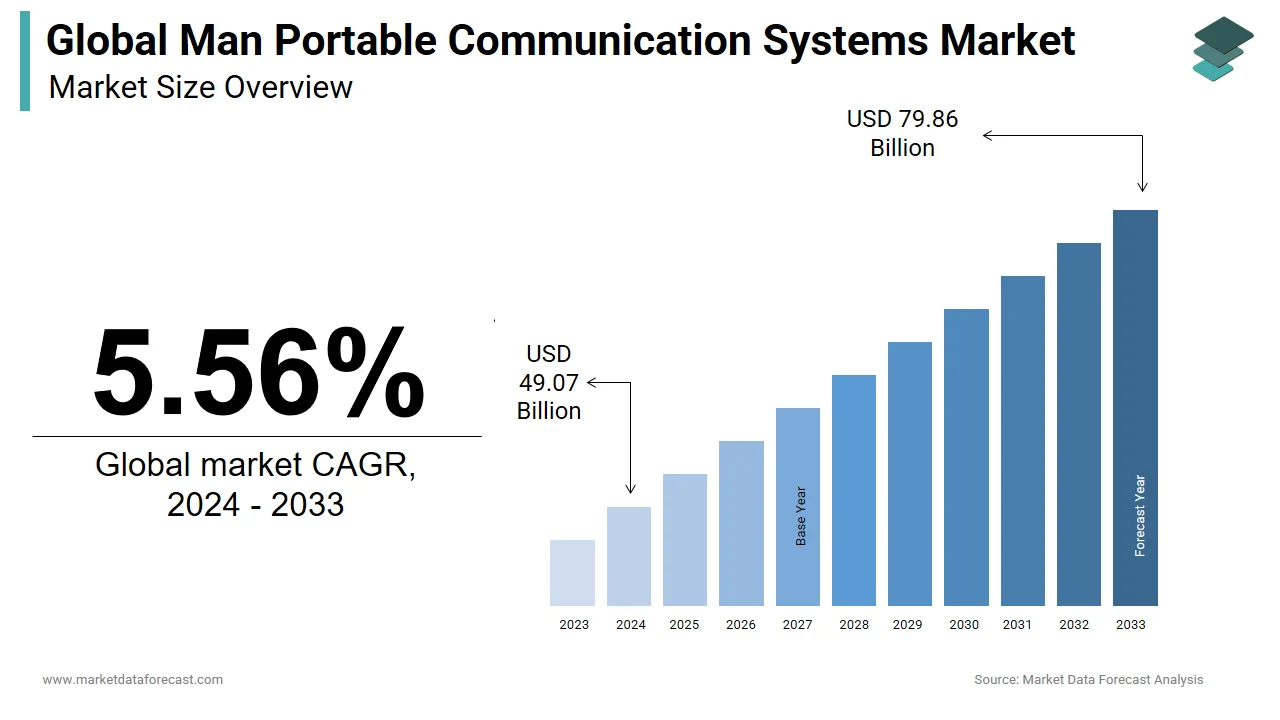
The man-portable communication Systems refer to lightweight, mobile communication devices designed for use by individuals in field operations, particularly within defense, disaster response, and law enforcement sectors. These systems are engineered for rapid deployment, durability in harsh environments, and secure transmission of voice, data, and video across dynamic operational landscapes. They include handheld radios, satellite terminals, tactical data links, and software-defined radios that enable seamless connectivity even in remote or infrastructure-limited areas.
Moreover, the growing reliance on real-time battlefield intelligence and coordinated command structures has significantly amplified demand for these systems globally. Also, the integration of AI-assisted situational awareness tools and encrypted communication protocols is further pushing innovation in this sector.
In parallel, non-military applications have expanded into humanitarian aid, search-and-rescue missions, and emergency response frameworks. This shows the evolving utility of such systems beyond traditional defense settings, reinforcing their strategic importance in global communication infrastructure.
MARKET DRIVERS
Increasing Military Modernization Programs Across Emerging Economies
One of the primary drivers of the man-portable communication systems market is that governments in countries such as India, South Korea, and Saudi Arabia have significantly increased their defense budgets to enhance battlefield readiness and adopt next-generation communication technologies. As per the Stockholm International Peace Research Institute (SIPRI), global military expenditure reached USD 2.24 trillion in 2023, with developing nations contributing a growing share, driven largely by regional security concerns and geopolitical tensions.
India alone allocated over USD 81 billion to its defense sector in 2023, prioritizing digital transformation and soldier modernization programs. Similarly, South Korea's Agency for Defense Development has been actively integrating Software Defined Radios (SDRs) into infantry units, aiming to achieve full network-centric warfare capabilities by 2027. These initiatives not only boost domestic procurement but also attract foreign OEMs and system integrators, expanding the overall market footprint. The shift from analog to digital communication platforms enhances interoperability, reduces signal interference, and improves situational awareness—key requirements for modern combat scenarios. Thus, sustained investments in defense modernization are directly fueling demand for advanced portable communication systems.
Rising Demand for Secure and Reliable Battlefield Communications
An additional major driver of the man-portable communication systems market is the increasing necessity for secure, high-bandwidth, and resilient communication solutions in combat zones. With the proliferation of cyber threats and electronic warfare tactics, military forces worldwide are prioritizing encryption standards and frequency agility in their communication gear.
Like, according to the U.S. Department of Defense’s 2023 Annual Report on Cybersecurity, nearly 72% of battlefield communication disruptions reported were due to jamming or spoofing attacks, underscoring the need for hardened communication systems.
To counteract these vulnerabilities, militaries are adopting Frequency Hopping Spread Spectrum (FHSS) technology and SATCOM-enabled portable radios that offer enhanced resistance to interception and jamming. For instance, the U.S. Army’s Project Manager for Tactical Radios (PM TR) has deployed over 90,000 AN/PRC-163 dual-channel radios since 2021, which support secure Voice over IP (VoIP), data transfer, and GPS synchronization.
Moreover, advancements in waveform encryption, such as the HAVEQUICK and SINCGARS protocols, have become standard features in modern portable radios. This evolution ensures that critical mission data remains protected against adversarial cyber intrusions. Given the rising complexity of hybrid warfare and the integration of unmanned assets into infantry operations, the requirement for reliable, secure communication at the edge of the battlefield has never been higher, thus propelling market growth.
MARKET RESTRAINTS
High Cost of Advanced Communication Equipment
A significant restraint in the man-portable communication systems market is the high cost associated with advanced communication equipment, particularly those incorporating cutting-edge encryption, satellite connectivity, and software-defined radio technologies. These systems often require extensive R&D investment, precision manufacturing, and continuous software updates to remain effective in evolving threat environments.
The pricing structure poses a barrier for many smaller or financially constrained defense forces, especially in low-income or conflict-prone regions where budget allocations are limited. For example, African Union peacekeeping missions have repeatedly cited procurement delays due to the unavailability of affordable, high-performance communication gear. Besides, maintenance and lifecycle management costs further add to the financial burden. Training personnel to operate complex systems and replacing obsolete components requires long-term budget planning, which many governments struggle to accommodate. Consequently, despite the clear operational benefits, affordability remains a persistent challenge, slowing down widespread adoption in several key markets.
Regulatory and Spectrum Allocation Limitations
Regulatory constraints and spectrum allocation issues present another major restraint in the expansion of the man-portable communication systems market. Effective operation of these systems depends heavily on access to designated radio frequency bands, which are tightly regulated by national and international telecommunication authorities. Like, only a limited portion of the RF spectrum is available for military and commercial use, leading to increasing congestion and competition.
In densely populated regions like Southeast Asia and parts of Europe, overlapping civilian and military frequency usage has resulted in frequent interference, prompting stricter licensing norms. This necessitates additional compliance measures, including frequency coordination and certification processes, which delay deployment timelines.
Furthermore, export controls imposed by major defense suppliers, such as the United States and France, under frameworks like the International Traffic in Arms Regulations (ITAR), restrict the availability of advanced communication systems to certain countries. These hurdles complicate supply chain logistics and limit market penetration in strategically important but politically sensitive regions.
MARKET OPPORTUNITIES
Integration of AI and IoT in Field Communication Devices
A transformative opportunity in the man-portable communication systems market lies in the integration of artificial intelligence (AI) and Internet of Things (IoT) technologies into field communication devices. These innovations are enabling smarter, adaptive, and context-aware communication systems that enhance battlefield efficiency and decision-making capabilities.
Leading defense contractors, including BAE Systems and Thales Group, have already begun embedding machine learning algorithms into their radio systems to dynamically optimize frequency selection and power consumption based on environmental conditions. For example, the Thales TCS5000 tactical radio employs AI to detect and avoid jamming signals autonomously, ensuring uninterrupted connectivity. Similarly, IoT-enabled wearable sensors are being used alongside communication gear to transmit biometric and geolocation data in real time which is enhancing situational awareness for both individual soldiers and command centers.
As per the U.S. Army’s Network Modernization Strategy released in 2023, AI-enhanced communication nodes are expected to be a core component of future multi-domain operations. By leveraging AI for autonomous network routing and threat detection, these systems provide a significant tactical advantage.
Expansion of Commercial Applications Beyond Defense
A growing opportunity for the man-portable communication systems market lies in expanding into commercial and civil sectors, including disaster response, mining, oil & gas exploration, and public safety. These industries increasingly rely on robust, mobile communication solutions to maintain coordination in remote or hazardous locations where traditional infrastructure may be absent or compromised.
According to the World Bank’s 2023 Disaster Risk Management Report, a large share of emergency responders in natural disaster zones depend on satellite-linked portable radios for real-time communication. As per a 2024 analysis by PwC’s Mining Innovation Outlook, over 60% of large-scale mining operations now deploy man-portable satellite communicators to coordinate activities in GPS-denied environments.
Similarly, offshore oil rigs and maritime vessels frequently utilize portable HF/VHF radios to maintain contact with onshore facilities and regulatory agencies. Public safety agencies in North America and Europe are also investing in next-generation portable radios that support broadband data transfer and video streaming. This diversification presents a lucrative avenue for market expansion, reducing dependency on defense budgets and opening new revenue streams.
MARKET CHALLENGES
Rapid Technological Obsolescence and Interoperability Issues
Among the foremost challenges facing the man-portable communication systems market is the rapid pace of technological obsolescence combined with interoperability difficulties across different platforms and allied forces. Communication systems deployed today often become outdated within three to five years due to advancements in processing power, waveform encryption, and wireless protocols.
As per the Defense Science Board’s 2023 Technology Refreshment Study, nearly 40% of military communication hardware in active inventory was found to be incompatible with newer network-centric warfare architectures, creating operational silos and inefficiencies.
Interoperability issues are particularly acute in multinational coalitions where varying radio standards and proprietary waveforms hinder seamless information exchange. According to a technical review by the NATO Communications and Information Agency (NCI Agency), resolving these compatibility gaps required costly middleware solutions and delayed operational readiness assessments.
Moreover, the transition to software-defined radios (SDRs), while promising greater flexibility, introduces complexities in backward compatibility. Many SDRs require specific firmware versions to interface with older analog systems still in use by partner nations. As per the U.S. Government Accountability Office (GAO), the DoD spent over USD 1.2 billion between 2020 and 2023 on waveform upgrades and system retrofits to address interoperability shortcomings. These factors pose a significant challenge to market participants seeking to scale their products across diverse user bases without compromising performance or requiring constant redesign.
Environmental and Operational Constraints in Harsh Terrains
Environmental and operational constraints present a critical challenge for the deployment and effectiveness of man-portable Communication Systems, particularly in extreme geographical and climatic conditions. These systems must function reliably in high-altitude regions, dense jungles, deserts, and Arctic environments, where temperature fluctuations, humidity, and terrain topography can severely impact signal integrity and device durability.
According to a 2024 white paper published by the U.S. Army Research Laboratory, signal attenuation in mountainous and forested areas can reduce radio range by up to 60%, even with line-of-sight configurations. In desert environments, dust infiltration has been identified as a leading cause of hardware failure, with sand particles damaging antenna connectors and internal circuitry. As per a field test conducted by the Indian Army in the Ladakh region found that 32% of deployed radios experienced partial functionality loss after just six months of exposure to sub-zero temperatures and high winds.
Operational constraints also extend to battery life limitations, which are exacerbated by cold weather and continuous high-power transmission. As per a 2023 energy efficiency report by the Defense Advanced Research Projects Agency (DARPA), current-generation tactical radios typically last only 4–8 hours on a single charge in adverse conditions, necessitating frequent resupply missions that expose logistics convoys to risk. To mitigate these challenges, manufacturers are investing in ruggedized casings, thermal-resistant batteries, and solar-powered charging solutions. However, achieving optimal performance without adding excessive weight remains a persistent engineering hurdle, directly affecting soldier mobility and mission endurance.
REPORT COVERAGE
| REPORT METRIC | DETAILS |
| Market Size Available | 2025 to 2034 |
| Base Year | 2025 |
| Forecast Period | 2026 to 2034 |
| CAGR | 5.56% |
| Segments Covered | By Platform, Application, and Region. |
|
Various Analyses Covered | Global, Regional & Country Level Analysis, Segment-Level Analysis, DROC, PESTLE Analysis, Porter’s Five Forces Analysis, Competitive Landscape, Analyst Overview on Investment Opportunities |
| Regions Covered | North America, Europe, APAC, Latin America, Middle East & Africa |
|
Market Leaders Profiled | Codan Ltd., Aselsan, L-3 Communication Holdings Inc., ITT Corporation, Rockwell Collins, Saab AB, Harris Corporation, General Dynamics Corporation, Thales Group, ViaSat and Others. |
SEGMENTAL ANALYSIS
By Platform Insights
The land-based segment dominated the man-portable communication systems market, accounting for 62.2% of total market revenue in 2024. This dominance is primarily driven by the extensive deployment of portable communication systems across infantry units, special forces, and border patrol operations. Ground forces remain the largest consumer of tactical radios, satellite terminals, and encrypted handheld devices due to their reliance on real-time battlefield coordination.

One key driver is the increasing modernization of ground forces globally. Another major factor is the growing use of man-portable systems in asymmetric warfare and counter-terrorism operations. These operational demands ensure sustained investment in land-based communication equipment, reinforcing its position as the leading platform segment.
The airborne segment is projected to grow at the fastest rate in the man-portable communication systems market, registering a CAGR of 9.3% during the forecast period. This rapid progress is attributed to the rising integration of portable communication systems into rotary-wing aircraft, drones, and airborne command posts used for reconnaissance and surveillance missions.
A key driver is the surge in unmanned aerial vehicle (UAV) deployments across both military and commercial sectors. For instance, the U.S. Department of Defense has expanded its use of man-portable SATCOM terminals aboard MQ-9 Reaper drones, enhancing beyond-line-of-sight communication during long-range missions.
Apart from these, the adoption of mesh networked communication systems that enable seamless data exchange between air and ground units is accelerating market penetration. The U.S. Air Force's Agile Combat Employment strategy emphasizes deploying lightweight, high-bandwidth radios on airborne platforms, ensuring rapid response and decentralized command structures. These technological and strategic shifts are fueling the airborne segment’s accelerated growth trajectory.
By Application Insights
Software radios (SDRs) constituted the largest application segment in the man-portable communication systems market, capturing 38.5% of total market value in 2024. Their dominance is due to the increasing adoption of multi-band, multi-mission capable radios that can be reprogrammed to adapt to different waveforms and encryption protocols without hardware modifications.
A primary growth driver is the push toward network-centric warfare, which requires interoperable and adaptable communication solutions. Another significant factor is the growing emphasis on cybersecurity and electronic warfare resilience. With defense agencies prioritizing flexible and secure battlefield communication, SDRs continue to maintain their stronghold in the market landscape.
SATCOM-integrated man-portable Communication Systems are witnessing the highest growth, projected to expand at a CAGR of 10.1%. This rapid expansion is fueled by the increasing reliance on satellite-based communications in remote and infrastructure-limited regions where terrestrial networks are either absent or unreliable.
A core driver is the proliferation of low Earth orbit (LEO) satellite constellations, which have drastically improved bandwidth availability and latency performance for portable terminals. Moreover, the integration of SATCOM into soldier-worn systems and UAVs has further boosted demand. The U.S. Army’s Integrated Visual Augmentation System (IVAS) incorporates SATCOM connectivity to relay real-time video feeds and situational awareness data from dismounted troops. Additionally, the UK Ministry of Defence signed a GBP 1.2 billion contract in 2023 with Inmarsat for next-generation mobile SATCOM services tailored for expeditionary forces. These developments underscore the pivotal role of SATCOM in driving the fastest-growing segment of the market.
REGIONAL ANALYSIS
North America Man-Portable Communication Systems Market Insights

North America held the largest regional market share at 35% in 2024, driven primarily by the United States' continuous investments in advanced tactical communication systems. The U.S. Department of Defense remains the world’s largest single buyer of man-portable radios and SATCOM equipment, allocating over USD 12 billion annually for modernizing battlefield communications , as outlined in its 2024 Budget Request.
A key contributing factor is the country’s focus on multi-domain operations and AI-enhanced battlefield networking. Additionally, the Pentagon’s adoption of software-defined radios under the JTRS program has led to widespread deployment of next-generation communication gear. Another major influence is the presence of leading defense electronics manufacturers such as Harris Corporation (now L3Harris Technologies), Raytheon, and General Dynamics, which dominate both domestic and export markets.
Europe Man-Portable Communication Systems Market Insights
Europe maintains a strong regional market, supported by strong defense collaboration among NATO members and ongoing modernization programs. Countries like France, Germany, and the UK are investing heavily in upgrading their tactical communication infrastructure to align with NATO’s Interoperability Standards.
France, for instance, has launched the SCORPION program, which aims to equip over 50,000 soldiers with next-generation communication gear, including the FELIN and TIGER radio systems. As per the French Ministry of Armed Forces, over EUR 3.8 billion has been allocated for SCORPION upgrades through 2027, making it one of the most ambitious soldier modernization initiatives in Europe.
Germany is also expanding its procurement of encrypted handheld radios under the Infanterist der Zukunft (IdZ-ES) system, which integrates GPS, voice encryption, and data transmission capabilities. The Bundeswehr has already deployed more than 20,000 IdZ-ES kits, as confirmed by the German Federal Office of Bundeswehr Equipment, Information Technology and In-Service Support (BAAINBw) in 2024. With collaborative procurement frameworks like the European Defence Fund promoting joint development projects, Europe continues to hold a prominent position in the global market.
Asia-Pacific Man-Portable Communication Systems Market Insights
Asia-Pacific is a major player in the global market, driven by rising geopolitical tensions and increased defense expenditures across countries like India, China, and South Korea. The region is witnessing a shift from legacy analog systems to digital, secure, and networked communication solutions. India leads the regional growth with a defense budget exceeding USD 81 billion in 2024, of which a significant portion is dedicated to modernizing infantry communication systems. China, too, is aggressively developing indigenous man-portable communication systems, particularly for its People's Liberation Army (PLA).
Middle East and Africa Man-Portable Communication Systems Market Insights
The Middle East represents a growing regional market, fueled by strategic investments in tactical communication upgrades by countries such as Saudi Arabia, UAE, and Israel. These nations are focusing on acquiring advanced, secure, and mobile communication gear to enhance battlefield coordination and intelligence sharing.
Saudi Arabia has significantly ramped up its defense budget, with a large portion allocated to modernizing its armed forces. The UAE is another key player, investing in next-generation SATCOM terminals for its elite Special Operations units. Israel, known for its advanced defense electronics industry, continues to deploy cutting-edge communication gear across its military formations. These strategic moves underline the Middle East’s growing prominence in the global market.
Latin America Man-Portable Communication Systems Market Insights
Latin America holds a relatively smaller but steadily growing market, driven by Brazil, Mexico, and Colombia’s efforts to upgrade their internal security and border patrol communication capabilities. Though defense budgets in the region are modest compared to other continents, there is a noticeable trend toward adopting modern communication tools.
Brazil, the largest economy in the region, has initiated a comprehensive modernization plan for its armed forces, including the acquisition of secure, lightweight tactical radios for jungle and coastal operations. Mexico, facing persistent drug cartel-related violence, has intensified its procurement of encrypted communication systems for law enforcement and national guard units. Colombia, too, is investing in SATCOM-enabled radios for anti-guerrilla operations in remote jungle areas where traditional infrastructure is lacking. While still an emerging market, Latin America is gradually gaining traction in the man-portable Communication Systems domain.
KEY MARKET PLAYERS
The main players in the market are Codan Ltd., Aselsan, L-3 Communication Holdings Inc., ITT Corporation, Rockwell Collins, Saab AB, Harris Corporation, General Dynamics Corporation, Thales Group, and ViaSat.
TOP LEADING PLAYERS IN THE MARKET
One of the leading companies in the market is L3Harris Technologies, known for its extensive portfolio of secure communication solutions tailored for defense and homeland security applications. L3Harris offers a wide range of man-portable radios, SATCOM terminals, and software-defined systems that are widely adopted by military forces across the globe. The company's focus on innovation, interoperability, and rugged design has made it a trusted name in tactical communications.
Another major player is Thales Group, a global leader in aerospace, defense, and security technologies. Thales provides advanced portable communication systems that integrate encryption, mobility, and multi-band capabilities. Its solutions are used by armed forces and emergency response units worldwide, emphasizing high performance in challenging environments. The company’s commitment to cybersecurity and digital transformation enhances its market influence.
Raytheon Technologies is also a dominant force in the market, offering cutting-edge communication systems designed for battlefield superiority. With a strong emphasis on research and development, Raytheon delivers highly reliable, lightweight, and secure communication gear that supports modern warfare strategies and mission-critical operations across land, air, and sea platforms.
TOP STRATEGIES USED BY KEY MARKET PARTICIPANTS
A primary strategy employed by key players is continuous innovation through research and development. Companies are investing heavily in next-generation communication technologies such as software-defined radios, AI-enabled signal processing, and encrypted SATCOM solutions to meet evolving battlefield demands and stay ahead of competitors.
Another critical approach is strategic partnerships and collaborations with defense agencies and system integrators. By aligning with government bodies and military contractors, companies ensure early adoption of their technologies, gain insights into operational requirements, and strengthen long-term procurement relationships.
Lastly, expanding into emerging markets and diversifying application domains beyond defense is a key growth tactic. Major firms are increasingly targeting commercial sectors like disaster management, oil & gas, and public safety to reduce dependency on defense budgets and unlock new revenue streams while enhancing global market penetration.
COMPETITION OVERVIEW
The competition in the man-portable Communication Systems Market is intense and dynamic, driven by rapid technological advancements and growing demand from both military and civilian sectors. Established defense electronics companies dominate the landscape, leveraging their R&D capabilities, global distribution networks, and deep-rooted relationships with national defense agencies. These firms continuously refine their product portfolios to incorporate cutting-edge features such as AI-driven signal optimization, enhanced cybersecurity, and seamless interoperability across multiple platforms. At the same time, smaller and regional players are gaining traction by offering cost-effective, niche solutions tailored to specific operational needs. Strategic acquisitions, joint ventures, and collaborative development initiatives are common tactics used to expand market reach and reinforce competitive positioning. As geopolitical tensions persist and the need for real-time, secure communication intensifies, the industry remains highly fragmented, with firms striving to differentiate themselves through superior performance, adaptability, and reliability in field-deployable communication systems.
RECENT MARKET DEVELOPMENTS
- In February 2024, L3Harris Technologies launched its next-generation AN/PRC-167(V) software-defined radio, designed to support multi-channel, multi-mission communication for dismounted soldiers, significantly enhancing tactical connectivity and network resilience.
- In May 2024, Thales Group announced a strategic partnership with a leading satellite service provider to integrate high-throughput SATCOM capabilities into its handheld radio systems, expanding their utility in remote and contested environments.
- In July 2024, Raytheon Technologies unveiled an upgraded version of its Battlefield Awareness Targeting System (BATS), incorporating AI-assisted voice-to-data conversion and improved geolocation tracking within portable communication modules.
- In September 2024, Elbit Systems introduced a new family of ultra-lightweight encrypted radios tailored for Special Forces and border patrol units, emphasizing ease of deployment and extended battery life under harsh conditions.
- In November 2024, BAE Systems entered a collaboration with a cybersecurity firm to embed real-time threat detection and self-healing encryption protocols into its portable tactical radios, reinforcing data integrity on the battlefield.
MARKET SEGMENTATION
This research report on the global man-portable communication systems market has been segmented and sub-segmented based on the platform, application, and region.
By Platform
- land
- airborne
- naval
By Application
- Software-defined radios
- SATCOM
- encryption
- smartphones
- homeland security
- commercial
By Region
- North America
- Europe
- Asia-Pacific
- Latin America
- The Middle East and Africa