- Product Description Description
- Table of Contents TOC
- List of Table & Figure LOT
- Get Free Sample PDF Sample PDF
Market Size, 2025
$7.36 BnMarket Estimate, 2026
$8.48 BnMarket Forecast, 2034
$26.34 BnCAGR, 2026–2034
15.22%Executive Summary: Global Marine Electrical Consumables Market
- Market Scope: Comprehensive overview of the global marine electrical consumables market covering component classes, vessel applications, regional deployments, and competitive industry leadership.
- Market Valuation: Valued at USD 7.36 billion in 2025, reaching USD 8.48 billion in 2026, and projected to scale up to USD 26.34 billion by 2034, registering a strong CAGR of 15.22% (2026–2034).
- Primary Growth Drivers: Paradigm shift toward maritime automation, increasing adoption of electronic and control equipment on ships, advances in maritime and coastal tourism, rising international trade, and major government investments in shipbuilding and naval infrastructure.
Key Market Segment Metrics (2026–2034)
| Category | Leading Segment Position | Core Focus / Alternative Segment |
|---|---|---|
| By Component | Hardware (significant expansion driven by widespread demand for GPS systems and lighting fixtures) | Software |
| By Application | Navigation (essential for managing and monitoring vessel movement, backed by maritime safety focus) | Automation, Communication, and Others |
| By Vessel Type | Commercial Logistics & Naval Vessels | Recreational Boats and Fishing Vessels |
| By Region | Asia-Pacific (fastest growth due to intensive shipbuilding activities in China, India, Japan, and Southeast Asia) | North America, Europe, Latin America, and Middle East & Africa |
Major Market Players & Market Structure
Market Structure: Highly competitive global ecosystem featuring specialized maritime electronics manufacturers, defense contractors, and power system innovators adopting green technologies like DC-grid electrical architectures and zero-emission drives.
Key Companies: Wartsila, SAM Electronics GmbH, Oceanlink Marine Services Pty Ltd, Mareleng, Inc., SRT Marine Systems, FLIR Systems, Furuno Electric, Raytheon Company, Icom Inc., Japan Radio, Kongsberg Maritime, Garmin Ltd., Ultra Electronics, Northrop Grumman Corporation, Atlas Elektronik GmbH, and Tokyo Keiki Inc.
Global Marine Electrical Consumables Market Size
The global marine electrical consumables market was valued at USD 7.36 billion in 2025 and is predicted to reach USD 26.34 billion by 2034 from USD 8.48 billion in 2026 at a CAGR of 15.22% over a foreseen period 2026 to 2034.
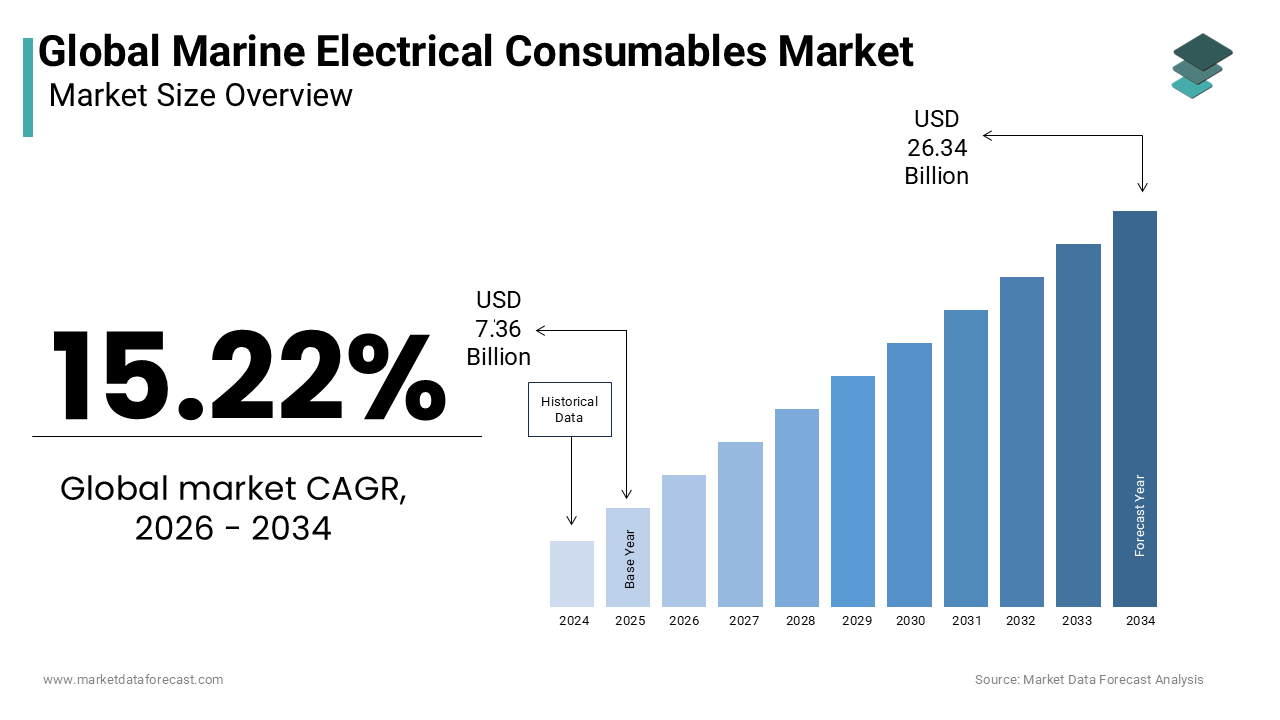
Marine electrical consumables are the everyday parts, supplies, and materials used to build, fix, and maintain electrical systems on boats and ships. The market covers a specialised array of essential components, including cables, connectors, fuses, circuit breakers and insulation materials required for the installation, maintenance and repair of electrical systems on vessels. These critical items ensure operational safety and reliability across commercial shipping, offshore platforms and recreational boating sectors. According to UN Trade and Development (UNCTAD), global seaborne trade volume reached approximately 12.3 billion tons in 2023, while the global maritime industry transports roughly 90% of world trade across commercial vessels, increasing the reliance on robust electrical infrastructure to support increasingly automated shipboard systems. As per UNCTAD, the global commercial merchant fleet consists of over 105,500 vessels (of at least 100 gross tons), and by number of ships, the average age of this fleet reached 22.2 years in 2023, which continues to drive demand for replacement consumables due to wear and corrosion. These points underscore the perpetual need for high-quality electrical supplies to maintain vessel integrity and compliance with international safety standards. The harsh marine environment accelerates degradation of electrical components, requiring frequent replacement cycles. Regulatory mandates for energy efficiency and emission reductions prompt retrofitting projects that consume significant volumes of wiring and connectivity solutions. Shipbuilders and repair yards prioritise certified materials that withstand saltwater exposure and vibration. This market serves as the backbone of maritime electrification, supporting both legacy fleets and modern eco-friendly designs.
MARKET DRIVERS
Stringent International Safety Regulations Drive Demand for Certified High-Quality Components
Stringent international safety regulations directly drive the demand for certified high-quality components within the Marine Electrical Consumables Market. The International Maritime Organisation mandates through the Safety of Life at Sea convention that all electrical installations must meet rigorous standards to prevent fire hazards and system failures at sea. Compliance requires the use of flame retardant cables and waterproof connectors that carry specific type approval certificates from classification societies such as DNV or Lloyd’s Register. According to global port state control (PSC) regime data, electrical safety and component violations are frequent focus points during vessel inspections, but specific class organisations analyse these issues locally. This regulatory pressure forces ship owners and operators to procure only verified consumables to avoid operational delays and financial penalties. Classification societies update their rules periodically to address emerging risks from lithium-ion batteries and hybrid propulsion systems. These updates necessitate the adoption of new types of fuses and protective devices designed for higher voltage applications. Shipyards must maintain detailed documentation for every electrical component installed to facilitate audits. The liability associated with electrical fires at sea encourages insurers to mandate the use of premium-grade consumables. Manufacturers respond by investing in testing facilities to obtain global certifications. This regulatory framework creates a barrier to entry for low-quality suppliers while securing demand for reputable brands. The continuous evolution of safety codes ensures ongoing innovation and replacement of older stock.
Expansion of Global Fleet Modernisation and Retrofitting Projects Increases Replacement Cycles
The expansion of global fleet modernisation and retrofitting projects significantly increases replacement cycles for electrical consumables in the Marine Electrical Consumables Market. According to sources, the average age of the world merchant fleet is increasing significantly, with roughly 28% of the global fleet currently exceeding 15 years of age, expanding the requirement for refurbishment to meet modern regulatory standards. Retrofitting initiatives often involve upgrading navigation, communication, and power management systems, which necessitate the removal of outdated wiring and installation of new connectors and terminals. As per studies, electrical power distribution retrofits and equipment overhauls make up a significant portion of capital allocation during mid-life vessel renewals during dry dock phases. Ageing insulation materials become brittle and prone to cracking in humid marine environments, leading to short circuits and power losses. Ship owners prioritise preventive maintenance programs that include scheduled replacement of circuit breakers and distribution boards to ensure uninterrupted service. The transition towards digitalisation on ships requires additional cabling for sensors and data transmission networks. These infrastructure enhancements consume substantial quantities of specialised marine-grade cables and junction boxes. Dry dock periods provide optimal opportunities for comprehensive electrical overhauls, driving bulk procurement of consumables. The increasing complexity of onboard automation further amplifies the need for reliable connectivity solutions. This trend ensures a steady baseline demand independent of new build volumes.
MARKET RESTRAINTS
Volatility in Raw Material Prices Impacts Profit Margins and Procurement Stability
Volatility in raw material prices severely impacts profit margins and procurement stability within the Marine Electrical Consumables Market. According to sources, copper prices, which are fundamental to cable manufacturing, can experience significant volatility and have historically fluctuated heavily on the London Metal Exchange (LME) due to inventory squeezes, mining constraints, and shifting global demand. Since copper constitutes a significant portion of the cost structure for marine cables, connector manufacturers struggle to maintain consistent pricing for long-term contracts. The International Copper Study Group indicates that global mine production deficits have tightened supply, forcing buyers to compete for limited resources. This instability complicates budgeting for shipyards and ship owners who face unpredictable cost escalations for electrical projects. Suppliers often pass these costs onto customers, leading to hesitation in large-scale procurement decisions. Aluminium alternatives offer some relief but lack the conductivity and flexibility required for many marine applications. Inventory management becomes challenging as companies balance between holding excess stock to hedge against price hikes and avoiding capital tie-up. Small and medium enterprises lack the bargaining power to secure fixed-price agreements with metal producers. Currency fluctuations further exacerbate the issue for international transactions involving raw material imports. This economic uncertainty discourages investment in inventory expansion and limits the ability to offer competitive bids. The market remains vulnerable to geopolitical tensions affecting key mining regions.
Complex Supply Chain Logistics and Lead Time Delays Hinder Timely Project Execution
Complex supply chain logistics and lead time delays hinder timely project execution in the Marine Electrical Consumables Market. According to studies, shipping delays, port congestion, and equipment constraints are known to extend delivery times for industrial components and maritime goods well beyond standard schedules during periods of high supply chain disruption. Marine electrical projects often operate on tight dry dock timelines where delays in receiving specific connectors or custom cables can halt entire repair operations. As per the Journal of Commerce, global freight rates experience periods of elevation driven by regional bottlenecks and capacity constraints, making the logistics of expediting urgent shipments more complex and costly. Ship managers face difficulties in sourcing obsolete components for older vessels as manufacturers discontinue certain product lines. The fragmentation of the supplier base means that different consumables may come from various geographic locations, increasing coordination complexity. Customs clearance procedures for hazardous materials like certain insulated wires add further administrative delays. Just-in-time inventory models prove risky in the maritime sector, where unexpected breakdowns require immediate part availability. The lack of standardised packaging for marine-specific items complicates handling and storage during transit. Damage during shipping due to inadequate protection leads to additional returns and replacements. These logistical bottlenecks force operators to maintain larger safety stocks, increasing working capital requirements. The inefficiency reduces overall operational agility and customer satisfaction.
MARKET OPPORTUNITIES
Adoption of Smart Ship Technologies Creates New Demand for Advanced Connectivity Solutions
The adoption of smart ship technologies creates new demand for advanced connectivity solutions, which opens new pathways for the growth of the Marine Electrical Consumables Market. According to research, smart shipping and integrated digital platforms represent a growing baseline for new commercial vessel orders, driving significant installation demand for robust fibre optic and high-speed communications architecture. These smart systems rely on thousands of sensors that need robust waterproof connectors and shielded cables to transmit real-time performance data to shore-based analytics centres. As per sources, the deployment of marine Internet of Things (IoT) technologies and high-bandwidth shipboard automation systems expands the structural necessity for Category 6A (Cat 6A) and fibre optic networking hardware on modern hulls. Traditional power cables are insufficient for these data-intensive applications, creating a niche for specialised hybrid cables. Shipowners seek to optimise fuel consumption and predictive maintenance through continuous monitoring, which depends on reliable electrical connectivity. The integration of autonomous navigation features further increases the density of electronic components and their interconnections. Manufacturers can develop innovative products such as plug-and-play sensor modules that simplify installation and reduce labour costs. The shift towards software defined vessels transforms electrical consumables from passive components into critical enablers of digital transformation. This technological evolution opens avenues for higher value-added products with better margins. Early movers in this segment can establish long term partnerships with technology integrators.
Growth in Offshore Renewable Energy Infrastructure Expands Application Scope Beyond Traditional Shipping
The growth in offshore renewable energy infrastructure expands the application scope beyond traditional shipping, which offers significant opportunities for the Marine Electrical Consumables Market. According to studies, the offshore wind sector is undergoing a massive multi-gigawatt expansion phase, expecting double-digit growth rates over the coming decade that will necessitate vast deployments of subsea array cables and grid hardware. These installations operate in harsh marine environments demanding highly durable and corrosion resistant electrical consumables that can withstand constant exposure to saltwater and high winds. As per the Global Wind Energy Council, each offshore wind farm requires hundreds of kilometers of internal array cables and numerous junction boxes for power aggregation. Maintenance vessels servicing these farms also require regular replenishment of electrical spares due to the aggressive operating conditions. The expansion of floating wind platforms introduces new challenges for dynamic cabling systems that must handle movement without failure. Manufacturers can adapt existing marine-grade products to meet the specific voltage and current ratings of renewable energy applications. Government subsidies for green energy projects ensure sustained investment in this sector regardless of commercial shipping cycles. The technical requirements for offshore energy often exceed those of conventional vessels, driving innovation in insulation and shielding materials. This diversification reduces dependence on the cyclical nature of the merchant fleet. It allows suppliers to tap into a rapidly growing adjacent market with similar technical competencies.
MARKET CHALLENGES
Counterfeit Products and Lack of Standardisation Compromise Safety and Brand Integrity
Counterfeit products and lack of standardization compromise safety and brand integrity, which are a serious constraint to the Marine Electrical Consumables Market. According to research, the infiltration of counterfeit or substandard electrical components into supply chains poses significant risks of premature failures and safety hazards, though tracking these international crimes falls outside the mandate of piracy reporting agencies. These substandard items often mimic certified branding but lack the necessary fire resistance and conductivity properties required for marine use. As per sources, inconsistent interpretations or applications of international technical baselines across different classification societies can create technical challenges for manufacturers and buyers during design compliance. A single batch of fake fuses can cause catastrophic electrical fires endangering crew lives and cargo. Reputable manufacturers spend significant resources on anti-counterfeiting measures such as holographic labels and traceability codes, which increase production costs. Buyers in price sensitive markets may inadvertently purchase inferior goods due to misleading packaging. The absence of a unified global database for approved marine electrical parts makes verification difficult for end users. Legal recourse against counterfeiters is complex and often ineffective across international jurisdictions. This erosion of trust damages the reputation of legitimate brands when failures occur. It forces industry bodies to invest in awareness campaigns and certification training. The resulting skepticism slows down the adoption of new innovative products.
Environmental Regulations on Hazardous Materials Restrict Product Formulations and Disposal Methods
Environmental regulations on hazardous materials restrict product formulations and disposal methods, which challenges the Marine Electrical Consumables Market. The European Union’s Registration, Evaluation, Authorisation and Restriction of Chemicals regulation prohibits the use of certain flame retardants and heavy metals commonly used in cable insulation and connector plating. Moreover, the International Maritime Organization’s guidelines on ship recycling mandate that electrical waste be handled and disposed of in environmentally sound manners, increasing operational costs for ship breakers. According to research, developing bio-based or recyclable insulation materials that successfully meet stringent marine performance and fire safety standards remains a technically difficult and economically challenging objective. Manufacturers must reformulate products to comply with evolving green chemistry standards, which requires extensive retesting and recertification. Non-compliant legacy stock becomes stranded assets that cannot be sold in regulated markets. The cost of proper disposal for old electrical consumables containing lead or brominated compounds is rising globally. Ship owners face pressure to demonstrate environmental compliance throughout the vessel lifecycle, including component sourcing. Smaller suppliers lack the R&D budget to develop eco-friendly alternatives quickly. This regulatory burden slows down product innovation and increases time to market. It creates a competitive disadvantage for companies unable to adapt their supply chains. The transition to sustainable materials is gradual due to performance trade offs.
REPORT COVERAGE
| REPORT METRIC | DETAILS |
| Market Size Available | 2025 to 2034 |
| Base Year | 2025 |
| Forecast Period | 2026 to 2034 |
| CAGR | 15.22% |
| Segments Covered | By Component, Application, Vessel, and Region. |
| Various Analyses Covered | Global, Regional & Country Level Analysis, Segment-Level Analysis, DROC, PESTLE Analysis, Porter’s Five Forces Analysis, Competitive Landscape, Analyst Overview on Investment Opportunities |
| Regions Covered | North America, Europe, APAC, Latin America, Middle East & Africa |
| Market Leaders Profiled | Wartsila SAM Electronics GmbH, Oceanlink Marine Services Pty Ltd, Mareleng, Inc, SRT Marine Systems, FLIR Systems, Furuno Electric, Raytheon Company, Icom Inc., Japan Radio, Kongsberg Maritime, Garmin Ltd., Ultra Electronics, Northrop Grumman Corporation, Atlas Elektronik GmbH, Tokyo Keiki Inc and Others. |
SEGMENTAL ANALYSIS
By Component Insights
The hardware segment was the largest in 2025 and occupied a commanding share of the Marine Electrical Consumables Market. This supremacy of the segment was credited to the fundamental physical requirements of vessel electrification and the harsh nature of the marine environment. According to the International Electrotechnical Commission, marine-grade cables and connectors must withstand constant vibration, salt spray, and temperature fluctuations, which lead to inevitable physical degradation over time. This necessitates regular replacement of tangible components such as fuses, circuit breaker terminals and wiring harnesses. As per sources, electrical distribution systems and hardware refits account for a significant share of operational repair budgets, though class entities publish guidelines rather than standardized cross-fleet expenditure reports. Unlike software, which may require updates, hardware physically wears out and fails, requiring immediate procurement to ensure safety. Classification societies mandate specific hardware standards for fire resistance and insulation integrity, driving consistent demand for certified products. The sheer volume of cabling required for a single commercial vessel often exceeds several kilometres, creating substantial material consumption. Shipyards and repair facilities maintain large inventories of these physical items to address emergency repairs during dry docking. The lifecycle of hardware is directly linked to operational hours and environmental exposure, ensuring predictable replacement cycles. Manufacturers focus on durability and corrosion resistance to meet these rigorous demands. This tangible necessity ensures that hardware remains the backbone of the market revenue structure.
The software segment is projected to register the highest CAGR of 12.5% in the Marine Electrical Consumables Market due to the digitalization of maritime operations and the rise of smart ships. According to studies, a growing baseline of modern commercial newbuilds incorporates integrated data management systems, accelerating the necessity for specialized diagnostic software and real-time monitoring infrastructure. These software solutions enable predictive maintenance by analyzing real time data from sensors to anticipate component failures before they occur. As per research, the deployment of Internet of Things (IoT) hardware on commercial fleets has expanded substantially, generating massive data volumes that require high-capacity edge and cloud processing architecture. Software allows for remote troubleshooting and firmware updates, reducing the need for physical technician visits. Ship owners are increasingly investing in energy management software to optimise power distribution and reduce fuel consumption. Regulatory pressures for emission reporting require accurate digital logging of electrical usage, which software facilitates efficiently. The shift towards autonomous shipping relies heavily on sophisticated control algorithms and cybersecurity protocols. This transition transforms electrical systems from passive infrastructure into intelligent networks. Consequently, the demand for licensing updates and cloud based services is accelerating rapidly. This intangible growth complements the hardware base by adding value through efficiency and intelligence.
By Application Insights
In 2025, the automation segment held the majority share in the Marine Electrical Consumables Market because of the widespread integration of automated control systems in modern vessel operations. The International Maritime Organization mandates stricter efficiency standards which drive the adoption of automated engine room monitoring and power management systems. According to the Society of International Gas Tanker and Terminal Operators (SIGTTO), automated electrical control networks and design criteria are central to minimising human operational risk. These systems require extensive networks of sensors, actuators, and control cables that constitute significant consumable usage. Modern container ships and tankers rely on automated cargo handling systems that depend on robust electrical connectivity for seamless operation. The complexity of automated propulsion systems such as azimuth thrusters demands high-quality electrical components to handle variable loads. Classification societies require redundant automated systems for critical functions, increasing the volume of wiring and connectors needed. Maintenance of these automated systems involves regular replacement of sensitive electronic modules and interface cables. The trend towards unmanned engine rooms further accelerates the deployment of comprehensive automation infrastructure. Shipbuilders prioritise integrated automation packages to enhance operational efficiency and reduce crew workload. This structural shift ensures sustained demand for automation-related electrical consumables across all vessel types.
The communication segment is experiencing the fastest growth owing to the escalating demand for high bandwidth connectivity and real time data exchange in the maritime industry. According to studies, satellite bandwidth consumption in the maritime sector experiences strong double-digit annual growth as vessels prioritize continuous connectivity for logistics and crew welfare. High-speed data transmission necessitates advanced coaxial cables fiber optics, and specialized connectors that can withstand marine conditions. As per research, a broad majority of modern commercial shipping operations rely on high-throughput broadband services to handle telemetry tracking, navigation routing updates, and video communication. These applications require robust electrical infrastructure to support high-frequency signals without interference. The introduction of Low Earth Orbit satellite constellations further drives the installation of new communication arrays and associated wiring. Crew welfare regulations encourage ship owners to provide internet access, leading to increased internal networking cabling. Cybersecurity measures for communication networks also require additional hardware such as encrypted modems and secure routers. The integration of communication systems with bridge navigation equipment creates a unified network architecture. This convergence increases the complexity and volume of electrical consumables required. As data becomes a critical asset for shipping companies, the reliability of communication infrastructure becomes paramount. This trend fuels rapid expansion in this application segment.
By Vessel Insights
The Others segment dominated the marine electrical consumables market and accounted for a substantial share in 2025. This segment primarily comprises commercial shipping vessels, including container ships, bulk carriers and tankers. As per the United Nations Conference on Trade and Development, commercial shipping handles over 80% of global trade by volume, maintaining a massive fleet that requires continuous electrical maintenance. These large vessels have complex electrical systems powering cargo handling machinery, navigation aids, and crew accommodations, leading to high consumable usage. According to sources, the advancing average age of the world merchant fleet places a structural focus on vessel retrofits, demanding continuous electrical rewiring and components. Commercial vessels operate continuously for long periods, exposing electrical systems to extreme wear and tear. Regulatory inspections for commercial ships are stringent, requiring certified electrical components to ensure safety compliance. The scale of these vessels means that a single retrofitting project can consume tons of cables and thousands of connectors. Port state control detentions often relate to electrical faults, prompting immediate corrective actions and parts procurement. The economic importance of these vessels ensures that owners prioritise maintenance to avoid costly delays. Bulk procurement by large shipping lines drives significant volume sales for manufacturers. This segment provides a stable and substantial revenue base for the market.
The recreational boats segment is rapidly expanding in the marine electrical consumables market. This quick surge is fuelled by the rising popularity of leisure boating and the increasing electrification of small craft. According to the National Marine Manufacturers Association, recreational boat sales in North America alone exceeded 300,000 units in recent years, with many featuring advanced electrical amenities. Modern recreational vessels are equipped with sophisticated entertainment systems, GPS navigation, and electric propulsion options requiring extensive wiring and connectors. As per sources, the total electrical load configuration on recreational boats has increased dramatically over the last decade due to heightened consumer integration of electronic comforts and navigation amenities. Owners frequently upgrade their electrical systems to support lithium-ion batteries and solar panels, driving demand for specialised consumables. The DIY culture among boat owners leads to frequent purchases of retail packaged electrical supplies for minor repairs and modifications. Marine electronics manufacturers release new products regularly, prompting upgrades that require new cabling and interfaces. Safety recalls for electrical components in recreational boats also spur replacement activity. The growth of marina infrastructure supports easier access to electrical supplies and services. This segment benefits from high consumer spending and a passion for vessel maintenance. The trend towards eco friendly boating further accelerates the adoption of new electrical technologies.
REGIONAL ANALYSIS
North America Marine Electrical Consumables Market Analysis
North America led the Marine Electrical Consumables Market and captured a significant share in 2025. This leading position of the North American market was attributed to a large recreational boating industry and strict regulatory standards. As per the United States Coast Guard, there are over 12 million registered recreational boats in the United States, creating a vast aftermarket for electrical supplies and maintenance components. The presence of major naval bases and commercial ports ensures steady demand for military- and industrial grade electrical consumables. The National Oceanic and Atmospheric Administration notes that the US maritime industry contributes billions to the economy, supporting robust infrastructure investment. Strict environmental regulations in the region drive the adoption of eco-friendly electrical components and efficient power management systems. The high disposable income of consumers supports frequent upgrades and maintenance of leisure vessels. Major manufacturers have established strong distribution networks ensuring wide availability of certified products. The region is also a hub for innovation in marine electronics, influencing global trends. Government initiatives to modernise port infrastructure further boost demand for heavy-duty electrical supplies. The mature market characteristics ensure consistent quality expectations and brand loyalty. This stability attracts global players seeking reliable revenue streams.
Europe Marine Electrical Consumables Market Analysis
Europe followed closely behind in the Marine Electrical Consumables Market and accounted for a significant share in 2025. The region has advanced technological adoption and stringent environmental regulations. According to the European Maritime Safety Agency, European ports handle a significant portion of global container traffic, necessitating reliable electrical infrastructure for shore power and vessel operations. The region is a leader in green shipping initiatives, driving demand for electrical components compatible with hybrid and electric propulsion systems. As per sources, retrofitting projects for emission compliance are expanding significantly across European shipyards, driving up the installation of specialized hardware and low-emission electrical components. High labor costs in Europe encourage the use of durable and low maintenance electrical products. The recreational boating sector in Mediterranean countries contributes significantly to seasonal demand spikes. Strict waste disposal regulations influence the formulation of insulation materials and connector platings. European classification societies set high standards for component certification, influencing global manufacturing practices. The region focuses on sustainability, driving innovation in recyclable electrical materials. Strong intellectual property protection fosters innovation among local manufacturers. This regulatory leadership shapes global market dynamics and product development.
Asia Pacific Marine Electrical Consumables Market Analysis
Asia-Pacific is the fastest-growing region in the Marine Electrical Consumables Market, fueled by expanding shipbuilding activities and increasing maritime trade. According to UN Trade and Development (UNCTAD), the three leading Asian shipbuilding economies, China, South Korea, and Japan, account for approximately 95% of global shipbuilding output, driving massive demand for newbuild electrical installations. Countries like China, South Korea, and Japan are leading producers requiring vast quantities of cables connectors and switchgear. The growing middle class in Southeast Asia is boosting the recreational boating sector, adding to aftermarket demand. Port expansion projects in India and Vietnam drive infrastructure related electrical consumption. The region faces challenges with counterfeit products, but increasing regulatory enforcement is improving quality standards. Local manufacturing capabilities are reducing reliance on imports for basic consumables. The adoption of digital technologies in Asian fleets is accelerating the need for smart electrical components. Government initiatives to develop blue economies support maritime infrastructure growth. The sheer volume of vessel traffic in the region ensures high turnover of maintenance spares. This dynamic growth offers significant opportunities for global suppliers.
Latin America Marine Electrical Consumables Market Analysis
Latin America holds an emerging position in the Marine Electrical Consumables Market due to offshore oil and gas activities and fishing industries. As per the Inter-American Development Bank, investments in port modernisation and coastal infrastructure are increasing demand for marine electrical supplies in countries like Brazil and Mexico. The region has a significant fishing fleet that requires regular maintenance of electrical systems for navigation and refrigeration. Offshore platforms require robust and certified electrical consumables to withstand harsh ocean conditions. Economic volatility in some countries affects procurement patterns, but essential maintenance continues. The recreational boating sector is growing in tourist destinations such as the Caribbean and Brazil. Local distributors play a crucial role in bridging the gap between global manufacturers and end users. Regulatory frameworks are gradually aligning with international standards, improving product quality. The expansion of aquaculture industries adds to the demand for underwater electrical components. Infrastructure deficits in some areas create opportunities for off-grid power solutions. This region offers potential for growth as economic stability improves.
The Middle East and Africa Marine Electrical Consumables Market Analysis
The Middle East and Africa region offers unique opportunities in the Marine Electrical Consumables Market owing to strategic maritime locations and energy exports. According to research, the Suez Canal and major deepwater ports in the Persian Gulf function as vital conduits for international trade and global oil shipments, which relies heavily on highly resilient shipboard and shore-side electrical infrastructure to prevent chokepoint delays. The region is investing heavily in port infrastructure and ship repair facilities to support its maritime ambitions. The African fishing industry is expanding leading to increased demand for electrical components for small and medium vessels. Solar powered electrical systems are gaining traction in remote coastal areas due to abundant sunlight. Political instability in some areas poses challenges, but major hubs like Dubai and Singapore serve as distribution centres. The push for economic diversification in Gulf countries supports maritime sector growth. Local content requirements are encouraging regional manufacturing and assembly of electrical products. The harsh climate necessitates high quality heat resistant electrical materials. International partnerships are facilitating technology transfer and capacity building. This region is gradually integrating into the global maritime supply chain.
COMPETITIVE LANDSCAPE
The competition in the Marine Electrical Consumables Market is characterized by a mix of global industrial giants and specialized niche manufacturers striving for dominance. Global players leverage their extensive research capabilities and brand reputation to introduce innovative products such as corrosion resistant connectors and high efficiency cables. These companies benefit from established distribution networks and strong relationships with major shipyards and classification societies worldwide. Specialized manufacturers compete primarily on technical expertise and customization offering tailored solutions for unique maritime applications. The market sees intense rivalry in the certification domain where compliance with international safety standards is crucial for market entry. Companies frequently engage in strategic collaborations with technology providers to enhance their product portfolios with smart features. Regulatory hurdles are stringent but consistent creating barriers to entry for smaller firms without adequate resources. The rise of green shipping has intensified competition for eco friendly and energy efficient electrical components. Intellectual property protection remains a critical factor influencing competitive dynamics as firms seek to safeguard their innovations. Continuous investment in quality assurance helps companies demonstrate reliability and justify premium pricing. The competitive landscape is further shaped by mergers and acquisitions as larger entities seek to consolidate their position. This dynamic environment drives continuous improvement in product durability and performance throughout the global maritime sector.
KEY MARKET PLAYERS
Some of the major players operating in the Global Marine Electrical Consumable Market are
- Wartsila
- SAM Electronics GmbH
- Oceanlink Marine Services Pty Ltd
- Mareleng, Inc.
- SRT Marine Systems
- FLIR Systems
- Furuno Electric
- Raytheon Company
- Icom Inc.
- Japan Radio
- Kongsberg Maritime
- Garmin Ltd.
- Ultra Electronics
- Northrop Grumman Corporation
- Atlas Elektronik GmbH
- Tokyo Keiki Inc.
Top Players in the Marine Electrical Consumables Market
TE Connectivity Ltd
TE Connectivity Ltd maintains a strong presence in the Marine Electrical Consumables Market through its extensive portfolio of high performance connectors and cable assemblies. The company focuses on developing corrosion resistant solutions that withstand harsh marine environments including salt spray and extreme vibrations. Recent initiatives include expanding manufacturing capabilities in Asia to meet the growing demand from shipbuilders in the region. TE Connectivity collaborates with classification societies to ensure all products meet rigorous international safety standards. This commitment to compliance builds trust among naval architects and marine engineers. The company invests heavily in research to create lightweight and compact components for modern vessel designs. Strategic partnerships with major shipyards enhance product integration during new construction phases. TE Connectivity continues to launch innovative sealing technologies that improve water ingress protection. Their focus on reliability ensures minimal downtime for commercial and recreational vessels. These efforts strengthen their reputation as a preferred supplier for critical electrical infrastructure.
Amphenol Corporation
Amphenol Corporation contributes significantly to the Marine Electrical Consumables Market with its robust range of interconnect solutions and sensor technologies. The company emphasizes durability by engineering products that maintain performance under high pressure and temperature fluctuations common at sea. Recent actions include acquiring specialized marine component manufacturers to broaden its product offerings and technical expertise. Amphenol actively participates in industry conferences to showcase advancements in fiber optic connectivity for smart ships. They engage in joint development projects with technology providers to support digitalization efforts on board vessels. Innovation in hybrid connectors allows for simultaneous power and data transmission reducing installation complexity. The company supports global distribution networks to ensure timely availability of spare parts for repairs. Amphenol focuses on custom solutions for naval applications requiring enhanced security and resilience. Their adaptability to evolving maritime regulations ensures continued relevance in the market. These strategies reinforce their position as a leader in marine interconnection systems.
Prysmian Group
Prysmian Group plays a vital role in the Marine Electrical Consumables Market by supplying high quality marine grade cables and wiring systems. The company focuses on sustainability by developing eco friendly insulation materials that reduce environmental impact without compromising safety. Recent developments include launching new cable series designed specifically for offshore wind farm applications and electric propulsion systems. Prysmian collaborates with regulatory bodies to establish best practices for cable installation and maintenance in marine settings. They have expanded production facilities in Europe to serve the growing demand for green shipping solutions. The company invests in testing laboratories to validate fire resistance and mechanical strength of their products. Prysmian supports shipowners with technical guidance on selecting appropriate cables for specific operational needs. Their commitment to innovation leads to regular updates in cable design for improved efficiency. These efforts help vessels achieve higher energy efficiency and regulatory compliance. The group remains a key partner for sustainable maritime electrification projects globally.
Top Strategies Used by Key Market Participants
Key players in the Marine Electrical Consumables Market employ several strategic approaches to strengthen their competitive position and drive growth. Product innovation remains a primary strategy as companies invest heavily in research and development to create durable and efficient components. These innovations address specific marine challenges such as corrosion resistance and vibration damping. Strategic partnerships with shipyards and classification societies enable companies to integrate their products early in the vessel design phase. Collaborations with technology firms facilitate the development of smart connectivity solutions for digitalized ships. Companies also focus on expanding global distribution networks to ensure timely delivery of spare parts to remote ports. Regulatory compliance is a critical strategy with firms obtaining certifications from major maritime authorities to build trust. Sustainability initiatives are increasingly adopted to meet environmental standards and appeal to eco conscious customers. Pricing strategies are adapted to balance quality and affordability for diverse customer segments. These combined strategies help companies navigate the complex regulatory and operational landscape of the maritime industry effectively.
RECENT MARKET HAPPENINGS
- ABB has introduced a new DC (direct current) electrical system for marine applications. Known as the DC-Grid, the system is designed for today's greenest ship designs. ABB says the system is part of a renaissance of power solutions that use DC electricity, reverting to old principles, but adapting them to use modern technology and avoid many sources of inefficiency in power distribution systems alternating current.
- Evoy introduces the world's most powerful electric outboard motor. He might be a 90-pound wimp next to the world's biggest and nastiest in combustion, but Evoy's new zero-emission outboard.
MARKET SEGMENTATION
This research report on the global marine electrical consumables market is segmented and sub-segmented into the following categories.
By Component
- Hardware
- Software
By Application
- Automation
- Communication
- Navigation
- Others
By Vessel
- Recreational Boats
- Naval Vessels
- Fishing Vessels
- Others
By Region
- North America
- Europe
- Asia Pacific
- Latin America
- Middle East & Africa