- Product Description Description
- Table of Contents TOC
- List of Table & Figure LOT
- Get Free Sample PDF Sample PDF
Market Size, 2025
$2.30 BnMarket Estimate, 2026
$2.40 BnMarket Forecast, 2034
$3.40 BnCAGR, 2026–2034
4.45%Executive Summary: Global Maritime Situational Awareness Systems Market
- Market Scope: Comprehensive market evaluation of the global maritime situational awareness systems sector, analyzing components (displays, sensors, others), types (command and control, radars, sonars, optronics), and regional performance across North America, Europe, Asia-Pacific, Latin America, and the Middle East & Africa.
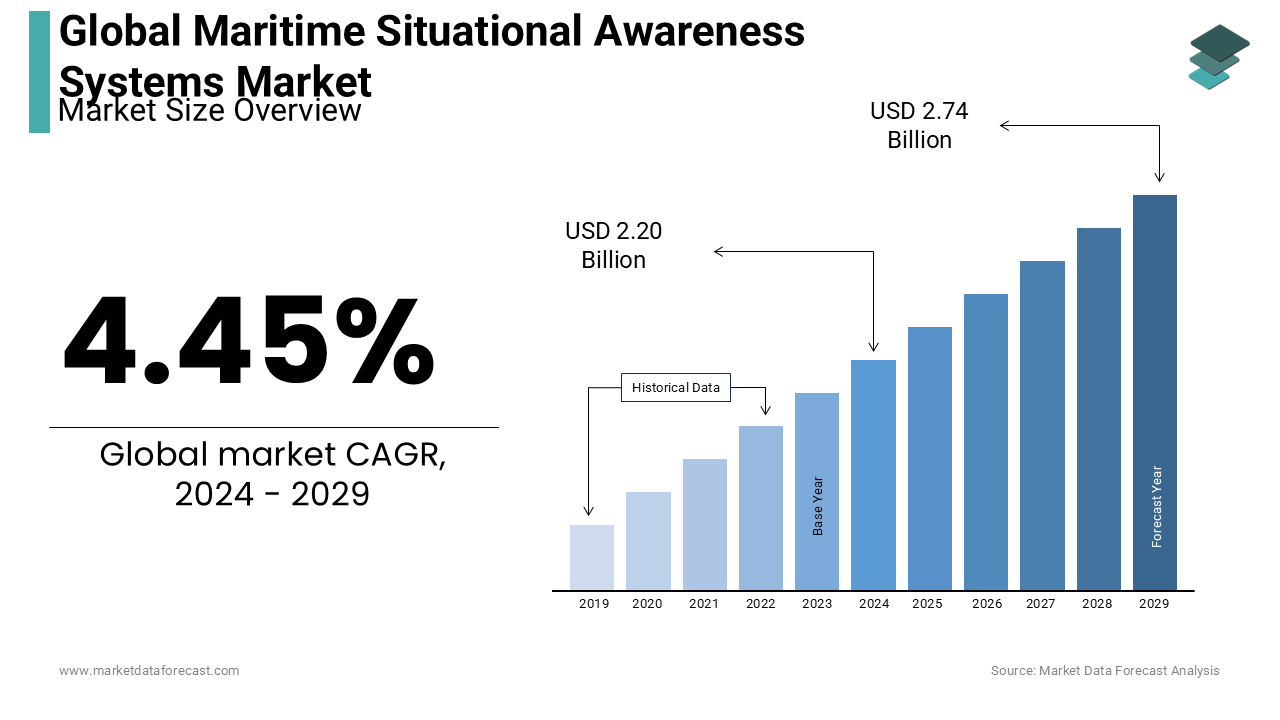
- Market Valuation: Valued at USD 2.30 billion in 2025, reaching USD 2.40 billion in 2026, and projected to expand up to USD 3.40 billion by 2034, registering a steady CAGR of 4.45% throughout the forecast period from 2026 to 2034.
- Primary Growth Drivers: Escalating maritime security concerns and boundary disputes, the growing importance of integrated cybersecurity and threat detection systems in naval operations, and rising investments in smart maritime infrastructure and vessel modernization.
Key Market Segment Metrics
| Category | Leading Segment (Base Year Position) | Fastest-Growing / High-Impact Segment |
|---|---|---|
| By Component & Type | Sensors Segment (holds the largest market share due to critical roles in intelligence, surveillance, platform survivability, and target acquisition) | Command and Control (C2) Segment (anticipated to register the highest growth rate driven by demand for advanced battle management software and asset coordination) |
| By Region | North America (anticipated to command the largest market share anchored by extensive military/defense applications and key industry primes) | Asia-Pacific (projected to be the fastest-growing regional market fueled by rising defense budgets, territorial disputes, and fleet modernizations in China, India, and Australia) |
Major Market Players & Market Structure
Market Structure: A consolidated, defense-focused industrial landscape featuring leading aerospace and defense contractors, specialized maritime electronics manufacturers, and technology innovators investing heavily in robust data acquisition and cybersecurity platforms.
Key Companies: Lockheed Martin Corporation, BAE Systems PLC, Leonardo S.P.A., Elbit Systems Limited, Thales Group, Honeywell International Inc., Raytheon Technologies Corporation (RTX), Rheinmetall AG, CMRE, and Hexagon Geospatial.
Global Maritime Situational Awareness Systems Market Size
The global maritime situational awareness systems market was valued at USD 2.30 billion in 2025 and is anticipated to reach USD 2.40 billion in 2026 to reach USD 3.40 billion by 2034, growing at a CAGR of 4.45% during the foreseen period from 2026 to 2034.
The tremendous growth of situational awareness in cybersecurity provides significant situational awareness, which is a major factor increasing the maritime situational awareness systems market demand.
A maritime situational awareness system utilizes information from the automatic identification system (AIS), applies anomaly detection algorithms, and provides maritime surveillance. The technology detects and communicates any unusual activity that obstructs the course of naval ships. Maritime situational awareness systems are equipment utilized by the military and the commercial sector. As tensions between sea boundaries, disputes, and lawbreakers rise, awareness systems are deployed to mitigate any potential threat. Manufacturers of maritime situational awareness systems are concentrating their efforts on research and development and integrating new technologies into the maritime sector. Maritime situational awareness systems are increasing steadily due to growing concerns about maritime safety and security.
MARKET DRIVERS
The growing importance of situational awareness in cybersecurity to provide significant situational awareness is the primary reason driving the maritime situational awareness system market growth.
The maritime situational awareness system market is growing due to the large growth of situational awareness in naval defenses and the employment of awareness systems to improve better Navy's tactical operations. With the integration of new products and equipment ready to be commissioned into the naval forces, such as network sensors, proximity sensors, temperature sensors, and gyroscopes, the maritime situational awareness market has seen growing demand. In many regions, technological developments and the deployment process of those technologies to clients drive the maritime situational awareness system market. The market for maritime situation awareness systems is predicted to grow due to the rising need for security and surveillance systems for early identification of problems, increased public safety concerns, and smart infrastructure development. In addition, as the demand for maritime situational awareness systems for cybersecurity grows, the market for situational awareness systems is likely to expand.
However, high implementation costs are expected to hamper market growth during the forecast period.
REPORT COVERAGE
| REPORT METRIC | DETAILS |
| Market Size Available | 2025 to 2034 |
| Base Year | 2025 |
| Forecast Period | 2026 to 2034 |
| CAGR | 4.45% |
| Segments Covered | By Component, Type, and Region |
| Various Analyses Covered | Global, Regional & Country Level Analysis, Segment-Level Analysis, DROC, PESTLE Analysis, Porter’s Five Forces Analysis, Competitive Landscape, Analyst Overview on Investment Opportunities |
| Regions Covered | North America, Europe, APAC, Latin America, Middle East & Africa |
| Market Leaders Profiled | Lockheed Martin Corporation, BAE Systems PLC, Leonardo S.P.A., Elbite Systems Limited, Thales Group, Honeywell International Inc., Raytheon Technologies Corporation, Rheinmetall AG, CMRE, Hexagon Geospatial, and others |
SEGMENTAL ANALYSIS
By Component Insights
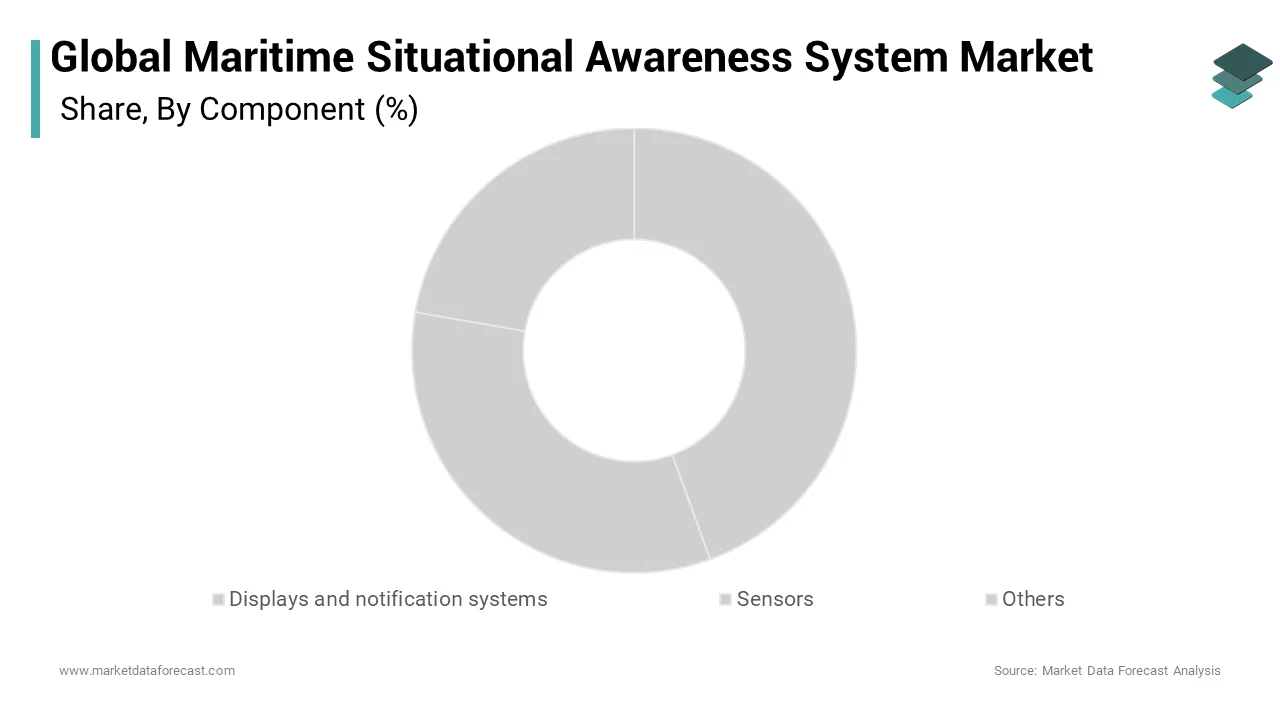
Based on components, the sensors segment is anticipated to hold the largest share in the maritime situational awareness systems market in the next six years. The sensors segments are required for intelligence, surveillance, platform survivability, targeting, and advanced weapon operation across all operating scenarios. In addition, they are in charge of transforming physical occurrences into amounts that data-acquisition devices can measure.
By Type Insights
The command and control segment is anticipated to have the highest growth rate in the maritime situational awareness systems market. Moreover, the market for command and control systems is predicted to grow in response to the growing demand for coordination between different fighting assets during war. To improve situational awareness, navies throughout the globe are investing considerably in creating new warships and outfitting them with cutting-edge battle management software and equipment. Western naval powerhouses are putting more emphasis on frigate construction and investing in frigate command and control systems. For example, the US Naval Sea Systems Command stated in July 2019 that Lockheed Martin would get USD 15.7 million to continue developing the Frigate Combat Management System based on COMBATSS-21 for the upcoming guided-missile frigate FFG (X). In addition, the United Kingdom's navy is working on creating new command and control systems based on smaller platforms that will communicate information over virtual networks, be resilient to cyber-attacks, and not be reliant on space-based networks as their size and capabilities grow. The factors and examples stated above are driving the development of marine command and control systems all around the globe.
REGIONAL ANALYSIS
Aisa Pacific Market Analysis
Asia-Pacific region is anticipated to be the fastest-growing in the maritime situational systems market, and it is predicted to increase at a CAGR of 4% during the forecast period. Countries such as China, India, Australia, Japan, South Korea, and others in the Asia-Pacific region are dramatically increasing their spending on the development and procurement of maritime situational awareness systems to improve their battle preparedness at sea. For example, China has accelerated the integration of its electro-optical sites, surface wave radars, and missile defense systems, a move that will significantly increase its maritime situational awareness capabilities. In addition, Saab and Luerssen Australia signed a 12-year deal in 2018 to deliver situational awareness equipment for the Royal Australian Navy's 12 Offshore Patrol Vessels (OPV). Such circumstances are fueling the Asia-Pacific market for maritime situational awareness systems.
North America Market Analysis
North America region is anticipated to experience the largest share in the maritime situational awareness systems market during the forecast period. The increasing use of situational awareness in military and defense, maritime security, homeland security, and aviation applications is credited with the expansion. In addition, the presence of prominent manufacturers like Lockheed Martin Corporation, Boeing Company, General Electric, Microsoft, L3Harris Technologies, Inc., Honeywell International Inc., and others supports the situational awareness market's growth throughout the area.
Europe Market Analysis
Europe region is estimated to have a significant maritime situational awareness systems market share over the forecast period. The presence of important players such as Airbus SAS, BAE Systems, Robert Bosch GmbH, and others drives the market growth of marine situational awareness systems in Europe. In addition, the rising demand for enhanced security and surveillance systems is propelling market expansion in the remainder of the world.
KEY MARKET PARTICIPANTS
These are the market players that are dominating the global maritime situational awareness systems market.
- Lockheed Martin Corporation
- BAE Systems PLC
- Leonardo S.P.A.
- Elbite Systems Limited
- Thales Group
- Honeywell International Inc.
- Raytheon Technologies Corporation
- Rheinmetall AG
- CMRE
- Hexagon Geospatial
RECENT MARKET NEWS
Honeywell launched a new security approach in September 2020 that gives users total situational awareness. Pro-Watch Integrated Security Suite is a software platform that helps secure people and property while maximizing productivity and responding to industry regulations. The platform provides a total view of all connected systems, and the software's scalability makes it simple to scale to meet a company's changing demands. Pro-Watch Intelligent Command is a web-based user interface that provides businesses with complete situational awareness of their security systems, ensuring the safety of people, property, and assets. The compliance-driven enterprise security software platform integrates access control, video surveillance, intrusion detection, and other business-critical services into a single user interface, helping companies improve productivity and reduce costs. In addition, it is simple to deploy and allows end customers to grow their enterprise security solutions effortlessly.
Raytheon Intelligence and Space Maritime Surveillance Systems for Japan Coast Guard Flight Tested on GA-ASI Sea Guardian in March 2021. Raytheon Intelligence & Space offers customers advanced technology itotaste success in a particular domain and be able to face hurdles.
MARKET SEGMENTATION
This research report on the global maritime situational awareness systems market has been segmented and sub-segmented based on the component, type, and region.
By Component
- Displays and notification systems
- Sensors
- Others
By Type
- Command and Control
- RADARs
- SONARs
- Optronics
By Region
- North America
- Asia-Pacific
- Europe
- Latin-America
- Middle-East-Africa