- Product Description Description
- Table of Contents TOC
- List of Table & Figure LOT
- Get Free Sample PDF Sample PDF
Market Size, 2025
$0.50 BnMarket Estimate, 2026
$0.62 BnMarket Forecast, 2034
$4.32 BnCAGR, 2026–2034
27.07%Middle East and Africa Agricultural Drones Market Size, Share, Trends & Forecast (2026–2034)
- Market Scope: Comprehensive regional evaluation of the Middle East and Africa agricultural drone sector, covering product divisions (hardware platforms and software analytics), core applications (crop spraying and variable rate application), and major geographical markets including Saudi Arabia, the United Arab Emirates, Israel, South Africa, and surrounding territories.
- Market Valuation: Valued at USD 0.50 billion in 2025, estimated at USD 0.62 billion in 2026, and projected to reach USD 4.32 billion by 2034, expanding at a robust CAGR of 27.07% from 2026 to 2034.
- Primary Growth Enablers: Acute rural labor shortages driving structural demand for aerial automation, extreme climate stress necessitating precision resource management, and state-led smart agricultural initiatives.
Key Middle East and Africa Agricultural Drones Segment Metrics (2026–2034)
| Category | Leading Segment Insights | Growth & Structural Highlights |
|---|---|---|
| By Product | Hardware (commanded a substantial share in 2025 due to foundational upfront capital requirements for ruggedized physical aircraft, sensors, and spraying systems) | Software is projected to expand at a notable 24.6% CAGR, driven by transitions toward recurring revenue data analytics and institutional geospatial procurement. |
| By Application | Crop Spraying (led the regional market in 2025 by addressing acute labor deficits and minimizing health risks associated with manual chemical application) | Variable Rate Application is predicted to witness the highest CAGR of 28.3% due to escalating fertilizer costs and strict nutrient-use efficiency mandates. |
| By Country / Region | Saudi Arabia & UAE (anchor regional adoption with a combined ~37.3% share backed by Vision 2030 smart farming programs and water-saving protected agriculture) | Israel and South Africa contribute significantly through advanced deep-tech R&D, water effluent recycling, and export-oriented horticultural automation. |
Major Market Players, Structure & Strategic Landscape
Market Structure: Highly competitive landscape featuring international hardware manufacturers, Western sensing providers, and specialized regional operators competing across fragmented regulatory environments, with success relying heavily on environmental ruggedization, local algorithm calibration, and after-sales support networks.
Key Companies: Trimble Navigation Ltd., DJI Technology, XAG Co Ltd, 3D Robotics, PrecisionHawk, AeroVironment Inc., Parrot SA, and DroneDeploy.
Middle East and Africa Agricultural Drones Market Size
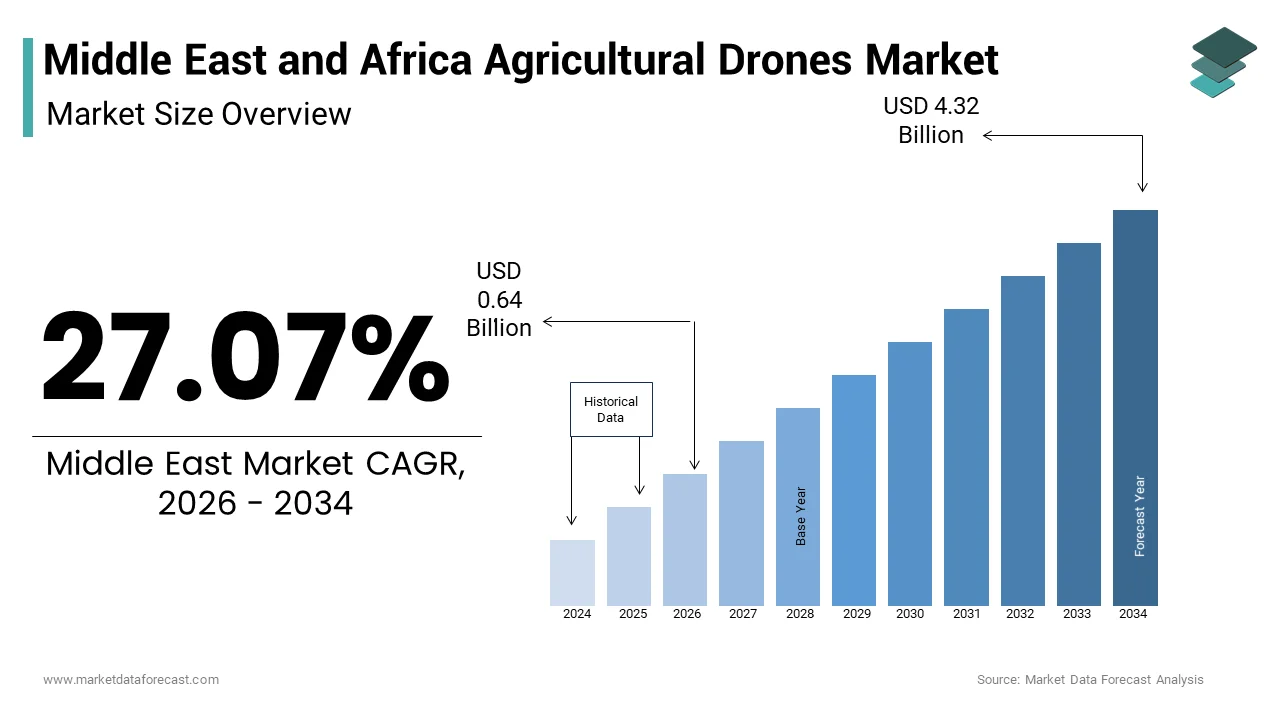
The Middle East and Africa agricultural drones market size was valued at USD 0.50 billion in 2025 and is anticipated to reach a valuation of USD 0.62 billion in 2026 to reach USD 4.32 billion by 2034, growing at a CAGR of 27.07% from 2026 to 2034.
Current Introduction and Definition of the Middle East and Africa Agricultural Drones Market
Agricultural drones are specialized unmanned aerial vehicles (UAVs) used in farming to monitor crop health, map fields, and spray liquids like fertilizers or pesticides. They use GPS, high-tech cameras, and sensors to help farmers do their work faster and with more precision. This sector is distinct from recreational or military applications due to its integration with agronomic decision support systems and regulatory frameworks governing pesticide application and airspace safety in food production contexts. According to the Food and Agriculture Organization, the agricultural sector remains the primary provider of livelihoods across Sub-Saharan Africa, employing more than 60% of the regional workforce and contributing roughly 23% to the continent's overall GDP. As per the World Bank, the agricultural infrastructure across the Middle East and North Africa consumes approximately 80% of the region’s total freshwater withdrawals, driving an active industry shift toward water-saving innovations due to severe regional water scarcity. According to the Food and Agriculture Organization, post-harvest losses for primary staple grains within developing regions historically average between 10% and 20%, driving local demand for improved storage infrastructures and specialized technical processing. This market is thus defined by convergence of labor scarcity, resource constraints, and digital infrastructure expansion rather than technology adoption alone.
MARKET DRIVERS
Acute Labor Shortages and Rural Demographic Shifts
Workforce Deficits Create Structural Demand for Aerial Automation
Accelerating rural outmigration and aging farmer populations are driving the growth of the Middle East and Africa agricultural drones market. These factors create chronic labor deficits that make traditional manual field operations unsustainable. According to the International Labour Organization, youth unemployment across several countries in North Africa exceeds 25%, continuing a trend where young citizens disproportionately face restricted employment access despite overall regional economic growth. According to the Food and Agriculture Organization, the agricultural sector remains the largest provider of employment across Sub-Saharan Africa, accounting for more than 60% of the total regional workforce and contributing roughly 23% to continental GDP. According to the World Bank, rural farming businesses in South Africa have actively adjusted operational models to absorb steady minimum wage adjustments and escalating input costs without interrupting primary domestic distribution channels. The demographic transformation converts drones from optional efficiency tools into operational necessities for maintaining cultivated area and crop protection schedules.
Precision Resource Management Under Climate Stress
Environmental Extremes Necessitate High Resolution Spatial Intelligence
Climate volatility and resource scarcity fuel demand for drone-based precision agriculture, which further propels the Middle East and Africa agricultural drones market. Conventional ground methods cannot provide the spatial and temporal resolution needed for adaptive management in stressed environments. According to the Intergovernmental Panel on Climate Change, communities spanning the Sahel and the Horn of Africa experience acute climate vulnerability and changing precipitation patterns that trigger prolonged droughts and severe regional food insecurity. As per the World Resources Institute, 25 countries globally face extremely high baseline water stress annually, utilizing over 80% of their available renewable supply and threatening domestic agricultural infrastructure under severe water shortages. According to a United Nations review, up to 65% of productive land in Africa is degraded, prompting extensive continental restoration partnerships to reverse desertification and secure vulnerable rural livelihoods. This environmental pressure creates non discretionary demand for aerial intelligence that enables survival rather than mere optimization.
MARKET RESTRAINTS
Restrictive Airspace Regulations and Licensing Complexity
Bureaucratic Barriers Delay Deployment and Increase Compliance Costs
Complex and often outdated aviation regulations constitute the most significant restraint, a factor which hinders the growth of the Middle East and Africa agricultural drones market. According to the International Civil Aviation Organization, over 60% of African nations maintain baseline visual line of sight regulations, highlighting a diverse regulatory environment where nations separately manage localized airspace access. As per the United Nations Conference on Trade and Development, regional e-commerce and digital service trade transformations require streamlined inter-agency collaboration to overcome structural logistics bottlenecks. According to a World Bank publication, standard detect-and-avoid technical hardware configurations for civilian drone applications command capital costs ranging from 5,000 to 50,000 dollars depending on integration specifications. These regulatory frictions effectively tax innovation and favor well capitalized incumbents who can navigate bureaucratic complexity, suppressing broader market development and limiting technology access to elite commercial operations.
Limited Technical Capacity and Maintenance Infrastructure
Skills Gaps and Service Network Deficits Cause Operational Failures
Widespread shortage of qualified pilots, technicians, and repair facilities undermines reliable drone operations and erodes user confidence across the region, which hampers the expansion of the Middle East and Africa agricultural drones market. According to the United Nations Industrial Development Organization, technical and vocational education programs require targeted curriculum modernisation to match evolving labor demands and bridge persistent youth employment mismatches. As per the International Livestock Research Institute, smallholder agricultural cooperatives are integrating data-driven technical innovations to maximize livestock value chains and safeguard rural food production systems. According to a World Bank analysis, rural populations in isolated sub-Saharan territories face severe geographic isolation, with fewer than 34% of residents living within two kilometers of an all-weather road network. This human capital deficit transforms temporary malfunctions into permanent asset losses, creating negative feedback loops that suppress future demand regardless of theoretical benefits.
MARKET OPPORTUNITIES
Integration with Digital Financial Services and Insurance
Fintech Convergence Creates Embedded Demand Channels Beyond Direct Sales
The proliferation of mobile money and digital financial platforms offers unique opportunities for the Middle East and Africa agricultural drones market. This paves the way to embed drone services within existing transaction ecosystems that smallholders already trust and use daily. According to the GSMA, sub-Saharan Africa remains the core epicenter of mobile money, recording over 1.1 billion registered mobile money accounts as of 2024 and demonstrating the sector's growing economic influence across the region's financial ecosystem. As per the InsuResilience Global Partnership, regional climate risk insurance initiatives are expanding structured financial protections across developing nations to enhance the local climate adaptation capabilities of vulnerable communities. According to the Bill and Melinda Gates Foundation, strategic investments in agricultural developments and smallholder innovation networks focus on accelerating crop productivity and enhancing long-term food security targets. This fintech agritech convergence allows drone services to bypass traditional distribution bottlenecks and reach millions at marginal cost structures impossible with conventional sales models.
Locust and Pest Early Warning Systems
Transboundary Threat Management Creates Institutional Demand Floors
Escalating transboundary pest outbreaks create sustained institutional demand for drone-based surveillance and response capabilities that ground teams cannot match in speed or coverage, which is expected to boost the expansion of the Middle East and Africa agricultural drones market. According to the Food and Agriculture Organization, the historic desert locust upsurge across East Africa and the Red Sea region required massive international response efforts to protect rural food security and secure smallholder agricultural livelihoods. As per the United Nations Office for Disaster Risk Reduction, early warning systems and multi-hazard risk tracking infrastructures are being prioritized across disaster-prone regions to reduce vulnerabilities and build localized public capacity. According to a World Bank assessment, regional institutional agricultural responses to biological threats depend heavily on coordinated national tracking programs and targeted regional contingency funding mechanisms. This shift from reactive emergency response to proactive surveillance infrastructure establishes stable government and donor funded demand that supports private sector ecosystem development even during periods of low commercial farm activity.
MARKET CHALLENGES
Data Privacy Concerns and Community Trust Deficits
Surveillance Anxieties and Land Tenure Ambiguities Hinder Social Acceptance
Community resistance rooted in privacy concerns and unclear land ownership creates social barriers that technical solutions alone cannot overcome and ultimately constrains the Middle East and Africa agricultural drones market. According to the United Nations Human Settlements Programme, more than 80 per cent of land in regions like Uganda is held under customary tenure, driving a localized expansion of community-based registration systems to mitigate systemic boundary disputes. According to the International Food Policy Research Institute, the integration of innovative Earth observation and digital tools across developing farmlands actively expands smallholder access to technical precision analytics and regional market intelligence. According to a World Bank publication, structural public utility reforms and sustainable financing models are expanding localized energy infrastructure grids to improve power delivery access for poor rural households. These socio political dimensions transform technical deployments into negotiated social contracts requiring cultural competence and trust building investments that pure technology vendors often underestimate.
Battery Technology Limitations in Extreme Environments
Thermal Stress and Charging Infrastructure Gaps Reduce Operational Reliability
Extreme heat and a lack of reliable charging infrastructure are major problems for the Middle East and Africa agricultural drones market. They fundamentally constrain drone flight endurance and mission reliability across much of the region. According to the International Renewable Energy Agency, grid-scale battery energy storage systems are securing significant national investment targets across arid regions to support clean electricity integration and manage intermittency under shifting climate conditions. According to a World Bank working paper, the financial underperformance of public electric utilities across sub-Saharan Africa represents a key constraint to expanding modern infrastructure networks and stabilizing power distribution. According to the United Nations Development Programme, distributed behind-the-meter thermal storage technologies are expanding in off-peak windows to absorb solar electricity and maintain industrial production continuity during power outages. The physical constraints mean theoretical drone capabilities advertised by manufacturers often overstate actual field performance in MEA conditions, creating expectation gaps that undermine user satisfaction and repeat adoption.
REPORT COVERAGE
| REPORT METRIC | DETAILS |
| Market Size Available | 2025 to 2034 |
| Base Year | 2025 |
| Forecast Period | 2026 to 2034 |
| CAGR | 27.07% |
| Segments Covered | By Product, Application, Region. |
| Various Analyses Covered | Global, Regional & Country Level Analysis, Segment-Level Analysis, DROC, PESTLE Analysis, Porter’s Five Forces Analysis, Competitive Landscape, Analyst Overview on Investment Opportunities |
| Regions Covered | KSA, UAE, Israel, South Africa, Ethiopia, Kenya, Egypt, Sudan, Rest of GCC Countries, and Rest of MEA |
| Market Leaders Profiled | Trimble Navigation Ltd., DJI Technology, 3D Robotics, PrecisionHawk, AeroVironment, Inc., Parrot SA, and Drone Deploy. |
SEGMENTAL ANALYSIS
By Product Insights
Hardware
The hardware segment dominated the Middle East and Africa agricultural drones market and accounted for a substantial share in 2025. This dominance occurred because physical aircraft, sensors, and spraying systems represent substantial upfront capital expenditures that dwarf recurring software subscription revenues in early adoption phases. According to the World Bank, rural agricultural modernization projects across sub-Saharan Africa emphasize capital investments in mechanical equipment to mitigate low structural productivity and scale up basic processing capabilities. As per the Food and Agriculture Organization, digital innovation initiatives across developing nations focus heavily on strengthening human capital, creating institutional advisory frameworks, and expanding localized extension service delivery. According to the International Telecommunication Union, mobile cellular network subscriptions have surpassed 90% population coverage globally, yet meaningful usage is constrained by structural gaps in digital literacy and high device costs. The infrastructural primacy ensures hardware maintains revenue leadership even as software ecosystems mature, since every new user acquired requires fresh capital outlay regardless of existing platform availability.
The leading position of this segment is bolstered by the harsh operating environment across the Middle East and Africa that necessitates specialized ruggedized equipment commanding premium pricing over standard global offerings. According to the United Nations Convention to Combat Desertification, climate-driven degradation impacts more than 65 per cent of productive land across Africa, compounding structural food insecurity risks for hundreds of millions of vulnerable rural smallholders. As per the International Renewable Energy Agency, off-grid renewable microgrids and solar-powered irrigation pumps are scaling up significantly across rural agricultural zones to stabilize localized decentralized energy access. According to a World Bank infrastructure assessment, logistical hurdles and dense road transport inefficiencies within sub-Saharan landlocked corridors raise final domestic freight costs by up to 50 percent. These environmental stressors transform hardware from commodity electronics into specialized industrial equipment with justified premium positioning that sustains segment revenue leadership.
Software
The software segment is expected to exhibit a noteworthy CAGR of 24.6% from 2026 to 2034, due to the transition from one-time hardware sales toward recurring revenue models based on data analytics and decision support services. According to the GSMA, 3G mobile broadband networks remain the baseline infrastructure tier across sub-Saharan Africa, covering roughly 85% of the continent's population despite a growing transition toward high-speed 4G data services. As per the Consultative Group on International Agricultural Research, open-source crop breeding methodologies and localized climate-smart agronomy frameworks enhance seasonal harvest quality for vulnerable farming cooperatives. According to the Bill and Melinda Gates Foundation, targeted structural micro-financing configurations and regional agricultural extension investments improve smallholder input application proficiencies to bolster community-wide yield targets. The convergence of connectivity expansion, algorithmic validation, and financial integration drives growth velocity exceeding hardware segments tied to physical deployment constraints.
The swift expansion of this segment gains further momentum from the emergence of government and donor agencies as bulk purchasers of geospatial analytics services for program monitoring and impact evaluation. According to a World Bank project overview, multi-sector structural development portfolios routinely emphasize satellite-based remote sensing and geographical information systems to audit environmental impacts and map sovereign infrastructure projects. As per the United Nations Office for Disaster Risk Reduction, early warning network frameworks and comprehensive space-based tracking technologies are expanding to minimize public economic vulnerabilities against severe natural hazards. According to the Food and Agriculture Organization, weather index-based agricultural insurance initiatives require coordinated regional parametric triggers to deliver timely automated payouts to rural households under severe drought conditions. The institutionalization of data procurement creates demand floors insulated from individual farmer purchasing volatility and accelerates software monetization pathways.
By Application Insights
Crop Spraying
The crop spraying segment led the Middle East and Africa agricultural drones market and captured a significant share in 2025. This leading position was attributed to acute labor shortages and increasing regulatory pressure to reduce pesticide exposure risks. These factors make aerial application economically and socially superior to manual methods. According to the International Labour Organization, employment across the agricultural sector remains the main source of income throughout sub-Saharan Africa, providing livelihoods for more than 60 percent of the regional workforce. According to a global health review, an estimated 200,000 acute pesticide poisoning deaths occur each year, with a substantial portion of these fatalities concentrated within developing agricultural economies. According to the Food and Agriculture Organization, digital farming ecosystems across developing regions focus heavily on strengthening local human capital, building institutional networks, and expanding localized extension service delivery. The convergence of economic necessity, health imperative, and regulatory alignment establishes crop spraying as primary use case driving hardware adoption across diverse farm scales.
The prominence of this segment is further reinforced by the tightening maximum residue limits imposed by export markets, that require precise application timing and dosage control only achievable through automated systems. According to the European Food Safety Authority, official import controls on incoming products rigorously enforce Maximum Residue Level compliance to ensure global dietary security and protect European consumer health. As per the United Nations Conference on Trade and Development, regional e-commerce transformations and digital agricultural trade updates require streamlined inter-agency collaboration to overcome structural logistics barriers. According to a World Bank sector engagement report, accelerating groundwater stress across developing territories drives an institutional transition toward alternative commercial cultivation setups and strict resource management strategies. These market access requirements create inelastic demand for precision spraying capabilities among export oriented producers who cannot afford compliance failures regardless of technology costs.
Variable Rate Application
The variable rate application segment is predicted to witness the highest CAGR of 28.3% during the forecast period owing to escalating fertilizer prices and policy mandates for nutrient use efficiency. According to the African Development Bank, fertilizer prices across many African nations escalated heavily between 2021 and 2022 due to global supply disruptions, compounding operational hurdles for rural smallholders. As per the International Fertilizer Association, sub-Saharan Africa represents approximately 1% of global fertilizer consumption, while experiencing severe soil degradation that limits regional output potential. According to a World Bank project overview, multi-sector structural development portfolios routinely emphasize satellite-based remote sensing and geographical information systems to audit environmental impacts and map sovereign infrastructure projects. The convergence of economic shock, soil degradation crisis, and policy conditionality creates explosive growth dynamics unique to this application segment.
The fast development of this segment is heightened by the increasing availability of high-resolution soil data, that makes site-specific management technically feasible across heterogeneous African landscapes. According to the International Soil Reference and Information Centre, digital mapping databases supply soil property grids at a standard resolution of 250 meters globally to assist macro-level environmental planning and landscape modeling. As per the Consultative Group on International Agricultural Research, open-source crop breeding methodologies and localized climate-smart agronomy frameworks enhance seasonal harvest quality for vulnerable farming cooperatives. According to the Bill and Melinda Gates Foundation, targeted structural micro-financing configurations and regional agricultural extension investments improve smallholder input application proficiencies to bolster community-wide yield targets. The data infrastructure maturation transforms VRA from theoretical concept to operational reality, unlocking growth potential constrained for decades by information scarcity.
COUNTRY LEVEL ANALYSIS
Kingdom of Saudi Arabia Agricultural Drones Market Analysis
Saudi Arabia was the top performer in the Middle East and Africa agricultural drones market and accounted for a 22.8% share in 2025. This dominance of the Saudi market was driven by massive state-sponsored smart farming initiatives under Vision 2030. According to the Saudi Ministry of Environment, Water, and Agriculture, the Kingdom actively drives digital transformation by integrating artificial intelligence and uncrewed aerial vehicles to manage smart irrigation, assess soil moisture levels, and monitor national dam infrastructures. As per the King Abdullah University of Science and Technology, dedicated institutional research facilities like the Center for Desert Agriculture advance translationally relevant plant sciences and localized sensor innovations to support sustainable desert cultivation. According to a World Bank sector engagement report, accelerating ground-water stress across the Gulf Cooperation Council zone drives an institutional transition toward alternative commercial farming setups and strict resource management strategies. The combination of sovereign wealth deployment, research excellence, and industrial policy establishes Saudi Arabia as undisputed market anchor whose strategic direction shapes regional technology standards.
United Arab Emirates Agricultural Drones Market Analysis
The United Arab Emirates followed closely behind in the Middle East and Africa agricultural drones market and captured a 14.5% share in 2025. This expansion of the UAE market was propelled by technology intensive protected agriculture and regulatory innovation leadership. According to the UAE Ministry of Climate Change and Environment, national agricultural strategies prioritize the expansion of hydroponic technology across commercial farms to reduce crop water consumption by up to 70 per cent. As per the UAE official government portal, the National Food Security Strategy 2051 targets making the United Arab Emirates the global leader on the Global Food Security Index by building comprehensive systems anchored in technology-enabled sustainable food production. According to a World Bank publication, developing regulatory sandboxes globally serves as a foundational tool to evaluate the structural, legal, and operational parameters of financial technology and digital trade. This focus on technological excellence and regulatory experimentation positions UAE as innovation laboratory where emerging solutions are validated before broader regional deployment.
Israel Agricultural Drones Market Analysis
Israel contributes notably to the Middle East and Africa agricultural drones market, due to its role as a global technology originator and exporter of precision aerial solutions. According to the Israel Innovation Authority, strategic focus sectors across deep-tech industries continue to drive advanced semiconductor R&D, photonics manufacturing, and quantum computing infrastructure projects. As per the Ministry of Foreign Affairs, Israel recycles over 80% of its wastewater for agricultural irrigation, establishing the highest rate of effluent reuse globally to counteract systemic water scarcity. According to a World Bank announcement, strategic development cooperations with regional partners focus on increasing technology-enabled financial inclusion, sustainable water allocations, and climate-smart farming models across sub-Saharan Africa. The fusion of IP leadership, demonstrated resource efficiency, and development diplomacy sustains disproportionate market influence relative to domestic scale.
South Africa Agricultural Drones Market Analysis
South Africa maintains a significant presence in the Middle East and Africa agricultural drones market owing to its advanced commercial farming sector and well-established drone service ecosystem. According to Statistics South Africa, export-oriented horticulture segments, including high-value citrus, viticulture, and deciduous fruits, generate short spraying windows and dense canopies that drive demand for advanced crop protection systems. As per the Water Research Commission, funded agricultural research projects evaluate the deployment of uncrewed aerial systems to monitor crop water requirements, map vegetation stress index data, and optimize precision irrigation scheduling. According to a Western Cape Provincial Government factsheet, the regional technology landscape offers sparse populations and arid climates that make it attractive for commercial uncrewed aerial vehicle testing, development, and engineering operations. The combination of existing infrastructure depth, proven economics, and indigenous capacity creates uniquely sophisticated market environment distinct from frontier contexts elsewhere in Africa.
COMPETITIVE LANDSCAPE
Competition in the Middle East and Africa agricultural drones market features intense rivalry between Chinese hardware manufacturers, Western sensing specialists, and emerging regional service providers vying for position across highly fragmented national markets with distinct regulatory and infrastructural characteristics. Global leaders compete on price performance and product breadth while local players leverage contextual knowledge, political relationships, and service networks to defend niches in underserved segments. Differentiation increasingly occurs through environmental ruggedization, local algorithm calibration, and after sales support rather than specifications alone due to commoditization of basic flight capabilities. Government procurement and donor funded programs create additional competitive dimensions where compliance capabilities and development alignment matter as much as technical merit. Market consolidation continues as scale economies become necessary to fund service infrastructure investments exceeding smaller player capacities. New entrants face significant barriers including regulatory complexity, spare parts logistics, and established training ecosystems built over years. Cross border competition remains limited by heterogeneous airspace regulations despite regional integration aspirations. Ultimately sustainable advantage derives from balancing global technology resources with deep local embeddedness and patience in this uniquely complex environment characterized by simultaneous growth opportunities and systemic operational challenges requiring adaptive business models beyond pure product sales.
KEY MARKET PLAYERS
Some of the major key players in the market are
- Trimble Navigation Ltd.,
- DJI Technology
- XAG Co Ltd
- 3D Robotics
- PrecisionHawk
- AeroVironment, Inc.
- Parrot SA,
- DroneDeploy.
Top Players In The Market
- DJI Agriculture maintains extensive involvement across the Middle East and Africa agricultural drones market through affordable spraying and mapping platforms tailored for emerging market conditions. The company recently strengthened its regional position by establishing authorized service centers in Kenya, Ethiopia, and South Africa to reduce repair turnaround times from weeks to days. DJI launched Agras T50 and Mavic 3 Multispectral models with enhanced dust protection and heat tolerance specifically validated for Sahelian and Gulf environments. Their partnership with local agro dealers enables last mile distribution and operator training networks reaching remote smallholders previously excluded from precision technology access. These strategic initiatives demonstrate commitment to adapting global products for MEA operational realities while building sustainable support ecosystems essential for long term customer retention and market development across diverse production systems throughout the continent.
- XAG Co Ltd contributes significantly to the Middle East and Africa agricultural drones landscape through autonomous spraying and seeding systems designed for labor scarce commercial operations. The company recently expanded demonstration farms in Saudi Arabia and Egypt to validate performance under extreme heat and saline conditions distinct from Chinese testing environments. XAG introduced P100 Pro platform with modular payload design enabling rapid switching between spraying, spreading, and mapping functions to maximize asset utilization across seasonal crop cycles. Their collaboration with regional distributors includes certified pilot training programs addressing technical skills gaps that hinder reliable operations. These actions reinforce XAG’s positioning as solutions provider balancing advanced automation with local capacity building essential for navigating fragmented MEA markets characterized by infrastructure deficits and workforce constraints affecting consistent technology adoption.
- Parrot SA serves the Middle East and Africa agricultural drones market through specialized multispectral sensing and analytics platforms targeting high value horticulture and research applications. The company recently partnered with Israeli and South African agritech firms to integrate Anafi USA imagery with local crop models calibrated for regional varieties and stress responses. Parrot launched cloud based processing suite accessible via low bandwidth connections enabling real time analysis in connectivity constrained rural areas without requiring high end local computing hardware. Their engagement with government research institutions creates validation pathways and reference sites that build trust among conservative commercial buyers. These science led initiatives demonstrate leadership in premium sensing segment where data quality and algorithmic accuracy create defensible competitive advantages beyond commodity drone manufacturing in resource constrained regions requiring specialized solutions.
Top Strategies Used By Key Market Participants
Key players in the Middle East and Africa agricultural drones market prioritize localization strategies including regional service hubs, environmental product adaptation, and operator training programs to overcome infrastructure and skills barriers. Companies establish authorized repair centers to reduce downtime caused by import delays for spare parts and technical expertise shortages. Strategic partnerships with local distributors and cooperatives enable last mile reach into fragmented smallholder segments inaccessible through direct sales channels. Product portfolios are modified with enhanced dust sealing, heat tolerant batteries, and low bandwidth software compatibility to address harsh operating conditions unique to the region. Training academies and certification programs build indigenous technical capacity while creating customer loyalty through knowledge transfer. Bundling hardware with software subscriptions and advisory services transforms one time transactions into recurring revenue streams aligned with seasonal cash flows. Engagement with government digital agriculture initiatives secures procurement contracts and regulatory alignment that de risk market entry. These multifaceted strategies reflect adaptation to uniquely MEA combination of climatic extremes, institutional voids, and demographic pressures requiring hybrid approaches blending commercial discipline with developmental engagement rather than standardized global deployment models.
MARKET SEGMENTATION
This research report on the Middle East and Africa agricultural drones market is segmented and sub-segmented into the following categories.
By Product
- Hardware
- Software
By Application
- Field mapping
- Variable rate application
- Crop scouting
- Crop spraying
- Livestock
By Country
- KSA
- UAE
- Israel
- Rest Of GCC Countries
- South Africa
- Ethiopia
- Kenya
- Egypt
- Sudan
- Rest Of MEA