- Product Description Description
- Table of Contents TOC
- List of Table & Figure LOT
- Get Free Sample PDF Sample PDF
Market Size, 2025
$1.02 BnMarket Estimate, 2026
$1.07 BnMarket Forecast, 2034
$1.57 BnCAGR, 2026–2034
4.95%Executive Summary: Middle East And Africa Apple Juice Market
- Market Scope: Comprehensive regional Middle East and Africa apple juice market analysis covering distribution channels, country-level leadership frameworks, organic/functional product trends, and import-dependent supply chain dynamics.
- Market Valuation: Valued at USD 1.02 billion (2025), estimated at USD 1.07 billion (2026), and projected to reach USD 1.57 billion by 2034, registering a steady CAGR of 4.95% (2026–2034).
- Primary Growth Drivers: Rising health consciousness among urban consumers shifting away from carbonated drinks and the rapid expansion of modern retail and e-commerce channels. Key trends include surging demand for premium organic and functional variants infused with ginger and turmeric.
Key Market Segment Metrics (2026–2034)
| Category | Leading Segment (2025 Position) | Fastest-Growing Segment |
|---|---|---|
| By Distribution Channel | Supermarkets (represented the largest channel with 41.5% of total sales volume in 2025) | Specialty Stores (fastest-growing segment at a 9.7% CAGR, catering to health-focused consumers) |
| By Product Category | Conventional Apple Juice Formulations and Standard Blends | Premium Organic Variants and Functional Juices Infused with Ginger and Turmeric |
| By Country Leadership | United Arab Emirates (leading regional position with 19.5% market share in 2025) | Key Markets expanding via wellness initiatives and domestic production (Saudi Arabia, South Africa, Egypt, and Israel) |
Major Market Players & Market Structure
Market Structure: Competitive regional beverage landscape featuring multinational corporations and regional players competing through product innovation in organic and blended segments, brand positioning targeting health-conscious urban consumers, and diversified pricing strategies.
Key Companies: Musselman Premium Apple Juice, Mishpacha Apple Juice, Mott’s, Simply Balanced Organic Apple Juice, Eden Organic Apple Juice, Martinelli’s Apple Juice, and Field Day Organic Apple Juice.
Middle East and Africa Apple Juice Market Size
The Middle East and Africa apple juice market size was valued at USD 1.02 billion in 2025 and is projected to reach USD 1.57 billion by 2034 from USD 1.07 billion in 2026, growing at a CAGR of 4.95%.
The Middle East and Africa apple juice market refers to the production, distribution, and consumption of apple-derived beverages across countries in these two broad regional clusters. While apple juice is not native to most parts of the region due to climatic constraints, its popularity has grown significantly over the past decade as a result of shifting consumer preferences toward healthier beverage options. Apple juice is often consumed as a ready-to-drink product or as a base ingredient in fruit-flavored blends. The market includes both locally processed products and imports, with key players focusing on packaging innovations and health-focused marketing strategies.
MARKET DRIVERS
Rising Health Consciousness Among Urban Consumers
A major factor contributing to the Middle East and Africa apple juice market is the growing health consciousness among urban populations. With increasing awareness about the benefits of natural and organic beverages, consumers are shifting away from carbonated soft drinks and opting for healthier alternatives like apple juice.
In South Africa, according to the Department of Health, 41% of adults suffer from lifestyle-related diseases such as hypertension and diabetes, prompting a government-led campaign promoting healthier eating habits. This has indirectly boosted the demand for apple juice, which is perceived as a heart-healthy and immune-boosting drink.
In addition, in Egypt, where obesity rates have reached 35% among adults, as per the World Health Organization, there has been a surge in demand for fruit juices with no added sugars. Local producers have responded by launching preservative-free apple juice lines, contributing to an annual growth in the sector.
Expansion of Modern Retail and E-commerce Channels
An additional significant driver of the Middle East and Africa apple juice market is the rapid expansion of modern retail formats and e-commerce platforms. Traditional retail still dominates much of the African continent; however, the proliferation of supermarkets, hypermarkets, and online grocery services has dramatically improved product accessibility. This convenience factor has helped increase repeat purchases and brand loyalty.
The availability of international brands in local markets has also enhanced consumer trust and widened the customer base, especially in urban centers.
MARKET RESTRAINTS
High Dependency on Apple Imports Due to Limited Local Cultivation
A major restraint affecting the Middle East and Africa apple juice market is the high dependency on apple imports due to limited local cultivation capabilities. Most countries in the region lack the suitable climate and agricultural infrastructure required for large-scale apple farming. Apples require temperate conditions, which are only present in limited areas such as Morocco, South Africa, and parts of Turkey.
According to the Food and Agriculture Organization (FAO), the Middle East and Africa imported over 1.2 million metric tons of fresh apples in 2023. This dependence leads to price volatility, especially during geopolitical tensions or supply chain disruptions.
These cost burdens are passed on to manufacturers, making apple juice more expensive compared to other locally sourced fruit juices. Consequently, affordability becomes a limiting factor, especially in lower-income markets where price sensitivity is high.
This reliance on imported raw materials restricts the scalability of apple juice production and hampers the ability of local manufacturers to maintain consistent pricing and quality standards.
Regulatory and Labeling Challenges Across Diverse Markets
A further critical challenge facing the Middle East and Africa apple juice market is the inconsistency in regulatory frameworks and labeling requirements across different countries. Unlike the European Union or North America, where food safety and labeling laws are harmonized, the MENA and African regions feature fragmented regulations that vary significantly by country.
For example, in Saudi Arabia, the Saudi Standards, Metrology and Quality Organization (SASO) mandates strict compositional standards for fruit juices, including minimum fruit content and labeling clarity.
According to a 2023 report by the Global Food Safety Initiative, compliance with multiple regulatory systems increases operational complexity for multinational juice manufacturers, delaying product launches and increasing time-to-market. Smaller regional players often struggle to meet these diverse requirements, limiting their expansion potential.
These regulatory inconsistencies create additional costs for reformulation, packaging redesign, and certification, which can be prohibitive for smaller firms. Consequently, many companies opt to focus only on larger, more stable markets such as the UAE or South Africa, leaving vast segments of the region underserved.
MARKET OPPORTUNITIES
Growth of Premium and Organic Apple Juice Segments
Among the most promising opportunities in the Middle East and Africa apple juice market lies in the rising demand for premium and organic apple juice products. As consumer preferences evolve toward clean-label and minimally processed foods, there is a growing niche for high-quality, additive-free apple juices.
Supermarkets such as Spinneys and Carrefour have dedicated organic sections, offering imported and locally produced organic apple juices from certified sources. Similarly, in South Africa, Woolworths and Pick n Pay have introduced private-label organic apple juice lines, targeting eco-conscious shoppers.
Although domestic production remains limited, partnerships with organic apple exporters from Europe and South America have enabled regional bottlers to meet the growing demand. With rising disposable incomes and an expanding middle class in urban centers, the premium apple juice segment presents a lucrative avenue for differentiation and value addition in the region’s competitive beverage landscape.
Increasing Demand for Functional Beverages and Blended Juices
A significant opportunity in the Middle East and Africa apple juice market is the rising interest in functional beverages and blended juice formulations. Consumers are increasingly seeking beverages that offer additional health benefits beyond hydration, such as immunity support, digestive health, and energy enhancement. Apple juice, due to its mild flavor and natural sweetness, serves as an ideal base for blending with other fruits, herbs, and superfoods.
Brands like Almarai in Saudi Arabia and Savola in Egypt have launched apple-based blends infused with ginger, turmeric, and chia seeds to cater to this trend.
In South Africa, functional apple juice variants fortified with vitamin C and zinc have gained traction, particularly during seasonal flu periods. This evolving demand offers beverage manufacturers an avenue to innovate and diversify their product portfolios while capitalizing on the versatility of apple juice as a foundational ingredient in functional beverage development.
MARKET CHALLENGES
Seasonal Availability and Price Volatility of Raw Apples
A significant challenge confronting the Middle East and Africa apple juice market is the seasonal availability and resultant price volatility of raw apples. Since most countries in the region do not produce apples domestically, they rely heavily on seasonal imports, primarily from Europe, China, and South America. The timing and volume of these imports directly impact the cost and consistency of apple juice production.
According to the Food and Agriculture Organization (FAO), global apple prices fluctuated in 2023 due to adverse weather conditions in major producing regions such as Poland and Washington State. These fluctuations are further exacerbated by transportation delays and customs clearance issues, particularly in African markets with less developed logistics networks. For instance, in Kenya, importers reported a 15% increase in apple procurement costs during the first quarter of 2023 due to port congestion and delayed shipments.
Apart from these, as per the United Nations Conference on Trade and Development (UNCTAD), perishable goods like fresh apples face higher storage and handling costs in sub-Saharan Africa due to inadequate cold-chain infrastructure. These challenges lead to inconsistent supply, forcing manufacturers to either raise retail prices or compromise on product quality by extending shelf life with preservatives—both of which negatively impact consumer perception and market growth.
Thus, the lack of stable and predictable apple supply chains poses a persistent obstacle to the sustained expansion of the apple juice industry in the region.
Competition from Locally Available Tropical Fruit Juices
Another pressing challenge for the Middle East and Africa apple juice market is the stiff competition posed by locally available tropical fruit juices, which are often more affordable and culturally ingrained. Countries across the region have abundant access to indigenous fruits such as mangoes, oranges, guavas, and tamarind, which are used extensively in traditional beverages. These fruits are typically cheaper to source and process, allowing manufacturers to offer competitively priced products that align with local taste preferences.
The dominance is partly attributed to the widespread availability of raw materials, which reduces production costs and enhances profit margins for local producers.
In Egypt, where citrus fruits are cultivated extensively, government subsidies for domestic fruit processors have further strengthened the position of orange and lemon-based beverages.
Apple juice, despite its perceived health benefits, struggles to gain similar traction due to higher input costs and a less familiar flavor profile in many African and Middle Eastern palates. This entrenched preference for tropical fruit juices continues to limit the penetration of apple juice in mainstream markets across the region.
REPORT COVERAGE
| REPORT METRIC | DETAILS |
| Market Size Available | 2025 to 2034 |
| Base Year | 2025 |
| Forecast Period | 2026 to 2034 |
| CAGR | 4.95% |
| Segments Covered | By Distribution Channel and Region |
|
Various Analyses Covered | Regional & Country Level Analysis, Segment-Level Analysis, DROC, PESTLE Analysis, Porter’s Five Forces Analysis, Competitive Landscape, Analyst Overview on Investment Opportunities |
| Regions Covered | UAE, Israel, KSA, South Africa, Egypt |
| Market Leaders Profiled | Musselman Premium Apple Juice, Mishpacha Apple Juice, Mott's, Simply Balanced Organic Apple Juice, Eden Organic Apple Juice, Martinelli's Apple Juice, Field Day Organic Apple Juice, and others |
SEGMENTAL ANALYSIS
By Distribution Channel Insights
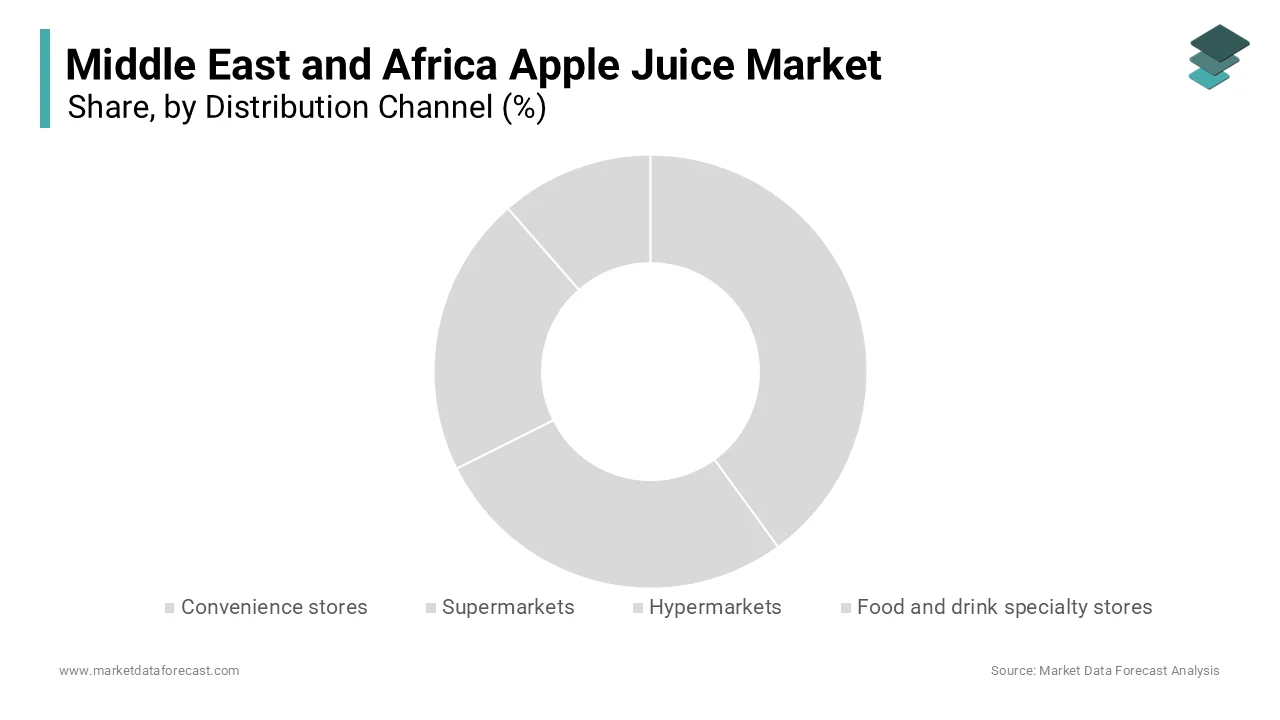
Supermarkets represented the largest distribution channel in the Middle East and Africa apple juice market, accounting for an estimated 41.5% of total sales volume in 2025. This dominance is primarily due to their widespread presence, organized retail infrastructure, and consumer preference for one-stop shopping experiences that include both food and beverage products.
The growth of private-label brands within supermarkets has also contributed to this segment’s expansion.
Apart from these, the integration of loyalty programs and promotional discounts in supermarkets encourages repeat purchases. With rising urbanization and increased disposable incomes across the region, consumers are increasingly opting for convenience-driven retail formats, reinforcing the leading position of supermarkets in the apple juice distribution landscape.
Specialty stores are emerging as the fastest-growing distribution channel in the Middle East and Africa apple juice market, recording a CAGR of 9.7%. These stores, which include organic boutiques, gourmet shops, and health-focused retailers, cater specifically to consumers seeking premium, additive-free, and certified organic apple juice products.
The surge in demand stems from increasing consumer awareness about clean-label ingredients and the perceived health benefits associated with minimally processed apple juice.
As per the International Trade Centre, the import value of organic apple juice into the Middle East rose by 16% in 2023, largely attributed to demand from specialty retail channels. This trend underscores the rising influence of niche, health-oriented retail formats in shaping the regional apple juice market.
REGIONAL ANALYSIS
United Arab Emirates
The United Arab Emirates held the top position in the Middle East and Africa apple juice market, capturing 19.5% of the regional market share in 2025. As a highly developed economy with a large expatriate population, the UAE presents a mature and diverse consumer base that prioritizes health and wellness, directly influencing beverage choices.
The popularity of apple juice is particularly high among expatriates from South Asia and the West, who are accustomed to consuming it regularly.
Dubai and Abu Dhabi serve as major hubs for international beverage brands, with companies like PepsiCo and Almarai leveraging modern retail infrastructure to promote ready-to-drink apple juice variants.
Government initiatives promoting healthier school meals and workplace nutrition have also played a role in expanding the category. With continued investment in retail expansion and product innovation, the UAE remains at the forefront of apple juice consumption in the MEA region.
Israel – high penetration of premium variants (Market Share: ~9%)
Israel ranks among the top five countries in the Middle East and Africa apple juice market. Known for its advanced healthcare system and high health consciousness, the Israeli market exhibits strong demand for premium and organic apple juice products.
Apple juice contributes substantially to this figure, especially in urban centers like Tel Aviv and Haifa, where health-focused lifestyles prevail.
Israeli consumers show a distinct preference for cold-pressed and unpasteurized apple juice varieties, with specialty health stores and direct-to-consumer delivery services playing a crucial role in distribution.
Moreover, the Ministry of Health’s emphasis on reducing sugar intake has encouraged manufacturers to introduce low-sugar and no-added-sugar apple juice lines. This regulatory environment, combined with high disposable income levels, positions Israel as a key growth market within the MEA apple juice landscape.
Saudi Arabia – Rapid Urbanization Drives Demand (Market Share: ~16%)
Saudi Arabia occupies a prominent position in the Middle East and Africa apple juice market. The country’s market status is shaped by rapid urbanization, government-backed health initiatives, and the ongoing transformation under Vision 2030, which includes promoting healthier lifestyles.
The rise in health awareness, particularly among younger demographics, has led to a shift away from sugary soft drinks toward natural alternatives like apple juice.
According to the Saudi Food and Drug Authority (SFDA), regulations introduced in 2022 requiring front-of-pack nutritional labeling have influenced consumer behavior, pushing manufacturers to reformulate products and highlight health benefits. This has benefited apple juice brands that emphasize purity and minimal processing.
With continued investment in retail modernization and digital commerce, Saudi Arabia remains a critical growth engine for the apple juice market in the MEA region.
South Africa
South Africa plays a pivotal role in the African apple juice market. As the most industrialized economy on the continent, South Africa offers a relatively sophisticated retail environment and a growing middle class that is increasingly receptive to imported and premium beverages.
While citrus-based juices still dominate, apple juice has seen steady growth, particularly in urban areas such as Johannesburg and Cape Town. Moreover, the expansion of supermarket chains like Shoprite and Checkers, along with e-commerce platforms such as Takealot, has improved accessibility to branded apple juice products. With rising disposable incomes and evolving dietary preferences, South Africa continues to be a key growth market for apple juice in the African sub-region.
Egypt – Expanding Domestic Production Base (Market Share: ~10%)
Egypt is a notable contributor to the Middle East and Africa apple juice market. The country’s apple juice market is characterized by a mix of local production and imports, with domestic manufacturers increasingly investing in processing facilities to meet rising consumer demand.
While traditionally dominated by citrus-based drinks, changing consumer tastes and targeted marketing campaigns have elevated apple juice’s presence in mainstream retail.
Local producers such as Juhayna and Panda Dairy have launched affordable, pasteurized apple juice variants tailored to middle-income households. Additionally, as per the estimates by the World Bank, 35% of Egyptian adults suffer from obesity, prompting a shift toward healthier drink options. This public health concern, coupled with rising urbanization and disposable incomes, is expected to sustain apple juice growth in the coming years, positioning Egypt as a key player in the MEA apple juice landscape.
KEY MARKET PLAYERS AND COMPETITIVE LANDSCAPE
Musselman Premium Apple Juice, Mishpacha Apple Juice, Mott's, Simply Balanced Organic Apple Juice, Eden Organic Apple Juice, Martinelli's Apple Juice, Field Day Organic Apple Juice
The competition in the Middle East and Africa apple juice market is shaped by a mix of multinational corporations and regional players vying for market share through differentiation, branding, and supply chain efficiency. As consumer demand for healthier beverages grows, companies are increasingly focused on product innovation, targeting niche segments such as organic, preservative-free, and blended apple juices. This has led to a more fragmented yet dynamic market landscape where local producers compete alongside global giants.
Brand positioning and marketing play a crucial role in distinguishing products, particularly in urban centers where health-conscious consumers seek transparency in ingredient sourcing and nutritional content. Additionally, pricing strategies vary significantly between premium imported brands and cost-effective local alternatives, creating diverse entry points for different consumer segments. The expansion of modern retail formats and digital commerce further intensifies competition, enabling smaller players to reach wider audiences without relying solely on traditional trade networks.
Furthermore, regulatory differences across countries present both challenges and opportunities, influencing how companies structure their operations and compliance strategies. While large firms leverage economies of scale and established distribution networks, emerging regional brands capitalize on cultural familiarity and localized supply chains. This evolving interplay between global and domestic forces continues to shape the competitive dynamics of the MEA apple juice market.
TOP PLAYERS IN THE MARKET
Almarai (Saudi Arabia)
Almarai is a leading dairy and beverage company in the Middle East, with a strong presence in the apple juice segment. The company offers a range of fruit juices, including apple variants, under its well-established brand name. Known for its high-quality production standards and extensive distribution network, Almarai plays a crucial role in shaping consumer preferences across the Gulf region. Its commitment to product innovation and food safety has helped it maintain a loyal customer base, making it a key contributor to both regional and global juice markets.
PepsiCo (United States, operating in MEA)
PepsiCo operates extensively in the Middle East and Africa through its Tropicana and Lipton brands, offering apple juice and apple-based blends. The company leverages its global expertise in beverage manufacturing and marketing to cater to health-conscious consumers in the region. With a focus on product diversification and sustainable sourcing, PepsiCo continues to strengthen its foothold in the MEA apple juice market. Its strategic partnerships and localized product adaptations further enhance its relevance in this growing sector.
Savola Group (Saudi Arabia)
Savola Group is a major player in the Middle Eastern food and beverage industry, with a strong portfolio that includes packaged juices. The company's apple juice offerings are widely available across Saudi Arabia and neighboring countries, benefiting from its robust supply chain and brand recognition. Committed to quality and consumer satisfaction, Savola integrates modern processing techniques to ensure freshness and nutritional value. Its regional influence makes it a key participant in the broader MEA apple juice landscape.
TOP STRATEGIES USED BY KEY MARKET PLAYERS
One of the primary strategies employed by key players in the Middle East and Africa apple juice market is product innovation and diversification . Companies are introducing new flavors, organic variants, and functional apple juice blends enriched with vitamins and probiotics to cater to evolving consumer preferences. This approach helps them differentiate their offerings in a competitive market and attract a wider consumer base.
Another critical strategy is expanding distribution networks through modern retail channels and e-commerce platforms. Leading brands are strengthening their presence in supermarkets, hypermarkets, and specialty stores while leveraging online delivery services to improve accessibility and convenience for consumers across urban and semi-urban areas.
Lastly, brand positioning through health-focused marketing is playing a pivotal role in market expansion. Manufacturers are emphasizing natural ingredients, minimal processing, and nutritional benefits in their promotional campaigns to align with rising health consciousness among consumers. This strategy enhances brand credibility and fosters long-term consumer loyalty.
RECENT HAPPENINGS IN THE MARKET
- In February 2023, Almarai launched a new line of organic apple juice in the UAE, targeting health-conscious consumers and expanding its premium beverage portfolio.
- In July 2023, PepsiCo introduced an apple-mango blended juice variant under the Tropicana brand in Egypt, aiming to capture younger demographics seeking flavorful and nutritious drink options.
- In November 2023, Savola Group expanded its cold-chain logistics infrastructure in Saudi Arabia to improve the shelf life and freshness of its apple juice products across remote regions.
- In March 2024, a leading South African beverage manufacturer, Ceres Limited, entered into a strategic partnership with a European apple juice concentrate supplier to ensure a stable and high-quality raw material supply.
- In June 2024, a Dubai-based private-label beverage company launched a sugar-free apple juice variant exclusively for supermarket chains, responding to increasing demand for low-calorie drinks in the GCC region.
MARKET SEGMENTATION
This research report on the Middle East and Africa apple juice market has been segmented and sub-segmented based on the following categories.
By Distribution Channel
- Convenience stores
- Supermarkets
- Hypermarkets
- Food and drink specialty stores
By Region
- UAE
- Israel
- KSA
- South Africa
- Egypt