- Product Description Description
- Table of Contents TOC
- List of Table & Figure LOT
- Get Free Sample PDF Sample PDF
Market Size, 2025
$51.72 BnMarket Estimate, 2026
$58.91 BnMarket Forecast, 2034
$166.87 BnCAGR, 2026–2034
13.90%Middle East and Africa Fennel Seeds Market Size, Growth, Trends & Forecast (2026–2034)
The Middle East and Africa fennel seeds market size was valued at USD 51.72 billion in 2025, is anticipated to reach USD 58.91 billion in 2026, and is projected to scale up to USD 166.87 billion by 2034, registering a compound annual growth rate (CAGR) of 13.9% during the forecast period from 2026 to 2034. Driven by a surging preference for ethnic and Asian cuisines, rising demand for convenient foods, and a strong cultural inclination toward traditional seasoning and mouth fresheners, the regional market continues to expand dynamically.
Key Executive Metrics (At-a-Glance)
- 2025 Base Valuation: USD 51.72 Billion
- 2026 Current Valuation: USD 58.91 Billion
- 2034 Forecast Valuation: USD 166.87 Billion
- Compound Annual Growth Rate (CAGR): 13.9% (2026–2034)
- Dominant Product Segment: Conventional Fennel Seeds (leading standard volume across commercial retail channels)
- Fastest-Growing Product Segment: Organic Fennel Seeds (expanding via growing health-conscious consumer segments)
- Dominant Application & End-User Segments: Flavor and Seasoning Ingredient (Application) & Food Industry (End-User) holding primary volume shares
- Regional Leader: GCC countries (KSA, UAE) and South Africa (leading regional consumption and import hubs)
Core Market Drivers
- Culinary Diversity & Flavor Exploration: Rising consumer appetite for Indian, Asian, and fusion recipes incorporating aromatic herbs and spices.
- Convenience Foods Growth: Increasing integration of pre-packaged and ready-to-eat products utilizing natural flavoring agents.
- Traditional & Functional Uses: Widespread consumption of fennel seeds as post-meal digestive aids and mouth fresheners across MEA populations.
Primary Market Restraints & Challenges
- Supply Chain Price Volatility: Fluctuations in agricultural yield and import-export tariffs affecting regional raw material pricing.
- Allergic & Medical Constraints: Potential health limitations regarding hormone sensitivities and excessive consumption side effects.
Middle East and Africa Fennel Seeds Market Segmentation Breakdown
| Segment Category | Leading Sub-Segment (2025 Base) | Fastest-Growing Sub-Segment (2026–2034) |
|---|---|---|
| By Product | Conventional Fennel Seeds (dominant commercial volume baseline) | Organic Fennel Seeds (fastest-growing due to clean-label health trends) |
| By Application | Flavor and Seasoning Ingredient (leading market share across food preparations) | Essential Oil & Beverages (expanding via aromatherapy and functional drink infusions) |
| By End User | Food Industry (dominant consumer of bulk seasoning ingredients) | Households & Personal Care (surging retail and cosmetic formulation demand) |
| By Country | KSA, UAE & South Africa (dominant regional economic and retail hubs) | Egypt, Israel, Ethiopia, Kenya, Sudan & Rest of MEA (emerging growth markets) |
Major Industry Players Profiled
Key enterprises shaping the competitive landscape of the Middle East and Africa fennel seeds market include McCormick & Company, Inc., Gregg’s Company, Willmar Schwabe GmbH & Co. KG, Steenbergs Organic, Just Ingredients, and Mangalam Seeds Ltd.
 Download Free Sample Report
Middle East and Africa Fennel Seeds Market Size
The Middle East and Africa fennel seeds market size was valued at USD 51.72 billion in 2025 and is anticipated to reach a valuation of USD 58.91 billion in 2026 and USD 166.87 billion by 2034, growing at a CAGR of 13.9% from 2026 to 2034.
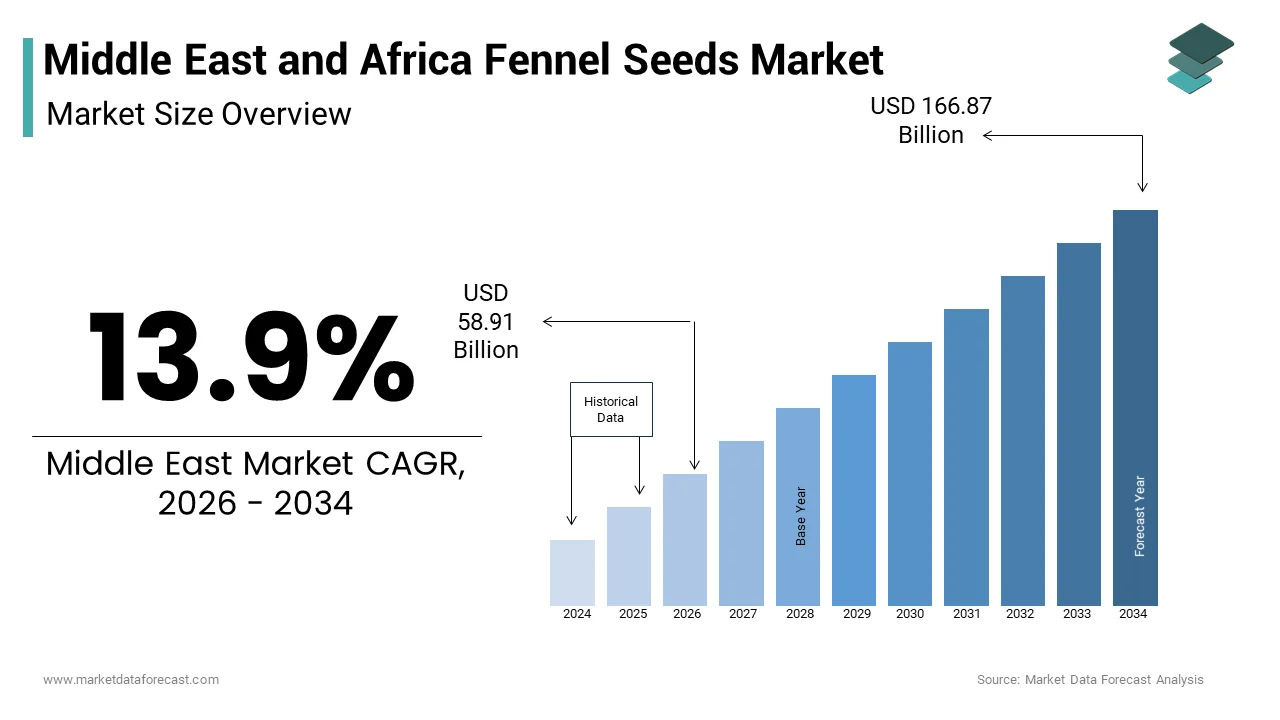
The market is showcasing evident potential in the mentioned forecasting period. The market continues to gain momentum with the rapid development in the food industry.
Fennel is a flowering herb that creates fragrant flowers and seeds and grows throughout the year. The fennel seeds act acted flavouring agents in the fore. The fennel seeds are a commonly used seasoning in the Asian region and are also consumed as mouth fresheners.
The increasing trend of Indian and Asian food, along with the increasing consumption of handy foods, is the key driver of the fennel seeds market, as fennel is a commonly used ingredient in Indian food. Moreover, the consumers' inclination towards experimenting with different flavors and the wide variety of interests in new tastes have increased product offerings.
REPORT COVERAGE
| REPORT METRIC | DETAILS |
| Market Size Available | 2025 to 2034 |
| Base Year | 2025 |
| Forecast Period | 2026 to 2034 |
| CAGR | 13.9% |
| Segments Covered | By Product, Application, End-User, and By Country |
| Various Analyses Covered | Global, Regional & Country Level Analysis, Segment-Level Analysis, DROC, PESTLE Analysis, Porter’s Five Forces Analysis, Competitive Landscape, Analyst Overview on Investment Opportunities |
| Regions Covered | KSA, UAE, Israel, the rest of GCC countries, South Africa, Ethiopia, Kenya, Egypt, Sudan, the rest of MEA. |
| Market Leaders Profiled | McCormick & Company, Inc.Inc., Gregg’s Company, Willmar Schwabe GmbH & Co. KG, Steenbergs Organic, Just Ingredients, and Mangalam Seeds Ltd. |
KEY MARKET PLAYERS
Some of the major companies dominating the market with their products are McCormick & Company, Inc., Gregg’s Company, Willmar Schwabe GmbH & Co. KG, Steenbergs Organic, Just Ingredients, and Mangalam Seeds Ltd.
MARKET SEGMENTATION
This research report on the Middle East and African fennel seeds market is segmented and sub-segmented into the following categories.
By Product
- Organic
- Conventional
By Application
- Essential Oil
- Flavor and Seasoning Ingredient
- Beverages
By End User
- Households
- Food Industry
- Personal Care Industry
By Country
- KSA
- UAE
- IsraelThe
- rest of GCC countries
- South Africa
- Ethiopia
- Kenya
- Egypt
- Sudan
- rest of MEA