- Product Description Description
- Table of Contents TOC
- List of Table & Figure LOT
- Get Free Sample PDF Sample PDF
Middle East and Africa Hand Sanitizer Market Size, Growth, Trends & Forecast (2025–2034)
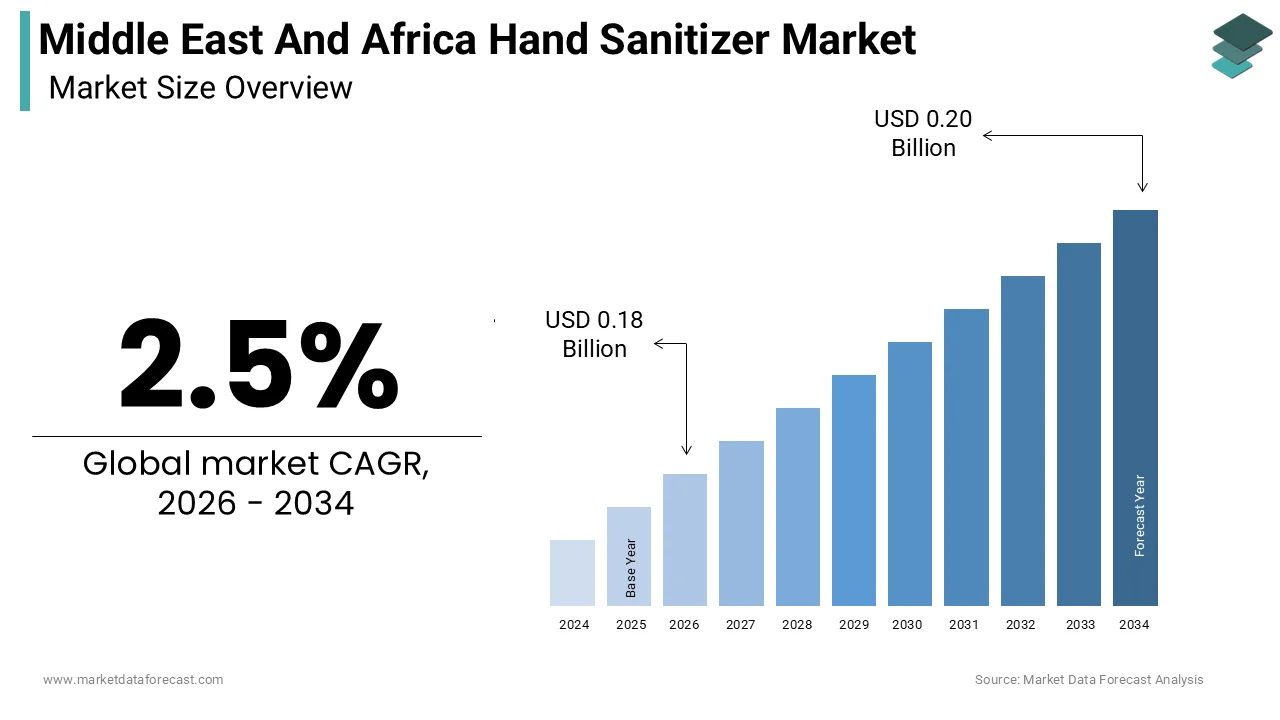
The Middle East & Africa hand sanitizer market size was valued at USD 0.17 billion in 2025, stands at USD 0.18 billion in 2026, and is expected to reach USD 0.20 billion by 2034, projecting a compound annual growth rate (CAGR) of 2.35% during the forecast period. Growth is propelled by high urbanization rates, a robust tourism sector across Gulf Cooperation Council (GCC) countries, and entrenched public health awareness supporting portable hygiene adoption.
Key Executive Metrics (At-a-Glance)
- 2025 Base Valuation: USD 0.17 Billion
- 2026 Current Valuation: USD 0.18 Billion
- 2034 Forecast Valuation: USD 0.20 Billion
- Compound Annual Growth Rate (CAGR): 2.35% (2025–2034)
- Dominant Product Segment: Gel segment accounts for 47.6% market share in 2025 due to its superior viscosity, spillage prevention, and compatibility with moisturizing agents.
- Fastest Growing Product Segment: Spray segment emerges as the fastest-growing at a CAGR of 8.5%, driven by touchless application and even mist coverage.
- Dominant End-User Segment: Hospitals account for 44.4% market share in 2025, anchored by stringent infection control protocols and clinical care volumes.
- Fastest Growing End-User Segment: Household purpose segment anticipates the fastest CAGR of 7.8%, fueled by routine domestic use and hygiene education.
- Regional Market Leadership: Saudi Arabia leads the regional landscape with 36.4% market share in 2025, supported by Vision 2030 mandates and pilgrim infrastructure.
Core Market Drivers
- Public Health Awareness: Heightened hygiene practices embedded into daily routines and institutional mandates to lower pathogen transmission risks.
- Urbanization & Commercial Infrastructure: Expanding dense urban environments, modern malls, airports, and mega-projects requiring robust public sanitation solutions.
Primary Market Restraints & Challenges
- Price Sensitivity: Affordability barriers in low-income demographics where essential food and shelter take precedence over discretionary personal care.
- Regulatory Fragmentation: Inconsistent enforcement allowing counterfeit or substandard formulations (such as methanol-laced products) to compromise consumer trust.
Middle East and Africa Hand Sanitizer Market Segmentation Breakdown
| Segment Category | Key Offerings / Categories | Largest / Leading Sub-Segment | Fastest Growing Sub-Segment |
|---|---|---|---|
| By Product | Gel, Foam, Spray, Others | Gel Segment (47.6% share in 2025) | Spray Segment (8.5% CAGR) |
| By End User | Restaurants, Schools, Hospitals, Household Purposes, Others | Hospitals Segment (44.4% share in 2025) | Household Purposes (7.8% CAGR) |
| By Region | KSA, UAE, Israel, Rest of GCC countries, South Africa, Ethiopia, Kenya, Egypt, Sudan, Rest of MEA | Saudi Arabia (36.4% share in 2025) | South Africa & UAE hubs |
Major Industry Players Profiled
Key market participants operating across the Middle East and Africa hand sanitizer market include Reckitt Benckiser Group Plc (Dettol), Procter and Gamble, Unilever (Lifebuoy), The Himalaya Drug Company, Best Sanitizers Inc., Kutol, GOJO Industries Inc., Vi-Jon, Chattern Inc., Henkel AG and Company, and Al Ahlia Group.
 Download Free Sample Report
Middle East And Africa Hand Sanitizer Market Size
The Middle East & Africa Hand Sanitizer Market size was valued at USD 0.17 billion in 2025 and is expected to reach USD 0.20 billion by 2034 from USD 0.18 billion in 2026. The market is projected to grow at a CAGR of 2.35%.
The hand sanitizer is an alcohol based and alcohol free antimicrobial formulation designed for topical application to reduce pathogenic microorganisms on human skin. The diverse end users include healthcare facilities, educational institutions, corporate offices, and residential households. In the Middle East, high urbanization rates and a robust tourism industry drive consistent demand for portable hygiene solutions. This gap necessitates the use of hand sanitizers as an alternative for disease prevention. The Gulf Cooperation Council countries exhibit higher penetration due to stringent regulatory standards and greater consumer awareness. Cultural practices emphasizing cleanliness in Islamic traditions further support adoption in the Middle East.
MARKET DRIVERS
Heightened Public Health Awareness Drives Sustained Hygiene Product Adoption
The heightened public health awareness by embedding hygiene practices into daily routines and institutional protocols is amplifying the growth of the Middle East and Africa hand sanitizer market. The aftermath of global health emergencies has left a lasting impact on consumer behavior, with individuals prioritizing personal protection against infectious diseases. As per the World Health Organization, regular hand hygiene can reduce the incidence of diarrheal diseases by up to 40% and respiratory infections by approximately 20%. This statistical evidence underpins government campaigns and non-governmental organization initiatives that promote sanitizer usage in public spaces. In the United Arab Emirates, the Ministry of Health and Prevention mandated the availability of sanitizing stations in all commercial establishments and public transport hubs, leading to widespread habitual use. Corporate entities across the region have adopted strict workplace hygiene policies requiring employees to sanitize their hands upon entry and exit. Retailers report a permanent shift in purchasing patterns, with hand sanitizers becoming a staple item alongside soaps and detergents. The proliferation of mobile health applications providing real-time hygiene tips further reinforces this behavioral change. This entrenched awareness ensures that demand remains resilient even in the absence of acute health threats, creating a stable baseline for market growth.
Rapid Urbanization and Expansion of Commercial Infrastructure Boost Demand
The rapid urbanization and the concurrent expansion of commercial infrastructure by increasing population density and foot traffic in shared spaces are other factors bolstering the growth of the Middle East and Africa hand sanitizer market. As cities grow, the concentration of people in malls, airports, offices, and public transport systems elevates the risk of pathogen transmission, necessitating accessible hygiene solutions. According to the United Nations Department of Economic and Social Affairs, the urban population in Africa is projected to reach 950 million by 2050, representing a substantial increase from current levels. This demographic shift drives the construction of modern commercial complexes where hygiene standards are strictly enforced to attract customers and tenants. In Saudi Arabia, the Vision 2030 initiative has spurred the development of mega projects, such as NEOM and the Red Sea Project, which incorporate advanced hygiene infrastructure, including automated sanitizer dispensers. The hospitality sector in Dubai and Doha maintains rigorous cleanliness protocols to uphold their reputation as global tourism destinations, with hotels installing dispensers in lobbies, elevators, and dining areas. Office buildings in Johannesburg and Lagos increasingly provide sanitizing stations to comply with occupational health and safety regulations. The rise of organized retail chains across the continent further standardizes hygiene practices, with stores offering sanitized shopping carts and entry point dispensers.
MARKET RESTRAINTS
Price Sensitivity Limits Accessibility in Low-Income Demographics
The price sensitivity by limiting accessibility among low-income individuals, who prioritize essential food and shelter expenses over discretionary hygiene products, is impeding the growth of the Middle East and Africa hand sanitizer market. In many sub-Saharan African nations, a significant portion of the population lives below the poverty line, making even modestly priced sanitizers unaffordable for regular use. For these households, purchasing branded hand sanitizers is often deemed a luxury compared to traditional and cheaper alternatives, such as bar soap or ash. The economic volatility in countries like Lebanon and Sudan has led to currency devaluation and inflation, causing the price of imported hygiene products to surge by over 50% in recent years. Local manufacturing capabilities are insufficient in many regions, forcing reliance on imports, which are subject to tariffs and supply chain disruptions. In rural areas of Ethiopia and Malawi, the cost of a single bottle of sanitizer can equate to a day's wage for a laborer, discouraging frequent purchase. Consequently, consumers may dilute products to extend usage, compromising efficacy, or revert to less effective hygiene methods.
Inconsistent Regulatory Enforcement Compromises Product Quality and Trust
The inconsistent regulatory enforcement compromises product quality and consumer trust by allowing substandard and counterfeit products to proliferate, and is also hindering the growth of the Middle East and Africa hand sanitizer market. While countries like Saudi Arabia and South Africa have robust regulatory frameworks, others lack the resources or infrastructure to monitor manufacturing and distribution channels effectively. The unregulated local producers sell sanitizers with insufficient alcohol content or harmful additives, such as methanol, which can cause skin irritation or systemic toxicity. The absence of standardized labeling requirements in some jurisdictions makes it difficult for consumers to verify ingredient lists and expiration dates. This lack of oversight erodes consumer confidence, leading to hesitation in purchasing unfamiliar brands. Healthcare professionals often report cases of dermatitis linked to poor-quality products, further dampening demand. Without harmonized regional standards and rigorous inspection mechanisms, the market remains fragmented with varying levels of safety and efficacy.
MARKET OPPORTUNITIES
Expansion of Local Manufacturing Capabilities Presents Significant Growth Potential
The expansion of local manufacturing capabilities by reducing dependence on imports and lowering production costs is inclined to propel new opportunities for the growth of the Middle East and Africa hand sanitizer market. Governments across the region are increasingly incentivizing domestic production to enhance self-sufficiency and create jobs. In Egypt, the government has encouraged local chemical companies to produce hygiene products, resulting in a 30% increase in domestic output over the past three years. This shift mitigates the impact of currency fluctuations and supply chain disruptions associated with imported goods. Local manufacturers can tailor formulations to suit regional preferences, such as adding moisturizers to counteract dry climates or incorporating culturally preferred fragrances. Furthermore, local production facilitates faster distribution to remote areas, improving accessibility. Partnerships between international brands and local firms enable technology transfer and quality improvement. By leveraging raw material availability, such as ethanol from agricultural byproducts, producers can achieve cost advantages. This strategic move towards localization not only strengthens supply chain resilience but also aligns with national economic goals, fostering sustainable market growth.
Integration of Digital Health Platforms Enhances Distribution and Education
The integration of digital health platforms enhances distribution and education by leveraging mobile technology to reach underserved populations, which is also to surge the growth of the Middle East and Africa hand sanitizer market. With high mobile phone penetration even in rural areas, digital channels offer a viable route for promoting hygiene products and facilitating sales. E-commerce platforms and mobile money services enable consumers to purchase sanitizers conveniently, while bypassing traditional retail barriers. Companies are using social media campaigns and SMS alerts to educate users on proper hand hygiene techniques and the importance of consistent sanitizer use. Telemedicine consultations often include recommendations for hygiene products, creating a direct link between health advice and product acquisition. Digital tracking allows manufacturers to monitor inventory levels and predict demand spikes in specific regions, optimizing supply chain efficiency. Furthermore, digital platforms facilitate collaboration between public health agencies and private sector players to launch coordinated hygiene drives.
MARKET CHALLENGES
Counterfeit Products Undermine Brand Integrity and Consumer Safety
The counterfeit products undermine brand integrity and consumer safety by flooding informal channels with ineffective or dangerous substitutes, is to inhibit the growth of the Middle East and Africa hand sanitizer market. The prevalence of unregulated street vendors and open markets makes it easy for counterfeiters to mimic popular brands with deceptive packaging. In countries like Nigeria and Ghana, counterfeit sanitizers often contain water and coloring agents instead of active antimicrobial ingredients, providing a false sense of security. These products fail to kill pathogens, increasing the risk of disease transmission despite user compliance. Reputable brands suffer reputational damage when consumers associate poor performance with their logos due to indistinguishable packaging. Legal recourse is often difficult and costly for multinational companies operating in jurisdictions with weak intellectual property enforcement. The health consequences can be severe, with some counterfeit products containing toxic substances like methanol, which has led to hospitalizations in several instances.
Supply Chain Vulnerabilities Disrupt Raw Material Availability
The supply chain vulnerabilities disrupt raw material availability by exposing producers to global logistical hurdles, and price volatility is additionally challenging the growth of the Middle East and Africa hand sanitizer market. The production of hand sanitizers relies heavily on key inputs, such as ethanol, glycerin, and packaging materials, which are often sourced internationally. Many African countries lack domestic production capacity for high-purity ethanol, forcing them to import from Europe or Asia, where competition for resources is intense. Port congestion in major hubs like Durban and Mombasa leads to delays of several weeks, causing stockouts and production halts. Currency fluctuations further complicate procurement as local manufacturers struggle to afford imported raw materials when exchange rates deteriorate. The lack of diversified sourcing options leaves producers vulnerable to single-point failures. Any disruption in global shipping routes or export restrictions by supplier countries immediately impacts local production schedules.
REPORT COVERAGE
| REPORT METRIC | DETAILS |
| Market Size Available | 2024 to 2033 |
| Base Year | 2024 |
| Forecast Period | 2025 to 2033 |
| Segments Covered | By Product, End User, and Region. |
| Various Analyses Covered | Global, Regional, and Country-Level Analysis, Segment-Level Analysis, Drivers, Restraints, Opportunities, Challenges; PESTLE Analysis; Porter’s Five Forces Analysis, Competitive Landscape, Analyst Overview of Investment Opportunities |
| Countries Covered | KSA, UAE, Israel, Rest of GCC countries, South Africa, Ethiopia, Kenya, Egypt, Sudan, Rest of MEA |
| Market Leaders Profiled | Reckitt Benckiser Group Plc, Procter and Gamble, The Himalaya Drug Company, Best Sanitizers Inc, Kutol, GOJO Industries Inc, Vi- Jon, Chattern Inc, Unilever, Henkel AG and Company. |
SEGMENTAL ANALYSIS
By Product Insights
The gel segment was accounted for in holding 47.6% of the Middle East and Africa hand sanitizer market share in 2025 due to its superior viscosity, which prevents spillage and ensures controlled application on hands. This physical property is particularly advantageous in regions with high temperatures and an active lifestyle,s where liquid products are prone to leakage from pockets or bags. The gel formulation allows for precise dosage control, reducing waste and ensuring that users apply an adequate amount for sanitization. In the Gulf Cooperation Council, countries where premium personal care is highly valued,d consumers prefer gels that include moisturizing agents, such as aloe vera and vitamin E, to counteract the drying effects of alcohol in arid climates. Manufacturers have capitalized on this trend by launching transparent, non-sticky gels that appeal to professional settings. The ease of transport in small bottles makes gels ideal for commuters and travelers who form a significant portion of the consumer base in urban centers like Dubai and Riyadh. This combination of functional reliability and aesthetic appeal solidifies the gel segment as the dominant product type.
The spray segment is swiftly emerging at a fastest CAGR of 8.5% during the forecast period, with its touchless application method and perceived hygienic advantages. Consumers increasingly view spray mechanisms as more sanitary because they avoid direct contact with dispenser nozzles or bottle openings, which can harbor bacteria. The fine mist provided by spray bottles ensures even coverage over the entire hand surface, including between fingers and under nails, enhancing efficacy. In corporate offices and healthcare facilities across South Africa and Kenya, the adoption of automatic spray dispensers has surged following updated occupational health standards. The portability ofpocket-sizedd spray bottles appeals to young professionals and students who prioritize convenience and speed. Furthermore, the visual appeal of sleek spray packaging aligns with modern lifestyle trends in urban areas. Manufacturers are introducing refillable spray options to address environmental concerns, attracting eco-conscious consumers.
By End User Insights
The hospitals segment accounted in holding 44.4% of the Middle East and Africa hand sanitizer market share in 2025 due to stringent infection control protocols and the high volume of daily usage required to maintain sterile environments. Healthcare-associated infections pose a significant risk in medical facilities, making hand hygiene the most critical preventive measure. In countries like Saudi Arabia and Egypt, government mandates require all public and private hospitals to maintain an adequate stock of alcohol-based sanitizers at every patient care point. The sheer number of healthcare interactions, including doctor visits, nursing care,e and surgical procedures, drives massive consumption levels. Medical staff perform hand sanitization dozens of times per shift, creating a recurring and predictable demand pattern. The preference for hospital-grade formulations with higher alcohol concentrations further distinguishes this segment. Bulk purchasing agreements between suppliers and hospital chains ensure stable revenue streams for manufacturers. Additionally, the expansion of healthcare infrastructure in the region, with new hospitals opening annually in the United Arab Emirates and Qatar, sustains long-term growth.
The household purpose segment is anticipated to grow at the fastest CAGR of 7.8% during the forecast period. Families now view hand sanitizers as essential household items alongside soaps and detergents, leading to consistent retail purchases. The hygiene education campaigns reaching millions of households in Africa have emphasized the importance of keeping sanitizers accessible for children and elderly family members. The rise of remote work and online schooling has kept families at home for longer periods, increasing the frequency of hand cleaning during daily activities. Parents are particularly keen on protecting children from common illnesses, leading to higher usage in play areas and dining spaces. The availability of child-friendly formulations with pleasant scents and safe ingredients encourages regular use among younger people. E-commerce platforms facilitate easy replenishment of home stocks, appealing to busy urban households.
REGIONAL ANALYSIS
Saudi Arabia Hand Sanitizer Market Analysis
Saudi Arabia's hand sanitizer market was the largest contributor by holding 36.4% of the share in 2025, with the robust regulatory mandates and the broader health objectives of Vision 2030. The Kingdom has implemented strict hygiene standards across all public and private sectors, requiring the installation of sanitizing stations in malls, mosques, and government buildings. The Hajj and Umrah pilgrimages bring millions of visitors annually, necessitating massive quantities of sanitizers to prevent disease spread in crowded holy sites. Local manufacturing initiatives under the National Industrial Development Program have boosted domestic production, reducing reliance on imports. Consumer awareness campaigns led by the Saudi Food and Drug Authority have educated the public on proper sanitizer use, increasing household penetration. The hot climate also drives demand for moisturizing gel formulations that protect skin integrity.
United Arab Emirates Hand Sanitizer Market Analysis
The United Arab Emirates hand sanitizer market accounted in holding 23.1% of the market share in 2025, with the high consumption standards driven by its thriving tourism and luxury retail sectors. The country hosts millions of international tourists each year, requiring impeccable hygiene standards in hotels, airports, and shopping malls to uphold its global reputation. The preference for high-end products with sophisticated packaging and added skincare benefits reflects the affluent consumer base. Government initiatives, such as the UAE Vision 2021, emphasize public health preparedness, leading to stockpiling and widespread distribution in schools and offices. The presence of major international hygiene brands ensures a competitive landscape with continuous innovation in product formats. High disposable incomes allow consumers to purchase premium sanitizers regularly without price sensitivity. The integration of smart dispensers in modern infrastructure further enhances user experience.
South Africa Hand Sanitizer Market Analysis
South Africa's hand sanitizer market growth is likely to grow at the fastest CAGR in the coming years, with the established retail networks and high levels of public health awareness compared to neighboring countries. The country has a well-developed pharmaceutical and cosmetic industry capable of producing and distributing hygiene products efficiently to urban and semi-urban areas. The legacy of HIV AIDS and tuberculosis campaigns has ingrained a culture of hygiene vigilance among the population, making sanitizer adoption easier. Corporate social responsibility programs by major retailers often include hygiene kits for underserved communities, expanding market reach. The middle class in cities like Johannesburg and Cape Town drives demand for premium and organic sanitizer variants. Regulatory oversight by the South African Health Products Regulatory Agency ensures product quality, building consumer trust. While economic challenges exist, the essential nature of hygiene products maintains steady demand.
Egypt Hand Sanitizer Market Analysis
Egypt's hand sanitizer market growth is driven by the large population base and growing local production capabilities. As per the research, public health campaigns targeting infectious diseases have increased awareness of hand hygiene in both urban and rural areas. The government has encouraged local chemical industries to produce alcohol-based sanitizers to reduce import dependency and lower costs for consumers. The pharmaceutical sector in Egypt has expanded its capacity to meet domestic demand for essential health products. Economic reforms have stabilized the currency, slightly improving affordability for imported raw materials used in local manufacturing. Rising urbanization in Cairo and Alexandria creates dense populations where portable hygiene solutions are essential for daily commuting.
Kenya Hand Sanitizer Market Analysis.
Kenya's hand sanitizer market growth is driven by innovative mobile health integration and rapid urbanization in Nairobi and other major cities. The country leverages its advanced mobile money ecosystem to facilitate the distribution and sale of hygiene products even in remote areas. As per the Kenya National Bureau of Statistics, urban population growth has increased the density of commercial spaces where hand sanitizers are mandatory for entry. Public-private partnerships have been instrumental in promoting hand hygiene, with telecom companies sponsoring sanitation initiatives that include sanitizer distribution. The education sector plays a vital role, with schools incorporating hand sanitization into daily routines, supported by non-governmental organizations. Local entrepreneurs are launching affordable sanitizer brands tailored to the Kenyan market using locally sourced ethanol. The hospitality industry in safari tourism hubs maintains high hygiene standards to attract international visitors.
COMPETITION OVERVIEW
The competition in the Middle East and Africa hand sanitizer market is characterized by a mix of established multinational corporations and agile local manufacturers vying for consumer trust and institutional contracts. Multinational brands leverage their global reputation and extensive distribution networks to dominate urban centers and premium retail segments. Local players compete effectively by offering lower prices and adapting products to specific regional preferences, such as fragrance and texture. In the Gulf Cooperation Council, competition among premium brands focuses on product quality and packaging aesthetics. Price wars are common in mass market segments where affordability drives purchasing decisions. Innovation in sustainable packaging and eco-friendly ingredients is becoming a key differentiator as environmental awareness grows. Supply chain reliability remains a critical competitive advantage, with companies investing in local production to ensure availability.
KEY MARKET PLAYERS
A few major players of the Middle East and Arica Hand Sanitizer Market include
- Reckitt Benckiser Group plc
- Procter and Gamble
- The Himalaya Drug Company
- Best Sanitizers Inc
- Kutol
- GOJO Industries Inc
- Vi- Jon
- Chattern Inc
- Unilever
- Henkel AG and Company
Top Strategies Used by Key Market Participants
Key players in the Middle East and Africa hand sanitizer market primarily focus on localizing production to reduce costs and mitigate supply chain vulnerabilities. Companies invest in establishing manufacturing facilities within the region to avoid import tariffs and currency fluctuations. Strategic partnerships with local distributors enable deeper market penetration into rural and underserved areas where infrastructure is limited. Product innovation centers on developing formulations suitable for arid climates, such as adding moisturizers to prevent skin dryness. Marketing campaigns emphasize cultural values of cleanliness and religious hygiene practices to connect with consumers emotionally. Digital platforms are utilized for education and e-commerce sales, reaching tech-savvy urban populations effectively. Bulk supply contracts with healthcare institutions and hospitality sectors ensure stable demand and revenue visibility. Regulatory compliance is prioritized to build trust and avoid penalties in strictly monitored markets like Saudi Arabia.
Leading Players in the MEA Hand Sanitizer Market
- Dettol maintains a dominant presence in the Middle East and Africa hand sanitizer market through its strong brand recognition and extensive distribution network. The company offers a wide range of alcohol based gels and sprays that are trusted by consumers for their proven efficacy against pathogens. Reckitt Benckiser has recently intensified its marketing campaigns across Gulf Cooperation Council countries, focusing on family protection and hygiene education. The firm has expanded its production capabilities in South Africa to ensure a consistent supply to sub-Saharan markets, reducing dependency on imports. Strategic partnerships with major retail chains have improved shelf visibility and accessibility in both urban and rural areas. Dettol also engages in corporate social responsibility initiatives by donating sanitizers to schools and healthcare facilities, enhancing brand loyalty.
- Lifebuoy leverages Unilever's vast resources to deliver affordable and effective hand sanitizers tailored to the economic realities of the Middle East and Africa. The brand focuses on mass market penetration by offering small sachets and budget-friendly bottles that appeal to price-sensitive consumers. Unilever has recently launched new formulations with moisturizing agents to suit the dry climates of North Africa and the Arabian Peninsula. The company utilizes its deep understanding of local cultural practices to design marketing messages that resonate with regional values of cleanliness and care. Distribution channels have been strengthened through collaborations with local distributors who navigate complex logistical landscapes efficiently. Lifebuoy also supports government hygiene programs, providing educational materials and products to underserved communities.
- Al Ahlia Group stands as a prominent local player in the Middle East hand sanitizer market, particularly in Saudi Arabia and neighboring Gulf states. The company specializes in producing high-quality hygiene products that comply with strict regional regulatory standards set by health authorities. Al Ahlia has recently invested in advanced manufacturing technologies to increase production capacity and improve product consistency. The firm focuses on supplying bulk quantities to institutional clients such as hospitals, hotels, and government entities, ensuring steady revenue streams. By prioritizing local sourcing of raw materials, the group mitigates supply chain risks associated with global disruptions. Recent expansions into retail packaging have allowed Al Ahlia to reach individual consumers directly through supermarkets and pharmacies. The company actively participates in national hygiene campaigns, reinforcing its commitment to public health.
MARKET SEGMENTATION
This research report on the Middle East and Africa Hand Sanitizer market has been segmented and sub-segmented into the following categories.
By Product
- Gel
- Foam
- Spray
- Others
By End Use
- Restaurants
- Schools
- Hospitals
- Household Purposes
- Others
By Region
- KSA
- UAE
- IsrThe rest
- Rest of the GCC countries
- South Africa
- Ethiopia
- Kenya
- Egypt
- Sudan
- Rest of MEA