- Product Description Description
- Table of Contents TOC
- List of Table & Figure LOT
- Get Free Sample PDF Sample PDF
Market Size, 2025
$0.49 BnMarket Estimate, 2026
$0.56 BnMarket Forecast, 2034
$1.64 BnCAGR, 2026–2034
14.36%Middle East and Africa Pharmacovigilance Market Size, Growth, Trends & Forecast (2026–2034)
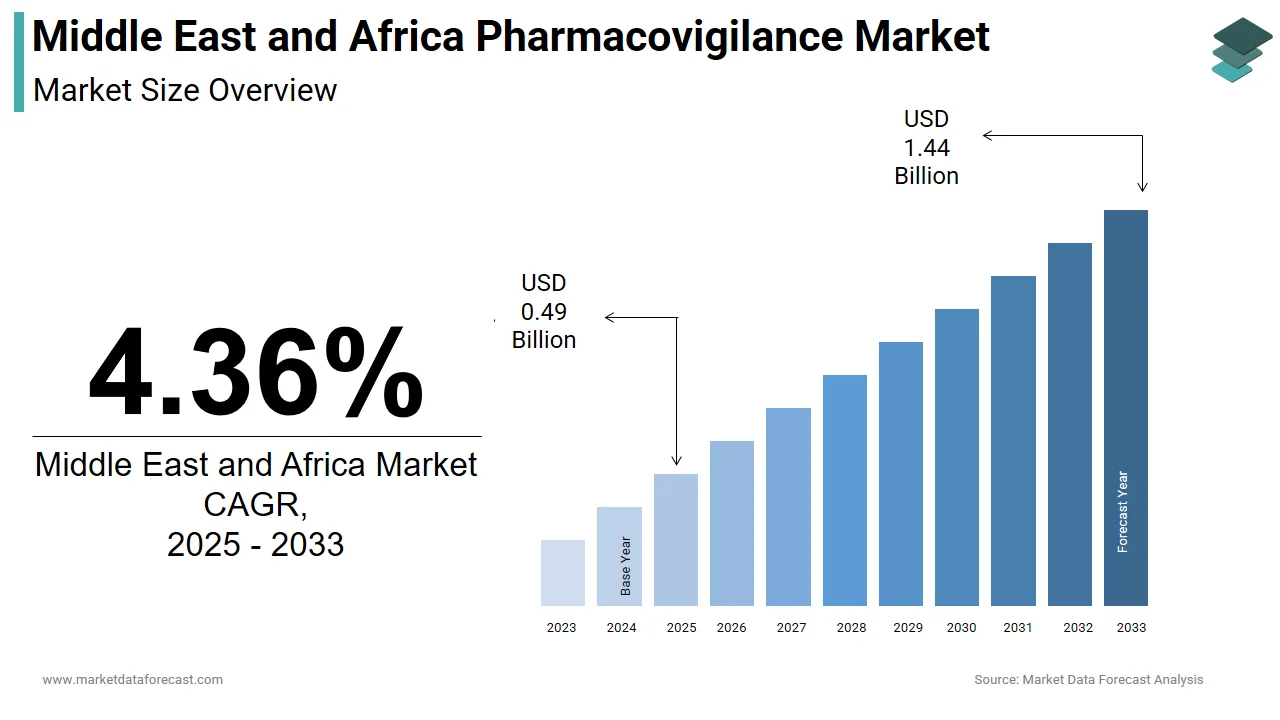
The Middle East and Africa (MEA) pharmacovigilance market size was valued at USD 0.49 billion in 2025, is estimated to reach USD 0.56 billion in 2026, and is projected to scale up to USD 1.64 billion by 2034, registering a robust compound annual growth rate (CAGR) of 14.36% during the forecast period from 2026 to 2034. Driven by the rising prevalence of chronic conditions, accelerating integration of advanced technologies like AI and machine learning, and heightened government initiatives for drug safety, the regional market continues to witness accelerated expansion.
Key Executive Metrics (At-a-Glance)
- 2025 Base Valuation: USD 0.49 Billion
- 2026 Current Valuation: USD 0.56 Billion
- 2034 Forecast Valuation: USD 1.64 Billion
- Compound Annual Growth Rate (CAGR): 14.36% (2026–2034)
- Dominant Clinical Trial Phase Segment: Phase IV / Post-Marketing Surveillance (vital for tracking long-term drug safety and adverse drug reactions)
- Dominant Service Provider Segment: Contract Outsourcing (preferred by expanding pharmaceutical entities seeking specialized expertise)
- Dominant Method Segment: Spontaneous Reporting (widely accepted baseline framework for adverse event tracking)
- Dominant Country/Sub-Region: KSA, UAE, Egypt, and South Africa (leading regional regulatory compliance and drug safety frameworks)
Core Market Drivers
- Rising Chronic Diseases: Growing patient numbers suffering from cancer, diabetes, and cardiovascular illnesses, fueling massive drug production and subsequent post-market safety requirements.
- Technological Integration: Deployment of artificial intelligence (AI) and machine learning (ML) systems to streamline adverse drug reaction (ADR) detection and data analysis.
- Government & Regulatory Support: Strengthening regional health authority mandates (e.g., Egyptian Ministry of Health, Saudi FDA equivalents) emphasizing safe drug usage and certified training centers.
Primary Market Restraints & Challenges
- Skilled Labor & Infrastructure Gaps: A scarcity of trained pharmacovigilance professionals and inconsistent healthcare infrastructure funding across parts of developing MEA nations.
Middle East and Africa Pharmacovigilance Market Segmentation Breakdown
| Segment Category | Leading Sub-Segment (2025 Base) | Fastest-Growing Sub-Segment (2026–2034) |
|---|---|---|
| By Clinical Trial Phase | Phase IV (Post-Marketing Surveillance) | Phase III & Phase II Trials |
| By Service Provider | Contract Outsourcing | Advanced Specialized CRO Services |
| By Method | Spontaneous Reporting | EHR Mining & Cohort Event Monitoring |
| By Country | GCC (KSA, UAE) & South Africa | Algeria & Egypt |
Major Industry Players Profiled
Key enterprises shaping the competitive Middle East and Africa pharmacovigilance market include Boehringer Ingelheim, Accenture, Bristol-Myers Squibb, Covance, ICON, PAREXEL, Quintiles, United BioSource, Synowlwedge, and Cognizant Technology Solutions Corporation.
Middle East and Africa Pharmacovigilance Market Size
The Middle East and Africa pharmacovigilance market was valued at USD 0.49 billion in 2025, is estimated to reach USD 0.56 billion in 2026, and is projected to reach USD 1.64 billion by 2034, growing at a CAGR of 14.36% from 2026 to 2034.
MARKET DRIVERS
Rising Chronic Diseases and Technological Integration in Pharmacovigilance
The growing number of people suffering from chronic diseases in the Middle East and African countries is expected to boost the need for pharmacovigilance in MEA and result in regional market growth. The prevalence of chronic diseases such as cancer, cardiovascular disease, and diabetes is growing significantly in MEA countries. The growing patient population suffering from chronic diseases in the MEA region is anticipated to boost the demand for the greater production of various combinations of drugs for treatments. The approved drugs undergo clinical tests to check for possible side effects during the manufacturing process. Detecting these side effects is majorly done through pharmacovigilance. Likewise, the demand for pharmacovigilance services in the MEA region is growing in the MEA region.
The increasing need for innovative drugs to address the growing burden of various diseases in the MEA region is expected to fuel the market’s growth rate. For instance, owing to the increasing spread of the coronavirus, researchers and pharmaceutical companies are focusing on the development of drugs and vaccine which helps the prevention and reduction of the disease. However, when using this medication, some people experience severe side effects that may lead to severe complications in their entire life. Some side effects after using the pharmaceutical drugs are headache, nausea, hair loss, memory loss, diarrhea, skin discoloration, increased sugar levels, formation of kidney stones, tiredness, etc. In addition, pharmaceutical companies also manufacture drugs for cancer, spinal cord pain management, and others.
The growing usage of technological developments in pharmacovigilance further propels the MEA market growth. For instance, artificial intelligence and machine learning are used in pharmacovigilance services for the best results. Furthermore, increasing government support, sufficient time for the verification of the drug side effects, and increasing awareness about the consumption of safe drugs by a large population are expected to drive the pharmacovigilance market forward in the MEA region.
MARKET RESTRAINTS
Shortage of Skilled Professionals and Poor Infrastructure
On the other hand, the lack of skilled pharmacovigilance professionals limits the market growth. In addition, a lack of awareness, particularly in developing countries like South Africa and the United Arab Emirates, also inhibits the market's growth rate. Also, variations in raw material availability limit the growth of the pharmacovigilance market in the MEA. Furthermore, issues associated with the healthcare infrastructure and lack of funding from the governments favoring pharmacovigilance in the Middle East and African countries are expected to hinder regional market growth.
REPORT COVERAGE
| REPORT METRIC | DETAILS |
| Market Size Available | 2025 to 2034 |
| Base Year | 2025 |
| Forecast Period | 2026 to 2034 |
| Segments Covered | By Clinical Trial Phase, Service Provider, Method, and Region. |
| Various Analyses Covered | Global, Regional and Country-Level Analysis, Segment-Level Analysis, Drivers, Restraints, Opportunities, Challenges; PESTLE Analysis; Porter’s Five Forces Analysis, Competitive Landscape, Analyst Overview of Investment Opportunities |
| Countries Covered | KSA, UAE, Israel, rest of GCC countries, South Africa, Ethiopia, Kenya, Egypt, Sudan, rest of Middle East and Africa |
| Market Leaders Profiled | Boehringer Ingelheim, Accenture, Bristol-Myers Squibb, Covance, ICON, PAREXEL, Quintiles, United BioSource, Synowlwedge, and Cognizant Technology Solutions Corporation. |
REGIONAL ANALYSIS
Regionally, the MEA is anticipated to register a moderate share in the global pharmacovigilance market during the forecast period. Rising government initiatives to strengthen pharmacovigilance management, increasing investment in R&D activities, and technological advancements in the healthcare sector are propelling the pharmacovigilance market in this region. In addition, the increasing efforts from the key market players to increase awareness programs through medical tourism are expected to boost market growth. As a result, the countries such as South Africa, UAE, and Saudi Arabia majorly contribute to the MEA regional market growth.
Saudi Arabia and Egypt are predicted to occupy a considerable share of the MEA market during the forecast period owing to the presence of advanced pharmacovigilance for detecting approved drugs and ensuring drug safety. In Egypt, this drug's safety is undertaken by the Egyptian Ministry of Health and Population, which provides some guidelines and the best drugs to the patients, reducing the side effects after the drug usage and increasing the treatment quality.
During the forecast period, the market in Algeria is predicted to showcase a healthy CAGR owing to the increasing number of training centers for pharmacovigilance and increasing job opportunities. The government has changed several guidelines for adopting safe drugs for the population. As a result, well-trained professionals with the certification are only allowed to work in the workplace to detect or find the adverse effects of the drug. In Algeria, there is also the presence of veterinary pharmacovigilance, which helps with market growth. Furthermore, increasing online and offline pharmacies in this region to support drug availability for various diseases also demands the production of various drugs, which results in the need for pharmacovigilance services to detect the drug's safety.
KEY MARKET PLAYERS
Boehringer Ingelheim, Accenture, Bristol-Myers Squibb, Covance, ICON, PAREXEL, Quintiles, United BioSource, Synowlwedge, and Cognizant Technology Solutions Corporation are notable players in the MEA pharmacovigilance market.
MARKET SEGMENTATION
This research report on the MEA pharmacovigilance market has been segmented and sub-segmented into the following categories:
By Clinical Trial Phase:
- Pre-clinical
- Phase I
- Phase II
- Phase III
- Phase IV
By Service Provider:
- In-house
- Contract Outsourcing
By Method:
- Spontaneous Reporting
- Intensified ADR Reporting
- Targeted Spontaneous Reporting
- Cohort Event Monitoring
- EHR Mining
By Country:
- KSA
- UAE
- Israel
- rest of GCC countries
- South Africa
- Ethiopia
- Kenya
- Egypt
- Sudan
- rest of MEA