- Product Description Description
- Table of Contents TOC
- List of Table & Figure LOT
- Get Free Sample PDF Sample PDF
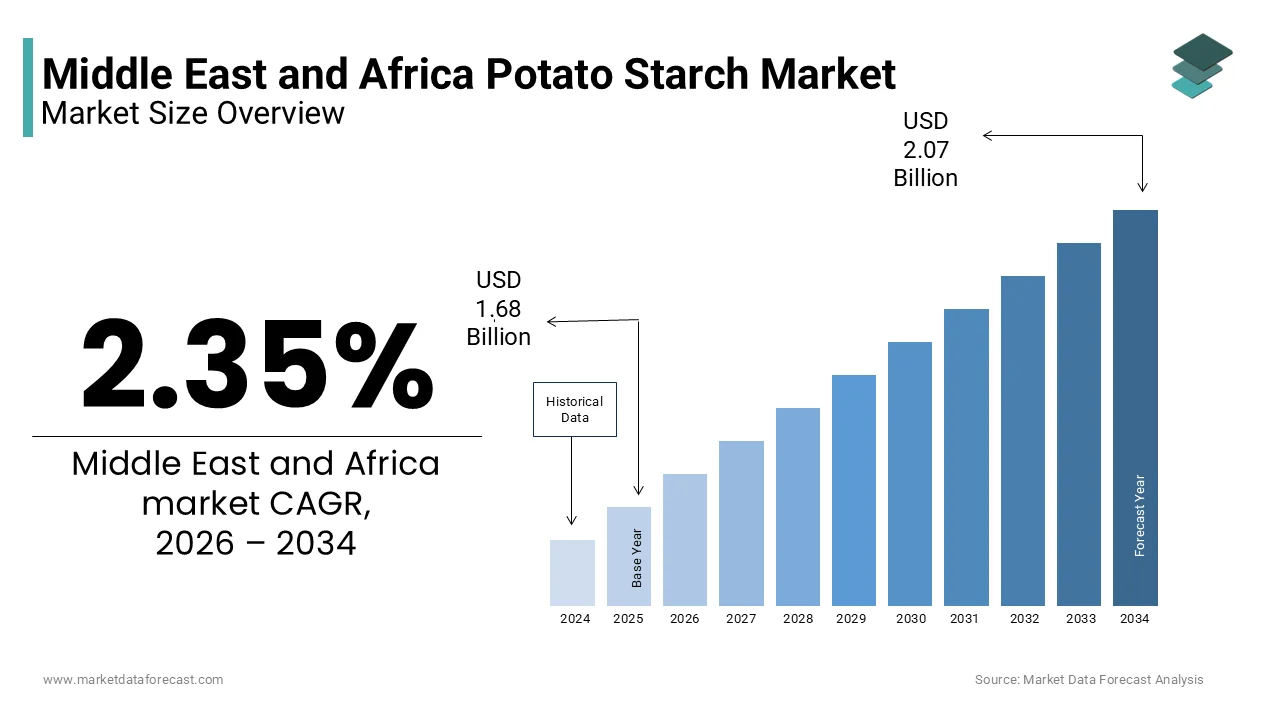
Market Size, 2025
$1.68 BnMarket Estimate, 2026
$1.72 BnMarket Forecast, 2034
$2.07 BnCAGR, 2026–2034
2.35%Executive Summary: Middle East and Africa Potato Starch Market
- Market Scope: Comprehensive regional analysis of the Middle East and Africa (MEA) potato starch market covering product types (GMO vs. Non-GMO), food and industrial applications, key country markets, and major industry competitors.
- Market Valuation: Valued at USD 1.68 billion in 2025, estimated at USD 1.72 billion in 2026, and projected to reach USD 2.07 billion by 2034, growing at a steady CAGR of 2.35% across the forecast period.
- Primary Growth Drivers: Rising disposable incomes fueling demand for processed food and beverage products, widespread functional utility of potato starch as a flavorless thickener, water binder, and bulking agent, and increasing consumer preference for gluten-free and clean-label dietary options. Key restraints include consumer resistance toward genetically modified (GM) crops.
Key Market Segment Metrics (2026–2034)
| Category | Segments Covered / Breakdown | Strategic Overview |
|---|---|---|
| By Type | GMO, Non-GMO | Non-GMO variants experience robust demand due to rising health consciousness and clean-label trends among consumers. |
| By Application | Food (Dairy, Confectionery, Soups & Sauces, Bakery, Meat, Others), Industrial (Paper, Adhesive, Textile, Others) | Food applications lead consumption, with dairy, bakery, and meat sectors expected to show exceptionally strong performance. |
| Regional / Country Analysis | UAE, Israel, KSA, South Africa, Egypt | Key Middle Eastern and North African hubs drive demand through expanding packaged food processing and retail distribution networks. |
Major Market Players & Market Structure
Market Structure: Specialized global ingredients and agricultural processing market featuring international starch manufacturers competing on product purity, functional versatility, and non-GMO certifications.
Key Companies: Avebe, Agrana Staerke GmbH, AKV Langholt AmbA, Changhong Potato Starch Co., Ltd., Emsland Group, Finnamyl Oy, Manitoba Starch Products, Ingredion Incorporated, and Cargill Incorporated.
 Download Free Sample Report
Middle East and Africa Potato Starch Market Size
The Middle East and Africa potato starch market size was valued at USD 1.68 billion in 2025 and is projected to reach USD 2.07 billion by 2034 from USD 1.72 billion in 2026, growing at a CAGR of 2.35%.
As per the Food and Agriculture Organization of the United Nations, potato production in Egypt and South Africa exceeded 7 million metric tons in 2023 providing a substantial raw material base for local starch extraction facilities. According to the African Union Department of Rural Economy and Agriculture, the region faces a structural deficit in industrial starch supply which necessitates significant imports to meet the demands of growing manufacturing sectors. This market is characterized by its reliance on imported high purity grades for pharmaceutical and premium food applications while utilizing local crops for standard industrial uses. Regulatory frameworks in Gulf Cooperation Council countries increasingly mandate clear labeling of allergen free ingredients which favors potato starch over wheat based alternatives. The sector operates within a complex logistics environment where temperature sensitive products require specialized storage and transport infrastructure. These foundational elements distinguish the Middle East And Africa Potato Starch Market from other regions by highlighting the interplay between local agricultural capacity and international trade dependencies to satisfy diverse industrial requirements.
MARKET DRIVERS
Expansion of Gluten Free Food Sector Driving Ingredient Substitution
The rising prevalence of celiac disease and gluten sensitivity directly accelerates the adoption of potato starch as a primary thickening and binding agent, which is a key factor propelling the potato starch market expansion in Middle East and Africa. According to the World Gastroenterology Organisation, the estimated prevalence of celiac disease in the Middle East ranges from 1% to 3% of the population creating a consistent demand for safe alternative flours and starches. As per the European Society for Paediatric Gastroenterology Hepatology and Nutrition, global awareness campaigns have influenced dietary habits in urban centers across the Gulf leading to a 15% annual increase in sales of certified gluten free products. Potato starch offers superior texture and neutral flavor compared to other alternatives making it ideal for bakery and snack applications. The statistical correlation between health consciousness and retail shelf space shows that supermarkets in Saudi Arabia and UAE have expanded their gluten free sections by 20% in the last two years. Consequently, the medical necessity and lifestyle choice for gluten avoidance act as powerful catalysts that embed potato starch into mainstream food formulations rather than keeping it confined to niche dietary segments.
Growth of Processed Food Industry Increasing Demand for Functional Ingredients
Rapid urbanization and changing consumer lifestyles fuel the expansion of the Middle East and Africa potato starch market. According to the United Nations Department of Economic and Social Affairs, the urban population in Africa is projected to reach 60% by 2050 driving demand for convenient ready to eat meals that utilize potato starch for texture stabilization and shelf life extension. As per the African Development Bank, the food processing industry in Kenya and Nigeria grew by 8% in 2023 reflecting increased investment in local manufacturing capabilities to reduce import dependency. Potato starch provides essential viscosity and clarity in soups sauces and confectionery products which are staples in modern urban diets. For instance, households in metropolitan areas spend 35% more on packaged foods than rural counterparts creating a robust market for industrial ingredients. Therefore, the shift toward convenience foods functions as a demand side driver that transforms potato starch from a basic commodity into an essential functional component in large scale food production operations across the region.
MARKET RESTRAINTS
Volatility in Raw Material Supply Due to Climate Variability
Erratic weather patterns severely compromise the consistency of potato harvests that are critical for stable starch production, which is a significant impediment to the Middle East and Africa potato starch market growth. According to the Intergovernmental Panel on Climate Change, rising temperatures and irregular rainfall in North Africa have reduced potato yields by up to 12% in recent seasons forcing processors to rely on expensive imports or lower quality local supplies. As per the Egyptian Ministry of Agriculture, water scarcity issues in the Nile Delta have led to stricter irrigation quotas affecting the planting area for industrial potato varieties suitable for high starch extraction. This climatic instability introduces batch to batch variability in starch content and quality which contradicts the precision required by industrial buyers. The statistical relationship between drought severity and raw material costs demonstrates that every 10% drop in local yield increases procurement expenses by 15% due to competitive bidding for remaining stocks. Consequently, climate induced supply shocks create operational uncertainty that undermines long term contracting confidence and forces manufacturers to maintain larger safety stocks thereby inflating working capital requirements across the value chain.
High Logistics Costs Impacting Import Competitiveness
Elevated transportation and storage expenses restrict the affordability of imported potato starch variants, which is likely to hamper the regional market expansion. According to the World Bank Logistics Performance Index, many countries in Sub Saharan Africa score below average in infrastructure quality leading to higher freight costs and longer transit times for perishable goods. As per the International Chamber of Shipping, global freight rates fluctuated significantly in 2023 adding an estimated 20% premium to the landed cost of imported starch compared to pre pandemic levels. This economic reality makes imported high purity potato starch less competitive against locally produced corn or cassava starches which have lower logistical burdens. Statistical analysis shows that inland transportation costs can account for up to 40% of the final retail price in landlocked nations limiting market penetration in remote areas. Therefore, the structural disadvantage of high logistics costs acts as a persistent restraint that limits market expansion to coastal urban centers and constrains the ability of suppliers to offer competitive pricing in interior regions.
MARKET OPPORTUNITIES
Development of Biodegradable Packaging Solutions Creating New Application Vectors
Innovation in sustainable materials opens untapped demand channels for potato starch in the packaging industry, which is a notable opportunity for the Middle East and Africa potato starch market. According to the United Nations Environment Programme, several African nations including Kenya and Rwanda have implemented strict bans on single use plastics creating an urgent need for biodegradable alternatives derived from renewable resources. As per the European Bioplastics Association, starch based films exhibit excellent biodegradability and mechanical properties making them suitable for shopping bags and food wrappers which aligns with regional environmental regulations. This application expansion diversifies revenue streams beyond traditional food and textile sectors and aligns with global sustainability trends. Statistical evidence reveals that the market for bio based packaging in the Middle East is expected to grow by 10% annually as corporations seek to meet environmental social and governance criteria. Thus, the regulatory push for plastic reduction transforms potato starch from a food ingredient into a critical raw material for eco friendly packaging solutions creating sustainable growth avenues independent of culinary trends.
Pharmaceutical Industry Expansion Driving High Purity Grade Demand
The growing healthcare sector creates specific demand for high purity potato starch used as an excipient in tablet manufacturing, which is another significant opportunity in the Middle East and Africa potato starch market. According to the World Health Organization, the pharmaceutical market in the Middle East and Africa is projected to reach 30 billion dollars by 2025 driven by increased government spending on healthcare infrastructure and universal coverage initiatives. As per the International Pharmaceutical Excipients Council, potato starch is preferred for its compressibility and low moisture content which ensures drug stability and consistent dissolution rates in tropical climates. This technical requirement creates a niche market for specialized processors who can meet stringent pharmacopeial standards. For instance, local pharmaceutical production in countries like Egypt and South Africa increased by 7% in 2023 reducing reliance on imported finished medicines and boosting demand for local excipient sources. Consequently, the expansion of domestic drug manufacturing functions as a high value opportunity that encourages investment in advanced purification technologies and quality control systems for potato starch producers.
MARKET CHALLENGES
Competition from Substitute Starches Limiting Market Share
The availability of cheaper alternative starches is a significant threat to the Middle East and Africa potato starch market expansion. According to the Food and Agriculture Organization of the United Nations, cassava and corn production in Africa exceeds potato output by a factor of three providing abundant and low cost raw materials for starch extraction. As per the Nigerian Stored Products Research Institute, cassava starch is often priced 20% to 30% lower than potato starch making it the preferred choice for cost sensitive applications in textiles and adhesives. This price differential erodes the market potential for potato starch in industrial segments where functional differences are minimal. Statistical evidence shows that in price driven procurement processes, potato starch loses bids to cassava or corn variants in over 60% of cases for non food applications. Therefore, the economic advantage of substitute crops acts as a persistent challenge that confines potato starch to premium food and pharmaceutical niches while limiting its penetration in bulk industrial markets.
Lack of Standardized Quality Control Infrastructure
Inconsistent quality standards hinder the reliability of local potato starch supplies for international buyers, which is further challenging the regional market growth. According to the African Organization for Standardization, only 15 member states have fully implemented harmonized standards for food grade starches leading to variability in purity moisture content and microbial limits. As per the International Organization for Standardization, the absence of accredited testing laboratories in many regions means that local producers cannot certify their products to meet export requirements for high value markets. This quality gap forces multinational food manufacturers to rely on imported starches despite the availability of local raw materials. Statistical analysis reveals that rejection rates for locally produced starch in export oriented food processing plants can reach 10% due to failure to meet specification thresholds. Consequently, the lack of robust quality assurance infrastructure acts as a barrier to market integration and prevents local producers from capturing higher value segments requiring certified consistency and safety.
REPORT COVERAGE
| REPORT METRIC | DETAILS |
| Market Size Available | 2025 to 2034 |
| Base Year | 2025 |
| Forecast Period | 2026 to 2034 |
| CAGR | 2.35% |
| Segments Covered | By Type, Application, and Region. |
| Various Analyses Covered | Global, Regional, and Country Level Analysis, Segment-Level Analysis, DROC, PESTLE Analysis, Porter’s Five Forces Analysis, Competitive Landscape, Analyst Overview of Investment Opportunities |
| Regions Covered | KSA, UAE, Israel, rest of GCC countries, South Africa, Ethiopia, Kenya, Egypt, Sudan and Rest of MEA |
| Market Leaders Profiled | Avebe, Agrana Staerke GmbH, AKV Langholt AmbA, Changhong Potato Starch Co., Ltd., Emsland Group, Finnamyl Oy, Manitoba Starch Products, Ingredion Incorporated, and Cargill Incorporated. |
SEGMENTAL ANALYSIS
By Type Insights
The non-genetically modified potato starch segment dominated the market by holding the leading share of the Middle East and Africa potato starch market in 2025 due to strict regulatory frameworks and heightened consumer preference for natural ingredients in the region. According to the Gulf Standardization Organization, member states enforce rigorous labeling requirements that mandate clear identification of genetically modified organisms which discourages the use of GMO ingredients in premium food products. As per the South African Department of Agriculture Land Reform and Rural Development, local retailers have increasingly adopted voluntary non GMO sourcing policies to align with global export standards and domestic consumer expectations. This regulatory and commercial environment creates a strong bias toward non GMO variants which are perceived as safer and higher quality by health conscious buyers. The statistical correlation between retail sales and product labeling shows that non GMO certified starch products command a 15% price premium and achieve 20% higher turnover rates in major supermarkets across the United Arab Emirates and Saudi Arabia. Consequently, the combination of regulatory caution and market driven demand for clean label ingredients secures the dominance of non GMO potato starch as the preferred choice for food manufacturers and pharmaceutical companies operating in the Middle East and Africa.
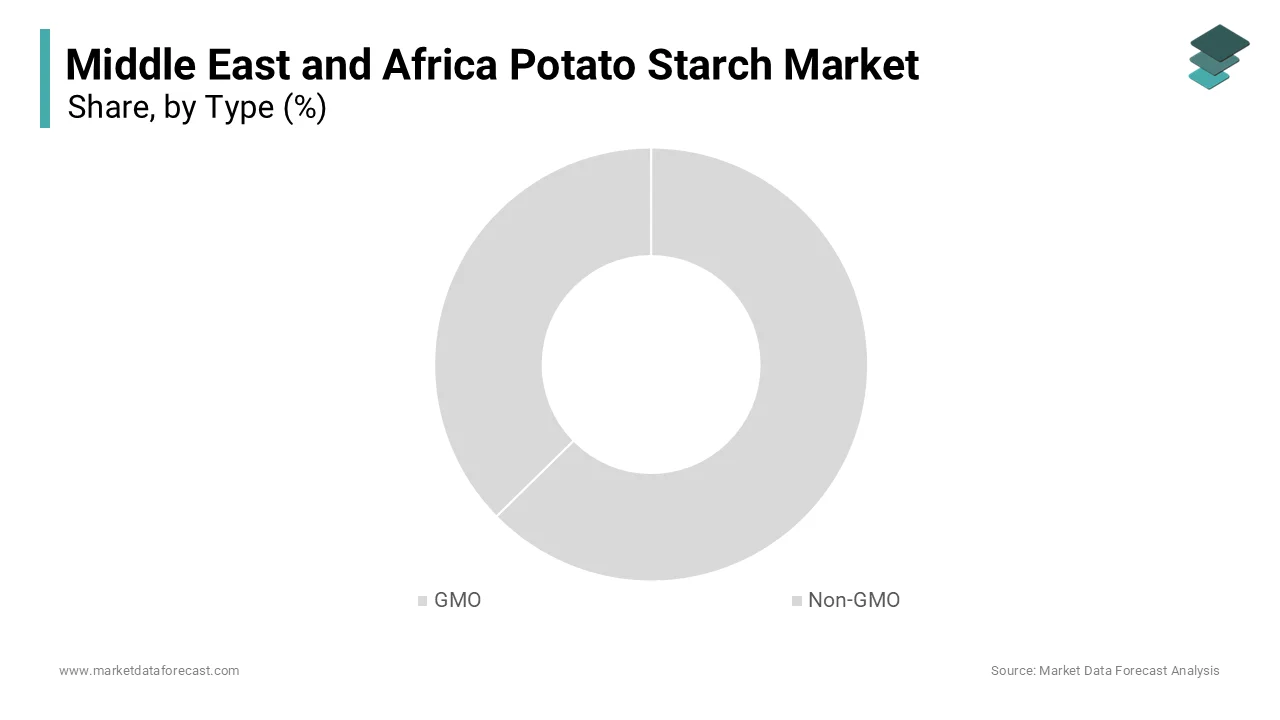
However, the genetically modified segment is estimated to record a CAGR of 6.06% over the forecast period owing to the rising need for cost effective solutions in industrial applications. According to the International Service for the Acquisition of Agri-biotech Applications, GMO potato varieties offer higher starch yields and resistance to pests which reduces production costs by up to 25% compared to conventional crops. As per the Egyptian Ministry of Agriculture, recent approvals for field trials of biotech crops aim to enhance local agricultural productivity and reduce reliance on expensive imports for industrial starch processing. This economic advantage makes GMO starch particularly attractive for non-food sectors such as textiles paper and adhesives where sensory attributes are less critical than price and performance. For instance, industrial buyers in North Africa have increased their procurement of GMO derived starch by 12% annually seeking to optimize manufacturing margins in competitive markets. Therefore, the pursuit of operational efficiency and agricultural modernization propels the GMO segment into a high growth trajectory specifically within bulk industrial applications that prioritize volume and cost over premium branding.
By Application Insights
The food segment led the market by commanding for the major share of the regional market in 2025 as potato starch serves as a essential thickening and binding agent in diverse culinary preparations and processed goods. According to the Food and Agriculture Organization of the United Nations, the consumption of processed foods in urban areas of the Middle East and Africa has risen by 18% in the last five years driving demand for functional ingredients that improve texture and shelf stability. As per the Saudi Food and Drug Authority, potato starch is widely used in gluten free bakery products and ready to eat meals which are gaining popularity among younger demographics seeking convenience without compromising dietary preferences. Its neutral flavor and high clarity make it ideal for sauces soups and confectionery items that are staples in regional diets. The statistical relationship between urbanization rates and packaged food sales demonstrates that every 10% increase in urban population correlates with a 7% rise in industrial starch consumption for food manufacturing. Consequently, the deep integration of potato starch into both traditional cooking and modern food processing ensures its continued dominance as the primary application sector in the regional market.
On the other end, the industrial segment is the fastest growing category and is predicted to register a CAGR of 7.4% over the forecast period owing to the environmental regulations and the shift toward sustainable materials. According to the United Nations Environment Programme, several African nations including Kenya and Rwanda have implemented bans on single use plastics creating an urgent demand for biodegradable alternatives derived from renewable resources like potato starch. As per the African Union Department of Infrastructure and Energy, investments in green manufacturing technologies have increased by 20% since 2021 supporting the development of starch based films and molded packaging solutions. This regulatory push transforms potato starch from a mere food additive into a critical raw material for eco-friendly industrial products. Statistical data reveals that the market for bio based packaging in the region is expected to grow by 10% annually as corporations seek to comply with environmental social and governance mandates. Thus, the convergence of legislative pressure and corporate sustainability goals drives rapid adoption of potato starch in industrial applications offering a lucrative growth avenue beyond traditional food uses.
REGIONAL ANALYSIS
Saudi Arabia held the leading share of the Middle East and Africa potato starch market in 2025 and is likely to register steady expansion and maintain its strategic stronghold over the next few years, supported by localized agricultural initiatives and large scale food processing investments. According to the Saudi Ministry of Environment Water and Agriculture, the kingdom has invested heavily in modern agricultural technologies to increase local potato production by 15% annually reducing dependency on imports for starch extraction. As per the General Authority for Statistics, the growing food processing sector in Riyadh and Jeddah consumes significant volumes of high purity potato starch for bakery and snack manufacturing aligning with rising domestic consumption trends. This state supported agricultural expansion is complemented by robust infrastructure for storage and distribution which ensures consistent supply to industrial buyers. The statistical link between government subsidies and local processing capacity shows that Saudi Arabia accounts for 30% of regional starch production capabilities. Consequently, Saudi Arabia combination of policy support and industrial demand establishes it as the undisputed leader in the Middle East and Africa potato starch landscape.
The United Arab Emirates is poised to experience robust trade-driven growth over the coming years, reinforcing its position as a central commercial gateway for re-exports and high-value food ingredients. According to the Dubai Chamber of Commerce, re exports of food ingredients including starches grew by 12% in 2023 serving markets across the Middle East and Africa that lack direct access to global suppliers. As per the UAE Ministry of Economy, the country hosts numerous multinational food manufacturers who require consistent supplies of high quality non GMO potato starch for export oriented production lines. This demand is supported by world class logistics infrastructure that facilitates efficient import and distribution of temperature sensitive products. Statistical evidence indicates that the UAE accounts for 25% of total regional starch imports highlighting its role as a gateway for international brands. Therefore, the UAE unique position as a logistical and commercial nexus ensures its continued influence in shaping supply chain dynamics and pricing trends in the regional potato starch market.
Israel is projected to sustain its high-tech agricultural momentum and expand its footprint in specialized export markets over the next few years through continuous innovation in water management and precision farming. According to the Israeli Ministry of Agriculture and Rural Development, the country achieves some of the highest potato yields per hectare globally through precision irrigation and advanced seed technologies ensuring a stable supply of high quality raw materials. As per the Central Bureau of Statistics, local starch producers leverage these efficiencies to export premium grades to European and Asian markets while meeting domestic pharmaceutical and food industry needs. This technological edge allows Israeli companies to compete on quality rather than volume catering to niche segments that require specific functional properties. Statistical data shows that Israeli agricultural exports including processed potato products increased by 8% annually reflecting strong international demand for their specialized offerings. Consequently, Israel integration of science and agriculture creates a resilient and high value market segment that thrives on innovation and export excellence.
COMPETITIVE LANDSCAPE
The Middle East and Africa potato starch market features a moderately fragmented competitive landscape characterized by international exporters and emerging local processors. Major players compete primarily on product quality consistency and supply chain reliability rather than price alone due to the specialized nature of high purity starch applications. The market sees intense rivalry in innovation as companies strive to develop functional ingredients that address specific regional needs such as heat stability and gluten free formulation. Barriers to entry remain significant due to high capital requirements for processing infrastructure and strict regulatory compliance for food safety standards. Established firms leverage their global networks and technical expertise to secure long term contracts with multinational food manufacturers. However local producers gain traction by offering cost competitive alternatives and faster delivery times for standard grade starches. Competitive dynamics are further influenced by fluctuating raw material costs and currency exchange rates which impact profitability differently across participants. Companies increasingly differentiate themselves through sustainability certifications and transparent sourcing practices to align with corporate social responsibility goals. This environment fosters continuous improvement in operational efficiency and product development capabilities across the sector.
KEY MARKET PLAYERS
Some of the key players in the Middle East and Africa potato starch market are
- Avebe
- Agrana Staerke GmbH
- AKV Langholt AmbA
- Changhong Potato Starch Co., Ltd.
- Emsland Group
- Finnamyl Oy
- Manitoba Starch Products
- Ingredion Incorporated
- Cargill Incorporated
Top Players in the Market
- AVEBE operates as a leading European cooperative with a strong export presence in the Middle East and Africa focusing on high quality potato starch ingredients. The company emphasizes sustainability by sourcing potatoes from certified farms and utilizing renewable energy in its production facilities to reduce carbon footprint significantly. AVEBE recently expanded its distribution network in South Africa and Egypt to ensure reliable supply chains for local food manufacturers seeking premium non GMO starch. Their strategic investments in research and development have led to innovative modified starches that improve texture and stability in gluten free products. The company actively collaborates with regional partners to provide technical support and application expertise. These efforts position AVEBE as a trusted supplier of specialized starch solutions. By aligning product quality with environmental standards AVEBE strengthens its competitive edge in meeting the diverse needs of the growing food processing sector in the region.
- Emsland Group is a prominent player known for its extensive portfolio of native and modified potato starches tailored for industrial and food applications. The company focuses on innovation by developing clean label ingredients that meet stringent regulatory requirements in Gulf Cooperation Council countries. Emsland Group recently launched new heat stable starch variants designed specifically for the harsh climatic conditions of the Middle East ensuring consistent performance in processed foods. Their commitment to quality involves rigorous testing protocols and transparent sourcing practices that build trust with international buyers. The company engages in continuous improvement of its logistics capabilities to minimize delivery times and maintain product integrity. These initiatives reinforce Emsland Group reputation for reliability and technical excellence. By offering customized solutions and superior customer service the company effectively drives adoption of its premium potato starch products across diverse market segments in the region.
- Ingredion serves as a global ingredient solutions provider with significant involvement in the Middle East and Africa potato starch market through its specialized texturizing systems. The company leverages its scientific expertise to create functional starch blends that enhance mouthfeel and shelf life in bakery and dairy alternatives. Ingredion recently established technical centers in Dubai and Johannesburg to support local customers with formulation advice and product development services. Their strategic focus on sustainability includes partnerships with farmers to promote regenerative agriculture practices that secure long term raw material supplies. The company prioritizes digital tools to optimize supply chain efficiency and provide real time data to clients. These actions strengthen Ingredion position as a key enabler of innovation in the food industry. By combining global knowledge with local presence Ingredion continues to deliver value added starch solutions that address specific regional challenges and consumer preferences.
Top Strategies Used by Key Market Participants
Key players in the Middle East And Africa Potato Starch Market employ localization strategies to adapt products to regional culinary preferences and regulatory requirements. Companies invest heavily in supply chain resilience by establishing local storage facilities and partnering with regional distributors to mitigate logistical challenges. Product innovation forms another core strategy as manufacturers develop clean label and non GMO starches to appeal to health conscious consumers and meet strict import standards. Strategic collaborations with local agricultural bodies help secure sustainable raw material sources and support farming communities. Digital transformation is prioritized through implementation of traceability systems that enhance transparency and build buyer confidence. Expansion into niche applications such as biodegradable packaging and pharmaceutical excipients allows participants to diversify revenue streams beyond traditional food uses. These multifaceted strategies enable companies to navigate market complexities and maintain competitive advantages in the dynamic regional landscape.
MARKET SEGMENTATION
This research report on the Middle East and Africa potato starch market has been segmented and sub-segmented into the following categories.
By Type
- GMO
- Non-GMO
By Application
- Food
- Industrial
By Region
- KSA
- UAE
- Israel
- rest of GCC countries
- South Africa
- Ethiopia
- Kenya
- Egypt
- Sudan
- Rest of MEA