- Product Description Description
- Table of Contents TOC
- List of Table & Figure LOT
- Get Free Sample PDF Sample PDF
Market Size, 2025
$0.65 BnMarket Estimate, 2026
$0.68 BnMarket Forecast, 2034
$1.07 BnCAGR, 2026–2034
5.8%Executive Summary: Middle East & Africa Radiotherapy Market
- Market Scope: Comprehensive Middle East and Africa (MEA) radiotherapy market analysis covering therapeutic types, application sectors, equipment categories, country-level insights, and oncology care trends.
- Market Valuation: Valued at USD 0.65 billion (2025), estimated at USD 0.68 billion (2026), and projected to reach USD 1.07 billion by 2034, registering a steady CAGR of 5.8% (2026–2034).
- Primary Growth Drivers: Rising cancer patient population due to lifestyle shifts (tobacco, alcohol, unhealthy diets), increasing public and organizational awareness regarding radiation therapy, and rapid adoption of advanced automated and precision radiotherapy devices.
Key Market Segment Metrics (2026–2034)
| Category | Leading Segment Position | Core Segment Categories |
|---|---|---|
| By Type | External Beam Radiation Therapy (holding the major share through advanced modalities like IMRT, IGRT, Tomotherapy, and Stereotactic Radiosurgery) | Internal Beam & Systemic Radiation Therapy, Proton Therapy, and Stereotactic Body Radiation Therapy |
| By Application | High-Incidence Cancers (led by prevalent regional cases such as breast, prostate, lung, head & neck, and cervical cancers) | Skin & Lip Cancer, Spine Cancer, and specialized pediatric oncology treatments |
| By Equipment Type | Linear Accelerators (LINAC) & Treatment Planning Systems (essential for precise tumor targeting and reducing radiation impact on healthy cells) | Radiation Therapy Simulators and automated imaging equipment |
| By Country | Saudi Arabia (KSA) (holding the major share driven by advanced cancer research centers and high adoption rates among Arab cancer patients) | Egypt (expanding via specialized radiotherapy centers and pediatric hospitals) and UAE (growing via advanced medical infrastructure and specialized radiology jobs) |
Major Market Players & Market Structure
Market Structure: Competitive regional landscape featuring leading global medical technology developers collaborating with healthcare facilities to expand radiotherapy accessibility, upgrade hospital infrastructure, and train skilled oncology professionals.
Key Companies: Nordion Inc., RaySearch Laboratories AB, Ion Beam Applications SA, C. R. Bard Inc., Mevion Medical Systems Inc., Varian Medical Systems Inc., IsoRay Medical Inc., Elekta AB, Accuray Incorporated, and Mitsubishi Electric Corporation.
 Download Free Sample Report
MEA Radiotherapy Market Size
The Middle East & Africa Radiotherapy Market is projected to grow from USD 0.65 billion in 2025 to USD 0.68 billion in 2026 and reach USD 1.07 billion by 2034, registering a CAGR of 5.8% during the forecast period from 2026 to 2034.
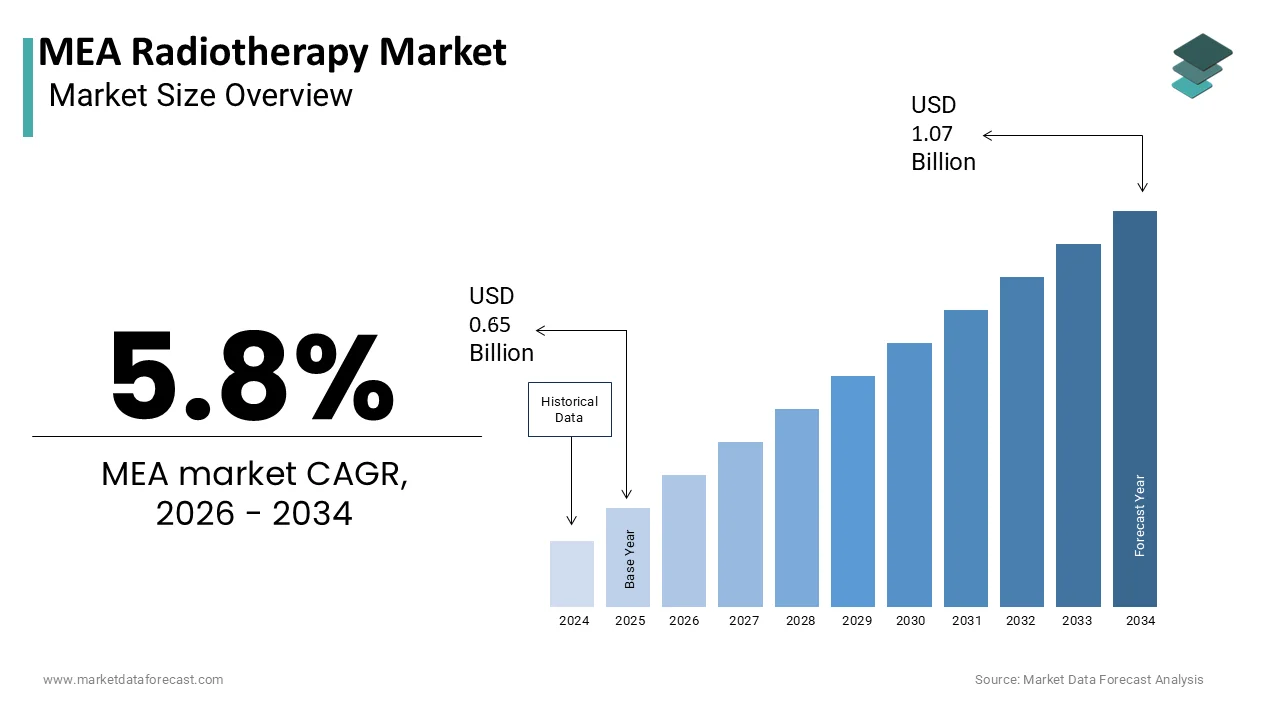
Radiotherapy is a specialized medical device utilized across hospitals and oncology centers for cancer treatment. The regional annual cancer diagnoses have grown significantly, driving a continuous need for advanced oncology infrastructure. Within this territory, government entities and private healthcare providers increasingly prioritize the integration of advanced linear accelerators and precision delivery systems. Consequently, clinical facilities continuously upgrade their therapeutic capabilities to address the rising incidence of oncological disorders across diverse demographic groups.
MARKET DRIVERS
Escalating Regional Oncology Burden and Patient Demographics
The surge in cancer incidence rates drives an urgent clinical demand for advanced radiation treatment modalities that is propelling the growth of the Middle East and Africa radiotherapy market. According to the study, annual cancer diagnoses within the Middle East and Africa region have escalated by over 18% over the past 5 successive years, directly multiplying the volume of patients requiring localized intervention. This clinical reality heavily propels the MEA Radiotherapy Market because radiation therapy serves as a primary frontline and palliative treatment modality for managing complex solid tumors. Furthermore, the regional populations aged 65 and older have expanded annually, creating a high-risk demographic cohort that is statistically more susceptible to oncological malignancies.
Aggressive Government Healthcare Infrastructure Investments and National Visions
Ambitious public sector economic diversification blueprints prioritize the modernization of national cancer treatment networks through substantial capital allocations that are accelerating the growth of the Middle East and Africa radiotherapy market. As per the International Monetary Fund's financial stability reviews, regional governments in the Gulf Cooperation Council and North Africa have allocated over national budgets toward modernizing public health infrastructure and specialized care facilities. This macroeconomic initiative acts as a major catalyst for the MEA Radiotherapy Market by financing the construction of state-of-the-art cancer centers equipped with high-precision radiotherapy hardware. Consequently, state-backed healthcare expansions facilitate the rapid deployment of advanced teletherapy and brachytherapy units across previously underserved medical districts.
MARKET RESTRAINTS
Prohibitive Upfront Capital Costs and Maintenance Expenses
The massive financial investment required to purchase and maintain advanced radiotherapy hardware restricts widespread adoption in resource-limited facilities, which is restricting the growth of the Middle East and Africa radiotherapy market. According to the World Health Organization, health technology assessments indicate that the acquisition and room shielding for a single high-end linear accelerator system frequently exceed 3.00 million dollars, representing a severe fiscal burden for regional clinics. Furthermore, International Monetary Fund economic inflation databases indicate that imported medical device maintenance contracts and specialized replacement parts experience annual price escalations of 6.00%, straining operational budgets. Many secondary healthcare facilities across developing African nations struggle to sustain continuous machine calibration and software updates, severely curtailing long-term equipment utilization rates.
Severe Shortages of Certified Radiation Oncologists and Medical Physicists
The scarcity of trained clinical personnel prevents healthcare facilities from operating radiation therapy machinery at maximum patient capacity is another factor limiting the growth of the Middle East and Africa radiotherapy market. This acute workforce deficit directly constrains operations by creating prolonged patient waiting lists and forcing newly installed linear accelerators to operate on restricted daily schedules. Additionally, the annual emigration rate of specialized medical graduates toward higher-income Western economies exacerbates the regional talent shortage. Consequently, hospital administrators face severe operational hurdles that delay treatment delivery and discourage smaller healthcare enterprises from investing in sophisticated radiation oncology infrastructure.
MARKET OPPORTUNITIES
Expansion of Public-Private Partnerships for Oncology Facility Development
The collaborative commercial agreements between government bodies and private medical providers unlock new avenues for advanced cancer center establishment is solely attributed to gearing up new opportunities for the growth of the Middle East and Africa radiotherapy market. According to World Bank infrastructure development indices, public-private partnerships in regional healthcare projects have expanded by 22% across emerging Middle Eastern and African commercial zones. This structural evolution creates a major opportunity for the MEA Radiotherapy Market by allowing private capital to finance cutting-edge oncology centers equipped with advanced intensity-modulated and image-guided radiotherapy systems. Furthermore, World Health Organization health sector investment reviews indicate that collaborative ventures reduce government capital expenditure pressures while accelerating the deployment of specialized cancer care networks by an average of 3 years. These partnerships broaden patient access to high-end radiation treatments, driving sustained revenue growth for medical technology manufacturers operating within the territory.
Integration of Artificial Intelligence and Digital Treatment Planning Software
The advanced computational tools and artificial intelligence algorithms revolutionize precision targeting, posing lucrative opportunities for the expansion of the Middle East and Africa radiotherapy market. As per International Telecommunication Union digital health transformation reports, regional adoption of cloud-based artificial intelligence diagnostic and treatment planning platforms has surged by 30% across major metropolitan hospitals. According to the World Health Organization digital health observatory, software-driven workflow optimization increases daily patient throughput by 15%, maximizing return on investment for hospital administrators. Consequently, forward-thinking medical device vendors that bundle intelligent contouring software with their hardware offerings successfully capture lucrative enterprise upgrade contracts across the region.
MARKET CHALLENGES
Complex Regulatory Approval Delays and Bureaucratic Compliance Hurdles
The lengthy administrative procedures for medical device licensing create significant lag times in introducing next-generation radiotherapy innovations, which is a major challenge for the growth of the Middle East and Africa radiotherapy market. According to World Health Organization regulatory system evaluations, national health authorities in developing regional jurisdictions require an average duration of 12 to 18 months to review and approve advanced medical imaging and radiation delivery hardware. This administrative lag severely challenges the MEA Radiotherapy Market by delaying the commercial rollout of cutting-edge technologies, leaving patients dependent on older-generation treatment devices. Furthermore, International Trade Administration regulatory compliance audits indicate that inconsistent cross-border licensing standards among African nations increase administrative expenditures for international device manufacturers by nearly 14%.
Inadequate Transportation Logistics and Radiation Safety Infrastructure
The substandard cold chain transport and deficient radioactive material storage facilities complicate the deployment of advanced brachytherapy and radioligand treatments and also contribute to the decline in the growth of the Middle East and Africa radiotherapy market. As documented in global supply chain security reviews by the World Health Organization, remote healthcare facilities across developing African territories experience frequent logistical disruptions, with 20% of specialized medical shipments facing transit delays. This infrastructure deficit directly challenges the MEA Radiotherapy Market by disrupting the timely delivery of short-lived radioactive isotopes and brachytherapy sources required for localized cancer treatments. Consequently, the high cost of retrofitting existing clinical structures to meet international radiation safety standards prevents widespread regional adoption of advanced internal beam and targeted radionuclide therapies.
REPORT COVERAGE
| REPORT METRIC | DETAILS |
| Market Size Available | 2025 to 2034 |
| Base Year | 2025 |
| Forecast Period | 2026 to 2034 |
| Segments Covered | By Type, Application, Equipment Type, and Region |
| Various Analyses Covered | Global, Regional, and Country-Level Analysis, Segment-Level Analysis, Drivers, Restraints, Opportunities, Challenges; PESTLE Analysis; Porter’s Five Forces Analysis, Competitive Landscape, Analyst Overview of Investment Opportunities |
| Countries Covered | KSA, UAE |
| Market Leaders Profiled | Nordion Inc. |
SEGMENT ANALYSIS
By Product Type Insights
The external beam radiation therapy segment accounted for a significant share of the Middle East and Africa radiotherapy market in 2025 due to its extensive non-invasive application profile across multiple oncology departments. The continuous technical refinement of high-energy linear accelerators is evident in their deployment in major metropolitan hospitals. The global installed base of linear accelerators exceed 14000 active systems, driving high replacement and software upgrade cycles across developing regional medical centers. Furthermore, World Health Organization clinical guidelines emphasize that external beam radiation serves as a foundational frontline therapeutic intervention, ensuring steady, high-volume procedural utilization across all tier-one oncology institutes.
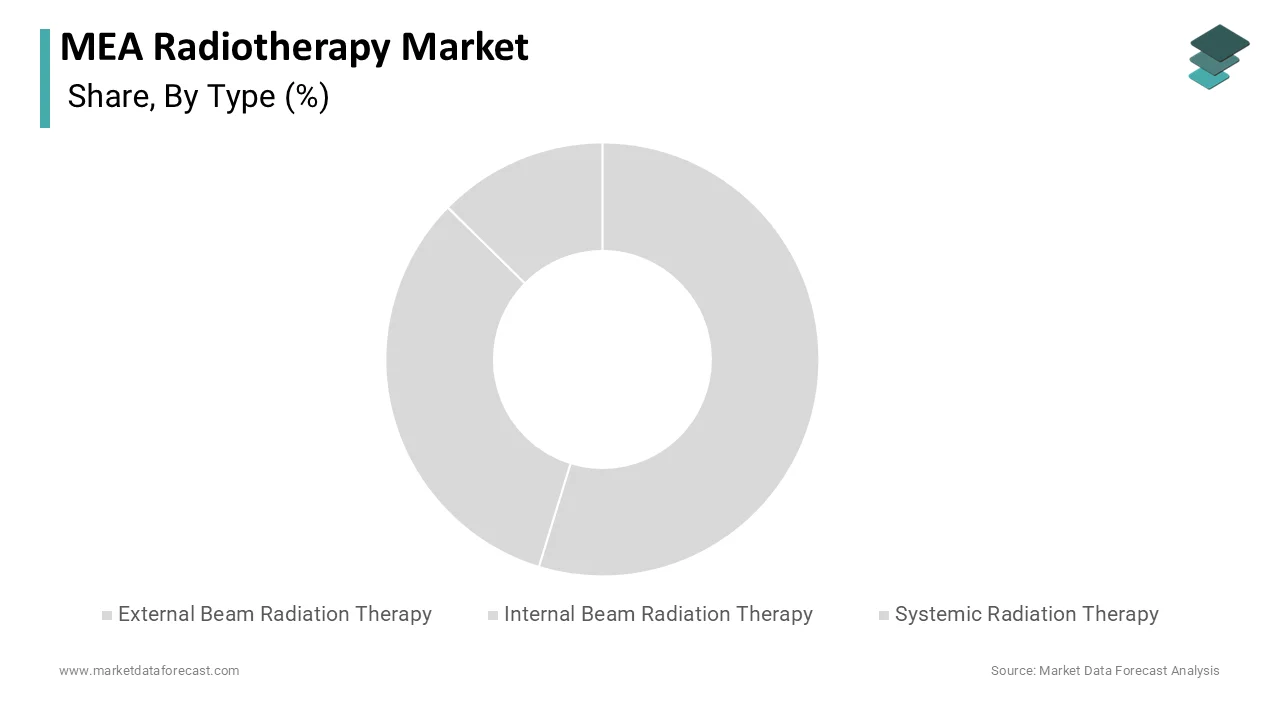
The systemic radiation therapy segment is deemed to witness the fastest CAGR of 9.3% during the forecast period, with the rising clinical adoption of targeted radioligand therapies designed to seek out and destroy disseminated cancer cells. The increasing availability of specialized radioisotopes and precision molecular imaging agents within regional nuclear medicine departments. As per the study, medical physics audits document an 18% annual increase in clinical trials utilizing targeted radionuclide treatments for advanced metastatic cancers. Additionally, World Health Organization global oncology updates demonstrate that systemic radiopharmaceutical protocols improve survival rates for hormone-refractory tumors, encouraging regional hospital networks to invest heavily in specialized handling infrastructure and dedicated nuclear treatment suites.
By Application Insights
The breast cancer segment was the largest,y holding 48.1% of the Middle East and Africa radiotherapy market share in 2025, with high regional screening rates and escalating incidence among female demographics. The widespread public health awareness campaigns organized by regional governments to promote early diagnostic detection are also boosting the growth of the segment. World Health Organization epidemiological data records that over 2.3 million new breast cancer cases are diagnosed each year globally, establishing a massive patient pool that necessitates localized radiation therapy.
The lung cancer segment is likely to witness the fastest CAGR of 8.7% from 2026 to 2034, with the surging prevalence of tobacco consumption and regional environmental air pollution factors. The clinical shift toward stereotactic body radiation therapy for early-stage inoperable lung tumors allows physicians to deliver precise ablative doses with minimal sessions. World Health Organization respiratory health studies document a 14% rise in regional thoracic oncology admissions over the past 3 successive years. Additionally, International Monetary Fund healthcare infrastructure reviews indicate that increased public investments in advanced computed tomography simulation hardware enable earlier, more accurate target localization, significantly improving survival outcomes for lung cancer patients.
By Equipment Type Insights
The linear accelerators accounted for 39.3% of the Middle East and Africa radiotherapy market share in 2025, with versatility in delivering high-energy photon and electron beams. The linear accelerator hardware commands over 60.00% of total equipment expenditures, driven by its indispensable role in standard external beam oncology protocols. Heavily propelled by continuous technological innovations that integrate real-time imaging guidance directly into the treatment gantry. Furthermore, World Health Organization hospital infrastructure audits report that regional health ministries prioritize linear accelerator procurement above all other therapeutic devices to maximize patient daily throughput in public cancer hospitals.
The treatment planning systems segment is expected to witness the fastest CAGR of 9.5% during the forecast period, with the rapid growth and widespread integration of advanced artificial intelligence algorithms that automate complex tumor contouring and dose calculations. This accelerated expansion is driven by the clinical necessity to optimize intensity-modulated and volumetric-modulated arc therapy plans rapidly without compromising healthy tissue sparing. Additionally, International Atomic Energy Agency technical bulletins emphasize that modern treatment planning software reduces physician calculation errors by up to 20% by encouraging clinical facilities across developing regional corridors to upgrade their software architecture.
COUNTRY LEVEL ANALYSIS
Saudi Arabia Radiotherapy Market Analysis
Saudi Arabia radiotherapy market was the largest contributor in the Middle East and Africa radiotherapy market, holding a 29.1% share in 2025, with robust government healthcare expenditures and state-of-the-art oncology research centers. The national public health spending per capita exceeds 1500 dollars annually, providing substantial capital reserves for advanced medical technology acquisition. Furthermore, the increase in advanced linear accelerator installations across Riyadh and Jeddah medical cities is ensuring cutting-edge therapeutic access for domestic and regional patients.
United Arab Emirates Radiotherapy Market Analysis
The United Arab Emirates radiotherapy market was ranked second by holding a 17.6% share in 2025, with world-class private hospital infrastructure, elite medical tourism, and rapid adoption of next-generation radiation technologies. The stringent federal healthcare accreditation standards are accelerating the growth of the market. As per the World Health Organization, over 80% of major urban clinics in Dubai and Abu Dhabi utilize digital artificial intelligence-integrated treatment planning software.
Israel Radiotherapy Market Analysis
Israel radiotherapy market growth is likely to grow with advanced clinical research capabilities, a dense network of university-affiliated medical centers, and indigenous medical device development. World Bank scientific publication indices highlight that local oncologists collaborate directly with global engineering firms, resulting in an 18% higher adoption rate of experimental adaptive radiotherapy software compared to neighboring territories. Furthermore, the national universal health insurance fully covers complex radiosurgical interventions by ensuring equitable patient access across all major population sectors.
South Africa Radiotherapy Market Analysis
South Africa radiotherapy market growth is driven by advanced private healthcare networks with extensive public hospital obligations. World Health Organization African regional office statistics note that South Africa accounts for a significant share of sub-Saharan oncology equipment installations, treating both domestic populations and medical cross-border referrals. Department of Health public expenditure reviews highlight that public-private partnerships facilitate the deployment of modern linear accelerators in major urban centers like Johannesburg and Cape Town.
Kenya Radiotherapy Market Analysis
Kenya radiotherapy market growth is propelled by the progressive modernization of its oncology service delivery through increased public investments and regional medical center developments. Nairobi functions as a primary destination for advanced cancer diagnostics and therapeutic interventions. The rise in patient throughput across specialized radiotherapy treatment vaults. Furthermore, non-communicable disease country profiles highlight that collaborative national insurance coverage expansions now subsidize specialized radiation sessions by significantly reducing financial abandonment rates among low-income cancer patients.
COMPETITIVE LANDSCAPE
Competition within the Middle East and Africa radiotherapy market is intensely driven by a select group of multinational medical technology giants vying for supremacy across expanding healthcare infrastructure networks. Market participants constantly strive to differentiate their product portfolios by introducing high-precision devices that reduce treatment times and minimize toxicity for complex oncology cases. Pricing pressures and stringent regulatory compliance requirements demand that equipment manufacturers continuously optimize their manufacturing efficiencies and offer flexible financing models to public and private hospital buyers. Key competitors frequently engage in aggressive technological innovation races, intellectual property acquisitions, and strategic distributor partnerships to capture emerging tender opportunities across high-growth territories.
KEY MARKET PLAYERS
Some of the companies that are playing a dominant role in the MEA Radiotherapy Market include:
- Nordion Inc.
- RaySearch Laboratories AB
- Ion Beam Applications SA
- C. R. Bard, Inc.
- Mevion Medical Systems, Inc.
- Varian Medical Systems, Inc.
- IsoRay Medical, Inc.
- Elekta AB
- Accuray Incorporated
- Mitsubishi Electric Corporation
TOP LEADING PLAYERS IN THE MARKET
- Varian Medical Systems operates as a premier global manufacturer contributing advanced linear accelerators, software platforms, and comprehensive oncology management tools to the healthcare sector. The company delivers cutting-edge radiation delivery systems and informatics software that enable clinics to administer high-precision treatments globally. Furthermore, the corporation continuously enhances its TrueBeam and Halcyon platforms to streamline clinical workflows and improve patient throughput across the diverse international healthcare sector.
- Elekta AB functions as a pioneering medical technology enterprise contributing sophisticated magnetic resonance-guided radiation therapy systems and stereotactic delivery solutions to oncology centers worldwide. The company provides specialized linear accelerators and advanced treatment planning software designed to maximize tumor targeting precision while preserving healthy tissue. To solidify its industry footprint, the organization invests heavily in clinical research collaborations and software upgrades that enhance adaptive radiotherapy capabilities. Additionally, the firm expands its global service infrastructure to support complex installations in emerging regional healthcare facilities.
- Accuray Incorporated operates as a dedicated radiation oncology innovator, contributing specialized robotic radiosurgery systems and advanced delivery technologies to specialized cancer hospitals globally. The enterprise delivers precision treatment platforms like the CyberKnife and TomoTherapy systems that address complex oncological indications with sub-millimeter accuracy. Moreover, the firm leverages strategic distributor networks to increase equipment placements across rapidly developing medical territories.
TOP STRATEGIES USED BY KEY MARKET PARTICIPANTS
Key market participants deploy aggressive research and development initiatives to integrate artificial intelligence algorithms and real-time imaging modalities directly into advanced linear accelerator platforms. Leading medical device corporations focus heavily on establishing strategic joint ventures and long-term service agreements with regional health ministries to secure large-scale hospital procurement contracts. Industry leaders frequently pursue digital software enhancements and cloud-connected treatment planning upgrades to ensure seamless interoperability across diverse oncology departments. Manufacturers also invest in comprehensive clinical training programs and professional education symposia to accelerate the adoption of complex adaptive radiotherapy and radiosurgery techniques.
MARKET SEGMENTATION
This research report on the Middle East and Africa radiotherapy market has been segmented and sub-segmented into the following categories
By Type
- External Beam Radiation Therapy
- Intensity-Modulated Radiation Therapy (IMRT)
- Image-Guided Radiation Therapy (IGRT)
- Tomotherapy
- Stereotactic Radiosurgery
- Stereotactic Body Radiation Therapy
- Proton Therapy
- Internal Beam Radiation Therapy
- Systemic Radiation Therapy
By Application
- Skin & Lip Cancer
- Head & Neck Cancer
- Breast Cancer
- Prostate Cancer
- Cervical Cancer
- Lung Cancer
- Spine Cancer
By Equipment Type
- Linear Accelerators
- Radiation Therapy Simulators
- Treatment Planning Systems
By Country
- KSA
- UAE
- Israel
- Rest of GCC countries
- South Africa
- Ethiopia
- Kenya
- Egypt
- Sudan
- Rest of MEA