- Product Description Description
- Table of Contents TOC
- List of Table & Figure LOT
- Get Free Sample PDF Sample PDF
Market Size, 2025
$40.76 BnMarket Estimate, 2026
$42.23 BnMarket Forecast, 2034
$56.09 BnCAGR, 2026–2034
3.61%Middle East and Africa Sorghum Market Size, Growth Drivers, and Forecast (2025–2034)
- Market Scope: Comprehensive regional industry analysis of the Middle East and Africa (MEA) sorghum market covering types, application verticals, country-level frameworks, and vital uses as a staple food and drought-tolerant crop.
- Market Valuation: Valued at USD 40.76 billion in 2025, estimated at USD 42.23 billion in 2026, and projected to reach USD 56.09 billion by 2034, registering a steady CAGR of 3.61% from 2026 to 2034.
- Primary Growth Drivers: High drought- and heat-tolerance making it an essential dietary staple for rural populations in arid regions, expansion by key players into an untapped market, and growing utilization across alternative sweeteners, animal feed, and multi-industry applications.
Middle East and Africa Sorghum Market Segment Metrics (2026–2034)
| Category | Leading Segment (2025 Position) | Fastest-Growing Segment |
|---|---|---|
| By Type | Grain Sorghum (established as a critical staple cereal crop in tropical and arid regions) | Sweet Sorghum & Biomass Sorghum (driven by beverage and alternative feedstock applications) |
| By Application | Human Consumption (vital staple for poor and rural communities across MEA) | Animal Feed & Industrial Processing (expanding due to regional livestock and agricultural shifts) |
| By Country | South Africa, Egypt, Sudan, and Ethiopia (leading regional production and consumption hubs) | GCC Countries (KSA, UAE, Israel, and Rest of GCC driven by strategic agribusiness expansions) |
Middle East and Africa Sorghum Market Players & Industry Structure
Market Structure: Emerging regional market landscape featuring international agribusiness leaders and specialized regional associations gradually scaling operations across largely untapped agricultural territories.
Key Companies: National Sweet Sorghum Producers & Processors Assn, Shri Lal Mahal Group, Sorghum Forum of South Africa, National Sorghum Producers, Mabele Fuels, Richardson Seeds, DuPont, and Advanta Seeds.
 Download Free Sample Report
Middle East and Africa Sorghum Market Size
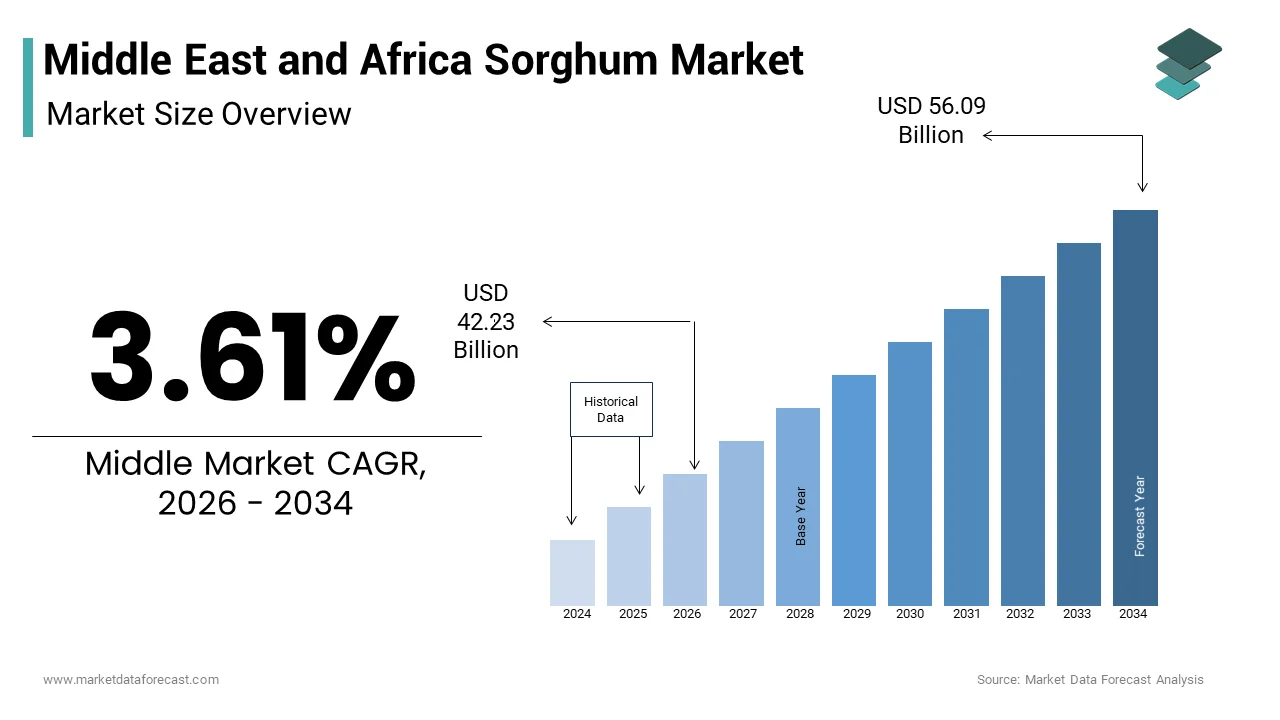
The Middle East and Africa sorghum market size will reach USD 40.76 billion in 2025 and is anticipated to reach USD 42.23 billion in 2026 to reach USD 56.09 billion by 2034, growing at a CAGR of 3.61% from 2026 to 2034.
Sorghum can be grown as a sweet crop or as a grain and is considered one of the main five cereal crops. One species of sorghum is grown for grains, while many other species are used as fodder plants, which are either cultivated in warm climates worldwide or naturalized in pasture lands. Most varieties of the sorghum plant are drought- and heat-tolerant and are especially essential in arid regions, where the grain is one of the staples for poor and rural people. These varieties are an important part of pastures in tropical regions.
Sorghum is mainly used as an alternative sweetener for various alcoholic beverages, which is the major driving factor. Also, it is used in floral arrangements, fencing, building material, pet food, and other applications, which further propels the market growth. Also,o due to its versatility, it can reach beyond traditional markets, which enhances producer productivity.
REPORT COVERAGE
| REPORT METRIC | DETAILS |
| Market Size Available | 2025 to 2034 |
| Base Year | 2025 |
| Forecast Period | 2026 to 2034 |
| CAGR | 3.61% |
| Segments Covered | By Type, Application, and Region. |
| Various Analyses Covered | Global, Regional & Country Level Analysis, Segment-Level Analysis, DROC, PESTLE Analysis, Porter’s Five Forces Analysis, Competitive Landscape, Analyst Overview on Investment Opportunities |
| Regions Covered | KSA, UAE, Israel, rest of GCC countries, South Africa, Ethiopia, Kenya, Egypt, Sudan, rest of MEA |
| Market Leaders Profiled | National Sweet Sorghum Producers & Processors Assn, Shri Lal Mahal Group, Sorghum Forum of South Africa, National Sorghum Producers, Mabele Fuels, Richardson Seeds, DuPont, Advanta Seeds |
COUNTRY ANALYSIS
Geographically, the market is further segmented into the Middle East and Africa. The Middle East and Africa have an untapped market, and key players are slowly expanding to their region,n which is the main reason for the growth of the market in this region.
KEY MARKET PLAYERS
These are the key players in the Middle East and Africa Sorghum market.
- National Sweet Sorghum Producers & Processors Assn
- Shri Lal Mahal Group
- Sorghum Forum of South Africa
- National Sorghum Producers
- Mabele Fuels
- Richardson Seeds
- DuPont
- Advanta Seeds
MARKET SEGMENTATION
This research report on the Middle East and African sorghum market is segmented and sub-segmented into the following categories.
By Type
- Grain Sorghum
- Forage Sorghum
- Biomass Sorghum
- Sweet sorghum
By Application
- Human Consumption
- Animal Feed
By Country
- KSA
- UAE
- Israel
- The rest of the GCC countries
- South Africa
- Ethiopia
- Kenya
- Egypt
- Sudan
- Rest of MEA