- Product Description Description
- Table of Contents TOC
- List of Table & Figure LOT
- Get Free Sample PDF Sample PDF
Market Size, 2025
$44.81 BnMarket Estimate, 2026
$48.50 BnMarket Forecast, 2034
$91.38 BnCAGR, 2026–2034
8.24%Executive Summary: Global Medical Equipment Maintenance Market
- Market Scope: Comprehensive global medical equipment maintenance market analysis covering equipment categories, service models, regional frameworks, and strategic industry developments.
- Market Valuation: Valued at USD 44.81 billion (2025), estimated at USD 48.50 billion (2026), and projected to reach USD 91.38 billion by 2034, registering a robust CAGR of 8.24% (2026–2034).
- Primary Growth Drivers: Growing global demand for medical equipment driven by an aging demographic and chronic disease burden, rising healthcare costs encouraging preventive and cost-effective maintenance outsourcing, and stringent regulatory requirements by agencies like the FDA and ISO. Key market constraints include high maintenance and equipment costs, poor awareness in developing regions, and a scarcity of skilled biomedical maintenance professionals.
Key Market Segment Metrics (2026–2034)
| Category | Leading Segment (2025 Position) | Fastest-Growing Segment |
|---|---|---|
| By Equipment | Imaging Equipment (CT, MRI, Digital X-Ray, and Ultrasound systems) | Life Support Devices and High-Tech Electromedical Equipment |
| By Service | Corrective Maintenance (accounted for the largest share due to unexpected breakdowns and immediate repair needs) | Preventive Maintenance and Operational Maintenance services |
| By Region | North America (held the major share of the worldwide market, led by the U.S.) | Asia-Pacific (projected to record the highest regional CAGR backed by expanding healthcare infrastructure) |
Major Market Players & Market Structure
Market Structure: Highly competitive global landscape featuring leading original equipment manufacturers (OEMs) and specialized third-party service providers engaging in long-term technology agreements, digital app-based tracking platforms, and service network expansions.
Key Companies: GE Healthcare, Siemens Healthineers, Koninklijke Philips N.V., Drägerwerk AG & Co. KGaA, Medtronic, B. Braun Melsungen AG, Aramark, BC Technical, Inc., Alliance Medical Group, and Althea Group.
 Download Free Sample Report
Global Medical Equipment Maintenance Market Size
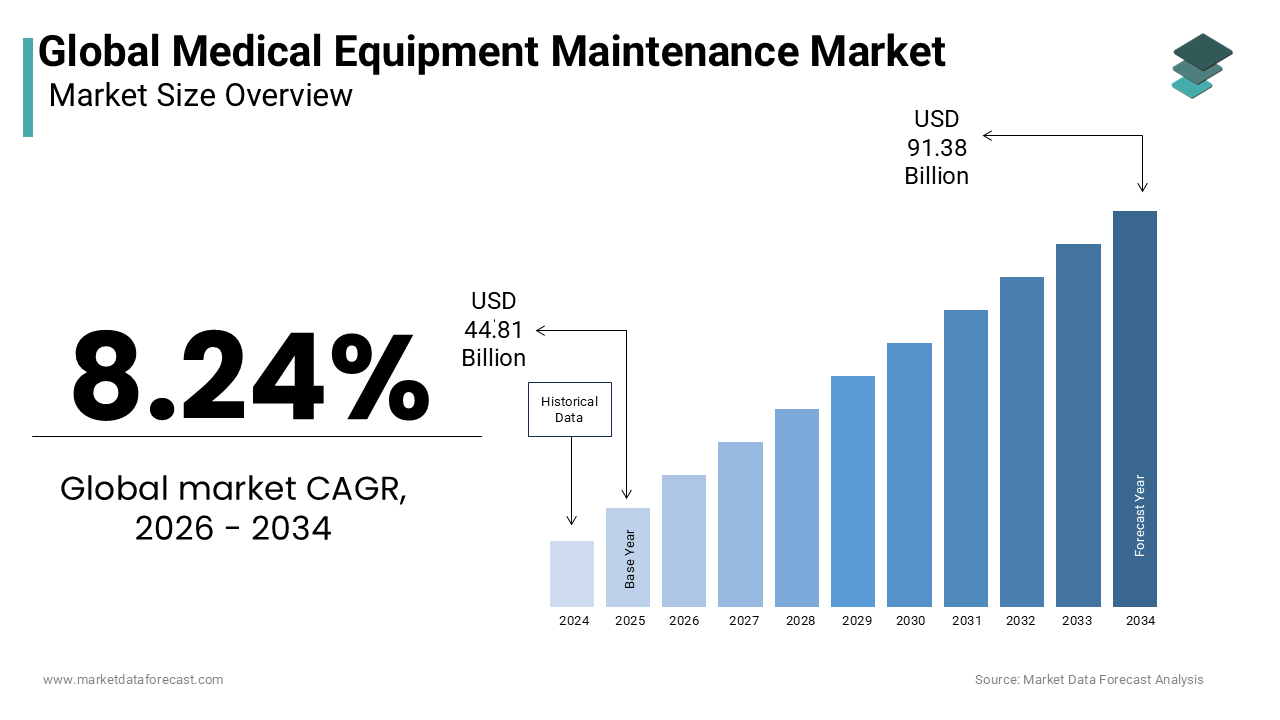
The global medical equipment maintenance market was valued at USD 44.81 billion in 2025. It is projected to reach USD 91.38 billion by 2034, rising from USD 48.50 billion in 2026, growing at a CAGR of 8.24% from 2026 to 2034.
The medical equipment maintenance are services required to ensure the operational integrity, safety, and longevity of diagnostic, therapeutic, and monitoring devices within healthcare facilities. As per the World Health Organization, approximately 40% of medical equipment in developing countries is out of service at any given time due to lack of proper maintenance infrastructure. This statistic underscores the urgent global need for robust service frameworks to maximize asset utilization. This extension directly impacts hospital capital expenditure strategies by delaying replacement costs. The increasing complexity of modern medical devices, which integrate software and hardware, necessitates specialized technical expertise. Regulatory bodies such as the Food and Drug Administration mandate strict compliance with safety standards, driving hospitals to engage certified service providers. The shift towards value-based care further emphasizes the importance of equipment reliability in delivering consistent patient outcomes.
MARKET DRIVERS
Stringent Regulatory Compliance And Patient Safety Standards Drive Demand
The enforcement of stringent regulatory compliance and patient safety standards, which is propelling the growth of the medical equipment maintenance market. Healthcare facilities are legally obligated to maintain their equipment according to rigorous guidelines to prevent adverse events and ensure diagnostic accuracy. This regulatory pressure compels hospitals to engage professional service providers who can guarantee compliance and documentation. Non-compliance can result in severe penalties loss of accreditation and increased liability risks. The Food and Drug Administration mandates that manufacturers and service providers adhere to specific quality system regulations for device servicing. These regulations require traceability of parts and standardized repair procedures. Hospitals prefer outsourcing maintenance to certified third party organizations that possess the necessary expertise and audit ready documentation. The rising number of medical device recalls also drives the need for immediate corrective maintenance services. Preventing these errors through regular maintenance is a priority for risk management departments.
Rising Complexity Of Integrated Medical Devices Increases Service Needs
The increasing complexity and integration of advanced medical devices is additionally elevating the growth of the medical equipment maintenance market. Modern healthcare equipment such as robotic surgical systems and hybrid imaging suites combines sophisticated hardware with complex software algorithms. The technological sophistication exceeds the in-house capabilities of many healthcare facilities particularly smaller clinics and rural hospitals. Manufacturers design these devices with proprietary components and software locks that restrict independent repairs. The integration of Internet of Things capabilities allows for remote monitoring but requires cybersecurity updates and network maintenance. Service providers must possess advanced technical skills to troubleshoot software glitches and hardware failures simultaneously. The rapid pace of technological innovation means that maintenance teams require continuous training to handle new models. This knowledge gap drives hospitals to outsource maintenance to ensure optimal performance. The dependency on specialized expertise creates a recurring revenue stream for service providers.
MARKET RESTRAINTS
High Operational Costs And Budget Constraints Limit Adoption
The substantial operational costs associated with comprehensive maintenance contracts is declining the growth of the medical equipment maintenance market. Healthcare facilities face intense pressure to reduce operating expenses, while maintaining high quality care. This financial burden forces administrators to prioritize essential services and defer non critical maintenance activities. Many public hospitals in resource constrained settings operate with limited funds making premium service contracts unaffordable. When budgets are tight hospitals may opt for break fix models instead of preventive maintenance leading to higher long-term costs. The high cost of genuine spare parts further exacerbates the financial strain on healthcare providers. Original equipment manufacturers often charge premium prices for proprietary components restricting access for independent service organizations. Small private practices find it difficult to justify the expense of full-service contracts for rarely used equipment. This cost sensitivity leads to fragmented maintenance practices and increased equipment downtime. The lack of transparent pricing in the service industry makes budgeting difficult for facility managers.
Shortage Of Skilled Biomedical Technicians Restrains Service Capacity
The acute shortage of skilled biomedical technicians is another factor limiting the growth of the medical equipment maintenance market. Maintaining modern medical equipment requires specialized knowledge in electronics mechanics and software engineering, which is in short supply globally. This workforce gap limits the ability of service providers to scale their operations and meet growing demand. Many experienced technicians retire without adequate replacements entering the field due to lack of awareness and training programs. Universities and technical colleges have limited capacity for specialized biomedical engineering courses. The rural areas suffer disproportionately from this shortage leading to prolonged equipment downtime. High turnover rates in the industry further destabilize service delivery and increase recruitment costs. Training new technicians is time consuming and expensive reducing the profitability of service firms. Hospitals struggle to retain in house staff due to competitive salaries offered by third party providers. This talent war drives up labor costs and reduces service availability.
MARKET OPPORTUNITIES
Adoption Of Predictive Maintenance Using IoT And AI Presents Growth Potential
The adoption of predictive maintenance technologies using Internet of Things and artificial intelligence is substantially to promote the growth of the medical equipment maintenance market. Sensors embedded in medical devices can transmit real time performance data allowing service providers to predict failures before they occur. This efficiency gain is highly attractive to hospital administrators seeking to optimize asset utilization. Technology companies are developing cloud-based platforms that aggregate data from multiple devices to identify patterns and anomalies. This shift from reactive to proactive service models creates new revenue streams for software and analytics providers. Service contracts can be customized based on actual usage data rather than fixed schedules. This personalization enhances customer satisfaction and loyalty. The integration of AI algorithms improves diagnostic accuracy for equipment faults reducing repair times. Remote troubleshooting capabilities allow experts to resolve issues without onsite visits saving travel costs. Investors are showing interest in health tech startups focusing on predictive analytics. Regulatory bodies are beginning to recognize the value of data driven maintenance for safety. This technological convergence positions the market for modernization and efficiency gains.
Expansion Of Third Party Independent Service Organizations Creates New Avenues
The expansion of third-party independent service organizations for cost effective maintenance solutions is additionally to surge the growth of the Medical Equipment Maintenance Market in coming years. Hospitals are increasingly seeking alternatives to original equipment manufacturer services due to high costs and limited flexibility. Independent providers are improving their technical capabilities through partnerships and certifications to handle complex devices. The Federal Trade Commission supports competition in the service market by preventing manufacturers from monopolizing repair options. This regulatory stance encourages the growth of independent players who can offer faster response times and personalized service. This simplification reduces administrative burden and improves coordination. Independent organizations are investing in training and certification to build trust with clients. The ability to source aftermarket parts further reduces costs for customers.
MARKET CHALLENGES
Proprietary Restrictions And Right To Repair Issues Complicate Operations
The prevalence of proprietary restrictions and right to repair issues is one of the major challenges for the growth of the Medical Equipment Maintenance Market. Original equipment manufacturers often use software locks and proprietary tools to prevent independent technicians from accessing device diagnostics and repairs. The medical device manufacturers restrict access to service manuals and software keys. This practice limits the ability of third-party providers and in house teams to perform timely repairs. Hospitals face longer downtime while waiting for authorized manufacturer technicians to arrive. The lack of transparency in pricing for spare parts and service calls further complicates budgeting. However, progress has been slow due to strong lobbying by manufacturers citing safety and intellectual property concerns. This regulatory uncertainty creates legal risks for independent service providers. The fragmentation of the service market due to these restrictions reduces competition and keeps prices high. Technicians must navigate complex legal landscapes to avoid violating warranty terms.
Cybersecurity Risks In Connected Medical Devices Threaten Service Integrity
The increasing connectivity of medical devices rises the cybersecurity risks that is also attributed to impede the growth of the Medical Equipment Maintenance Market. As devices become part of hospital networks, they become vulnerable to cyberattacks that can compromise patient data and device functionality. Maintenance providers must now incorporate cybersecurity measures into their service protocols including software patches and firewall configurations. This adds complexity and cost to maintenance contracts. Many older devices lack built in security features making them difficult to protect. Service providers must balance the need for remote access with security requirements. Failure to secure devices can lead to liability claims and reputational damage. The rapid evolution of cyber threats requires continuous monitoring and updates. Hospitals are demanding higher security standards from service providers. This shift requires significant investment in cybersecurity expertise and tools. The lack of standardized security protocols across manufacturers complicates compliance. Ensuring the integrity of connected devices remains a critical and evolving challenge for the industry.
REPORT COVERAGE
| REPORT METRIC | DETAILS |
| Market Size Available | 2025 to 2034 |
| Base Year | 2025 |
| Forecast Period | 2026 to 2034 |
| Segments Covered | By Equipment, Service, and Region |
| Various Analyses Covered | Global, Regional & Country Level Analysis, Segment-Level Analysis, Drivers, Restraints, Opportunities, Challenges, PESTLE Analysis, Porter’s Five Forces Analysis, Competitive Landscape, Analyst Overview on Investment Opportunities |
| Regions Covered | North America, Europe, Asia Pacific, Latin America, Middle East & Africa |
| Market Leader Profiled | GE Healthcare, Siemens Healthineers, Koninklijke Philips N.V., Drägerwerk AG & Co. KGaA, Medtronic, B. Braun Melsungen AG, Aramark, BC Technical, Inc., Alliance Medical Group, and Althea |
SEGMENTAL ANALYSIS
By Equipment Insights
The imaging equipment segment was accounted in holding 44.3% of the Medical Equipment Maintenance Market share in 2025 due to the high capital value and critical diagnostic role of modalities such as MRI CT and ultrasound systems. These devices represent a significant portion of hospital asset portfolios requiring specialized and frequent maintenance to ensure operational continuity. The substantial financial allocation underscores the priority placed on keeping these high value assets functional. Downtime in imaging services directly impacts patient throughput and revenue generation by making rapid repair essential. The complexity of these systems involving superconducting magnets and sensitive detectors necessitates expert intervention. This economic pressure drives hospitals to invest in comprehensive service contracts. Additionally, regulatory standards for radiation safety and image quality require regular calibration and testing. The Food and Drug Administration mandates strict performance benchmarks for diagnostic accuracy which can only be met through professional maintenance. The aging installed base of imaging equipment in developed markets further sustains demand for repair services. Manufacturers and third-party providers compete intensely to service this lucrative segment. The integration of advanced software in modern scanners also requires regular updates and cybersecurity checks.
The endoscopic devices segment is lucratively growing at a fastest CAGR of 8.5% from 2026 to 2034 with the rising volume of minimally invasive surgical and diagnostic procedures globally. Hospitals are increasingly preferring endoscopy over open surgery due to faster recovery times and lower complication rates. This surge in procedure volume leads to higher wear and tear on flexible and rigid endoscopes. These delicate instruments require meticulous cleaning disinfection and repair to prevent cross contamination and maintain functionality. The Association for Professionals in Infection Control and Epidemiology states that improper reprocessing is a leading cause of endoscope damage and infection outbreaks. This risk drives hospitals to engage specialized service providers who adhere to strict hygiene protocols. The high cost of replacing damaged endoscopes makes repair a cost effective alternative. Service contracts often include leak testing and optical alignment which are critical for patient safety. The growing prevalence of gastrointestinal cancers and respiratory diseases further boosts demand for diagnostic endoscopy. Ambulatory surgical centers are expanding their endoscopic capabilities requiring reliable maintenance support.
By Service Insights
The preventive maintenance segment held a prominent share of the Medical Equipment Maintenance Market in 2025 due to regulatory mandates and the critical need for risk mitigation in healthcare settings. Healthcare facilities are required to perform scheduled inspections and calibrations to ensure equipment safety and reliability. The Joint Commission standards mandate that hospitals maintain a comprehensive preventive maintenance program for all medical equipment. The World Health Organization recommends preventive maintenance as a key strategy to reduce equipment downtime and extend asset life. Studies show that regular maintenance can prevent up to 80% of equipment failures. This proactive approach minimizes unexpected breakdowns that can disrupt patient care. Hospitals prefer fixed cost preventive maintenance contracts to budget effectively and avoid surprise repair bills. This cost efficiency drives widespread adoption across public and private sectors. Preventive maintenance also ensures that devices operate within manufacturer specifications preserving warranty validity. Service providers bundle preventive visits with compliance reporting adding value for clients. The shift towards value based care emphasizes equipment availability and performance which preventive maintenance supports.
The operational maintenance is the fastest growing segment with a CAGR of 9.2% due to the integration of Internet of Things and remote monitoring technologies in medical devices. This service model focuses on real time performance tracking and optimization rather than just scheduled repairs. The Healthcare Information and Management Systems Society reports that 50% of new medical devices come equipped with connectivity features enabling remote diagnostics. This capability allows service providers to monitor device health continuously and intervene proactively. Operational maintenance includes software updates configuration changes and user training, which are increasingly critical for complex systems. Hospitals are adopting operational maintenance to manage large fleets of connected devices centrally. The data generated from operational monitoring helps identify usage patterns and optimize asset deployment. Service providers offer dashboards that provide insights into equipment utilization and performance trends. This analytics capability adds strategic value beyond traditional repair services. The shift towards digital health ecosystems drives demand for operational support. Manufacturers are bundling operational services with device sales to create recurring revenue streams. The ability to ensure seamless integration with hospital information systems is a key selling point.
REGIONAL ANALYSIS
North America Medical Equipment Maintenance Market Analysis
North America was the top performer in the Medical Equipment Maintenance Market by holding 40.2% of the share in 2025. The region benefits from a highly developed healthcare infrastructure and stringent regulatory frameworks. The United States Department of Health and Human Services mandates rigorous maintenance standards for Medicare participating facilities driving consistent demand. The presence of major original equipment manufacturers facilitates easy access to spare parts and technical support. This substantial expenditure supports a mature service industry with diverse providers. The high adoption of advanced technologies such as robotic surgery and AI driven diagnostics requires specialized maintenance expertise. Labor costs are high but so is the willingness to pay for quality service. The shift towards value-based care encourages hospitals to optimize asset utilization through professional maintenance. Cybersecurity concerns are also driving demand for operational maintenance services. The region leads in the adoption of predictive maintenance technologies using IoT. Strong intellectual property laws protect service innovations. The aging population increases the utilization of medical devices sustaining market growth.
Europe Medical Equipment Maintenance Market Analysis
Europe medical equipment maintenance market held second position with 30.4% of the share in 2025 with the strong public healthcare systems and environmental regulations. The European Union Medical Device Regulation imposes strict post market surveillance and maintenance requirements. This regulatory environment ensures high standards for equipment safety and performance. The focus on sustainability drives the preference for repair and refurbishment over replacement. The Circular Economy Action Plan encourages extending the lifecycle of medical devices. This policy supports the growth of independent service organizations offering cost effective alternatives. The aging population in Europe increases the demand for chronic disease management devices. Home healthcare equipment maintenance is an emerging segment driven by decentralization of care. Cross border trade within the EU facilitates the movement of service providers and parts. However economic variability in some Southern European countries affects spending power. The region is a leader in adopting green maintenance practices.
Asia Pacific Medical Equipment Maintenance Market Analysis
Asia Pacific medical equipment maintenance market growth is anticipated to have a prominent growth opportunities with the rapid healthcare infrastructure expansion and rising medical tourism. Countries like China, India, and Japan are investing heavily in modernizing hospitals and clinics. This investment fuels demand for both new equipment and maintenance services. The large population base creates immense pressure on healthcare resources requiring efficient asset management. Governments are promoting local manufacturing of medical devices which supports the development of domestic service networks. The shortage of skilled biomedical engineers is a challenge but training initiatives are expanding. Private hospitals prefer comprehensive maintenance contracts to ensure service quality. Medical tourism hubs in Thailand and Singapore require world class equipment reliability. The adoption of digital health technologies is accelerating creating opportunities for operational maintenance. Cost sensitivity remains a factor favoring independent service providers.
Latin America Medical Equipment Maintenance Market Analysis
Latin America medical equipment maintenance market growth is likely to grow with the improving healthcare access and economic stabilization. The equipment availability in public hospitals has improved due to better maintenance programs. However, budget constraints remain a challenge limiting spending on premium services. The high import duties on spare parts increase maintenance costs encouraging local refurbishment industries. Independent service organizations are gaining traction due to their cost effectiveness. The growing prevalence of chronic diseases increases the utilization of diagnostic and therapeutic devices. Medical tourism in countries like Costa Rica and Brazil drives demand for high quality maintenance. Regulatory harmonization efforts within Mercosur facilitate regional trade. The shortage of trained technicians is being addressed through vocational training programs. Political instability in some countries creates uncertainty for long term investments. Currency fluctuations affect the affordability of imported service contracts.
Middle East And Africa Medical Equipment Maintenance Market Analysis
The Middle East and Africa medical equipment maintenance market growth is driven by growing investments in world class healthcare facilities, which is driving demand for sophisticated maintenance services. The Saudi Vision 2030 initiative includes substantial healthcare infrastructure development. This creates opportunities for international service providers to enter the market. In contrast many African nations face significant challenges with equipment downtime due to lack of maintenance infrastructure. International aid organizations are supporting initiatives to improve equipment management. The lack of local technical capacity relies on expatriate experts or remote support. Mobile maintenance units are being deployed to reach rural areas. Regulatory frameworks are weak in many areas hindering standardization.
COMPETITIVE LANDSCAPE
The competition in the Medical Equipment Maintenance Market is characterized by a dynamic interplay between original equipment manufacturers and independent service organizations. Major manufacturers leverage their proprietary technology and extensive global networks to offer comprehensive lifecycle management solutions. They compete on the basis of technical expertise, brand reputation, and integrated digital services. Independent service organizations challenge this dominance by providing cost-effective alternatives and flexible service terms. These third-party providers often specialize in multi-vendor support, which simplifies procurement for hospitals. The market exhibits moderate consolidation, as larger players acquire smaller regional firms to expand their footprint. New entrants face high barriers due to the need for specialized technical knowledge and regulatory compliance. Competitive dynamics are driven by the increasing complexity of medical devices and the demand for uptime guarantees. Companies differentiate themselves through innovative service models, such as predictive maintenance and remote diagnostics. Price sensitivity remains a factor, particularly in public healthcare systems and emerging markets.
KEY MARKET PARTICIPANTS
Some of the companies that are playing a dominating role in the global medical equipment maintenance market include
- GE Healthcare
- Siemens Healthineers
- Koninklijke Philips N.V.
- Drägerwerk AG & Co. KGaA
- Medtronic
- B. Braun Melsungen AG
- Aramark
- BC Technical, Inc.
- Alliance Medical Group
- Althea Group
TOP MARKET PLAYERS
GE HealthCare Technologies Inc
GE HealthCare Technologies maintains a dominant presence in the Medical Equipment Maintenance Market through its comprehensive lifecycle management services for imaging and monitoring devices. The company leverages its extensive installed base to offer predictive maintenance solutions powered by artificial intelligence. GE HealthCare recently expanded its digital service platform to include remote diagnostics for MRI and CT scanners, reducing onsite visit requirements. This innovation enhances operational efficiency for hospitals and minimizes equipment downtime. The firm invests heavily in training certified biomedical technicians globally, to ensure high-quality service delivery. Their focus on cybersecurity integration within maintenance contracts addresses growing regulatory concerns. GE HealthCare also partners with healthcare systems to optimize asset utilization through data analytics. These initiatives strengthen customer loyalty and create recurring revenue streams.
Siemens Healthineers AG
Siemens Healthineers plays a pivotal role in the Medical Equipment Maintenance Market by delivering integrated service solutions for diagnostic and laboratory equipment. The company utilizes Internet of Things connectivity to monitor device performance in real time and predict potential failures. Siemens Healthineers recently launched a unified service portal that allows clients to manage maintenance schedules and access technical documentation seamlessly. This digital transformation improves transparency and simplifies administrative workflows for healthcare providers. The firm emphasizes rapid response times through a global network of specialized engineers. Their service contracts often include software updates and cybersecurity patches, to ensure compliance with latest regulations. Siemens Healthineers collaborates with hospitals to implement customized maintenance strategies based on usage patterns. This personalized approach maximizes equipment availability and clinical throughput. The company also offers refurbishment services that provide cost-effective alternatives to new purchases.
Philips NV
Philips NV contributes significantly to the Medical Equipment Maintenance Market through its focus on connected care and holistic service offerings. The company integrates maintenance services with its broader health technology ecosystem, including patient monitoring and sleep therapy devices. Philips recently introduced advanced analytics tools that help hospitals track equipment performance and identify optimization opportunities. These insights enable proactive interventions that prevent unexpected breakdowns and extend asset life. The firm prioritizes sustainable practices by promoting repair and refurbishment over replacement. Philips offers flexible service agreements tailored to the specific needs of different healthcare settings. Their global service network ensures consistent quality and support across diverse geographic regions. The company invests in continuous education for clinical staff to ensure proper device usage and care. This training reduces user-induced errors and enhances patient safety. Philips also collaborates with third-party providers to expand service coverage in underserved areas.
Top Strategies Used By Key Market Participants
Key players in the Medical Equipment Maintenance Market employ digital transformation strategies to enhance service efficiency and customer engagement. Companies invest heavily in Internet of Things sensors and artificial intelligence algorithms, to enable predictive maintenance capabilities. This shift from reactive to proactive service models reduces downtime and lowers total cost of ownership for healthcare facilities. Strategic partnerships with independent service organizations allow manufacturers to expand their geographic reach and service coverage, without significant capital expenditure. Product-as-a-service models are gaining traction where providers charge based on equipment usage, rather than fixed contracts. This flexibility appeals to budget-conscious hospitals seeking predictable expenses. Cybersecurity integration has become a core component of maintenance strategies to protect connected devices from threats. Manufacturers also focus on sustainability by offering refurbishment and recycling programs to extend device lifecycles. Training and certification programs for biomedical technicians ensure high-quality service delivery and build trust.
RECENT MARKET DEVELOPMENTS
- In partnership with the Association of Healthcare Providers, Sodexo India launched Sodexo Healthcare Technology Management (HTM). This mobile app-based service will provide maintenance administrations for biomedical equipment and life cycle management in December 2020. (AHPI).
- In conjunction with the Association of Healthcare Providers, Sodexo India launched the "Sodexo Healthcare Technology Management (HTM)" initiative in December 2020, a mobile app-based service that will provide maintenance services for biomedical equipment and life cycle management (AHPI).
- PartsSource will start providing medical equipment repair services in October 2020. In addition to purchasing medical equipment on the PartsSource.com marketplace, the new On-Site Service provides access to a network of over 1,000 technology service professionals.
- Siemens Healthineers (Germany) and Kantonsspital Baden (KSB, Switzerland) signed an eight-year technology agreement in February 2021 to acquire and maintain medical imaging and systems, technology management, and expand telemedicine solutions.
- In December 2019, GE Healthcare (US) secured a six-year service deal with Affidea's network in the Netherlands for imaging technologies.
MARKET SEGMENTATION
This research report on the global medical equipment maintenance market has been segmented and sub-segmented based on equipment, service, and region.
By Equipment
- Imaging Equipment
- CT
- MRI
- Digital X-Ray
- Ultrasound
- Others
- Life Support Devices
- Dental Equipment
- Electromedical Equipment
- Endoscopic Devices
- Surgical Instruments
- Other Medical Equipment
By Service
- Preventive Maintenance
- Corrective Maintenance
- Operational Maintenance
By Region
- North America
- Europe
- Asia Pacific
- Latin America
- Middle East & Africa