- Product Description Description
- Table of Contents TOC
- List of Table & Figure LOT
- Get Free Sample PDF Sample PDF
Market Size, 2025
$5.86 BnMarket Estimate, 2026
$6.22 BnMarket Forecast, 2034
$9.98 BnCAGR, 2026–2034
6.1%Global Medical Fiber Optics Market Size, Growth, Trends & Forecast (2026–2034)
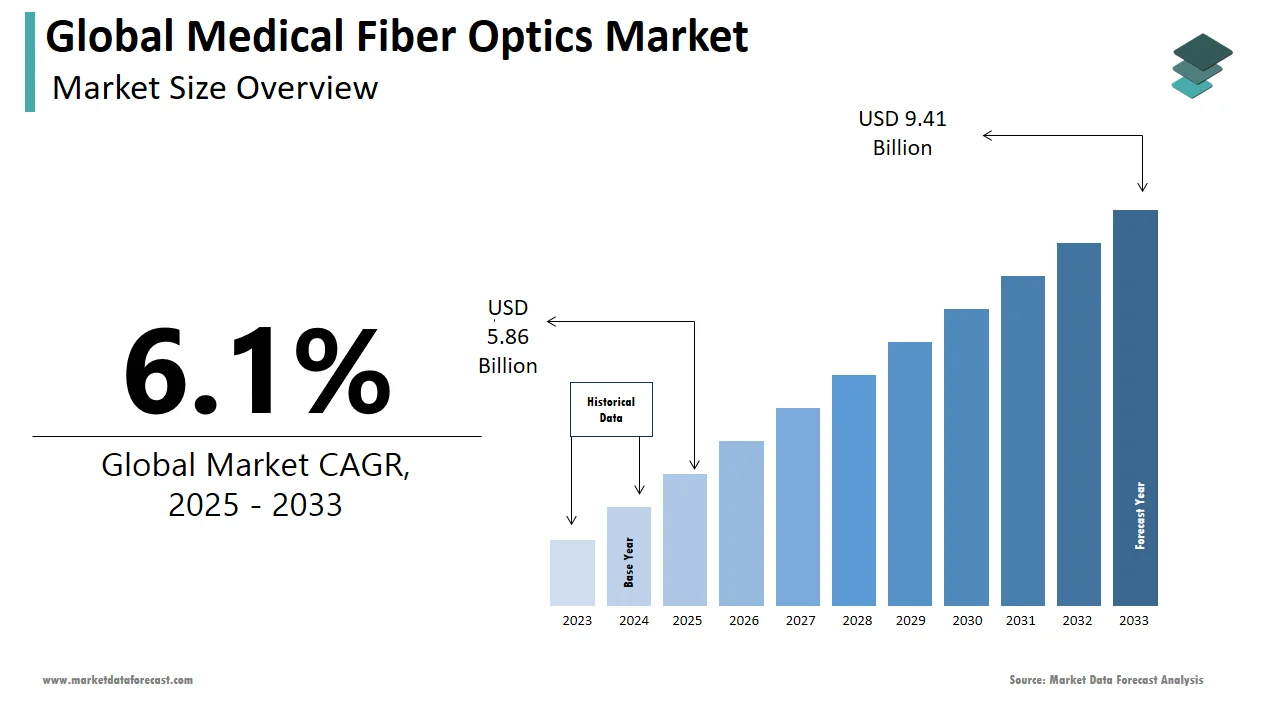
The global medical fiber optics market was valued at US$ 5.86 billion in 2025, reached US$ 6.22 billion in 2026, and is projected to scale up to US$ 9.98 billion by 2034, registering a compound annual growth rate (CAGR) of 6.1% during the forecast period from 2026 to 2034. Driven by the rising volume of minimally invasive surgeries, technological developments in diagnostics, and increasing chronic disease caseloads globally, the market continues to experience steady expansion.
Key Executive Metrics (At-a-Glance)
- 2025 Base Valuation: US$ 5.86 Billion
- 2026 Current Valuation: US$ 6.22 Billion
- 2034 Forecast Valuation: US$ 9.98 Billion
- Compound Annual Growth Rate (CAGR): 6.1% (2026–2034)
- Dominant Regional Market: North America (retaining over 40% global revenue share backed by high healthcare expenditure and advanced infrastructure)
- Key Growth Segments: Pure silica fibers, illumination & image transmission applications, reusable/disposable variants, and hospital/ASC end-user channels
Core Market Drivers & Growth Triggers
- Minimally Invasive Surgeries: Surging clinical preference for procedures utilizing flexible, miniature, and lightweight optical fibers that minimize patient morbidity and shorten hospital stays.
- Advanced Diagnostic Instruments: Growing adoption of network-linked tools (such as smartphone-connected otoscopes and endoscopes) and precision laser signal delivery applications.
Primary Market Restraints & Challenges
- Maintenance & Device Costs: High expenses associated with maintaining medical fiber optic instruments alongside stringent regulatory approval delays for new diagnostic devices.
- Contamination Risks: Potential cross-contamination risks linked with improper reprocessing of semi-disposable catheters and optical instruments.
Global Medical Fiber Optics Market Segmentation Breakdown
| Segment Category | Largest Segment / Leader | Fastest-Growing Segment |
|---|---|---|
| By Fiber Type | Pure Silica Fiber (Captured 46.8% share, driven by deep UV transmission base material and high mechanical strength) | Polymer Optical Fiber (POF) (Grows due to lower Young's modulus, higher flexibility, and cost-effective connections) |
| By Application | Illumination (Held 50.6% share utilizing low-loss optical fibers to carry laser light for surgery and photocoagulation) | Image Transmission & Laser Delivery (Expanding rapidly alongside endoscopic and diagnostic upgrades) |
| By Usage | Reusable (Dominates historical demand through biocompatible autoclavable silica configurations) | Disposable (Expanding rapidly to eliminate cross-contamination and reprocessing wear-and-tear risks) |
| By End User | Hospitals (Captures critical market value backed by high surgical procurement rates) | Ambulatory Surgical Centers (Fastest-growing healthcare facility channel prioritizing cost-efficient outpatient care) |
| By Region | North America (Leads global market revenue driven by high per capita healthcare expenditures and U.S. adoption) | Asia-Pacific (Fastest-growing regional market fueled by rising disposable incomes and expanding healthcare infrastructure in China and India) |
Major Industry Players Profiled
Key corporations shaping the global medical fiber optics market include Schott, Leoni AG, Rofin, IPG Photonics, American Medical System LLC, Applied Fiberoptics, Biolitec AG, Boston Scientific Corporation, Molex, Fiberguide Industries, and Timbercon Inc..
Global Medical Fiber Optics Market Size
The global medical fiber optics market was worth US$ 5.86 billion in 2025 and is anticipated to reach a valuation of US$ 9.98 billion by 2034 from US$ 6.22 billion in 2026, and it is predicted to register a CAGR of 6.1% during the forecast period 2026 to 2034.
Medical fiber optics are used in medical applications such as X-ray imaging, Dental, surgical & diagnostic instruments, clinical laboratories, and surgical microscopy to deliver laser signals image transfer. This fiber optics is generally used to remove the light between two ends. These are manufactured using flexible materials, i.e., glass, plastic, metal-coated silica, and plastic-clad silica. Optical fibers have small dimensions of optical-based pressure sensors for monitoring. Flexible and rigid multi-fibers help visualize internal organs and tissues through body orifices by doctors to study symptoms like nausea and abdominal pain to confirm diagnoses by performing biopsies.
With its most recent contributions of network-linked medical tools, like an otoscope or ophthalmoscope connected to a smartphone, fiber optic technology is continuing to influence healthcare. Since smartphones can transfer data through mobile communication channels, this breakthrough is helpful for researchers and medical professionals conducting their jobs in remote regions. Other applications of fiber optics in medicine include scintillation counting, pressure and location sensing, and remote spectrophotometry. These and additional applications, such as in vivo oximeters and intravascular pressure transducers, are detailed.
MARKET DRIVERS
Growing minimally invasive surgeries and technological developments in diagnostics primarily drive the global medical fiber optics market.
Growth in several people suffering from diseases such as ophthalmic, cancer, cardiac, and urology is a significant factor driving the market's demand. In addition, the increasing need for instruments and medical devices to monitor results accurately further accelerates the medical fiber optics market growth. Furthermore, fiber optics can improve operation effectiveness & decrease the data loss risk from electronic device systems, accelerating market demand.
Medical Optics Fiber can be placed in a particular space between a restricted environment, such as Minimally Invasive Surgery and an X-ray machine. The demand for optics fiber in healthcare accelerates the trends of medical devices & instruments in critical surgeries. The advantages offered by optical fibers are non-toxicity, miniature, flexibility, dielectric, thin, and chemical inertness. The most significant Impact of the increased use of fiber optic technology in surgery includes decreased morbidity associated with invasive surgeries, reduced length of hospital stay, and reduced time spent in the hospital.
The primary factor driving the growth of the global medical fiber optics market is the vastly profitable advancements in this field, which have proven helpful in several areas of medical practice, including urology, ophthalmology, and cardiology, since fiber optic instrumentation is ideal for space-constrained applications like surgical endoscopes and catheters, the fiber being flexible, miniature, and lightweight, all that a medical device industry needs along with being cost-effective solution with the maintenance and sterilization process of reusable devices.
Developing disposable fiber optic catheters or endoscopes for invasive surgery has produced several advantages over older surgical methods, including avoiding any incidental contamination associated with reusing a semi-disposable device. Furthermore, advances in the development of fiber optic medical instruments may provide alternatives to sterilization and reuse of semi-disposable devices, including the prevention of problem of contamination, which can occur during the sterilization process, resulting in transmission of and infectious agents, such as prions, through water or reprocessing equipment. Nowadays, the frequent adoption of single-use fiber optic catheters, which may also reduce the risk of disease transmission to other patients, is due to the reduced maintenance costs due to wear and tear, which prove to be safer for the patient and improve the quality of care.
MARKET RESTRAINTS
The high cost of maintaining medical fiber optic-based instruments and devices is hampering the global medical fiber optics market growth. In addition, the delay in the approvals of the regulatory body for developing new diagnostic devices is restraining the market growth. Furthermore, chemotherapy treatment for cancer diseases requires a high intensity of light, limiting the demand of the market. Moreover, it has been claimed by many industry players that semi-disposable catheters carry a risk of accidental contamination and possible transmission of pathogens during surgery and after reprocessing, further hampering the market growth.
REPORT COVERAGE
| REPORT METRIC | DETAILS |
| Market Size Available | 2025 to 2034 |
| Base Year | 2024 |
| Forecast Period | 2026 to 2034 |
| Segments Covered | By Fiber Type, Application, Usage, End User, and Region. |
| Various Analyses Covered | Global, Regional and Country-Level Analysis, Segment-Level Analysis, Drivers, Restraints, Opportunities, Challenges; PESTLE Analysis; Porter’s Five Forces Analysis, Competitive Landscape, Analyst Overview of Investment Opportunities |
| Regions Covered | North America, Europe, Asia Pacific, Latin America, Middle East & Africa |
| Market Leaders Profiled | Schott, Leoni AG, Rofin, IPG Photonics, American Medical System LLC, applied fiberoptics Biolitec AG, Boston Scientific Corporation, Molex, Fiberguide Industries, Timbercon Inc., and Others. |
SEGMENTAL ANALYSIS
By Fiber Type Insights
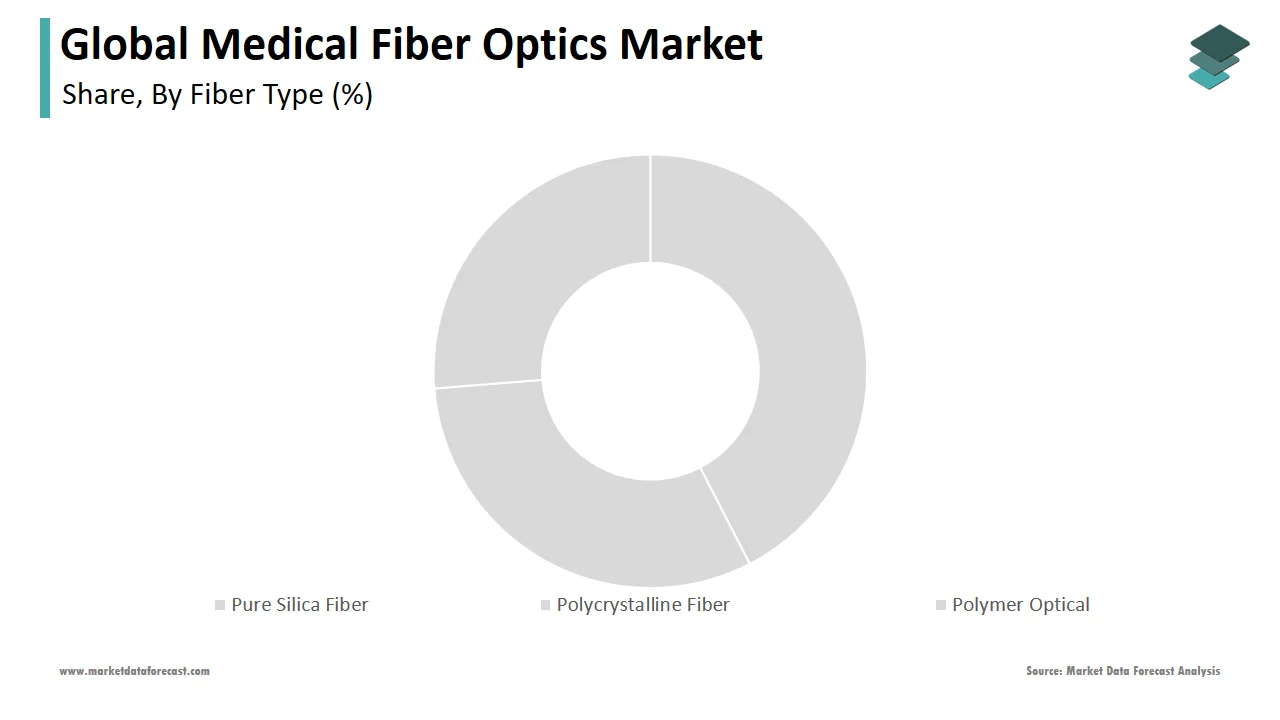
Based on the fiber type, the pure silica fiber segment accounted for 46.8% of the global medical fiber optics market share in 2023. It will likely grow with a CAGR value of 5.8% during the forecast period. The growth is driven due to advanced technologies and agile development in fiber technology. Also, massive demand for silica medical fiber optics is anticipated to fuel the market's need. Pure silica could be used as the base material for deep UV transmission. Fibers doped with silica serve as power fibers for transmitting laser energy since silica has surprisingly high mechanical strength, which resists bending and pulling, which can be further improved by coating with a suitable polymer.
Polymer optical fiber (POF) is also foreseen to dominate the market owing to additional advantages provided by the sensors like lower Young's modulus, high flexibility, higher yield strengths, less expensive connection, and superior flexibility with a better transmission technology than silica-based systems.
By Application Insights
Based on the Application, the illumination segment had a 50.6% share in the global market and was predicted to grow at a CAGR of 7.8% over the analysis period. Low-loss optical fibers are utilized to carry laser light for surgery and photocoagulation.
Image Transmission is also anticipated to hold a significant market share since it allows the doctor to see a picture of the inside, which further help diagnose diseases such as cancer. In addition, it is used to see during minimally invasive surgery by carrying some light into the body and some light reflected from the body's internal surfaces outward.
By Usage Insights
The reusable segment is observed to witness the most significant market over the medical fiber optics market based on the usage type. The growth is due to different technological upgrades in the medical field, which have decreased its size. This reusable can be used again once they are done with sterilization. It is a biocompatible autoclavable silica fiber used for a wide range of wavelengths and applications and helps in protected cleaning and sterilization; a sturdy screw cap connects its fiber.
Disposable optical fiber, biocompatible silica-based fiber, is presumed to dominate in this segment. All fibers are made from high-quality silica, providing a wide range of wavelengths and applications, optimizing the delivery of laser energy to the surgical site, and used with compatible instruments such as rigid and flexible endoscopes and surgical laser applicators.
By End-users Insights
Based on the end-users, the hospital's segment is expected to have a critical market value during the period. Factors such as increasing the obtainment of advanced technologies for surgeries in hospitals and treatment for multiple diseases are expected to fuel medical fiber optics.
The ASC, on the other hand, is the fastest growing healthcare facility and is proving to be gaining patients satisfaction with the outcome of the surgery, low cost, and quality of care they receive and also impressed with the way the facility is run, which is why the ambulatory surgical centers are also expected to grow over the forecast period.
REGIONAL ANALYSIS
North America Medical Fiber Optics Market Analysis
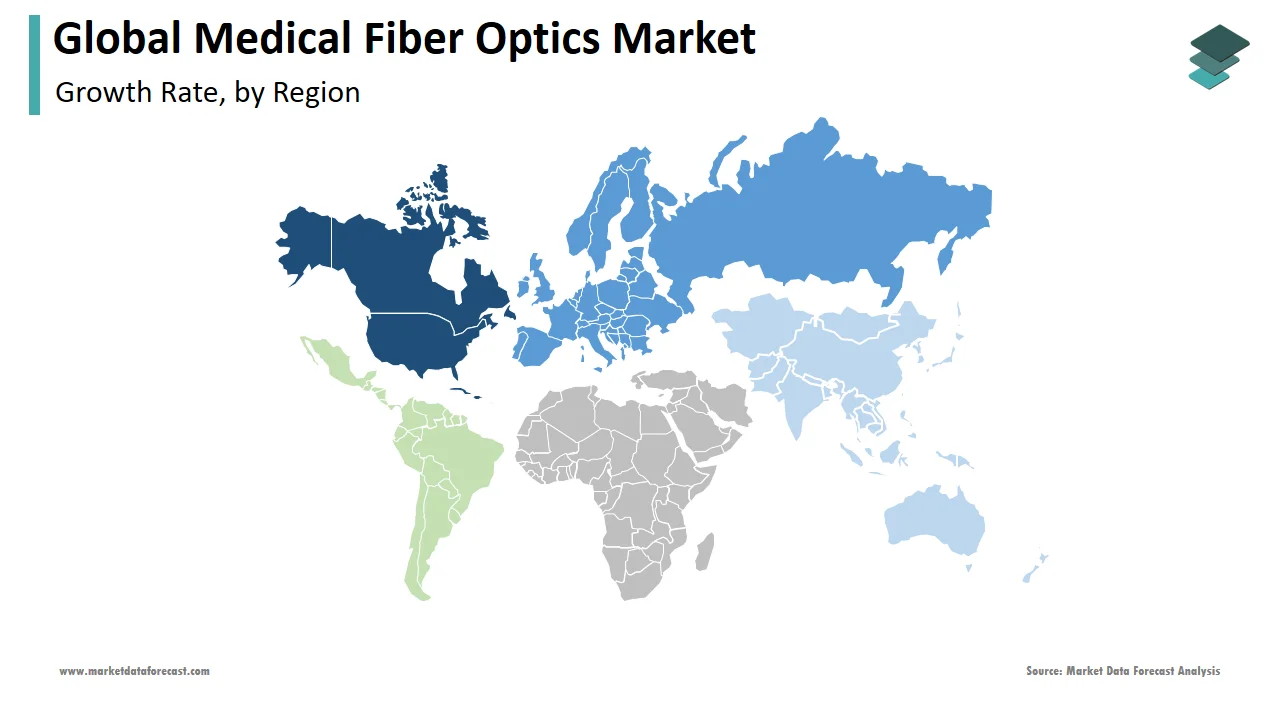
Geographically, the global medical fiber optics market was dominated by the North American medical fiber optics market, with an overall market share of over 40% globally. Europe and Asia-Pacific followed North America. However, North America is dominating the medical fiber optics market in the present situation. The growth is due to high per capita income and healthcare expenditure. By country, the U.S. is the largest market of medical fiber optics.
Europe Medical Fiber Optics Market Analysis
Europe's medical fiber optics market occupied the second-largest share over the analysis period. This region's growth is attributed to different advanced technologies in the medical field; the increasing aging population and per capita income are fuelling the market growth. Moreover, strict rules to be followed and the risks involved with the high intensity of optical light are hampering Europe's growth.
Asia Pacific Medical Fiber Optics Market Analysis
The Asia Pacific medical fiber optics market is predicted to increase in the coming years. Existence of highly fulfilled and improving healthcare infrastructure. Increasing awareness about advanced technologies in surgical technologies is encouraging the growth of Asia-Pacific. Existing countries like China and India are considered the quick-growing markets for the medical fiber optics market. The increase in these countries is due to high disposable income levels.
COMPETITIVE LANDSCAPE
The medical fiber optics market is growing faster in North America, with prominent players investing. American Medical System LLC, applied fiberoptics Inc, Biolitec AG, Boston scientific corporation, Molex, Fiberguide industries. These are the most recent critical players in this segment. Molex produces large core multimode silica-based polymer coating films used in laser surgeries. Gulf Fiberoptics, another segment major, exhibited a technology mixing fiberoptics and photonics at the conference in San Francisco. These key players play a significant role in minimally invasive and non-invasive surgeries. The growth of electronics and increased R&D of these companies in developing the best quality lasers and fiberoptics propel the market's growth. With the support of the native governments and massive R&D investments, these key players are propelling the growth of fiber optics markets. They are also striving for cost-effective solutions in the diagnosis of the disorders.
KEY MARKET PLAYERS
Some of the major companies dominating the global medical fiber optics market profiled in the report are
- Schott
- Leoni AG
- Rofin
- IPG Photonics
- American Medical System LLC
- Applied Fiberoptics
- Biolitec AG
- Boston Scientific Corporation
- Molex
- Fiberguide Industries
- Timbercon Inc.
GLOBAL MEDICAL FIBER OPTICS MARKET NEWS
- In Aug 2022, a project at National Yang-Ming Chiao Tung University made a breakthrough through its creation of a susceptible fiber-optic sugar sensor with the coating of spider silk with a metallic nanolayer with superior optomechanical properties, as reported in Biomedical Optics Express, which might provide a new way to perform accurate and sensitive online sugar measurements for point-of-care diagnostics.
- In July 2022, a photoacoustic imaging endoscope probe was created by researchers using two thin optical fibers, which combine light and sound to create 3D images, can fit inside a medical needle, and provide important clinical information.
MARKET SEGMENTATION
This research report on the global medical fiber optics market has been segmented based on the fiber type, application, usage, end-user, and region.
By fiber type
- Pure Silica Fiber
- Polycrystalline Fiber
- Polymer Optical
By Application
- Image Transmission
- Illumination
- Laser Signal Delivery
- Fiber Optic Confocal Scanning
- Laser Soldering
By Usage
- Reusable
- Disposable
By End-users
- Hospitals
- Specialty Clinics
- Ambulatory Surgical Centres
- Diagnostic Laboratories
By Region
- North America
- Europe
- Asia-Pacific
- Latin America
- Middle East and Africa