- Product Description Description
- Table of Contents TOC
- List of Table & Figure LOT
- Get Free Sample PDF Sample PDF
Global Metal Fabrication Market Summary
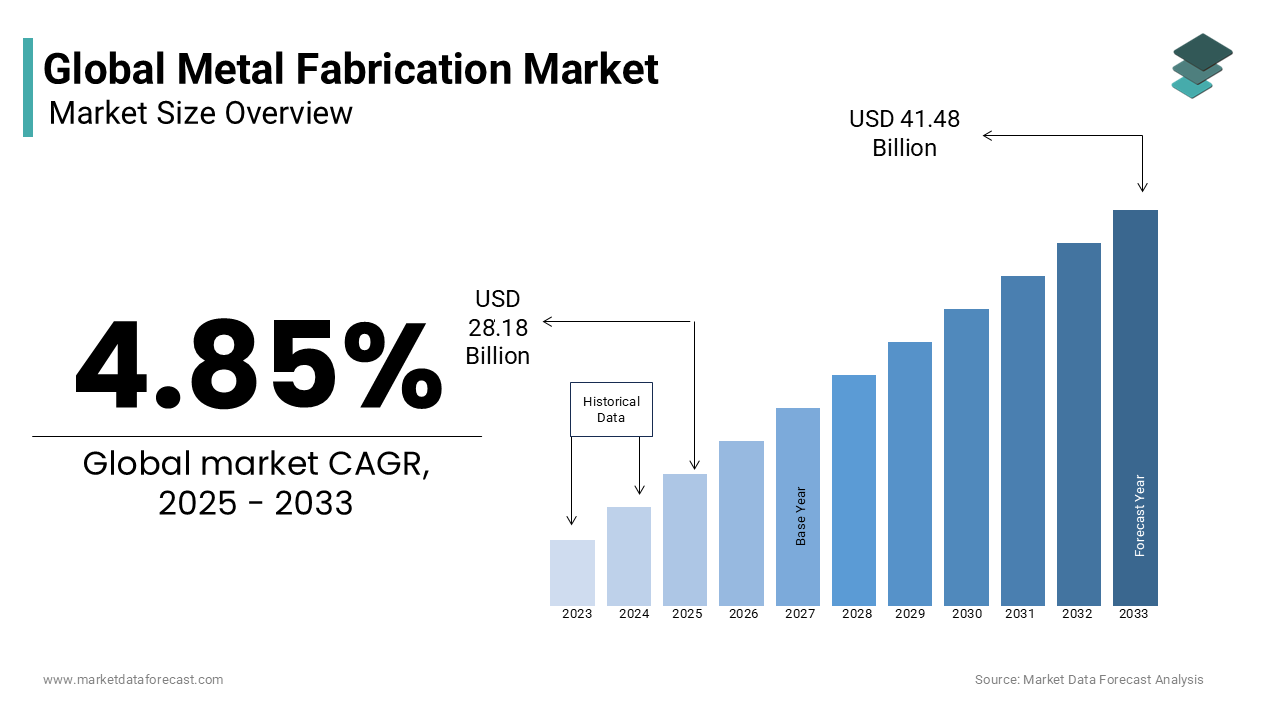
The global metal fabrication market was valued at USD 26.85 billion in 2024 and is projected to reach USD 28.18 billion in 2025 and USD 41.48 billion by 2033, growing at a CAGR of 4.85% from 2025 to 2033. The growth of the metal fabrication market is driven by increasing infrastructure and construction projects, rising demand for customized metal components across industrial sectors, advancements in fabrication technologies, and expanding automotive and machinery manufacturing activities.
Key Market Trends
- Rising adoption of automated and precision metal fabrication technologies.
- Increasing use of carbon steel and advanced alloys for durable and cost-effective fabrication.
- Growing demand from the construction, automotive, and heavy machinery sectors.
- Expansion of customized and contract manufacturing services for industrial clients.
- Technological advancements in laser cutting, CNC machining, and welding processes are enhancing efficiency.
Segmental Insights
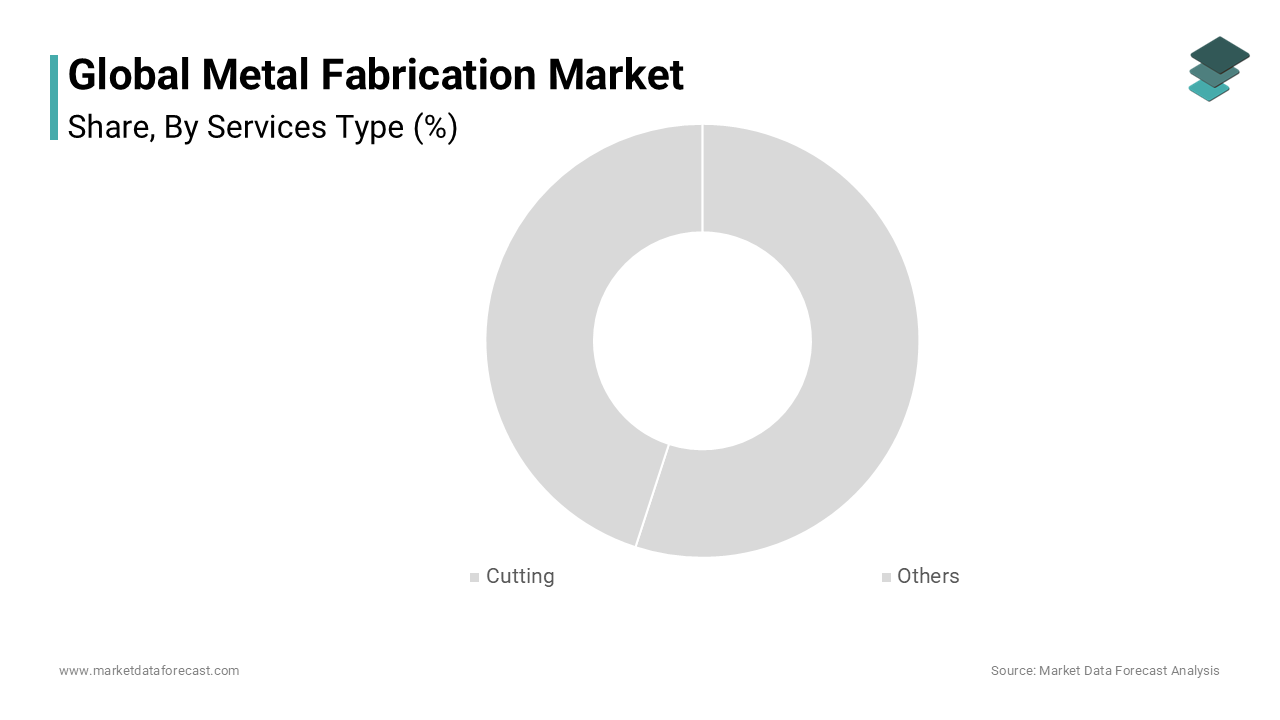
- Based on service type, the cutting segment dominated the market in 2024 with a 42.3% share, supported by high demand for precision-cut components.
- Based on material, the carbon steel segment accounted for a 58.3% share in 2024, due to its strength, affordability, and wide industrial applicability.
- Based on end-user industry, the construction and infrastructure segment held the largest share of 39.3% in 2024, driven by ongoing urbanization and infrastructure development.
Regional Insights
- Asia-Pacific was the leading region in the global metal fabrication market with a 44.3% share in 2024, fueled by rapid industrialization, a growing manufacturing base, and high infrastructure investments.
- North America showed steady growth due to the modernization of manufacturing facilities and the adoption of advanced fabrication technologies.
- Europe witnessed moderate growth supported by the automotive and aerospace industries and strong industrial standards.
- Latin America experienced gradual expansion driven by industrial development and construction activities.
- Middle East & Africa is emerging as a potential market due to infrastructure development and increased metal component demand.
Competitive Landscape
The global metal fabrication market is competitive, with key players focusing on technological advancements, capacity expansion, and strategic partnerships. Prominent companies include O’Neal Manufacturing Services, Mayville Engineering Company (MEC), BTD Manufacturing Inc., Kapco Metal Stamping, Watson Engineering, Matcor-Matsu Group, Standard Iron & Wire Works, Reliance Steel & Aluminum, ArcelorMittal S.A., Nucor Corporation, Thyssenkrupp AG, Tata Steel Limited, POSCO, Nippon Steel Corporation, Howmet Aerospace, AMETEK, and Parker-Hannifin.
Global Metal Fabrication Market Size
The global metal fabrication market was valued at USD 26.85 billion in 2024, is estimated to reach USD 28.18 billion in 2025, and is projected to reach USD 41.48 billion by 2033, growing at a CAGR of 4.85% from 2025 to 2033.
The metal fabrication is a network of processes including cutting, bending, and assembling that employed to transform raw metal materials into finished or semi-finished products for diverse industrial applications. This sector serves as a foundational pillar for industries such as construction, transportation, energy, and heavy machinery. As per the International Organization for Standardization, metal fabrication adheres to stringent quality benchmarks under ISO 3834, which governs welding quality requirements, ensuring structural integrity across fabricated components.
MARKET DRIVERS
Expansion of Renewable Energy Infrastructure
The global push toward renewable energy systems is significantly amplifying the growth of metal fabrication market. Wind turbine towers, nacelles, and support structures require extensive fabrication using high-strength steel alloys, with each utility-scale turbine containing approximately 120 to 230 tons of steel, as detailed by the Global Wind Energy Council. Additionally, solar farms rely on custom-fabricated mounting structures and tracking systems, with the International Renewable Energy Agency noting that utility-scale solar installations require between 25 to 35 tons of structural steel per megawatt.
Resurgence of Onshoring in Industrial Manufacturing
The shift toward onshoring and nearshoring of manufacturing operations in North America and Western Europe, is accelerating the growth of metal fabrication market. As per the Reshoring Initiative, U.S. companies reshored over 350,000 manufacturing jobs between 2010 and 2023, driven by supply chain vulnerabilities exposed during global disruptions. This transition has led to increased reliance on local fabricators for just-in-time production of components in automotive, aerospace, and industrial equipment sectors.
MARKET RESTRAINTS
Chronic Skilled Labor Shortage in Precision Fabrication
The persistent deficit in skilled trades personnel, particularly welders, CNC operators, and certified fabricators is hampering the growth of metal fabrication market. As per the American Welding Society, the United States alone anticipates a shortfall of approximately 375,000 welders by 2026, a gap exacerbated by an aging workforce and insufficient vocational training pipelines. The average age of a certified welder in the U.S. exceeds 55, according to the Fabricators & Manufacturers Association, indicating an impending wave of retirements without adequate replacements.
Volatility in Raw Material Supply Chains
Metal fabrication remains highly sensitive to fluctuations in the availability and pricing of primary inputs such as steel, aluminum, and specialty alloys is hampering the growth of metal fabrication market. In early 2023, the London Metal Exchange observed a 27% spike in aluminum prices over six months, triggered by energy constraints in European smelters, forcing many fabricators to renegotiate contracts or delay orders. According to the Institute for Supply Management, 62% of metal fabricators reported material delivery delays exceeding four weeks in 2023.
MARKET OPPORTUNITIES
Integration of Digital Twins and Smart Fabrication Systems
The adoption of digital twin technology virtual replicas of physical fabrication systems is enabling unprecedented precision, predictive maintenance, and process optimization across modern metalworking facilities. As per the International Society of Automation, manufacturers utilizing digital twins report a 30% reduction in machine downtime and up to 25% improvement in throughput efficiency. Siemens Energy, for instance, implemented digital twin models in its turbine component fabrication lines, achieving a 40% faster prototyping cycle. The U.S. Department of Energy’s Advanced Manufacturing Office confirms that smart fabrication systems integrated with IoT sensors and AI analytics can reduce material waste by 18% on average.
Growth in Modular and Offsite Construction
The construction industry’s pivot toward modular and prefabricated building systems is also to elevate the growth of metal fabrication market. Each modular unit typically contains over 1.2 tons of structural steel, as documented by the National Institute of Building Sciences. In healthcare and education infrastructure, where precision and compliance are paramount, prefabricated steel modules account for nearly 45% of new builds in Scandinavia, as reported by the Nordic Built Environment Council.
MARKET CHALLENGES
Compliance with Evolving Environmental Regulations
Metal fabrication facilities are increasingly subject to stringent emissions and waste management regulations, particularly concerning particulate matter, volatile organic compounds, and hazardous byproducts from cutting and welding operations. As per the European Environment Agency, industrial metal processing accounts for approximately 8% of total industrial PM10 emissions in the EU, prompting tighter enforcement under the Industrial Emissions Directive. A survey by the Canadian Fabrication Association found that 64% of mid-sized fabricators spent over $120,000 annually on compliance upgrades between 2021 and 2023.
Cybersecurity Risks in Digitized Production Networks
They become increasingly vulnerable to cyber threats, as metal fabrication plants adopt connected machinery, cloud-based design platforms, and automated control systems. According to the Cybersecurity and Infrastructure Security Agency, the manufacturing sector experienced a 300% increase in ransomware attacks between 2020 and 2023, with metal fabricators being prime targets due to their integration in supply chains. In 2022, a cyberattack on a major U.S. steel fabricator disrupted CNC operations for 11 days, delaying shipments worth $27 million, as reported by the National Association of Manufacturers.
REPORT COVERAGE
| REPORT METRIC | DETAILS |
| Market Size Available | 2024 to 2033 |
| Base Year | 2024 |
| Forecast Period | 2025 to 2033 |
| Segments Covered | By Service Type, Material, End-User Industry, and Region. |
| Various Analyses Covered | Global, Regional, & Country Level Analysis; Segment-Level Analysis, Drivers, Restraints, Opportunities, Challenges, PESTLE Analysis, Porter’s Five Forces Analysis, Competitive Landscape, Analyst Overview of Investment Opportunities |
| Regions Covered | North America, Europe, Asia Pacific, Latin America, Middle East, and Africa |
| Key Market Players | O’Neal Manufacturing Services, Mayville Engineering Company (MEC), BTD Manufacturing Inc., Kapco Metal Stamping, Watson Engineering, Matcor-Matsu Group, Standard Iron & Wire Works, Reliance Steel & Aluminum, ArcelorMittal S.A., Nucor Corporation, Thyssenkrupp AG, Tata Steel Limited, POSCO, Nippon Steel Corporation, Howmet Aerospace, AMETEK, and Parker-Hannifin. |
SEGMENTAL ANALYSIS
By Service Type Insights
The cutting segment dominated the global metal fabrication market by capturing 42.3% of the share in 2024 with its foundational role in nearly all downstream fabrication workflows. Cutting is the initial and most phase in shaping raw metal stock, and its widespread application across industries from aerospace to heavy machinery. According to the Association for Manufacturing Technology, over 78% of CNC machine installations in 2022 were dedicated to laser and plasma cutting systems.
The "Others" category is projected to grow with a CAGR of 7.8% during the forecast period with the rising demand for integrated, end-to-end fabrication solutions that combine multiple secondary processes. The aerospace and defense sectors are demanding complex assemblies requiring precision welding and post-cut forming, with Boeing reporting that each 787 Dreamliner contains over 2.3 million rivets and 38 miles of welded seams. The structural steel components now mandates full traceability across all fabrication stages, including post-cut operations, which is further boosting demand for holistic service packages.
By Material Insights
The carbon steel segment was accounted in holding 58.3% of the metal fabrication market shar ein 2024 with its exceptional balance of strength, weldability, and cost efficiency by making it the material of choice for structural frameworks, industrial machinery, and energy infrastructure. According to the American Institute of Steel Construction, 95% of non-residential steel buildings in the United States utilize carbon steel due to its compliance with ASTM A36 and A572 standards.
The "Others" material segment is anticipated to grow at a CAGR of 8.3% during the forecast period with the increasing demand in high-performance and corrosion-sensitive applications. According to the Food and Drug Administration mandates the use of AISI 304 or 316 stainless steel in all food-contact surfaces, a regulation that has driven a 19% year-on-year increase in stainless fabrication for processing equipment since 2021. Meanwhile, aluminum usage in transportation has surged, with the Aluminum Association reporting that the average North American passenger vehicle now contains 408 pounds of aluminum.
By End-User Industry Insights
The construction and infrastructure segment in the metal fabrication market by accounting for 39.3% of share in 2024 with the sector’s reliance on structural steel frameworks, bridges, and utility support systems, particularly in urbanization-driven economies. The United Nations estimates that 2.4 billion people will be added to urban populations by 2050. According to the Ministry of Housing and Urban-Rural Development, over 1.8 million metric tons of fabricated steel were used in bridge construction during 2022 in China. Moreover, the American Road and Transportation Builders Association states that 43% of U.S. bridges require repair or replacement, with steel-intensive rehabilitation projects accelerating fabrication demand.
The energy sector is swiftly emerging with an expected CAGR of 9.1% throughout the forecast period with the global transition toward wind, solar, and hydrogen infrastructure, all of which depend heavily on custom-fabricated metal components. Solar farms, meanwhile, demand extensive use of aluminum and galvanized steel mounting structures. According to the International Renewable Energy Agency estimates that 1 GW of solar capacity requires 25,000 to 35,000 tons of structural metal. In hydrogen production, the U.S. Department of Energy notes that each gigawatt-scale electrolyzer plant requires over 12,000 tons of pressure vessels and piping, predominantly fabricated from high-grade alloys.
REGIONAL ANALYSIS
Asia Pacific metal fabrication market Analysis
Asia Pacific was the top performer of the global metal fabrication market by capturing 44.3% of share in 2024 with its industrial scale, export-oriented manufacturing, and rapid urbanization. China alone produces over 55% of the world’s crude steel, according to the China Iron and Steel Association, providing a robust feedstock base for domestic fabricators. India’s National Steel Policy aims to triple steel production to 300 million tons by 2030, directly stimulating fabrication activity in construction and rail infrastructure. Over 70% of commercial buildings in Tokyo are steel-framed, which is likely to increase the demand for the advanced fabrication adoption.
North America metal fabrication market Analysis
North America metal fabrication market is expected to have a significant growth of the technologically advanced fabrication ecosystem. According to the Canada’s Natural Resources Department, over 80% of oil sands facilities in Alberta rely on locally fabricated pressure vessels and piping systems.
Europe metal fabrication market Analysis
Europe metal fabrication market growth is likely to grow with a strong emphasis on quality, sustainability, and engineering excellence. Germany, the industrial core, accounts for 31% of Europe’s fabricated metal output, according to the German Engineering Federation (VDMA), with companies like Siemens and ThyssenKrupp leading in turbine and industrial plant fabrication. France’s Grand Défi program is modernizing 1,500 km of rail lines, involving extensive steel bridge and tunnel fabrication. Stringent environmental regulations under the EU Emissions Trading System are also pushing fabricators to adopt low-carbon processes, which is positioning Europe as a leader in sustainable metalworking innovation.
Middle East & Africa metal fabrication market Analysis
Middle East & Africa metal fabrication market growth is expected to grow steadily with increasingly concentrated in Gulf Cooperation Council (GCC) nations. In the UAE, the Dubai Supreme Council of Energy mandates that 75% of components in solar projects like Mohammed bin Rashid Al Maktoum Solar Park be locally sourced. South Africa remains a key hub in sub-Saharan Africa, with the Steel Master Plan aiming to increase local fabrication value addition to 60% by 2030.
Latin America metal fabrication market Analysis
Latin America metal fabrication market is expected to grow steadily in next coming years. Brazil and Mexico are major contributors for the growth of the market in this region. Chile’s mining sector, responsible for 28% of global copper production, relies heavily on custom-fabricated crushers, conveyors, and processing units, as documented by the Chilean Copper Commission.
COMPETITIVE LANDSCAPE
The metal fabrication market exhibits a fragmented yet highly competitive landscape, characterized by the coexistence of large multinational corporations and regional specialist fabricators. Competition is driven by technological capability, quality certification, delivery speed, and cost efficiency. Major players differentiate through automation, precision engineering, and compliance with international standards such as ISO 3834 and EN 1090. Price pressures from low-cost regional suppliers, particularly in South and Southeast Asia, intensify rivalry among mid-tier fabricators. Innovation in digital manufacturing and sustainability practices has become a key differentiator. Contract bidding for large infrastructure and energy projects often determines market positioning, with performance history and technical expertise playing decisive roles.
KEY MARKET PLAYERS
A few of the major companies in the global metal fabrication market include
- O’Neal Manufacturing Services
- Mayville Engineering Company (MEC)
- BTD Manufacturing Inc.
- Kapco Metal Stamping
- Watson Engineering
- Matcor-Matsu Group
- Standard Iron & Wire Works
- Reliance Steel & Aluminum
- ArcelorMittal S.A.
- Nucor Corporation
- Thyssenkrupp AG
- Tata Steel Limited
- POSCO
- Nippon Steel Corporation
- Howmet Aerospace
- AMETEK
- Parker-Hannifin
Top Players in the Metal Fabrication Market
Larsen & Toubro Limited
Larsen & Toubro (L&T) is a dominant engineering and construction conglomerate headquartered in India, with extensive operations across the Asia Pacific metal fabrication landscape. The company operates advanced fabrication yards in Hazira, Vizag, and Coimbatore, specializing in heavy structural steel, pressure vessels, and offshore platforms for oil and gas, power, and infrastructure sectors. L&T has consistently invested in automation, integrating robotic welding cells and CNC cutting systems to enhance precision and throughput. In 2023, it commissioned a new digital fabrication hub in Chennai, leveraging Building Information Modeling (BIM) and AI-driven nesting software to optimize material utilization.
Shanghai Zhenhua Heavy Industries Co., Ltd. (ZPMC)
Shanghai Zhenhua Heavy Industries, a subsidiary of China Communications Construction Company, is a leading force in large-scale metal fabrication, particularly in port machinery, offshore structures, and bridge components across the Asia Pacific region. The company operates one of the largest fabrication complexes in Changxing Island, equipped with automated assembly lines and high-capacity cranes capable of handling mega-structures. The firm has also expanded into offshore wind foundation fabrication, supplying jacket and monopile structures for projects in Taiwan and Vietnam.
Nippon Steel & Sumitomo Metal Corporation (NSSMC)
Nippon Steel & Sumitomo Metal Corporation plays a pivotal role in Japan’s metal fabrication ecosystem, integrating upstream steel production with downstream precision fabrication for automotive, rail, and industrial machinery sectors. The company operates integrated facilities where steel is directly processed into fabricated components, minimizing supply chain delays and ensuring material traceability. NSSMC has pioneered the use of ultra-high-strength steel in lightweight vehicle frames, collaborating with Toyota and Honda to reduce emissions through advanced stamping and laser-welding techniques.
Top Strategies Used by the Key Market Participants
Key players in the metal fabrication market are deploying strategic initiatives to enhance competitiveness, including vertical integration, digital transformation, and geographic expansion. Companies are investing in automated cutting and welding systems to improve precision and reduce labor dependency. Strategic partnerships with engineering firms and OEMs enable end-to-end project delivery. Capacity expansion through new fabrication yards in emerging markets strengthens regional presence. Adoption of Industry 4.0 technologies such as IoT-enabled machinery, digital twins, and AI-based predictive maintenance optimizes production efficiency.
MARKET SEGMENTATION
The research report on the global metal fabrication market has been segmented and sub-segmented based on categories.
By Service Type
- Cutting
- Others
By Material
- Carbon Steel
- Others
By End-User Industry
- Construction & Infrastructure
- Others
By Region
- North America
- Europe
- Asia-Pacific
- Latin America
- Middle East and Africa