- Product Description Description
- Table of Contents TOC
- List of Table & Figure LOT
- Get Free Sample PDF Sample PDF
Market Size, 2025
$6.56 BnMarket Estimate, 2026
$7.06 BnMarket Forecast, 2034
$12.77 BnCAGR, 2026–2034
7.68%Executive Summary: Global Microarray Analysis Market
- Market Scope: Comprehensive global analysis of the microarray analysis sector, detailing product categories, microarray types, research and diagnostic applications, end-user settings, and regional market landscapes.
- Market Valuation: Valued at USD 6.56 billion in 2025, reaching USD 7.06 billion in 2026, and projected to expand to USD 12.77 billion by 2034, growing at a robust CAGR of 7.68% from 2026 to 2034.
- Primary Growth Drivers: Rising prevalence of cancer and genetic disorders, expanding applications in genotyping and drug discovery, increased government and private funding for genomics and proteomics research, and growing demand for personalized medicine.
Key Market Segment Metrics
| Category | Leading Segment (Base Position) | Fastest-Growing / High-Growth Segment |
|---|---|---|
| By Product | Consumables (dominated the market share, driven by recurring usage in hybridization assays, probes, and methylation studies) | Software and Services (high-growth segment propelled by advanced bioinformatics data processing and genomic analysis software) |
| By Type | DNA Microarrays (led the market via extensive utilization in clinical diagnostics, cancer research, and gene expression profiling) | Protein Microarrays (fastest-growing segment driven by simultaneous multiplex protein analysis and biomarker discovery) |
| By Application | Research Applications (accounted for the largest share backed by heavy funding for genomics and proteomics initiatives) | Drug Discovery (high-growth segment fueled by target identification and pharmacogenomics research) |
| By End User | Research and Academic Institutes (leading contributor supported by numerous research projects and government grants) | Pharmaceutical and Biotechnology Companies (fastest-growing segment driven by drug development and clinical trial workflows) |
| By Region | North America (market leader backed by advanced healthcare infrastructure, high cancer incidence, and major key players) | Asia-Pacific (fastest-growing regional market driven by improving healthcare facilities, rising geriatric populations, and expanding R&D investments) |
Major Market Players & Industry Landscape
Market Structure: Highly competitive environment characterized by strategic technology acquisitions, single-cell isolation advancements, and continuous innovations in genomic platforms by leading life science enterprises.
Key Companies: Thermo Fisher Scientific, Agilent Technologies, Molecular Devices, PerkinElmer, Illumina, GE Healthcare, and Bio-Rad Laboratories.
 Download Free Sample Report
Global Microarray Analysis Market Size
The global microarray analysis market was valued at USD 6.56 billion in 2025, is estimated to reach USD 7.06 billion in 2026, and is projected to reach USD 12.77 billion by 2034, growing at a CAGR of 7.68% from 2026 to 2034.

Microarray Analysis is a beneficial laboratory tool for simultaneously detecting thousands of gene expressions through microscope slides with thousands of tiny dots containing a known DNA sequence or gene in each, called gene chips or DNA chips. The most preferred sample for microarray analysis is a blood sample, which helps find tiny extra or missing chromosome fragments that are unrecognizable by a microscope. In addition, DNA molecules act as probes for detecting a transcriptome, also called mRNA transcripts, helping identify single nucleotide polymorphisms (SNPs) and mutation identification. These not only help in the identification of related genes to drug resistance and drug discovery but also help in the identification of tumor suppressor target genes, classification of tumors, and identification of cancer biomarkers.
MARKET DRIVERS
The rising prevalence of cancer is one of the many factors driving the growth of the global microarray analysis market in recent years.
In addition, the increasing use of microarrays in applications such as genotyping, measurement of disease susceptibility, drug discovery, forensic analysis, assessment of gene mutations in cancers, and pharmacogenomics research drives the market growth in the coming years.
cDNA arrays can only be used for gene expression analysis, but oligonucleotide arrays can be used for mutation genotyping and gene expression analysis. These DNA chips are used for the diagnosis of various types of cancer. The DNA molecules are diagnosed using DNA chips and help determine disease progression. The accuracy of mutation detection is high using microarrays. The increasing prevalence of cancer globally supports the growth of the market. According to the WHO, cancer is the second leading cause of death worldwide, with reports indicating over 8.8 million deaths in 2015.
Additionally, from the GLOBOCAN reports, the cancer incidence rate will increase from 14.14 million in 2012 to 21.7 million by 2030. In 2015, over 15.24 million cancer cases were diagnosed globally, and 57.55% were reported in live developing countries in Africa, Latin America, and Asia. Moreover, microarray technology is also used in immunological research, such as studying the relationship between phenotype and gene expression, immune cell activation and differentiation, regulation of immune responses, analysis of the molecular mechanisms of allergy, and immunological pharmacology. All these applications provide market growth opportunities in the years to come.
The utilization of a microarray enables the analysis of numerous previously unrecorded or fresh samples and the testing of the prevalence of a particular marker in the tumor. DNA chips have just lately been used a minimal amount in dentistry, but if the technology becomes more widely available and less expensive, its use may expand. For example, association and linkage studies can use the genotyping of hundreds of distinct loci at once, made possible by microarray technology, to identify chromosomal areas associated with a particular disease. Additionally, this network can be utilized to find chromosomal abnormalities linked to cancer, such as allelic imbalance regions that can be recognized by loss of heterozygosity.
Owing to the wide variety of microarray applications, the market is anticipated to grow even in underdeveloped and developing regions across the globe. In addition, factors such as applications of research based on DNA chips, increasing awareness, the presence of the senior population who are more prone to cancer, and favorable government initiatives will provide growth opportunities for the market.
MARKET RESTRAINTS
On the contrary, the global microarray analysis market will be hampered by the rapid advancements in next-generation DNA sequencing (NSG) technology which has proven to be more cost-effective and accurate, coupled with stringent government regulations, lack of trained professionals, and database standardization.
The availability of such substitutes and alternative means of analysis will challenge the market growth. For example, RNA sequencing allows complete sequencing of the entire transcriptome, while microarray analysis only profiles genes by hybridization. Moreover, the global microarray analysis market in regions like Africa will witness restrained growth due to underdeveloped healthcare institutions, lack of awareness, inadequate funds, and poor research facilities.
REPORT COVERAGE
| REPORT METRIC | DETAILS |
| Market Size Available | 2025 to 2034 |
| Base Year | 2025 |
| Forecast Period | 2026 to 2034 |
| Segments Covered | By Product, Type, Application, End user & Region. |
| Various Analyses Covered | Global, Regional and Country-Level Analysis, Segment-Level Analysis, Drivers, Restraints, Opportunities, Challenges; PESTLE Analysis; Porter’s Five Forces Analysis, Competitive Landscape, Analyst Overview of Investment Opportunities |
| Regions Covered | North America, Europe, Asia Pacific, Latin America, Middle East & Africa |
| Market Leaders Profiled | Thermo Fisher Scientific, Inc. (the US), Agilent Technologies, Inc. (the US), Molecular Devices (US), PerkinElmer Inc. (US), Illumina, Inc. (US), GE Healthcare (US), and Bio-Rad Laboratories Inc |
SEGMENTAL ANALYSIS
By Product Insights
Based on the product, the consumables segment dominated the market and is estimated to control most of the microarray analysis market in the forecast year. All microarray systems have almost the same consumables, which share the key components such as immobilized nucleic acid sequences containing matrix, targets, and labeled samples called probes for the quantification of hybridization signal. Additionally, the increase in DNA and mRNA methylation studies has increased the adoption of microarray consumables.
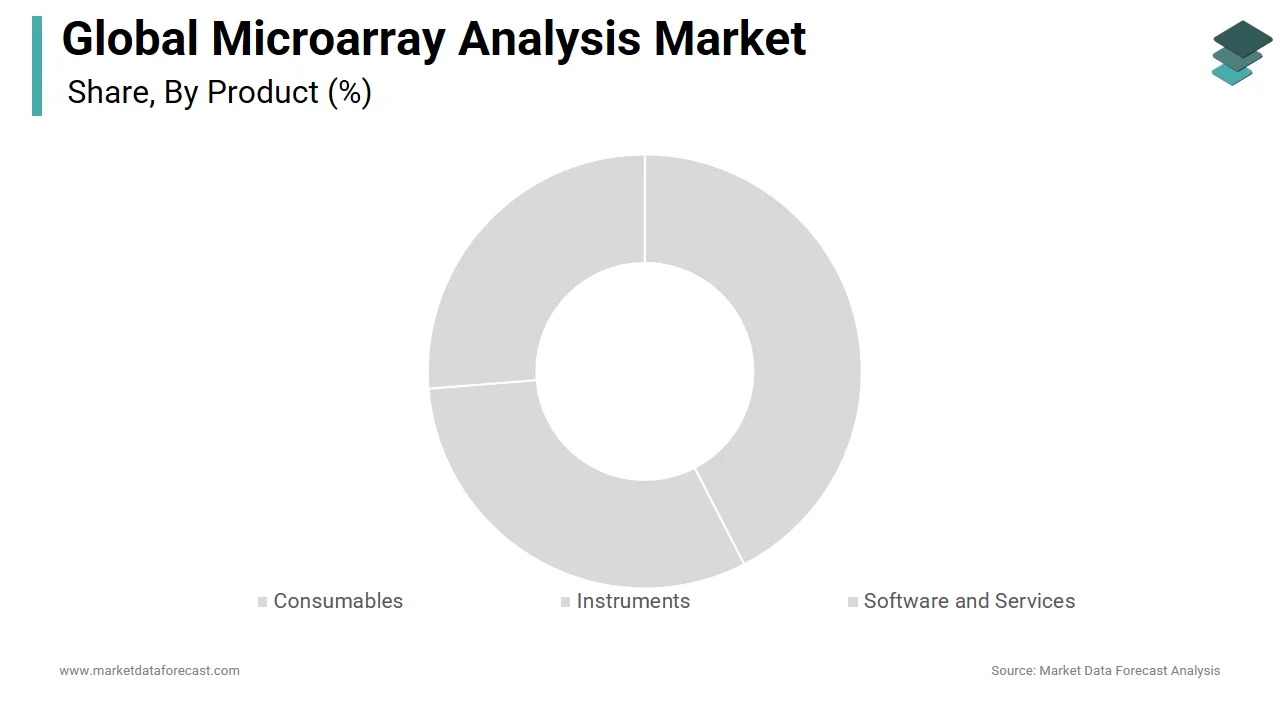
The instrument segment is also expected to hold a significant market share due to the high adoption of biochips or microarrays as a glass slide, consisting of a substrate of interest used for genotyping, comparative genome analysis, and antibody detection.
By Type Insights
Based on type, DNA microarrays are expected to account for the largest share of the studied market in 2024. This segmental growth can be attributed to microarrays in various applications and the increasing prevalence of cancer. DNA chips find wide application in clinical diagnostic tests, determining the best available drug to be prescribed for certain diseases, and DNA sequencing for the various diseases diagnosis and treatments.
Protein chips are expected to have a significant market share over the forecast period because they enable the simultaneous determination of numerous analyses from small samples in a single experiment through the use of miniature parallel assay systems containing modest amounts of purified protein in high-density formats.
By Application Insights
Based on the application, the research application segment is projected to account for the largest market share. The increase in private and government funding for genomics and proteomics research will be the primary driver of this market. In contrast, research applications are used to analyze, determine, and diagnose diseases.
The DNA chip helps analyze genome-wide gene expression patterns and is used in many areas for various applications, including drug discovery and clinical applications. Due to this, the drug discovery segment is also expected to dominate the market over the forecasted period.
By End User Insights
Based on end-user, academic and research institutes are anticipated to hold the largest market share. Factors such as an increase in government funding and initiatives to support genomics and proteomics, a large number of research projects, and an increasing number of universities and research institutes will drive this segmental growth.
An increase in diagnostic laboratories and research institutes has led to a rise in the demand for consumables. Furthermore, with a focus on drug development and therapeutic applications, crucial factors for a fruitful experiment are also covered. Finally, clinical research is used as an example to show the potential of microarrays as a clinical tool and how they can be utilized to identify genetic signatures.
REGIONAL ANALYSIS
Geographically, the North American microarray analysis market dominated the global microarray analysis market, followed by Europe due to the rapidly growing incidence of diseases such as cancer and genetic disorders, increasing funding for genomics and proteomics research, and the presence of key market players will drive the market in this region.
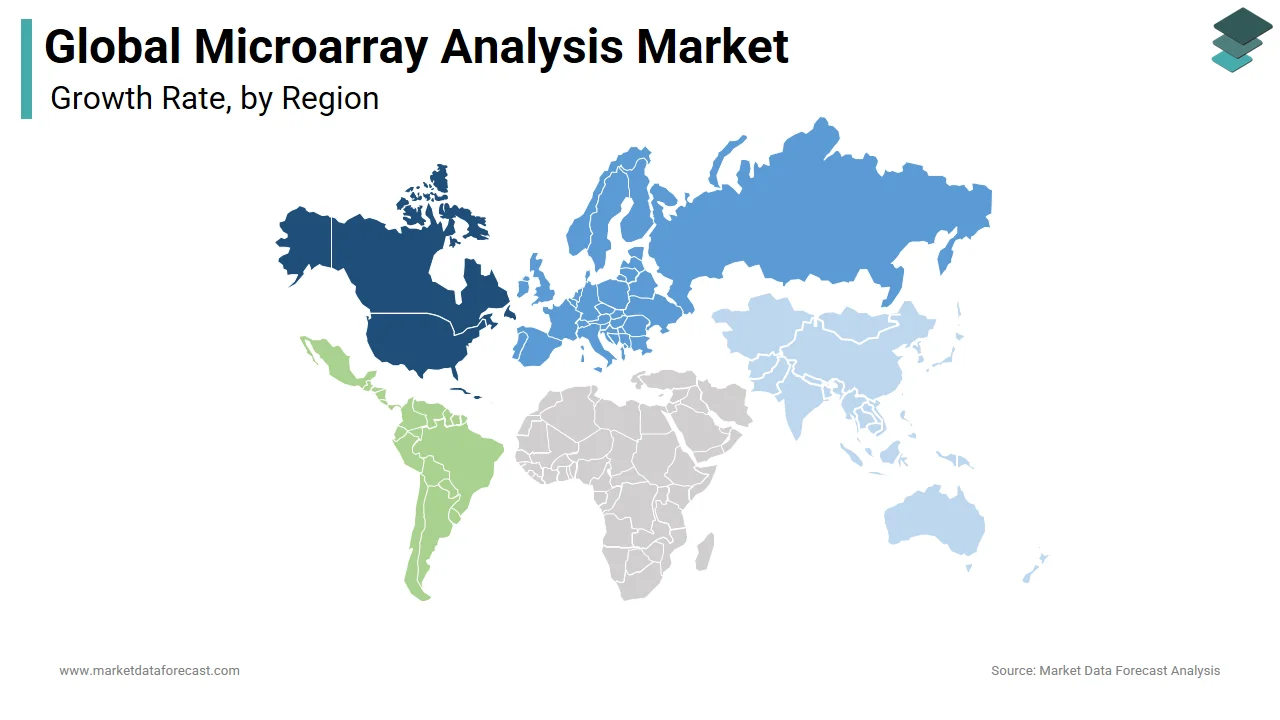
The Europe microarray analysis market holds a large share of the global market. It is the second-largest market owing to a highly developed healthcare industry, well-developed research and development infrastructure, and product accessibility.
Regional markets in France, the UK, and Spain will have a good market share and dominate the market seen in Germany. The regional market in Germany is anticipated to be boosted due to the prevalence of cancer and various chronic diseases in this region.
The Asia Pacific microarray analysis market is expected to witness the fastest growth globally due to the growing geriatric population, improving healthcare infrastructure, and increasing prevalence of chronic diseases and cancer, which has led to the adoption of microarray analysis.
The Latin America microarray analysis market is expected to grow significantly during the forecast period.
The Middle East & Africa microarray analysis market is predicted to reach a decent CAGR.
According to the World Health Organization, in 2018, approximately 1.8 million people were diagnosed with cancer. Additionally, in 2020, according to the American Cancer Society, 45% of new cases were diagnosed in the United States alone.
KEY MARKET PLAYERS
Key players dominating the global microarray analysis market profiled in the report are
- Thermo Fisher Scientific
- Agilent Technologies
- Molecular Devices
- PerkinElmer
- Illumina
- GE Healthcare
- Bio-Rad Laboratories
GLOBAL MICROARRAY ANALYSIS MARKET NEWS
- In Oct 2022, an international reagent and service provider, Sino Biological, focused on the fact that early diagnosis is essential to provide appropriate and well-designed treatment plans, which might help in preventing disease progression, primarily by nuclear magnetic resonance (NMR) and positron emission tomography (PET) detection, for biomarkers, mainly beta-amyloid plaques and Tau tangles.
- In October 2022, Harvard and Colossal advance the cutting-edge CRISPR genetic work had led to the advancements of all sciences and innovations in biofuels, biomaterials, or biomanufacturing of drugs, and still hoping for the replacement of conventional, heavy-coded software with easy, fewer efforts and fast platform.
- In November 2022, Bionano Genomics, Inc. appointed Donna Polizio as Global Head of Market Access to fulfill the desire to adopt advanced optical genome mapping (OGM), enabling researchers and clinicians to get answers to complex questions in biology and medicine.
- In April 2020, Bio-Rad acquired Celsee, Inc. This acquisition helped improve the company's single-cell isolation, detection, and analysis capabilities.
- In August 2019, Agilent Technologies, Inc. took over Lionheart Technologies LLC, a renowned leader in manufacturing innovative life science instruments across the globe.
MARKET SEGMENTATION
This research report on the global microarray analysis market has been segmented and sub-segmented into the following categories.
By Product
- Consumables
- Instruments
- Software and Services
By Type
- DNA Microarrays
- Protein Microarrays
- Others
By Application
- Research Applications
- Drug Discovery
- Disease Diagnostics
- Others
By End User
- Research and Academic Institutes
- Pharmaceutical and Biotechnology Companies
- Diagnostic Laboratories
- Others
By Region
- North America
- Europe
- Asia Pacific
- Latin America
- Middle East & Africa