- Product Description Description
- Table of Contents TOC
- List of Table & Figure LOT
- Get Free Sample PDF Sample PDF
Market Size, 2025
$24.72 BnMarket Estimate, 2026
$28.93 BnMarket Forecast, 2034
$101.73 BnCAGR, 2026–2034
17.02%Executive Summary: Global Microchannel Heat Exchanger Market
- Market Scope: Comprehensive global analysis of the microchannel heat exchanger (MCHE) market covering type segments, application fields, regional dynamics, energy efficiency standards, and HVAC expansion trends.
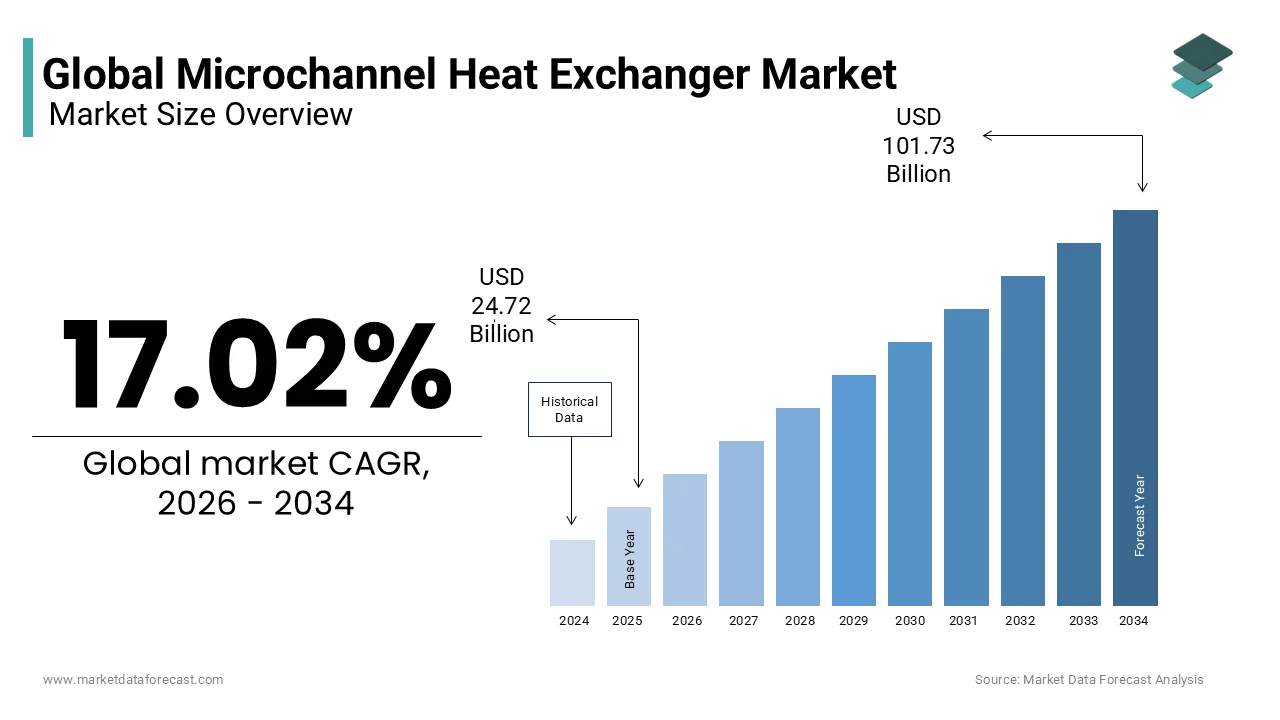
- Market Valuation: Valued at USD 24.72 billion in 2025, estimated at USD 28.93 billion in 2026, and projected to reach USD 101.73 billion by 2034, registering an impressive CAGR of 17.02% from 2026 to 2034.
- Primary Growth Drivers: Surging global demand for heating, ventilation, air conditioning (HVAC), and refrigeration systems; stringent energy efficiency and emission regulations; and the lightweight, high-efficiency advantages of aluminum-based heat exchangers over traditional copper-tube designs.
Key Market Segment Metrics (2026–2034)
| Category | Leading Segment / Position | Segment Details / Breakdown |
|---|---|---|
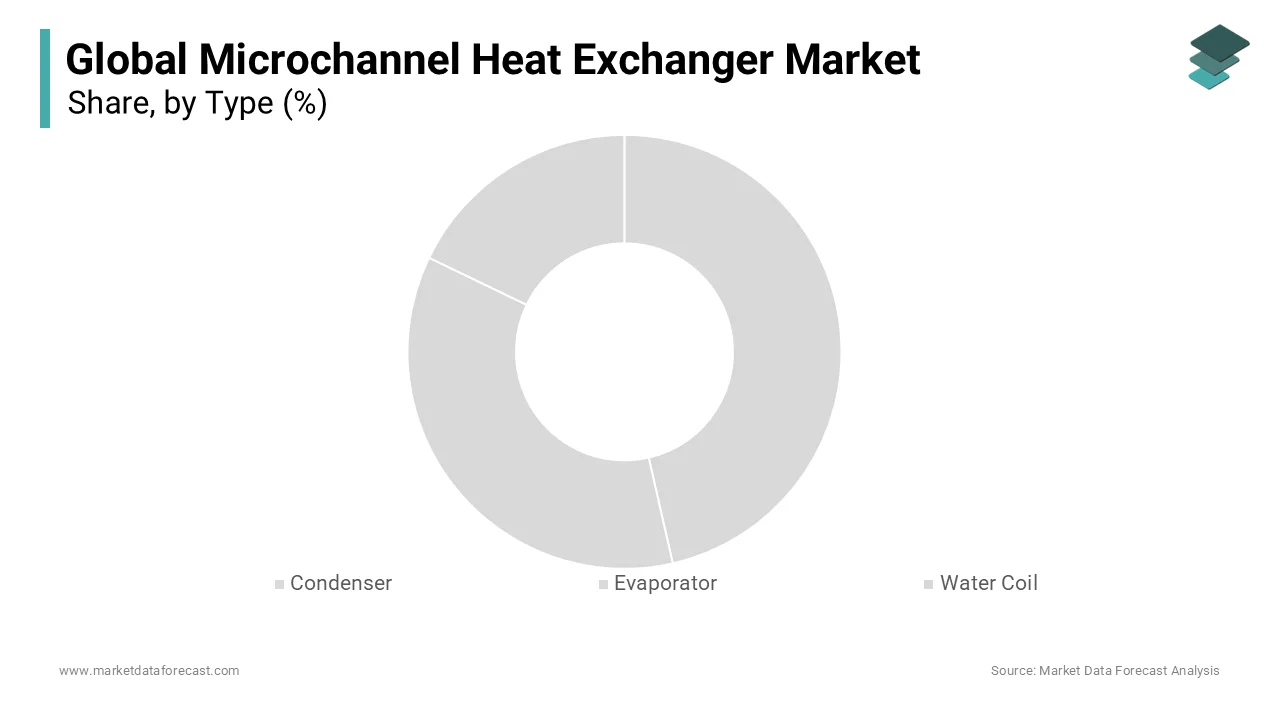
| By Type | Condenser (Held >90% share) | Condensers dominate due to high utilization in automotive and HVAC chillers; water coils are registered as the fastest-growing type segment. |
| By Application | HVAC, Automotive, Refrigeration & Cold Storage | HVAC applications register the highest growth rate driven by demand for lightweight, compact systems with lower refrigerant volumes. |
| By Region | Asia-Pacific (Largest and Dominant Market) | Powered by massive automotive manufacturing and soaring AC demand across major hubs like China, India, Japan, and South Korea. |
Major Market Players & Market Structure
Market Structure: Highly competitive global marketplace comprising specialized thermal management leaders and major automotive component suppliers focusing on innovative aluminum microchannel configurations.
Key Companies: Sanhua, MAHLE, Denso Corporation, Modine, Hanon Systems, Kangsheng Group, Kaltra, Climetal, Danfoss, and API Heat Transfer.
Global Microchannel Heat Exchanger Market Size
The global microchannel heat exchanger (MCHE) market size was valued at USD 24.72 billion in 2025 and is expected to reach USD 101.73 billion by 2034 from USD 28.93 billion in 2026. The market is projected to grow at a CAGR of 17.02%.
The Microchannel Heat Exchanger Market encompasses the design manufacturing and deployment of advanced thermal management systems characterized by flat tubes with multiple small channels that significantly enhance heat transfer efficiency. As per the International Energy Agency the cooling sector accounts for nearly 10 percent of global electricity consumption driving an urgent need for energy efficient technologies to mitigate environmental impact. The United States Environmental Protection Agency states that hydrofluorocarbon refrigerants used in traditional systems have a global warming potential thousands of times higher than carbon dioxide necessitating a shift toward low charge systems compatible with microchannel designs. This market is distinct due to its ability to reduce refrigerant volume by up to 50 percent while maintaining superior thermal performance compared to conventional fin and tube exchangers. Current dynamics reflect a strategic transition in HVACR and automotive industries where space constraints and regulatory pressures converge to favor compact high efficiency solutions. These technological advantages align with global sustainability mandates as manufacturers seek to minimize carbon footprints and operational costs through innovative heat exchange architectures within diverse industrial and commercial applications.
MARKET DRIVERS
Stringent Environmental Regulations Drive Refrigerant Reduction Needs
According to the Kigali Amendment to the Montreal Protocol signatory countries are committed to reducing hydrofluorocarbon consumption by 80 percent over the next three decades to combat climate change impacts. This international mandate directly accelerates the adoption of microchannel heat exchangers because their compact design allows for significantly lower refrigerant charges compared to traditional copper aluminum coils. The United Nations Environment Programme reports that the HVACR sector contributes approximately 10 percent of global greenhouse gas emissions prompting governments to enforce stricter limits on refrigerant leakage and total system capacity. Such regulatory pressure compels original equipment manufacturers to redesign systems using microchannel technology which inherently minimizes refrigerant volume while maximizing heat transfer surface area. Consequently the legal imperative to phase down high global warming potential substances serves as a primary driver that transforms microchannel heat exchangers from a niche option into a standard requirement for compliant heating ventilation air conditioning and refrigeration systems globally.
Demand for Energy Efficiency in HVACR Systems Boosts Adoption
As per the International Energy Agency air conditioning demand is projected to triple by 2050 driven by rising temperatures and increasing ownership in developing economies creating an urgent need for more efficient cooling technologies. Microchannel heat exchangers offer up to 20 percent improvement in heat transfer efficiency which directly translates to lower energy consumption and reduced operational costs for end users. The World Bank indicates that improving energy efficiency in buildings could save 50 billion dollars annually in energy costs providing a strong economic incentive for adopting advanced thermal management solutions. Facility managers and homeowners increasingly prioritize systems with higher seasonal energy efficiency ratios to meet green building certifications and reduce utility bills. Therefore the escalating global demand for cooling combined with the economic benefits of reduced energy usage acts as a fundamental driver that sustains robust growth for microchannel heat exchangers in both residential and commercial HVACR markets.
MARKET RESTRAINTS
High Initial Manufacturing Costs Limit Mass Market Penetration
According to the Society of Automotive Engineers the production of microchannel heat exchangers requires specialized brazing techniques and precision aluminum extrusion processes which are significantly more capital intensive than traditional copper tube manufacturing. This cost disparity results in higher upfront prices for original equipment manufacturers who may hesitate to switch from established supply chains without guaranteed long term savings. The International Monetary Fund notes that inflation in raw material costs has increased production expenses by 15 percent in recent years further squeezing margins for manufacturers investing in new microchannel facilities. Such financial barriers slow down adoption particularly in price sensitive markets where initial purchase price outweighs long term operational benefits. Consequently high manufacturing complexity functions as a persistent restraint that restricts the widespread replacement of conventional heat exchangers especially in entry level appliances and vehicles within the global market.
Susceptibility to Corrosion and Fouling in Harsh Environments
As per the National Association of Corrosion Engineers aluminum based microchannel coils are more prone to galvanic corrosion when exposed to salty or humid environments compared to copper alternatives which have natural resistance to oxidation. This vulnerability increases maintenance requirements and reduces lifespan in coastal or industrial settings where airborne contaminants accelerate degradation of the thin channel walls. The American Society of Heating Refrigerating and Air Conditioning Engineers reports that fouling rates in microchannel units can be 30 percent higher than in traditional coils due to the smaller passage sizes that trap debris and dust more easily. Such operational risks deter potential buyers in harsh climates who prioritize durability and ease of cleaning over marginal efficiency gains. Thus the technical limitation regarding material durability acts as a significant restraint that limits application scope and necessitates additional protective coatings or maintenance protocols within the Microchannel Heat Exchanger Market.
MARKET OPPORTUNITIES
Expansion of Electric Vehicle Thermal Management Systems
According to the International Energy Agency electric vehicle sales reached 14 million units globally in 2023 representing 18 percent of all cars sold and creating a massive new demand for compact and efficient thermal management components. Microchannel heat exchangers are ideal for electric vehicles because they provide superior cooling for battery packs and power electronics while occupying minimal space and weight. The World Economic Forum notes that extending battery range by just 10 percent can increase consumer adoption rates by 25 percent making efficient heat exchange critical for competitive vehicle performance. Automakers are increasingly integrating microchannel radiators and condensers to manage heat dissipation effectively without compromising vehicle aerodynamics or interior space. Hence the rapid electrification of the automotive sector presents a transformative opportunity for microchannel manufacturers to expand beyond traditional HVACR applications into the high growth mobility market.
Growth in Data Center Cooling Infrastructure
As per the International Data Corporation global data center spending is expected to reach 200 billion dollars by 2025 driven by the explosion of artificial intelligence and cloud computing services that generate immense heat loads. Microchannel heat exchangers offer the high heat flux handling capability required for liquid cooling systems which are becoming essential for managing temperature in high density server racks. The Uptime Institute reports that cooling accounts for 40 percent of data center energy usage prompting operators to seek advanced solutions that improve power usage effectiveness and reduce carbon footprints. By enabling more efficient heat removal microchannel technology supports the scalability of modern computing infrastructure while lowering operational expenses. Therefore the booming digital economy and the corresponding need for sophisticated thermal management create a distinct opportunity stream for microchannel heat exchanger suppliers targeting the IT and telecommunications sectors.
MARKET CHALLENGES
Complexity of Repair and Maintenance Procedures
According to the Air Conditioning Contractors of America repairing damaged microchannel coils often requires complete unit replacement rather than simple patching due to the intricate internal structure and specialized brazing needed for leaks. This lack of repairability increases total cost of ownership for end users who face higher downtime and replacement expenses compared to traditional systems that can be easily serviced in the field. The National Institute of Standards and Technology highlights that skilled labor shortages in the HVAC industry exacerbate this issue as fewer technicians are trained to handle delicate aluminum microchannel components safely. Such maintenance challenges discourage adoption in remote locations or among small businesses with limited technical support resources. Thus the difficulty in servicing these units represents a systemic challenge that affects customer satisfaction and long term reliability perceptions within the Microchannel Heat Exchanger Market.
Supply Chain Volatility for Aluminum Raw Materials
As per the United States Geological Survey aluminum prices fluctuated by 25 percent in 2023 due to geopolitical tensions and energy cost variations affecting smelting operations in major producing regions. Since microchannel heat exchangers rely heavily on high purity aluminum alloys any disruption in supply or sudden price spike directly impacts manufacturing costs and profit margins for producers. The World Bank notes that trade restrictions on raw materials have increased lead times by 20 percent causing delays in production schedules and delivery commitments to original equipment manufacturers. When input costs are unpredictable companies struggle to maintain stable pricing strategies and may pass costs onto consumers potentially dampening demand. Therefore supply chain instability for key raw materials acts as a major challenge that threatens production consistency and financial planning for manufacturers in the Microchannel Heat Exchanger Market.
REPORT COVERAGE
| REPORT METRIC | DETAILS |
| Market Size Available | 2025 to 2034 |
| Base Year | 2025 |
| Forecast Period | 2026 to 2034 |
| CAGR | 17.02% |
| Segments Covered | By Type, Application, and Region. |
| Various Analyses Covered | Global, Regional & Country Level Analysis, Segment-Level Analysis, DROC, PESTLE Analysis, Porter’s Five Forces Analysis, Competitive Landscape, Analyst Overview of Investment Opportunities |
| Regions Covered | North America, Europe, APAC, Latin America, Middle East & Africa |
| Market Leaders Profiled | Sanhua Intelligent, MAHLE, Modine Manufacturing Company, Denso Corporation, Modine, Hanon Systems, Hanwha TotalEnergies Petrochemical, Kangsheng Group, Kaltra, Climetal, Danfoss, and API Heat Transfer |
SEGMENTAL ANALYSIS
By Type Insights
Leading Segment: Condenser
The condenser segment commands the largest share of the Microchannel Heat Exchanger Market due to its critical role in rejecting heat within air conditioning and refrigeration cycles across residential commercial and automotive sectors. This dominance is anchored in the universal requirement for efficient heat rejection in virtually every cooling system manufactured globally.
Universal Adoption in Residential Air Conditioning Units
According to the International Energy Agency over 130 million room air conditioners are sold annually worldwide with microchannel condensers now standard in more than 85 percent of new split system units due to their superior heat rejection capabilities. This widespread integration directly correlates with market volume because each residential unit requires at least one condenser coil making it the highest volume component type. The United States Department of Energy reports that replacing traditional fin and tube condensers with microchannel versions improves seasonal energy efficiency ratio by an average of 12 percent which drives manufacturer preference to meet regulatory standards. Such technical superiority ensures that condensers remain the primary entry point for microchannel technology adoption. Consequently the sheer scale of global residential cooling equipment production sustains the leadership position of the condenser segment by creating consistent high volume demand that outweighs other component types in total unit shipments.
Regulatory Pressure for Lower Refrigerant Charges
As per the United Nations Environment Programme the Kigali Amendment mandates an 80 percent reduction in hydrofluorocarbon consumption by 2047 compelling manufacturers to adopt condensers that minimize refrigerant volume without sacrificing performance. Microchannel condensers achieve this by reducing internal volume by up to 50 percent compared to conventional designs making them essential for compliance with tightening environmental regulations. The European Union F Gas Regulation has already phased out high global warming potential refrigerants in many applications forcing original equipment manufacturers to redesign systems around low charge microchannel condensers. This regulatory alignment transforms the condenser from a performance upgrade into a legal necessity for market access in major economies. Therefore environmental mandates act as a structural driver that locks in the dominance of the condenser segment by making it indispensable for meeting international climate commitments and avoiding penalties.
Fastest Growing Segment: Water Coil
The water coil segment is projected to register the highest compound annual growth rate of 9.4 percent during the forecast period driven by emerging applications in liquid cooling for data centers and industrial process heat recovery. This rapid expansion reflects a fundamental shift toward liquid based thermal management solutions that offer higher heat transfer coefficients than air cooled alternatives.
Surging Demand for Liquid Cooling in Data Centers
According to the Uptime Institute over 40 percent of new hyperscale data centers deployed in 2023 incorporated liquid cooling systems utilizing microchannel water coils to manage heat densities exceeding 30 kilowatts per rack. This technological transition creates substantial new demand for water coils as operators seek to support artificial intelligence workloads and high performance computing that generate unprecedented thermal loads. The International Data Corporation forecasts that spending on liquid cooling infrastructure will grow by 18 percent annually through 2026 as traditional air cooling becomes insufficient for next generation server architectures. Each new liquid cooled facility requires multiple microchannel water coils for coolant distribution units and direct chip cooling loops. Hence the digital transformation and associated heat management challenges serve as a powerful catalyst accelerating water coil adoption beyond traditional HVAC applications into the high growth IT infrastructure sector.
Industrial Waste Heat Recovery Initiatives
As per the World Bank industrial facilities waste approximately 20 to 50 percent of input energy as heat representing a massive untapped opportunity for efficiency improvements through advanced heat exchange technologies. Microchannel water coils enable compact and efficient heat recovery systems that capture low grade waste heat for reuse in preheating or domestic hot water applications. The International Renewable Energy Agency reports that industrial heat recovery projects increased by 15 percent in 2023 driven by rising energy costs and corporate sustainability targets that prioritize circular energy use. These installations require specialized water coils capable of handling variable flow rates and temperatures while resisting fouling from industrial fluids. Thus the convergence of economic incentives and decarbonization goals fuels rapid growth in water coil deployments across manufacturing chemical processing and power generation sectors within the global market.
By Application Insights
Leading Segment: HVAC
The HVAC application segment holds the dominant position in the Microchannel Heat Exchanger Market accounting for the majority of global volume due to ubiquitous installation in residential commercial and institutional buildings. This leadership is sustained by the fundamental need for space conditioning in nearly all constructed environments and continuous replacement cycles in existing building stock.
Global Construction Activity Drives New Installation Volume
According to the United Nations Environment Programme the buildings sector accounts for 36 percent of final energy use and 39 percent of energy related carbon dioxide emissions globally prompting governments to mandate high efficiency HVAC systems in new construction. This regulatory framework ensures that virtually every new residential and commercial building incorporates microchannel heat exchangers to meet minimum energy performance standards. The World Green Building Council reports that green building certifications have increased by 25 percent annually since 2020 with HVAC efficiency being a primary scoring criterion that favors microchannel technology. Each certified project represents guaranteed demand for multiple evaporator and condenser units creating predictable volume streams for manufacturers. Consequently the alignment of construction codes with sustainability objectives anchors the HVAC segment’s dominance by embedding microchannel technology into the foundational requirements of modern built environments worldwide.
Replacement Market Sustains Aftermarket Demand
As per the International Energy Agency the global installed base of air conditioners exceeds 2 billion units with an average lifespan of 15 years generating continuous replacement demand as aging systems reach end of life. Microchannel heat exchangers benefit from this cycle because retrofitting older units often involves complete system upgrades to comply with current efficiency and refrigerant regulations. The United States Environmental Protection Agency estimates that 12 million residential HVAC systems are replaced annually in North America alone with over 70 percent now featuring microchannel components as standard equipment. This massive installed base creates a self reinforcing demand loop where each replacement further expands the addressable market for future service and parts. Therefore the natural obsolescence of existing HVAC infrastructure provides a stable foundation that maintains the application segment’s leadership independent of new construction volatility.
Fastest Growing Segment: Automotive
The automotive application segment is experiencing the fastest growth with a compound annual growth rate of 8.7 percent driven primarily by the electrification of vehicle powertrains and increasing thermal management complexity. This acceleration reflects the fundamental difference between internal combustion engine vehicles and electric vehicles which require significantly more sophisticated cooling systems.
Electric Vehicle Battery Thermal Management Requirements
According to the International Energy Agency electric vehicle sales reached 14 million units in 2023 with each vehicle requiring dedicated battery cooling systems that utilize microchannel heat exchangers to maintain optimal operating temperatures. Unlike traditional vehicles that only cool the cabin electric vehicles must also manage battery pack thermal loads which can exceed 5 kilowatts during fast charging or high performance driving. BloombergNEF projects that electric vehicle penetration will reach 35 percent of global passenger car sales by 2030 creating exponential growth in demand for specialized automotive microchannel components. Each electric vehicle typically contains three to four additional heat exchangers compared to conventional counterparts multiplying the addressable market per unit sold. Thus the structural shift toward electrification acts as a transformative driver that accelerates automotive segment growth far beyond historical rates tied to vehicle production volumes alone.
Cabin Comfort Standards Increase System Complexity
As per the Society of Automotive Engineers modern vehicles now incorporate multi zone climate control heated and ventilated seats and windshield dehumidification systems that collectively increase thermal management requirements by 40 percent compared to vehicles from 2010. These comfort features necessitate additional microchannel evaporators and condensers distributed throughout the vehicle cabin to deliver personalized temperature control without compromising overall system efficiency. J.D. Power reports that cabin comfort has become the second most important purchase factor for premium vehicle buyers prompting automakers to invest heavily in advanced HVAC architectures. Each additional comfort feature translates directly into incremental demand for microchannel components as manufacturers seek compact solutions that fit within increasingly constrained vehicle packaging envelopes. Hence evolving consumer expectations for personalized mobility experiences fuel rapid expansion of the automotive application segment beyond basic propulsion cooling needs.
REGIONAL ANALYSIS
North America Microchannel Heat Exchanger Market Analysis
North America holds a mature and technologically advanced position in the Microchannel Heat Exchanger Market characterized by near universal adoption in residential HVAC and strong regulatory drivers. According to the United States Department of Energy federal efficiency standards have mandated minimum seasonal energy efficiency ratio levels since 2015 effectively making microchannel condensers the default technology for all new air conditioning equipment sold in the region. This regulatory certainty has created a stable high volume market where manufacturers focus on incremental performance improvements rather than technology adoption. The Air Conditioning Heating and Refrigeration Institute reports that over 90 percent of residential condensing units shipped in 2023 featured microchannel coils reflecting complete market saturation at the component level. Additionally stringent Environmental Protection Agency regulations on refrigerant transitions continue to drive innovation in low charge designs. These factors combine to sustain North America’s position as a benchmark market where technology maturity enables focus on optimization and cost reduction rather than basic adoption.
Latin America Microchannel Heat Exchanger Market Analysis
Latin America represents an emerging growth market for microchannel heat exchangers driven by expanding middle class populations and increasing air conditioning penetration in tropical climates. According to the Inter American Development Bank residential air conditioner ownership in Brazil and Mexico has grown by 8 percent annually over the past decade creating substantial new demand for efficient cooling technologies. However market development is uneven with microchannel adoption concentrated in premium segments and multinational brand products while local manufacturers still rely heavily on traditional copper aluminum coils due to cost considerations. The Economic Commission for Latin America and the Caribbean notes that import tariffs on finished HVAC equipment encourage local assembly but limit technology transfer for advanced manufacturing processes. Despite these challenges rising energy costs and growing awareness of efficiency benefits are gradually shifting preferences toward microchannel solutions. Thus Latin America presents significant long term potential tempered by current economic and infrastructural constraints that slow widespread adoption.
Europe Microchannel Heat Exchanger Market Analysis
Europe maintains a leadership position in sustainable thermal management driven by aggressive decarbonization policies and early adoption of low global warming potential refrigerants. According to the European Commission the F Gas Regulation has successfully reduced hydrofluorocarbon quotas by 55 percent since 2015 accelerating the transition to microchannel heat exchangers compatible with natural and alternative refrigerants. This regulatory framework has made Europe the global testing ground for next generation low charge systems with manufacturers developing specialized designs for propane and carbon dioxide applications. Eurostat reports that heat pump installations increased by 40 percent in 2023 as part of the REPowerEU initiative with virtually all new units incorporating microchannel technology for both heating and cooling modes. Additionally strict Ecodesign directives ensure continuous improvement in minimum efficiency standards. These policy driven dynamics position Europe as an innovation hub where regulatory ambition directly shapes global technology development trajectories.
Asia Pacific Microchannel Heat Exchanger Market Analysis
Asia Pacific is the largest and fastest growing regional market for microchannel heat exchangers fueled by massive manufacturing capacity and surging domestic demand across developing economies. According to the International Energy Agency the region accounts for over 60 percent of global air conditioner production with China India and Southeast Asian nations serving as both manufacturing hubs and consumption markets. This dual role creates unique dynamics where export oriented production adheres to international microchannel standards while domestic markets exhibit varied adoption rates based on income levels and regulatory enforcement. The Asian Development Bank reports that urbanization rates exceeding 2 percent annually drive continuous growth in residential and commercial construction supporting sustained HVAC demand. Additionally government initiatives like India’s Perform Achieve and Trade scheme incentivize industrial energy efficiency promoting microchannel adoption in process cooling applications. These converging forces make Asia Pacific the central engine of global market growth balancing volume leadership with gradual technological advancement.
Middle East and Africa Microchannel Heat Exchanger Market Analysis
The Middle East and Africa region occupies a niche but strategically important position in the Microchannel Heat Exchanger Market driven by extreme climate conditions and large scale infrastructure projects. According to the World Bank cooling demand in Gulf Cooperation Council countries consumes up to 70 percent of peak electricity load creating urgent economic incentives for high efficiency technologies that reduce grid strain. This operational reality makes microchannel heat exchangers particularly valuable despite higher upfront costs because lifecycle savings justify investment in premium equipment. The United Nations Environment Programme notes that several regional governments have implemented minimum energy performance standards aligned with international best practices encouraging adoption in new construction and major retrofits. However market growth remains concentrated in wealthy Gulf states and select African urban centers while broader regional adoption is limited by affordability and supply chain constraints. Thus the region serves as a high value niche market where extreme environmental conditions amplify the economic case for advanced thermal management solutions.
COMPETITIVE LANDSCAPE
The competition in the Microchannel Heat Exchanger Market is characterized by a mix of established global manufacturers and specialized regional producers who compete on technology quality and supply chain reliability. Large multinational companies leverage their extensive research and development capabilities to introduce innovative designs that offer superior efficiency and durability. Meanwhile smaller players often focus on niche applications or specific geographic markets where they can provide highly customized solutions at competitive prices. The market remains consolidated among a few key players due to high barriers to entry related to capital intensive manufacturing processes and stringent quality standards. Competitors increasingly emphasize sustainability and compliance with environmental regulations as key differentiators to appeal to environmentally conscious customers. Strategic mergers and acquisitions are common as companies seek to expand their product portfolios and technological expertise. This dynamic environment drives continuous improvement in manufacturing techniques and material science benefiting end users through better performance and lower total cost of ownership.
KEY MARKET PLAYERS
Some of the key players in the global microchannel heat exchanger market are
- Sanhua Intelligent
- MAHLE
- Modine Manufacturing Company
- Denso Corporation
- Modine
- Hanon Systems
- Hanwha TotalEnergies Petrochemical
- Kangsheng Group
- Kaltra
- Climetal
- Danfoss
- API Heat Transfer
Top Players in the Market
- Modine Manufacturing Company maintains a strong presence in the Microchannel Heat Exchanger Market through its extensive portfolio of aluminum based thermal management solutions for HVACR and automotive sectors. The company focuses on delivering high efficiency condensers and evaporators that reduce refrigerant charge and improve system performance. Recently Modine expanded its production capacity in Europe to meet growing demand for low global warming potential refrigerant compatible systems. This strategic expansion allows the company to serve key automotive original equipment manufacturers with localized supply chains. By investing in advanced brazing technologies Modine strengthens its ability to produce complex microchannel geometries with superior durability. These initiatives enhance operational reliability and solidify its reputation as a leading innovator in sustainable heat exchange technologies across global markets.
- Hanwha TotalEnergies Petrochemical contributes significantly to the Microchannel Heat Exchanger Market by leveraging its integrated aluminum value chain to produce high quality flat tubes and fins. The company supplies critical raw materials and finished components to major heat exchanger manufacturers worldwide ensuring consistent quality and supply stability. Recently Hanwha invested in research and development facilities dedicated to developing next generation alloys with improved corrosion resistance and thermal conductivity. This innovation supports the industry shift toward thinner walled designs that maximize heat transfer efficiency while minimizing material usage. Additionally the company formed strategic partnerships with European HVAC manufacturers to co develop customized solutions for specific climate conditions. These efforts reinforce its position as a key enabler of technological advancement and supply chain resilience in the global microchannel sector.
- Sanhua Intelligent Controls Co Ltd serves as a key supplier in the Microchannel Heat Exchanger Market offering comprehensive thermal management components for residential commercial and automotive applications. The company integrates microchannel coils with valves and controllers to provide complete system solutions that optimize energy efficiency. Sanhua recently acquired several technology firms to expand its intellectual property portfolio in advanced heat transfer designs and manufacturing processes. These acquisitions enable the company to offer more sophisticated products that meet stringent international environmental regulations. By focusing on vertical integration Sanhua strengthens its competitive advantage and ensures cost effective production at scale. This approach allows it to respond quickly to changing market demands and support global customers with reliable high performance microchannel heat exchangers.
Top Strategies Used by Key Market Participants
Key players in the microchannel heat exchanger market primarily employ vertical integration and technological innovation to strengthen their competitive positions. Companies focus on controlling the entire supply chain from aluminum extrusion to final assembly to ensure quality consistency and cost efficiency. Another major strategy involves investing in research and development to create advanced alloys and coatings that improve corrosion resistance and heat transfer performance. Manufacturers also pursue strategic partnerships with original equipment manufacturers to co develop customized solutions for specific applications such as electric vehicles and data centers. Additionally firms expand their geographic footprint by establishing local production facilities in key markets like Europe and Asia to reduce logistics costs and comply with regional content requirements. These approaches collectively help participants address technical challenges and capitalize on growing demand for energy efficient thermal management solutions globally.
Microchannel Heat Exchanger Market News
- In March 2024, Modine Manufacturing Company expanded its European production facility for microchannel coils. This expansion is anticipated to improve supply chain efficiency and strengthen the Microchannel Heat Exchanger Market presence
- In June 2023, Hanwha TotalEnergies Petrochemical launched new corrosion resistant aluminum alloys for heat exchangers. This launch is anticipated to enhance product durability and strengthen the Microchannel Heat Exchanger Market presence
- In September 2023, Sanhua Intelligent Controls Co Ltd acquired a specialized thermal technology firm in North America. This acquisition is anticipated to expand intellectual property rights and strengthen the Microchannel Heat Exchanger Market presence
- In January 2024, a leading Chinese manufacturer partnered with a German automotive supplier for joint development. This partnership is anticipated to accelerate innovation and strengthen the Microchannel Heat Exchanger Market presence
- In May 2023, a global player introduced a new lightweight microchannel design for electric vehicles. This introduction is anticipated to improve vehicle range and strengthen the Microchannel Heat Exchanger Market presence
MARKET SEGMENTATION
This research report on the global microchannel heat exchanger market is segmented and sub-segmented into the following categories.
By Type
- Condenser
- Evaporator
- Water Coil
By Application
- Automotive
- HVAC
- Residential AC
- Commercial AC
- Precision Cooling
- Commercial Refrigeration
- Stationary Refrigeration
- Transport Refrigeration
- Cold Storage
By Region
- North America
- Europe
- Asia Pacific
- Latin America
- Middle East & Africa