- Product Description Description
- Table of Contents TOC
- List of Table & Figure LOT
- Get Free Sample PDF Sample PDF
Global Micromotor Control Unit Market Report Summary
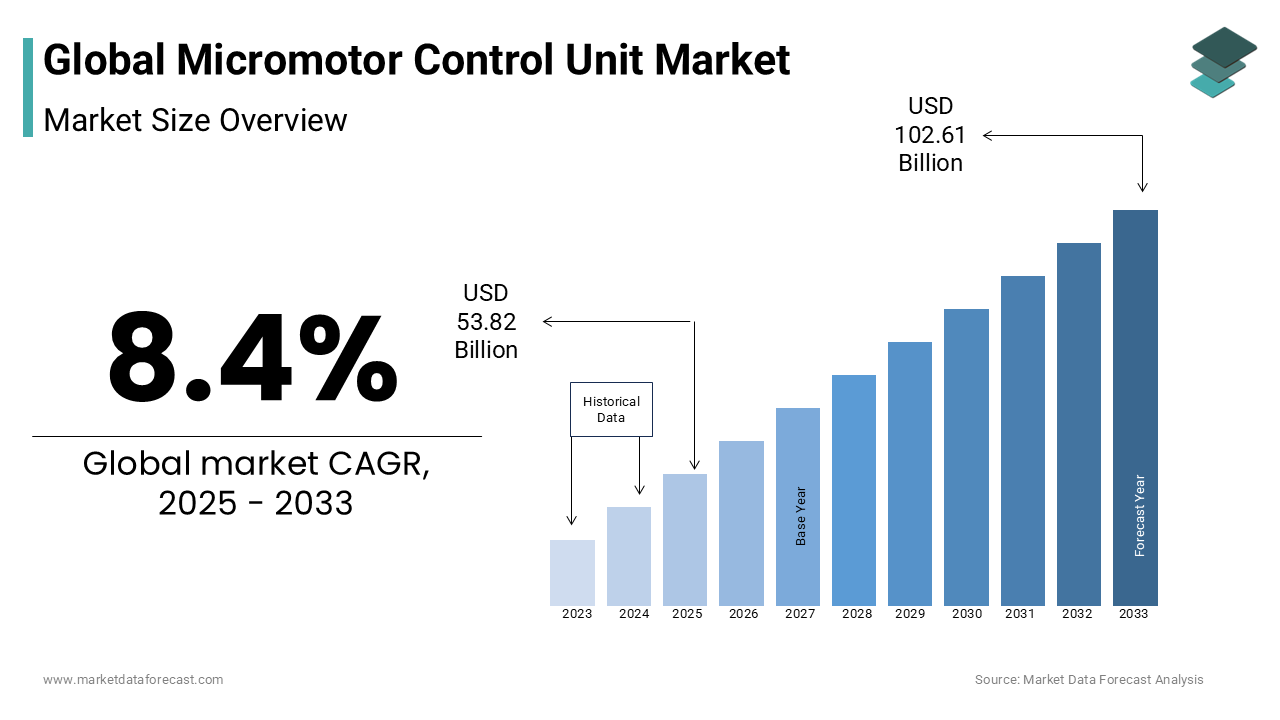
The global micromotor control unit market was valued at USD 49.65 billion in 2024, is estimated to reach USD 53.82 billion in 2025, and is projected to reach USD 102.61 billion by 2033, growing at a CAGR of 8.4% during the forecast period from 2025 to 2033. The growth of the global micromotor control unit market is driven by the rising demand for compact and high-performance consumer electronics, increasing adoption of micromotors in medical devices, and growing automation across industrial and robotic applications. Expanding use of micromotor control units in precision-driven technologies such as dental equipment, robotic surgery, and wearable electronics is further fueling market growth. Moreover, continuous technological innovation in microcontrollers, smart control algorithms, and miniaturized components is strengthening the role of micromotor control units across diverse end-use industries.
Key Market Trends
- Rising integration of micromotor control units in consumer electronics such as smartphones, cameras, and wearable devices.
- Growing adoption of micromotor control units in medical devices requiring high precision, including dental tools and surgical equipment.
- Increasing focus on miniaturization and enhanced functionality in compact electromechanical systems.
- Advancements in smart control algorithms improving efficiency, precision, and reliability of micromotor operations.
- Gradual shift toward environmentally conscious and energy-efficient micromotor control solutions.
Segmental Insights
- Based on type, the electronic micromotor control unit segment dominated the global micromotor control unit market in 2024. The segment’s leadership is attributed to its versatility, reliability, and widespread use across consumer electronics, automotive systems, and medical devices for precise speed and direction control.
- Based on application, the dental segment held a significant share of the global micromotor control unit market in 2024. The dominance of this segment is driven by the critical requirement for precision, stability, and controlled motion in dental drills and other dental instruments. The aesthetic medicine segment also accounts for a notable share due to increasing use of micromotor-driven devices in cosmetic and dermatological procedures.
Regional Insights
The global micromotor control unit market is witnessing steady growth across major regions, supported by technological advancement and expanding healthcare and electronics industries.
- North America led the global micromotor control unit market in 2024, driven by strong adoption of advanced medical technologies, robotics, and high-end consumer electronics.
- Europe ranked as the second-largest market, supported by a well-established healthcare infrastructure and early adoption of precision medical and industrial technologies.
- The Asia Pacific region is emerging as a fast-growing market, fueled by rapid industrialization, expanding electronics manufacturing, and increasing demand for healthcare devices.
- Latin America and the Middle East & Africa are witnessing gradual growth, supported by improving healthcare infrastructure and rising investment in advanced technologies.
Competitive Landscape
The global micromotor control unit market is characterized by the presence of established global manufacturers focusing on precision engineering, innovation, and application-specific solutions. Leading companies are investing in compact designs, enhanced control algorithms, and integrated interfaces to meet the evolving needs of medical, industrial, and consumer electronics applications. Strategic product launches, technological advancements, and expansion into emerging markets are strengthening competitive positioning. Prominent players in the global micromotor control unit market include Maxon Motor AG, FAULHABER Group, Nidec Corporation, Portescap (a division of Danaher Corporation), Oriental Motor Co., Ltd., Phytron GmbH, Crouzet (part of Schneider Electric), ElectroCraft Inc., Nanotec Electronic GmbH & Co. KG, Applied Motion Products Inc., Moog Inc., Elmo Motion Control Ltd., Allied Motion Technologies Inc., Kollmorgen (a subsidiary of Fortive Corporation), LINAK A/S, and Anaheim Automation Inc.
Global Micromotor Control Unit Market Size
The size of the global micromotor control unit market was worth USD 49.65 billion in 2024. The global market is anticipated to grow at a CAGR of 8.4% from 2025 to 2033 and be worth USD 102.61 billion by 2033 from USD 53.82 billion in 2025.
A micromotor control unit is a compact system managing tiny electric motor functions. It orchestrates power supply, speed, direction, and other vital aspects of micromotors. Comprising microcontrollers, sensors, and interface modules, this unit ensures precise, controlled movements in limited spaces. It finds wide application in robotics, medical devices, automotive tech, and industries requiring meticulous yet small-scale operations. By regulating and overseeing micromotor performance, this device facilitates efficient, targeted movements crucial in intricate tasks, exemplifying its significance across various fields where accuracy in compact dimensions is paramount.
MARKET DRIVERS
The Micromotor Control Unit Market share is experiencing a notable surge driven by the rising demand for consumer electronics.
The widespread integration of micromotors in smartphones, cameras, and wearables acts as an important factor in increasing the market growth rate. As consumers seek more compact and high-performance devices, micromotors satisfy the need by enabling precise and efficient functionality within these electronics. However, the miniaturization trend in consumer electronics and the need for enhanced functionalities have created a profitable market for micromotor control unit manufacturers. As a result, technology continues to evolve; the Micromotor Control Unit Market is poised for sustained expansion, driven by its integral role in powering the next generation of compact and feature-rich consumer electronic products.
The expanding medical device market's demands act as another pivotal driver. The medical industry's increasing reliance on precise and miniature components, particularly in robotic surgery, diagnostic devices, and drug delivery systems, underscores the critical role of micromotor control units. These units play an important role in facilitating the complex movements required for precision-driven medical devices. However, the market's trajectory is complicated, linked to its contribution to enhancing the performance and functionality of cutting-edge medical devices, reinforcing its position as an indispensable component within the rapidly growing landscape of medical technology.
MARKET RESTRAINTS
The Micromotor Control Unit Market also faces a restraint in the form of cost constraints.
The difficulty involved in crafting these high-precision components contributes to an increasing production cost, causing a challenge to widespread adoption. Particularly impactful in price-sensitive markets and industries, these cost constraints can also limit the accessibility of micromotor control units. However, manufacturers and end-users must maintain a delicate balance between advanced functionalities and affordability. As the demand for smaller, more efficient devices continues to rise across various sectors, addressing cost concerns becomes imperative for sustaining market growth.
MARKET OPPORTUNITIES
Continuous technological innovations are an important opportunity for the micromotor control unit market growth. Ongoing research and development put a major focus on elevating micromotor control unit technology, introducing advanced materials, pioneering novel designs, and implementing smart control algorithms. These innovations promise to redefine the landscape by enhancing precision, efficiency, and reliability. The integration of cutting-edge materials and design concepts ensures optimal performance, while smart control algorithms contribute to seamless and intelligent operations. This technological evolution not only addresses current industry needs but also unlocks new possibilities for micromotor control units in diverse applications.
MARKET CHALLENGES
The Micromotor Control Unit Market is undergoing a transformative challenge as the global focus on environmental sustainability intensifies. The rising awareness of ecological impacts is compelling manufacturers to pivot towards eco-friendly solutions within the micromotor control unit. This shift is highly driven by the imperative to reduce the environmental footprint associated with electronic components. As market demand grows for devices that align with green principles, manufacturers face the challenge of developing micromotor control units with minimal environmental impact.
REPORT COVERAGE
| REPORT METRIC | DETAILS |
| Market Size Available | 2024 to 2033 |
| Base Year | 2024 |
| Forecast Period | 2025 to 2033 |
| CAGR | 8.4% |
| Segments Covered | By Type, Application, and Region. |
| Various Analyses Covered | Global, Regional & Country Level Analysis, Segment-Level Analysis, DROC, PESTLE Analysis, Porter’s Five Forces Analysis, Competitive Landscape, Analyst Overview of Investment Opportunities |
| Regions Covered | North America, Europe, APAC, Latin America, Middle East & Africa |
| Market Leaders Profiled | Maxon Motor ag, FAULHABER Group, Nidec Corporation, Portescap (a division of Danaher Corporation), Oriental Motor Co., Ltd., Phytron GmbH, Crouzet (part of Schneider Electric), ElectroCraft, Inc., Nanotec Electronic GmbH & Co. KG, Applied Motion Products, Inc., Moog Inc., Elmo Motion Control Ltd., Allied Motion Technologies Inc., Kollmorgen (a subsidiary of Fortive Corporation), LINAK A/S, Anaheim Automation, Inc., EAD Motors, ARC Systems, Inc., Anaheim Automation, Inc., and Others. |
SEGMENTAL ANALYSIS
By Type Insights
Electronic micromotor control units dominate the micromotor control unit market growth and are widely used in various industries, including consumer electronics, automotive, and medical devices. They mostly rely on electronic components to control the speed, direction, and precision of the micromotors. However, electronic control units are well known for their versatility and effectiveness.
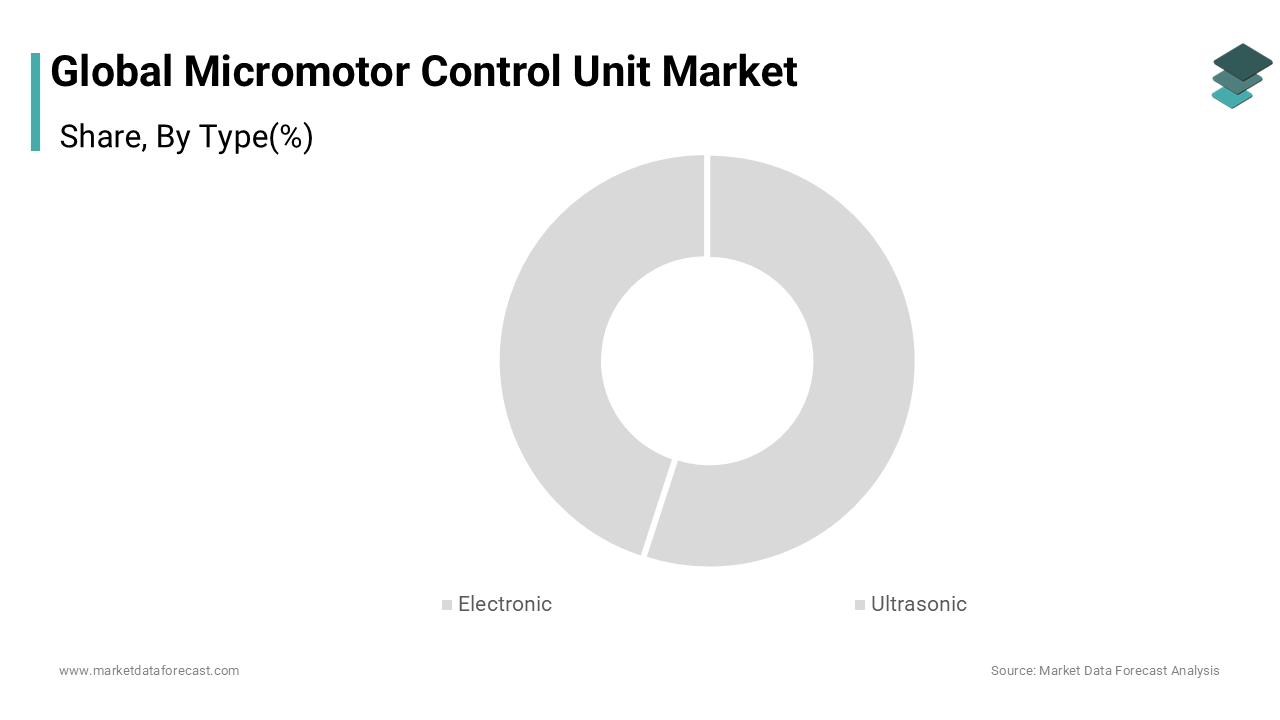
By following, ultrasonic micromotor control units hold the second largest micromotor control unit market share as they utilize ultrasonic vibrations to achieve precise control and motion. They are commonly employed in applications where silent operation, high torque at low speeds, and low heat generation are essential.
By Application Insights
Micromotor control plays an important role in dental applications, particularly in dental drills and other precision tools. These units are essential for achieving the required precision and control in dental procedures.
In aesthetic medicine, micromotor control units are second-leading as they are used in various devices such as dermatological lasers and other cosmetic procedures. The demand for precise control and accuracy in aesthetic treatments has likely driven the use of micromotor control units in this sector.
REGIONAL ANALYSIS
North America has been a significant player in the development and adoption of advanced technologies. The region is often a leader in medical technology and innovation. The demand for micromotor control units may be influenced by the strong presence of healthcare and technology industries.
Europe is the second most prominent market for medical devices and advanced technologies. The region has a well-established healthcare infrastructure and is often an early adopter of innovative medical technologies.
The Asia-Pacific region has seen rapid economic growth and has become a significant player in the global medical device market. The dominance of micromotor control units in this region may be influenced by the increasing demand for healthcare solutions, growth in manufacturing capabilities, and the adoption of advanced medical technologies.
Latin America may have a growing market for medical devices, but factors such as economic conditions and healthcare infrastructure development can impact the dominance of micromotor control units. Access to advanced medical technologies may surge the market value.
The Middle East and Africa region may have a developing market for medical devices. Factors such as healthcare infrastructure development, government initiatives, and investment in technology can influence the dominance of micromotor control units in this region.
KEY PLAYERS IN THE MARKET
Companies playing a prominent role in the global micromotor control unit market include
- Maxon Motor AG
- FAULHABER Group
- Nidec Corporation
- Portescap (a division of Danaher Corporation)
- Oriental Motor Co., Ltd.
- Phytron GmbH
- Crouzet (part of Schneider Electric)
- ElectroCraft, Inc.
- Nanotec Electronic GmbH & Co. KG
- Applied Motion Products, Inc.
- Moog Inc.
- Elmo Motion Control Ltd.
- Allied Motion Technologies Inc.
- Kollmorgen (a subsidiary of Fortive Corporation)
- LINAK A/S
- Anaheim Automation, Inc.
- EAD Motors
- ARC Systems, Inc.
- Others
RECENT HAPPENINGS IN THE MARKET
- In 2024, Maxon introduced advanced Micromotor Control Units focusing on compact designs and enhanced control algorithms for precise motion control in miniature applications.
- In 2024, FAULHABER Group announced advancements in integrated control interfaces emphasizing adaptability and versatility for micromotor control in various industries.
MARKET SEGMENTATION
This global micromotor control unit market research report has been segmented and sub-segmented based on type, application, and region.
By Type
- Electronic
- Ultrasonic
By Application
- Dental
- Aesthetic Medicine
- Surgery
- Veterinary
By Region
- North America
- Europe
- Asia Pacific
- Latin America
- Middle East & Africa