- Product Description Description
- Table of Contents TOC
- List of Table & Figure LOT
- Get Free Sample PDF Sample PDF
Market Size, 2025
$940 MnMarket Estimate, 2026
$1036.82 MnMarket Forecast, 2034
$2,271 MnCAGR, 2026–2034
10.30%Global Microscope Software Market Size
The global microscope software market was worth USD 940 million in 2025. The global market is predicted to reach USD 1036.82 million in 2026 and USD 2,271 million by 2034, growing at a CAGR of 10.30% from 2026 to 2034.

Microscope software permits advanced picture processing in various fields, for instance, biological research, medication, cancer research, drug testing, metallurgy, etc. The software remakes a 3D model of the sample, and the processing transforms a 2D into a 3D model. It is generally utilized for various scientific discoveries in cell biology. The software is maintained on multiple platforms like Windows, Mac, and Linux. Utilizing software has many benefits: magnifying and measuring pictures continuously, storing and transmitting pictures for future review, and making microscopy workable for students and specialists.
The microscope software market consists of sales of microscope software and related services by organizations (associations, sole merchants, and partnerships) that give integrated and independent software services. Microscope software is utilized for collecting, examining, and presenting pictures produced from a microscope utilizing digital picture handling procedures. Technology advancement is showing an uprising pattern in the microscope software market. Significant organizations working in the microscope software area are centered around creating innovative solutions for microscope software.
MARKET DRIVERS
There is an increase in funding from the government in the area of scientific hardware, which is relied upon to drive the market for microscope software in the forecast period.
Globally, there has been a surge of bacterial diseases. Several public investments are being made to battle bacterial contaminations and to decide their structure using a microscope. The growing use of microscope software in virus imaging and accuracy modeling draws government funding. Microscope software combines the highlights of computerized/digital cameras and accessories into a completely integrated solution. The product permits consumers to record, capture, process, and analyze pictures in different aspects and over different periods. The vital imaging job played by this Microscope software in Life Science research makes it a demanding microscope software, further driving the market growth.
Furthermore, technological advancements in microscopy further drive the growth of the global microscope software market during the forecast period. Digitization, live-cell imaging, super-resolution, and high-throughput technologies are examples of technological advances in microscopy. These developments further help in reducing product and testing expenses. Expansion microscopes, scanning helium microscopes, multi-view microscopes, and integrated microscopy processes are among the most recent innovations in microscopes. Digital microscopy is another vital trend in this sector since it provides higher image resolution and precision, resulting in fewer distorted images and better sample viewing.
MARKET RESTRAINTS
The high microscopes and software subscription costs have become a significant restraint for the growth of the global market. Owing to technological progressions, there has been a change in the utilization of microscope patterns. Conventional microscopes are progressively losing their market to excellent quality microscopes like electron microscopes, scanning probe microscopes, and computerized microscopes because of their high-level features, higher resolution, and amplification power.
Nevertheless, these microscopes cost a lot of money, a major factor restricting their adoption in hospitals, pathological labs, and small-scale businesses. The expense of these systems rises dramatically with the expansion of sample preparation and transfer systems and custom software for examining the generated pictures. While basic software is priced less, software with cutting-edge features and specific applications, for example, applied sciences and materials, is usually expensive. This changes in light of the end-user. Because of budget issues, academic and research institutions are offered lower prices than industrial end-users.
REPORT COVERAGE
| REPORT METRIC | DETAILS |
| Market Size Available | 2025 to 2034 |
| Base Year | 2025 |
| Forecast Period | 2026 to 2034 |
| CAGR | 10.30% |
| Segments Covered | By Type Of Microscope, Category, Application, and Region. |
|
Various Analyses Covered | Global, Regional & Country Level Analysis, Segment-Level Analysis, DROC, PESTLE Analysis, Porter’s Five Forces Analysis, Competitive Landscape, Analyst Overview on Investment Opportunities |
| Regions Covered | North America, Europe, APAC, Latin America, Middle East & Africa |
|
Market Leaders Profiled | Carl Zeiss AG, Oxford Instruments plc, Olympus Corporation, Leica Microsystems, Nikon Corporation, Gatan Inc, Basler AG, Arivis AG, Object Research Systems, Inc., Thermo Fisher Scientific, and Others. |
SEGMENTAL ANALYSIS
By Type of Microscope Insights
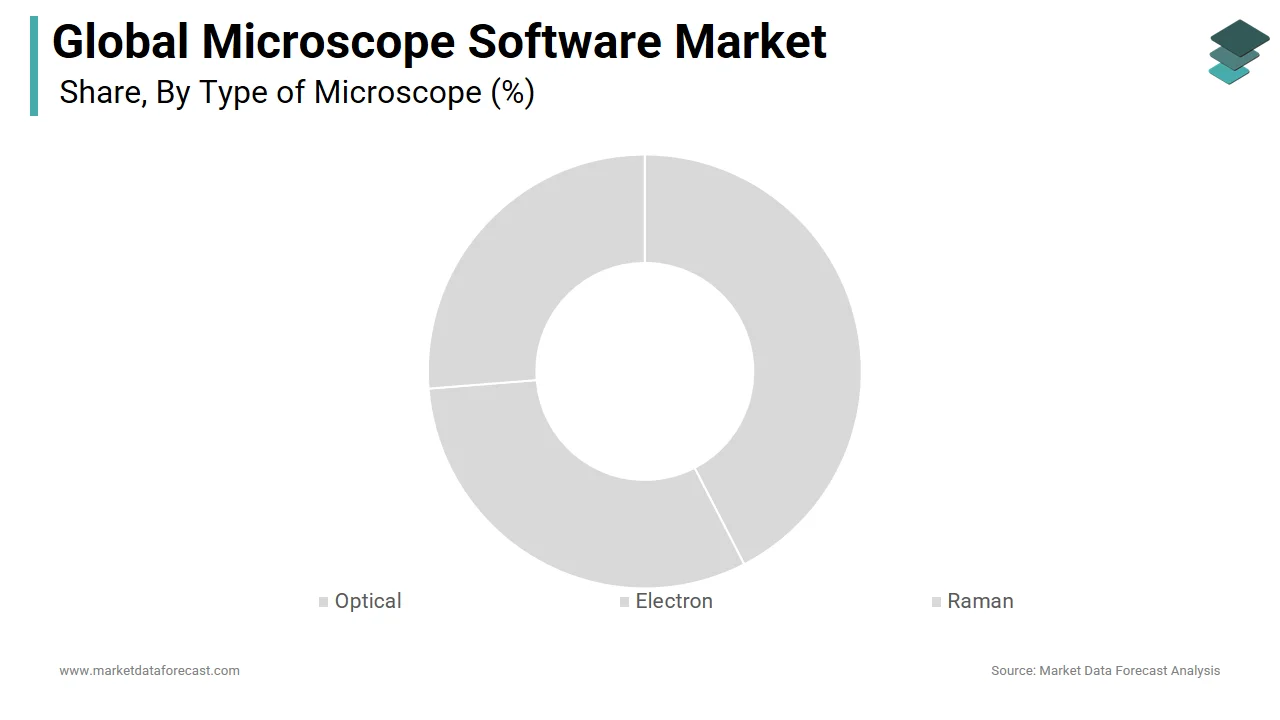
The optical microscopes accounted for the largest global microscope software market share as an optical microscope takes a magnified picture of an article specimen with an objective lens and magnifies the picture with an eyepiece to permit the user to notice it with the naked eye.
By Category Insights
Integrated software dominates the microscope software market as it integrates cutting-edge computer vision and customized software/equipment arrangements that best suit the software environment and its requirements—utilizing the driving brands of microscopes, stages, and cameras to maintain top-notch outcomes with the integrated software.
By Application Insights
The healthcare industry has dominated the microscope software market due to the extraordinary possibilities of microscopes. The healthcare field has various sorts of microscopes under everyday use. Doctors, researchers, and healthcare experts in Medical Education wouldn't have acquired exceptional information without microscopes. This instrument has been a staple in their everyday illustrations and pragmatic assessments. An excellent microscope is a primary instrument in surgical procedures during specific surgeries. A microscope turns into the doctor's eyes during techniques on a minute scale.
REGIONAL ANALYSIS
North America is the largest microscope software market. As the county had a mature market for the microscope software industry. A broad customer base and had set up distribution channels all over North America. Danaher Corporation and Thermo Fisher Scientific, two significant participants in the microscope software market, have a strong presence in North America, with a large client base and well-established distribution networks. Advanced microscopy equipment and software, such as electron microscopes, digital microscopes, and confocal microscopes, have a high penetration rate in this region's numerous end-use sectors. These businesses are actively engaged in research to increase the region's uses of correlative microscopy in materials science and geology and contribute to its growth.
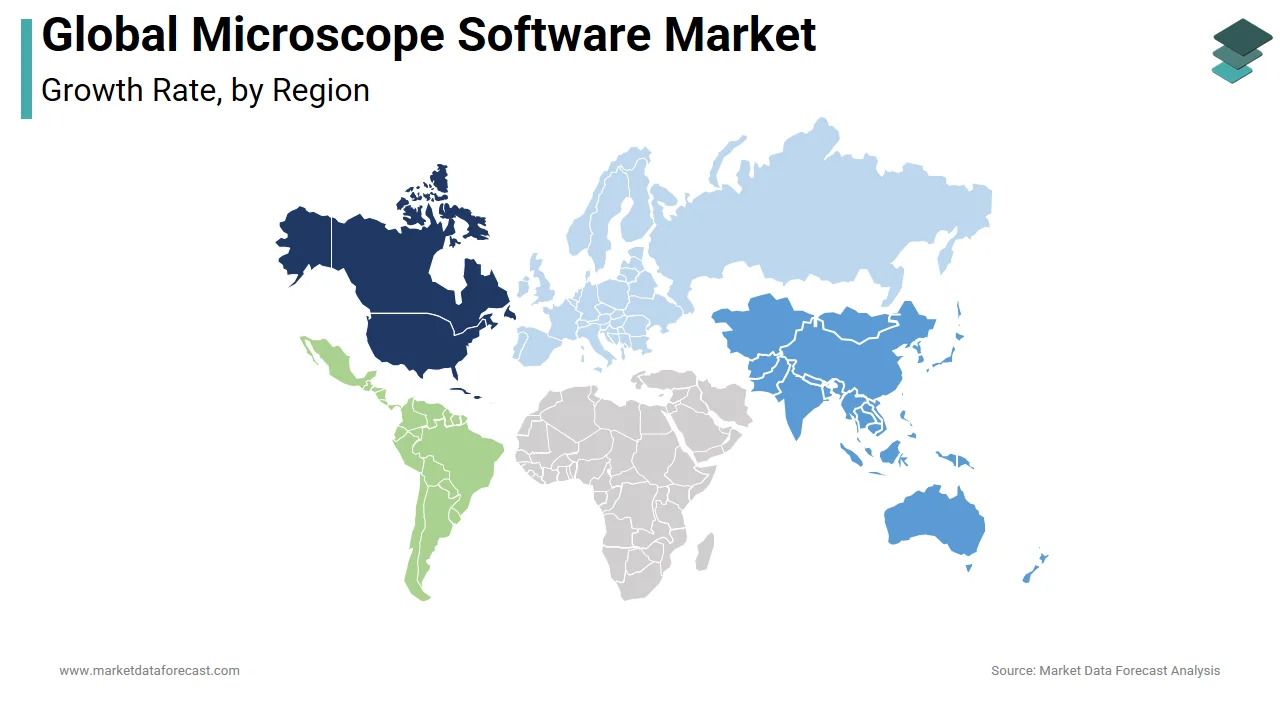
The Asia Pacific region is predicted to have the highest CAGR in the global microscope software market from 2025 to 2029 because of the increasing emphasis on R&D across several industrial verticals such as automotive, aerospace, and healthcare, as well as the expanding use of microscopes in industries like polymers, are expected to push the industry's growth in the coming years.
KEY MARKET PARTICIPANTS
The major companies operating in the global microscope software market include Carl Zeiss AG, Oxford Instruments plc, Olympus Corporation, Leica Microsystems, Nikon Corporation, Gatan Inc, Basler AG, Arivis AG, Object Research Systems, Inc., Thermo Fisher Scientific
RECENT MARKET HAPPENINGS
-
Olympus Corporation has introduced new clinical microscopy software. LabSens is a complete documentation solution for clinical and research imaging from Olympus. The software has a workflow-oriented user interface that makes it easy to find and use the essential functionalities for digital photography, analysis, and documentation.
-
Olympus' PRECiV software allows manufacturing, quality control, and inspection users to take precise, repeatable 2D measurements and produce findings that meet the most stringent industry standards.
MARKET SEGMENTATION
This research report on the global microscope software market has been segmented and sub-segmented based on the type of microscope, category, application, and region.
By Type of Microscope
-
Optical
-
Electron
-
Raman
By Category
-
Integrated
-
Standalone
By Application
-
Semiconductor
-
Aerospace
-
Automotive
-
Healthcare
-
Medical Device
-
Implant
By Region
-
North America
-
The United States
-
Canada
-
Rest of North America
-
-
Europe
-
The United Kingdom
-
Spain
-
Germany
-
Italy
-
France
-
Rest of Europe
-
-
The Asia Pacific
-
India
-
Japan
-
China
-
Australia
-
Singapore
-
Malaysia
-
South Korea
-
New Zealand
-
Southeast Asia
-
-
Latin America
-
Brazil
-
Argentina
-
Mexico
-
Rest of LATAM
-
-
The Middle East and Africa
-
Saudi Arabia
-
UAE
-
Lebanon
-
Jordan
-
Cyprus
-