- Product Description Description
- Table of Contents TOC
- List of Table & Figure LOT
- Get Free Sample PDF Sample PDF
Market Size, 2025
$4.76 BnMarket Estimate, 2026
$5.27 BnMarket Forecast, 2034
$11.96 BnCAGR, 2026–2034
10.78%Executive Summary: Middle East and Africa Agricultural Biotechnology Market
- Market Scope: Regional analysis of the Middle East and Africa (MEA) agricultural biotechnology market covering applications (synthetic biology-enabled products, tools, and transgenic crops like corn, soybean, and cotton) and country-level breakdowns across KSA, UAE, Israel, GCC countries, South Africa, Ethiopia, Kenya, Egypt, Sudan, and the Rest of MEA.
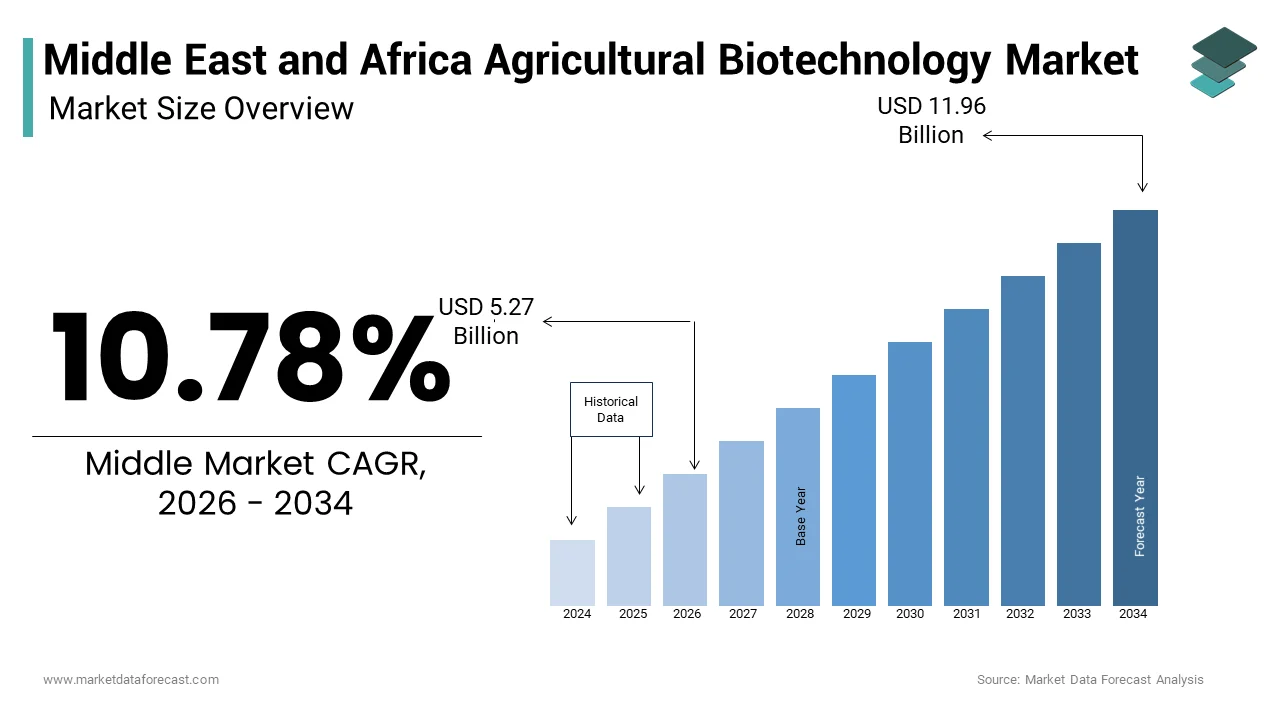
- Market Valuation: Valued at USD 4.76 billion (2025), estimated at USD 5.27 billion (2026), and projected to reach USD 11.96 billion by 2034, registering a strong CAGR of 10.78% (2026–2034).
- Primary Growth Drivers: High consumer and producer benefits from transgenic crop adoption, enhanced yield and pest resistance, reduced food grain demand-supply gaps, and surging biofuel demand amid depleting conventional resources.
Key Market Segment Metrics (2026–2034)
| Category | Leading Segment / Position | Fastest-Growing Segment / Scope |
|---|---|---|
| By Application | Transgenic Crops (expected to account for the major share of market revenue, led by corn and cotton) | Soybean (projected to grow at the highest rate during the forecast period; synthetic biology and tools holding smaller historical shares) |
| By Country / Region | South Africa (anchoring regional adoption under established biosafety laws) | KSA, UAE, Kenya, and Egypt (expanding through food security initiatives, trials, and agricultural modernization) |
Major Market Players & Competitive Landscape
Market Structure: A developing regional marketplace influenced by major global seed technology and agricultural science corporations addressing food security and productivity demands.
Key Companies: Bayer CropScience (Monsanto), Dow AgroSciences, Syngenta, DuPont, KWS SAAT AG, Vilmorin, Certis USA, and Evogene Ltd.
 Download Free Sample Report
Middle East and Africa Agricultural Biotechnology Market Size
The Middle East and Africa Agricultural Biotechnology Market size was valued at USD 4.76 billion in 2025 and is anticipated to reach USD 5.27 billion in 2026 to reach USD 11.96 billion by 2034, estimated to grow at a CAGR of 10.78% from 2026 to 2034.
Transgenic crops increase agricultural productivity and benefit producers, consumers, and farmers in terms of improved yield and crop quality. Genetically modified or transgenic crops are among the top end users of agricultural biotechnology. Agricultural biotechnology could advantage consumers and also producers, and farmers.
MARKET DRIVER
The transgenic cropping method offers more crop varieties to consumers than cross-pollination or any natural process can offer. It provides higher & improved yield, resistance to pests, longer shelf life, and high nutritional value, due to which the food grains demand supply gap is reduced. This is expected to drive the market. An increase in the demand for biofuel due to exhaustion of conventional resources is further expected to fuel the market growth.
REPORT COVERAGE
| REPORT METRIC | DETAILS |
| Market Size Available | 2025 to 2034 |
| Base Year | 2025 |
| Forecast Period | 2026 to 2034 |
| CAGR | 10.78% |
| Segments Covered | By Application, and By Country |
| Various Analyses Covered | Global, Regional & Country Level Analysis, Segment-Level Analysis, DROC, PESTLE Analysis, Porter’s Five Forces Analysis, Competitive Landscape, Analyst Overview on Investment Opportunities |
| Regions Covered | KSA, UAE, Israel, the rest of GCC countries, South Africa, Ethiopia, Kenya, Egypt, Sudan, the rest of MEA. |
| Market Leaders Profiled | Dow AgroSciences, Vilmorin, Certis USA, KWS SAAT AG, Monsanto, Syngenta, Evogene Ltd, Bayer Crop Science, and DuPont. |
By Application Insights
Transgenic crops are expected to account for a major share of the market revenue. Corn and soybeans are the most widely consumed crops. Soybeans are expected to grow at the highest rate during the forecast period. Synthetic biology-enabled products and tools, on the other hand, are growing at a slower pace considering their smaller shares in the past.
KEY MARKET PLAYERS
These Are the market players that are dominating the Middle East and Africa agricultural biotechnology market.
- Dow AgroSciences
- Vilmorin
- Certis USA
- KWS SAAT AG
- Monsanto
- Syngenta
- Evogene Ltd
- Bayer Crop Science
- DuPont.
MARKET SEGMENTATION
This research report on the Middle East and Africa Agricultural Biotechnology Market is segmented and sub-segmented into the following categories.
By Application
- Synthetic Biology Enabled Products
- Tools
- Transgenic Crops
- Corn
- Soyabean
- Cotton
By Country
- KSA
- UAE
- Israel
- The rest GCC countries
- South Africa
- Ethiopia
- Kenya
- Egypt
- Sudan
- Rest of MEA