Middle East And Africa Agriculture Analytics Market Size, Share, Trends, & Growth Forecast Report Segmented By Application Area, Farm size, Component, Deployment Types, And By Country (KSA, UAE, Israel, rest of GCC countries, South Africa, Ethiopia, Kenya, Egypt, Sudan, rest of MEA), Industry Analysis From, (2026 to 2034)
Market Size, 2025
$1273 MnMarket Estimate, 2026
$1478 MnMarket Forecast, 2034
$4879 MnCAGR, 2026–2034
16.1%Middle East And Africa Agriculture Analytics Market Size
The Middle East and Africa agriculture analytics market size was valued at USD 1273.27 million in 2025, and is anticipated to reach USD 1478.27 million in 2026 to reach USD 4879.90 million by 2034, growing at a CAGR of 16.1% during the forecast period from 2026 to 2034.

Agriculture Analytics is the application of data-driven technologies, including satellite imaging, IoT sensors, AI-based forecasting tools, and farm management software, to optimize agricultural productivity, resource utilization, and decision-making. As climate variability, water scarcity, and population growth intensify pressure on food systems in the region, analytics solutions are increasingly being adopted to enhance yield efficiency and sustainability.
Moreover, the sector is witnessing a gradual but significant shift toward digital agriculture, particularly in countries like South Africa, Egypt, Israel, and the UAE, where government-backed smart farming initiatives are gaining traction. According to the Food and Agriculture Organization (FAO), over 60% of smallholder farmers in sub-Saharan Africa face challenges related to inefficient input use, highlighting the need for precision agriculture tools.
Apart from these, as per research from the International Center for Biosaline Agriculture (ICBA), over 40% of arable land in the Gulf Cooperation Council (GCC) countries suffers from salinity and water stress, making data-driven irrigation and soil monitoring essential.
Moreover, universities and tech startups across Kenya, Nigeria, and Morocco are developing localized agritech platforms to support real-time crop health assessments and market intelligence. These efforts align with regional goals to improve food security and reduce post-harvest losses through advanced analytics.
MARKET DRIVERS
Increasing Adoption of Precision Farming Techniques
The growing adoption of precision farming techniques aimed at maximizing yield while minimizing resource consumption is one of the primary drivers fueling the Middle East and Africa Agriculture Analytics Market. With water scarcity and arid conditions limiting traditional farming methods, especially in North Africa and the Gulf region, farmers are turning to data-driven approaches to optimize inputs such as water, fertilizers, and pesticides.
According to the International Water Management Institute, irrigation accounts for over 80% of freshwater usage in the Middle East, underscoring the urgent need for precision irrigation systems powered by analytics.
Similarly, in South Africa, the Agricultural Research Council has been promoting the use of satellite imagery and soil moisture sensors to help commercial and subsistence farmers make informed planting decisions. A pilot program conducted in Limpopo province found that farmers using analytics tools achieved an increase in maize yield compared to conventional methods
In addition, startups in Kenya and Nigeria are deploying mobile-based agronomy advisory services that utilize machine learning algorithms to provide localized recommendations.
Government Support and Investment in Smart Agriculture Initiatives
Government backing plays a crucial role in accelerating the growth of the Middle East and Africa Agriculture Analytics Market, with several national and regional policies prioritizing digital transformation in agriculture. Public investments in smart farming infrastructure, digital extension services, and agri-tech incubators have created an enabling environment for the adoption of analytics tools.
Egypt’s Ministry of Agriculture and Land Reclamation has also introduced subsidies for digital farm management systems, encouraging large-scale farmers to adopt analytics platforms that monitor crop health and predict harvest yields.
In Sub-Saharan Africa, Ghana and Rwanda have implemented national digital agriculture strategies supported by the African Development Bank, which has funded training programs for farmers on how to use mobile apps and cloud-based analytics for better decision-making. These policy-driven interventions are instrumental in expanding the reach and impact of agriculture analytics across the region.
MARKET RESTRAINTS
Limited Digital Infrastructure and Internet Penetration
The limited availability of reliable digital infrastructure and low internet penetration rates, particularly in rural areas where agriculture remains a dominant economic activity, are major restraints affecting the growth of the Middle East and Africa Agriculture Analytics Market. Without consistent connectivity, farmers struggle to access cloud-based analytics platforms, real-time weather forecasts, or mobile advisory services.
According to the International Telecommunication Union (ITU), less than 40% of the rural population in Sub-Saharan Africa has regular access to high-speed internet, severely limiting the scalability of digital agriculture solutions. In countries like Ethiopia and Malawi, where agriculture contributes more than 30% to GDP, poor network coverage hampers the deployment of IoT-enabled farm monitoring systems.
Even in relatively developed nations such as South Africa, disparities persist between urban and rural broadband access. In response, some governments and private players are investing in offline-compatible analytics applications and SMS-based advisory services.
Low Awareness and Technical Knowledge Among Farmers
The limited awareness and technical knowledge among farmers regarding the benefits and usage of data-driven agricultural tools is another significant barrier to the expansion of the Middle East and Africa Agriculture Analytics Market. Many smallholder and traditional farmers remain unfamiliar with digital platforms, reducing their willingness to adopt analytics-based solutions.
According to research conducted by the African Economic Research Consortium in 2024, over 65% of surveyed farmers in Nigeria and Tanzania were unaware of available agritech tools, with many relying on conventional practices passed down through generations. Similarly, as per a study by the Ethiopian Institute of Agricultural Research, only 18% of smallholder farmers had received any formal training on digital agriculture technologies.
This knowledge gap is further exacerbated by language barriers and limited access to localized educational materials.
To address this challenge, several organizations, including the Alliance for a Green Revolution in Africa (AGRA), have launched farmer education campaigns and demonstration projects showcasing the effectiveness of analytics tools in improving yields and profitability. Despite these efforts, overcoming skepticism and building trust in digital agriculture remains a persistent hurdle across the region.
MARKET OPPORTUNITY
Expansion of Mobile-Based Agritech Platforms
The rapid expansion of mobile-based agritech platforms tailored for smallholder and mid-sized farmers is one of the most promising opportunities shaping the future of the Middle East and Africa Agriculture Analytics Market. With mobile phone penetration surpassing 80% in many African countries, mobile apps and SMS-based services offer a scalable solution for delivering real-time analytics, weather alerts, and agronomic advice directly to farmers.
Startups such as Twiga Foods in Kenya and Hello Tractor in Nigeria are leveraging mobile networks to connect farmers with analytics tools that optimize planting schedules, pest control, and market access.
In Egypt, the Ministry of Communications and Information Technology collaborated with local agritech firms to launch a national mobile farming platform that delivers customized soil and crop health reports based on satellite imagery. Early results showed an improvement in fertilizer efficiency among participating farmers.
Besides, in the UAE, mobile-based irrigation advisory services have gained traction among date palm and vegetable growers, helping them conserve water while maintaining productivity.
Integration of AI and Remote Sensing for Crop Monitoring
The integration of artificial intelligence (AI) and remote sensing technologies presents a transformative opportunity for the Middle East and Africa Agriculture Analytics Market. By leveraging satellite imagery, drone-based monitoring, and machine learning algorithms, farmers can gain unprecedented insights into crop health, soil conditions, and yield predictions.
In 2024, the African Union Commission partnered with the European Space Agency (ESA) to expand the use of Copernicus satellite data for agricultural planning across member states. This initiative enables early detection of drought conditions and pest outbreaks, allowing for timely intervention measures.
According to research from the University of Pretoria, AI-enhanced image analysis improved early blight detection in potato crops by 35%, giving farmers a critical advantage in managing disease outbreaks.
Startups like Aerobotics in South Africa and Flamingo Agritech in Kenya are also gaining momentum by offering drone-assisted scouting and predictive analytics to commercial farms.
MARKET CHALLENGES
Fragmented Data Ecosystem and Lack of Standardization
The fragmented nature of agricultural data ecosystems, which limits interoperability and hinders the seamless exchange of information between stakeholders, is a critical challenge facing the Middle East and Africa Agriculture Analytics Market. Unlike in more developed markets, where standardized data formats and centralized agricultural databases exist, the region struggles with inconsistent data collection methods, siloed datasets, and varying levels of digitization. This fragmentation prevents policymakers and agribusinesses from making data-driven decisions at scale.
According to a case study from Nigeria’s Federal Ministry of Agriculture, discrepancies between state and federal-level data delayed emergency responses during a recent locust infestation.
Efforts to establish common data standards, such as those led by the Global Open Data for Agriculture and Nutrition (GODAN) initiative, are still in early stages.
High Costs and Limited Access to Advanced Technologies
Despite growing interest in digital agriculture, the high cost of advanced analytics tools and limited access to financing options pose significant challenges for farmers in the Middle East and Africa. Unlike in developed economies, where subsidies and credit facilities support technology adoption, many smallholder farmers in the region lack the financial capacity to invest in premium analytics platforms.
According to a 2024 survey conducted by the International Fund for Agricultural Development (IFAD), only 12% of smallholder farmers in Eastern and Southern Africa could afford subscription-based agri-tech services, citing affordability as the primary barrier to adoption. Even basic analytics tools often require recurring payments for updates, cloud storage, and support, making them inaccessible to lower-income producers.
In response, some companies have introduced tiered pricing models and pay-as-you-go systems to cater to budget-conscious users. However, without stronger financial inclusion mechanisms—such as microloans, insurance products, and government subsidies—the majority of farmers remain excluded from the benefits of data-driven agriculture.
Moreover, the absence of well-established distribution networks in rural areas further complicates access to hardware components such as sensors, drones, and smart irrigation controllers.
REPORT COVERAGE
| REPORT METRIC | DETAILS |
| Market Size Available | 2025 to 2034 |
| Base Year | 2025 |
| Forecast Period | 2026 to 2034 |
| CAGR | 16.1% |
| Segments Covered | By Application Area, Farm Size, Component, and Region. |
| Various Analyses Covered | Global, Regional, Country-Level Analysis, Segment-Level Analysis, DROC, PESTLE Analysis, Porter’s Five Forces Analysis, Competitive Landscape, Analyst Overview of Investment Opportunities |
| Regions Covered | KSA, UAE, Israel, the rest of GCC countries, South Africa, Ethiopia, Kenya, Egypt, Sudan, the rest of MEA |
| Market Leaders Profiled | Accenture Plc., Agribotix LLC, Agrivi Ltd., aWhere Inc., Conservis Corporation, Deere Company, De Laval Inc., DNT Ltd., Farmers Business Network Inc., Farmers Edge Inc., Geosys Inc., Granular Inc., Gro Intelligence Inc., IBM Corporation, Iteris Inc., Monsanto Company, Oracle Corporation, Precision Hawk Inc., SAP Inc., Trimble Inc. |
SEGMENTAL ANALYSIS
By Application Area Insights
Farm Analytics
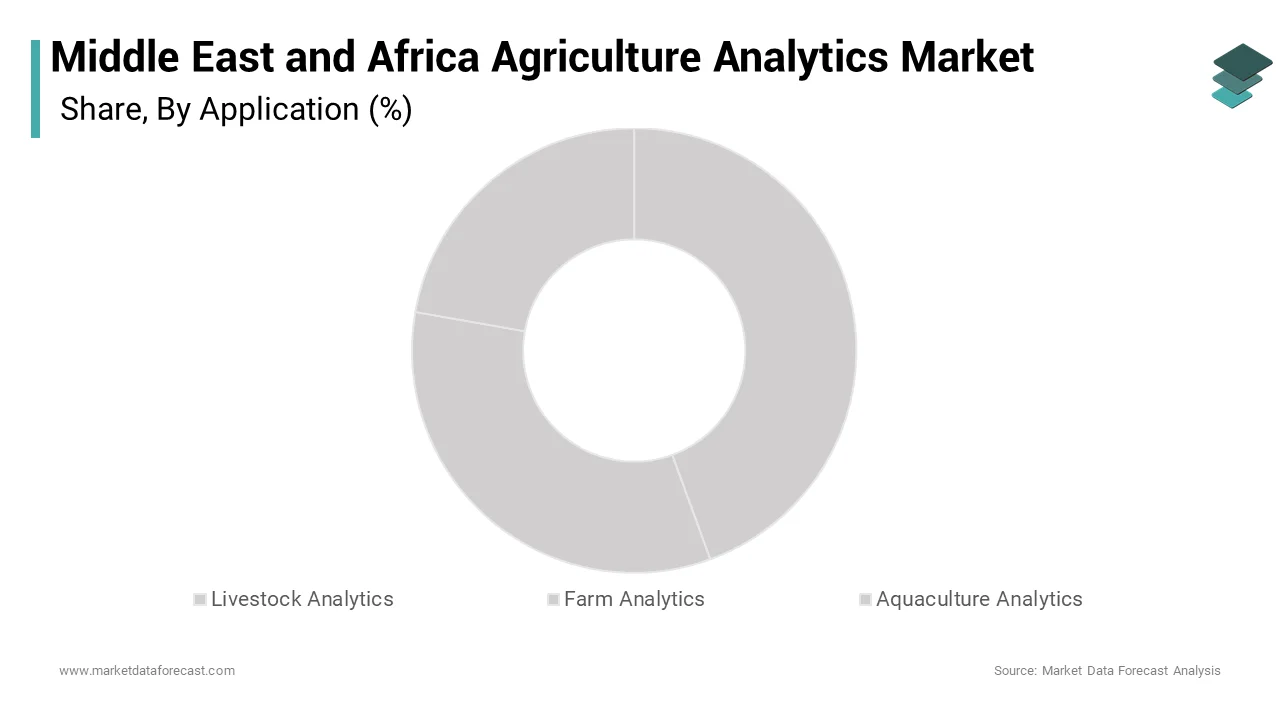
The farm analytics segment dominated the Middle East and Africa Agriculture Analytics Market with a share of 58.5%. Its widespread applicability across diverse crop types and farming practices is primarily driving the growth of the arm analytics segment. This segment includes data-driven tools used for soil monitoring, yield prediction, pest control, irrigation scheduling, and overall farm management.
The increasing reliance on precision agriculture to enhance productivity in regions facing water scarcity and unpredictable weather patterns is also among the key drivers behind this dominance of the segment. According to the Food and Agriculture Organization (FAO), over 40% of arable land in the Gulf Cooperation Council (GCC) countries suffers from salinity issues, making data-driven soil and irrigation management essential for sustainable farming.
Further, government-backed digital agriculture initiatives are accelerating adoption. In Egypt, as per the Ministry of Agriculture and Land Reclamation, over 300,000 farmers accessed satellite-based analytics platforms in 2023, significantly improving decision-making for wheat and maize production.
Moreover, startups in Kenya and Nigeria have developed mobile-based analytics applications tailored for smallholder farmers, contributing to broader accessibility.
Livestock Analytics
The livestock analytics segment is projected to grow at the fastest CAGR of 21.4% through 2033. Rising demand for livestock health monitoring, breeding optimization, and feed efficiency analysis in both commercial and subsistence farming systems is fuelling the development of the livestock analytics segment.
This rapid growth is also fueled by the increasing integration of IoT-enabled wearables and AI-powered monitoring systems in animal husbandry.
In Kenya, the Ministry of Agriculture launched a national livestock digitization program aimed at curbing disease outbreaks through real-time tracking and early warning systems. The initiative has resulted in a 25% reduction in foot-and-mouth disease spread in targeted regions since 2022.
Furthermore, in the United Arab Emirates, where meat and dairy imports remain high, local producers are adopting analytics solutions to boost domestic output. The UAE’s Ministry of Climate Change and Environment reported that livestock analytics contributed to a 30% improvement in feed conversion ratios in camel and cattle farms in Abu Dhabi.
By Farm Size Insights
Small-Sized Farms
The small-sized farms segment led with a 47.4% of the Middle East and Africa Agriculture Analytics Market, which is reflecting the vast number of smallholder farmers who rely on affordable, accessible analytics tools to improve productivity and reduce input wastage.
The lead position of this segment is credited to the fact that over 80% of agricultural producers in Sub-Saharan Africa operate on less than two hectares of land, according to the African Development Bank. These farmers often face challenges related to inefficient resource allocation, limited access to credit, and vulnerability to climate shocks—issues that digital analytics aim to address.
In response, agritech startups such as Hello Tractor in Nigeria and Twiga Foods in Kenya have introduced mobile-based analytics platforms designed specifically for small-scale operations.
Apart from these, governments and development agencies are promoting low-cost digital tools to support rural livelihoods. Ethiopia’s Agricultural Transformation Agency implemented a pilot project that provided smallholders with free soil testing apps linked to analytics dashboards, resulting in an improvement in fertilizer efficiency.
Large-Sized Farms
The large-sized farms segment is experiencing the highest growth within the Middle East and Africa Agriculture Analytics Market, expanding at a CAGR of 19.8% through 2033. The increasing adoption of advanced analytics technologies by agribusinesses and commercial farming enterprises seeking operational efficiency and yield optimization is attributed to the surge of the large-sized farms segment.
The shift toward mechanized and precision farming techniques among large-scale producers in countries like South Africa, Egypt, and Saudi Arabia is another primary factor driving this growth.
Moreover, multinational agribusinesses operating in the region are investing heavily in analytics-driven supply chain management.
In the Gulf region, large-scale date palm and vegetable producers are leveraging remote sensing and predictive analytics to manage scarce water resources more efficiently. The UAE’s Smart Farming Initiative supported the deployment of AI-enhanced irrigation systems, which led to a 22% improvement in water-use efficiency.
By Component Insights
Solution
The solution component segment commanded the Middle East and Africa Agriculture Analytics Market by capturing 56.5% of total revenue in 2024. The increasing availability of cloud-based and mobile-compatible analytics solutions tailored for different farming contexts is one of the main reasons for the dominance of the solution component segment. This segment includes software platforms, analytical tools, and integrated systems used for crop monitoring, livestock tracking, weather forecasting, and resource planning.
In Kenya, startups like UjuziKilimo offer soil analytics tools that integrate with smartphones, helping smallholder farmers optimize nutrient application based on real-time data.
Similarly, in the UAE, precision agriculture companies such as Pure Harvest Smart Farms are deploying proprietary analytics platforms to manage greenhouse environments and automate irrigation schedules.
Services
The services segment is emerging as the fastest-growing component of the Middle East and Africa Agriculture Analytics Market and is expanding at a CAGR of 20.1% through 2033.
A key factor driving the growth of this segment is the increasing need for technical assistance and capacity building among small and mid-sized farms. This segment includes consulting, implementation, training, and managed services that support farmers in effectively utilizing analytics tools. Many farmers lack the expertise to interpret complex datasets or deploy digital tools independently, necessitating hands-on support from agritech service providers.
In South Africa, organizations like the Agricultural Research Council (ARC) have launched training programs in partnership with tech firms to educate farmers on using satellite-based analytics for irrigation and pest control. These initiatives have shown measurable improvements in crop outcomes and farmer confidence levels.
Besides, in the UAE, the Abu Dhabi Investment Office has funded agritech incubators that provide end-to-end support—from installation to maintenance—for smart farming analytics systems.
COUNTRY ANALYSIS
Saudi Arabia Agriculture Analytics Market Analysis
Saudi Arabia secured a prominent position in the Middle East and Africa Agriculture Analytics Market by accounting for 14.4% of total regional revenue in 2024. The country’s lead position is underpinned by its strategic push toward food self-sufficiency under Vision 2035, which prioritizes technology-driven agriculture to overcome water scarcity and desertification challenges.
The Ministry of Environment, Water, and Agriculture has been actively promoting digital tools to optimize resource use, particularly in wheat, barley, and date palm cultivation.
Moreover, the Public Investment Fund (PIF) also allocated USD 150 million in 2023 to support agritech startups, many of which focus on data-driven farming solutions.
United Arab Emirates Agriculture Analytics Market Analysis
The United Arab Emirates is seeing strong adoption in the Middle East and Africa Agriculture Analytics Market, which is driven by its commitment to transforming arid-land agriculture through cutting-edge digital solutions. As part of the UAE Centennial 2071 strategy, the government has prioritized smart farming and food security, encouraging the adoption of analytics-driven technologies.
The Ministry of Climate Change and Environment (MOCCAE) has been instrumental in promoting digital agriculture through initiatives such as the "Smart Farming Program," which supports the integration of AI, IoT, and remote sensing in commercial farming.
Abu Dhabi’s Food Tech Valley, launched in 2023, serves as a hub for agritech startups developing predictive analytics tools for crop and livestock management. In Al Ain, several date palm plantations have adopted drone-based analytics to detect early signs of pests and diseases, reducing losses by 30%, as reported by the Abu Dhabi Agriculture and Food Safety Authority.
South Africa Agriculture Analytics Market Analysis
South Africa is witnessing significant growth in the Middle East and Africa Agriculture Analytics Market owing to its diversified agricultural landscape and well-established agri-food value chains. The country's structured approach to digital agriculture has facilitated the adoption of analytics in both commercial and smallholder farming ecosystems.
The Department of Agriculture, Land Reform and Rural Development has been actively integrating digital tools into national extension services.
Moreover, universities such as Stellenbosch University and the University of Pretoria are collaborating with agritech firms to develop localized analytics platforms tailored for maize, citrus, and vineyard production.
Startups like Aerobotics and AgriProphet are gaining traction by offering AI-based scouting and predictive analytics to commercial farms, enhancing pest and disease management.
Egypt – Expanding Digital Infrastructure Supporting Market Growth
Egypt contributes a notable portion to the Middle East and Africa Agriculture Analytics Market and is benefiting from government-led digital agriculture initiatives and an extensive network of small and medium-sized farms adopting data-driven tools.
The Ministry of Communications and Information Technology has also partnered with global agritech firms to introduce AI-powered platforms that analyze satellite data for early detection of crop stress and irrigation inefficiencies. In the Nile Delta, a joint initiative between the Ministry and IBM showed an improvement in nitrogen-use efficiency among rice growers using predictive analytics
Further, Cairo University and the Agricultural Research Center have established digital extension services to train farmers on analytics tools, particularly in Upper Egypt, where water scarcity is a major concern.
Kenya Agriculture Analytics Market Analysis
Kenya is positioning itself as a regional innovation hub for mobile-based agritech solutions tailored to smallholder farmers.
The Kenyan government, in collaboration with the World Bank and the International Fund for Agricultural Development (IFAD), has supported the proliferation of mobile platforms that deliver real-time analytics, weather forecasts, and agronomic advice directly to farmers' smartphones. According to the Kenya Agricultural and Livestock Research Organization (KALRO), over 1.2 million farmers accessed digital advisory services in 2023.
Universities and incubation centers, including Jomo Kenyatta University of Agriculture and Technology (JKUAT) and the iCow platform, are playing a crucial role in adapting analytics tools to local conditions. Field trials in Nakuru County revealed that farmers using analytics-supported irrigation strategies experienced an increase in potato yields compared to conventional methods.
Israel Agriculture Analytics Market Analysis
Israel maintains a significant presence in the Middle East and Africa Agriculture Analytics Market. The country’s position is attributed to its world-renowned expertise in precision agriculture, water management, and agritech innovation.
Israeli companies such as Netafim, Taranis, and Prospera (now part of Cainiao Smart Agriculture) have been at the forefront of developing AI-driven analytics platforms that optimize irrigation, pest control, and yield forecasting.
Furthermore, Israel has become a knowledge-sharing partner for several African and Gulf nations. The Ministry of Foreign Affairs’ MASHAV program has trained thousands of farmers from Ethiopia, Ghana, and Morocco in using analytics for drought-resistant crop management.
As regional demand for sustainable farming solutions grows, Israel’s influence in the analytics market continues to expand.
COMPETITIVE LANDSCAPE
The competition in the Middle East and Africa Agriculture Analytics Market is intensifying as both global agritech firms and regional startups vie for influence in an evolving digital landscape. Established players from North America and Europe are entering the region through partnerships and localized offerings, while homegrown startups are leveraging deep contextual knowledge to develop tailored solutions for smallholder and commercial farms alike. The market is characterized by a mix of technological innovation, policy support, and grassroots-level adaptability, creating a dynamic environment where success depends on understanding local farming systems and overcoming infrastructural barriers. While larger companies bring advanced analytics capabilities and global expertise, smaller firms often outperform in agility and community engagement, offering hyper-localized tools that resonate with end users. Besides, the convergence of mobile technology, artificial intelligence, and remote sensing is reshaping competitive dynamics, compelling firms to differentiate through affordability, ease of use, and integration with existing supply chains. As digital agriculture gains traction, the market remains highly fragmented, fostering continuous innovation and collaboration among stakeholders seeking to transform the agricultural sector across the region.
KEY MARKET PLAYERS
These are the market players that are dominating the Middle East and Africa Agriculture Analytics Market.
- Accenture Plc.
- Agribotix LLC
- Aerobotics (South Africa)
- Hello Tractor (Nigeria)
- Prospera Technologies (Israel – now part of Cainiao Smart Agriculture)
- Agrivi Ltd.
- Where Inc.
- Conservis Corporation,
- Deere Company
- De Laval Inc.
- DNT Ltd.
- Farmers Business Network Inc.
- Farmers Edge Inc.
- Geosys Inc.
- Granular Inc.
- Gro Intelligence Inc
- IBM Corporation
- Iteris Inc
- Monsanto Company
- Oracle Corporation
- Precision Hawk Inc.
- SAP Inc.
- Trimble Inc.
Top Players In The Market
- Aerobotics is a leading agritech company specializing in AI-driven aerial analytics for precision agriculture. The company uses drone and satellite imagery combined with machine learning to monitor crop health, detect disease outbreaks, and optimize yield predictions. Aerobotics has made significant contributions to global agricultural analytics by providing scalable solutions tailored not only for large commercial farms but also for smallholder operations across Sub-Saharan Africa. Its technology supports early intervention strategies that enhance productivity and sustainability, positioning it as a key player in advancing digital agriculture on the continent.
- Hello Tractor is a mobile-based platform that facilitates tractor sharing and farm equipment access for smallholder farmers across West and East Africa. Beyond machinery sharing, the company integrates analytics to provide insights on soil conditions, planting schedules, and market access. Hello Tractor plays a crucial role in bridging the digital divide in rural agriculture by offering affordable, localized data solutions. Its innovative approach has influenced similar platforms globally, reinforcing its position as a transformative force in agriculture analytics for emerging markets.
- Prospera Technologies has been a pioneer in deploying AI and IoT-based analytics for greenhouse and open-field farming. Although headquartered in Israel, its impact extends across the Middle East and Africa, where its real-time monitoring systems are used to manage irrigation, nutrient levels, and environmental stressors in arid and semi-arid regions. By enabling resource-efficient farming, Prospera contributes significantly to sustainable agriculture practices, particularly in water-scarce environments. Its integration into Cainiao Smart Agriculture has further expanded its reach and capabilities in the regional agri-tech ecosystem.
Top Strategies Used By Key Market Participants
Localization of Digital Solutions
To better serve diverse agricultural ecosystems and user needs, leading players are tailoring their analytics tools to local languages, farming practices, and climatic conditions. This includes adapting mobile apps, dashboards, and SMS-based advisory services to ensure relevance and usability for smallholder farmers who may lack formal technical training.
Partnerships with Governments and Development Agencies
Key players are forming strategic alliances with public institutions, NGOs, and international development bodies to scale adoption through subsidized programs and national digital agriculture initiatives. These collaborations help integrate analytics into extension services and improve accessibility for under-resourced farming communities.
Integration with Financial and Supply Chain Services
To enhance farmer engagement and trust, companies are embedding analytics within broader digital ecosystems that include microfinance, insurance, and market linkage services. This holistic approach not only improves decision-making but also increases the value proposition for farmers, driving deeper market penetration and sustained usage.
RECENT MARKET NEWS
- In January 2024, Aerobotics launched a new feature within its app specifically designed for date palm monitoring, expanding its analytics capabilities to meet the demands of commercial growers in the Gulf region, enhancing its regional service offerings.
- In March 2024, Hello Tractor introduced an integrated soil fertility analysis module into its mobile platform, allowing Nigerian farmers to receive customized fertilizer recommendations based on field-specific data collected via connected devices.
- In June 2024, Prospera Technologies partnered with a major UAE-based agribusiness to deploy real-time greenhouse monitoring systems that adjust climate controls automatically based on predictive analytics, improving yield consistency and resource efficiency.
- In September 2024, UjuziKilimo expanded its soil analytics services to Tanzania, collaborating with local cooperatives to deliver actionable insights directly to smallholder farmers via SMS and voice-based interfaces.
- In November 2024, AgriProphet launched an AI-powered pest prediction system in Kenya, integrating drone-captured imagery with historical infestation data to enable early warning alerts for maize and cassava farmers.
MARKET SEGMENTATION
This research report on the Middle East and Africa agriculture analytics market is segmented and sub-segmented into the following categories.
By Application Area
- Livestock Analytics
- Farm Analytics
- Aquaculture Analytics
By Farm Size
- Small-sized farms
- Medium-sized farms
- Large-sized farms
By Component
- Solution
- Service
By Deployment Type
- Cloud on
- Premises
By Country
- KSA
- UAE
- Israel
- The rest of the GCC countries
- South Africa
- Ethiopia
- Kenya
- Egypt
- Sudan
- Rest of MEA
Frequently Asked Questions
What is agriculture analytics?
Agriculture analytics refers to the use of data-driven tools and technologies to collect, process, and analyze information related to farming practices. This includes data on soil health, weather patterns, crop performance, pest infestations, irrigation efficiency, and more. The goal is to help farmers and agribusinesses make informed decisions that improve productivity, reduce waste, and increase profitability.
Why is agriculture analytics becoming important in the Middle East and Africa?
In these regions, agriculture faces challenges like water scarcity, unpredictable weather, limited arable land, and growing populations. Agriculture analytics helps optimize resource usage—especially water and fertilizers—while enabling early detection of threats such as pests or drought. As digital infrastructure improves and mobile technology spreads, more farmers are gaining access to analytical tools that can significantly boost yields and sustainability.
How does mobile technology support agriculture analytics in this region?
Mobile phones have become the primary tool for accessing agriculture analytics in many parts of Africa and the Middle East. Farmers can receive SMS alerts about weather changes, download apps to assess crop health, or upload images of diseased plants for expert diagnosis. Mobile networks provide affordable access to data-driven decision-making tools, especially for smallholder farmers.
What impact is climate change having on the need for agriculture analytics?
Climate change has made weather patterns less predictable and extreme events more frequent. Agriculture analytics provides early warning systems for droughts, floods, and pest outbreaks. It also helps in selecting resilient crop varieties and optimizing irrigation schedules, which is vital in areas already struggling with water shortages.
How is agriculture analytics supporting food security in the region?
By enabling smarter farming practices, agriculture analytics helps increase crop yields and reduce losses. This is especially important in regions where population growth is outpacing food production. Better planning and resource management ensure that available farmland produces more with less environmental impact.
What is the projected growth of the agriculture analytics market in the Middle East and Africa?
The market is expected to grow steadily over the next decade, fueled by rising investments in agri-tech startups, increasing smartphone penetration, and supportive policy frameworks. Industry experts estimate a CAGR of around 10–14% during the forecast period, with particular growth in precision farming and farm management software segments.
How is agriculture analytics being integrated into education and training?
Universities and vocational institutions in countries like South Africa, Egypt, and Kenya are incorporating agriculture analytics into their curricula. Additionally, online learning platforms are offering short courses in digital agriculture, empowering young entrepreneurs and farmers to adopt new technologies confidently.
How is agriculture analytics being integrated into education and training?
Universities and vocational institutions in countries like South Africa, Egypt, and Kenya are incorporating agriculture analytics into their curricula. Additionally, online learning platforms are offering short courses in digital agriculture, empowering young entrepreneurs and farmers to adopt new technologies confidently.
How are women and youth being empowered through agriculture analytics in the region?
Agriculture analytics is opening up new opportunities for women and young people who may not traditionally have had access to land or capital. Mobile-based platforms allow them to offer digital advisory services, manage farm data, or even start agri-tech startups. In countries like Nigeria and Kenya, many young entrepreneurs are developing local apps that help farmers interpret soil health reports or track market prices—making farming more attractive and profitable for a new generation.
What role do cooperatives and farmer associations play in promoting agriculture analytics?
Farmer cooperatives and associations are increasingly acting as intermediaries for adopting digital tools. They often provide shared access to analytics platforms, organize training sessions, and help members interpret data on crop performance and resource usage. This collective approach lowers individual costs and builds trust in new technologies, especially among older or less tech-savvy farmers.
Related Reports
Access the study in MULTIPLE FORMATS
Purchase options starting from
$ 1600
Didn’t find what you’re looking for?
TALK TO OUR ANALYST TEAM
Need something within your budget?
NO WORRIES! WE GOT YOU COVERED!
Call us on: +1 888 702 9696 (U.S Toll Free)
Write to us: sales@marketdataforecast.com