- Product Description Description
- Table of Contents TOC
- List of Table & Figure LOT
- Get Free Sample PDF Sample PDF
Market Size, 2025
$88 MnMarket Estimate, 2026
$101.81 MnMarket Forecast, 2034
$326.95 MnCAGR, 2026–2034
15.7%Middle East and Africa Aquaponics System Market Size, Share, Trends & Forecast (2026–2034)
- Market Scope: Comprehensive market analysis of the Middle East and Africa aquaponics system market covering equipment components, production types, system components, application segments, country-level adoption patterns, and arid-climate agricultural drivers.
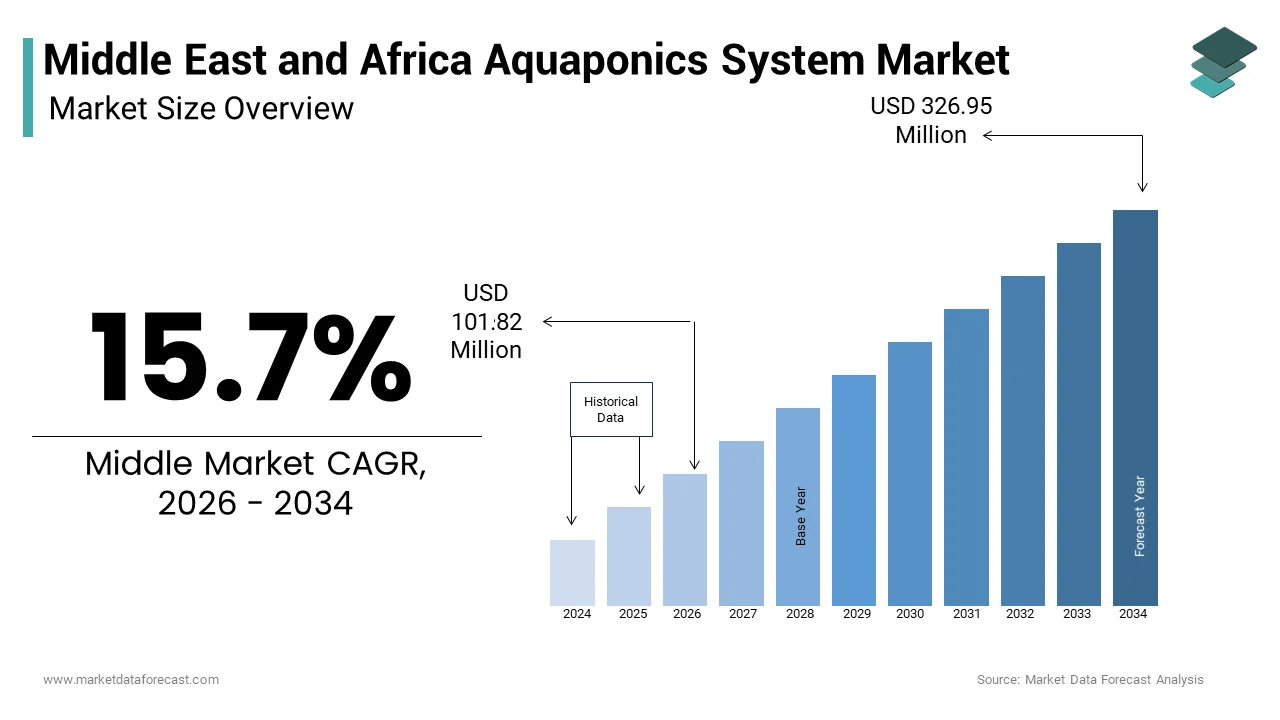
- Market Valuation: Valued at USD 88 million in 2024, estimated at USD 101.82 million in 2026, and projected to reach USD 326.95 million by 2034, growing at a high compound annual growth rate (CAGR) of 15.7% (2026–2034).
- Primary Growth Drivers: Water scarcity and the acute need for water-efficient food production in arid regions, rising population and demand for organic fresh produce, and foreign investments (e.g., from the US, UK, and China) bolstering regional agritech infrastructure.
Middle East and Africa Aquaponics System Market Segment Metrics (2026–2034)
| Category | Leading Segment (2025/2026 Position) | Fastest-Growing Segment |
|---|---|---|
| By Equipment | Pumps, valves, & Aeration systems (vital for water circulation and dissolved oxygen) | Water quality testing & Grow lights (for precision control in controlled environments) |
| By Production Type | Vegetables & Fruits (leading output value for local food security) | Herbs and specialty high-value crops |
| By Application | Commercial Scale Operations (driven by food security and government-backed agricultural initiatives) | Household & Educational/Research installations |
| By Country / Region | GCC Countries (KSA & UAE leading through intensive agritech and food security investments) | South Africa & Israel (expanding commercial urban and desert farming) |
Major Industry Players & Market Structure
Market Structure: Emerging market landscape characterized by international system providers and localized agritech innovators collaborating to overcome arid conditions, water scarcity, and infrastructure hurdles.
Key Companies: Nelson & Pade Inc., Urban Farms AG, ECF Farm Systems GmbH, Backyard Aquaponics Pty Ltd, My Aquaponics, Colorado Aquaponics, and Green Life Aquaponics.
Middle East and Africa Aquaponics System Market Size
The Middle East and Africa aquaponics system market size was valued at USD 88 million in 2024 and is anticipated to reach USD 101.82 million in 2026, from USD 326.95 million by 2034, estimated to grow at a CAGR of 15.7% from 2026 to 2034.
Aquaponics is the combination of aquaculture and hydroponics in an ideal environment. Aquaculture is the growing of aquatic animals like fish, prawns, and other aquatic animals. Hydroponics is the cultivation of plants in water without soil. The aquaculture waste provides organic food for the plants. In return, plants naturally clean the water that goes back to the fish. The third participant is microbes, which provide for the plants. The microbes convert ammonia from the fish waste into nitrites and then into nitrate, which are the f, forms of nitrogen that plants can uptake and use to grow. The result is a perfect collaboration between aquaculture and hydroponics.
Aquaponics is a perfect hope for sustainable aquaculture, organic crop production, and water consumption. Aquaponics uses the same systems; no differences in how the system works, except for the added fish in the water tanks. pH control is a very important part of aquaponics. Flood and drain, drip irrigation, deep culture or water submerged roots, and nutrient film techniques are highly compatible and customizable to merge with growing fish. Few primA few methods of aquaponics that are growing widely are Deep water culture, Media-based aquaponics, Nutrient Film Technique and Ver, and Vertical Aquaponics. Aquaponics is becoming famous as an efficient way to produce eco-friendly food and eco-friendly.
MARKET DRIVERS
Rise in population, increasing demand for organic fruits and vegetables, rise in disposable income, improvement in urban farming methods and off-season availability of fruits & vegetables, growing of new diseases due to the unhygienic food, technological advancements and innovations in the field of agriculture, low cost in terms of lesser preparation time, rise in urbanisation, lower transport & storage costs of food and higher margins of benefits are driving the Middle-East and Africa aquaponics market growth from last few years. However, high-cost equipment, a limited number of skilled professionals, andlackc,k of awareness in rural areas are hampering the growth of the market.
REPORT COVERAGE
| REPORT METRIC | DETAILS |
| Market Size Available | 2025 to 2034 |
| Base Year | 2025 |
| Forecast Period | 2026 to 2034 |
| CAGR | 15.7% |
| Segments Covered | By Equipment, Production, Component, Application, and Region. |
| Various Analyses Covered | Global, Regional & Country Level Analysis, Segment-Level Analysis, DROC, PESTLE Analysis, Porter’s Five Forces Analysis, Competitive Landscape, Analyst Overview of Investment Opportunities |
| Regions Covered | KSA, UAE, Israel, rest of GCC countries, South Africa, Ethiopia, Kenya, Egypt, Sudan, rest of MEA |
| Market Leaders Profiled | Nelson & Pade Inc., Urban Farms AG, ECF Farm systems GmbH, Backyard Aquaponics Pty Ltd, My Aquaponics, Colorado Aquaponics, and Green Life Aquaponics. |
COUNTRY ANALYSIS
The market has been geographically segmented into the Middle East and Africa. The market is growing slowly because of many problems the region faces, in terms of battles, and also the unstable economy. However, countries like the USA, China, and the UK are investing in the region, and this increased financial revenue will aid the agricultural sectors in this region.
KEY MARKET PLAYERS
The key players dominating the Aquaponics market are
- Nelson & Pade Inc.
- Urban Farms AG
- ECF Farm systems GmbH
- Backyard Aquaponics Pty Ltd
- My Aquaponics
- Colorado Aquaponics
- Green Life Aquaponics.
MARKET SEGMENTATION
This research report on the Middle East and African aquaponics system market is segmented and sub-segmented into the following categories.
By Equipment
- pumps and valves
- water heaters
- grow lights
- fish purge systems
- water quality testing
- aeration systems
- others
By Production Type
- fish
- vegetables & fruits
- herbs
- others
By Component
- rearing tanks
- biofilter
- settling basin
- sump
- hydroponics subsystem
- others
By Application
- commercial
- education & research
- household
- community
- others
By Country
- KSA
- UAE
- Israel
- Rest Of GCC Countries
- South Africa
- Ethiopia
- Kenya
- Egypt
- Sudan
- Rest Of MEA