- Product Description Description
- Table of Contents TOC
- List of Table & Figure LOT
- Get Free Sample PDF Sample PDF
Market Size, 2025
$73.72 MnMarket Estimate, 2026
$76.35 MnMarket Forecast, 2034
$101.08 MnCAGR, 2026–2034
3.57%Executive Summary: Middle East and Africa Ascorbic Acid Market
- Market Scope: Regional analysis of the Middle East and Africa (MEA) ascorbic acid market covering grade categories, application industries, country-level breakdowns, and personal care/fortified food trends.
- Market Valuation: Valued at USD 73.72 million in 2025, estimated at USD 76.35 million in 2026, and projected to reach USD 101.08 million by 2034, registering a steady CAGR of 3.57% from 2026 to 2034.
- Primary Growth Drivers: Increasing adoption of ascorbic acid in fortified foods, beverages, and personal care formulations; rising health awareness and dietary/diabetic population growth; and antioxidant/preservative demand across multiple industries.
Key Market Segment Metrics (2026–2034)
| Category | Leading Segment / Position | Segment Details / Breakdown |
|---|---|---|
| By Grade | Food, Pharmaceutical & Industrial | Food and pharmaceutical grades drive primary volume usage as preservatives, dietary additives, and medical formulations. |
| By Application | Food and Beverages, Pharmaceuticals, Chemicals, Personal Care & Agriculture | Food & beverages lead consumption, while personal care/cosmetics expand rapidly via anti-aging and skin-brightening products. |
| By Country / Region | KSA, UAE, Israel, South Africa & Rest of MEA | Emerging regional markets boosted by rising demand for personal care products, better living standards, and health awareness. |
Major Market Players & Market Structure
Market Structure: Competitive global and regional supply network characterized by major chemical and pharmaceutical manufacturers engaging in strategic acquisitions and cosmetic ingredient innovations.
Key Companies: GlaxoSmithKline Plc., DSM, NBTY Inc., Shandong Luwei Pharmaceutical, DuPont, Aland Nutraceuticals Group, Dishman Group, North China Pharmaceutical Group, Hebei Welcome Pharmaceutical Co., Northeast Pharmaceutical Group, BASF SE, CSPC Pharmaceutical Group, and Bactolac Pharmaceutical Inc.
Middle East and Africa Ascorbic Acid Market Size
The Middle East and Africa ascorbic acid market size was valued at USD 73.72 million in 2025 and is projected to reach USD 101.08 million by 2034 from USD 76.35 million in 2026, growing at a CAGR of 3.57%.
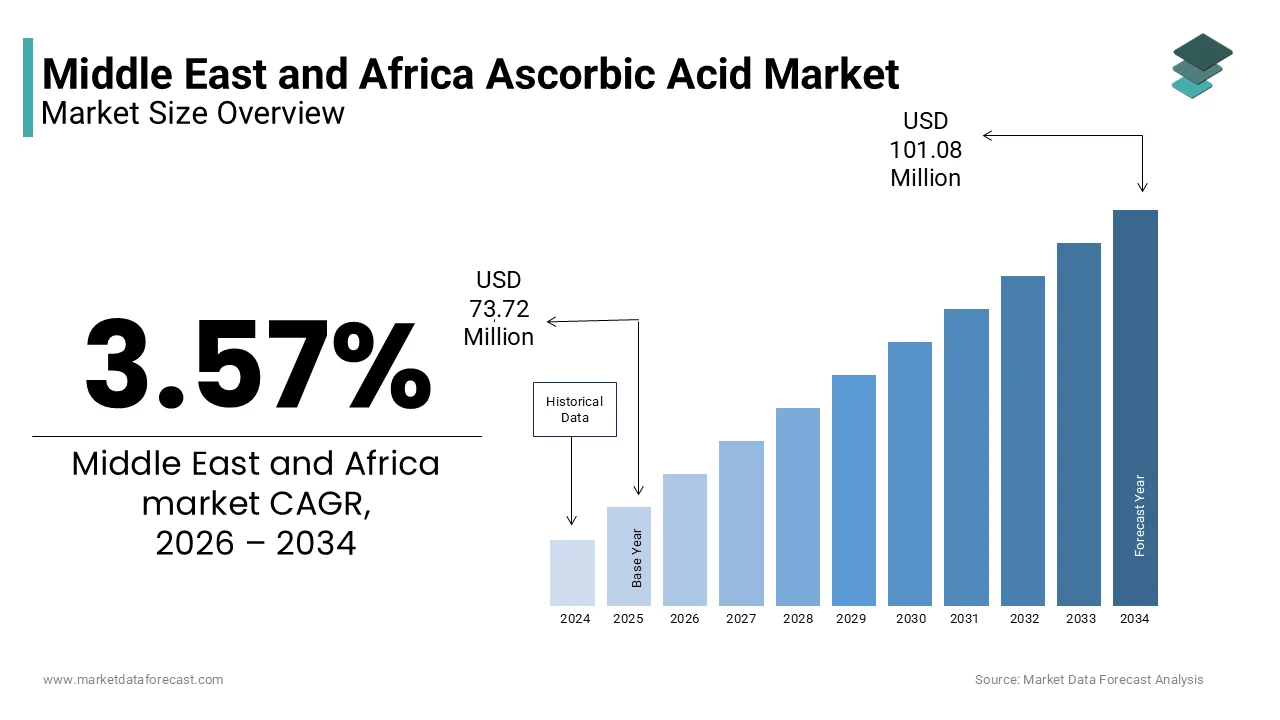
The ascorbic acid is the utilization of vitamin C, across pharmaceutical nutritional and industrial sectors within a diverse geopolitical sector. The heavy reliance on imports and growing domestic processing capabilities aligned with national food security strategies rather than pure commercial expansion. Current dynamics reflect a shift toward localized production to mitigate supply chain vulnerabilities, while addressing specific regional health mandates and agricultural preservation needs across varying economic development stages within the continent.
MARKET DRIVERS
Expanding Pharmaceutical Manufacturing Capabilities Drive Domestic Demand
The expanding pharmaceutical manufacturing capabilities is boosting the growth of the Middle East and Africa ascorbic acid market. According to the United Nations Industrial Development Organization, the pharmaceutical manufacturing sector in North Africa has expanded by 12% annually over the last 5 years creating substantial internal consumption requirements for active pharmaceutical ingredients including ascorbic acid. This industrial growth correlates directly with market volume because local production facilities require consistent raw material inputs to formulate vitamin supplements and fortified medicines that serve domestic populations. These financial commitments translate into stable demand streams as governments prioritize preventative medicine and nutritional supplementation to reduce long term disease burdens. Consequently, the expansion of regional drug manufacturing infrastructure is levelling up the growth of the Middle East and Africa ascorbic acid market.
Rising Fortification Mandates Boost Nutritional Applications
The rising fortification mandates boost nutritional applications is escalating the growth of the Middle East and Africa ascorbic acid market. This regulatory framework generates non-discretionary demand because compliance is compulsory for access rather than optional for product differentiation. Such widespread coverage ensures baseline consumption volumes remain resilient even during economic downturns since government subsidized safety nets continue to procure these additives. Therefore, legislative enforcement of nutritional standards serves as a fundamental demand driver that anchors the Middle East and Africa Ascorbic acid Market to public health outcomes rather than consumer preference cycles or premium pricing strategies in emerging territories.
MARKET RESTRAINTS
Import Dependency Creates Supply Chain Vulnerability
The import dependency creates supply chain vulnerability is hindering the growth of the Middle East and Africa ascorbic acid market. This heavy reliance on foreign sources means that any fluctuation in international shipping costs or export restrictions immediately impacts local availability and pricing stability for end users. The structural weakness in regional supply networks that prevents efficient redistribution of available stocks during shortages. Such fragmentation amplifies risk because individual countries cannot leverage collective bargaining power or shared inventory buffers to smooth out supply inconsistencies. Consequently, this dependency acts as a restraint that limits market predictability and forces buyers to maintain excessive safety stocks, which ties up working capital and reduces overall operational efficiency.
Currency Volatility Erodes Purchasing Power Stability
The currency volatility erodes purchasing power stability is additionally degrading the growth of the Middle East and Africa ascorbic acid market. This exchange rate instability directly constrains buyer capacity because importers must allocate more local currency to secure identical physical volumes thereby squeezing margins or forcing price pass through to sensitive end consumers. When purchasing power deteriorates rapidly procurement decisions shift from strategic planning to reactive crisis management causing order cancellations or downgrades to lower quality alternatives. Thus, monetary instability functions as a persistent restraint that undermines long term contracting and discourages investment in downstream processing capabilities within the Middle East and Africa Ascorbic acid Market, despite underlying demand fundamentals remaining intact.
MARKET OPPORTUNITIES
Local Production Initiatives Unlock Import Substitution Potential
The local production intiatives unlock import substitution potential is anticipated to foster new opportunities for the growth of the Middle East and Africa ascorbic acid market. According to the African Union Agenda 2063 framework, member states have committed to achieving 75% self-sufficiency in essential medicines and nutrients by 2030, which creates policy backed incentives for domestic ascorbic acid synthesis projects. This strategic vision opens avenues for joint ventures and technology transfers that can establish regional manufacturing hubs capable of serving multiple neighboring markets efficiently. These investments are specifically targeted at reducing import bills and creating skilled employment, which aligns commercial returns with national development objectives. Therefore, the emergence of political will and targeted financing for stakeholders, who position themselves as enablers of regional self-reliance.
Agricultural Preservation Needs Stimulate Industrial Grade Demand
The agricultural preservation needs stimulate industrial grade demand, which is also to leverage the growth of the Middle East and Africa ascorbic acid market. Addressing this waste through simple chemical treatment could recover an estimated 12 billion dollars in lost value each year, creating strong economic justification for widespread adoption among smallholder cooperatives and agribusinesses, according to the study. Unlike pharmaceutical applications, where demand is regulated and predictable this segment offers elastic growth potential tied directly to agricultural modernization efforts and cold chain development initiatives across rural areas. Extension services promoting low cost preservation techniques can rapidly accelerate uptake when paired with affordable supply channels.
MARKET CHALLENGES
Regulatory Harmonization Gaps Impede Cross Border Trade
The regulatory harmonization gaps are a major challenge for the growth of the Middle East and Africa ascorbic acid market. This lack of alignment forces distributors to maintain separate inventories and labeling schemes for each jurisdiction increasing compliance costs and reducing logistical efficiency across borders. The non-tariff barriers related to divergent technical standards as responsible for delayed shipments within regional trade corridors. Such administrative friction disproportionately affects smaller players, who lack resources to navigate complex approval processes in multiple areas, simultaneously.
Quality Assurance Deficiencies Undermine Consumer Confidence
The quality assurance deficiencies undermine consumer confidence is also to decline the growth of the Middle East and Africa ascorbic acid market. This prevalence of substandard products erodes trust in legitimate brands and creates hesitation among healthcare providers to recommend supplementation programs broadly. As per the World Health Organization, counterfeit and substandard medical products cause 100000 preventable deaths annually in Sub Saharan Africa linking quality failures directly to adverse health outcomes. When consumers associate the category with unreliability they may abandon beneficial usage patterns entirely or seek unregulated alternatives perceived as safer. Restoring confidence requires substantial investment in traceability systems and third-party verification, which raises entry barriers and operating costs.
REPORT COVERAGE
| REPORT METRIC | DETAILS |
| Market Size Available | 2025 to 2034 |
| Base Year | 2025 |
| Forecast Period | 2026 to 2034 |
| CAGR | 3.57% |
| Segments Covered | By Grade, Application, and Region. |
| Various Analyses Covered | Global, Regional, and Country Level Analysis, Segment-Level Analysis, DROC, PESTLE Analysis, Porter’s Five Forces Analysis, Competitive Landscape, Analyst Overview of Investment Opportunities |
| Regions Covered | South Africa, Ethiopia, Kenya, Egypt, Sudan, rest of MEA |
| Market Leaders Profiled | GlaxoSmithKline Plc., DSM, NBTY Inc, Shandong Luwei Pharmaceutical, DuPont, Aland Nutraceuticals Group, Dishman Group, North China Pharmaceutical Group, Hebei Welcome Pharmaceutical Co, Northeast Pharmaceutical Group, BASF SE, CSPC Pharmaceutical Group, Bactolac Pharmaceutical Inc, Zhejiang Tianxin Pharmaceutical Co Ltd |
SEGMENTAL ANALYSIS
By Grade Insights
The pharmaceutical grade segment was the largest by holding 45.2% of the Middle East and Africa Ascorbic acid Market share in 2025 due to stringent regulatory requirements for purity and bioavailability in medical applications. This regulatory mandate creates a barrier to entry for lower grade alternatives ensuring that manufacturers must source premium raw materials to maintain market access. The compliance with Good Manufacturing Practices has increased, among local drug producers since 2020, driving consistent demand for certified inputs. These quality assurances allow suppliers to command higher margins, while securing long term contracts with government procurement agencies. Consequently, the emphasis on regulatory adherence solidifies the dominance of pharmaceutical grade products by linking participation, directly to public health safety protocols rather than price competition alone.
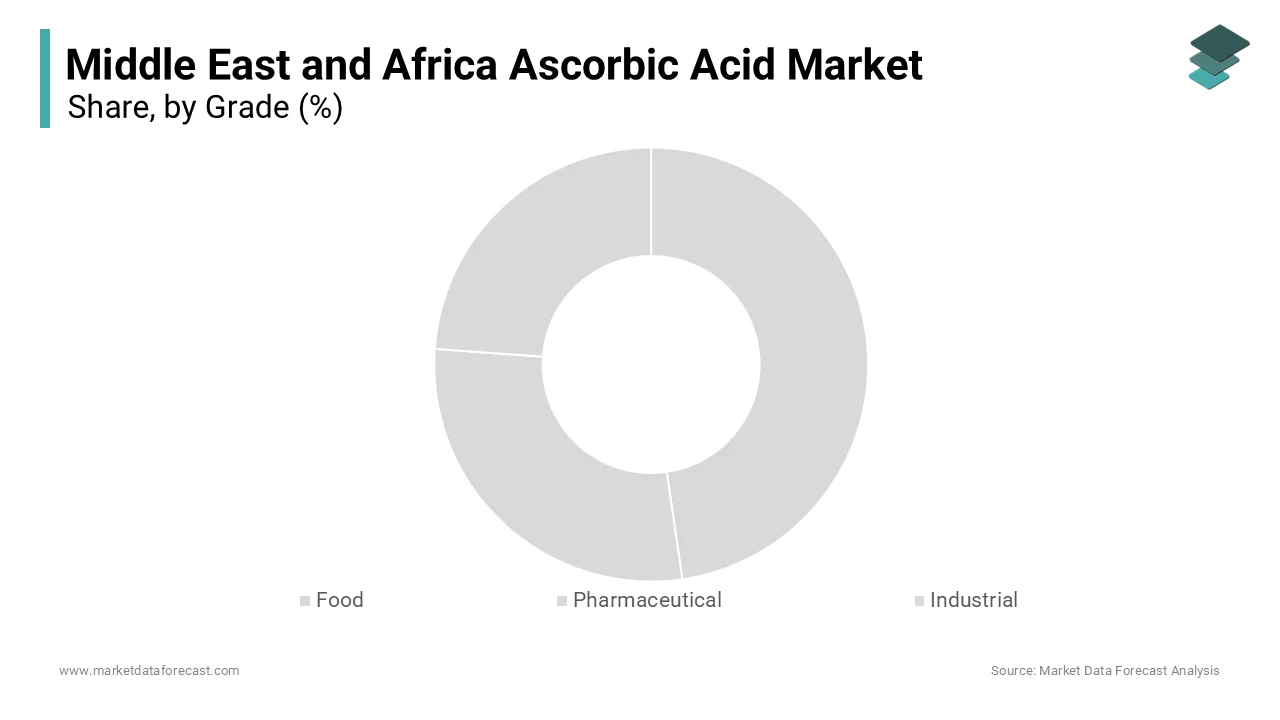
The food grade segment is esteemed to witness a fastest CAGR of 6.8% during the forecast period driven by expanding processed food industries and mandatory fortification policies. This industrial expansion correlates with urbanization rates that exceed 50% in many Middle Eastern countries leading to higher reliance on packaged goods with extended shelf lives. Such capacity additions require proportional increases in raw material inputs, thereby accelerating adoption of food grade variants. Hence, the structural shift toward industrialized food systems is propelling the growth of the segment.
By Application Insights
The pharmaceuticals application segment was the largest by holding 44.2% of the Middle East and Africa Ascorbic acid Market share in 2025 due to its role in drug formulation and direct therapeutic supplementation. This financial commitment enables hospitals and clinics to maintain adequate stocks of vitamin C based treatments for conditions ranging from scurvy to adjunctive cancer therapy support. The hospital bed density has increased in North Africa since 2018, reflecting broader access to formal medical care where standardized supplements are prescribed. Such institutional uptake ensures consistent baseline demand that is less susceptible to economic volatility compared to consumer driven segments. Therefore, sustained government investment in healthcare facilities directly underpins the continued dominance of pharmaceutical applications within the regional market landscape.
The agriculture application segment is anticipated to grow at a fastest CAGR of 7.2% from 2026 to 2034 with the urgent needs to reduce postharvest losses and improve crop resilience against climate stressors. According to the Food and Agriculture Organization, postharvest losses in Sub Saharan Africa result in annual economic losses exceeding 4 billion dollars primarily due to spoilage of perishable fruits and vegetables during transport and storage. Applying ascorbic acid as an anti- browning agent and antioxidant, significantly extends shelf life offering a cost effective solution for smallholder farmers and commercial exporters alike. Extension services promoted by ministries of agriculture are increasingly recommending these methods to improve farmer incomes and reduce waste.
REGIONAL ANALYSIS
Saudi Arabia Market Analysis
Saudi Arabia was the largest contributor in the Middle East and Africa Ascorbic acid Market by accounting for 33.2% of share in 2025 with the advanced healthcare infrastructure and Vision 2030 diversification goals. This investment supports robust demand for high purity ascorbic acid used in both clinical settings and domestic supplement production. Additionally, the government’s push for food security includes initiatives to reduce import dependency on essential nutrients fostering opportunities for local blending and packaging facilities. These strategic priorities ensure steady growth in pharmaceutical and food grade consumption, while positioning the country as a regional hub for high value added vitamin products.
United Arab Emirates Market Analysis
The United Arab Emirates ascorbic acid market was positioned second by holding 18.2% of share in 2025 with its strategic logistics infrastructure and free zone policies. The country’s robust tourism and hospitality sector also drives demand for premium fortified foods and beverages catering to international visitors seeking health conscious options. Furthermore, ongoing investments in biotechnology parks aim to attract multinational manufacturers seeking regional production bases.
Israel Market Analysis
Israel ascorbic acid market growth is anticipated to grow at a fastest CAGR in coming years with the high technological sophistication and strong research and development capabilities. The country’s advanced agricultural sector extensively uses ascorbic acid for crop protection and postharvest treatment supported by precision farming technologies that optimize input efficiency. Additionally, robust intellectual property protections encourage multinational companies to conduct clinical trials and develop new applications locally. This innovation driven ecosystem ensures sustained demand for premium grade ascorbic acid, while fostering collaborations that may eventually extend to broader African markets through technology transfer agreements.
South Africa Market Analysis
South Africa ascorbic acid market growth is likely to grow with in its developed industrial base and comprehensive public health programs. The National Department of Health implements widespread fortification mandates for maize meal and wheat flour reaching millions of low-income households annually. This policy creates stable institutional demand for food grade ascorbic acid while private healthcare providers drive pharmaceutical grade consumption. Additionally, growing export oriented horticulture sectors utilize ascorbic acid for preserving fresh fruit quality during long distance shipping to European and Asian countries.
Ethiopia Market Analysis
Ethiopia ascorbic acid market growth is driven by large population size and ongoing agricultural modernization efforts. The postharvest handling techniques to reduce losses, which currently affect perishable crops, according to the Food and Agriculture Organization. This initiative opens opportunities for industrial grade ascorbic acid usage among cooperatives and agro processors seeking to improve marketability of their produce. Additionally, expanding urban middle class consumers are increasingly purchasing packaged foods and beverages that contain added vitamins for perceived health benefits. Government partnerships with international donors often include nutritional components that further stimulate demand.
Kenya Market Analysis
Kenya ascorbic acid market growth is likely to grow with the vibrant agricultural exports and growing pharmaceutical manufacturing capabilities. The local pharmaceutical industry is expanding with several manufacturers achieving World Health Organization prequalification status thereby increasing demand for certified active pharmaceutical ingredients. The Ministry of Health supports community-based nutrition programs that distribute fortified foods to vulnerable populations creating steady institutional procurement channels. Additionally, rising disposable incomes in urban centers like Nairobi drive retail sales of health supplements and functional beverages.
COMPETITIVE LANDSCAPE
The competition in the Middle East and Africa Ascorbic acid Market is characterized by a mix of global giants and regional distributors who vie for dominance through quality assurance and logistical efficiency. International manufacturers leverage their established reputations and advanced production technologies to supply high purity pharmaceutical grade products to sophisticated healthcare systems in Gulf nations. Meanwhile local and Asian suppliers compete aggressively on price and flexibility catering to cost sensitive segments in Sub Saharan Africa where budget constraints dictate purchasing decisions. Competitors increasingly focus on building resilient supply chains capable of withstanding currency fluctuations and shipping delays. Strategic alliances with local entities have become essential for navigating bureaucratic hurdles and ensuring timely delivery.
KEY MARKET PLAYERS
Some of the notable companies in the Middle East and Africa ascorbic acid market are
- GlaxoSmithKline Plc.
- DSM
- NBTY Inc.
- Shandong Luwei Pharmaceutical
- DuPont
- Aland Nutraceuticals Group
- Dishman Group
- North China Pharmaceutical Group
- Hebei Welcome Pharmaceutical Co.
- Northeast Pharmaceutical Group
- BASF SE
- CSPC Pharmaceutical Group
- Bactolac Pharmaceutical Inc.
- Zhejiang Tianxin Pharmaceutical Co. Ltd.
Top Players in the Market
- BASF SE maintains a strong presence in the Middle East and Africa Ascorbic acid Market through its extensive distribution networks and high-quality production standards. The company focuses on supplying pharmaceutical and food grade ascorbic acid to major manufacturers across the region. Recently, BASF enhanced its logistics capabilities by partnering with local distributors in South Africa and Egypt to ensure timely delivery and reduce supply chain disruptions. These strategic collaborations allow the company to respond quickly to fluctuating demand while maintaining consistent product availability.
- DSM Nutritional Products contributes significantly to the Middle East and Africa Ascorbic acid Market by offering innovative solutions for food fortification and animal nutrition. The company actively supports government health initiatives by providing technical expertise for mandatory fortification programs in several African nations. DSM recently launched educational campaigns targeting local millers and food processors to promote the benefits of stable vitamin C formulations. This approach helps build trust and encourages wider adoption of their products among small and medium enterprises.
- Zhejiang Tianxin Pharmaceutical Co Ltd serves as a key supplier of cost effective ascorbic acid to the Middle East and Africa region focusing on bulk pharmaceutical and industrial applications. The company has strengthened its position by establishing direct relationships with local importers and regulatory bodies to streamline customs clearance processes. Recently, Zhejiang Tianxin invested in quality certification upgrades to meet stringent international standards required by Gulf Cooperation Council countries. This commitment to compliance enables the company to compete effectively against premium brands by offering reliable products at competitive prices.
Top Strategies Used by Key Market Participants
Key players in the Middle East and Africa Ascorbic acid Market primarily employ strategic partnerships and local distribution enhancements to strengthen their foothold. Companies focus on collaborating with regional distributors to navigate complex logistical challenges and ensure consistent product availability across diverse territories. Another major strategy involves aligning with government health initiatives such as food fortification programs, which creates stable institutional demand and builds long term contractual relationships. Manufacturers also invest in regulatory compliance and quality certifications to meet varying national standards thereby gaining access to restricted markets like the Gulf Cooperation Council countries. Additionally, firms engage in educational outreach to local processors and healthcare providers to demonstrate product efficacy and build brand trust.
MARKET SEGMENTATION
This research report on the Middle East and Africa ascorbic acid market has been segmented and sub-segmented into the following categories.
By Grade
- Food
- Pharmaceutical
- Industrial
By Application
- Food And Beverages
- Pharmaceuticals
- Chemicals
- Personal Care
- Agriculture
By Country
- KSA
- UAE
- Israel
- rest of GCC countries
- South Africa
- Ethiopia
- Kenya
- Egypt
- Sudan
- rest of MEA