- Product Description Description
- Table of Contents TOC
- List of Table & Figure LOT
- Get Free Sample PDF Sample PDF
Market Size, 2025
$0.25 BnMarket Estimate, 2026
$0.27 BnMarket Forecast, 2034
$0.51 BnCAGR, 2026–2034
8.32%Middle East and Africa Biostimulants Market Size, Growth, Trends & Forecast (2026–2034)
The Middle East and Africa (MEA) biostimulants market size was valued at USD 0.25 billion in 2025, is anticipated to reach USD 0.27 billion in 2026, and is projected to expand up to USD 0.51 billion by 2034, registering a compound annual growth rate (CAGR) of 8.32% during the forecast period from 2026 to 2034. Driven by severe environmental challenges such as acute water scarcity, high soil salinity in arid/semi-arid lands, and strong national food security mandates across GCC nations and South Africa, the regional market continues to witness steady transformation.
Key Executive Metrics (At-a-Glance)
- 2025 Base Valuation: USD 0.25 Billion
- 2026 Current Valuation: USD 0.27 Billion
- 2034 Forecast Valuation: USD 0.51 Billion
- Compound Annual Growth Rate (CAGR): 8.32% (2026–2034)
- Dominant Ingredient Segment: Humic Acid (dominating the regional share due to local lignite/leonardite sources and exceptional sodium-chelating efficacy in saline soils)
- Fastest-Growing Ingredient Segment: Seaweed Extracts (projected to expand at a 10.2% CAGR driven by organic export demands and superior abiotic stress tolerance)
- Dominant Application Segment: Foliar Application (leading the market due to rapid nutrient uptake, bypassing soil lock-up issues in calcareous conditions)
- Fastest-Growing Application Segment: Seed Treatment (projected to record a 9.2% CAGR powered by early-season vigor and improved germination rates in rain-fed/arid systems)
- Dominant Regional Hubs: Kingdom of Saudi Arabia, United Arab Emirates, Israel, and South Africa
Core Market Drivers
- Soil Salinity & Degradation: Over 60% of land in MENA being arid/semi-arid, forcing reliance on humic and fulvic active ingredients to reclaim degraded soils.
- Government Initiatives: Strategic food security frameworks (such as Saudi Vision 2030, UAE National Strategy for Food Security 2051, and African Union Agenda 2063) prioritizing sustainable agricultural technologies.
Primary Market Restraints & Challenges
- Regulatory Gaps: Absence of standardized testing protocols and unified registration frameworks across many African and Middle Eastern nations.
- Economic & Knowledge Barriers: High product costs relative to conventional inputs, complex last-mile logistics, and limited agronomic awareness among smallholder farmers.
Middle East and Africa Biostimulants Market Segmentation Breakdown
| Segment Category | Leading Sub-Segment (2025 Base) | Fastest-Growing Sub-Segment (2026–2034) |
|---|---|---|
| By Active Ingredients | Humic Acid (market leader for soil salinity remediation and local resource availability) | Seaweed Extracts (fastest-growing at 10.2% CAGR for organic export compliance) |
| By Application | Foliar Application (dominant leader bypassing alkaline soil barriers for quick absorption) | Seed Treatment (fastest-growing at 9.2% CAGR for early root vigor and drought survival) |
| By Crop Type | Fruits, Vegetables, Field Crops & Date Palms | Greenhouse, Hydroponic, and High-Value Export Crops |
| By Region / Country | South Africa, KSA, UAE, Israel, and Egypt | GCC Urban Ag & Sub-Saharan Smallholder Growth Markets |
Major Industry Players Profiled
Key enterprises shaping the competitive MEA biostimulants market include BASF SE, Haifa Group, Valagro SpA (Syngenta Group), Biostadt India Limited, Novozymes A/S, Biolchim SpA, Isagro SpA, and Koppert B.V.
Middle East and Africa Biostimulants Market Size
The Middle East and Africa biostimulants market size was valued at USD 0.25 billion in 2025 and is anticipated to reach USD 0.27 billion in 2026 to from USD 0.51 billion by 2034, estimated to be growing at a CAGR of 8.32% from 2026 to 2034.
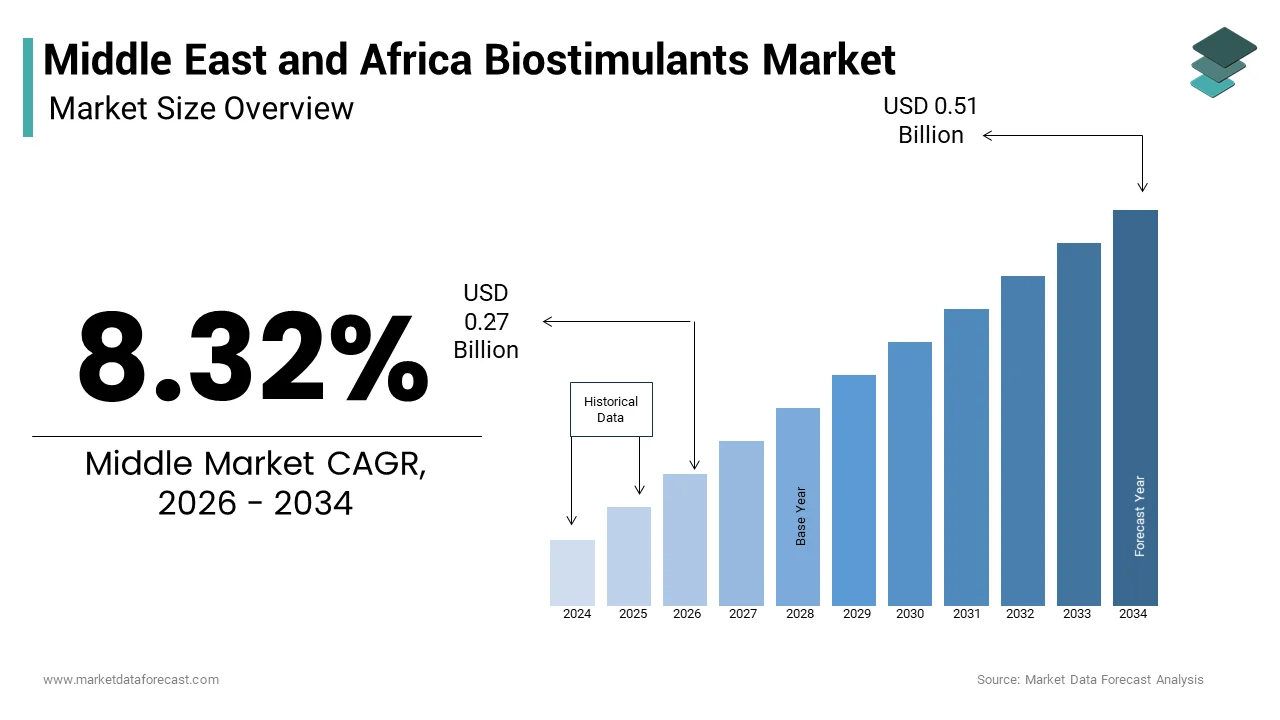
According to the Food and Agriculture Organization of the United Nations, agriculture in this region faces severe challenges including water scarcity, soil salinity, and extreme temperatures, which necessitate advanced agronomic solutions. According to the World Bank, approximately 60% of the land in the Middle East and North Africa is classified as arid or semi-arid, highlighting the critical need for resilience enhancing technologies. The regulatory landscape is evolving with countries like South Africa and Kenya establishing clearer guidelines for biological product registration while Gulf Cooperation Council nations are increasingly investing in sustainable agriculture initiatives. Consumer awareness regarding food safety and environmental sustainability is driving the shift away from synthetic chemicals toward biological alternatives. The market is characterized by a mix of imported premium products and locally sourced organic inputs reflecting diverse economic conditions across the region. This sector operates at the intersection of traditional farming practices and modern biotechnology aiming to secure food production in one of the most climatically vulnerable regions globally.
MARKET DRIVERS
Increasing Soil Salinity and Degradation Issues
The rising issue of soil salinity and land degradation is primarily fuelling the biostimulants market growth in the Middle East and Africa. Extensive irrigation practices in arid climates have led to the accumulation of salts in the soil profile, rendering large areas unsuitable for conventional agriculture. According to the Food and Agriculture Organization of the United Nations, salt-affected soils currently occupy 833 million hectares of the earth's surface, and the Middle East and North Africa has the highest percentage of its land area affected by salinity. Biostimulants, particularly those containing humic and fulvic acids, help mitigate these effects by improving soil structure and enhancing nutrient availability in saline conditions. According to agricultural research institutions, the application of seaweed extracts has been shown to increase the tolerance of crops such as tomatoes and dates to high salt levels by regulating ion uptake and maintaining cellular homeostasis. Farmers in countries like Egypt and Saudi Arabia are increasingly turning to these biological solutions to reclaim degraded lands and maintain productivity. The economic pressure to utilize marginal lands for food production drives the demand for inputs that can overcome environmental constraints. Furthermore, government initiatives aimed at combating desertification and promoting sustainable land management encourage the use of soil ameliorants. The ability of biostimulants to restore soil health and support plant vitality in adverse conditions makes them an essential tool for modern agriculture in the region. This environmental necessity ensures a consistent and growing demand for effective biostimulant products.
Government Initiatives for Sustainable Agriculture and Food Security
Government initiatives focused on sustainable agriculture and national food security are further contributing to the Middle East and Africa biostimulants market expansion. Many nations in the region are implementing strategic plans to reduce dependence on food imports and enhance domestic production capabilities amidst climate change challenges. As per the African Union Agenda 2063, there is a strong emphasis on modernizing agriculture through the adoption of eco-friendly technologies that ensure long term sustainability. Countries such as Morocco and the United Arab Emirates have launched national programs that promote the use of biological inputs to reduce the environmental footprint of farming. According to policy documents, these initiatives often include subsidies, technical training, and research funding for farmers who adopt sustainable practices. The shift away from synthetic fertilizers and pesticides is driven by the need to protect water resources and soil biodiversity, which are critical for future food production. Biostimulants align with these goals by enhancing nutrient use efficiency and reducing chemical runoff. The regulatory support for organic farming and integrated pest management further creates a favorable environment for biostimulant adoption. Governments are also partnering with international organizations to introduce best practices and innovative solutions. This top down approach accelerates market growth by creating institutional demand and fostering a culture of sustainable agriculture. The alignment of national policies with global sustainability trends ensures sustained investment in the biostimulants sector.
MARKET RESTRAINTS
Lack of Regulatory Frameworks and Standardization
The absence of comprehensive regulatory frameworks and standardization is impeding the Middle East and Africa biostimulants market growth. Unlike established markets in Europe and North America, many countries in this region lack clear definitions and registration procedures for biostimulants. According to the United Nations Industrial Development Organization, small and medium enterprises in the region often face difficulties in accessing global markets due to non-compliance with international standards. This lack of clarity often leads to delays in product approval and market entry, hindering the availability of innovative solutions. According to industry analyses, the absence of standardized testing methods makes it difficult to verify product efficacy and quality, leading to variability in performance. Farmers may encounter counterfeit or substandard products that fail to deliver promised benefits, eroding trust in the category. The complexity of navigating multiple regulatory systems increases operational costs for international companies seeking to expand in the region. Furthermore, the lack of harmonized labels and claims confuses consumers, making it challenging to differentiate between genuine biostimulants and general agricultural supplements. This regulatory gap stifles innovation and discourages investment in research and development. Until robust and unified regulatory structures are established, the market will struggle to achieve its full potential. The need for legal clarity remains a persistent barrier to widespread adoption and professionalization of the sector.
Limited Awareness and Technical Knowledge among Farmers
Limited awareness and technical knowledge among farmers is further hindering the regional market expansion. A significant portion of the agricultural community consists of smallholder farmers who rely on traditional practices and may be skeptical of new technologies. As per the International Fund for Agricultural Development, over 60% of the population in Sub-Saharan Africa are smallholder farmers, and about 23% of Sub-Saharan Africa’s GDP comes from agriculture. According to agricultural surveys, there is a prevalent misconception that biostimulants are similar to fertilizers, leading to incorrect usage and disappointing results. The complexity of biological products requires specific handling and timing which, if not followed, can render them ineffective. This knowledge gap results in low adoption rates and limited repeat purchases. The lack of localized demonstration projects and success stories further hinders acceptance as farmers prefer proven methods over experimental ones. Distributors often lack the technical expertise to provide adequate guidance, exacerbating the problem. The high cost of education and outreach programs limits the ability of manufacturers to reach remote communities. Without effective communication and training, the perceived value of biostimulants remains low. This educational barrier restricts market penetration and prevents farmers from realizing the potential yield improvements. Bridging this knowledge gap is essential for unlocking market growth and ensuring sustainable agricultural practices.
MARKET OPPORTUNITIES
Expansion of Organic Farming and Export Markets
The expansion of organic farming and export oriented agriculture is a lucrative opportunity for the Middle East and Africa biostimulants market. Global demand for organic produce is rising, driven by health consciousness and environmental concerns in key import markets such as Europe and North America. According to the Research Institute of Organic Agriculture, organic farmland in Africa grew by 16% to reach 2.7 million hectares in 2022. Biostimulants are essential components of organic farming systems as they enhance soil fertility and plant health without synthetic chemicals. According to trade data, organic exports from the region command premium prices, providing strong economic incentives for farmers to transition. The European Union and other international bodies have strict regulations on pesticide residues, making biostimulants a viable alternative for compliance. Local governments are supporting organic certification programs to boost export revenues and rural incomes. The growth of niche markets for high value crops such as herbs, spices, and fruits further drives demand for biological inputs. Manufacturers can capitalize on this trend by offering certified organic biostimulants tailored to specific crop needs. Partnerships with certification bodies and export agencies can facilitate market access for farmers. This alignment with global sustainability trends opens new revenue streams and fosters long term growth. The shift toward organic production ensures a stable and expanding customer base for biostimulant providers.
Integration with Precision Agriculture Technologies
The integration of biostimulants with precision agriculture technologies is another significant opportunity for the regional market. Precision agriculture involves the use of sensors, drones, and data analytics to optimize input application and monitor crop health. According to the World Bank, the digital transformation of agriculture in Africa could help increase the productivity of the continent’s 33 million smallholder farms. Biostimulants can be precisely applied using these technologies to maximize efficacy and minimize waste. According to industry reports, the combination of biological inputs with real time data allows for targeted interventions based on specific plant stress levels and growth stages. This synergistic approach enhances resource use efficiency and improves overall productivity. The development of smart delivery systems that release biostimulants in response to environmental triggers further optimizes performance. Technology providers and biostimulant manufacturers can collaborate to create integrated solutions that offer comprehensive crop management. The ability to track and verify the impact of biostimulants through digital platforms builds trust and demonstrates value to farmers. This technological convergence appeals to modern agribusinesses seeking data driven decision making capabilities. The potential for improved yields and reduced environmental impact supports the business case for adoption. This innovation pathway positions biostimulants as a key component of next generation farming systems.
MARKET CHALLENGES
High Cost and Accessibility Issues in Rural Areas
High product costs and limited accessibility in rural areas is a significant challenge to the growth of the Middle East and Africa biostimulants market. Biostimulants are often priced higher than conventional fertilizers due to complex production processes and import dependencies. According to the World Bank, about 82% of the world's poor live in rural areas, and many are dependent on agriculture for their livelihood. According to economic analyses, the initial investment required for biostimulants can be prohibitive for subsistence farmers who operate on thin margins. The lack of local manufacturing facilities in many countries necessitates imports, which incur additional tariffs and logistics costs. Distribution networks in remote areas are often underdeveloped, making it difficult for farmers to access quality products. According to infrastructure reports, poor road conditions and limited storage facilities further exacerbate supply chain inefficiencies. The high cost of last mile delivery increases the final price for end users, reducing affordability. Financial institutions are hesitant to provide credit for agricultural inputs perceived as risky or unproven. This financial barrier restricts market penetration to wealthier commercial farms, excluding the majority of the agricultural population. Manufacturers face the challenge of developing cost effective formulations and scalable distribution models. Until pricing becomes more competitive and access improves, the market will remain segmented. Addressing these economic and logistical hurdles is crucial for inclusive market growth.
Climate Instability and Unpredictable Weather Patterns
Climate instability and unpredictable weather patterns are further challenging the regional market expansion. The region is highly vulnerable to climate change impacts including erratic rainfall, prolonged droughts, and extreme heat waves. According to the Intergovernmental Panel on Climate Change, temperatures in the Middle East and North Africa are rising twice as fast as the global average. According to meteorological data, the frequency and intensity of extreme weather events have increased, affecting crop cycles and input efficacy. Biostimulants require specific environmental conditions to activate and function effectively, which may not be met during severe stress periods. Farmers may experience inconsistent results, leading to skepticism about product value. The unpredictability of weather makes it difficult to plan application timings accurately, reducing effectiveness. According to agronomic studies, the interaction between biostimulants and extreme abiotic stress is complex and not fully understood in all local contexts. This scientific uncertainty complicates recommendation protocols for extension agents. The risk of crop failure due to climate shocks discourages investment in premium inputs. Manufacturers must develop robust products that can withstand harsh conditions, but this requires extensive research and testing. The volatility of the climate adds a layer of risk that hinders widespread adoption. Adapting to these changing conditions remains a persistent challenge for the industry.
REPORT COVERAGE
| REPORT METRIC | DETAILS |
| Market Size Available | 2025 to 2034 |
| Base Year | 2025 |
| Forecast Period | 2026 to 2034 |
| CAGR | 8.32% |
| Segments Covered | By Active Ingredients, Application, Crop Type, and Region. |
| Various Analyses Covered | Global, Regional & Country Level Analysis, Segment-Level Analysis, DROC, PESTLE Analysis, Porter’s Five Forces Analysis, Competitive Landscape, Analyst Overview of Investment Opportunities |
| Regions Covered | KSA, UAE, Israel, rest of GCC countries, South Africa, Ethiopia, Kenya, Egypt, Sudan, rest of MEA |
| Market Leaders Profiled | BASF SE, Biostadt India Limited, Valagro SpA, Novozymes A/S, Biolchim SpA, Isagro SpA, and Koppert B.V. |
SEGMENTAL ANALYSIS
By Active Ingredients
The humic acid segment dominated the market by capturing the highest share of the regional market in 2025 due to its widespread availability from local lignite and leonardite sources and its proven efficacy in improving soil health in arid regions. The primary driver for the domination of humic acid is its critical role in soil remediation and management of high salinity levels which are prevalent across the Middle East and Africa. According to the Food and Agriculture Organization of the United Nations, salt-affected soils currently occupy 833 million hectares of the earth's surface globally. Humic acids function by chelating sodium ions and improving soil structure, thereby enhancing water infiltration and root penetration. According to agricultural research conducted in Egypt and Saudi Arabia, the application of humic acid has been shown to reduce soil electrical conductivity and increase the availability of essential nutrients such as phosphorus and potassium. Farmers in these regions rely on humic acid to reclaim degraded soils and maintain yields in challenging environments. The cost effectiveness of humic acid compared to other specialized biostimulants makes it accessible to a broad range of farmers, including smallholders. Its ability to buffer soil pH and enhance cation exchange capacity provides immediate agronomic benefits that are visible within a single growing season. This practical utility ensures that humic acid remains the preferred choice for soil conditioning. The extensive historical use and familiarity with humic substances further reinforce their market leadership. The continuous need to combat desertification and soil degradation sustains the high demand for this versatile active ingredient.
However, the seaweed extracts segment is expected to expand at a promising CAGR of 10.2% during the forecast period in the Middle East and Africa biostimulants market owing to the increasing demand for organic inputs and the superior stress tolerance properties of seaweed based products. The rapid growth of the seaweed extract segment is largely attributed to the rising global and domestic demand for organic and residue free produce, particularly in export oriented markets. Seaweed extracts are naturally derived and certified for use in organic farming systems, making them ideal for growers targeting premium markets in Europe and the Gulf. According to the Research Institute of Organic Agriculture, organic farmland in Africa grew by 16% in 2022. Seaweed extracts provide essential micronutrients and natural growth hormones such as cytokinins and auxins that enhance plant vigor without synthetic chemicals. According to trade data, organic fruits and vegetables command significantly higher prices, providing strong economic incentives for farmers to adopt biological inputs. The strict maximum residue limits imposed by international buyers necessitate the replacement of synthetic pesticides and fertilizers with safer alternatives. Seaweed extracts help plants resist pests and diseases naturally, reducing the need for chemical interventions. The alignment with global sustainability trends and consumer preferences for clean label food drives the adoption of seaweed based biostimulants. Manufacturers are responding by offering certified organic seaweed products tailored to specific crops. This market pull from high value export sectors ensures that seaweed extracts continue to grow at a faster rate than other ingredients.
By Application Insights
The foliar segment held the leading position in the Middle East and Africa biostimulants market in 2025. The dominance of foliar segment in this regional market can be credited to the rapid nutrient uptake and ability to correct micronutrient deficiencies quickly, which is crucial for high value crops. In many parts of the Middle East and Africa, soil conditions such as high pH or calcareous nature lock up essential nutrients, making them unavailable to roots. Foliar application bypasses the soil barrier, delivering nutrients and biostimulants directly to the metabolic sites in the leaves. According to agronomic research, foliar applied biostimulants can be absorbed within hours, providing immediate relief from stress symptoms. According to extension services in countries like Kenya and Ethiopia, farmers prefer foliar sprays for correcting iron, zinc, and magnesium deficiencies in fruit trees and vegetables. The visibility of results, such as improved leaf color and vigor, encourages repeat usage. Foliar application is also less dependent on soil moisture levels, which is advantageous in arid regions where irrigation may be limited. The ability to tank mix biostimulants with pesticides and fungicides reduces application costs and labor. This operational efficiency makes foliar application the preferred method for commercial growers. The precision and speed of delivery ensure that crops receive timely support during critical support stages. This practical advantage solidifies the leadership of foliar application in the market.
However, the seed treatment segment is the fastest growing application segment in the Middle East and Africa biostimulants market and is likely to record a CAGR of 9.2% during the forecast period owing to the rising need to improve germination rates and early plant vigor in challenging soil conditions. In many parts of the Middle East and Africa, poor soil quality and erratic rainfall can lead to poor crop establishment and yield losses. Biostimulant seed treatments coat seeds with protective and growth promoting substances that enhance root development and stress tolerance from the outset. According to agricultural studies, seeds treated with amino acids and seaweed extracts show significantly higher germination percentages and faster emergence compared to untreated controls. According to field trials in Sudan and Nigeria, treated seeds exhibit stronger root systems that can access water and nutrients more effectively during the critical early growth phase. This early advantage translates into higher yields and better resilience against subsequent stresses. The cost effectiveness of seed treatment is high as only small amounts of biostimulants are required per hectare. Farmers recognize the value of securing a strong start for their crops, especially in rain fed systems. The ability to reduce seeding rates while maintaining plant population further enhances economic returns. This agronomic benefit drives the adoption of seed treatment technologies. The focus on maximizing every input ensures sustained growth for this segment.
COUNTRY ANALYSIS
Saudi Arabia Biostimulants Market Analysis
Saudi Arabia is likely to undergo a significant transformation in its agricultural technology landscape over the next few years due to government initiatives aimed at transforming the agricultural sector to be more sustainable and water efficient. According to the Ministry of Environment, Water and Agriculture, Saudi Arabia aims to achieve a self-sufficiency rate of 80% for dates and 70% for some vegetables by 2030. According to policy documents, the National Agricultural Development Company and other entities are promoting the use of biostimulants to enhance crop resilience in arid conditions. The focus on date palm cultivation and greenhouse vegetables drives demand for high quality biostimulants. The regulatory framework is evolving to support the registration and import of biological products. The availability of financial incentives for farmers adopting sustainable practices accelerates market growth. The strategic importance of food security ensures continued investment in agricultural innovation. This top down support creates a favorable environment for biostimulant adoption. The emphasis on technology and sustainability positions Saudi Arabia as a key market.
United Arab Emirates Biostimulants Market Analysis
The United Arab Emirates is expected to advance as a pioneer for high-tech, urban agricultural solutions in the region for the next several years owing to the rapid adoption of advanced agricultural technologies and the growth of urban farming initiatives. According to the Ministry of Climate Change and Environment, the UAE’s National Strategy for Food Security 2051 aims to put the country at the top of the Global Food Security Index by 2051. According to industry reports, the use of biostimulants in hydroponic and vertical farming systems is increasing to optimize plant growth and nutrient uptake. The high value of produce grown in these systems justifies the use of premium biostimulants. The regulatory environment supports the import and use of innovative agricultural inputs. The focus on sustainability and food security drives investment in biological solutions. The presence of research institutions and pilot projects fosters innovation. This technological leadership ensures steady market growth. The emphasis on efficiency and quality sustains demand.
Israel Biostimulants Market Analysis
Israel is projected to maintain its role as the research and development engine for biological agricultural inputs in the region through the coming years. The Israel market is fundamentally driven by its status as a global leader in agricultural innovation and research. According to the Volcani Center, Israel recycles about 90% of its wastewater for agriculture, the highest rate in the world. According to industry data, Israeli companies are major developers and exporters of biostimulant technologies. The domestic market serves as a testing ground for new products before global launch. The high level of technical expertise among farmers ensures optimal use of biostimulants. The integration of biostimulants with precision irrigation systems is widespread. The strong intellectual property framework supports innovation. This research driven approach maintains Israel’s leadership. The export orientation of the industry influences domestic trends. The focus on sustainability and efficiency drives continuous adoption.
South Africa Biostimulants Market Analysis
South Africa is anticipated to reinforce its status as the regional powerhouse for commercial agricultural exports and biological input usage in the next few years due to its mature commercial agricultural sector which produces a wide range of fruits, vegetables, and field crops for export. According to the Department of Agriculture, Land Reform and Rural Development, South Africa’s agricultural exports reached a record $13.2 billion in 2023. According to industry reports, South African farmers are early adopters of biostimulants to meet international quality standards. The presence of local manufacturers and multinational companies ensures a competitive market. The regulatory framework is clear and supportive of biological products. The focus on sustainable farming practices drives demand. The extensive export market for citrus and wine grapes sustains high usage. This established base ensures market stability. The technical knowledge among farmers supports effective application. The mature market dynamics drive continuous innovation.
COMPETITIVE LANDSCAPE
The competitive landscape of the Middle East And Africa Biostimulants Market is characterized by a mix of international specialists and emerging local manufacturers who compete on technology and regional expertise. Incumbent players leverage strong research and development capabilities and established distribution networks to maintain dominance. However the market is becoming increasingly fragmented as local companies offer affordable alternatives tailored to specific crop needs. Competition is driven by the need for solutions that address water scarcity and soil salinity challenges. Price sensitivity remains a significant factor particularly among smallholder farmers prompting companies to offer tiered product portfolios. Innovation in seaweed extracts and microbial solutions serves as a key differentiator. Regulatory harmonization efforts are influencing market entry strategies and compliance requirements. Strategic collaborations with agricultural cooperatives and government bodies enhance market penetration. The rise of organic farming creates niche opportunities for certified biological inputs. Overall the market favors companies that can balance technological advancement with affordability and local responsiveness while navigating diverse regulatory environments.
KEY MARKET PLAYERS
The major companies dominating the Biostimulants market in this region are
- BASF SE
- Haifa Group
- Biostadt India Limited
- Valagro SpA
- Novozymes A/S
- Biolchim SpA
- Isagro SpA
- Koppert B.V.
Top Players In The Market
- Valagro S.p.A. maintains a strong presence in the Middle East and Africa biostimulants market through its specialized portfolio of plant health solutions. The company focuses on delivering high quality seaweed extracts and amino acid based products tailored to arid conditions. Recent strategic initiatives include expanding distribution partnerships in key markets such as Egypt and South Africa to enhance product accessibility. Valagro has invested in technical training programs for local agronomists to ensure proper application and maximize efficacy. The corporation emphasizes sustainability by promoting biological solutions that reduce chemical dependency. By leveraging its global research capabilities Valagro adapts its formulations to regional crop needs. These efforts aim to solidify its reputation for innovation and reliability while supporting sustainable agricultural practices in the region.
- Haifa Group contributes significantly to the market with its extensive range of specialty fertilizers and biostimulants designed for precision agriculture. The company leverages its expertise in plant nutrition to offer integrated solutions that enhance crop yield and quality. Recent actions involve launching new biostimulant products specifically formulated for high value crops in the Gulf Cooperation Council countries. Haifa has strengthened its logistical infrastructure in Israel and North Africa to ensure timely delivery and supply chain resilience. The organization focuses on digital agriculture tools to provide farmers with data driven recommendations. By combining nutritional expertise with biological innovations Haifa builds strong customer loyalty. These strategies enable the company to maintain a competitive edge and drive growth in the evolving Middle East and Africa agricultural sector.
- Biostadt India Limited plays a pivotal role in the Middle East and Africa biostimulants market with its diverse portfolio of organic and biological inputs. The company focuses on providing cost effective solutions for smallholder and commercial farmers across the region. Recent strategic moves include establishing joint ventures and licensing agreements with local distributors in Kenya and Nigeria to expand market reach. Biostadt has invested in research and development to create products that address specific regional challenges such as soil salinity and drought. The organization emphasizes education and awareness campaigns to promote the benefits of biostimulants. By offering affordable and accessible solutions Biostadt strengthens its market presence. These initiatives help the company build trust and drive adoption among diverse farming communities in the region.
Top Strategies Used by Key Market Participants
Key players in the Middle East And Africa Biostimulants Market primarily employ localization and educational outreach strategies to sustain growth. Companies are increasingly adapting product formulations to suit specific regional climatic conditions and crop types. This approach ensures higher efficacy and farmer satisfaction. Another major strategy involves investing in technical training and demonstration plots to educate farmers on proper usage and benefits. Manufacturers collaborate with local distributors and agronomists to build trust and overcome knowledge gaps. Strategic partnerships with government agencies and research institutions facilitate regulatory compliance and market access. Digital platforms are utilized to provide real time support and monitoring services. By focusing on capacity building and localized solutions key participants strengthen their market positions and adapt to unique regional agricultural needs effectively.
MARKET SEGMENTATION
This research report on the Middle East and Africa Biostimulants market is segmented and sub-intimented into the following categories.
By Active Ingredients
- Fulvic Acid
- Protein Hydrolysates
- Seaweed Extracts
- Amino Acid
- Humic Acid
- Others
By Application
- Seed
- Foliar
- Soil
By Crop Type
- Fruits & Vegetables
- Cereals & Oilseeds
- Turfs & Ornaments
- Others
By Country
- KSA
- UAE
- Israel
- Rest Of GCC Countries
- South Africa
- Ethiopia
- Kenya
- Egypt
- Sudan
- Rest Of MEA