- Product Description Description
- Table of Contents TOC
- List of Table & Figure LOT
- Get Free Sample PDF Sample PDF
Market Size, 2025
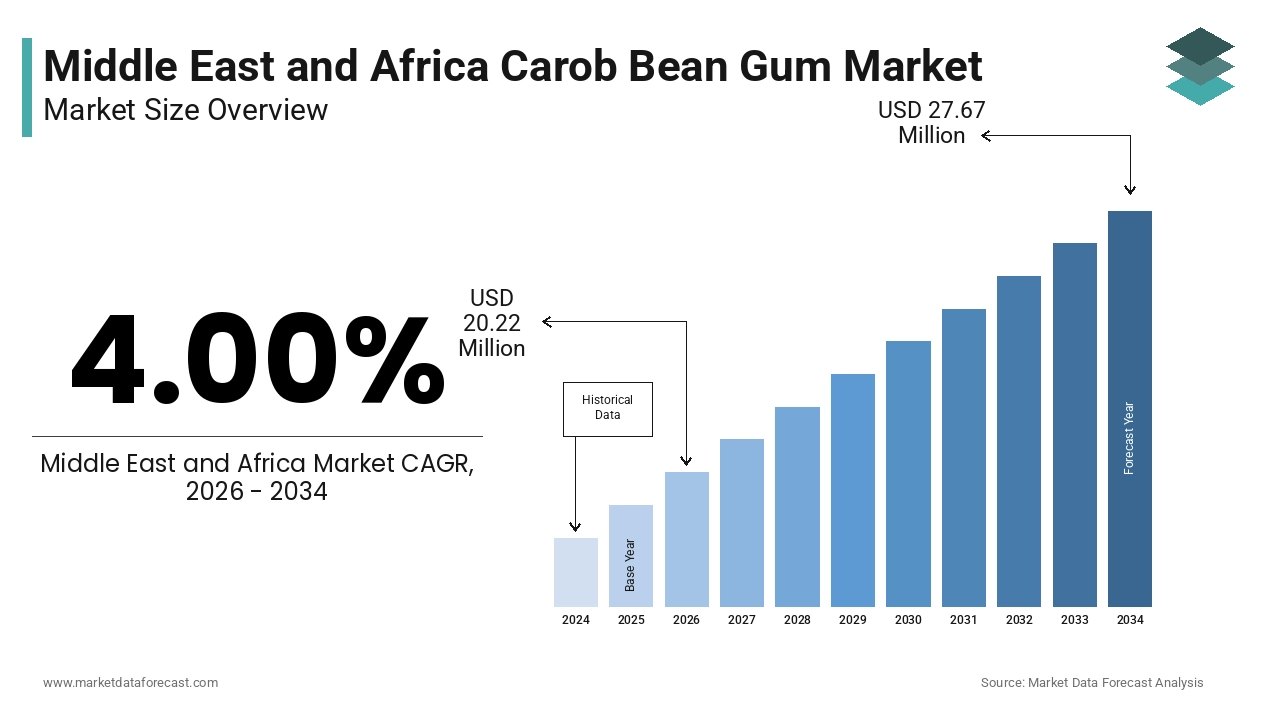
$19.44 MnMarket Estimate, 2026
$20.22 MnMarket Forecast, 2034
$27.67 MnCAGR, 2026–2034
4.00%Executive Summary: Middle East and Africa Carob Bean Gum Market
- Market Scope: Comprehensive analysis of the Middle East and Africa carob bean gum (locust bean gum) market covering product forms, food and non-food applications, regional country dynamics, growth drivers, restraints, and competitive landscapes.
- Market Valuation: Valued at USD 19.44 million (2025), estimated at USD 20.22 million (2026), and projected to reach USD 27.67 million by 2034, registering a steady CAGR of 4.00% during the forecast period (2026–2034).
- Primary Growth Drivers: Taste-enhancing and thickening properties of carob bean gum, shifting manufacturer and consumer focus from artificial additives toward natural, plant-based stabilizers, and expanding food processing industries across the MEA region.
Key Market Segment Metrics (2026–2034)
| Category | Leading Segment (2025 Position) | Fastest-Growing Segment |
|---|---|---|
| By Form | Gel Form (widely utilized due to extensive application in food processing and textile industries) | Powdered Form (driven by easy blending in dairy, bakery, and beverage formulations) |
| By Application | Food Applications (occupies the major share as a thickening agent, sweetener, and chocolate substitute in dairy, dressings, and meats) | Cosmetics (non-food segment expected to experience the fastest growth due to natural personal care trends) |
| By Region / Country | Middle East (holds the major market share owing to established market leaders and advanced food processing infrastructure) | Middle East & North Africa hubs (experiencing rapid adoption of clean-label and natural food additives) |
Major Market Players & Market Structure
Market Structure: Moderately consolidated hydrocolloid and food ingredient processing landscape featuring global specialty chemical firms and regional distributors competing on supply stability, natural certifications, and functional customization.
Key Companies: Scalzo Food Industries, LBG Sicilia Ingredients, G. Araouzos and Son, Gum Technology Corporation, CEAMSA, TIC Gums Incorporation, CP Kelco, FMC Specialty Chemicals, Fiberstar Inc., Kerry Group, Cargill, and others.
 Download Free Sample Report
Middle East and Africa Carob Bean Gum Market Size
The Middle East and Africa carob bean gum market size was valued at USD 19.44 million in 2025 and is projected to reach USD 27.67 million by 2034 from USD 20.22 million in 2026, growing at a CAGR of 4.00%.
The Middle East and Africa carob bean gum market encompasses the extraction, processing, and distribution of locust bean gum derived from the seeds of the Ceratonia siliqua tree, primarily utilized as a natural thickening and stabilizing agent in food and industrial applications. According to the Food and Agriculture Organization of the United Nations, carob is cultivated throughout Mediterranean countries, and its seeds are processed to produce locust bean gum, which is widely used as a food hydrocolloid. This market is distinct due to its reliance on wild-harvested or semi-cultivated trees that thrive in arid climates, making it a sustainable alternative to water-intensive crops. According to the Food and Agriculture Organization of the United Nations, carob is well adapted to Mediterranean environments and can tolerate dry conditions, supporting its use in agroforestry systems. These agricultural characteristics directly influence the availability of raw seeds for gum processors, ensuring a steady input base despite climatic volatility. The industry serves diverse sectors, including dairy, bakery, and pharmaceuticals, where clean-label demands are rising. According to peer-reviewed research, locust bean gum is widely used in food, pharmaceuticals, cosmetics, paper, textiles, and other industrial applications because of its thickening, stabilizing, and gel-forming properties. This export orientation defines the market structure, linking local agronomic performance with international regulatory and consumer trends.
MARKET DRIVERS
Rising Demand for Clean Label and Natural Food Additives
The global shift toward clean-label ingredients is favouring the Middle East and Africa carob bean gum market expansion by positioning locust bean gum as a preferred natural alternative to synthetic thickeners. According to the European Food Safety Authority, locust bean gum is authorized as food additive E410 and has been evaluated for safety in food applications. This consumer preference translates into direct procurement increases for carob bean gum, as it is recognized as a natural E-number additive with a long history of safe use. Locust bean gum offers useful thickening and stabilizing functionality in dairy products, such as ice cream and yogurt, which are important applications for the ingredient. According to peer-reviewed research, locust bean gum can reduce ice crystal formation in frozen foods and improve water holding and texture in dairy products. This functional superiority, combined with natural status, ensures sustained demand. Consequently, the Middle East and Africa carob bean gum market benefits from a structural tailwind where health consciousness drives ingredient substitution, creating long-term volume growth for producers who can meet purity and consistency standards required by global food giants.
Expansion of Drought-Resistant Agroforestry Initiatives
Government-led programs promoting drought-resistant further supports the Middle East and Africa carob bean gum market growth by expanding the cultivation base and securing raw material supply. According to the Food and Agriculture Organization of the United Nations, carob is a drought-tolerant Mediterranean tree that can grow in dry environments and is suitable for agroforestry systems. This ecological advantage has prompted interest in carob cultivation across Mediterranean and North African production areas. The statistical increase in planted hectares directly correlates with higher seed availability for gum processors, reducing dependency on wild harvesting, which is often inconsistent. Additionally, research on carob cultivation indicates that orchard management practices, such as irrigation, pruning, and cultivar selection, can influence pod yield and quality. Higher yields lower raw material costs and stabilize supply chains against climate shocks. Furthermore, the integration of carob into agroforestry systems provides additional income streams for rural communities, encouraging long-term commitment to cultivation. Thus, the Middle East and Africa carob bean gum market is bolstered by policy-driven agricultural expansion that ensures sustainable and scalable raw material production, aligning economic goals with environmental resilience.
MARKET RESTRAINTS
Labor-Intensive Harvesting and Processing Constraints
The reliance on manual labor for harvesting and initial processing is a key restraint for the Middle East and Africa carob bean gum market by limiting scalability and increasing production costs. According to the Food and Agriculture Organization of the United Nations, carob harvesting in traditional production systems commonly relies on manual collection and handling because trees are frequently cultivated on uneven terrain and in low-input systems. This labor dependency creates bottlenecks during peak harvest seasons, leading to delays and potential spoilage if pods are not processed quickly. For instance, carob gum production requires several processing stages, including seed separation, dehulling, germ removal, and milling of the endosperm. Furthermore, rural labor availability can affect harvesting costs and the timing of post-harvest processing. These structural inefficiencies restrict the ability of the market to rapidly expand output in response to surging global demand. Consequently, the Middle East and Africa carob bean gum market faces inherent supply constraints, where high operational costs and limited throughput capacity hinder competitiveness and profit margins.
Vulnerability to Climate Variability and Yield Fluctuations
Erratic weather patterns and prolonged droughts pose a critical threat to the Middle East and Africa carob bean gum market by causing unpredictable fluctuations in pod yields and seed quality. According to the Intergovernmental Panel on Climate Change, the Mediterranean region is particularly vulnerable to increasing temperatures and declining precipitation under climate change scenarios, creating additional stress for rain-fed agriculture. While carob trees are drought-tolerant, extreme water scarcity during flowering and fruit development can affect productivity and fruit quality. This variability creates supply instability for gum processors who require consistent seed volumes to maintain production schedules. The statistical unpredictability forces buyers to seek alternative sources or hold larger inventories, increasing working capital requirements. Additionally, heat and drought stress can influence plant growth and fruit development. According to peer-reviewed agricultural research, carob productivity is influenced by temperature, water availability, and orchard management practices. Such quality inconsistencies can damage buyer trust and lead to supply contract challenges. Thus, the Middle East and Africa carob bean gum market is constrained by climatic risks that undermine supply reliability and product uniformity essential for maintaining long-term relationships with international industrial clients.
MARKET OPPORTUNITIES
Development of Value-Added Derivatives for Pharmaceutical Applications
Expanding into high-value pharmaceutical and cosmetic grades presents a significant opportunity for the Middle East and Africa carob bean gum market by leveraging its biocompatible and non-toxic properties. According to peer-reviewed pharmaceutical research, locust bean gum has been investigated as a pharmaceutical excipient because of its swelling, gelling, mucoadhesive, and controlled-release properties. This regulatory and scientific acceptance opens doors to B2B applications with pharmaceutical manufacturers who prioritize functional natural ingredients. Locust bean gum can serve as a binder, stabilizer, disintegrant, and matrix-forming material in pharmaceutical formulations. Furthermore, the cosmetic industry increasingly uses carob gum as a natural thickener in creams and lotions, appealing to consumers seeking naturally derived personal care products. According to recent peer-reviewed research, locust bean gum and its derivatives have potential applications in drug delivery, wound healing, cosmetics, and other biomedical systems. Producers in the region can invest in refining technologies to achieve higher purity levels required for these sectors, commanding premium prices far above food-grade equivalents. This diversification reduces dependence on volatile food commodity cycles. Consequently, the Middle East and Africa carob bean gum market can capture higher margins by transitioning from bulk food additives to specialized industrial ingredients with stricter quality but greater profitability.
Integration into Plant-Based Meat Alternatives
The expanding plant-based food sector offers a substantial opportunity for the Middle East and Africa carob bean gum market by providing a potential texturizing and stabilizing ingredient for meat analogues. According to peer-reviewed research, locust bean gum has strong water-binding and rheological properties and can act synergistically with other hydrocolloids in food formulations. Carob bean gum is particularly useful in controlling water mobility and improving texture in formulated food systems. The statistical rise in vegan and flexitarian consumption drives demand for functional ingredients that improve the sensory properties of plant-based foods. According to the Good Food Institute, the global plant-based meat category continues to develop through improvements in product formulation, texture, and sensory performance. Regional producers can position their gum as a sustainable and locally sourced alternative to imported stabilizers, appealing to brands with strong environmental narratives. Additionally, partnerships with food technology companies can facilitate early adoption and custom formulation support. This strategic alignment with a growing food industry segment allows for volume expansion and brand differentiation. Thus, the Middle East and Africa carob bean gum market can leverage the plant-based food sector to secure long-term off-take agreements and drive innovation in application-specific grades.
MARKET CHALLENGES
Competition from Cheaper Alternative Hydrocolloids
Intense competition from lower-cost hydrocolloids, such as guar gum and xanthan gum, challenges the Middle East and Africa carob bean gum market by exerting downward pressure on prices and market share. According to peer-reviewed research, locust bean gum has functional synergies with hydrocolloids, including xanthan gum and carrageenan, but these alternative materials are also widely used across food and industrial applications. This broad availability creates strong competition for formulators seeking cost-effective thickening and stabilizing systems. According to scientific literature, formulators frequently combine locust bean gum with other hydrocolloids to obtain specific viscosity, gel strength, and texture characteristics. Additionally, xanthan gum provides strong thickening performance across a broad range of pH and processing conditions. These alternatives create a ceiling on carob gum pricing and limit its penetration in mass-market segments. Consequently, the Middle East and Africa carob bean gum market must continuously innovate and educate customers on unique benefits to defend its niche against commoditized substitutes that dominate the broader hydrocolloid landscape.
Lack of Standardized Quality Grading and Certification
The absence of unified quality grading standards and certification protocols hinders the Middle East and Africa carob bean gum market by creating inconsistency and reducing buyer confidence in international trade. According to the Joint FAO and WHO Expert Committee on Food Additives, specifications exist for locust bean gum as food additive E410, including defined purity requirements. These requirements provide a common technical basis for international food use, although commercial buyers may impose additional specifications for viscosity, particle size, microbiological quality, and other characteristics. This fragmentation can lead to variable product quality, where one batch may differ significantly from another, causing formulation issues for industrial buyers. According to the European Food Safety Authority, locust bean gum has established purity specifications under European food additive legislation. Furthermore, the lack of widely recognized sustainability certifications can make it difficult to substantiate ethical sourcing claims demanded by premium brands. This regulatory ambiguity increases transaction costs and risk for importers who must conduct extensive testing. Thus, the Middle East and Africa carob bean gum market faces a structural barrier where quality inconsistency and certification gaps impede access to high-value markets and limit the ability to command premium pricing based on verified standards.
REPORT COVERAGE
| REPORT METRIC | DETAILS |
| Market Size Available | 2025 to 2034 |
| Base Year | 2025 |
| Forecast Period | 2026 to 2034 |
| CAGR | 3.08% |
| Segments Covered | By Form, Application, and Region |
| Various Analyses Covered | Global, Regional, & Country Level Analysis; Segment-Level Analysis; DROC; PESTLE Analysis; Porter’s Five Forces Analysis; Competitive Landscape; Analyst Overview of Investment Opportunities |
| Regions Covered | KSA, UAE, Israel, rest of GCC countries, South Africa, Ethiopia, Kenya, Egypt, Sudan and Rest of MEA |
| Market Leaders Profiled | Scalzo Food Industries, Silvateam, LBG Sicilia Ingredients, Ashland Global, G Araouzos and Son, Gum Technology Corporation, Ceamsa, TIC Gums Incorporation, CP Kelco, FMC Specialty Chemicals, DuPont Nutrition and Biosciences, Fiberstar Inc., Kerry Group, and Cargill |
SEGMENTAL ANALYSIS
By Form Insights
The powdered segment dominated the market by holding the leading share of the Middle East and Africa carob bean gum market in 2025 due to its ease of storage, extended shelf life, and versatility in industrial applications. The dominance of powdered carob bean gum is driven by its superior logistical advantages, which significantly reduce transportation and warehousing costs for exporters and importers. According to peer-reviewed research, commercial locust bean gum is generally produced as a milled powder from the endosperm of carob seeds and is supplied in powdered form for industrial formulation. This efficiency is critical for the Middle East and Africa region, where export distances to major markets in Europe and North America are substantial. Additionally, powdered gum can be stored under appropriate dry conditions without the refrigeration required for hydrated gum systems. According to scientific literature, locust bean gum is milled, sifted, graded, and packaged after separation of the seed endosperm, making powder the established commercial form. These metrics make powder the preferred format for bulk trade and long-term inventory management. According to a 2025 market assessment, powdered locust bean gum accounted for 63.42% of the global locust bean gum market, making it the largest form segment. Consequently, the Middle East and Africa carob bean gum market relies on powdered forms to maintain supply chain resilience and minimize waste, ensuring consistent availability for international buyers who prioritize reliability and cost efficiency.
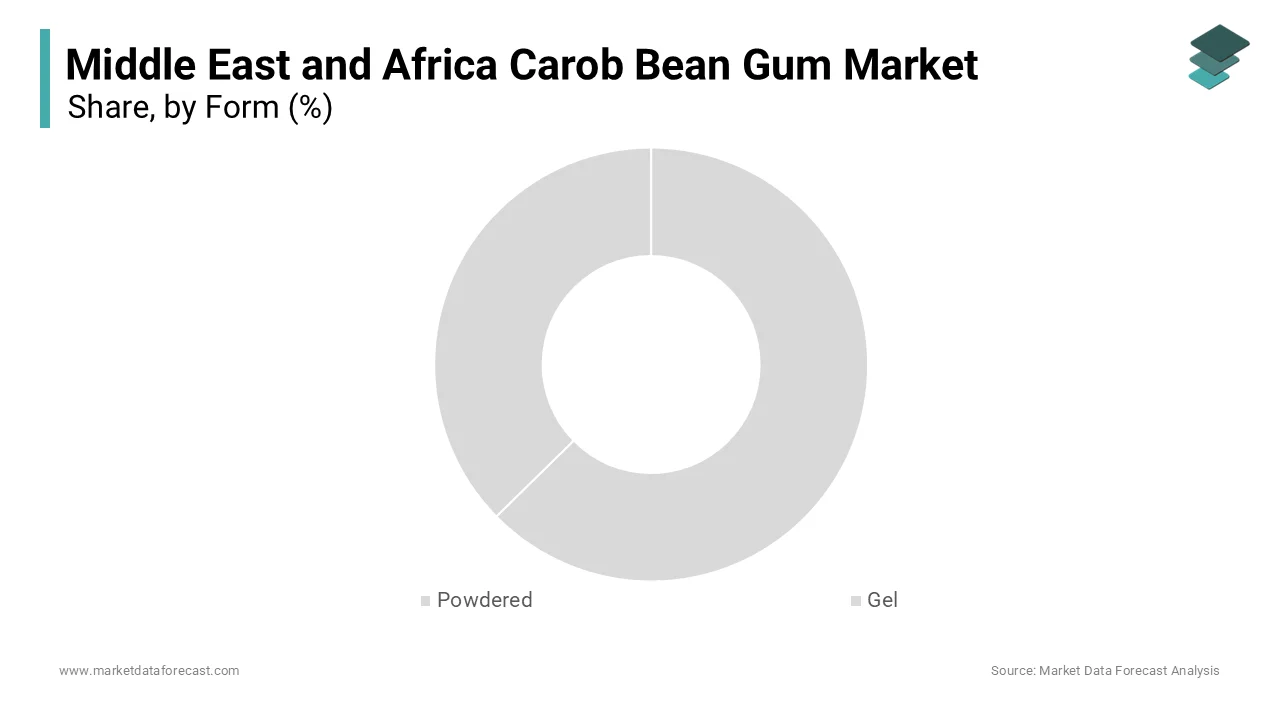
However, the gel-form carob bean gum segment is the fastest-growing segment in the Middle East and Africa carob bean gum market and is estimated to record a CAGR of 8.1% over the forecast period owing to the growing demand for ready-to-use solutions in specialized culinary and pharmaceutical applications. The rapid growth of gel-form carob bean gum is fueled by demand for convenient hydrocolloid systems that can provide consistent texture and viscosity. According to scientific literature, locust bean gum requires heating for complete solubilization and can form gels or structured systems when combined with suitable hydrocolloids. Ready-to-use gel systems can therefore reduce some formulation and hydration requirements in specialized applications. Additionally, food service and specialized formulation operations can benefit from pre-formulated texturizing systems where consistency and preparation time are important. According to peer-reviewed research, locust bean gum is used in combination with other hydrocolloids, including xanthan and carrageenan, to modify gel strength and rheological properties. This operational efficiency appeals to busy food service operators. Consequently, the Middle East and Africa carob bean gum market captures this premium segment by supplying high-quality gel forms that meet the exacting standards of modern culinary and formulation professionals.
By Application Insights
The food segment constituted the leading segment in the Middle East and Africa carob bean gum market in 2025 and the dominance of food segment in this regional market is majorly driven by its widespread use as a stabilizer, thickener, and emulsifier in dairy, bakery, and confectionery products. The dominance of food applications is further propelled by the essential role carob bean gum plays in stabilizing ice cream, yogurt, and processed cheese, which are staple consumption items in the region and key export products. According to peer-reviewed research, locust bean gum is widely used in dairy products, frozen foods, baked products, beverages, and processed foods because of its thickening, stabilizing, and water-binding properties. This functional necessity ensures consistent demand regardless of economic cycles, as dairy remains a dietary staple. According to the European Food Safety Authority, locust bean gum is an authorized food additive with established specifications for use in food products. Additionally, carob bean gum synergizes with other hydrocolloids, like guar gum, to enhance texture in low-fat dairy products, which are gaining popularity. This versatility makes it indispensable for formulators aiming to maintain quality while reducing fat content. Consequently, the Middle East and Africa carob bean gum market is anchored by the food sector, which provides a stable and high-volume application base for producers.
However, the non-food segment are the fastest-growing segment in the Middle East and Africa carob bean gum market and is estimated to register a CAGR of 9.1% over the forecast period due to innovation in pharmaceuticals, cosmetics and industrial uses and the increasing use of carob bean gum in pharmaceutical formulations, particularly for controlled-release drug delivery and tablet binding. According to peer-reviewed pharmaceutical research, locust bean gum has demonstrated potential as a matrix-forming and controlled-release material in oral drug delivery systems. Carob bean gum offers excellent mucoadhesive properties, allowing for prolonged drug residence time in the gastrointestinal tract, which can support controlled drug delivery. The statistical rise in chronic diseases in the Middle East and Africa has increased demand for advanced oral medications that utilize functional excipients. According to recent pharmaceutical research, locust bean gum and modified locust bean gum have been investigated for oral, transdermal, and mucosal drug delivery applications. Additionally, the material has applications in cosmetics and personal care because of its thickening, stabilizing, and film-forming properties. This trend encourages pharmaceutical and personal care companies to evaluate natural excipients and functional polymers. Consequently, the Middle East and Africa carob bean gum market captures high-value opportunities in the healthcare and personal care sectors, where quality and functionality are paramount.
REGIONAL ANALYSIS
United Arab Emirates Market Analysis
The United Arab Emirates is likely to maintain a strategic position in the Middle East and Africa carob bean gum market over the next few years as a major re-export hub and center for high-value food processing. The country serves as a gateway for distributing carob gum to neighboring Gulf states and beyond. According to the Dubai Department of Economy and Tourism, Dubai welcomed 18.72 million international overnight visitors in 2024, supporting continued demand across hospitality and food service channels. This trade and tourism activity supports local distributors who specialize in premium ingredients. Additionally, the UAE’s robust hospitality sector drives direct consumption in luxury hotels and restaurants. According to the Dubai Department of Economy and Tourism, Dubai's hotel occupancy rate reached 78.2% in 2024, supporting demand for food and beverage ingredients. The government’s focus on food security also encourages local processing investments. These factors ensure that the UAE remains a key commercial node in the regional market, facilitating efficient distribution and value addition.
Saudi Arabia Market Analysis
Saudi Arabia is likely to remain a growing consumption center in the Middle East and Africa carob bean gum market over the next few years because of its expanding food processing industry and Vision 2030 initiatives. The kingdom is investing heavily in local manufacturing to reduce import dependency. According to the General Authority for Statistics, Saudi Arabia's food and beverages manufacturing activity forms an important component of the country's manufacturing sector, supported by national industrial diversification initiatives. This industrial growth creates steady demand for bulk hydrocolloids. Additionally, the rising population and changing dietary habits boost consumption of processed dairy and bakery products. According to the Saudi Food and Drug Authority, Saudi Arabia maintains regulatory requirements for food additives and their permitted uses, supporting structured demand for compliant food ingredients. Government programs for local food production also support opportunities for regional agricultural raw material supply. These dynamics position Saudi Arabia as a key growth driver in the regional market through industrial expansion and policy support.
Egypt Market Analysis
Egypt is likely to maintain a pivotal position in the Middle East and Africa carob bean gum market over the next few years because of its large food processing industry and geographic position connecting African, Middle Eastern, and Mediterranean markets. The country has a long tradition of carob cultivation in parts of Egypt. According to the Food and Agriculture Organization of the United Nations, carob is cultivated in Mediterranean and North African production systems, and the seeds are an established raw material for locust bean gum extraction. This domestic and regional supply potential can reduce reliance on distant raw material sources for local processors. Additionally, Egypt’s large population drives demand for affordable food products where carob gum is used as a stabilizer and thickener. According to the Central Agency for Public Mobilization and Statistics, Egypt has a large and expanding food manufacturing base serving domestic and regional consumers. Export opportunities to Europe also exist due to geographic proximity. These factors ensure Egypt remains a significant player in the regional market through balanced production and consumption.
COMPETITIVE LANDSCAPE
The competition in the Middle East And Africa Carob Bean Gum Market is characterized by a mix of large multinational corporations and specialized regional processors who compete on quality consistency and supply reliability. Multinational entities leverage their global distribution networks and technical expertise to dominate high value segments while local players focus on cost efficiency and raw material proximity. The barrier to entry is moderate due to the capital intensive nature of processing infrastructure and the need for strict quality control measures. Competitive intensity is rising as demand for natural hydrocolloids grows driven by clean label trends in food and cosmetics. Price competition exists but is secondary to quality and certification status which are critical for accessing international markets. Suppliers differentiate themselves through sustainability credentials and traceability programs that appeal to ethically conscious buyers. Regulatory compliance with food safety standards remains a key competitive factor. This dynamic landscape forces participants to continuously invest in technology and farmer support to maintain supply stability and product excellence.
KEY MARKET PLAYERS
Some of the key players in the Middle East and Africa carob bean gum market are
- Scalzo Food Industries
- Silvateam
- LBG Sicilia ingredients
- Ashland Global
- G Araouzos and Son
- Gum Technology Corporation
- Ceamsa
- TIC Gums Incorporation
- CP Kelco
- FMC Specialty Chemicals
- DuPont Nutrition and Biosciences
- Fiberstar Inc
- Kerry Group
- Cargill
Top Players in the Market
- Silvateam operates as a leading processor of carob bean gum with significant involvement in the Middle East And Africa Carob Bean Gum Market through its extensive sourcing network in North Africa. The company specializes in transforming raw carob seeds into high purity industrial grades for food and pharmaceutical applications. Recently Silvateam invested in advanced milling technology at its facilities to enhance particle size consistency and viscosity control. This technological upgrade allows the firm to meet stringent international quality standards required by premium buyers in Europe and Asia. Their commitment to sustainable sourcing practices strengthens relationships with local farmers ensuring a stable supply of raw materials. By focusing on traceability and certification Silvateam builds trust with global clients. These actions solidify their reputation as a reliable supplier capable of delivering consistent quality in a competitive market landscape.
- Ashland Global Holdings contributes significantly to the Middle East And Africa Carob Bean Gum Market by providing specialized hydrocolloid solutions tailored for diverse industrial applications. The company leverages its global research capabilities to develop custom formulations that optimize texture and stability in food and personal care products. Recently Ashland expanded its technical support services in the region offering formulation assistance to local manufacturers seeking to replace synthetic additives with natural alternatives. This service oriented approach helps clients navigate regulatory requirements and improve product performance. They also prioritize sustainability by sourcing certified carob gum from verified suppliers in Morocco and Egypt. These initiatives enhance customer loyalty and drive adoption of their premium grades. Consequently Ashland strengthens its market position through innovation and strategic partnerships that address specific regional needs.
- DuPont Nutrition and Biosciences plays a pivotal role in the Middle East And Africa Carob Bean Gum Market by integrating carob gum into its broader portfolio of texturizing agents. The company focuses on creating synergistic blends that combine carob gum with other hydrocolloids to achieve superior functional properties. Recently DuPont launched new product lines specifically designed for plant based meat alternatives which are gaining traction in the region. This innovation targets the growing demand for clean label ingredients in emerging food categories. They also collaborate with local distributors to ensure efficient supply chain management and timely delivery. By leveraging its brand reputation and technical expertise DuPont captures high value segments. These efforts reinforce its leadership in providing advanced ingredient solutions that meet evolving consumer preferences.
Top Strategies Used by Key Market Participants
Key players in the Middle East And Africa Carob Bean Gum Market primarily employ vertical integration strategies to secure raw material supplies and control production quality from farm to factory. Companies invest in long term contracts with local farmers to ensure consistent access to high quality carob seeds while supporting sustainable agricultural practices. Another major strategy involves product differentiation through the development of specialized grades tailored for specific applications such as pharmaceuticals or premium dairy products. Manufacturers invest heavily in research and development to enhance functional properties like viscosity and stability. Additionally participants focus on obtaining international certifications such as organic and halal to access lucrative export markets and build consumer trust. Strategic partnerships with global distributors help expand reach and improve logistics efficiency. These combined tactics enable firms to command premium prices and maintain competitive advantages in a niche but growing sector.
MARKET SEGMENTATION
This research report on the Middle East and Africa carob bean gum market is segmented and sub segmented into following categories
By Form
- Powdered
- Gel
By Application
- Food
- Non Food Applications
- Breakfast cereals
- Salad Dressings
- Meat Products
- Breads
- Dairy Products
By Region
- KSA
- UAE
- Israel
- rest of GCC countries
- South Africa
- Ethiopia
- Kenya
- Egypt
- Sudan
- rest of MEA