Middle East and Africa Color Concentrates Market By type (solid, liquid), end use industry (Consumer Goods, Packaging, Construction, Automotive), And Region (Middle East and Africa) - Industry Analysis, Size, Share, Growth, Trends, and Forecast | (2026 to 2034)
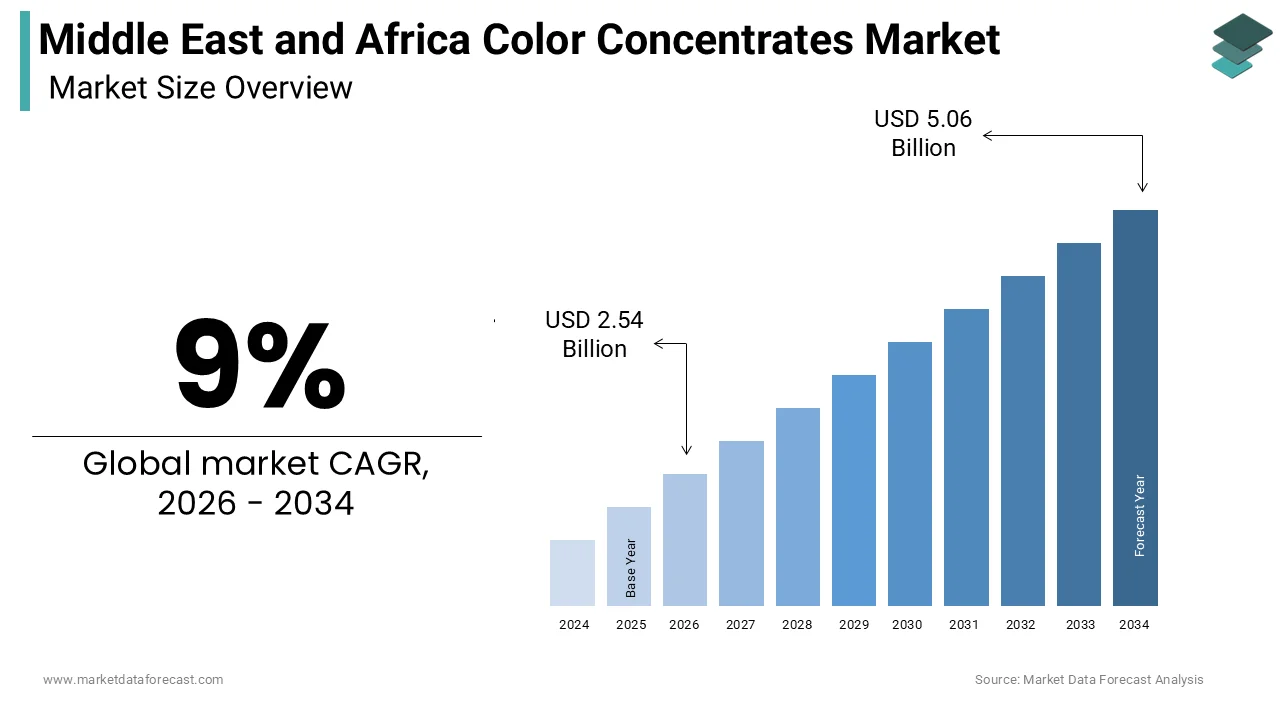
Market Size, 2025
$2.33 BnMarket Estimate, 2026
$2.54 BnMarket Forecast, 2034
$5.06 BnCAGR, 2026–2034
9%Middle East and Africa Color Concentrates Market Size
The Middle East and Africa Color Concentrates Market size was calculated to be USD 2.33 billion in 2025 and is anticipated to be worth USD 5.06 billion by 2034, growing from USD 2.54 billion in 2026 at a CAGR of 9% during the forecast period.
The color concentrates are broader, encompassing the plastics and coatings industry, characterized by the production and distribution of highly pigmented masterbatches used to impart color to polymers. These concentrates serve major functions in packaging construction, automotive components, and consumer goods by providing consistent hue dispersion and enhanced material properties. The region exhibits distinct consumption patterns driven by rapid urbanization and industrial diversification efforts away from hydrocarbon dependence. According to the United Nations Department of Economic and Social Affairs, the population of Africa is projected to reach 2.5 billion by 2050, which significantly amplifies the demand for packaged goods and infrastructure materials that utilize colored plastics. Furthermore, infrastructure investment in the continent reached 100 billion dollars in 2026, driving the need for durable and aesthetically pleasing construction materials.
MARKET DRIVERS
Rapid Expansion of the Packaging Industry Drives Demand for Aesthetic Differentiation
The burgeoning packaging sector, with the increasing need for brand differentiation and product appeal, is fuelling the growth of the Middle East and Africa color concentrates market. Food waste in the region remains a significant challenge, prompting manufacturers to invest in high-quality protective packaging that also offers visual attractiveness to consumers. Color concentrates allow producers to create vibrant and consistent branding elements on bottles, containers, and films, which is crucial in competitive retail environments. Additionally, the growth of e-commerce in countries like the United Arab Emirates and Nigeria has increased the demand for durable and visually appealing shipping materials. Manufacturers are increasingly opting for custom color matches to distinguish their products in crowded places. This trend toward premiumization and brand loyalty through visual identity sustains the robust demand for high-performance color concentrates across various packaging applications.
Government-Led Infrastructure Development Boosts Construction Material Consumption
The strategic government initiatives aimed at modernizing infrastructure, with the consumption of color concentrates in the construction sector, are leveraging the growth of the Middle East and Africa color concentrates market. Large-scale projects, such as smart cities, housing developments, and transportation networks, require vast quantities of colored polymers for pipes, cables, roofing, and interior fittings. In Saudi Arabia, the NEOM project mandates the use of innovative building materials including colored composite panels and durable plastic fixtures to achieve its futuristic architectural vision. Color concentrates offer superior weather resistance and UV stability compared to traditional paints, making them ideal for exterior applications in harsh climatic conditions. Furthermore, green building certifications are encouraging the use of long-lasting colored materials that reduce maintenance needs.
MARKET RESTRAINTS
Volatility in Raw Material Prices Impacts Production Costs
The fluctuating prices of petrochemical feedstocks, such as polyethylene and polypropylene, which serve as carriers for color concentrates is limiting the growth of the Middle East and Africa color concentrates market. Since the region is heavily dependent on oil and gas derivatives, any disruption in the global energy sector directly affects the cost structure of concentrate manufacturers. Small and medium-sized enterprises often lack the financial buffers to absorb these sudden cost increases, forcing them to raise prices or reduce quality. Additionally, currency fluctuations in countries like Turkey and Egypt exacerbate the issue for importers of specialized pigments and additives. This economic instability discourages long-term contracts and investment in advanced formulation technologies. Manufacturers are compelled to operate with thin margins, which limits their ability to innovate or expand capacity.
Stringent Environmental Regulations Limit Use of Certain Pigments
The increasingly strict environmental regulations regarding hazardous substances in plastics and coatings are declining the growth of the Middle East and Africa color concentrates market. Governments are aligning their standards with international norms such as the Restriction of Hazardous Substances Directive, which bans heavy metals like lead, cadmium, and chromium in consumer products. According to the United Nations Environment Programme, several African nations have begun implementing bans onsingle-use plastics containing toxic additives, which affects the formulation of color concentrates. Compliance with these new standards requires significant investment in research and development as well as testing infrastructure, which many local producers lack. Additionally, the lack of recycling infrastructure for colored plastics complicates waste management efforts. These regulatory pressures force companies to switch to more expensive organic pigments, which may not offer the same durability or color strength.
MARKET OPPORTUNITIES
Growth in Automotive Manufacturing Creates Niche Opportunities
The expanding automotive manufacturing sector in high-performance and durable formulations is likely to set up new opportunities for the growth of the Middle East and Africa color concentrates market. As local assembly plants increase production to meet domestic demand, there is a growing need for colored interior and exterior plastic components. Color concentrates offer advantages, such as weight reduction and design flexibility compared to painted metal parts. Furthermore, the rise of electric vehicles in the region encourages the use of lightweight colored composites to improve energy efficiency. Manufacturers can capitalize on this trend by developing specialized concentrates that meet rigorous automotive specifications for heat resistance and fade protection.
Expansion of Agricultural Film Usage Supports Market Growth
The increasing adoption of modern agricultural techniques, including the use of colored mulch films and greenhouse covers, is an additional factor to bolster the growth of the Middle East and Africa color concentrates market. These specialized films help control weed growth, regulate soil temperature, and protect crops from pests, thereby improving yield in arid climates. According to the Food and Agriculture Organization, the use of plastic mulch films in North Africa increased by 18% in 2025 to combat water scarcity and enhance crop productivity. In Egypt, the Ministry of Agriculture promotes the use of black and silver colored films to reduce evaporation and reflect sunlight, protecting sensitive crops. Color concentrates enable the production of films with specific light transmission properties tailored to different crop needs. The flower exporters are increasingly using colored nets and films to meet international quality standards. Furthermore, the Saudi Arabian Ministry of Environment, Water and Agriculture supports initiatives to modernize farming practices, including the adoption of advanced plastic technologies. This agricultural shift drives demand for specialized colorants that offer UV stability and longevity in harsh outdoor conditions.
MARKET CHALLENGES
Lack of Standardized Testing Infrastructure Hinders Quality Assurance
The absence of comprehensive and standardized testing facilities for color consistency and durability poses a major challenge for the growth of the Middle East and Africa color concentrates market. Many local manufacturers rely on subjective visual assessments rather than precise instrumental measurements, leading to inconsistencies in product quality. According to the International Organization for Standardization, only 10 countries in the region have accredited laboratories capable of performing advanced colorimetric analysis for plastics. This quality variability undermines trust among end users, who require precise color matching for branding purposes. Consequently, disputes between suppliers and buyers are common, resulting in delayed payments and lost business. The lack of regional harmonization in testing protocols further complicates cross-border trade. The East African Community has attempted to standardize quality benchmarks, but implementation remains uneven across member states.
Supply Chain Disruptions Affect Availability of Specialized Pigments
The reliance on imported specialty pigments and additives is attributed to global supply chain disruptions that impede the growth of the Middle East and Africa color concentrates market. While base polymers are locally available in some Gulf countries, high-performance organic pigments and effect additives are largely sourced from Europe and Asia. The Turkish Chemical Manufacturers Association reported that shipping costs for pigment imports rose by 20% due to geopolitical tensions and fuel surcharges. These disruptions led to inventory shortages and production stoppages for local compounders. The lack of local production capabilities for complex pigments means that manufacturers have limited alternatives during supply crises. This dependency creates operational inefficiencies and increases lead times for customers. Companies are attempting to mitigate these risks by holding larger safety stocks, but this ties up capital and increases storage costs.
REPORT COVERAGE
| REPORT METRIC | DETAILS |
| Market Size Available | 2026 to 2034 |
| Base Year | 2026 |
| Forecast Period | 2026 to 2034 |
| CAGR | 9% |
| Segments Covered | By Form, Carrier, End User, And Region |
| Various Analyses Covered | Global, Regional & Country Level Analysis; Segment-Level Analysis; DROC, PESTLE Analysis; Porter’s Five Forces Analysis; Competitive Landscape; Analyst Overview of Investment Opportunities |
| Regions Covered | KSA, UAE, Israel, rest of GCC countries, South Africa, Ethiopia, Kenya, Egypt, Sudan and Rest of MEA |
| Market Leaders Profiled | Ampacet Corporation, Ferro Corporation, A. Schulman, Inc, Penn Color, Inc, and PolyOne Corporation |
SEGMENTAL ANALYSIS
By Form Insights
The solid color concentrates segment held a dominant share of the Middle East and Africa Color Concentrates Market in 2026 due to their superior handling characteristics, storage stability, and compatibility with existing plastic processing machinery. These solid forms eliminate the risk of leakage and spillage associated with liquid alternatives, making them ideal for large-scale industrial operations. The ease of transportation and reduced packaging waste further enhance their appeal in regions with developing logistics infrastructure. Furthermore, solid forms offer better shelf life in hot and humid climates common in parts of Africa where liquid carriers may degrade or separate. Many small and medium enterprises utilize solid concentrates due to lower initial investment requirements for handling systems.
The liquid color concentrates segment is expected to register the fastest CAGR of 6.8% from 2026 to 2034 owing to the increasing demand for high-precision coloring in sophisticated applications, such as thin film packaging and fiber production, where uniform dispersion is important. The liquid concentrates provide superior color strength and clarity compared to solid forms, making them ideal for transparent and lightweight products. Liquid forms allow for instant color changes and reduced startup waste, which enhances operational efficiency in continuous processing lines. As per the study, 40% of new flexible packaging lines installed in 2025 were equipped with liquid injection units to meet stringent quality standards. Furthermore, the ability to achieve vibrant and metallic effects with liquid pigments appeals to premium consumer goods manufacturers.
By Carrier Insights
The polyethylene segment was accounted for, holding 34.8% of the Middle East and Africa Color Concentrates Market share in 2026 due to the region's vast petrochemical resources and the widespread use of polyethylene in packaging and construction applications. The abundance of ethylene feedstock in Gulf countries ensures a stable and cost-effective supply of polyethylene carriers for local concentrate producers. The versatility of polyethylene allows it to be used in various forms, including high-density and low-density variants, catering to diverse end-use requirements. Local color concentrate production utilizes polyethylene carriers due to their compatibility with common processing methods like blown film extrusion. Furthermore, polyethylene-based concentrates offer excellent dispersion properties and mechanical strength, making them suitable for heavy-duty applications, such as pipes and geomembranes.
The polypropylene segment is likely to exhibit the fastest CAGR of 7.2% during the forecast period owing to the increasing use of polypropylene in automotive components and rigid packaging due to its high heat resistance and stiffness. The local production of polypropylene-based parts has expanded significantly, driving demand for specialized color concentrates. In the packaging sector, the shift toward reusable containers and caps made from polypropylene is boosting carrier demand. The UAE Food Safety Authority notes that polypropylene is preferred for food contact applications due to its safety profile and durability. Additionally, the development of high-performance polypropylene grades with improved impact resistance is opening new applications in consumer goods. These trends contribute to the rapid expansion of the polypropylene carrier segment.
By End User Insights
The packaging sector segment was the largest, holding 46.3% of the Middle East and Africa Color Concentrates Market share in 2026 due to the rapid growth of consumer goods industries and increasing urbanization. The rising middle class and changing lifestyles are driving demand for packaged foods, beverages, and personal care products, which rely heavily on colored plastics for branding and protection. Color concentrates enable manufacturers to create distinctive brand identities through vibrant and consistent colors on bottles, jars, and films. The Dubai Municipality notes that strict labeling regulations require clear and durable printing, which is facilitated by high-quality colored substrates. Furthermore, the growth of e-commerce has increased the demand for durable shipping packaging that maintains visual appeal.
The building and construction sector is expected to grow at the fastest CAGR of 8.5% from 2026 to 2034 owing to the massive infrastructure investments and urban development projects across the region. In Saudi Arabia, the NEOM and Red Sea projects require vast quantities of colored polymers for pipes, cables, roofing, and interior finishes. The Egyptian Ministry of Housing reports that the government aims to deliver 1 million affordable housing units by 2026, driving demand for durable and aesthetically pleasing construction materials. Color concentrates offer advantages, such as weather resistance and long term-color retention compared to traditional paints. The growing emphasis on sustainable construction practices is also boosting the use of color concentrates in the building sector.
REGIONAL ANALYSIS
Saudi Arabia Color Concentrates Market Analysis
Saudi Arabia was the largest contributor in the Middle East and Africa Color Concentrates Market by holding 25.3% of the share in 2026, with its robust petrochemical industry and ambitious infrastructure projects. The kingdom is a global leader in polymer production, providing a strong foundation for downstream color concentrate manufacturing. The Vision 2030 initiative includes mega projects like NEOM and Qiddiya, which require extensive use of colored plastics for construction and interior design. The Saudi Standards Metrology and Quality Organization enforces strict quality controls, ensuring that local products meet international benchmarks. The growing population and rising disposable incomes are also boosting demand for packaged consumer goods. The Saudi Arabian General Investment Authority offers incentives for foreign investors to set up production units, further strengthening the market.
United Arab Emirates Color Concentrates Market Analysis
The United Arab Emirates color concentrates market was next, holding 18.3% of the share in 2026 with its advanced manufacturing base and status as a trade hub. The country hosts numerous multinational plastic processors, who require high-performance color concentrates for export-oriented products. The UAE government promotes innovation in materials science through initiatives like the Advanced Materials Research Center. The construction sector remains a key driver with ongoing projects in Dubai and Abu Dhabi utilizing colored polymers for facades and fittings. The Emirates Authority for Standardization and Metrology ensures compliance with safety and environmental standards.
Israel Color Concentrates Market Analysis
Israel color concentrates market growth is driven by the high value-added applications in agriculture and electronics. The country is a leader in drip irrigation technology, which relies heavily on colored plastic tubes and fittings to prevent algae growth and protect crops. The electronics sector also contributes significantly with colored housings for medical and communication devices. The Israeli Standards Institution maintains rigorous quality requirements fostering innovation in pigment technology. Local research institutions collaborate with industry players to develop nano pigment solutions for enhanced performance.
South Africa Color Concentrates Market Analysis
South Africa's color concentrates market is likely to grow with its mature industrial base and well-established recycling infrastructure. The country is a major producer of automotive components and packaging materials, which drive demand for high-quality color concentrates. The automotive industry in particular requires precise color matching for interior and exterior parts. The Cape Town and Durban ports serve as gateways for imports and exports, facilitating trade with other African nations. The South African Bureau of Standards enforces quality regulations that encourage the use of certified products.
Egypt Color Concentrates Market Analysis
Egypt color concentrates market growth is expected to grow with the large population and expanding manufacturing sector. The country has a strong presence in textile and packaging industries, which are major consumers of color concentrates. The government is investing in new industrial cities to attract foreign investment in the plastics sector. The Suez Canal Economic Zone offers logistical advantages for importing raw materials and exporting finished goods. The rising middle class is driving consumption of packaged foods and beverages. The Egyptian Standardization and Quality Authority is working to improve product quality standards.
COMPETITION OVERVIEW
The competition in the Middle East and Africa Color Concentrates Market is characterized by the presence of global giants and emerging local manufacturers, who strive to capture market share through innovation and service excellence. Major international companies leverage their technological expertise and broad product portfolios to offer high-performance solutions for diverse applications. These firms often engage in strategic collaborations with local entities to enhance distribution efficiency and regulatory compliance. Meanwhile, regional players compete by providing cost-effective alternatives and personalized customer support tailored to specific needs. The market sees intense rivalry in terms of product quality, pricing, and delivery speed. Companies frequently launch new sustainable products to differentiate themselves from competitors. Additionally, the rise of local manufacturing initiatives under national vision programs has intensified competition by fostering domestic production capabilities.
KEY MARKET PLAYERS
A few major players in the Middle East and Africa color concentrates market include
- Ampacet Corporation
- Ferro Corporation
- A. Schulman, Inc
- Penn Color, Inc
- PolyOne Corporation
Top Strategies Used by Key Market Participants
Key players in the Middle East and Africa Color Concentrates Market primarily focus on localization and sustainability to enhance their competitive edge. Companies are establishing local production facilities to reduce logistics costs and improve supply chain resilience in the region. This approach addresses the challenges of import dependency and currency fluctuations. Manufacturers also invest in research and development to create eco-friendly colorants that comply with evolving environmental regulations. Strategic partnerships with local distributors and raw material suppliers help navigate complex regulatory landscapes and cultural nuances. Additionally, firms emphasize technical support and custom formulation services to meet specific client requirements. These comprehensive strategies enable companies to strengthen their brand presence and drive adoption of advanced color concentrate solutions across the diverse Middle East and Africa region.
Leading Players in the Middle East and Africa Color Concentrates Market
- Clariant AG maintains a strong presence in the Middle East and Africa Color Concentrates Market through its advanced masterbatch solutions tailored for packaging and automotive applications. The company focuses on delivering high-performance pigments that meet strict regulatory standards in countries like Saudi Arabia and South Africa. Recently, Clariant launched bio-based color concentrates to support the sustainability goals of local manufacturers. The firm expanded its technical service centers in Dubai to provide faster customer support and formulation advice. These initiatives demonstrate its commitment to innovation and regional engagement, while strengthening relationships with key industrial partners.
- Ampacet Corporation contributes significantly to the market by offering a wide range of color and additive masterbatches for various plastic processing methods. The company emphasizes customization and rapid response to client needs, which is critical for competitive industries in the region. In recent developments, Ampacet enhanced its production capabilities in Egypt to serve North African markets more efficiently. It also introduced new UV-stable formulations designed for harsh climatic conditions prevalent in the Gulf states. These strategic moves help the company address specific regional challenges and improve supply chain reliability, thereby enhancing its reputation among local converters and brand owners throughout the Middle East and Africa.
- Avient Corporation plays a vital role in the Middle East and Africa Color Concentrates Market by providing specialized color solutions for agriculture and construction sectors. The company actively engages in developing durable pigments that withstand extreme weather conditions, ensuring long-term performance for outdoor applications. Recently, Avient partnered with local distributors in Kenya and Nigeria to expand its reach in sub-Saharan Africa. It also launched digital color matching tools to accelerate product development cycles for clients. These efforts reflect its dedication to supporting regional growth and improving operational efficiency for customers while maintaining high quality standards in its diverse product portfolio, across the region.
MARKET SEGMENTATION
This research report on the Middle East and Africa color concentrates market has been segmented and sub-segmented based on form, carrier, end user & region.
By Form
- Solid
- Liquid
By Carrier
- Polyethylene
- Polypropylene
- PC
- Polystyrene
- EVA
- ABS
- Others
By End User
- Packaging
- Automotive
- Electronics
- Healthcare
- Consumer Goods
- Textile
- Building and Construction
- Others
By Region
- KSA
- UAE
- Israel
- Rest of GCC countries
- South Africa
- Ethiopia
- Kenya
- Egypt
- Sudan
- Rest of MEA
Frequently Asked Questions
1. What is the current size and projected growth of the Middle East and Africa color concentrates market?
The Middle East and Africa color concentrates market is experiencing steady growth, driven by increasing demand from the packaging, automotive, construction, consumer goods, and textile industries. The market is expected to expand at a healthy CAGR during the forecast period, supported by rapid industrialization, growing plastics consumption, and advancements in polymer processing technologies.
2. Which countries are driving the growth of the Middle East and Africa color concentrates market?
Saudi Arabia, the United Arab Emirates, and South Africa are the leading contributors to the Middle East and Africa color concentrates market. Growth in these countries is supported by expanding manufacturing activities, rising investments in plastic packaging, infrastructure development, and increasing demand for colored polymer products across multiple industries.
3. What are the major trends shaping the Middle East and Africa color concentrates market?
The Middle East and Africa color concentrates market is being shaped by growing demand for sustainable and recyclable plastics, high-performance color masterbatches, customized color solutions, and UV- and heat-resistant pigments. Manufacturers are also focusing on bio-based additives, improved color consistency, and advanced formulations to meet evolving industrial requirements.
4. What factors are driving demand in the Middle East and Africa color concentrates market?
Demand for color concentrates is increasing due to the expansion of the packaging industry, rising production of consumer goods, growth in automotive manufacturing, and increasing use of plastics in construction and healthcare applications. Technological advancements in polymer processing and growing demand for aesthetically appealing plastic products are also supporting market growth.
5. Which product segments hold the largest share of the Middle East and Africa color concentrates market?
Color masterbatches hold the largest share of the Middle East and Africa color concentrates market due to their extensive use in plastic packaging, automotive components, consumer goods, and industrial applications. Pigment concentrates and specialty color concentrates also account for a significant market share, while eco-friendly and recyclable color concentrate solutions are expected to witness the fastest growth during the forecast period.
Access the study in MULTIPLE FORMATS
Purchase options starting from
$ 1600
Didn’t find what you’re looking for?
TALK TO OUR ANALYST TEAM
Need something within your budget?
NO WORRIES! WE GOT YOU COVERED!
Call us on: +1 888 702 9696 (U.S Toll Free)
Write to us: sales@marketdataforecast.com