- Product Description Description
- Table of Contents TOC
- List of Table & Figure LOT
- Get Free Sample PDF Sample PDF
Market Size, 2025
$4.94 BnMarket Estimate, 2026
$5.05 BnMarket Forecast, 2034
$6.03 BnCAGR, 2026–2034
2.24%Middle East And Africa Confectionery Market Size
The Middle East and Africa confectionery market size was valued at USD 4.94 billion in 2025. It is expected to reach USD 6.03 billion by 2034 from USD 5.05 billion in 2026. The market's promising CAGR for the predicted period is 2.24%.
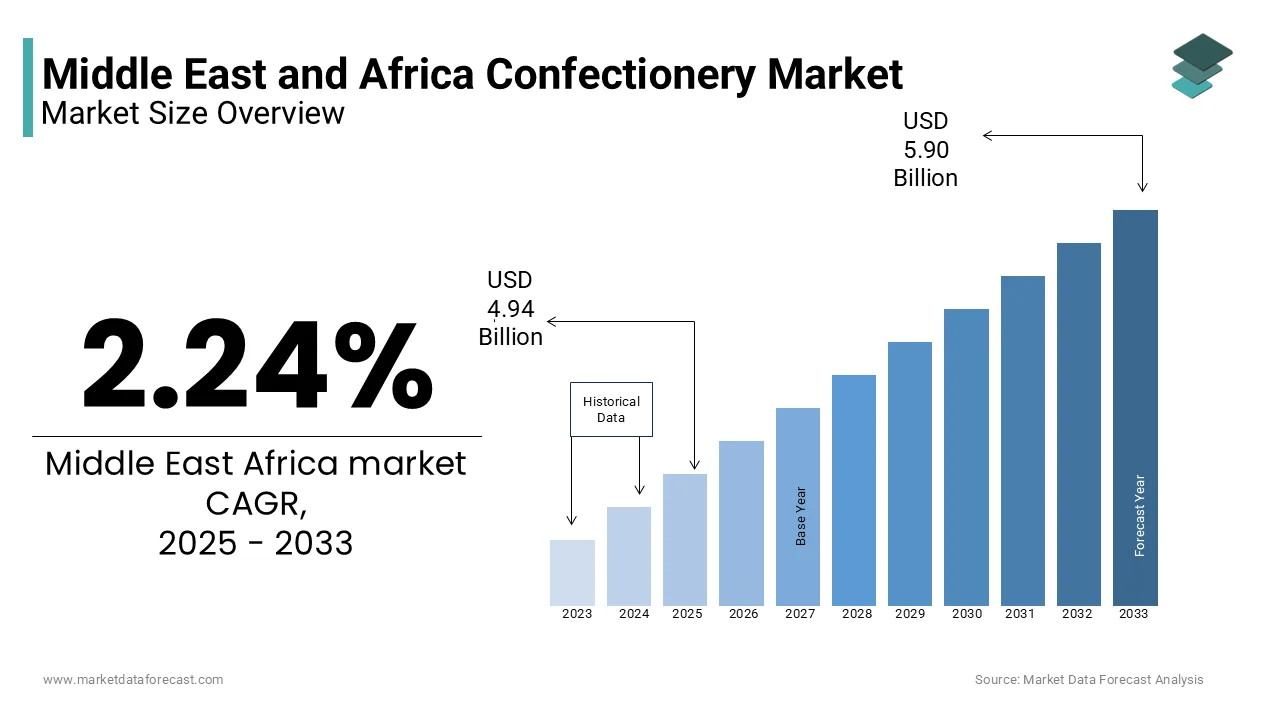
MARKET OVERVIEW
The confectionery market comprises an array of food products such as chocolates, raw pastes, and various sugar-based products. In addition, it includes therapeutic and dietetic confectioneries that differ in formulations from traditional confections. The preferred type of confectioneries often differ according to the geographical regions due to differences in regulatory norms and other factors such as economy and taste & preference of customers. The introduction of odor sensations, a combination of liquid & solid flavors, and energy boosts in confectionery products drive the growth and development of the confectionery market worldwide. A wide range of confectionery products are vended through various retail channels such as hypermarkets, supermarkets, convenience stores, discounters, forecourt retailers, and grocery stores. These stores act as Middle East and Africa marketing tools, assisting in building an impressive brand image and raising brand exposure of a wide variety of products.
Sugar is the key ingredient responsible for the prevalence of obesity and diabetes making this the primary restraint of this market. The primary raw materials used in confectionery production are sugar and cocoa. Cocoa prices are unstable and can be affected by a series of factors, like political instability, extreme weather, and pests & disease. Additionally, increase in supply demand gap in chocolate industry has increased the prices of cocoa beans. Sugar prices grew owing to less production and more demand.
REPORT COVERAGE
| REPORT METRIC | DETAILS |
| Market Size Available | 2025 to 2034 |
| Base Year | 2025 |
| Forecast Period | 2026 to 2034 |
| CAGR | 2.24% |
| Segments Covered | By Type, and Region |
| Various Analyses Covered | Global, Regional, & Country Level Analysis; Segment-Level Analysis; DROC, PESTLE Analysis; Porter’s Five Forces Analysis; Competitive Landscape; Analyst Overview of Investment Opportunities |
| Regions Covered | KSA, UAE, Israel, rest of GCC countries, South Africa, Ethiopia, Kenya, Egypt, Sudan and Rest of MEA |
| Market Leaders Profiled | Delfi Limited (Singapore), Ezaki Glico Co., Ltd. (Japan), Ferrero SpA (Italy), Lindt & Sprüngli AG (Switzerland), Lotte Confectionery Co. Ltd. (South Korea), Mars, Incorporated (U.S.), Mondelez International, Inc. (U.S.), Nestlé S.A. (Switzerland), The Hershey Company (U.S.), Wm. Wrigley Jr. Company (U.S.) |
MARKET SEGMENTATION
This research report on the Middle East and Africa Confectionery market has been segmented and sub-segmented into the following categories.
By Type
- Sugar
- Hard-boiled sweets
- Caramels & Toffees
- Gums & Jellies
- Medicated Confectionary
- Mints
- Chocolate
- White
- Milk
- Dark
By Country
- UAE
- Israel
- KSA
- South Africa
- Egypt
KEY MARKET PLAYERS
Key Players In Middle East And Africa Confectionery Market are Delfi Limited (Singapore), Ezaki Glico Co., Ltd. (Japan), Ferrero SpA (Italy), Lindt & Sprüngli AG (Switzerland), Lotte Confectionery Co. Ltd. (South Korea), Mars, Incorporated (U.S.), Mondelez International, Inc. (U.S.), Nestlé S.A. (Switzerland), The Hershey Company (U.S.), Wm. Wrigley Jr. Company (U.S.)