- Product Description Description
- Table of Contents TOC
- List of Table & Figure LOT
- Get Free Sample PDF Sample PDF
Market Size, 2025
$0.28 BnMarket Estimate, 2026
$0.29 BnMarket Forecast, 2034
$0.41 BnCAGR, 2026–2034
4.44%Middle East and Africa Dairy Herd Management Market Size, Growth, Trends & Forecast (2026–2034)
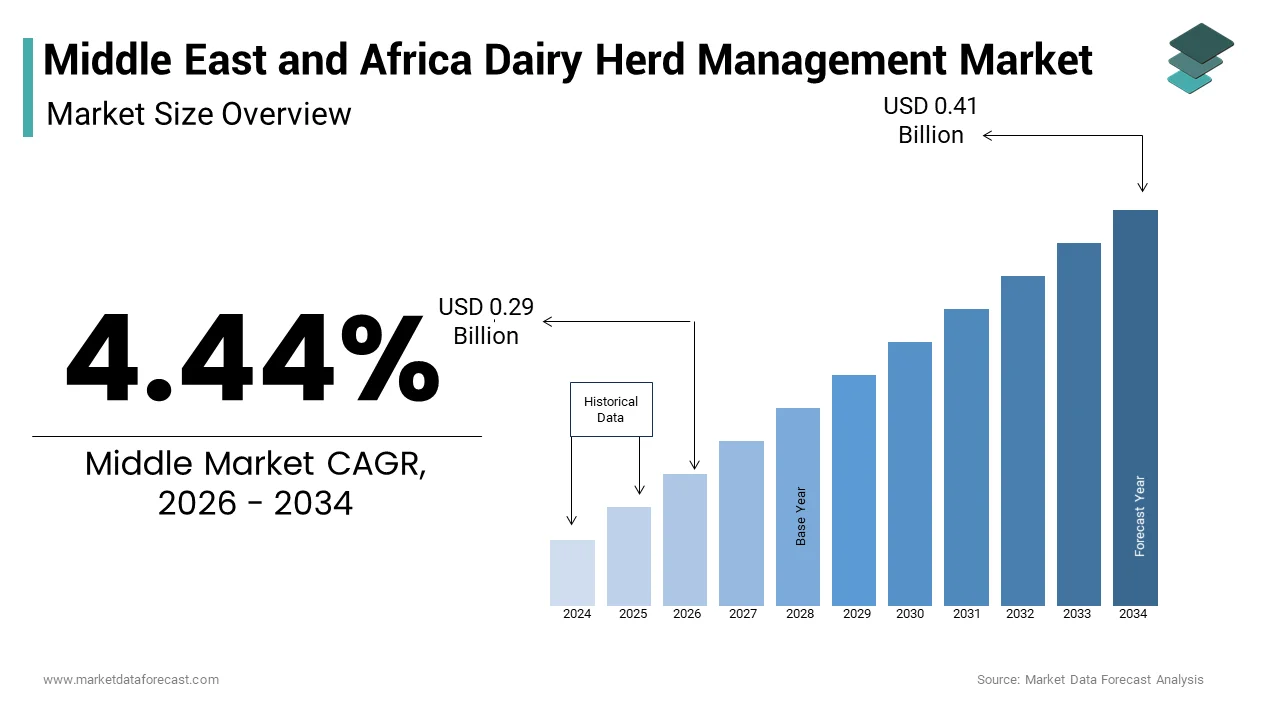
The Middle East and Africa dairy herd management market size was valued at USD 0.28 billion in 2025, is anticipated to reach USD 0.29 billion in 2026, and is projected to scale up to USD 0.41 billion by 2034, registering a compound annual growth rate (CAGR) of 4.44% from 2026 to 2034. Growth is primarily propelled by aggressive government initiatives for food security and self-sufficiency, the necessity of precision environmental control amid extreme climatic conditions, and the expansion of large-scale commercial dairy operations and foreign investments.
Key Executive Metrics (At-a-Glance)
- 2025 Base Valuation: USD 0.28 Billion
- 2026 Current Valuation: USD 0.29 Billion
- 2034 Forecast Valuation: USD 0.41 Billion
- Compound Annual Growth Rate (CAGR): 4.44% (2026–2034)
- Dominant Product Segment: Hardware
- Fastest-Growing Product Segment: Web Based Software (17.5% CAGR)
- Dominant Application Segment: Milk Harvesting
- Fastest-Growing Application Segment: Heat Stress Management (19.2% CAGR)
- Leading Country Markets: Saudi Arabia, United Arab Emirates, Israel, and South Africa
Core Market Drivers & Restraints
- Key Drivers: National food security strategies (such as Saudi Vision 2030 and UAE National Food Security Strategy 2051), extreme summer temperature-humidity indices, and integration of IoT and AI for predictive analytics.
- Market Restraints: High initial capital expenditures, limited access to financing for smallholders, inadequate rural digital connectivity, data privacy ambiguities, and technical skill shortages.
Middle East and Africa Dairy Herd Management Market Segmentation Breakdown
| Segment Category | Largest / Leading Segment | Fastest-Growing Segment |
|---|---|---|
| By Product | Hardware | Web Based Software (17.5% CAGR) |
| By Application | Milk Harvesting | Heat Stress Management (19.2% CAGR) |
| By Region / Country | Saudi Arabia | UAE & Ethiopia |
Major Industry Players Profiled
Key market leaders shaping the Middle East and Africa dairy herd management landscape include Afimilk Ltd., BouMatic, Dairy Master, DeLaval, GEA Group AG, Infovet, Lely Holdings S.A.R.L., SCR Dairy Inc., Sum-It Computer Systems, Ltd., and Valley Agriculture Software.
Middle East and Africa Dairy Herd Management Market Size
The Middle East and Africa dairy herd management market size was valued at USD 0.28 billion in 2025 and it is anticipated to reach a vauation of USD 0.29 billion in 2026 and USD 0.41 billion by 2034, growing at a CAGR of 4.44% from 2026 and 2034.
Introduction and Market Definition
Dairy herd management is the practice of overseeing and caring for a group of dairy animals to maximize their health, comfort, and milk production. This market includes advanced solutions such as automated milking systems, wearable health sensors, and data analytics platforms designed to optimize herd productivity and animal welfare. As per the Food and Agriculture Organization, the Near East and North Africa region accounts for approximately 15% to 18% of global dairy imports, driving total market values to surpass $44 billion as regional urban centers expand their reliance on specialized yogurt, premium cheeses, and milk powders. The market is increasingly driven by the need to maximize yield per animal due to limited arable land and water resources. According to the African Union, Africa accounts for approximately 25% of the global cattle population, prompting a continent-wide livestock sector repositioning to double its annual economic contribution and secure long-term food sovereignty. Furthermore, rising consumer awareness regarding food safety and quality compels producers to adopt systems that ensure traceability and compliance with international standards. The integration of Internet of Things devices allows for precise monitoring of estrus cycles, feed intake, and disease detection, which is vital for maintaining profitability in high cost operating environments. With national visions in Gulf countries emphasizing agricultural self sufficiency, the adoption of herd management systems has become a strategic imperative for sustaining growth and meeting the escalating demand for high quality dairy products.
MARKET DRIVERS
Government Initiatives for Food Security and Self Sufficiency Drive Technology Adoption
The aggressive pursuit of food security and agricultural self-sufficiency by governments in the region is a major accelerator for the Middle East and Africa dairy herd management market. According to the Saudi Vision 2030 Annual Report 2024, the domestic fresh dairy industry already fulfills 109% of total national consumption demands, prompting structural state investments to focus on expanding processing plants and vertical farming infrastructures. The strategic directive compels large scale dairy operators to implement advanced management tools that maximize output from limited resources. As per studies, local dairy automation systems are expanding via direct investments from private commercial operations, while public field development projects prioritize heavy plowing and automated irrigation networks. These government led initiatives create a favorable regulatory and economic environment where investment in digital herd management is not only encouraged but often financially supported. The focus on reducing the import bill for dairy products, which constitutes a major portion of the food import budget in many Gulf states, drives the urgency for efficiency gains. Herd management systems enable producers to achieve higher yields per cow, making domestic production more competitive against imported powdered and fresh milk. Consequently, the alignment of national security goals with technological adoption transforms herd management from an operational choice into a policy driven necessity, accelerating market penetration across the region.
Extreme Climatic Conditions Necessitate Precision Environmental Control
The prevalence of extreme heat and arid conditions in the region creates an urgent operational need for precision environmental control and health monitoring, which boosts the growth of the Middle East and Africa dairy herd management market. This drives the demand for advanced herd management technologies. According to the International Livestockhousing Guide, elevated temperature-humidity indices during peak summer seasons drop regional milk yields by up to 25%, stimulating wide-scale farm installation of automated cooling fans and high-pressure misting lines. The physiological challenge necessitates the use of sophisticated monitoring systems that track body temperature, respiration rates, and activity levels in real time to trigger automated cooling interventions. As per the Journal of Animals and Livestock Climate Review, severe thermal stress triggers a nonspecific immune response that maximizes cow vulnerability to mastitis and metritis, driving the deployment of wearable subcutaneous biotelemetry sensors. Herd management systems integrate with environmental controls such as misters and fans to maintain optimal thermal comfort, ensuring consistent production levels despite external weather volatility. In Africa, unpredictable rainfall patterns and droughts further exacerbate feed and water scarcity, requiring precise resource management tools to optimize usage. The ability of these systems to provide data driven insights into animal welfare under stress conditions allows farmers to mitigate risks and maintain productivity. Thus, the harsh climatic reality of the region makes advanced herd management an essential tool for survival and profitability, rather than merely a luxury for optimization.
MARKET RESTRAINTS
High Initial Investment Costs and Limited Access to Financing
The substantial capital expenditure required for implementing comprehensive dairy herd management systems acts as a significant restraint to the Middle East and Africa dairy herd management market. This trend is particularly true for the majority of smallholder and medium-sized farms that dominate the African agricultural landscape. As per the World Bank, the financing deficit for agricultural small and medium-sized enterprises across the region sits at $96 billion, accelerating the expansion of tech-enabled credit platforms and localized risk-sharing models. According to Nebraska Dairy Extension, the baseline initial investment for a single automatic robotic milking unit typically ranges between $150,000 and $200,000, propelling a market shift toward large-scale automation frameworks that minimize long-term labor variables. As per the African Development Bank, commercial lenders maintain a ninety-seven percent insurance protection gap across rural agribusiness markets, forcing the deployment of blended finance structures under the Agri-Food SME Catalytic Financing Mechanism to unlock private capital pools. The financial constraint creates a dualistic market where large corporate farms in the Gulf can afford state of the art technology while smaller producers remain reliant on inefficient manual methods. Additionally, the high cost of maintenance and spare parts in regions with limited local supply chains further increases the total cost of ownership. The high entry cost will continue to limit market penetration and slow the modernization of the dairy sector in price-sensitive segments. To overcome this, the region needs innovative financing models like leasing or pay-per-use schemes.
Inadequate Technical Infrastructure and Connectivity Limitations
Rural areas often lack robust digital infrastructure and reliable internet connectivity, which slows down the growth of the Middle East and African dairy herd management market. This deficit poses a major barrier to the effective deployment of cloud-based dairy herd management systems across many parts of the region. According to the International Telecommunication Union, the internet usage rate for rural populations across the African continent rests at 23%, forcing agricultural IoT networks to utilize low-Earth orbit satellite integrations to bypass terrestrial telecommunication deficits. The connectivity gap prevents farmers from utilizing advanced features such as remote monitoring, predictive analytics, and instant alerts, limiting the functionality of sophisticated herd management tools to basic local recording. As per the World Bank, the urban-to-rural digital connectivity imbalance reflects a 2.6-to-1 usage gap across the region, motivating sub-Saharan administrative bodies to prioritize mobile money and low-bandwidth agritech solutions over high-cost physical line installation. Many dairy farms operate in regions with intermittent power supply, which further complicates the continuous operation of electronic monitoring devices and data servers. The lack of technical support and maintenance services in these isolated areas means that hardware failures often go unresolved for extended periods, discouraging long term adoption. Significant improvements must be made in rural telecommunications and power infrastructure. Until then, the full potential of connected herd management systems will remain unrealized, restricting their scalability and effectiveness in key production hubs.
MARKET OPPORTUNITIES
Integration of Artificial Intelligence for Predictive Health and Breeding Analytics
The incorporation of artificial intelligence and machine learning into dairy herd management platforms is a key growth area to enhance decision-making and operational efficiency for producers across the region and is predicted to fuel the expansion of the Middle East and Africa market. According to research, advanced connectivity and IoT monitoring of animal health and growth conditions are projected to unlock between $70 billion and $90 billion in global value by 2030, driving the commercial expansion of specialized agritech analytics. By analyzing vast amounts of historical and real time data from sensors, AI algorithms can predict diseases such as mastitis or lameness days before clinical symptoms appear, allowing for early intervention and reduced treatment costs. As per Wageningen University and Research, classical and multispectral phenotype-based breeding indices identify specific heat-resilient parental genotypes, enabling livestock operators to select animals capable of offsetting 11% of climate-induced milk yield declines. The precision approach reduces the number of unsuccessful inseminations and shortens calving intervals, directly boosting profitability. Furthermore, AI can optimize feed rations based on individual animal needs and local ingredient availability, minimizing waste and enhancing nutrient efficiency in resource constrained settings. The ability to automate complex analytical tasks empowers farmers to make data driven decisions with greater confidence and speed. Computing power is becoming more accessible and algorithms are increasingly sophisticated. Therefore, integrating AI offers regional producers a clear pathway to achieve unprecedented levels of efficiency and sustainability while securing a competitive edge globally.
Expansion of Large Scale Commercial Dairy Farms and Foreign Investment
The rapid expansion of large-scale commercial dairy farms and increased foreign direct investment in the region offer significant opportunities for the growth of the Middle East and Africa dairy herd management market. According to the United Nations Conference on Trade and Development, continental agribusiness strategy prioritizes localized public-private integration across the African Continental Free Trade Area, accelerating domestic investment inside regional value chains to scale up agro-processing capacity. These large scale enterprises have the capital and strategic intent to adopt state of the art herd management technologies to ensure operational excellence and meet international quality standards. As per the Gulf News, regional dairy industry leaders are implementing multibillion-dollar capital budgets to diversify corporate portfolios directly into red meat and seafood processing infrastructure. The shift from fragmented smallholder production to consolidated commercial operations facilitates the implementation of standardized digital protocols and economies of scale in technology adoption. Furthermore, partnerships between local governments and international agri tech firms are bringing advanced expertise and technology to the region, fostering knowledge transfer and innovation. This trend toward industrialization and professionalization of the dairy sector creates a fertile ground for technology providers to deploy integrated solutions that manage large herds efficiently, driving substantial growth in the market for advanced herd management systems.
MARKET CHALLENGES
Data Privacy Concerns and Lack of Regulatory Frameworks
Ambiguity surrounding data ownership and privacy rights remains a major roadblock in the Middle East and Africa Dairy Herd Management Market. Consequently, farmers are often hesitant and uncertain about sharing their sensitive operational data. As per the African Union Commission, national data protection statutes entirely lack explicit frameworks for agricultural data licensing, motivating independent developers to establish unified voluntary codes of conduct across local agritech networks. Farmers often fear that their proprietary data on herd performance and management practices could be exploited by technology providers or third parties for commercial gain without adequate compensation or consent. According to the African Union Commission, a 35% digital literacy gap exists between urban centers and rural environments, prompting public-private partnerships to expand localized training programs for emerging smallholders. The absence of standardized contracts and clear legal frameworks for data sharing agreements exacerbates this issue, leaving producers vulnerable to unfavorable terms. Furthermore, concerns about cybersecurity threats and potential data breaches add another layer of risk, as compromised data could reveal competitive weaknesses or disrupt operations. Harmonized regulations and industry standards must first establish clear rights and protections for agricultural data. Until then, skepticism will persist, impeding the collaborative innovation and data pooling necessary for advancing the sector.
Shortage of Skilled Personnel and Technical Expertise
The acute shortage of skilled personnel capable of operating and maintaining sophisticated dairy herd management systems is a significant inhibitor to the expansion of the Middle East and Africa market. According to the World Bank, sub-Saharan enterprise development will require over 230 million digitally skilled workers by 2030, accelerating the overhaul of technical and vocational curricula across regional agricultural hubs. The deficiency means that even when farms invest in monitoring systems, they often struggle to interpret the data correctly or troubleshoot technical issues, leading to underutilization and frustration. As per the 2024 UNESCO Forum on Higher Education in Africa, continental institutional strategies are prioritizing the integration of precision agriculture, land restoration, and climate-smart farming courses into higher education systems to secure long-term food infrastructure. The absence of local technical support networks further exacerbates this problem, as farmers in remote areas may wait weeks for specialized technicians to arrive, during which time the monitoring system remains nonfunctional. This reliance on external expertise increases operational costs and reduces the reliability of the technology, discouraging long term adoption. Moreover, the rapid pace of technological advancement means that existing skills quickly become obsolete, requiring continuous training and upskilling that is rarely available in rural communities. The regional human capital deficit will remain a persistent bottleneck for the livestock sector. This barrier will continue to limit the effectiveness and scalability of monitoring systems unless comprehensive educational programs and vocational training initiatives are launched.
REPORT COVERAGE
| REPORT METRIC | DETAILS |
| Market Size Available | 2025 to 2034 |
| Base Year | 2025 |
| Forecast Period | 2026 to 2034 |
| CAGR | 4.44% |
| Segments Covered | By Type of Motors, Voltage, End-User, and Region |
| Various Analyses Covered | Global, Regional & Country Level Analysis, Segment-Level Analysis, DROC, PESTLE Analysis, Porter’s Five Forces Analysis, Competitive Landscape, Analyst Overview on Investment Opportunities |
| Regions Covered | KSA, UAE, Israel, rest of GCC countries, South Africa, Ethiopia, Kenya, Egypt, Sudan, rest of MEA |
| Market Leaders Profiled | Afimilk Ltd., BouMatic, Dairy Master, DeLaval, GEA Group AG, Infovet, Lely Holdings S.A.R.L, SCR Dairy Inc., Sum-It Computer Systems, Ltd, and Valley Agriculture Software. |
SEGMENTAL ANALYSIS
By Product Insights
Hardware
The hardware segment remained the largest in 2025 and occupied a commanding share of the Middle East and Africa Dairy Herd Management Market. This segment’s prominence was supported by physical devices, such as robotic milking units, wearable sensors, and automated feeders, which form the foundational layer required for any digital monitoring initiative. As per the Food and Agriculture Organization, the expansion of large-scale camel milk enterprises across the region is driving an autonomous commodity market projected to scale from $2 billion to $13 billion by 2030. The structural shift ensures that hardware remains the primary revenue generator as farms modernize their infrastructure to meet national food security goals. As per the International Dairy Federation, regional dairy processors have elevated the installation of spray-dried manufacturing machinery to 60%, establishing a 5.1% compound annual growth rate for specialized milk powder output across Middle Eastern processing hubs. The durability and necessity of hardware in harsh outdoor environments mean that replacements and upgrades occur regularly, sustaining consistent demand. Furthermore, the proliferation of low cost sensor technologies has made basic hardware accessible to medium sized farms in emerging markets like Egypt and Kenya, expanding the total addressable market significantly. Without these physical components, the collection of biological and locational data is impossible, making hardware the indispensable backbone of the entire monitoring ecosystem. The sheer volume of animals in the region necessitates millions of individual hardware units, thereby securing its position as the leading segment in terms of both volume and value within the market structure.
Web Based Software
The web-based software segment is expected to exhibit a noteworthy CAGR of 17.5% between 2026 and 2034 owing to the increasing need for scalable, accessible, and real-time data processing capabilities that transcend local server limitations. According to sources, tech-enabled livestock connectivity networks and global farm data integration frameworks are on track to unlock up to $90 billion in market value by 2030. The transition allows producers to access herd data from mobile devices anywhere, enhancing decision making speed and operational flexibility in regions where technical expertise is scarce. As per the International Telecommunication Union, average mobile broadband connections per 100 people across regional urban and commercial corridors reached 85, leading to rapid integration of digital services inside specialized corporate supply chains. The scalability of web based platforms means that farms can easily add features or integrate new devices without significant hardware upgrades, offering a cost effective pathway for expansion. Additionally, cloud based systems facilitate data aggregation and benchmarking across multiple farms, providing valuable insights into best practices and performance metrics for regional cooperatives. Consequently, as connectivity improves and trust in cloud security grows, the demand for intelligent web based software solutions that can optimize complex farming operations is outpacing the growth of on premise systems, marking it as the fastest expanding component of the market.
By Application Insights
Milk Harvesting
In 2025, the milk harvesting segment held the majority share in the Middle East and Africa Dairy Herd Management Market because of its direct correlation with farm revenue and its critical role in addressing acute labour shortages across the region. According to the International Dairy Federation, there are approximately 133 million dairy farms globally supporting over 600 million rural livelihoods, forcing market expansion into precision diagnostics to secure steady farm income pipelines. Automated milking systems not only increase milking frequency and consistency but also provide real time quality metrics that enable premium pricing for high grade milk. As per Wageningen University and Research, automatic milking systems trigger a 15% to 20% surge in raw milk output through enhanced daily milking frequencies, allowing enterprise operators to fulfill regional supply quotas with smaller total cow herds. The application also directly addresses the labor crisis, with automated systems reducing milking labor requirements, allowing farmers to reallocate human resources to higher value tasks such as animal care and breeding. Furthermore, regulatory requirements for milk hygiene and traceability mandate precise recording of harvest data, which automated systems provide seamlessly. The convergence of economic necessity, labor substitution, and regulatory compliance ensures that milk harvesting remains the largest and most mature application segment in the Middle East and Africa market.
Heat Stress Management
The heat stress management segment is predicted to witness the highest CAGR of 19.2% over the forecast period, due to rising temperatures in the Middle East and parts of Africa and the resulting impact on dairy productivity. According to the World Bank, severe climate vulnerabilities across arid agricultural belts are driving multi-million dollar public funding allocations directly into automated livestock cooling systems and shaded production barns. The physiological challenge necessitates the use of sophisticated monitoring systems that track body temperature, respiration rates, and activity levels in real time to trigger automated cooling interventions. As per the International Livestock Research Institute, developing dairy networks are boosting farm profits by expanding crossbred cattle populations that combine advanced milk output capacities with robust genetic environmental tolerance. Herd management systems integrate with environmental controls such as misters and fans to maintain optimal thermal comfort, ensuring consistent production levels despite external weather volatility. The growing emphasis on animal welfare standards in export markets also drives adoption, as retailers increasingly require proof of ethical treatment and environmental control. Furthermore, insurance providers are beginning to offer premium discounts for farms with certified heat stress mitigation systems, adding another financial incentive. The combination of climate urgency, regulatory pressure, and measurable economic protection positions heat stress management as the most dynamic growth area in the Middle East and Africa dairy technology sector.
REGIONAL ANALYSIS
Saudi Arabia Dairy Herd Management Market Analysis
Saudi Arabia led the Middle East and Africa Dairy Herd Management Market and captured a significant share in 2025. This leading position of the Saudi market was driven by its ambitious Vision 2030 strategy, which prioritizes food security and agricultural self-sufficiency. According to the Ministry of Environment, Water and Agriculture, Saudi Arabia's domestic dairy production successfully reached 109% self-sufficiency, shifting structural investments toward the deployment of digital cold chain logistics and advanced feed optimization systems. The government provides substantial subsidies for the import of advanced milking robots and monitoring systems, lowering the barrier to entry for commercial operators. As per the General Authority for Statistics, specialized agricultural cow farms across the Kingdom generated 2.8 billion liters of raw milk from a stable national population of 234,000 dairy cows, advancing regional market optimization through strict compliance with Saudi GAP standards. Major players like Almarai have pioneered the use of fully automated barns equipped with IoT sensors, setting a benchmark for the region. The focus on reducing water usage through efficient feeding and monitoring systems aligns with national sustainability goals. This strong policy support and corporate leadership ensure Saudi Arabia remains the primary driver of technological innovation and market growth in the Gulf region.
United Arab Emirates Dairy Herd Management Market Analysis
The United Arab Emirates followed closely behind in the Middle East and Africa Dairy Herd Management Market and accounted for a significant share in 2025. This growth of the UAE’s market was fuelled by high-tech urban farming initiatives and a strong focus on resilient food security. According to the Ministry of Climate Change and Environment, the UAE has launched the National Food Security Strategy 2051, which encourages the adoption of smart agriculture technologies to reduce reliance on imports. The country’s extreme climate necessitates advanced environmental control systems integrated with herd management platforms to maintain animal welfare and productivity. As per the UAE National Food Security Strategy 2051 framework, local agricultural development centers are accelerating the installation of hydroponic facilities that use up to 90% less water, modernizing the national food basket across 24 core commodities. The presence of major international agri tech firms and local innovators fosters a competitive environment that drives continuous improvement in service and technology. The UAE’s role as a regional hub for trade and logistics also facilitates the easy import of advanced equipment. This combination of strategic vision, climatic necessity, and technological readiness positions the UAE as a key market for premium herd management solutions.
Israel Dairy Herd Management Market Analysis
Israel continues to be a significant player in the Middle East and Africa Dairy Herd Management Market. It is renowned for its world-leading dairy productivity and innovation in agricultural technology. According to the Israeli Cattle Breeders Association, the average milk yield per cow in Israel exceeds 12,000 liters annually, the highest in the world, achieved through extensive use of precision herd management systems. The country’s limited natural resources drive the development of highly efficient technologies for water and feed management, which are integrated into comprehensive herd monitoring platforms. As per the Israel Cattle Breeders Association Herd Book, regional dairy managers submit continuous epidemiological data directly to the centralized national NOA database to evaluate bovine ephemeral fever outbreaks and coordinate livestock insurance portfolios. Israeli companies are global leaders in developing innovative sensors and analytics tools, exporting their expertise to neighboring regions. The strong collaboration between farmers, researchers, and tech startups creates a vibrant ecosystem for continuous innovation. This unique blend of necessity driven innovation and high technical capability makes Israel a critical source of technology and best practices for the broader Middle East and Africa market.
South Africa Dairy Herd Management Market Analysis
South Africa holds the most mature position in the Africa segment of the Middle East and Africa Dairy Herd Management Market due to a well-developed commercial dairy sector and established supply chains. According to Milk SA, South Africa's domestic dairy herd generates approximately 3.34 billion liters of milk annually, accelerating industry-wide consolidation into heavily automated corporate operational units. The presence of multinational agribusinesses and local cooperatives facilitates access to advanced monitoring systems and technical support. As per the Department of Agriculture, Land Reform and Rural Development, domestic market operators are prioritizing strict disease mitigation frameworks and trade protocols to scale up raw milk output and capture new export agreements with China. The country’s robust infrastructure and high level of digital literacy among farmers enable effective utilization of web based management software. South Africa serves as a gateway for technology providers entering the broader African market, offering a testing ground for solutions adapted to diverse conditions. The focus on export quality and efficiency drives continuous investment in herd management technologies, maintaining its leadership position on the continent.
Ethiopia Dairy Herd Management Market Analysis
Ethiopia is an emerging player in the Middle East and Africa Dairy Herd Management market owing to its large cattle population and government efforts to modernize the livestock sector. According to the Central Statistical Agency of Ethiopia, the national cattle population has surpassed 70.3 million heads, positioning the livestock sector to provide up to 45% of the total agricultural gross domestic product. The government’s Livestock Master Plan aims to improve productivity through better breeding and management practices, creating opportunities for introductory herd management tools. As per the Ministry of Agriculture, administrative bodies are expanding the digital DHIS2 animal health surveillance platform to enable real-time infectious disease reporting and veterinary diagnostics tracking nationwide. While current adoption of advanced automation is low due to financial constraints, the growing urban demand for processed milk is encouraging larger farms to invest in basic monitoring systems. International development agencies are supporting initiatives to introduce affordable technologies to smallholders. This combination of scale, policy support, and growing market demand positions Ethiopia as a key future growth area for basic and mid tier herd management solutions.
COMPETITIVE LANDSCAPE
The competition in the Middle East And Africa Dairy Herd Management Market is characterized by a mix of global technology leaders and specialized regional providers vying for market dominance through innovation and localization. Global players leverage their extensive research capabilities and broad product portfolios to offer comprehensive solutions while local firms capitalize on their deep understanding of regional agricultural practices and regulatory environments. The market exhibits moderate fragmentation with no single entity holding absolute control leading to intense rivalry in terms of pricing and feature differentiation. Companies are increasingly focusing on forming strategic alliances with local distributors and agricultural cooperatives to enhance their reach and credibility among farmers. The entry of new startups offering niche solutions such as artificial intelligence driven analytics further intensifies competitive pressure by introducing disruptive technologies. Established firms respond by acquiring innovative startups or integrating advanced features into their existing platforms to maintain relevance. Customer loyalty is largely driven by the reliability of hardware and the quality of after sales support making service excellence a critical competitive factor. As connectivity improves and digital literacy rises the barrier to entry lowers attracting more participants and fostering a dynamic competitive landscape focused on delivering tangible value to producers.
KEY MARKET PLAYERS:
The major Middle East and Africa dairy herd management market leaders are
- Afimilk Ltd.
- BouMatic
- Dairy Master
- DeLaval
- GEA Group AG
- Infovet
- Lely Holdings S.A.R.L
- SCR Dairy Inc
- Sum-It Computer Systems, Ltd
- Valley Agriculture Software.
Top Players In The Market
- DeLaval maintains a strong presence in the Middle East And Africa Dairy Herd Management Market by providing comprehensive automated milking and herd management solutions tailored to harsh climatic conditions. The company focuses on integrating advanced sensors with robust hardware to enhance animal welfare and operational efficiency in arid environments. Recently DeLaval expanded its service network in Saudi Arabia and Egypt to offer localized technical support and training programs for farmers. This strategic move enhances customer retention and ensures optimal utilization of their monitoring technologies. The company also launched new cloud based analytics platforms designed for heat stress management which help producers optimize cooling strategies. By emphasizing sustainability and data driven insights DeLaval strengthens its brand reputation as a trusted partner for modernizing dairy operations across the region.
- GEA Group is a leading provider of process technology and components for the dairy industry offering sophisticated herd management systems that integrate seamlessly with milking and processing equipment. The company leverages its engineering expertise to develop durable and efficient solutions for large scale commercial farms in the Gulf Cooperation Council. Recently GEA introduced advanced robotic milking units with improved hygiene features and real time health monitoring capabilities to meet stringent quality standards in the region. The company also partnered with local distributors in South Africa and Kenya to expand its reach and provide better after sales service. By focusing on innovation and reliability GEA enables farmers to achieve higher productivity and compliance with international export requirements. Their commitment to digital transformation solidifies their position as a key enabler of smart farming practices.
- Afimilk specializes in cloud based herd management software playing a pivotal role in addressing connectivity challenges and improving decision making for dairy farmers in Africa and the Middle East. The company provides user friendly mobile applications that allow farmers to track health reproduction and milk production data in real time. Recently Afimilk strengthened its market position by launching offline capable features that ensure data continuity in areas with unstable internet connectivity. The company also collaborated with local agricultural cooperatives in Ethiopia and Kenya to provide affordable subscription models for smallholder farmers. By focusing on accessibility and ease of use Afimilk empowers farmers to manage herds efficiently without requiring extensive technical expertise. Their proactive approach to solving regional infrastructure issues drives widespread adoption of digital tools in emerging markets.
Top Strategies Used By Key Market Participants
Key players in the Middle East And Africa Dairy Herd Management Market primarily employ product localization and strategic partnerships to strengthen their competitive position. Companies invest heavily in research and development to create solutions tailored to regional challenges such as extreme heat stress and limited connectivity. They frequently collaborate with local agricultural institutions and government bodies to promote digital adoption and ensure regulatory compliance. Another common strategy is the expansion of service networks to provide timely technical support and training which enhances customer satisfaction and retention. Manufacturers also focus on developing interoperable systems that integrate with existing farm management software allowing for seamless data flow and comprehensive analytics. Pricing strategies often include flexible payment models or leasing options to make technology accessible to smallholder farmers. Additionally companies engage in educational initiatives to improve digital literacy among rural populations thereby creating a more receptive market for advanced monitoring technologies. These multifaceted approaches enable firms to navigate complex market dynamics and drive sustainable growth in the region.
MARKET SEGMENTATION
This research report on the Middle East And Africa dairy herd management market is segmented and sub-segmented into the following categories.
By Product:
- Hardware
- Milk
- Fertility
- Feeding
- Cattle Management Systems
- Software
- On-Premise
- Web-Based
By Application:
- Milk Harvesting
- Reproduction
- Heat Stress
- Calf Management
By Country:
- KSA
- UAE
- Israel
- rest of GCC countries
- South Africa
- Ethiopia
- Kenya
- Egypt
- Sudan
- rest of MEA