- Product Description Description
- Table of Contents TOC
- List of Table & Figure LOT
- Get Free Sample PDF Sample PDF
Market Size, 2025
$6.27 BnMarket Estimate, 2026
$6.55 BnMarket Forecast, 2034
$9.32 BnCAGR, 2026–2034
4.50%Executive Summary: Middle East and Africa Farm Mechanization Market
- Market Scope: Comprehensive Middle East and Africa farm mechanization market analysis covering machinery types, country-level leadership frameworks, regional agricultural policies, and technology adoption metrics.
- Market Valuation: Valued at USD 6.27 billion (2025), estimated at USD 6.55 billion (2026), and projected to reach USD 9.32 billion by 2034, registering a steady CAGR of 4.50% (2026–2034).
- Primary Growth Drivers: Rising food security concerns, rapid population growth, and increasing government initiatives to modernize agriculture across the Middle East and Africa. Key catalysts include national mechanization programs, tractor subsidies, precision irrigation, digital farm management technologies, and institutional backing from COMESA, GCC, and the African Development Bank.
Key Market Segment Metrics (2026–2034)
| Category | Leading Segment (2025 Position) | Fastest-Growing Segment |
|---|---|---|
| By Equipment Type | Tractor Segment (dominated by accounting for 37.4% of total revenue in 2025) | Power Tiller Segment (projected to expand at the fastest CAGR of 7.6%) |
| By Farming Practice | Commercial and mechanized large-scale farming operations | Smallholder farm mechanization and tractor-sharing platforms |
| By Technology Integration | Standard mechanical farm machinery and equipment | GPS-enabled tractors, precision irrigation, and digital farm management systems |
| By Country / Region | Saudi Arabia (led regional market with 22.4% of total revenue in 2025) | UAE, South Africa, Egypt, and Kenya (strengthening regional smart agriculture adoption) |
Major Market Players & Market Structure
Market Structure: Highly competitive regional market landscape featuring global equipment leaders expanding product portfolios, fuel-efficient precision machinery, and distribution networks aligned with government-backed agricultural modernization initiatives.
Key Companies: John Deere, CNH Global, AGCO, Alamo Group, Kubota, International Harvester, TAFE, CLAAS, and Mitsubishi.
Middle East and Africa Farm Mechanization Market Size
The Middle East and Africa farm mechanization market size was valued at USD 6.27 billion in 2025 and is anticipated to reach a valuation of USD 6.55 billion in 2026 and USD 9.32 billion by 2034, growing at a CAGR of 4.50%, from 2026 to 2034.
Farm mechanization refers to the integration of machinery and automated systems into agricultural practices to enhance efficiency, reduce labor dependency, and improve yield consistency. In the Middle East and Africa, the adoption of mechanized farming is gaining momentum as governments and private stakeholders seek to modernize traditional agricultural systems and address food security challenges. The region, historically reliant on manual labor and subsistence farming, is witnessing a gradual shift toward tractor-based operations, precision irrigation, and digital farm management tools.
According to the Food and Agriculture Organization (FAO), over 60% of the population in Sub-Saharan Africa is engaged in agriculture, yet productivity remains significantly lower compared to other regions. In the Middle East, particularly in countries like Saudi Arabia, Egypt, and the UAE, large-scale mechanized farming has been prioritized to mitigate water scarcity and ensure sustainable food production. As per the African Development Bank (AfDB), agricultural mechanization can potentially increase crop yields by up to 50% in many African countries, making it a crucial component of regional development strategies.
Moreover, the Common Market for Eastern and Southern Africa (COMESA) and the Gulf Cooperation Council (GCC) have initiated regional programs aimed at promoting mechanization through policy reforms and investment in rural infrastructure. These efforts, combined with increasing foreign investment and agritech innovation, are shaping the trajectory of the Middle East and Africa Farm Mechanization Market.
MARKET DRIVERS
Growing Food Security Concerns and Population
The urgent need to enhance food security in the face of rapid population growth and climate-induced agricultural challenges is one of the most compelling drivers of the Middle East and Africa Farm Mechanization Market. According to the United Nations, the population of Sub-Saharan Africa is projected to double by 2050, reaching over 2.1 billion people, while the Middle East is also experiencing steady demographic expansion. This surge in population is increasing pressure on existing agricultural systems that are largely inefficient and dependent on manual labor.
To meet rising food demands, governments and private investors are increasingly prioritizing mechanization as a means to boost productivity and stabilize food supplies. For instance, Ethiopia and Nigeria have launched national mechanization strategies to modernize farming practices and reduce post-harvest losses. Similarly, the United Arab Emirates has invested heavily in mechanized desert farming technologies, aiming to reduce reliance on food imports.
Furthermore, climate variability, including prolonged droughts and erratic rainfall patterns, is making traditional farming methods less viable, especially in arid and semi-arid regions. As per the World Bank, agricultural productivity in the Middle East and Africa could decline by up to 30% by 2050 due to climate change, reinforcing the need for mechanized solutions that enhance resilience and efficiency.
Expansion of Government-Led Agricultural Modernization Programs
The expansion of government-led agricultural modernization initiatives aimed at boosting productivity and rural development is another key driver of the Middle East and Africa Farm Mechanization Market. Several countries in the region have introduced national programs that provide subsidies, financing, and training to encourage farmers to adopt mechanized systems.
For example, Egypt’s Ministry of Agriculture has launched the National Mechanization Program, offering interest-free loans to farmers for purchasing tractors and irrigation equipment. This initiative has already led to an increase in mechanization adoption in key agricultural zones.
In Sub-Saharan Africa, the African Union’s Comprehensive Africa Agriculture Development Programme (CAADP) promotes mechanization as a core strategy for improving food security and economic growth. Countries like Kenya and Zambia have introduced tractor-sharing schemes, allowing smallholder farmers to access mechanized services at reduced costs.
Apart from these, regional trade agreements and donor-funded projects are facilitating the import and local assembly of farm equipment.
MARKET RESTRAINTS
Limited Access to Financing and High Capital Costs
Limited access to financing remains a major barrier across the Middle East and Africa, particularly for smallholder farmers who constitute the majority of agricultural producers. According to the World Bank, less than 25% of smallholder farmers in Sub-Saharan Africa have access to formal credit, restricting their ability to invest in modern agricultural machinery.
The high upfront costs associated with farm equipment further exacerbate this issue. Even used machinery imports often come with high maintenance and operational expenses, making them unaffordable for many rural producers.
In response, some governments have introduced subsidy programs to support mechanization. For instance, Tunisia’s Ministry of Agriculture provides partial financing for tractor purchases. Until financial accessibility improves significantly, the widespread adoption of farm mechanization will remain constrained across much of the region.
Underdeveloped Rural Infrastructure and Poor Distribution Networks
The lack of robust rural infrastructure and inconsistent distribution networks is a critical constraint affecting the growth of the Middle East and Africa Farm Mechanization Market. Many farms, particularly in remote regions of Sudan, Chad, and parts of East Africa, lack reliable road networks, electricity supply, and service centers—key enablers for deploying and maintaining modern agricultural equipment.
As per the Economic Commission for Africa (ECA), nearly 60% of rural roads in Sub-Saharan Africa are unpaved, making transportation of heavy machinery difficult and costly. Further, spare parts distribution centers and technical support teams are often concentrated in urban areas, making after-sales service inaccessible for rural users.
This infrastructure deficit also affects the adoption of digital farming tools. Mobile network coverage in many rural areas remains limited, hampering the functionality of GPS-guided tractors and drone-based monitoring systems, which rely on continuous data transmission.
MARKET OPPORTUNITY
Rise of Agritech Startups and Digital Farming Platforms
The growing emergence of agritech startups and digital farming platforms that cater to smallholder farmers is a significant opportunity for the Middle East and Africa Farm Mechanization Market. These innovations are transforming how agricultural services are delivered, particularly in regions where traditional mechanization models are financially or logistically unfeasible.
In countries like Kenya, Nigeria, and Egypt, agritech firms are developing mobile-based platforms that connect farmers with tractor-sharing services, equipment rentals, and remote diagnostics.
These platforms enable farmers to access mechanized services on a pay-per-use basis, significantly lowering entry barriers. Moreover, digital tools such as satellite-based soil analysis and AI-driven crop planning are improving decision-making and resource efficiency
Expansion of Public-Private Partnerships in Agricultural Development
The growing number of public-private partnerships (PPPs) aimed at accelerating agricultural modernization is another promising opportunity for the Middle East and Africa Farm Mechanization Market. Governments, international organizations, and private sector players are increasingly collaborating to improve access to mechanized farming solutions, particularly in rural and underserved areas.
For example, the African Development Bank (AfDB) has partnered with private machinery manufacturers and financial institutions to launch the Technologies for African Agricultural Transformation (TAAT) program, which promotes the large-scale adoption of mechanized tools.
In the Middle East, the UAE’s Ministry of Climate Change and Environment has collaborated with international agribusiness firms to introduce solar-powered mechanized irrigation systems in arid regions. These partnerships not only enhance access to modern equipment but also promote knowledge transfer and capacity building among local farmers.
MARKET CHALLENGES
Fragmentation of Agricultural Land and Diverse Farming Conditions
The highly fragmented nature of land ownership and the wide diversity of farming conditions across the region are key challenges facing the Middle East and Africa Farm Mechanization Market. Unlike in Europe or North America, where large-scale commercial farms dominate, much of the agricultural landscape in this region consists of small plots managed by individual farmers or cooperatives.
According to the Food and Agriculture Organization (FAO), over 80% of farms in Sub-Saharan Africa are less than two hectares in size, making it difficult to deploy large-scale mechanized equipment efficiently. These small holdings often have irregular shapes and are scattered across vast areas, limiting the effectiveness of traditional mechanization models.
Besides, soil types, rainfall patterns, and crop varieties vary significantly across countries and even within regions, necessitating highly adaptable machinery that can perform under different conditions. However, customized equipment that can function efficiently in small, irregularly shaped fields is still underdeveloped, posing a challenge for manufacturers aiming to cater to all segments of the agricultural sector.
Limited Technical Expertise and Training for Advanced Farming Equipment
The lack of technical expertise and training required to operate and maintain advanced agricultural equipment is another pressing challenge impacting the Middle East and Africa Farm Mechanization Market. While larger agribusinesses in countries like South Africa and the UAE can afford specialized technicians, small and mid-sized farmers often struggle with knowledge gaps related to digital farming tools, GPS-guided systems, and automated machinery.
According to the International Labour Organization (ILO), lea a percentage of rural agricultural workers in Sub-Saharan Africa receive formal training in mechanized farming techniques, limiting their ability to fully utilize modern equipment. This shortage of skilled labor results in lower efficiency and higher downtime, discouraging farmers from investing in mechanized solutions.
Apart from these, equipment manufacturers face difficulties in establishing comprehensive after-sales support networks due to the region’s vast geographical spread and logistical complexities. Without adequate training and service infrastructure, even when farmers acquire new machinery, they may not be able to maximize its benefits.
REPORT COVERAGE
| REPORT METRIC | DETAILS |
| Market Size Available | 2025 to 2034 |
| Base Year | 2025 |
| Forecast Period | 2026 to 2034 |
| CAGR | 4.50% |
| Segments Covered | By Product, and By Country |
| Various Analyses Covered | Global, Regional & Country Level Analysis, Segment-Level Analysis, DROC, PESTLE Analysis, Porter’s Five Forces Analysis, Competitive Landscape, Analyst Overview on Investment Opportunities |
| Regions Covered | KSA, UAE, Israel, rest of GCC countries, South Africa, Ethiopia, Kenya, Egypt, Sudan, rest of MEA |
| Market Leaders Profiled | John Deere, CNH Global, AGCO, Alamo Group, Kubota, International Harvester, TAFE, CLAAS, Mitsubishi. |
SEGMENTAL ANALYSIS
By Product Insights
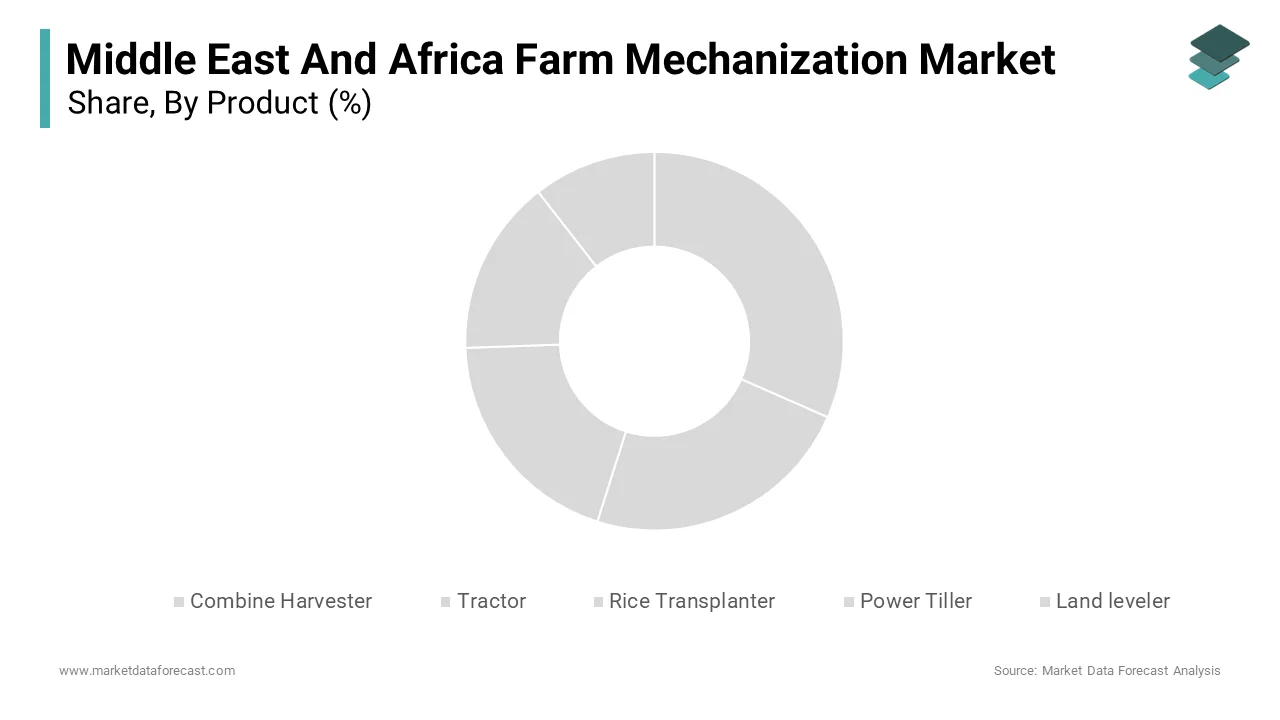
The tractor segment dominated the market by accounting for 37.4% of total revenue in 2025. The expanding use of tractors in both large-scale commercial farms and smallholder operations, particularly in Egypt, Ethiopia, and Saudi Arabia, is one key factor behind this dominance of the tractor segment. The adoption of mid-sized and high-horsepower tractors equipped with GPS-guided systems has further reinforced demand, especially in irrigated farming zones.
Tractors serve as the cornerstone of mechanized agriculture across the region due to their versatility in performing multiple tasks such as plowing, planting, spraying, and hauling.
Moreover, government-backed financing programs have made tractor purchases more accessible to small and medium-sized farmers. For instance, Saudi Arabia’s Ministry of Environment, Water and Agriculture offers subsidies covering up to 40% of machinery costs, significantly lowering entry barriers. These factors ensure that the tractor segment remains the largest and most influential within the Middle East and Africa farm mechanization landscape.
Power Tiller Market
The power tiller segment is projected to grow at the fastest rate by expanding at a CAGR of 7.6% between 2025 and 2033. Increasing demand from smallholder farms, which constitute the majority of agricultural holdings across the region, is fuelling the rapid expansion of the power tiller segment.
Power tillers offer an affordable and efficient alternative to traditional plowing methods, especially in countries like Kenya, Sudan, and Yemen, where small farms account for over 85% of total agricultural units, as reported by the International Fund for Agricultural Development (IFAD) in 2023. These compact machines provide greater maneuverability in smaller plots and require less maintenance compared to larger tractors, making them highly suitable for fragmented land structures.
Moreover, rising investments in sustainable farming practices and government support through localized distribution networks are accelerating adoption. In Egypt, for example, the Ministry of Agriculture introduced financial incentives for farmers purchasing eco-friendly power tillers, leading to a notable increase in sales.
COUNTRY ANALYSIS
Saudi Arabia
Saudi Arabia led the Middle East Farm Mechanization Market by contributing 22.4% of total regional revenue in 2025. As part of its Vision 2030 initiative, the country has prioritized food security and sustainable agriculture, investing heavily in mechanized irrigation systems, precision farming tools, and automated harvesting equipment. Also, a major driver behind Saudi Arabia’s strong market position is the expansion of government-led modernization programs, including subsidies for importing high-efficiency farm machinery.
Besides, the country’s reliance on mechanized desert farming technologies has led to increased deployment of autonomous tractors and drone-based monitoring systems, particularly in wheat and date palm production zones.
United Arab Emirates
The United Arab Emirates is seeing rapid expansion in the Middle East Farm Mechanization Market. As one of the world's leaders in smart agriculture, the UAE is leveraging mechanization to address extreme climate conditions and limited arable land. In addition, a primary driver of mechanization in the UAE is the strong government backing for agri-tech innovation, particularly through initiatives like the National Program for Sustainable Agriculture and the Dubai Future Accelerators program.
Moreover, the integration of AI-driven farm management systems and solar-powered irrigation mechanisms has enhanced efficiency and resource optimization.
South Africa
South Africa is witnessing a strong growth in the Middle East and Africa Farm Mechanization Market. As the continent’s most industrialized economy, South Africa plays a crucial role in regional food production, managing over 12 million hectares of cultivated land, according to the Department of Agriculture, Land Reform and Rural Development. A key driver behind South Africa’s growing mechanization trend is the expansion of large-scale agribusinesses that rely on high-efficiency machinery to optimize production.
Apart from these, labor shortages in rural areas have intensified the shift toward mechanization, particularly in maize, wheat, and citrus-producing provinces where seasonal worker availability has declined. Furthermore, the government has introduced policies encouraging sustainable farming practices ing subsidies for eco-friendly machinery under the Comprehensive Agricultural Support Programme (CASP). With increasing focus on productivity and climate resilience, South Africa continues to strengthen its role in the regional farm mechanization landscape.
Egypt
Egypt holds a significant portion of the Middle East and Africa Farm Mechanization Market. Known for its extensive use of the Nile River for irrigation, Egypt manages over 8 million feddans of arable land according to the Central Agency for Public Mobilization and Statistics (CAPMAS). This vast agricultural output requires efficient mechanization strategies to maintain productivity and water-use efficiency. A primary driver of mechanization in Egypt is the growing adoption of specialized equipment in rice, cotton, and wheat production, hwheremanual labor is becoming harder to source.
Moreover, the Egyptian government supports modernization through funding programs like the National Mechanization Project, which encourages farmers to adopt fuel-efficient and low-emission machinery. With its focus on water conservation and yield optimization, Egypt is emerging as a strategic market for advanced agricultural machinery in the Middle East and Africa.
Kenya
Kenya, despite traditionally relying on subsistence farming, is witnessing a gradual shift toward mechanized agriculture, particularly among smallholder farmers engaged in maize, tea, and horticultural exports. A major driver of this transition is the increasing need for labor-saving technologies due to urban migration and rising wages in rural areas.
Further, agritech startups are playing a critical role in expanding access to mechanization through mobile-based platforms that connect farmers with tractor-sharing services. Companies like Hello Tractor and Apollo Agriculture have gained traction by offering pay-per-use models that lower entry barriers for small-scale producers.
Rest of MEA
The Rest of the Middle East and Africa, which includes countries such as Ethiopia, Sudan, Israel, Oman, Qatar, and others, holds a considerable share of the regional farm mechanization market. While traditionally lagging behind larger economies like Saudi Arabia and South Africa, this segment is experiencing steady growth due to increasing awareness of mechanized farming benefits and supportive government policies.
As per FAO, over 80% of farms in these countries are classified as small-scale, creating demand for cost-effective, easy-to-operate machinery.
Moreover, regional trade agreements and foreign direct investment are facilitating easier access to imported agricultural equipment. Countries like Oman and Qatar are benefiting from cross-border partnerships that reduce import tariffs and expand distribution networks. With ongoing rural development efforts and increasing digital connectivity, the Rest of MEA presents a promising outlook for future mechanization expansion.
KEY MARKET PLAYERS
John Deere, CNH Global, AGCO, Alamo Group, Kubota, International Harvester, TAFE, CLAAS, Mitsubishi. Are the market players that are dominating the Middle East and Africa Farm Mechanization Market?
Top Players In The Market
John Deere
John Deere is a dominant force in the Middle East and Africa Farm Mechanization Market, known for its high-performance tractors, harvesters, and precision agriculture technologies. The company has tailored its product offerings to suit diverse agricultural conditions across the region, from large-scale commercial farms in Saudi Arabia to smallholder operations in Kenya. John Deere’s commitment to sustainability, digital integration, and after-sales service has strengthened its regional presence. Globally, it continues to lead through innovation in autonomous machinery and data-driven farm management solutions.
CNH Industrial
CNH Industrial plays a key role in the Middle East and Africa with its well-established brands such as Case IH and New Holland Agriculture. The company offers a broad range of mechanized farming solutions adapted to local needs, including drought-resistant planting equipment and fuel-efficient tractors. CNH Industrial emphasizes technological advancement and customer support, ensuring reliability in challenging environments. Its global supply chain and localized distribution network enhance accessibility, making it a strategic player in expanding farm mechanization across emerging markets.
AGCO Corporation
AGCO Corporation contributes significantly to the Middle East and Africa Farm Mechanization Market through its focus on sustainable and scalable agricultural solutions. Operating under brands like Fendt and Massey Ferguson, AGCO delivers high-efficiency machinery integrated with smart farming technologies. The company invests in localized manufacturing and agritech partnerships to improve affordability and accessibility for small and mid-sized farmers. AGCO’s emphasis on climate-smart agriculture positions it as a forward-looking leader in the evolving global mechanization landscape.
Top Strategies Used by Key Market Participants
Localization of Production and Distribution Networks
To better serve the diverse agricultural landscape of the Middle East and Africa, leading players are establishing regional manufacturing hubs and expanding their dealer networks. This strategy enables faster delivery, cost-effective maintenance, and more responsive customer support tailored to local needs.
Investment in Digital Farming Solutions
Major companies are integrating digital technologies such as GPS guidance, telematics, and data analytics into their equipment. These innovations enhance productivity and resource efficiency, positioning firms at the forefront of smart and sustainable agriculture.
Strategic Partnerships with Local Institutions and Governments
Key players are forming alliances with research institutions, agritech startups, and national agricultural agencies to develop customized mechanization solutions. Collaborative efforts also include training programs and financing initiatives that facilitate wider adoption among small and mid-sized farmers.
COMPETITION OVERVIEW
The competition in the Middle East and Africa Farm Mechanization Market is shaped by a mix of global manufacturers, regional distributors, and emerging agritech innovators. Established multinational corporations dominate the high-end segment with advanced machinery and digital solutions, while local brands and smaller manufacturers focus on affordability and adaptability to regional farming conditions. The market is highly fragmented due to the diversity of farm sizes, crop types, and economic conditions across countries.
Product differentiation is a key battleground, with companies investing in technology-driven features such as autonomous operation, fuel efficiency, and precision agriculture capabilities. Customer engagement strategies, including after-sales service, digital support, and farmer education programs, play a crucial role in building brand loyalty and trust.
Besides, regulatory influences and government policies significantly impact market dynamics, particularly in terms of subsidies, import tariffs, and environmental compliance. As demand for efficient and sustainable farming grows, competition is intensifying not only in terms of product innovation but also in financial accessibility and rural outreach, shaping the future trajectory of the Middle East and Africa farm mechanization sector.
RECENT HAPPENINGS IN THE MARKET
- In January 2024, John Deere launched an updated version of its Operations Center platform tailored for African farmers, offering real-time field monitoring, predictive maintenance alerts, and remote diagnostics to improve equipment uptime and operational efficiency.
- In March 2024, CNH Industrial announced a joint venture with an Egyptian agritech startup to develop AI-powered irrigation and planting solutions specifically designed for arid climates and medium-sized farms across North Africa.
- In June 2024, AGCO Corporation expanded its distribution network in Kenya by opening two new regional service centers aimed at enhancing after-sales support and reducing equipment downtime for farmers in key agricultural zones.
- In August 2024, Ubotacorpn introduced a new line of compact, fuel-efficient tractors in Sudan, targeting smallholder farmers and aligning with regional sustainability goals by incorporating low-emission engine technology.
- In October 2024, Dere & Company partnered with a Saudi Arabian renewable energy firm to power its regional logistics hub using clean energy, reinforcing its sustainability commitments while strengthening its market presence in one of the Middle East’s fastest-growing agricultural economies.
MARKET SEGMENTATION
This research report on the Middle East And Africa farm mechanization market is segmented and sub-segmented into the following categories.
By Product Type
- Combine Harvester
- Tractor
- Rice Transplanter
- Power Tiller
- Land leveler
By Country
- KSA
- UAE
- IsraelThe
- rest of the GCC countries
- South Africa
- Ethiopia
- Kenya
- Egypt
- Sudan
- rest of MEA