- Product Description Description
- Table of Contents TOC
- List of Table & Figure LOT
- Get Free Sample PDF Sample PDF
Market Size, 2025
$3.56 BnMarket Estimate, 2026
$3.76 BnMarket Forecast, 2034
$5.84 BnCAGR, 2026–2034
5.65%Middle East and Africa Fresh Cherries Market Report Summary
The Middle East and Africa fresh cherries market was valued at USD 3.56 billion in 2025, is estimated to reach USD 3.76 billion in 2026, and is projected to reach USD 5.84 billion by 2034, growing at a CAGR of 5.65% during the forecast period from 2026 to 2034. The growth of the Middle East and Africa fresh cherries market is driven by rising consumer demand for premium fresh fruits, increasing health awareness, and growing disposable incomes across the region. Expanding modern retail infrastructure, improvements in cold chain logistics, and increasing imports of high-quality cherries are further supporting market growth. Additionally, the growing popularity of healthy snacking and fresh fruit consumption is accelerating demand for fresh cherries in both retail and foodservice sectors.
Key Market Trends
-
Rising consumer preference for fresh, premium, and nutrient-rich fruits is driving demand for fresh cherries across the Middle East and Africa.
-
Increasing health awareness and growing consumption of antioxidant-rich fruits are supporting market expansion.
-
Expansion of modern retail chains and improvements in cold storage and logistics are enhancing product availability and quality.
-
Growing urbanization and higher disposable incomes are increasing demand for imported premium fruits.
-
Rising use of fresh cherries in desserts, bakery products, beverages, and gourmet cuisine is creating new market opportunities.
Segmental Insights
-
Based on taste, the sweet cherries segment dominated the Middle East and Africa fresh cherries market in 2025. The segment's leadership is attributed to changing consumer preferences, superior taste, high nutritional value, and increasing demand for premium fresh fruits.
-
Based on sales channel, the modern trade segment held the largest share of 45.3% of the Middle East and Africa fresh cherries market in 2025. The segment's dominance is driven by the expansion of supermarkets, hypermarkets, and organized retail chains offering high-quality imported fresh produce.
-
Based on application, the direct consumption segment accounted for the largest share of the Middle East and Africa fresh cherries market in 2025. The segment's growth is supported by increasing consumer preference for healthy snacks, fresh fruit consumption, and premium-quality produce.
Regional Insights
-
The Middle East and Africa fresh cherries market is witnessing steady growth due to increasing demand for premium fruits, expanding retail infrastructure, and rising health-conscious consumer behavior.
-
South Africa dominated the Middle East and Africa fresh cherries market by accounting for 38.3% of the regional market share in 2025. The country's leadership is supported by rising urbanization, increasing disposable incomes, expanding modern retail networks, and strong demand for premium fruits in major cities such as Johannesburg and Cape Town.
-
The United Arab Emirates remains a significant market due to high imports of premium fruits, growing retail expansion, and increasing demand for healthy food products.
Competitive Landscape
The Middle East and Africa fresh cherries market is moderately competitive, with producers, exporters, and distributors focusing on product quality, cold chain efficiency, and expansion of distribution networks to strengthen their market positions. Companies are investing in improved post-harvest handling, sustainable sourcing, and strategic partnerships to meet the growing demand for premium fresh cherries across retail and foodservice sectors. Key players operating in the Middle East and Africa fresh cherries market include Dell's Maraschino Cherries, ALIANA TRADING, Rainier Fruit Co., Hood River Cherry Co., The Global Green Co. Ltd., Alacam Tarim, Smelterz Orchard Co., and Reid Fruits.
 Download Free Sample Report
Middle East and Africa Fresh Cherries Market Size
The Middle East and Africa fresh cherries market size was valued at USD 3.56 billion in 2025, and is expected to reach USD 5.84 billion by 2034 from USD 3.76 billion in 2026. The market's promising CAGR for the predicted period is 5.65%.
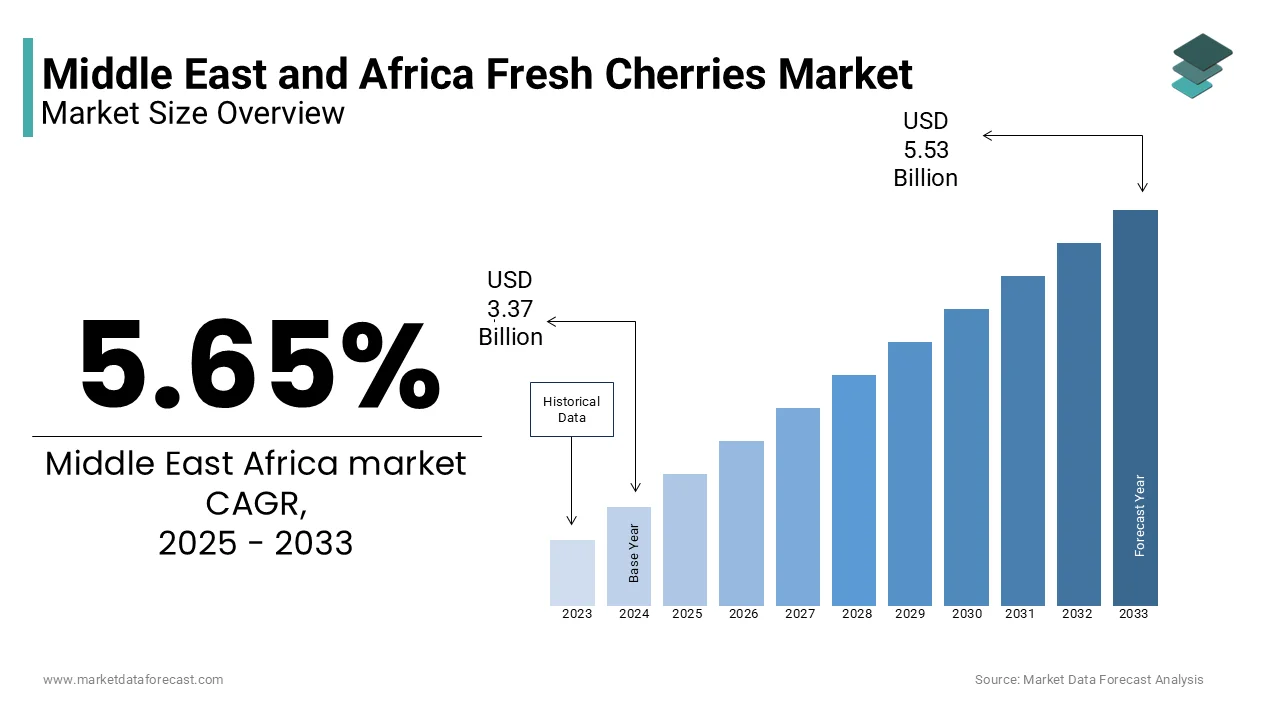
Fresh cherries refer to naturally harvested cherries that are consumed without undergoing extensive processing, typically within a short time after being picked. While traditionally not associated with the Middle East and Africa (MEA), the fresh cherries market in this region has been gaining momentum due to shifting consumer preferences and increasing disposable incomes. The MEA region is characterized by diverse climatic conditions, with countries like South Africa and Morocco having suitable agro-climatic zones for cherry cultivation. According to FAO data, South Africa accounted for nearly 85% of regional cherry production in 2023, though volumes remain modest compared to global leaders. Meanwhile, Gulf Cooperation Council (GCC) countries have emerged as key importers, driven by urbanization and demand for premium fruits. As per Eurostat, GCC nations imported over 4,500 metric tons of fresh cherries in 2022, with Saudi Arabia and the UAE leading consumption.
MARKET DRIVERS
Rising Urbanization and Changing Consumer Lifestyles
The rapid pace of urbanization and evolving consumer lifestyles is driving the growth of the Middle East and Africa fresh cherries market. There is a noticeable shift toward healthier diets and premium food choices as cities expand and more people move into urban centers. According to World Bank estimates, urban population growth in the Middle East reached 67% in 2023, while in North Africa it stood at approximately 59%. Moreover, modern retail formats such as hypermarkets and specialty stores have expanded significantly, offering easy access to fresh cherries during their short seasonal window. Cherries are also gaining traction due to their perceived health benefits, including high antioxidant content and anti-inflammatory properties.
Increasing Import Volumes and Trade Liberalization
The surge in import volumes and trade liberalization policies has significantly contributed to the expansion of the fresh cherries market in the Middle East and Africa. Countries like Saudi Arabia, Egypt, and the UAE have eased customs regulations and reduced tariffs on agricultural imports, facilitating easier access to international cherry suppliers. As per UN Comtrade data, cherry imports into the Middle East rose by 18% between 2021 and 2023, with Chile and Turkey remaining the dominant exporters. Additionally, bilateral agreements between MEA countries and major cherry-producing nations have streamlined import procedures and ensured quality compliance standards. For instance, China's phytosanitary protocols with Egypt and Saudi Arabia have set precedents for similar agreements with other fruit-exporting countries.
MARKET RESTRAINTS
Limited Domestic Production Due to Climatic Constraints
The region’s limited domestic production due to unfavorable climatic conditions is restraining the growth of the Middle East and Africa fresh cherries market. Cherry trees require a temperate climate with distinct cold winters and mild summers to break dormancy and produce fruit effectively. However, much of the MEA region experiences arid or semi-arid weather patterns, which is making large-scale cherry cultivation challenging without significant investment in controlled-environment agriculture.
According to Food and Agriculture Organization (FAO) statistics, total cherry production across the entire African continent was less than 10,000 metric tons in 2023, with South Africa accounting for the majority. Even within South Africa, cherry farming remains restricted to small regions such as the Western Cape, where microclimates allow limited commercial production. Furthermore, the high cost of setting up greenhouses or using chilling technologies to simulate cherry-friendly conditions makes local production economically unviable for many farmers. Despite rising demand, the lack of scalable domestic production remains a persistent barrier to market autonomy and consistent supply stability.
High Cost and Perishability Affecting Affordability
The high cost of fresh cherries combined with their highly perishable nature is also hindering the growth of the Middle East and Africa fresh cherries market. Cherries are considered a luxury item due to their elevated price point, which is largely attributed to the complexities involved in harvesting, handling, and transporting them over long distances. This pricing dynamic limits consumption to affluent consumers and niche markets, preventing widespread adoption across income groups. This perishability necessitates advanced cold chain infrastructure, which is often lacking in many parts of Africa.
MARKET OPPORTUNITIES
Expansion of E-commerce and Direct-to-Consumer Distribution Channels
The rapid growth of e-commerce platforms and direct-to-consumer (D2C) distribution channels is creating new opportunities in the Middle East and Africa fresh cherries market. Online grocery shopping has gained substantial traction in urban centers is prompting the growth of the market. This shift allows for efficient distribution of perishable items like fresh cherries through temperature-controlled logistics and same-day delivery services.
According to Hootsuite, internet penetration in the Middle East reached 73% in 2023, while in North Africa it stood at approximately 60%. These digital advancements have enabled the proliferation of online grocery platforms such as InstaShop in the UAE and Takealot in South Africa, which now offer premium fruits like cherries with guaranteed freshness. Moreover, D2C models allow cherry suppliers to bypass intermediaries, ensuring better profit margins and fresher products for end consumers. Some companies have even started leveraging social media influencers and targeted advertising to promote cherries as a luxury health product during festive seasons. This digital transformation in retail is unlocking new market avenues and driving higher consumer engagement with fresh cherries across the MEA region.
Growing Demand During Religious and Cultural Festivities
The heightened demand during religious and cultural festivities is additionally to pose growth opportunities for the Middle East and Africa fresh cherries market. Events such as Ramadan, Eid al-Fitr, and Christmas witness a surge in premium fruit consumption, as these occasions are marked by gift-giving traditions and elaborate meals. Fresh cherries, often marketed as a luxurious and healthy fruit option, have found a place in festive baskets and gourmet platters among affluent consumers. According to Euromonitor International, seasonal gifting of premium fruits in the Middle East saw a 17% increase in value terms during Ramadan 2023, with cherries included in high-end assortments offered by supermarkets and online vendors. In Ethiopia and Kenya, cherries are becoming popular additions to holiday tables, particularly in urban households. This trend is further supported by aggressive promotional campaigns by importers who capitalize on seasonal demand spikes.
MARKET CHALLENGES
Seasonal Availability and Supply Chain Disruptions
The issue of seasonal availability and associated supply chain disruptions is huge challenging factor for the Middle East and Africa fresh cherries market. Cherries are a highly seasonal crop, with global harvest periods concentrated between May and August. This limited availability window creates logistical pressures for importers and retailers who must manage inventory carefully to avoid shortages or oversupply. As per Rabobank analysis, cherry exports from major producing countries like Chile and Turkey follow a tight schedule, with nearly 90% of shipments occurring within a 12-week period each year. This compressed timeline increases dependency on air freight and cold chain logistics to ensure cherries reach MEA markets in optimal condition. For instance, in early 2023, severe storms in South America affected cherry exports, causing delayed shipments to the UAE and Saudi Arabia. According to the Dubai Chamber of Commerce, some retailers faced stockouts during peak demand periods, impacting customer satisfaction.
Regulatory and Phytosanitary Barriers for Imports
Stringent regulatory and phytosanitary requirements pose a significant challenge for cherry exporters aiming to enter the Middle East and Africa markets. Many MEA countries enforce rigorous inspection protocols to prevent the entry of pests and diseases, which can result in shipment rejections or prolonged clearance times. These barriers are particularly impactful for cherries, which are sensitive to quarantine measures due to their perishable nature. For example, Saudi Arabia requires all cherry imports to undergo mandatory inspections at designated ports, and non-compliance can lead to costly re-exportation or destruction of consignments. According to the Saudi Agricultural and Livestock Investment Company (SALIC), nearly 8% of cherry shipments were rejected in 2022 due to phytosanitary violations. In addition, evolving regulatory frameworks such as Egypt’s recent updates to pesticide residue thresholds add complexity for exporters trying to maintain compliance. These hurdles increase operational costs and reduce profit margins for importers, discouraging smaller players from entering the market.
REPORT COVERAGE
| REPORT METRIC | DETAILS |
| Market Size Available | 2025 to 2034 |
| Base Year | 2025 |
| Forecast Period | 2026 to 2034 |
| CAGR | 5.65% |
| Segments Covered | By Taste, Sales Channel, Application, and Region |
| Various Analyses Covered | Global, Regional, & Country Level Analysis; Segment-Level Analysis; DROC; PESTLE Analysis; Porter’s Five Forces Analysis; Competitive Landscape; Analyst Overview of Investment Opportunities |
| Regions Covered | KSA, UAE, Israel, South Africa, And Ethiopia, Kenya, Egypt, Sudan, Rest of GCC Countries, and Rest of MEA |
| Market Leaders Profiled | Dell's Marachino Cherries, ALIANA TRADING, Rainier Fruit Co., Hood River Cherry Co., The Global Green Co. Ltd., Alacam Tarim, Smelterz Orchard Co., Reid Fruits, and other |
SEGMENTAL ANALYSIS
By Taste Insight
The sweet cherries segment dominated the Middle East and Africa fresh cherries market share in 2025 with the changing consumer tastes and a growing inclination toward fruits that offer both indulgence and perceived health benefits. Sweet cherries are widely consumed raw or as part of desserts and fruit platters, making them more appealing than sour varieties, which are typically reserved for processed foods. Another major factor is the influence of Western dietary habits on MEA consumers, especially in GCC countries. According to Euromonitor International, gourmet fruit assortments featuring sweet cherries have become popular during festive gifting seasons like Ramadan and Eid, further cementing their position as a luxury item.

The sour cherries segment is lucratively to grow with an estimated CAGR of 5.3% in the next coming years. While traditionally less dominant due to limited direct consumption, sour cherries are gaining traction due to increasing awareness of their unique nutritional profile and expanding applications in beverages and health-focused products. Additionally, foodservice operators in the UAE and Egypt are incorporating sour cherries into innovative menu items such as cocktails, smoothies, and gourmet desserts. According to Food Business News, sour cherry-based beverages saw a 20% rise in restaurant offerings across Dubai in 2023.
By Sales Channel Insight
The modern trade segment was accounted in holding 45.3% of the Middle East and Africa fresh cherries market share in 2025 with the modern trade’s supremacy is the aggressive merchandising strategies employed by large supermarket chains such as Carrefour, Spinneys, and Pick n Pay. These retailers frequently feature premium fruits like cherries in seasonal promotions and luxury gift baskets, especially during Ramadan, Christmas, and other festive periods. Moreover, modern trade channels invest heavily in cold chain infrastructure and shelf placement optimization to ensure freshness, a critical factor for perishable commodities like cherries. According to the Dubai Chamber of Commerce, 68% of surveyed consumers in the UAE preferred purchasing cherries from supermarkets due to confidence in hygiene and traceability.
The online channels segment is likely to witness a CAGR of 22.4% in the next coming years. The increasing penetration of smartphones and mobile internet, which has expanded access to e-commerce platforms is driving the growth of the segment. According to GSMA Intelligence, smartphone adoption in the Middle East reached 78% in 2023, significantly boosting online grocery shopping trends. Platforms such as InstaShop, Zomato Blinkit, and Takealot now offer same-day delivery of fresh cherries, ensuring product freshness while catering to time-constrained consumers. Additionally, social media-driven marketing campaigns have played a crucial role in creating awareness and demand for cherries as a luxury health product. Influencers in the UAE and Egypt have actively promoted cherry-based detox drinks and skincare regimens via Instagram and TikTok, influencing younger demographics.
By Application Insight
The direct consumption segment was the largest and held a significant share of the Middle East and Africa fresh cherries market share in 2025. Consumers prefer eating cherries raw due to their naturally sweet flavor, juiciness, and ease of preparation, which is making them a convenient snack option across various age groups. The integration of cherries into gourmet dining and luxury food culture. High-end restaurants and hotels in Dubai and Tel Aviv often serve fresh cherries as part of dessert platters or cheese boards, enhancing their prestige. According to Food Business News, fine dining establishments in the UAE incorporated cherries into over 40% of their summer dessert menus in 2023.
The ice creams segment is anticipated to register a CAGR of 11.3% during the forecast period due to the rising demand for exotic and differentiated flavors in the premium ice cream market. As per NielsenIQ, specialty ice cream brands in the UAE and South Africa have introduced limited-edition cherry-based variants, capitalizing on the fruit’s seasonal exclusivity and vibrant color. In 2023, Magna Gelato in Dubai launched a “Tart Cherry Swirl” line, which sold out within two weeks of release, demonstrating strong consumer interest.Additionally, the expansion of high-end ice cream parlors and café chains in urban centers has created new avenues for cherry-infused frozen treats. According to Euromonitor International, premium ice cream sales in Egypt rose by 18% in 2023, with cherry-flavored options gaining popularity among younger people.
REGIONAL ANALYSIS
South Africa
South Africa was the top performer in the fresh cherries market with 38.3% of share in 2025.Urbanization and rising disposable incomes have fueled demand for premium fruits, with Johannesburg and Cape Town emerging as major consumption hubs.
The expansion of organized retail and the proliferation of imported fresh fruits in supermarkets and specialty stores is fuelling the growth of the Middle East and Africa fresh cherries market. Additionally, the country's growing health-conscious population has shown a preference for nutrient-rich fruits like cherries, which are marketed for their antioxidant and anti-inflammatory properties. Furthermore, the hospitality sector has played a role in boosting demand, with upscale restaurants and hotels incorporating fresh cherries into gourmet dishes and desserts. As per Hospitality Insights Africa, over 30% of five-star hotels in Pretoria included cherries in their seasonal menus in 2023.
Egypt
Egypt fresh cherries market is lucratively to grow with highest CAGR during the forecast period due to the rising middle class in Cairo, Alexandria, and Giza, who are increasingly purchasing premium fruits for home consumption and gifting purposes. As per the Egyptian Central Agency for Public Mobilization and Statistics (CAPMAS), per capita expenditure on imported fruits rose by 19% in 2023, with cherries gaining traction as a luxury item during religious festivals like Ramadan and Eid. The expansion of modern trade and e-commerce platforms that facilitate the distribution of perishable goods is additionally to gear up the growth of the market in this country. According to the Information and Decision Support Center (IDSC), online fruit sales in Egypt grew by 27% in 2023, with fresh cherries becoming a sought-after item among affluent consumers. Coupled with favorable import policies and improved cold storage infrastructure, these developments are propelling Egypt’s growing prominence in the MEA fresh cherries market.
Saudi Arabia
Saudi Arabia fresh cherries market growth is steadily growing with high per capita income, coupled with its robust import infrastructure, positions it as a key market for premium fruits like cherries, particularly during religious festivities and special occasions. Additionally, the government’s Vision 2030 initiative, which includes promoting healthier lifestyles and supporting retail modernization, has indirectly boosted cherry consumption. As per Al-Ula Consulting Group, health-conscious consumers in Riyadh and Jeddah are increasingly opting for cherries due to their perceived nutritional benefits.
United Arab Emirates
United Arab Emirates fresh cherries market is driven with the high disposable incomes, and advanced logistics infrastructure make it a prime destination for premium fruit imports, including fresh cherries. As per NielsenIQ, premium fruit sales in the UAE increased by 14% year-on-year in 2023, with cherries being among the top-performing categories. Retailers such as Waitrose and Carrefour frequently introduce limited-time cherry bundles, especially during the summer season and festive months, to cater to high-end shoppers. Another major growth catalyst is the expansion of the foodservice sector, particularly in Dubai and Abu Dhabi, where luxury hotels and fine dining establishments incorporate cherries into gourmet desserts and cocktails.
Israel
Israel fresh cherries market is having steady growth with the rising health consciousness among consumers, particularly in cities like Tel Aviv and Haifa. According to the Central Bureau of Statistics (CBS), per capita consumption of imported fruits increased by 12% in 2023, with cherries gaining popularity due to their antioxidant content and anti-inflammatory properties. Supermarkets such as Shufersal and Rami Levy have introduced organic cherry lines, targeting health-focused shoppers willing to pay a premium. Another major factor is the expansion of the country’s culinary scene, where chefs and restaurateurs are increasingly using fresh cherries in fusion dishes, salads, and desserts. As per the Israeli Gastronomy Institute, over 25% of fine dining restaurants in Tel Aviv incorporated cherries into their summer menus in 2023. Additionally, the efficient logistics infrastructure and strong customs facilitation enable timely cherry imports by ensuring product freshness.
COMPETITIVE LANDSCAPE
The competition in the Middle East and Africa fresh cherries market is characterized by a mix of global exporters, regional importers, and local distributors vying for a share of a growing but niche market. Since domestic production remains limited due to climatic constraints, the market is largely shaped by international suppliers who cater to rising demand driven by urbanization, health consciousness, and premium lifestyle trends. Leading global cherry exporters have established strong footholds by leveraging efficient logistics, brand positioning, and strategic partnerships with regional importers and retailers.
In addition to traditional players, new entrants from emerging economies are increasingly participating in the market by offering cost-effective alternatives without compromising on quality. The expansion of e-commerce platforms and modern trade channels has further intensified competition, pushing suppliers to innovate in packaging, branding, and customer engagement. Retailers and foodservice operators also play a crucial role in influencing consumer preferences through merchandising strategies and seasonal promotions.
KEY MARKET PLAYERS
Key players in the Middle East and Africa Fresh Cherries Market include
- Dell's Marachino Cherries
- ALIANA TRADING
- Rainier Fruit Co.
- Hood River Cherry Co.
- The Global Green Co. Ltd.
- Alacam Tarim
- Smelterz Orchard Co.
- Reid Fruits
TOP PLAYERS IN THE MARKET
Several international and regional players play a crucial role in shaping the dynamics of the Middle East and Africa fresh cherries market. Among them, Chelan Fresh, Pietro Carnaghi S.A., and FruitSmart Inc. stand out for their strategic contributions to both regional and global markets.
- Chelan Fresh is a leading global marketer and distributor of tree fruit, including cherries. The company plays a pivotal role in supplying premium cherries from the U.S. and Chile to high-end markets in the Middle East. Its focus on quality control, cold chain logistics, and brand positioning has made it a preferred supplier in luxury retail and hospitality sectors across the region.
- Pietro Carnaghi S.A. is a major South American exporter of fresh cherries, particularly from Chile. With extensive orchards and strong export networks, the company ensures timely delivery of high-quality cherries to MEA markets during peak seasons. Its expertise in air freight coordination and compliance with phytosanitary standards makes it a key player in the region’s cherry imports.
- FruitSmart Inc. specializes in sourcing and distributing fresh and processed fruits globally. In the MEA region, it serves as a critical link between cherry producers and importers by ensuring product traceability, sustainable sourcing, and supply chain efficiency. Its diversified portfolio and long-term partnerships with growers allow it to maintain a steady presence in niche markets across the Middle East and North Africa.
TOP STRATEGIES USED BY KEY MARKET PLAYERS
Key players in the Middle East and Africa fresh cherries market employ several strategies to strengthen their positions and ensure sustained growth. One of the most common approaches is expanding direct export partnerships with producing countries like Chile, Turkey, and the United States. Companies can guarantee supply consistency and freshness, which are crucial for maintaining consumer trust by securing early-season agreements and exclusive contracts.
Branding and marketing initiatives play a vital role in differentiating offerings in a competitive landscape. Companies engage in promotional campaigns, collaborate with luxury retailers, and participate in food expos to position cherries as a premium health product. These efforts help drive consumer awareness and reinforce brand loyalty in key MEA markets.
RECENT HAPPENINGS IN THE MARKET
- In June 2023, Chelan Fresh expanded its distribution network by partnering with leading UAE-based retailers such as Spinneys and Waitrose to enhance cherry availability during peak seasons. This collaboration ensured faster delivery and greater visibility in high-end supermarkets.
- In July 2023, Pietro Carnaghi S.A. launched a dedicated air freight charter program to expedite cherry shipments into Saudi Arabia and Egypt by reducing transit time and improving product freshness upon arrival.
- In October 2023, FruitSmart Inc. signed a long-term agreement with a major Qatari wholesale distributor to supply fresh cherries directly to luxury hotels and gourmet stores across Doha.
- In February 2025, a prominent Dubai-based online grocery platform introduced an exclusive cherry subscription service in collaboration with multiple international suppliers, which is targeting affluent customers seeking premium produce on a recurring basis.
- In May 2025, a consortium of European cherry exporters initiated a joint marketing campaign in Cairo and Cape Town to promote cherries as a superfood by focusing on health benefits and culinary versatility to expand consumer base beyond elite segments.
MARKET SEGMENTATION
This research report on the Middle East and Africa fresh cherries market is segmented and sub-segmented into the following categories.
By Taste
- Sweet
- Sour
By Sales Channel
- Convenience Stores
- Online Channels
- Modern Trade
- Traditional Grocery Stores
By Application
- Salads
- Alcoholic Beverages
- Ice Creams
- Jellies
- Direct Consumption
- Dairy Beverages
By Country
- KSA
- UAE
- Israel
- rest of GCC countries
- South Africa
- Ethiopia
- Kenya
- Egypt
- Sudan
- rest of MEA