- Product Description Description
- Table of Contents TOC
- List of Table & Figure LOT
- Get Free Sample PDF Sample PDF
Market Size, 2025
$0.16 BnMarket Estimate, 2026
$0.21 BnMarket Forecast, 2034
$1.72 BnCAGR, 2026–2034
30.18%Executive Summary: Middle East and Africa Grow Light Market
- Market Scope: Comprehensive market analysis of the Middle East and Africa grow light industry covering technologies (LED, LEP, HID, fluorescent), installations (new installation, retrofit installation), applications (indoor farming, vertical farming), and country-level landscapes across KSA, UAE, Israel, the rest of GCC countries, South Africa, Ethiopia, Kenya, Egypt, Sudan, and the rest of MEA.
- Market Valuation: Valued at USD 0.16 billion in 2025, estimated at USD 0.21 billion in 2026, and projected to reach USD 1.72 billion by 2034, registering an explosive CAGR of 30.18% (2026–2034).
- Primary Growth Drivers: Widespread adoption of controlled environment agriculture (CEA) in arid and semi-arid regions to combat water scarcity and food security challenges; and government-led financial incentives and sustainability policies (such as Saudi Vision 2030 and UAE National Food Security Strategy 2051).
Key Market Segment Metrics (2026–2034)
| Category | Leading Segment / Position | Growth Dynamics |
|---|---|---|
| By Technology | LED Lights (dominated with a 52.5% share in 2025 due to superior energy efficiency, custom spectrums, and low heat emission) | Light Emitting Plasma (LEP) grow lights are registering the fastest CAGR of 17.8% driven by full-spectrum sunlight simulation for high-value crops. |
| By Installation | New Installation (captured 54.1% in 2025, propelled by government-backed agritech infrastructure and new greenhouse projects) | Retrofit installations are expanding at a CAGR of 16.2%, supported by cost-effective upgrades of older facilities and regulatory efficiency mandates. |
| By Application | Indoor Farming (largest segment with 32.2% in 2025, addressing harsh climates, water scarcity, and urban food demand) | Vertical farming is the fastest-growing application at a CAGR of 19.5%, driven by severe land scarcity in metropolitan centers. |
| By Country | United Arab Emirates (led the MEA market with 27.4% in 2025, anchored by strategic food security initiatives and smart farm tech) | Saudi Arabia, Israel, South Africa, and Egypt maintain strong positions through localized agritech ecosystems and sustainability funding. |
Major Market Players & Market Structure
Market Structure: Highly dynamic competitive landscape featuring global tech conglomerates and regional agritech innovators competing on custom spectrum efficiency, local distribution networks, and strategic public-private partnerships.
Key Companies: Royal Philips Electronics (Signify N.V.), OSRAM Licht AG, PAR source Lighting Solutions, Bridgelux, General Electric Company, Alta LED Corporation, Solarmax, Heliospectra, LumiFlow, and AeroFarms.
Middle East and Africa Grow Light Market Size
The Middle East and Africa light market size was valued at USD 0.16 billion in 2025 and is anticipated to reach a valuation of USD 0.21 billion in 2026 and USD 1.72 billion by 2034, growing at a CAGR of 30.18%, from 2026 to 2034.
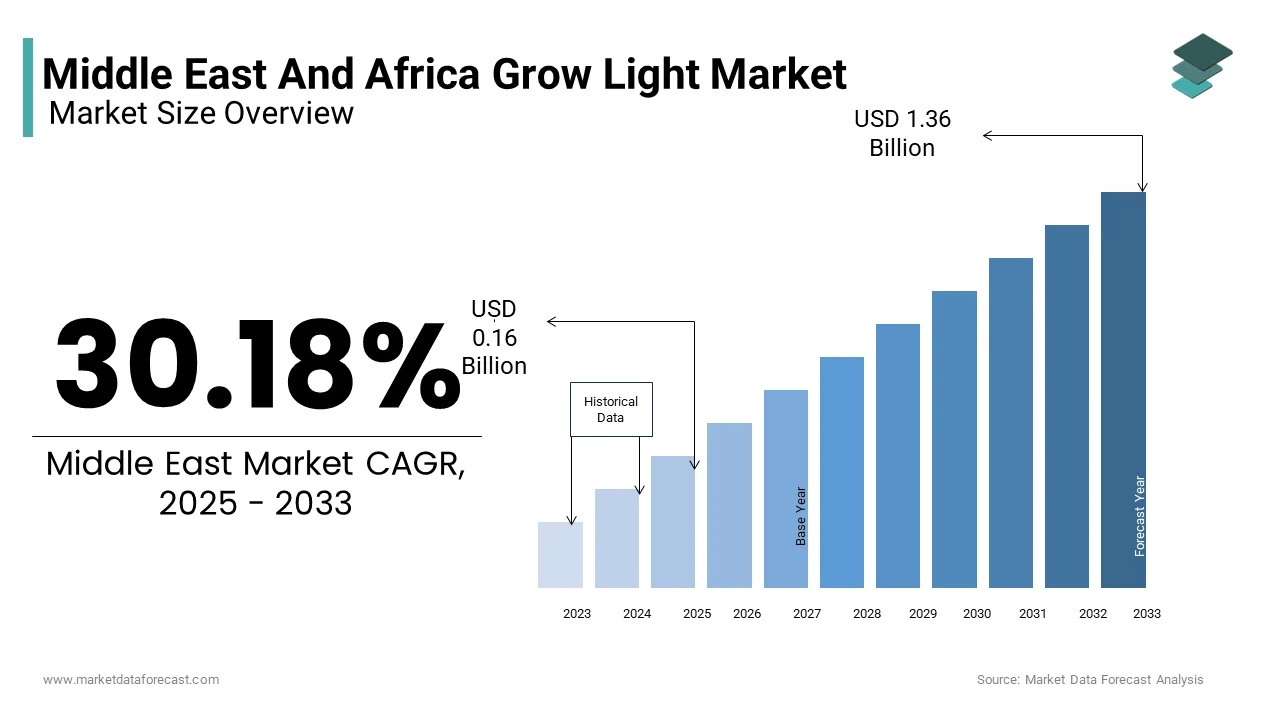
Grow light is a specialized lighting system designed to stimulate plant growth by emitting an electromagnetic spectrum appropriate for photosynthesis. These lighting solutions, which include LED, high-intensity discharge (HID), and fluorescent lights, are increasingly being adopted in controlled environment agriculture (CEA) such as vertical farms, greenhouses, and indoor cultivation facilities. With rapid urbanization, declining arable land, and growing food security concerns across the region, interest in alternative agricultural practices is rising. As per the Food and Agriculture Organization (FAO), over 28% of the population in parts of Sub-Saharan Africa faces undernourishment, prompting governments and private players to invest in sustainable farming technologies.
In the Middle East, where water scarcity and extreme climatic conditions limit traditional farming, countries like the United Arab Emirates and Saudi Arabia have emerged as early adopters of advanced horticultural technologies. The UAE’s Ministry of Climate Change and Environment has been actively promoting hydroponics and indoor farming, leading to a surge in demand for energy-efficient grow lights. Additionally, only 6% of cultivated land in Africa uses irrigation, highlighting a significant gap that indoor and greenhouse farming could bridge using artificial lighting systems.
MARKET DRIVERS
Increasing Adoption of Controlled Environment Agriculture (CEA) in Arid Regions
The widespread adoption of controlled environment agriculture (CEA) in arid and semi-arid regions is one of the most influential drivers of the Middle East and Africa grow light market. Countries such as Saudi Arabia, Egypt, and the United Arab Emirates face severe limitations in traditional farming due to extreme temperatures, limited freshwater resources, and poor soil quality. In response, governments and private entities have turned to CEA techniques, including vertical farming and greenhouse cultivation, which rely heavily on artificial grow lights. According to the International Center for Biosaline Agriculture (ICBA), approximately 80% of the UAE's fresh vegetables are now produced through protected agriculture methods, with grow lights playing a pivotal role in extending growing seasons and improving crop yields.
Moreover, the integration of smart farming technologies and automation in CEA setups has further fueled the demand for efficient grow lighting systems. As per a report from the Gulf Research Center, investments in agri-tech startups in the GCC region reached $340 million in 2023, with a significant portion allocated to indoor farming infrastructure. The use of LED-based grow lights, known for their energy efficiency and spectral customization, has gained particular traction. For instance, the Dubai Future Foundation launched the "Smart Farmer" initiative, supporting local farmers in transitioning to technology-driven agriculture, thereby boosting the regional demand for grow lights. This shift toward resource-efficient farming models is expected to continue driving market growth across the MEA region.
Government Initiatives and Policy Support for Sustainable Agriculture
Government-led initiatives aimed at enhancing food security and promoting sustainable agricultural practices serve as another critical driver for the Middle East and Africa's growing light market. Many countries in the region have introduced policies and financial incentives to encourage the adoption of modern farming technologies. In Saudi Arabia, Vision 2030 includes strategic goals for increasing domestic food production while reducing reliance on imports. As part of this vision, the Saudi Ministry of Environment, Water and Agriculture has allocated over SAR 1.2 billion ($320 million) to support greenhouse farming and vertical agriculture projects that utilize grow lights. Similarly, the Egyptian government has partnered with international organizations such as the United Nations Development Programme (UNDP) to pilot climate-resilient farming systems in desert areas, incorporating LED grow lighting solutions.
In addition, the African Union's Comprehensive Africa Agriculture Development Programme (CAADP) has emphasized the importance of innovative farming methods to combat food insecurity. Several African nations, including Kenya and South Africa, have introduced subsidies for agri-tech equipment, making grow lights more accessible to smallholder farmers. According to the World Bank, over 60% of sub-Saharan Africa’s population depends on agriculture for livelihood, yet productivity remains low due to environmental constraints.
MARKET RESTRAINTS
High Initial Investment Costs for Advanced Lighting Systems
High initial investment required for advanced lighting systems is one major restraint for the market. While LED grow lights offer long-term benefits such as energy efficiency and improved yield, their upfront costs remain prohibitive for many small-scale farmers and emerging agri-tech ventures. According to a study conducted by the International Finance Corporation (IFC), the average cost of setting up a commercial vertical farm in the Middle East ranges between $1.5 million and $3 million per acre, with lighting accounting for nearly 30% of total capital expenditure. This financial burden limits the adoption of grow lights, especially among independent farmers who lack access to credit or government funding.
Furthermore, in Sub-Saharan Africa, where over 60% of the population resides in rural areas and relies on subsistence farming, affordability remains a key challenge. Although some governments provide subsidies or soft loans for agri-tech upgrades, these programs often lack sufficient reach and implementation efficiency.
Limited Technical Expertise and Infrastructure Constraints
The lack of technical expertise and inadequate infrastructure necessary for deploying and maintaining advanced lighting systems is another significant restraint affecting the Middle East and Africa's growing light market. Grow lights, particularly LED-based ones, require specific knowledge regarding light intensity, spectrum tuning, and integration with climate control systems. However, as per a report published by the International Labour Organization (ILO), only 37% of the agricultural workforce in Sub-Saharan Africa has received formal training in modern farming techniques. This skills gap results in inefficient usage and maintenance of grow lighting systems, discouraging potential investors and farmers from adopting the technology.
Additionally, unreliable power supply in several parts of the region poses operational challenges. As per the World Bank, nearly 600 million people in Africa still lack access to electricity, limiting the feasibility of energy-intensive grow light installations. Even in urban centers, frequent power outages disrupt continuous operation of indoor farms.
MARKET OPPORTUNITY
Expansion of Urban Farming and Indoor Agriculture Initiatives
The expanding urban farming and indoor agriculture initiatives across the region are a major opportunity fueling the Middle East and Africa grow light market. Rapid urbanization, coupled with increasing consumer demand for fresh, locally grown produce, has led to a surge in vertical farming and rooftop greenhouse projects. According to the United Nations Department of Economic and Social Affairs (UN DESA), the urban population in Africa is projected to increase by 950 million by 2050, necessitating localized food production solutions. In response, cities such as Cape Town, Nairobi, and Riyadh are witnessing a rise in commercial and community-level indoor farming ventures that rely on artificial lighting systems to optimize plant growth.
Integration of Renewable Energy Sources with Grow Light Technology
The integration of renewable energy sources with grow light technology presents a compelling opportunity for the Middle East and Africa grow light market. Given the region’s abundant sunlight and increasing investments in solar power infrastructure, there is significant potential to develop off-grid or hybrid farming systems powered by clean energy.
In Morocco, for example, the Noor Ouarzazate Solar Complex, one of the world’s largest solar farms, has enabled agritech firms to experiment with solar-powered grow lighting systems in remote agricultural zones. Similarly, in Kenya, the Lake Turkana Wind Power project has contributed to grid stability, indirectly supporting the deployment of energy-intensive agricultural technologies. Moreover, companies like Sunne Life Science in Egypt are pioneering solar-powered LED grow light systems tailored for smallholder farmers.
MARKET CHALLENGES
Regulatory Fragmentation and Lack of Standardization
The regulatory fragmentation and absence of standardized guidelines governing the import, certification, and application of grow lighting technologies a significant challenges facing the Middle East and Africa grow light market. Unlike mature markets such as North America and Europe, where clear regulations exist for horticultural lighting systems, the MEA region lacks a unified framework.
Additionally, customs and trade barriers vary widely across the region, increasing compliance costs. The World Bank’s Logistics Performance Index ranks several African countries below average in terms of trade efficiency, citing complex import procedures and inconsistent enforcement of technical regulations. In the Middle East, while the Gulf Standardization Organization (GSO) has attempted to harmonize regulations among GCC countries, discrepancies persist in product labeling, safety requirements, and performance testing protocols. These regulatory hurdles discourage foreign investment and slow down the adoption of advanced grow light technologies, ultimately hindering market growth across the MEA region.
Cultural Resistance and Low Awareness Among Traditional Farmers
Cultural resistance and low awareness among traditional farmers regarding the benefits of artificial lighting in agriculture are another pressing challenge confronting the Middle East and Africa grow light market. Despite increasing government and private sector efforts to promote modern farming technologies, a large segment of the agricultural community remains skeptical about shifting away from conventional practices. According to a survey conducted by the International Fund for Agricultural Development (IFAD), over 70% of smallholder farmers in West Africa rely on traditional knowledge passed down through generations, showing reluctance toward adopting unfamiliar technologies such as grow lights.
This resistance is compounded by insufficient extension services and educational outreach programs. In many rural communities, farmers lack access to training on how to integrate grow lights into existing farming systems. Furthermore, misconceptions about the complexity and cost of grow light systems deter potential users from exploring their practical applications.
REPORT COVERAGE
| REPORT METRIC | DETAILS |
| Market Size Available | 2025 to 2034 |
| Base Year | 2025 |
| Forecast Period | 2026 to 2034 |
| CAGR | 30.18% |
| Segments Covered | By Installation, Technology, Application, and Region. |
| Various Analyses Covered | Global, Regional, Country-Level Analysis, Segment-Level Analysis, DROC, PESTLE Analysis, Porter’s Five Forces Analysis, Competitive Landscape, Analyst Overview of Investment Opportunities |
| Regions Covered | KSA, UAE, Israel, the rest of GCC countries, South Africa, Ethiopia, Kenya, Egypt, Sudan, the rest of MEA |
| Market Leaders Profiled | Royal Philips Electronics, OSRAM Licht AG, PAR source Lighting Solutions, Bridgelux, General Electric Company, Alta LED Corporation, Solarmax, Heliospectra, LumiFlow |
SEGMENT ANALYSIS
By Technology Used Insights
LED Lights
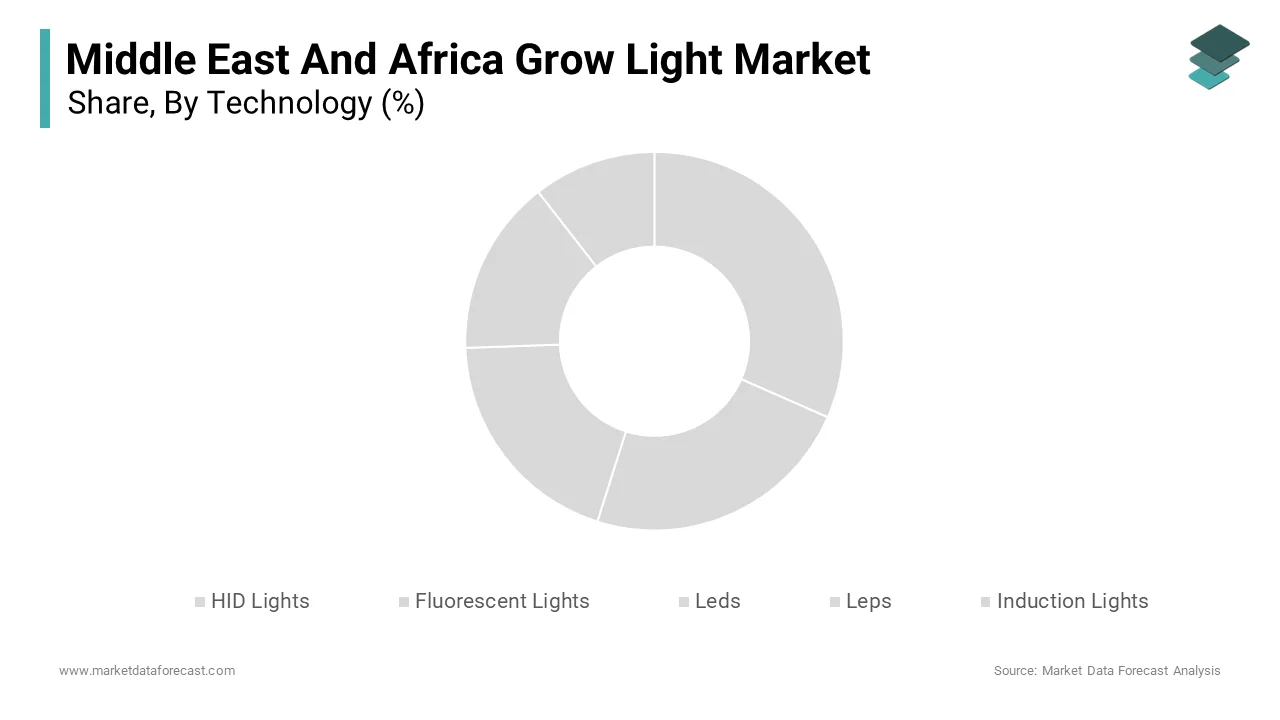
The Light Emitting Diodes (LEDs) segment dominated the MEA grow light market by accounting for 52.5% of the total share in 2025. Their superior energy efficiency, longer lifespan, and customizable light spectrums tailored for plant growth are driving the dominance of the LED segment. Unlike traditional lighting technologies such as HID or fluorescent lights, LEDs consume notably less energy, significantly reducing operational costs—a critical factor in regions like the Middle East where electricity is expensive and water resources are limited. According to the International Energy Agency (IEA), energy consumption in the agricultural sector in the Gulf Cooperation Council (GCC) countries has risen by over 30% since 2018, pushing farmers and agribusinesses to adopt more sustainable solutions. LEDs align with this need, offering not only energy savings but also reduced heat emission, which minimizes cooling requirements in greenhouses—an essential feature in the hot climate of MEA. Moreover, government support has played a pivotal role in accelerating LED adoption. Similarly, in Saudi Arabia, Vision 2030 includes agricultural modernization goals that emphasize the integration of LED-based vertical farming systems, particularly in arid zones where soil degradation limits traditional farming. In addition to policy incentives, technological advancements have made LED grow lights more accessible. Companies like Signify Holding and OSRAM Licht AG have introduced modular LED systems specifically designed for desert climates, allowing growers to optimize photosynthesis without excessive water usage. These systems can be integrated with smart controls and IoT-enabled sensors, enabling real-time monitoring and adjustment of light intensity and spectrum—features that further enhance productivity and reduce resource waste.
LEPs
The Light Emitting Plasma (LEP) grow lights segment, though currently holding a modest market share, is projected to register the highest CAGR of 17.8% during the forecast period. Its superior spectral output is one of the primary drivers of LEP adoption. Unlike conventional lamps, LEPs emit a full-spectrum white light closely resembling natural sunlight, making them ideal for cultivating high-value crops like medicinal plants and cannabis. This exponential growth trajectory positions LEPs as the fastest-growing segment within the MEA grow light market. Despite their higher upfront costs compared to LEDs or fluorescents, LEPs are gaining traction due to their unique advantages in horticultural applications. Additionally, LEPs offer longer lifespans (up to 20,000 hours) and minimal lumen depreciation, which translates into lower maintenance costs over time. In remote areas of Ethiopia and Kenya, where access to replacement parts and technical expertise is limited, the durability and reliability of LEP systems make them increasingly attractive. The growing interest in urban and vertical farming is another key driver. As cities like Dubai and Cape Town explore innovative ways to boost food production, LEPs provide an efficient alternative to traditional lighting sources in multi-tiered farms. Their compact size and omnidirectional light output allow even coverage across stacked plant layers, enhancing yield consistency.
By Installation Insights
New Installation
The new installation segment dominated the MEA grow light market by capturing 54.1% in 2025. The surge in new installations is largely driven by government-led investments in agri-tech infrastructure, especially in the Gulf states. Countries like the United Arab Emirates and Saudi Arabia have launched ambitious initiatives to transform their agricultural sectors. For example, the UAE’s National Food Security Strategy 2051 aims to make the country one of the most food-secure nations globally by investing heavily in indoor farming and greenhouse projects equipped with state-of-the-art grow lights. In parallel, private equity and venture capital firms are increasingly funding agritech startups in the region. As per a 2023 report by Wamda Capital, agritech investment in the Middle East grew by 45% year-on-year, with many startups focusing on setting up new vertical farms using cutting-edge grow light systems. Furthermore, the expansion of urban farming initiatives in cities like Johannesburg and Nairobi is fueling demand for new installations. To meet the rising demand for fresh vegetables, governments and private players are investing in purpose-built indoor farms, all requiring brand-new grow light setups.
Retrofit Installation
The retrofit installation segment is emerging as the fastest-growing segment in the MEA grow light market, with a projected CAGR of 16.2% through 2033. Cost-effectiveness is one of the key reasons behind this growth. This segment is gaining momentum due to the increasing number of existing greenhouses and indoor farms seeking to upgrade their outdated lighting systems without dismantling entire infrastructures. Retrofitting allows farmers to replace old High-Intensity Discharge (HID) or fluorescent systems with energy-efficient LEDs or other modern alternatives at a fraction of the cost of building new facilities. Like, retrofitting can reduce energy costs by up to 40%, which is particularly impactful in countries like Egypt and Morocco, where agriculture accounts for a large portion of national energy consumption. Additionally, regulatory pressure and sustainability mandates are pushing older farms to modernize. In South Africa, for instance, the Department of Agriculture, Land Reform and Rural Development introduced a greenhouse efficiency standard in 2022, requiring all commercial farms to upgrade to energy-efficient lighting systems by 2027. This regulation has spurred a wave of retrofits across the Western Cape and Gauteng provinces, where large-scale greenhouse operations are concentrated. The availability of financing options. Several banks and development agencies are offering low-interest loans and grants to encourage retrofitting in the agricultural sector is Another contributing factor. In 2023, the Islamic Development Bank partnered with Moroccan cooperatives to fund retrofitting projects across 100 farms, providing USD 15 million in subsidized loans. Such financial support makes it easier for small and medium-sized growers to transition to more sustainable practices without significant upfront investment.
By Applications Insights
Indoor Farming
The indoor farming segment represented the largest application in the MEA grow light market by accounting for 32.2% in 2025. The harsh environmental conditions in much of the MEA region, particularly in the Gulf and North Africa, make traditional open-field farming challenging. Extreme temperatures, water scarcity, and poor soil quality have led governments and private entities to invest heavily in indoor farming solutions. According to the World Bank, only 5% of land in Saudi Arabia is arable, prompting the government to allocate USD 130 million under the National Center for Agricultural Technology to promote indoor farming technologies. Urbanization is another major catalyst. Cities like Cairo, Lagos, and Riyadh are experiencing rapid population growth, increasing the demand for fresh, locally grown produce. Indoor farms, often located near urban centers, help reduce transportation costs and ensure consistent supply chains. In Dubai, for example, as per the Dubai Municipality in 2023, over 200 indoor farms were operating across the city, producing leafy greens, herbs, and microgreens using advanced grow light systems. Moreover, indoor farming supports year-round crop production , independent of seasonal fluctuations. This is particularly important in countries like Sudan and Ethiopia, where droughts and floods frequently disrupt traditional agriculture. As per a 2023 study by the CGIAR Research Program on Climate Change, Agriculture and Food Security, indoor farms in Addis Ababa could achieve 3–5 harvest cycles per year, compared to just one or two in conventional farming.
Vertical Farming
The vertical farming segment is the fastest-growing application in the MEA grow light market, with a projected CAGR of 19.5% from 2025 to 2033. Land scarcity in major metropolitan centers is one of the main drivers of this growth. Although still relatively small in terms of current market size, vertical farming is gaining momentum due to its space-saving design and ability to maximize yield in densely populated urban areas. In cities like Nairobi, Johannesburg, and Doha, available land for agriculture is minimal, prompting entrepreneurs and governments to explore vertical farming as a viable alternative. The UAE, for instance, has been at the forefront of this trend, with companies like Badia Farms and Pure Harvest Smart Farms establishing large-scale vertical farms in industrial zones. Government policies are also playing a crucial role. In 2022, the Saudi Ministry of Environment, Water and Agriculture launched the “Vertical Farming Pilot Program,” allocating USD 50 million to test the feasibility of stacking hydroponic systems in urban settings. Early results showed that vertical farms could use 90% less water than traditional farming methods while yielding 10 times more per square meter. Additionally, the integration of AI and automation in vertical farming is attracting investor interest. Startups like Infarm and AeroFarms have begun partnering with regional investors to deploy modular vertical farms in supermarkets and logistics hubs. These units rely heavily on grow lights, with each layer requiring precise light spectra to optimize plant development.
COUNTRY ANALYSIS
United Arab Emirates (UAE)
The UAE led the MEA grow light market with 27.4% in 2025. Positioned as a regional leader in agritech innovation, the UAE has aggressively pursued strategies to bolster domestic food production amid extreme climatic conditions and limited arable land. The UAE’s leadership in the grow light market is primarily driven by its National Food Security Strategy 2051, which prioritizes the adoption of smart agriculture technologies. Dubai alone hosts more than 200 smart farms , many of which utilize LED grow lights to cultivate high-value crops such as lettuce, tomatoes, and strawberries. In addition to policy support, the UAE benefits from a highly developed infrastructure and favorable investment climate , attracting global agritech firms like Netafim , Signify , and AeroFarms to establish regional headquarters and pilot farms. The Abu Dhabi Investment Office (ADIO) offers financial incentives, including grants covering up to 50% of setup costs , encouraging startups and international players to scale their operations in the country. Moreover, the UAE’s desalination-based water supply system ensures stable irrigation for indoor farms, complementing the use of grow lights.
Saudi Arabia
Saudi Arabia is also a key player in the MEA grow light market. The country’s strategic pivot toward food security and agricultural diversification under Vision 2030 has catalyzed the adoption of advanced grow light technologies. Central to this transformation is the National Center for Agricultural Technology (NCAT) , established in 2021 to drive innovation in farming practices. NCAT has funded several pilot projects involving vertical farming and hydroponics , all relying on LED-based grow lighting. For instance, the NEOM Smart City project plans to integrate fully automated indoor farms powered by renewable energy and grow lights, aiming to serve over 500,000 residents sustainably. Water scarcity remains a critical challenge, yet the country’s advanced irrigation infrastructure and desalination capabilities enable large-scale indoor farming.
Israel
Israel is known for its world-class agricultural technology ecosystem, Israel leverages decades of expertise in precision farming, irrigation, and controlled environment agriculture to lead in grow light adoption. The country’s advanced research institutions and startup culture foster continuous innovation in grow light technologies. Universities such as the Hebrew University of Jerusalem and Technion-Israel Institute of Technology collaborate with agritech firms to develop next-generation lighting systems optimized for high-yield indoor farming. Israeli companies like Nextlight Agritech and Growlight Technologies Ltd. export customized LED grow lights to markets across the Middle East and Africa. Israel’s medical cannabis industry also drives grow light demand. Moreover, the export-oriented nature of Israeli agriculture encourages the use of high-efficiency grow lighting to ensure year-round production of premium-quality fruits and vegetables.
South Africa
South Africa serves as a regional hub for agritech innovation in sub-Saharan Africa, benefiting from a relatively mature economy and growing urban farming movement. One of the primary growth drivers is the rising prevalence of food insecurity and unemployment , particularly in urban townships. Organizations like AgriSETA and GreenCape are supporting the development of urban farms using grow lights to create jobs and improve access to fresh produce. Additionally, the South African government’s Renewable Energy Independent Power Producer Procurement Programme (REIPPPP) indirectly supports grow light adoption by promoting clean energy integration in agriculture. Solar-powered grow light systems are becoming increasingly common in rural and peri-urban areas, reducing reliance on grid electricity. The country’s expanding horticulture sector , coupled with increasing investments in greenhouse and vertical farming, further strengthens its position in the MEA grow light market.
Egypt
Egypt captures a notable share of the MEA grow light market. The Nile Delta , once the breadbasket of Egypt, is experiencing severe salinization and urban encroachment, reducing fertile farmland. In response, the government has launched the National Project for Sustainable Agriculture , which promotes the use of smart greenhouses and LED grow lights to increase productivity on limited land. The Ministry of Agriculture estimates that adopting controlled environment agriculture could double vegetable yields while conserving water. Egypt is also leveraging international partnerships to boost its grow light sector. Additionally, private sector investment in agritech startups is rising, with companies like FarmShots and VeggieGrow introducing affordable LED grow kits tailored for smallholder farmers.
KEY MARKET PLAYERS
Royal Philips Electronics, OSRAM Licht AG, PAR source Lighting Solutions, Bridgelux, General Electric Company, Alta LED Corporation, Solarmax,Heliospectra,LumiFlow. Are the market players that are dominating the Middle East and Africa grow light market.
Top Players In The Market
One of the leading companies in the Middle East and Africa grow light market is Signify N.V. (formerly Philips Lighting) . Known for its innovation in LED technology, Signify has been instrumental in developing energy-efficient and spectrum-optimized grow lights tailored for controlled environment agriculture. The company’s solutions are widely adopted in vertical farms and greenhouses across the UAE and Saudi Arabia, where demand for sustainable agricultural practices is rising. Signify’s commitment to sustainability and smart lighting integration has made it a trusted name in the global horticultural lighting industry.
OSRAM Licht AG is another key player with a strong presence in the MEA region. The company offers a comprehensive range of grow lights, including LED and specialized spectrum lighting, designed to enhance plant growth in indoor farming systems. OSRAM has collaborated with agritech firms and greenhouse operators in the Gulf to deploy customized lighting solutions that maximize yield while minimizing energy consumption. Their expertise in lighting innovation and strategic partnerships have positioned them as a major contributor to the global expansion of horticultural lighting.
AeroFarms , a U.S.-based vertical farming company, plays a significant role in shaping the grow light market in the MEA region. While primarily known for its farming operations, AeroFarms utilizes proprietary LED grow light systems that are being studied and adopted by regional partners. Their technology enables high-yield, resource-efficient farming, aligning with MEA’s growing focus on food security and climate-resilient agriculture. AeroFarms’ influence extends beyond its own operations, inspiring startups and investors to adopt similar models across the region.
Top Strategies Used By Key Market Participants
Key players in the Middle East and Africa grow light market employ several strategic approaches to solidify their presence and expand their reach. One major strategy is technology innovation and customization , where companies focus on developing advanced LED and spectrum-specific lighting systems tailored for regional agricultural needs. These innovations enhance plant growth efficiency and cater to the unique climatic and infrastructural conditions of the MEA region.
Another key approach is strategic partnerships and collaborations with local governments, agritech startups, and research institutions. By working closely with regional stakeholders, market leaders gain insights into local demands, secure government-backed projects, and accelerate the adoption of grow light technologies in emerging markets.
Lastly, market expansion through localized distribution and service networks plays a crucial role. Companies are establishing regional offices, warehouses, and technical support centers to ensure faster delivery, after-sales service, and customer engagement, thereby strengthening their foothold in the MEA market.
COMPETITION OVERVIEW
The Middle East and Africa grow light market is characterized by a mix of global leaders and emerging regional players striving to capture a growing demand driven by food security concerns and technological advancements in agriculture. As governments across the region push for sustainable farming solutions, the competition among grow light providers intensifies, particularly in countries like the UAE, Saudi Arabia, and Israel, where investment in agritech is substantial. Established players leverage their technological expertise and brand reputation to maintain dominance, while local startups and regional distributors offer cost-effective alternatives, targeting small and medium-sized farms. The market also sees increasing collaboration between lighting companies and agricultural technology firms to develop integrated solutions that optimize plant growth and resource efficiency. With rising awareness of controlled environment agriculture and supportive policy frameworks, the competitive landscape is evolving rapidly, with companies focusing on innovation, strategic partnerships, and localized market penetration to gain an edge. As the region continues to invest in smart farming infrastructure, the competition is expected to grow further, fostering a dynamic and innovation-driven market environment.
RECENT HAPPEENINGS IN THE MARKET
- In February 2024, Signify N.V. launched a new line of horticultural LED grow lights specifically designed for desert farming conditions in the Middle East. This product rollout was accompanied by a partnership with a leading UAE-based agritech firm to integrate the lights into commercial vertical farms.
- In June 2023, OSRAM Licht AG established a regional distribution and technical support center in Riyadh, Saudi Arabia, aimed at improving accessibility and after-sales service for agricultural clients across the Gulf and North Africa.
- In November 2023, AeroFarms announced a strategic collaboration with a Dubai-based investment group to deploy its proprietary indoor farming and grow light technology in the region, focusing on urban agriculture and food security initiatives.
- In September 2024, Netafim , a global leader in precision irrigation, expanded its offerings to include integrated grow light solutions for greenhouse operators in Egypt and Kenya, enhancing its position in the agritech value chain.
- In March 2024, Ujala Cygnature , an Indian lighting company with a growing presence in Africa, entered into a joint venture with a Moroccan agricultural cooperative to supply affordable LED grow lights for greenhouse farming in North Africa.
MARKET SEGMENTATION
This research report on the Middle East And Africa grow light market is segmented and sub-segmented into the following categories.
By Technology
- HID Lights
- Fluorescent Lights
- Leds
- Leps
- Induction Lights
By Type of Installation
- New Installation
- Retrofit Installation
By Applications
- Indoor Farming
- Vertical Farming
- Commercial Greenhouses
- Rooftop Farming
- Others
By Country
- KSA
- UAE
- Israel
- Rest of the GCC countries
- South Africa
- Ethiopia
- Kenya
- Egypt
- Sudan
- Rest of MEA