- Product Description Description
- Table of Contents TOC
- List of Table & Figure LOT
- Get Free Sample PDF Sample PDF
Market Size, 2025
$7.68 BnMarket Estimate, 2026
$9.08 BnMarket Forecast, 2034
$34.53 BnCAGR, 2026–2034
18.17%Executive Summary: Middle East & Africa IoT Healthcare Market
- Market Scope: Comprehensive Middle East and Africa (MEA) IoT healthcare market analysis covering components, application sectors, end-user settings, country-level insights, and regional digital health transformation trends.
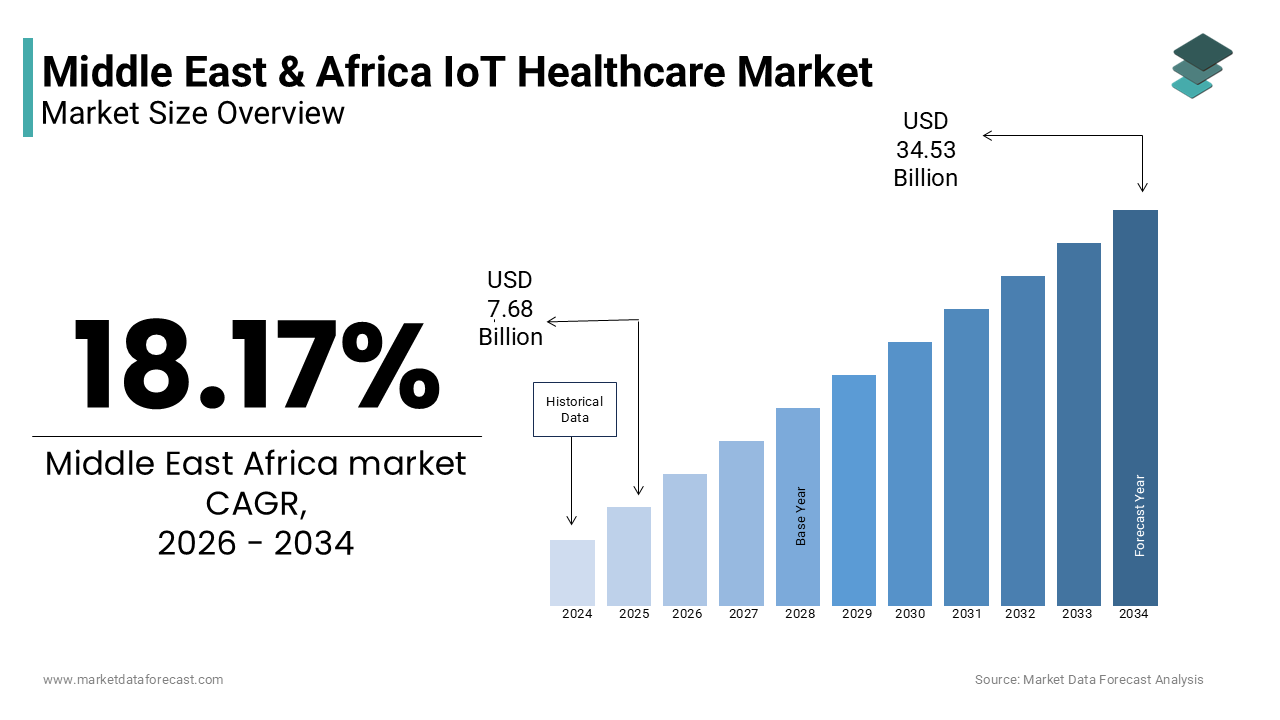
- Market Valuation: Valued at USD 7.68 billion (2025), estimated at USD 9.08 billion (2026), and projected to reach USD 34.53 billion by 2034, registering a strong CAGR of 18.17% (2026–2034).
- Primary Growth Drivers: Rising prevalence of chronic and non-communicable diseases (accounting for over 60% of regional deaths), high demand for remote patient monitoring systems, and massive government investments in digital health infrastructure (such as Saudi Arabia's Vision 2030 and UAE smart healthcare initiatives).
Key Market Segment Metrics (2026–2034)
| Category | Leading Segment (2025 Position) | Fastest-Growing Segment |
|---|---|---|
| By Component | Medical Devices & Connected Sensors (holding foundational share through wearable monitors and diagnostic tools) | Systems & Software / Cloud Analytics (driven by AI integration and real-time health data processing) |
| By Application | Workflow Management & Connected Imaging (optimizing clinical operations across modern healthcare facilities) | Telemedicine & Remote Patient Monitoring (expanding rapidly to bridge healthcare access gaps in remote/underserved areas) |
| By End-User | Hospitals (the largest contributor to the MEA IoT healthcare industry, boosted by smart hospital projects) | Surgical Centers, Clinics & Personal Wearables (surging due to rising personal fitness tracking and outpatient care) |
| By Country | Saudi Arabia (holding a major market share driven by Vision 2030 and substantial digital transformation funding) | UAE & South Africa (frontrunners in adopting advanced 5G networks, smart clinics, and digital health insurance programs) |
Major Market Players & Market Structure
Market Structure: Highly strategic and evolving market featuring leading global healthcare suppliers, medical technology corporations, and localized innovators collaborating on smart hospital deployments, telemedicine platforms, and cybersecurity frameworks.
Key Companies: 3M, Cardinal Health, Medline Industries, Ansell Ltd., AMD Medicom, Alpha Pro Tech, and Medisca Inc.
 Download Free Sample Report
Middle East & Africa IoT Healthcare Market Size
The IoT healthcare market size in the Middle East and Africa was valued at USD 7.68 billion in 2025 and is estimated to grow at a CAGR of 18.17% from 2026 to 2034 and be worth USD 34.53 billion by 2034 from USD 9.08 billion in 2026.
IoT Healthcare, also called the Internet of Medical Things (IoMT), is a network of connected medical devices and software that collect and share health data over the internet. This market includes remote patient monitoring smart hospital infrastructure wearable health trackers and telemedicine platforms designed to address healthcare accessibility gaps. According to the World Health Organization, the African region bears 24% of the global disease burden yet possesses only 3% of the world’s health workers, highlighting the critical need for technological augmentation. As per the International Telecommunication Union (ITU), mobile-cellular subscriptions in Africa have reached a penetration rate of 92 subscriptions per 100 inhabitants, creating a foundational network for deploying IoT-based health solutions. These facts highlight the urgent need for digital health programs to bring doctors and patients closer together. Governments in Gulf Cooperation Council countries are aggressively investing in smart city initiatives that include integrated healthcare systems. The adoption of electronic health records and real time vital sign monitoring is gaining traction in major urban centers. Private sector participation is increasing as startups develop innovative applications for chronic disease management. Regulatory bodies are beginning to establish frameworks for data privacy and device certification. This evolving landscape positions IoT as a pivotal tool for achieving universal health coverage goals in resource constrained settings.
MARKET DRIVERS
Rising Prevalence of Chronic Diseases
The increasing prevalence of chronic diseases in the Middle East and Africa is a major driver for the regional IoT in the healthcare market. Conditions such as diabetes, hypertension, and cardiovascular diseases have become significant public health concerns. According to the World Health Organization, non-communicable diseases account for 60% of all deaths in the region, with diabetes affecting approximately 12% of the adult population in the Middle East. IoT-enabled solutions like continuous glucose monitors and wearable blood pressure monitors are gaining traction to facilitate early detection and effective disease management. These technologies empower patients and healthcare providers with real-time data, reducing complications and enhancing treatment outcomes.
Government Investment in Digital Health Infrastructure
Government initiatives aimed at modernizing healthcare systems are a critical driver of IoT adoption in the Middle East and Africa. For instance, Saudi Arabia’s Vision 2030 plan emphasizes digital healthcare transformation, including the integration of IoT technologies to enhance patient care. Similarly, the United Arab Emirates has launched initiatives to develop smart hospitals equipped with IoT-enabled devices. According to the International Trade Administration, healthcare expenditure in the Middle East was projected to grow at an annual rate of 12% by 2025, driven by investments in digital health. These strategic investments create a fertile ground for IoT solutions to revolutionize healthcare delivery in the region.
MARKET RESTRAINTS
Limited Digital Infrastructure in Developing Regions
Inadequate digital infrastructure is a significant restraint on the IoT in healthcare market across the Middle East and Africa. Many rural and underserved areas lack reliable internet connectivity, which is essential for the seamless operation of IoT-enabled devices and platforms. The International Telecommunication Union reports that only 33% of Africa’s population had access to the Internet in 2022, creating substantial barriers to adopting advanced digital healthcare solutions. This limitation prevents effective implementation of telemedicine, remote monitoring, and data sharing, particularly in low-income regions. Addressing these infrastructural gaps is critical for expanding IoT adoption in the region’s healthcare systems.
High Implementation Costs and Budget Constraints
The high costs associated with IoT implementation pose a challenge for healthcare facilities in the Middle East and Africa. IoT integration requires significant investment in devices, data storage systems, and cybersecurity infrastructure. According to the African Development Bank, healthcare spending in sub-Saharan Africa remains low, averaging only 5% of GDP, compared to 10% in high-income countries. Budget constraints limit hospitals’ ability to procure and maintain IoT-enabled technologies. Additionally, many public healthcare systems prioritize basic healthcare needs over advanced technologies, delaying the widespread adoption of IoT solutions. These financial hurdles significantly restrict the growth potential of the IoT in healthcare market in resource-limited settings.
MARKET OPPORTUNITIES
Expansion of Telemedicine Services
The growing adoption of telemedicine in the Middle East and Africa presents a significant opportunity for the IoT in healthcare market. Telemedicine platforms, enhanced by IoT devices such as wearable monitors and connected diagnostic tools, enable remote patient consultations and continuous health monitoring. According to the World Bank, telemedicine usage in sub-Saharan Africa increased by over 40% during the COVID-19 pandemic, highlighting its growing acceptance. In the Middle East, governments are investing in telehealth infrastructure to address healthcare access disparities in rural areas. For example, the UAE’s Ministry of Health has launched smart clinics equipped with IoT technology to provide virtual care. This trend drives demand for IoT solutions, revolutionizing healthcare delivery across the region.
Integration of Artificial Intelligence with IoT
The integration of artificial intelligence (AI) with IoT technologies creates immense growth potential for healthcare innovation in the region. AI-powered IoT systems can analyze vast amounts of patient data collected from connected devices, enabling early disease detection and personalized treatment plans. According to the International Data Corporation, healthcare spending on AI in the Middle East and Africa is projected to grow at a compound annual growth rate (CAGR) of over 40% through 2025. Countries like Saudi Arabia and South Africa are adopting AI-enabled IoT solutions in smart hospitals to improve diagnostic accuracy and operational efficiency. This convergence of AI and IoT offers unparalleled opportunities to transform healthcare outcomes and optimize resource utilization.
MARKET CHALLENGES
Data Privacy and Cybersecurity Concerns
The Middle East and Africa IoT in healthcare market faces significant challenges related to data privacy and cybersecurity. IoT-enabled healthcare systems collect and transmit sensitive patient information, making them vulnerable to cyberattacks. The African Union Commission highlighted that over 34% of businesses in Africa reported experiencing cyber incidents in 2022, with healthcare being a primary target. Similarly, the Gulf Cooperation Council (GCC) countries reported increasing cybersecurity threats targeting their rapidly digitizing healthcare systems. The lack of robust data protection laws in several countries further exacerbates the issue, creating hesitancy among healthcare providers to adopt IoT technologies without adequate safeguards.
Lack of Standardization and Interoperability
The absence of standardized protocols and interoperability among IoT devices remains a critical challenge in the Middle East and Africa healthcare sector. IoT solutions often come from diverse manufacturers, leading to compatibility issues when integrating devices into a unified system. According to the International Telecommunication Union, 67% of IoT projects globally face delays due to interoperability concerns, impacting healthcare efficiency. In countries like Nigeria and Kenya, healthcare providers struggle to synchronize data across different IoT platforms, hindering the seamless exchange of patient information. This lack of standardization complicates deployment, increases costs, and reduces the potential benefits of IoT in streamlining healthcare operations.
REPORT COVERAGE
| REPORT METRIC | DETAILS |
| Market Size Available | 2025 to 2034 |
| Base Year | 2025 |
| Forecast Period | 2026 to 2034 |
| CAGR | 18.17% |
| Segments Covered | By Components, Application, End-User and Region. |
| Various Analyses Covered | Global, Regional & Country Level Analysis, Segment-Level Analysis, DROC, PESTLE Analysis, Porter’s Five Forces Analysis, Competitive Landscape, Analyst Overview of Investment Opportunities |
| Regions Covered | KSA, UAE, Israel, the rest of GCC countries, South Africa, Ethiopia, Kenya, Egypt, Sudan, and Rest of MEA.. |
| Market Leaders Profiled | 3M, Cardinal Health, Medline Industries, Ansell Ltd., AMD Medicom, Alpha Pro Tech, and Medisca Inc. |
SEGMENTAL ANALYSIS
By Component Insights
In 2025, the medical device segment held the majority share of the Middle East and Africa IoT healthcare market because of the foundational requirement for hardware in any connected health ecosystem. According to sources, developing nations often allocate a significant portion of their total health technology spending toward procurement of essential medical devices, though exact regional percentages remain variable across sub-Saharan Africa. This high expenditure reflects the critical need to equip facilities with basic diagnostic and monitoring tools before layering software solutions. As per studies, imports of digital health tracking technologies, including connected glucose monitors and blood pressure cuffs, have consistently expanded across Africa to support localized priorities in chronic disease management. These devices serve as the primary data collection points enabling remote patient monitoring and telemedicine services. Governments in the Gulf Cooperation Council are mandating the use of certified digital devices in public hospitals to ensure data accuracy. The aging population in countries like Saudi Arabia drives demand for wearable health trackers that monitor vital signs continuously. Local distributors are expanding their portfolios to include smart inhalers and connected insulin pens tailored to regional disease patterns. The durability and reliability of these devices are crucial in regions with fluctuating power supplies. Manufacturers are focusing on battery efficient designs to suit infrastructure constraints. The widespread adoption of these physical assets creates a steady revenue stream and establishes the base for subsequent software and service integration
The systems and software segment is projected to register the highest CAGR of 18.5% in the Middle East and Africa IoT healthcare market over the forecast period due to the urgent need for data integration and analytics. According to research, healthcare organizations across the Middle East are generating exponential volumes of clinical data, boosting institutional demand for modern, cloud-based healthcare data platforms. Hospitals are increasingly investing in electronic health record systems that can interface with various IoT devices to create unified patient profiles. As per sources, deploying interoperable electronic health records and standardized medical software systems helps reduce clinical data fragmentation and mitigate administrative workflows prone to human error. This efficiency gain motivates healthcare administrators to prioritize software upgrades alongside hardware purchases. The rise of artificial intelligence algorithms for predictive analytics requires sophisticated software infrastructure to process real time data streams. Startups in Israel and South Africa are leading the development of localized software solutions that address specific regional health challenges. Government initiatives such as the Saudi Vision 2030 emphasize digital transformation which includes the deployment of advanced health information systems. Cybersecurity features embedded in these software packages address growing concerns about data privacy. The scalability of cloud based solutions allows smaller clinics to access enterprise grade analytics without heavy upfront investment. This flexibility accelerates adoption rates across diverse healthcare settings.
By Application Insights
The telemedicine segment was the largest in 2025 and occupied a commanding share of the Middle East and Africa IoT Healthcare Market. This prominence of the segment was supported by its ability to bridge geographical gaps and improve access to specialist care. As per studies, the widespread adoption of telemedicine consultations across the Eastern Mediterranean region expanded drastically during recent public health crises to establish remote delivery options as a standard component of care. This surge in usage has normalized remote interactions between patients and providers creating sustained demand for integrated IoT platforms. According to the International Telecommunication Union (ITU), mobile broadband subscriptions in Africa have reached a penetration rate of roughly 41% for 3G networks and 33% for 4G networks, steadily expanding the digital ecosystem necessary for remote healthcare delivery. Patients in rural areas benefit from accessing urban specialists without the burden of travel costs and time. Insurance providers in the United Arab Emirates and South Africa have begun reimbursing telemedicine visits encouraging wider adoption among the population. The integration of IoT wearables with telemedicine apps allows for real time transmission of vital signs enhancing diagnostic accuracy. Chronic disease patients rely on these platforms for regular follow ups and medication adjustments. Government support through regulatory frameworks facilitates the licensing of cross border telemedicine services. The cost effectiveness of virtual care compared to in person visits appeals to both payers and patients. This application addresses the critical shortage of healthcare professionals by optimizing their reach and efficiency.
The workflow management segment is experiencing the fastest growth owing to the pressing need for operational efficiency and resource optimization in healthcare facilities. According to research, a substantial portion of nursing time in Middle Eastern healthcare centers is consumed by manual administrative overhead, highlighting the operational utility of IoT-enabled workflow automation. These solutions track asset location monitor staff movements and manage patient flow to reduce bottlenecks and wait times. According to sources, the deployment of real-time location systems (RTLS) within hospital campuses optimizes biomedical equipment utilization tracks and prevents the financial overhead of redundant capital expenditures. Healthcare administrators are prioritizing these technologies to lower operational costs and improve staff satisfaction. The complexity of managing large hospital campuses in cities like Riyadh and Cairo necessitates digital coordination tools. IoT sensors provide data on room occupancy and cleaning schedules ensuring optimal hygiene and turnover. Integration with electronic health records allows for seamless handoffs between departments reducing medical errors. Private hospital chains are leading the adoption to differentiate themselves through superior service quality. The return on investment from reduced waste and improved throughput drives rapid procurement. As facilities expand their capacity they require scalable workflow solutions to maintain standards. This segment benefits from the broader trend towards smart hospital initiatives in the region.
By End-User Insights
The hospitals segment led the Middle East and Africa IoT healthcare market and captured a significant share in 2025. This leading position of the segment was attributed to its scale, complexity, and mandate to provide comprehensive care. As per studies, tertiary care facilities across the region manage a substantial volume of critical and specialized medical cases that rely heavily on automated electronic health infrastructure and inpatient clinical data networks. These institutions have the financial resources and technical expertise to implement large scale IoT infrastructure including smart beds connected imaging and centralized monitoring stations. According to the Saudi Ministry of Health, the Kingdom is accelerating its healthcare modernization under Vision 2030 through digital technologies and AI investments exceeding SAR 13.3 billion, which support testing and deploying Internet of Things solutions. The high volume of patients necessitates efficient triage and tracking systems to prevent overcrowding and ensure timely care. Academic medical centers use IoT data for research and quality improvement initiatives driving further adoption. Regulatory requirements for patient safety and infection control compel hospitals to adopt automated monitoring solutions. The presence of international joint ventures brings global best practices and technology standards to local facilities. Bulk procurement by hospital networks allows for negotiated pricing and standardized implementations. Training programs for medical staff are often centered in hospital settings promoting widespread competency. The central role of hospitals in the healthcare ecosystem makes them the primary drivers of IoT innovation and deployment.
The clinical research organizations segment is witnessing rapid expansion. This quick surge of the segment is propelled by the increasing number of clinical trials conducted in the Middle East and Africa. As per research, the Middle East and Africa region has experienced an expansion in regional clinical trial registrations due to regulatory updates and access to diverse patient cohorts. CROs are leveraging IoT devices to collect real world evidence and monitor patient adherence remotely improving data quality and trial efficiency. According to sources, leveraging remote patient monitoring and digital tracking frameworks helps improve data compliance and reduces subject dropout rates during long-term operational studies. This capability is crucial for recruiting and retaining participants in decentralized trials. Sponsor companies prefer CROs that utilize digital tools to accelerate drug development timelines and reduce costs. The establishment of research hubs in countries like Israel and South Africa attracts international investment and partnerships. IoT enabled wearables provide continuous physiological data that traditional site visits cannot capture. Regulatory agencies are increasingly accepting digital endpoints in clinical trial submissions. CROs are investing in secure data platforms to manage the vast amounts of information generated by IoT devices. This specialization creates a competitive advantage in winning contracts from global pharmaceutical companies. The shift towards precision medicine further fuels the demand for granular data collection capabilities.
COUNTRY ANALYSIS
KSA IoT Healthcare Market Analysis
Saudi Arabia dominated the Middle East and Africa IoT healthcare market and accounted for a substantial share in 2025. Factors such as ambitious national transformation goals and substantial government investment have contributed to the dominance of the Saudi market. According to sources, Saudi Arabia's Health Sector Transformation Program under Vision 2030 aims to maximize electronic health services, expand e-health networks, and incorporate digital solutions across patient care touchpoints. The kingdom is investing heavily in smart city projects such as NEOM which integrate advanced health monitoring systems into urban infrastructure. As per studies, capital healthcare expenditures in Saudi Arabia have expanded consistently, strengthening public and private procurement of digital health technologies and smart medical infrastructure. Public private partnerships are facilitating the deployment of telemedicine and remote patient monitoring services across the country. The high prevalence of diabetes and cardiovascular diseases drives the adoption of connected wearable devices for chronic care management. Regulatory reforms by the Saudi Food and Drug Authority are streamlining the approval process for digital health products. Local startups are emerging to develop customized IoT applications for the Arabic speaking population. The establishment of specialized health clusters encourages innovation and collaboration between tech firms and medical institutions. High internet penetration rates provide a robust foundation for scalable digital health services. The focus on preventive care aligns with the capabilities of IoT technologies to monitor health trends proactively.
UAE IoT Healthcare Market Analysis
The United Arab Emirates is quickly expanding within the Middle East and Africa IoT Healthcare Market. It is known for early adoption of smart health technologies. The nation has firmly established itself as a premier global digital health hub. This rapid expansion is primarily propelled by strategic government initiatives, including the Dubai Health Authority's (DHA) active promotion of the Dubai Health Experience (DXH). According to the Dubai Health Authority (DHA), the Dubai Health Strategy 2021 laid the foundation for adopting advanced health technologies and electronic health records, which evolved into Dubai's Nabidh platform connecting facilities into a unified patient record system. The country boasts one of the highest smartphone penetration rates globally facilitating the use of mobile health applications and connected devices. As per research, the United Arab Emirates ranks as a leading digital economy, creating a highly responsive environment for the deployment and integration of smart healthcare infrastructure. Private healthcare providers compete on technological sophistication offering premium IoT enabled concierge services to expatriates and locals. The government supports innovation through regulatory sandboxes that allow testing of new digital health models. Abu Dhabi’s healthcare sector is also advancing rapidly with investments in AI driven diagnostics and remote monitoring. The compact geography of the UAE allows for efficient rollout of nationwide digital health initiatives. High disposable incomes enable consumers to purchase advanced wearable health trackers and home monitoring kits. The emphasis on medical tourism drives hospitals to adopt state of the art IoT infrastructure to attract international patients. Strong cybersecurity laws build trust in digital health platforms among users.
Israel IoT Healthcare Market Analysis
Israel holds a strong presence in the Middle East and Africa IoT healthcare market. It is a global innovation hub influencing the regional market through its advanced technological ecosystem. According to the Israel Innovation Authority, the country hosts over 500 digital health startups, many of which specialize in IoT-enabled medical devices and analytics platforms. These companies export their solutions to neighboring markets leveraging Israel’s reputation for scientific excellence. As per sources, Israel maintains a highly skilled workforce of clinicians and academic researchers, creating an advantageous environment for local clinical IoT development. The integration of military grade sensor technology into civilian healthcare products provides a competitive edge in accuracy and durability. Venture capital funding in the Israeli health tech sector remains robust supporting continuous innovation and commercialization. Collaborations with international pharmaceutical companies drive the development of IoT solutions for clinical trials and drug monitoring. The small domestic market encourages startups to design scalable solutions for global export including to Africa and the Gulf. Government incentives support R&D activities in areas such as remote surgery and personalized medicine. The strong intellectual property protection framework attracts foreign investment and partnerships. Israeli technologies often set the benchmark for quality and performance in the regional market.
South Africa IoT Healthcare Market Analysis
South Africa plays a key role in the Middle East and Africa IoT healthcare market. The country has the most advanced healthcare industry in Sub-Saharan Africa and serves as a gateway for IoT healthcare expansion into the continent. According to the South African Department of Health, the National Digital Health Strategy aims to leverage technology to address inequalities in healthcare access. The country has a well established private healthcare sector that readily adopts IoT innovations for competitive advantage. As per studies, Nigeria and Egypt host the largest absolute number of internet users in Africa, whereas South Africa stands out for having one of the highest daily online engagement averages and regional penetration rates. Private hospitals are implementing smart ward systems and remote monitoring for chronic disease patients. The prevalence of HIV and tuberculosis drives the development of IoT enabled adherence monitoring tools. Local universities collaborate with tech companies to develop affordable IoT solutions suitable for resource constrained settings. Mobile network operators play a crucial role in providing connectivity for rural health initiatives. Regulatory frameworks are evolving to accommodate digital health innovations while ensuring patient safety. The presence of multinational pharmaceutical companies supports clinical research involving IoT devices. South Africa’s experience serves as a model for other African nations seeking to digitize their health systems.
Egypt IoT Healthcare Market Analysis
Egypt is an emerging leader in the Middle East and Africa IoT healthcare market due to its large population and ongoing healthcare modernization efforts. According to the Egyptian Ministry of Health and Population, the Universal Health Insurance System project involves the digitization of health records and services across governorates. This massive undertaking creates substantial demand for IoT infrastructure and software solutions. As per sources, Egypt is dedicating significant national capital funding to expand and upgrade its public hospital networks to align with international clinical accreditation frameworks. The high burden of infectious and chronic diseases drives the need for efficient monitoring and management tools. Private healthcare providers in Cairo and Alexandria are early adopters of telemedicine and smart diagnostic equipment. The government is promoting local manufacturing of medical devices to reduce import dependence and costs. Mobile health initiatives are reaching millions of citizens with health education and appointment scheduling services. Regulatory bodies are working to establish standards for digital health data security and privacy. The young demographic profile of the population supports the adoption of mobile based health solutions. International collaborations are bringing expertise and technology to support the digital transformation journey.
Kenya IoT Healthcare Market Analysis
Kenya is also a major contributor to the Middle East and Africa IoT healthcare market. It is positioned as the tech hub of East Africa. This is powered by high mobile internet penetration, platforms like M-TIBA, and public-private partnerships focused on remote rural patient monitoring. According to the Kenyan Ministry of Health, the Universal Health Coverage pilot programs incorporate digital registration and monitoring systems to improve service delivery. The success of M Pesa has created a foundation for paying for IoT health services and insurance premiums digitally. As per studies, Kenya features high mobile internet and smartphone adoption infrastructure within East Africa, supporting a highly responsive landscape for mobile health applications. Startups are developing IoT solutions for maternal health malaria monitoring and chronic disease management. Private hospitals in Nairobi are adopting electronic medical records and remote patient monitoring systems. The government supports innovation through policies that encourage public private partnerships in health tech. Community health volunteers use tablets to collect data and receive real time feedback from supervisors. This data driven approach improves the targeting of health interventions and resource allocation. International organizations view Kenya as a test bed for scalable digital health solutions. The vibrant startup ecosystem continues to produce innovative IoT applications tailored to local needs.
Ethiopia IoT Healthcare Market Analysis
Ethiopia is a developing player in the Middle East and Africa IoT healthcare market. The country exhibits significant potential driven by government reforms and international aid. According to the Ethiopian Ministry of Health, the Health Sector Transformation Plan II emphasizes the use of digital tools to strengthen primary healthcare services. The country is piloting IoT enabled supply chain solutions to improve the availability of essential medicines in rural clinics. As per research, community health workers are being equipped with mobile devices for data collection and remote guidance through tools like the Electronic Community Health Information System. These initiatives aim to overcome the shortage of skilled healthcare professionals in remote areas. International donors are funding projects that introduce solar powered IoT devices for off grid health posts. The growing mobile phone penetration rate enables the rollout of SMS based health alerts and reminders. Local tech hubs are fostering innovation in low cost diagnostic tools connected to smartphones. Challenges remain regarding infrastructure reliability and digital literacy among the population. However the commitment to universal health coverage drives continued investment in digital health. Partnerships with global tech firms are helping to build local capacity and expertise.
COMPETITIVE LANDSCAPE
The competition in the Middle East and Africa IoT Healthcare Market is characterized by a mix of global technology giants and emerging local startups striving for dominance. Global players leverage their extensive research capabilities and brand reputation to introduce comprehensive digital health ecosystems including connected devices and analytics platforms. These companies benefit from established distribution networks and strong relationships with government health ministries and large hospital groups. Local startups compete primarily on agility and contextual understanding offering niche solutions tailored to specific cultural and infrastructural realities. The market sees intense rivalry in the telemedicine and remote monitoring segments where ease of use and affordability are crucial for mass adoption. Companies frequently engage in strategic collaborations with telecom providers to bundle health services with mobile data plans enhancing accessibility. Regulatory landscapes vary significantly across countries creating barriers to entry for smaller firms but opportunities for those with robust compliance frameworks. The rise of universal health coverage initiatives has intensified competition for contracts to supply digital infrastructure to public health systems. Intellectual property protection remains a critical factor influencing competitive dynamics as firms seek to safeguard their innovations. Continuous investment in local talent and infrastructure helps companies build long term sustainability. The competitive landscape is further shaped by international aid organizations driving demand for cost effective digital health solutions. This dynamic environment drives continuous improvement in product relevance and service quality throughout the Middle East and Africa region.
KEY MARKET PLAYERS
Some of the most prominent companies dominating the Middle East and Africa IoT Healthcare market analyzed in this report include
- 3M
- Cardinal Health
- Medline Industries
- Ansell Ltd.
- AMD Medicom
- Alpha Pro Tech
- Medisca Inc.
Top Players in the Middle East and Africa IoT Healthcare Market
Siemens Healthineers Siemens Healthineers maintains a strong presence in the Middle East and Africa IoT Healthcare Market through its advanced diagnostic imaging and laboratory automation solutions. The company focuses on integrating artificial intelligence with connected medical devices to enhance diagnostic accuracy and operational efficiency. Recent initiatives include partnering with government health ministries in Saudi Arabia and the United Arab Emirates to deploy smart hospital infrastructure. Siemens collaborates with local distributors to ensure timely maintenance and support for its IoT enabled equipment. This approach builds trust and ensures high uptime for critical healthcare facilities. The company invests in training programs for radiologists and technicians on digital workflows. Strategic alliances with cloud providers enable secure data storage and analytics for large healthcare networks. Siemens continues to launch innovative connected modalities tailored to regional disease profiles. Their commitment to sustainability drives the development of energy efficient medical technologies. These efforts strengthen their reputation as a key enabler of digital transformation in the region.
Philips
Philips contributes significantly to the Middle East and Africa IoT Healthcare Market with its comprehensive portfolio of connected care solutions and telehealth platforms. The company emphasizes patient monitoring and sleep respiratory care through IoT enabled devices that transmit real time data to clinicians. Recent actions include expanding its digital health hubs in South Africa and Egypt to support remote patient management programs. Philips partners with telecom operators to leverage mobile networks for widespread health monitoring coverage. The company actively participates in public private partnerships to improve maternal and child health outcomes using digital tools. They engage in capacity building initiatives to train healthcare workers on using connected devices effectively. Innovation in portable ultrasound and handheld diagnostics helps reach underserved rural populations. Philips focuses on interoperability ensuring its devices integrate seamlessly with existing hospital information systems. Their holistic approach addresses both clinical and operational challenges in healthcare delivery. These strategies reinforce their position as a leader in value based healthcare technologies across the region.
GE HealthCare
GE HealthCare plays a vital role in the Middle East and Africa IoT Healthcare Market by offering intelligent enterprise solutions and connected imaging technologies. The company focuses on improving workflow efficiency and asset utilization through its Edison digital health platform. Recent developments include launching AI powered applications for early disease detection in partnership with leading hospitals in the Gulf region. GE HealthCare collaborates with local governments to implement national electronic health record systems supported by IoT infrastructure. They have established innovation centers in Israel and South Africa to foster local talent and develop customized solutions. The company invests in cybersecurity measures to protect sensitive patient data generated by connected devices. Clinical education programs help medical professionals maximize the benefits of digital tools. GE HealthCare supports sustainable healthcare by optimizing energy consumption in medical facilities. Their commitment to precision health drives the adoption of personalized medicine approaches. These efforts help patients receive timely and accurate diagnoses while reducing overall healthcare costs.
Top Strategies Used by Key Market Participants
Key players in the Middle East and Africa IoT Healthcare Market employ several strategic approaches to strengthen their competitive position and drive growth. Product localization remains a primary strategy as companies adapt their IoT solutions to address specific regional health challenges such as infectious diseases and chronic conditions. Strategic partnerships with telecom operators enable companies to leverage existing mobile infrastructure for widespread connectivity and data transmission. Collaborations with government bodies facilitate participation in national digital health initiatives and large scale procurement tenders. Companies also focus on capacity building by training healthcare professionals on the use of digital tools and data analytics. Cloud based service models are increasingly adopted to reduce upfront costs and provide scalable solutions for smaller healthcare facilities. Regulatory compliance and engagement with local authorities help navigate complex approval processes and build trust. Investment in cybersecurity is crucial to protect patient data and ensure system reliability. Marketing efforts emphasize the return on investment and improved patient outcomes to justify technology adoption. These combined strategies help companies overcome infrastructure limitations and achieve sustainable growth in the diverse Middle East and Africa region.
RECENT MARKET DEVELOPMENTS
- In March 2024, Siemens Healthineers partnered with the Saudi Ministry of Health to deploy AI driven imaging solutions. This partnership is anticipated to allow Siemens Healthineers to enhance diagnostic capabilities and strengthen the Middle East and Africa IoT Healthcare Market
- In May 2024, Philips expanded its telehealth operations in South Africa through a collaboration with local insurers. This expansion is anticipated to allow Philips to increase remote patient monitoring access and strengthen the Middle East and Africa IoT Healthcare Market
- In February 2024, GE HealthCare launched a new digital innovation center in Tel Aviv Israel. This launch is anticipated to allow GE HealthCare to accelerate software development and strengthen the Middle East and Africa IoT Healthcare Market
- In June 2024, Oracle Cerner signed a agreement with a major hospital group in the United Arab Emirates. This agreement is anticipated to allow Oracle Cerner to implement integrated health records and strengthen the Middle East and Africa IoT Healthcare Market
- In January 2024, Cisco Systems introduced a new cybersecurity framework for healthcare IoT devices in Egypt. This introduction is anticipated to allow Cisco Systems to improve data security standards and strengthen the Middle East and Africa IoT Healthcare Market
MARKET SEGMENTATION
This research report on the Middle East and Africa IoT Healthcare market is segmented into the following categories.
By Component
- Medical Device
- Systems & Software
- Service
- Connectivity Technology
By Application
- Telemedicine
- Workflow Management
- Connected Imaging
- Medication Management
By End-User
- Hospitals
- Surgical Centers and Clinics
- Clinical Research Organizations (CRO)
- Government and Defense Institutions
- Research and Diagnostic Laboratories Energy
By Country
- KSA
- UAE
- Israel
- rest of GCC countries
- South Africa
- Ethiopia
- Kenya
- Egypt
- Sudan
- Rest of MEA