- Product Description Description
- Table of Contents TOC
- List of Table & Figure LOT
- Get Free Sample PDF Sample PDF
Market Size, 2025
$0.54 BnMarket Estimate, 2026
$0.58 BnMarket Forecast, 2034
$0.99 BnCAGR, 2026–2034
7.01%Executive Summary: Middle East And Africa Manufactured Soil Market
- Market Scope: Comprehensive Middle Eastern and African manufactured soil (soil blends & mixes) industry analysis covering brand categories, type structures, application sectors, regional country leadership frameworks, strategic corporate developments, and competitive landscapes.
- Market Valuation: Valued at USD 0.54 billion (2025), estimated at USD 0.58 billion (2026), and projected to reach USD 0.99 billion by 2034, registering a steady CAGR of 7.01% (2026–2034).
- Primary Growth Drivers: Rapid expansion of controlled environment agriculture in arid zones, government-led urban greening initiatives combating desertification, sustainable organic soil solutions from recycled waste, and smart soil technology integration. Restraints include high raw material costs, logistical complexities, and cross-border regulatory fragmentation.
Key Market Segment Metrics (2026–2034)
| Category | Leading Segment (2025 Position) | Fastest-Growing Segment |
|---|---|---|
| By Brand Share | Ferry-Mores brand (held largest share of 28% in 2025) | Super Soil (projected CAGR of 12.4%) |
| By Type | Soil mix segment (led by type with a 42.1% share in 2025) | Manure and compost (expanding fastest at a CAGR of 11.8%) |
| By Application | Greenspace development (dominant application at 36.2% share in 2025) | Cultivation (anticipated to grow fastest at a CAGR of 13.2%) |
| By Region / Country | United Arab Emirates (led the regional market with a 24.4% share in 2025) | Strategic MEA agricultural hubs (Saudi Arabia, South Africa, Egypt, and Kenya) |
Major Market Players & Market Structure
Market Structure: Highly strategic regional growth ecosystem driven by salt-tolerant coastal soil developments, agrifood education partnerships, localized e-commerce distribution expansions, compost technology joint ventures, and mobile soil blending innovations.
Key Companies: Boxley Materials Company Inc., Casella Organics Inc., The Scotts Miracle-GRO Company, London Rock Supplies Limited, Resource Management Inc., Peaceful Valley Farm & Garden Supply, Tim O’Hare Associates LLP, Jiffy International, B.D. White Top Soil Company Inc., and Boughton Loam & Turf Management Limited.
Middle East and Africa Manufactured Soil (Soil Blends & Mixes) Market Size
The Middle East and Africa manufactured soil (Soil Blends & Mixes) market size was valued at USD 0.54 billion in 2025 and is anticipated to reach USD 0.58 billion in 2026 and USD 0.99 billion by 2034, growing at a CAGR of 7.01% from 2026 to 2034.
The Middle East and Africa (MEA) manufactured soil market covers engineered soil blends and mixes designed to support agriculture, landscaping, horticulture, and environmental restoration in regions where natural soil is either scarce or unsuitable for cultivation. These manufactured soils are typically composed of organic matter, mineral substrates, and nutrient-enriched additives that enhance water retention, aeration, and fertility are key properties required for sustainable plant growth in arid and semi-arid climates.
Given the harsh environmental conditions prevalent across much of the MEA region, including extreme temperatures, low rainfall, and high salinity levels, traditional agricultural practices face significant challenges. As a result, the demand for customized soil solutions has surged, particularly in urban greening initiatives, rooftop gardens, and greenhouse farming. Also, according to the Food and Agriculture Organization (FAO), over 65% of the Middle East and North Africa region is classified as arid or hyper-arid, severely limiting arable land availability.
In response, countries such as the United Arab Emirates, Saudi Arabia, and South Africa have been investing in alternative agricultural technologies, including hydroponics, vertical farming, and soilless cultivation methods. These developments have created a growing dependency on manufactured soil products tailored for specific applications. As per the International Center for Biosaline Agriculture (ICBA), research into saline-tolerant soil blends has gained traction, especially in coastal and desert environments where conventional soil fails to support crop production.
Moreover, increasing government-led afforestation programs and landscape beautification projects in Gulf Cooperation Council (GCC) nations have further reinforced the relevance of manufactured soil systems. This evolving market is not only reshaping agricultural strategies but also contributing to broader sustainability goals in one of the world’s most ecologically challenging regions.
MARKET DRIVERS
Expansion of Controlled Environment Agriculture (CEA) in Arid Zones
An important factor fuelling the Middle East and Africa manufactured soil market is the rapid expansion of controlled environment agriculture (CEA), particularly in countries facing acute water scarcity and poor soil quality. With traditional farming constrained by limited freshwater resources and non-arable land, governments and private enterprises are increasingly turning to greenhouse farming, hydroponics, and vertical agriculture, all of which rely heavily on specialized soil blends and substrate mixes.
Also, a notable portion of agricultural investments in the Gulf Cooperation Council (GCC) region between 2020 and 2023 were directed toward CEA-based food production models. Countries like the UAE and Qatar have aggressively pursued these alternatives to boost food security while reducing reliance on imports. As per the UAE Ministry of Climate Change and Environment, in 2024, indoor farms now contribute nearly 15% of the country's fresh vegetable supply, all of which utilize manufactured soil or soilless growing media.
Furthermore, institutions such as the International Center for Biosaline Agriculture (ICBA) have developed salt-tolerant soil mixes specifically for use in coastal and desert farming. These engineered substrates incorporate biochar, composted organic waste, and moisture-retaining polymers to enhance productivity under extreme conditions. As climate change continues to exacerbate agricultural challenges, the demand for reliable, performance-optimized soil blends is expected to grow substantially across the region.
Government-Led Urban Greening and Land Rehabilitation Initiatives
A further major driver fueling the Middle East and Africa manufactured soil market is the rise in government-backed urban greening and land rehabilitation efforts aimed at combating desertification and enhancing environmental resilience. In cities like Riyadh, Dubai, and Cape Town, authorities are investing heavily in large-scale landscaping, tree planting, and green infrastructure projects to improve air quality, reduce heat island effects, and promote biodiversity.
As per the United Nations Convention to Combat Desertification (UNCCD), approximately 50% of Africa’s landmass is affected by desertification, with similar concerns in parts of the Middle East. In response, several national governments have launched ambitious afforestation and reclamation programs.
According to the Dubai Municipality reported in 2024, over 80% of newly landscaped public spaces utilized engineered soil mixes to maintain plant health without excessive water consumption. These policy-driven interventions are significantly boosting regional demand for manufactured soil products, positioning them as essential components in sustainable land development strategies.
MARKET RESTRAINTS
High Cost of Raw Materials and Transportation Logistics
A key restraint affecting the Middle East and Africa manufactured soil market is the elevated cost of raw materials and the logistical complexities involved in transporting bulk soil blends across vast and often underdeveloped regions. Many of the essential components used in soil mix formulation, such as peat moss, coco coir, perlite, and composted organic matter, are either imported or sourced from limited local suppliers, leading to increased production expenses.
As per a 2024 report by the African Development Bank (AfDB), transportation costs account for up to 30% of the total value of manufactured soil products in Sub-Saharan Africa due to inadequate road infrastructure and inconsistent distribution networks. In countries like Kenya and Ethiopia, where internal logistics remain fragmented, the delivery of soil blends to remote agricultural zones remains a persistent challenge.
Furthermore, import tariffs and regulatory restrictions on certain organic inputs can further inflate material costs. In the Gulf region, where peat-based substrates are commonly imported from Europe, fluctuating exchange rates and customs duties have made pricing unpredictable for local manufacturers. According to the Gulf Research Center (GRC), small-scale producers in Oman and Bahrain struggle to compete with international suppliers due to these financial burdens, limiting market accessibility for end users.
These economic barriers hinder widespread adoption, particularly among smallholder farmers and municipal agencies seeking affordable yet effective soil solutions for landscaping and agriculture.
Lack of Awareness and Technical Expertise Among End Users
Another significant constraint impeding the growth of the Middle East and Africa manufactured soil market is the limited awareness and technical understanding among potential end users regarding the benefits and proper application of engineered soil blends. Many traditional farmers, landscapers, and even municipal planners continue to rely on native soil or basic compost without recognizing how customized soil mixes can enhance yield, water efficiency, and plant longevity.
Moreover, according to the International Fund for Agricultural Development (IFAD), less than 20% of smallholder farmers in Sub-Saharan Africa had access to training on modern soil management techniques as of 2023. In rural areas of Egypt, Sudan, and Yemen, misconceptions about synthetic or processed soil persist, with many believing it to be unnatural or harmful to long-term soil health.
Also, educational gaps are evident in urban planning sectors, where decision-makers may not fully appreciate the advantages of manufactured soil in rooftop gardens, green walls, or stormwater management systems. This lack of knowledge limits market penetration and delays the adoption of more advanced soil technologies that could significantly improve agricultural and landscaping outcomes across the region.
MARKET OPPORTUNITY
Growing Demand for Sustainable and Organic Soil Solutions
A potential opportunity emerging in the Middle East and Africa manufactured soil market is the rising demand for sustainable and organic soil blends driven by increasing consumer awareness of environmental conservation and soil degradation issues. Governments, NGOs, and private enterprises are actively promoting eco-friendly alternatives to conventional soil amendments, encouraging the use of recycled organic waste, biochar, and biodegradable substrates in agricultural and landscaping applications.
In addition, a significant majority of surveyed consumers in GCC countries expressed a preference for sustainably sourced agricultural inputs in 2024, reflecting a shift toward environmentally responsible practices. In response, several local manufacturers have introduced certified organic soil blends that meet European and U.S. sustainability standards, enabling exports to premium markets.
South Africa has emerged as a key player in this movement, with companies like AgriGen and GreenGro Technologies developing compost-based soil mixes derived from municipal solid waste and agricultural byproducts.
In the Gulf, initiatives such as Abu Dhabi’s Circular Economy Policy encourage the reuse of industrial byproducts like fly ash and crushed marble dust in soil blend formulations. These trends indicate strong future growth potential for sustainable manufactured soil solutions across the MEA region.
Integration of Smart Soil Technology with Precision Agriculture
An emerging opportunity in the Middle East and Africa manufactured soil market is the integration of smart soil technology with precision agriculture systems, allowing for real-time monitoring and optimization of soil conditions. Advances in sensor-based soil analytics, IoT-enabled irrigation controls, and data-driven nutrient management are transforming how manufactured soil blends are utilized in both commercial and subsistence farming. Companies like Smart Earth in the UAE and SoilCares in Kenya are pioneering the use of AI-powered soil analysis tools that recommend customized soil blends based on field-specific data.
Also, academic institutions such as the International Center for Biosaline Agriculture (ICBA) are developing self-regulating soil matrices that respond dynamically to environmental stressors. As digital agriculture gains traction across the MEA region, the demand for intelligent, data-compatible soil solutions is poised to accelerate.
MARKET CHALLENGES
Regulatory Fragmentation Across Regional Markets
A major challenge facing the Middle East and Africa manufactured soil market is the lack of standardized regulations governing the production, labeling, and certification of soil blends across different countries. Unlike in Europe or North America, where clear guidelines exist for compost quality, nutrient content, and pathogen limits, MEA nations exhibit varying compliance requirements, making cross-border trade and product consistency difficult.
According to the African Organisation for Standardisation (ARSO), only 12 out of 55 African countries have established formal quality benchmarks for manufactured soil products as of 2024. This inconsistency leads to discrepancies in product reliability and consumer trust. In the Gulf, while the UAE and Saudi Arabia have implemented comprehensive soil amendment standards through their respective standardization bodies, other regional markets lag, creating operational hurdles for multinational suppliers.
Moreover, import regulations differ widely; some countries require extensive testing for heavy metals and pathogens, while others impose arbitrary tariffs on organic soil inputs. As per the World Trade Organization (WTO) 2023 Trade Policy Review for Africa, non-harmonized regulatory frameworks have discouraged investment in large-scale manufacturing facilities.
Regarding this issue, industry stakeholders are advocating for regional cooperation through organizations like the Gulf Standardization Organization (GSO) and the Southern African Development Community (SADC) to develop unified soil quality norms that facilitate smoother market access and product acceptance.
Limited Local Manufacturing Capacity and Dependence on Imports
Another critical challenge in the Middle East and Africa manufactured soil market is the limited local production capacity, resulting in a heavy reliance on imported soil blends and raw materials. While demand for engineered soil products is rising, domestic manufacturing infrastructure remains underdeveloped, particularly in Sub-Saharan Africa, where only a handful of companies produce high-quality soil mixes at scale.
As per the African Development Bank (AfDB), over 70% of manufactured soil products used in West and Central Africa are imported from Europe, the Middle East, and Asia. This dependence increases costs and exposes the market to global price fluctuations and supply chain disruptions. For instance, in Nigeria, local soil blending companies struggle to compete with foreign suppliers due to high energy costs and limited access to advanced processing equipment.
Even in the Gulf region, where demand is robust, most soil mix ingredients such as peat, vermiculite, and coco coir are imported from countries like Canada, India, and Sri Lanka. According to the Gulf Petrochemicals and Chemicals Association (GPCA), the absence of integrated supply chains hampers the ability of regional producers to offer cost-effective alternatives.
Efforts to build local manufacturing capabilities are underway, with initiatives like the UAE’s Industrial Strategy 4.0 encouraging investment in agritech production. However, overcoming infrastructure gaps and fostering technological adoption will take time, posing a continued challenge for market expansion.
REPORT COVERAGE
| REPORT METRIC | DETAILS |
| Market Size Available | 2025 to 2034 |
| Base Year | 2025 |
| Forecast Period | 2026 to 2034 |
| CAGR | 7.01% |
| Segments Covered | By Brand, Type, Application, And Region. |
| Various Analyses Covered | Global, Regional and Country Level Analysis, Segment-Level Analysis, DROC, PESTLE Analysis, Porter’s Five Forces Analysis, Competitive Landscape, Analyst Overview of Investment Opportunities |
| Regions Covered | KSA, UAE, Israel, rest of GCC countries, South Africa, Ethiopia, Kenya, Egypt, Sudan, rest of MEA |
| Market Leaders Profiled | Boxley Materials Company Inc., Casella Organics Inc., The Scotts Miracle-GRO Company, London Rock Supplies Limited, Resource Management Inc. (RMI), Peaceful Valley Farm & Garden Supply, Tim O’Hare Associates LLP, Jiffy International, B.D. White Top Soil Company Inc., Boughton Loam & Turf Management Limited. |
SEGMENTAL ANALYSIS
By Brand Insights
Ferry-Mores
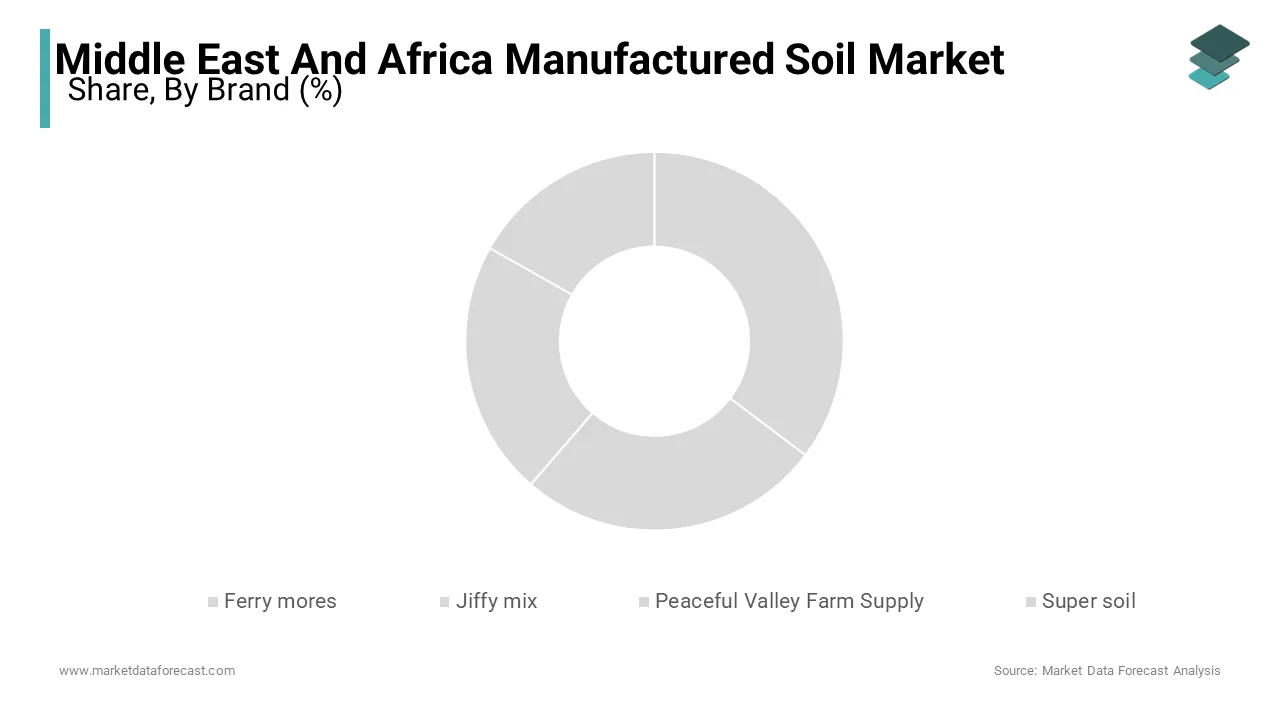
Ferry-Mores held the largest share of 28% in the MEA-manufactured soil blends and mixes market in 2025. The brand's dominance is primarily attributed to its long-standing reputation for producing high-quality, nutrient-rich soil substrates tailored for both commercial agriculture and landscaping applications.
One key driver behind Ferry-Mores' leadership is its strong distribution network across the Gulf Cooperation Council (GCC) countries and North Africa, where it has established partnerships with major agricultural input suppliers and landscape contractors. Another contributing factor is the brand’s emphasis on customized soil formulations that cater to arid climate requirements, including enhanced water retention and microbial activity. These attributes have strengthened Ferry-Mores’ position as the most trusted and widely adopted manufactured soil brand in the region.
Super Soil
Super Soil is coming up as the booming brand in the Middle East and African soil market, registering a CAGR of 12.4% in the coming years. This rapid growth is largely driven by increasing demand for organic and biologically active soil solutions among urban farmers, vertical farming startups, and eco-conscious landscapers.
Also, a primary reason for this surge is the rising popularity of regenerative agriculture practices across the region, particularly in South Africa, Kenya, and the UAE. Super Soil’s compost-enriched formulations are marketed as living soils that support natural nutrient cycling without synthetic fertilizers. Besides, the brand’s aggressive expansion into online retail channels and direct-to-consumer delivery models has made it more accessible to individual gardeners and hobby farmers. In the UAE, e-commerce platforms like GGreenMarket.ae.aeae reported a 75% increase in Super Soil product orders between 2022 and 2024. With growing awareness around sustainable gardening and soil health, Super Soil is well-positioned to continue outpacing other brands in terms of adoption and market penetration.
By Type Insights
Soil Mix
The soil mix segment spearheaded the Middle East and Africa manufactured soil market with a share of 42.1% in 2025. This segment comprises engineered blends that combine organic matter, mineral substrates, and moisture-retaining agents to create optimized growing media for controlled environment agriculture, landscaping, and land reclamation projects.
A major driver of this segment’s dominance is the widespread adoption of precision agriculture techniques in GCC countries, where traditional desert soils lack essential nutrients and water-holding capacity. Another key factor is the increasing use of soil mixes in large-scale afforestation and urban greening programs, particularly in Saudi Arabia and Egypt. As per the Saudi Ministry of Environment, Water, and Agriculture, in 2024, over 9 million treewere s were planted under the "Green Middle East" initiative, utilizing specialized soil mixes to improve root development and survival rates in sandy terrain.
Also, academic institutions such as the International Center for Biosaline Agriculture (ICBA) have been actively promoting soil mix usage in saline-affected areas, further reinforcing their market prominence across the MEA region.
Manure & Compost
Among others, manure and compost-based soil products are experiencing the highest growth rate, recording a CAGR of 11.8%. This upward trend is being driven by increased awareness of organic farming benefits and government-led initiatives promoting sustainable waste management practices.
A key driver is the expansion of municipal composting programs across major cities in the Middle East and Southern Africa, where organic waste is converted into high-value soil amendments. For instance, Dubai’s Integrated Waste Management Strategy aims to divert 80% of organic waste from landfills by 2030, resulting in a significant increase in compost availability for agricultural and landscaping uses.
In addition, smallholder farmers in Ethiopia, Kenya, and Nigeria are increasingly adopting manure-based soil enhancers as cost-effective alternatives to chemical fertilizers, especially in regions where soil degradation is prevalent. According to a 2024 survey by the International Institute of Tropical Agriculture (IITA), over 30% of surveyed farmers reported improved crop yields after incorporating locally produced compost into their fields. Moreover, rising consumer demand for organic produce in MEA markets has encouraged agro-producers to shift toward natural soil enrichment methods, further fueling the growth of the manure and compost segment.
By Application Insights
Greenspace Development
Greenspace development remained the prominent application segment in the MEA-manufactured soil market, accounting for 36.2% of total consumption in 2025. This includes public parks, roadside plantations, and green corridors designed to mitigate urban heat effects and enhance environmental aesthetics in rapidly expanding cities.
A key driver behind this dominance is the intensifying focus on city beautification and ecological restoration in Gulf nations, particularly the UAE and Saudi Arabia. The Riyadh Municipality alone allocated SAR 4.2 billion in 2023 for urban greening initiatives, emphasizing the use of engineered soil blends to sustain vegetation in desert landscapes.
Furthermore, governments in Egypt and Morocco have launched national tree planting campaigns that rely heavily on manufactured soils to establish vegetation in degraded lands. These coordinated efforts underscore the critical role of green space applications in driving regional market growth.
Cultivation
The cultivation application segment is growing at the fastest rate, registering a CAGR of 13.2%. This rapid expansion is primarily fueled by the surge in greenhouse farming, hydroponics, and vertical agriculture systems that depend on high-performance soil blends to maximize yield efficiency in limited-space environments.
A main catalyst is the escalating investment in controlled environment agriculture (CEA) in arid regions, particularly in the GCC and North Africa. Countries like Oman and Libya have introduced subsidies for indoor farming technologies, leading to increased adoption of manufactured soil substrates that offer superior aeration, drainage, and nutrient availability.
Also, agricultural cooperatives in Kenya and South Africa are turning to enriched soil mixes to rehabilitate degraded farmland, supporting food security goals while reducing dependency on synthetic fertilizers. With continued advancements in smart agriculture and soil science, the cultivation segment is poised to maintain its accelerated growth momentum across the MEA region.
COUNTRY-LEVEL ANALYSIS
United Arab Emirates
The United Arab Emirates led the Middle East and Africa manufactured soil market, capturing a share of 24.4% in 2025. The country’s strong economic base, coupled with ambitious sustainability and food security policies, has positioned it as a key hub for advanced soil technology adoption.
A central driver is the UAE’s National Food Security Strategy 2051, which promotes the use of soilless and engineered soil systems to reduce reliance on imports. Government-backed entities like the Abu Dhabi Investment Office (ADIO) have funded numerous agritech ventures that integrate manufactured soil blends into vertical farms and greenhouse operations.
Besides, the rapid expansion of urban landscaping and golf course developments has boosted demand for high-performance soil mixes that can sustain vegetation in extreme desert conditions. With robust regulatory support, private sector innovation, and growing consumer awareness, the UAE continues to set benchmarks in manufactured soil utilization across the MEA region.
Saudi Arabia
Saudi Arabia is another major player in the market, driven by extensive investments in land rehabilitation, afforestation, and controlled-environment agriculture under Vision 2030 and the Green Middle East initiative.
One of the key contributors is the massive tree-planting campaign launched by the Saudi government, aiming to plant 10 billion trees across the Middle East by 2030. Another major influence is the expansion of greenhouse farming and hydroponic systems, particularly in the Al-Ula and Tabuk regions. Furthermore, the King Abdullah University of Science and Technology (KAUST) has been researching salt-tolerant soil blends, enhancing the viability of cultivated agriculture in coastal and hyper-saline areas. These combined efforts make Saudi Arabia a pivotal player in the MEA-manufactured soil market.
South Africa
South Africa is positioning itself as a growing manufacturing and export center for soil blends and compost-based products. The country’s relatively developed infrastructure and progressive agricultural policies facilitate widespread adoption across commercial and subsistence farming sectors.
A major growth driver is the expansion of the organic farming industry, supported by the Department of Agriculture, Land Reform and Rural Development’s push for sustainable soil management. Also, urban greening initiatives in Cape Town and Johannesburg have led to increased procurement of manufactured soils for rooftop gardens, stormwater management, and roadside landscaping. The City of Cape Town’s Biodiversity Management Plan encourages the use of native plants in urban settings, necessitating compatible soil substrates. South Africa also serves as a distribution gateway for manufactured soil products across Sub-Saharan Africa, with companies exporting blends to neighboring countries like Zambia, Zimbabwe, and Namibia. These factors collectively reinforce its strategic importance in the regional market.
Egypt – Expanding Agricultural Modernization Efforts
Egypt is making notable strides in the market. The country’s ongoing agricultural modernization efforts, particularly in response to declining arable land and rising salinity levels, are propelling demand for engineered soil solutions.
A key factor is the government’s New Lands Reclamation Program, which seeks to cultivate an additional 3.4 million feddans (1.4 million hectares) by 2030. As part of this initiative, the Agricultural Engineering Research Institute (AERI) has been developing sand-mix soil amendments to improve fertility in reclaimed desert areas. Another influential element is the growing use of manufactured soil in aquaponic and greenhouse farming setups, particularly in urban centers like Cairo and Alexandria. Moreover, nonprofit organizations such as the Food and Business Knowledge Platform (FBKP) have partnered with local firms to distribute affordable compost-based soil blends to smallholder farmers, improving crop resilience in marginal lands. These developments highlight Egypt’s increasing relevance in the regional manufactured soil market.
Kenya
Kenya is a key player in the MEMEA-manufactured oil market, driven by a surge in horticultural exports and grassroots-level urban gardening movements. The country’s focus on improving soil fertility in degraded farmlands has spurred interest in commercially available soil blends.
A major contributor is the expansion of floriculture and export-oriented horticulture, particularly in Naivasha and Nakuru regions. Also, urban agriculture initiatives in Nairobi and Mombasa have boosted demand for bagged soil mixes among small-scale growers. Organizations like the Kenya Urban Food Security Program (KUFSP) promote the use of compost-enhanced soils to improve food production in densely populated areas. Kenya is also home to several local manufacturers such as EcoSoil Kenya and GreenGro Limited, which supply customized blends for both domestic and regional markets. With increasing emphasis on sustainable agriculture and land restoration, Kenya is steadily strengthening its foothold in the MEA-manufactured soil landscape.
KEY MARKET PLAYERS
The major companies showing interest in the market lately include Boxley Materials Company Inc., Casella Organics Inc., The Scotts Miracle-GRO Company, London Rock Supplies Limited, Resource Management Inc. (RMI), Peaceful Valley Farm & Garden Supply, Tim O’Hare Associates LLP, Jiffy International, and B.D. White Top Soil Company Inc., Boughton Loam & Turf Management Limited are the market players that are dominating the Middle East and Africa manufactured soil market.
Top Players In The Market
One of the leading companies in the MEA manufactured soil market is Ferry-Mores, a globally recognized brand known for its premium soil blends tailored to both agricultural and landscaping needs. The company has established a strong presence across the Gulf and North Africa by offering high-performance substrates that cater to arid climate conditions. Ferry-Mores’ commitment to consistent quality and innovation has made it a preferred choice among commercial growers, landscape architects, and government-led afforestation programs.
Another major player is Super Soil, which has gained rapid traction in recent years due to its focus on organic, biologically enriched soil mixes. Popular among urban farmers, greenhouse operators, and eco-conscious landscapers, Super Soil’s products are designed to enhance microbial activity and promote natural nutrient cycling. Its expansion into online retail channels and partnerships with sustainable agriculture initiatives has significantly boosted its regional visibility and adoption.
Jiffy Mix also holds a prominent position in the market with its wide range of peat-based growing media and soilless blends. Known for reliability and ease of use, Jiffy Mix is widely used in horticulture, container gardening, and controlled-environment agriculture. The brand's emphasis on research-backed formulations and environmental responsibility has positioned it as a key supplier in both large-scale farming and residential gardening sectors across the MEA region.
Top Strategies Used by Key Market Participants
A primary strategy adopted by key players in the Middle East and Africa manufactured soil market is product diversification through formulation innovation. Companies are continuously developing customized soil blends tailored for specific applications such as hydroponics, rooftop gardens, and saline-tolerant agriculture to meet diverse customer needs and expand their market reach.
Another crucial approach is strategic collaborations with local distributors and agritech startups. By partnering with regional stakeholders, manufacturers can better understand local soil challenges and consumer preferences while enhancing last-mile delivery and after-sales support across remote and underdeveloped areas.
Lastly, brand positioning through sustainability messaging and educational outreach plays a vital role in strengthening market presence. Leading firms are actively engaging with farmers, landscapers, and policymakers through workshops, digital content, and certification programs to build trust and encourage the adoption of engineered soil solutions over traditional alternatives.
COMPETITION OVERVIEW
The competition in the Middle East and African manufacturing market is intensifying as both international and regional players strive to capture a larger share of a rapidly evolving industry. While global brands bring technological expertise and product consistency, local manufacturers are leveraging cost advantages and proximity to better serve niche markets and underserved regions. The market remains fragmented, with a mix of well-established agritech firms and emerging startups vying for relevance through innovation and strategic positioning.
Differentiation strategies are centered around product customization, branding, and sustainability claims, as consumers become more discerning about soil health and environmental impact. In addition to competing on quality and performance, companies are increasingly investing in awareness campaigns to educate end users about the benefits of manufactured soil over conventional options. Distribution networks are also being expanded, particularly in Sub-Saharan Africa, where logistical challenges require localized supply chain adaptations.
As governments across the region prioritize food security, land restoration, and urban greening, demand for engineered soil solutions continues to rise. This presents opportunities for both multinational corporations and domestic producers to strengthen their foothold through partnerships, R&D investments, and alignment with national development agendas.
RECENT HAPPENINGS IN THE MARKET
- In January 2024, Ferry-Mores launched a new line of salt-tolerant soil blends specifically designed for coastal and desert farming in the Middle East, addressing the unique soil degradation issues faced by regional farmers and reinforcing its leadership in arid-zone agriculture.
- In March 2024, Super Soil partnered with a Nairobi-based agro-education platform to conduct a series of farmer training sessions across Kenya, aiming to raise awareness about the benefits of organic soil mixes and improve adoption among smallholder farming communities.
- In June 2024, Jiffy Mix introduced an e-commerce-enabled distribution model in Egypt, allowing direct-to-consumer sales and faster delivery of soil products to urban gardeners and greenhouse operators, expanding its footprint in North Africa.
- In August 2024, a leading South African soil manufacturer entered into a joint venture with a European compost technology firm to develop locally sourced, high-efficiency compost blends, enhancing regional production capabilities and reducing import dependency.
- In October 2024, a UAE-based agritech startup unveiled a mobile soil blending unit that allows on-site customization of soil mixes for large-scale landscaping and infrastructure projects, improving efficiency and reducing logistics costs across the GCC region.
MARKET SEGMENTATION
This research report on the Middle East and Africa manufactured soil market is segmented and sub-segmented into the following categories.
By Brand
- Ferry mores
- Jiffy mix
- Peaceful Valley Farm Supply
- Super soil
By Type
- Include manure & compost
- Soil mix
- Garden soil
By Application
- Lawns
- Sports field
- Commercial developments
- Greenspace
- Cultivation
By Country
- KSA
- UAE
- Israel
- rest of the GCC countries
- South Africa
- Ethiopia
- Kenya
- Egypt
- Sudan
- rest of MEA