- Product Description Description
- Table of Contents TOC
- List of Table & Figure LOT
- Get Free Sample PDF Sample PDF
Market Size, 2025
$33.63 BnMarket Estimate, 2026
$36.76 BnMarket Forecast, 2034
$74.87 BnCAGR, 2026–2034
9.30%Middle East and Africa Mechanized Irrigation Systems Market Size, Growth, Trends & Forecast (2026–2034)
The Middle East and Africa mechanized irrigation systems market size was valued at USD 33.63 billion in 2025, is anticipated to reach USD 36.76 billion in 2026, and is projected to hit USD 74.87 billion by 2034, growing at a compound annual growth rate (CAGR) of 9.30% during the forecast period from 2026 to 2034. Driven by escalating regional water scarcity, climate volatility, national food security sovereignty initiatives, and the integration of solar-powered and digital smart water management platforms, the regional market continues to expand rapidly.
Key Executive Metrics (At-a-Glance)
- 2025 Base Valuation: USD 33.63 Billion
- 2026 Current Valuation: USD 36.76 Billion
- 2034 Forecast Valuation: USD 74.87 Billion
- Compound Annual Growth Rate (CAGR): 9.30% (2026–2034)
- Dominant Type Segment: Center Pivot Irrigation Systems (holding the majority share in 2025 anchored by unmatched operational efficiency across expansive regional mega farms)
- Fastest-Growing Type Segment: Lateral Move Irrigation Systems (projected at a 9.2% CAGR driven by the conversion of irregular traditional plots into optimized rectangular fields)
- Dominant Application Segment: Agricultural Crop (holding a commanding share in 2025 driven by food sovereignty mandates and export-oriented horticulture)
- Fastest-Growing Application Segment: Nursery Crops (projected at an 11.4% CAGR driven by urban greening, afforestation programs, and climate policy)
- Dominant Country Market: Kingdom of Saudi Arabia (capturing 28.9% market share in 2025 propelled by massive state-sponsored agricultural transformation programs)
Core Market Drivers
- Hydrological Stress & Scarcity: Acute water deficits forcing the adoption of high-efficiency localized and mechanized irrigation networks.
- Food Security Sovereignty: Government-led agricultural self-sufficiency programs stimulating public and private infrastructure investment.
Primary Market Restraints & Challenges
- High Capital Expenditure: Prohibitive initial investments and financing gaps that exclude smallholder farmers from technology adoption.
- Technical & Environmental Hurdles: Shortages of qualified technicians, rapid groundwater depletion, and regulatory policy interventions.
Middle East and Africa Mechanized Irrigation Systems Market Segmentation Breakdown
| Segment Category | Leading Sub-Segment (Base/Current) | Fastest-Growing Sub-Segment |
|---|---|---|
| By Type | Center Pivot Irrigation Systems (majority share in 2025) | Lateral Move Irrigation Systems (9.2% CAGR driven by geometric field optimization) |
| By Application | Agricultural Crop (commanding share in 2025) | Nursery Crops (11.4% CAGR driven by urban greening and land restoration) |
| By Region / Country | Kingdom of Saudi Arabia (28.9% share in 2025) & UAE | South Africa & Israel (advanced commercial infrastructure and technology origination) |
Major Industry Players Profiled
Key enterprises shaping the competitive Middle East and Africa mechanized irrigation systems market include Lindsay Corporation, Nelson Irrigation Corporation, Jain Irrigation Systems Limited, Driptech India Pvt. Ltd., Rain Bird Corporation, Premier Irrigation Adritec, Rivulis Irrigation, Netafim Limited, The Toro Company, T-L Irrigation, and Valmont Industries.
Middle East and Africa Mechanized Irrigation Systems Market Size
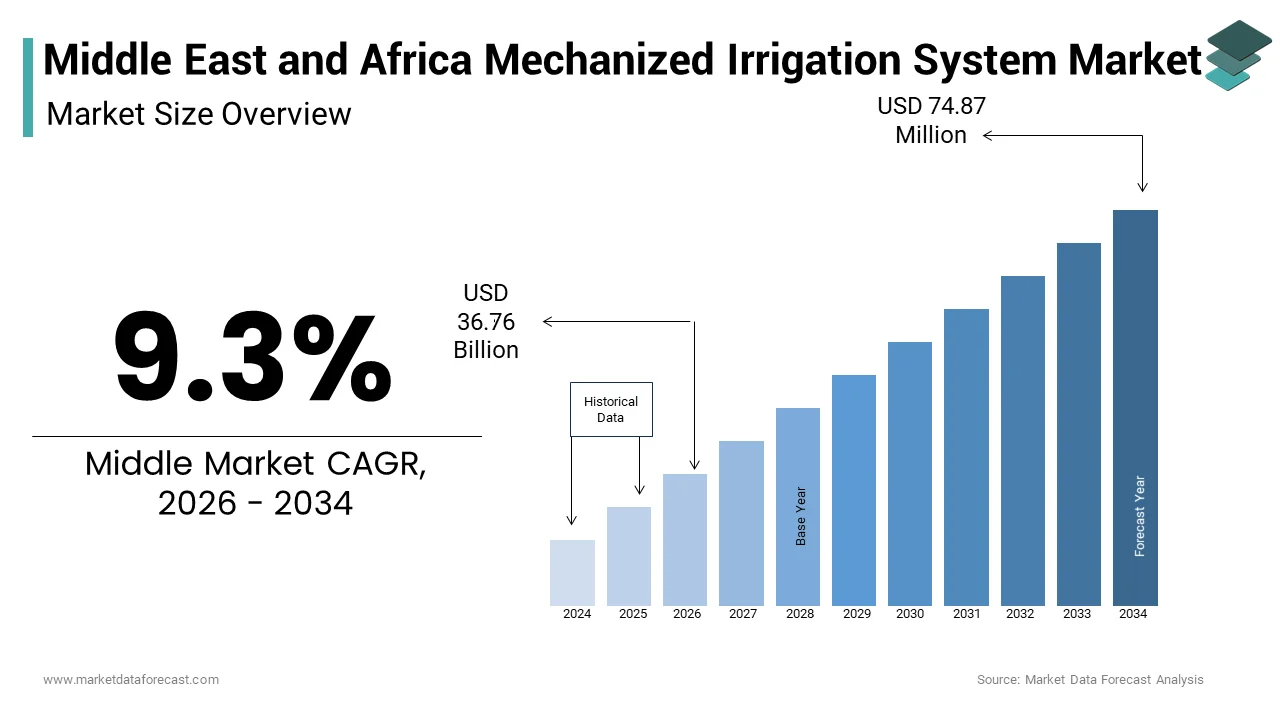
The Middle East and Africa mechanized irrigation systems market size was valued at USD 33.63 billion in 2025 and it is anticipated to reach a valuation of USD 36.76 billion in 2026 and USD 74.87 billion by 2034, growing at a CAGR of 9.3% from 2026 to 2034.
Market Scope and Hydrological Context
Mechanized irrigation systems use mechanical and electrical equipment, such as pumps, engines, and moving pivots, to apply water to crops automatically. This market is fundamentally distinct from traditional flood methods as it integrates precision engineering with hydrological management to address severe resource scarcity across the region. According to the World Bank, the agricultural sector accounts for up to 90% of total freshwater withdrawals across the Middle East and North Africa, creating an acute supply strain as regional groundwater resources face severe depletion. As per the Food and Agriculture Organization, smallholder farms in Sub-Saharan Africa utilize localized, community-based climate adaptation techniques to scale up irrigation systems across under-managed arable land. According to the United Nations Convention to Combat Desertification, regional initiatives are deploying sustainable land management practices and agroecological restoration frameworks to rehabilitate millions of hectares of degraded soil across the African continent. These systems now serve as critical infrastructure for national food security strategies rather than optional farm upgrades. As per the International Water Management Institute, smallholders are expanding micro-catchment rainwater harvesting and conservation systems to increase crop and livestock water productivity in dryland agricultural basins.
MARKET DRIVERS
Escalating Regional Water Scarcity and Climate Volatility
Intensifying Hydrological Stress Demands Precision Water Application Technologies
Acute water deficits drive the growth of the Middle East and Africa mechanized irrigation systems market. This lack of water makes conventional irrigation economically and ecologically unviable in both regions. According to the World Resources Institute, twenty-five countries globally, representing a significant portion of the Middle East and North Africa, face extremely high baseline water stress by regularly utilizing over 80% of their available renewable supply each year. The physical scarcity forces governments and farmers to adopt mechanized systems that achieve significant application efficiencies. As per the Food and Agriculture Organization, modern localized irrigation networks optimize water resource distribution to cross an operational threshold of 90% application efficiency compared to traditional surface methods. According to climate projection frameworks of the Intergovernmental Panel on Climate Change, rapid regional warming trends across the Arabian Peninsula are accelerating structural atmospheric demands and altering baseline hydrological availability. Consequently, the market expands not because of profit maximization but due to absolute survival requirements where water allocation per hectare determines whether farming continues at all in increasingly hostile climatic zones.
National Food Security Sovereignty Initiatives
Government Led Agricultural Self Sufficiency Programs Stimulate Infrastructure Investment
Strategic government mandates aim to reduce import dependency, which further propels the Middle East and Africa mechanized irrigation systems market. These rules create high artificial demand for irrigation systems, regardless of commercial returns. According to the Saudi Ministry of Environment, Water and Agriculture, the government is expanding targeted financial allocations to re-engineer regional agricultural terraces and achieve sustainable domestic self-sufficiency. As per the Comprehensive Africa Agriculture Development Programme, regional development blueprints establish a clear benchmark to expand total irrigated land area across Sub-Saharan Africa by at least 5 million hectares. According to the Egyptian Ministry of Water Resources and Irrigation, public works are actively modernizing distribution structures across agricultural governorates in Upper Egypt to enhance water-use efficiency among local smallholders. These state driven initiatives transform mechanized irrigation from a private capital expenditure into public infrastructure essential for national resilience against external shocks.
MARKET RESTRAINTS
Prohibitive Capital Expenditure and Financing Gaps
High Initial Investment Costs Exclude Smallholder Farmers From Technology Adoption
The substantial upfront capital required for mechanized systems restricts the growth of the Middle East and Africa mechanized irrigation systems market. This high cost remains out of reach for most local farmers. As per the African Development Bank, the annual financing gap for agricultural transformation in Africa, leaving irrigation projects chronically underfunded despite proven returns. According to micro-lending analyses from the World Bank, modern commercial financing initiatives are restructuring lending frameworks to lower operational interest rates and align credit facilities with seasonal agricultural cash flows. The financial barrier creates a dualistic market structure where large corporate farms and state enterprises adopt advanced systems while the vast majority of food producers remain locked in low productivity traditional practices, severely limiting overall market penetration depth and equitable technology diffusion across the socioeconomic spectrum.
Technical Skills Deficit and Maintenance Infrastructure Weaknesses
Inadequate Human Capital and Service Networks Cause System Failures and Abandonment
The widespread shortage of qualified technicians and spare parts supply chains necessary to sustain complex mechanized systems over their intended lifespan further hinders expansion of the Middle East and Africa mechanized irrigation systems market. According to research by the International Water Management Institute, public-private partnership models are expanding across East Africa to introduce structural improvements, enhance system operational efficiencies, and counter persistent technical maintenance gaps. As per the African Union Commission, regional agricultural blueprints are accelerating technical training for extension networks to expand sustainable land and water management area benchmarks. The systemic incapacity transforms temporary malfunctions into permanent asset losses, eroding farmer confidence in mechanization and creating negative feedback loops that suppress future demand regardless of theoretical economic benefits.
MARKET OPPORTUNITIES
Solar Powered Irrigation Integration Potential
Renewable Energy Convergence Creates Off Grid Viability For Remote Agricultural Zones
The convergence of declining photovoltaic costs with irrigation needs in areas lacking reliable grid electricity provides a transformative opportunity for the Middle East and Africa mechanized irrigation systems market. According to the International Renewable Energy Agency, global levelised costs of electricity for utility-scale solar photovoltaics fell by approximately 90% between 2010 and 2023, expanding the financial viability of off-grid solar-powered pump applications over fossil fuel infrastructure. As per the Global Solar Atlas, wide-scale regional diagnostic mappings indicate that long-term yearly averages of practical photovoltaic power potential exceed standard minimums across Sub-Saharan Africa, offering clean generation capacity to eliminate operational fuel logistics. According to the World Bank, targeted solar energy deployment programs enable remote smallholders to acquire solar water pumps, eliminating persistent dependency on fluctuating diesel prices and greenhouse gas emissions. The synergy allows expansion into previously unelectrified rural territories where mechanization was historically impossible, effectively doubling the addressable geographic market while aligning with international climate finance mechanisms that prioritize decarbonized agricultural development.
Digital Agriculture and Smart Water Management Platforms
Data Driven Precision Technologies Unlock Efficiency Gains Beyond Hardware Alone
The integration of Internet of Things sensors and satellite analytics with mechanized systems paves the way to maximize return on existing infrastructure investments through intelligent automation, which is expected to fuel the expansion of the Middle East and Africa mechanized irrigation systems market. According to the GSMA, unique mobile subscriber numbers continue to grow across regional markets, projecting a trajectory to reach 751 million subscribers by 2030 to bridge long-standing connectivity gaps. As per the CGIAR Research Framework, the integration of digital agricultural tools and precision sensor technologies scales up localized irrigation efficiency to manage ongoing water scarcity crises across regional food systems. According to ESA Space Solutions, Earth Observation datasets are integrated with localized water balance modeling to generate variable-rate irrigation maps that match input requirements for modern field machinery. This technological layer transforms static hardware into adaptive systems capable of responding to real time plant needs and weather forecasts, creating value propositions that justify premium pricing and recurring revenue models beyond one time equipment sales.
MARKET CHALLENGES
Groundwater Depletion and Regulatory Enforcement Risks
Unsustainable Aquifer Extraction Triggers Restrictive Policy Interventions That Disrupt Demand
Mechanized irrigation accelerates groundwater depletion faster than natural recharge rates, which constrains the growth of the Middle East and Africa mechanized irrigation systems market. This paradox creates a profound challenge by prompting regulatory crackdowns that undermine market sustainability. According to the UNESCO, anthropogenic groundwater overdraft accounts for approximately 25% of all water withdrawn for global agricultural irrigation, leading to rapid resource mismanagement. As per the World Resources Institute, roughly 60% of the world's irrigated agricultural infrastructure, particularly fields dedicated to sugarcane, wheat, rice, and maize, currently faces extremely high water stress. The environmental backlash threatens to convert growth drivers into regulatory liabilities, requiring the market to pivot toward water accounting and sustainable yield management rather than pure volume expansion.
Geopolitical Instability and Cross Border Water Tensions
Regional Conflicts and Transboundary Disputes Create Unpredictable Operating Environments
Political volatility and interstate water disputes introduce systemic risks, which challenge the expansion of the Middle East and Africa mechanized irrigation systems market. These risks deter long-term investment in mechanized irrigation infrastructure across shared river basins. According to the Stockholm International Peace Research Institute, targeted regional cross-border cooperation and climate resilience initiatives are expanding across the Horn of Africa to proactively manage transboundary water-sharing security. As per the United Nations Economic Commission for Africa, regional development blueprints establish a clear target framework to increase total irrigated land area across Sub-Saharan Africa by at least 5 million hectares. The geopolitical dimension means market participants must navigate not only agronomic and commercial variables but also security assessments and diplomatic forecasting, adding layers of complexity that generic market analyses often overlook but which fundamentally shape deployment feasibility and insurance costs.
REPORT COVERAGE
| REPORT METRIC | DETAILS |
| Market Size Available | 2025 to 2034 |
| Base Year | 2025 |
| Forecast Period | 2026 to 2034 |
| CAGR | 9.30% |
| Segments Covered | By Type, Application, and Region. |
| Various Analyses Covered | Global, Regional & Country Level Analysis, Segment-Level Analysis, DROC, PESTLE Analysis, Porter’s Five Forces Analysis, Competitive Landscape, Analyst Overview of Investment Opportunities |
| Regions Covered | KSA, UAE, Israel, rest of GCC countries, South Africa, Ethiopia, Kenya, Egypt, Sudan, rest of MEA |
| Market Leaders Profiled | Lindsay Corporation, Nelson Irrigation Corporation, Jain Irrigation Systems Limited, Driptech India Pvt. Ltd, Rain Bird Corporation, Premier Irrigation Adritec, Rivulis Irrigation, Netafim Limited, The Toro Company, T-L Irrigation, Valmont Industries. |
SEGMENTAL ANALYSIS
By Type Insights
Center Pivot Irrigation Systems
In 2025, the center pivot irrigation systems segment held the majority share in the Middle East and Africa mechanized irrigation systems market because of its unmatched operational efficiency across expansive agricultural tracts typical of regional mega farms. According to the Food and Agriculture Organization, the Middle East and North Africa region faces extreme agricultural water stress by managing only 1% of the world's total renewable freshwater resources. As per ResearchGate, center pivot machinery operating across large-scale commercial schemes in the Atbara River Region of Sudan achieves a Christiansen's coefficient of uniformity ranging from 71.7% to 87.1% under varying rotational configurations. According to sector expenditure metrics from Market Data Forecast, the Middle East and Africa center pivot irrigation systems market is scaling up rapidly and is projected to expand to 283.43 million dollars to support intensive regional crop cultivation. The convergence of agronomic suitability, policy support, and labor economics solidifies center pivot dominance despite higher initial capital costs.
The leading position of this segment is bolstered by its superior adaptability to the sandy and saline soils prevalent throughout the Middle East and African drylands, where alternative systems face performance limitations. According to agricultural data compiled by the Food and Agriculture Organization, modern water distribution systems deployed on commercial farms are intended to lower net water application requirements while scaling up total crop productivity. As per Lindsay Corporation, high-performance lateral move irrigation systems are actively rolling out across field networks to deliver full-field coverage on square or rectangular agricultural plots. According to sources, expanding commercial greenhouse operations are integrating advanced micro-irrigation hardware to maintain year-round vegetable and crop supply lines. The multifunctional capability in harsh edaphic conditions creates a technological moat that sustains market leadership against competing mechanized formats.
Lateral Move Irrigation Systems
The lateral move irrigation systems segment is anticipated to witness the fastest CAGR of 9.2% from 2026 to 2034, owing to the increasing conversion of irregular traditional plots into geometrically optimized rectangular fields. According to Rainfine Irrigation, specialized dual-wing ditch-feed linear systems are scaling up to span lengths exceeding 800 metres and irrigate contiguous square configurations up to 160 hectares. As per Lindsay Corporation, linear mechanized irrigation hardware integrates dedicated GPS guidance mechanisms to ensure repeatable, highly precise path performance with minimized physical maintenance. According to studies, the Vaalharts Irrigation Scheme operates as one of the largest structured watering networks in Africa, spanning approximately 369.50 square kilometres in the Northern Cape Province.
The swift expansion of this segment gains further momentum from their exceptional labor productivity advantage in intensive horticultural and row crop operations that dominate emerging commercial agriculture sectors. According to corporate equipment overviews from Lindsay Corporation, specialized linear machinery variants are engineered to optimize overall agricultural yields by maximizing total arable land coverage with minimal equipment counts. As per sources, the operational alignment of physical crop rows and field networks remains a key determinant for maximizing delivery efficiency inside regional mechanized farming grids. The human capital efficiency makes lateral moves the preferred choice for next generation commercial farming enterprises driving segmental growth.
By Application Insights
Agricultural Crop
The agricultural crop irrigation segment remained the largest in 2025 and occupied a commanding share of the Middle East and Africa mechanized irrigation systems market. This supremacy of the segment was credited to overwhelming governmental prioritization of staple food self sufficiency and caloric security over ornamental or waste management applications. According to the Food and Agriculture Organization, volatile global commodity price spikes are driving structural agricultural policy reorientations across low-income, food-deficit territories to protect domestic supply streams. As per the Food and Agriculture Organization, regional food security frameworks rely on optimizing physical water-use efficiency through modern delivery networks to insulate strategic grain production against extreme hydrological stress. According to the African Development Bank Group, targeted multi-million dollar structural infrastructure loans are expanding climate-resilient water networks and modernized delivery schemes to shield smallholder yields from intense drought cycles. The policy driven focus on food sovereignty creates a structural demand floor for agricultural crop irrigation that dwarf alternative applications regardless of relative profitability per unit of water applied.
The prominence of this segment is further reinforced by the rapid expansion of export-oriented horticulture and industrial crop production that generates foreign exchange earnings, justifying premium mechanized irrigation investments. According to the World Bank, high-value agricultural export supply chains require continuous technical adherence to stringent global food safety benchmarks to capture premium margins in foreign markets. As per the World Bank, multi-billion dollar private capital infusions are increasingly targeting automated water delivery and closed-loop agritech infrastructures to optimize long-term commercial yields. Additionally, according to the African Export-Import Bank, cross-border commercial transactions under the continental free trade framework require integrated climate adaptation strategies to cushion local food supply lines from severe environmental shocks. This dual engine of domestic food security and export competitiveness ensures agricultural crop irrigation maintains dominant market share across diverse economic contexts.
Nursery Crops
The nursery crops segment is on the rise and is expected to be the fastest growing segment in the market by witnessing a CAGR of 11.4% during the forecast period due to unprecedented urban greening and afforestation programs across major metropolitan centers. According to UN-Habitat, municipal regeneration plans dictate strict sustainable land-use directives to transform regional municipal centers into highly resilient, climate-adapted habitats. As per the UAE Government Portal, state-led greening networks deploy extensive localized irrigation grids to cultivate native flora and actively reverse long-term soil desertification trends. According to the African Union Commission, transboundary land and water restoration frameworks establish direct target benchmarks to expand total irrigated land area by at least 5 million hectares. The convergence of urban planning, environmental restoration, and climate policy creates explosive growth dynamics unique to the nursery segment.
The fast development of this segment is heightened by the professionalization of commercial horticulture that replaces informal propagation with standardized mechanized production systems. According to AGRA, smallholder digital advisory channels are expanding across pilot networks to accelerate technical information delivery and streamline input logistics within local farming sectors. As per Scribd documents, modern plant micropropagation facilities operate specialized growth rooms equipped with fluorescent lamps, custom media tools, and climate control to maintain aseptic clone establishment. According to the World Bank, institutional lenders prioritize direct fiscal support for localized, energy-efficient micro-irrigation systems to strengthen smallholder financial solvency against volatile operating costs. The transition from artisanal to industrial propagation models generates sustained demand for specialized mechanized irrigation equipment distinct from broader agricultural trends.
COUNTRY LEVEL ANALYSIS
Kingdom of Saudi Arabia Mechanized Irrigation Systems Market Analysis
Saudi Arabia dominated the Middle East and Africa mechanized irrigation systems market and accounted for a 28.9% share in 2025. This prominence of the Saudi market was propelled by massive state-sponsored agricultural transformation programs. According to the Food and Agriculture Organization, modern automated systems are scaling up localized water conservation by boosting irrigation efficiency metrics from 50% to over 92% across pilot farmlands. As per the Food and Agriculture Organization, precision technology adoption initiatives are altering agricultural management practices to establish robust, climate-resilient farming models capable of thriving in arid climates. According to the Food and Agriculture Organization, localized automated irrigation systems are expanding across farming networks to successfully slash regional baseline crop water consumption by up to 40%. The combination of sovereign wealth deployment, regulatory enforcement, and strategic vision establishes Saudi Arabia as the undisputed market anchor whose policy decisions set regional technology standards and pricing benchmarks.
United Arab Emirates Mechanized Irrigation Systems Market Analysis
The United Arab Emirates followed closely behind in the Middle East and Africa mechanized irrigation systems market and captured a 14.9% share in 2025. This position of the UAE market was fuelled by technology-intensive protected agriculture and smart farming integration. According to urban environmental parameters tracked by the UAE Government Portal, federal greening initiatives are scaling up the expansion of protected nature reserves, native vegetation, and public landscaping to actively combat desertification across hyper-arid zones. As per the Food Tech Challenge, the nation participates in a multi-billion dollar multilateral framework to mobilize climate-smart agritech investments and speed up innovation across vulnerable food networks. According to the UAE National Food Security Strategy 2051, commercial operators are significantly multiplying the deployment of localized agritech and indoor hydroponics to establish reliable local food supply chains and buffer import reliance. The focus on technological excellence over sheer area expansion positions the UAE as the innovation leader whose pilot projects validate emerging solutions before broader regional rollout.
Israel Mechanized Irrigation Systems Market Analysis
Israel is another key player in the Middle East and Africa mechanized irrigation systems market due to its role as a global technology originator and the exporter of precision irrigation solutions. According to Orbia’s Netafim, pioneer engineers built global footprints spanning over 15 million hectares globally to expand precision drip systems and combat climate uncertainty across water-scarce territories. As per the OECD, Israel is the largest user of recycled effluent water for agriculture among member countries, with more than 87% of wastewater effluent actively reused for crop irrigation. According to agribusiness tracking from Msinje Agro Solutions, Israel routinely exports agricultural commodities worth approximately 2 billion dollars annually despite operating on territory that is 60% desert landscape. The fusion of technological leadership, demonstrated resource efficiency, and development diplomacy sustains Israel’s disproportionate market influence relative to domestic acreage.
South Africa Mechanized Irrigation Systems Market Analysis
South Africa is moving ahead steadfastly in the Middle East and Africa mechanized irrigation systems market, owing to its advanced commercial farming sector and well-established irrigation infrastructure base. According to the Agricultural Research Council, South Africa operates approximately 1.2 million hectares of land under irrigation networks to anchor vital commercial crop export markets. As per the Water Research Commission, researchers are leveraging remote sensing, satellite data, and energy balance modeling to actively trace and map the changing footprints of local agricultural water use. According to field pilot monitoring by the International Water Management Institute, smallholder irrigation schemes in the Limpopo Province are undergoing structured institutional evaluations to pinpoint day-to-day management bottlenecks and secure crop yields. The combination of existing infrastructure depth, climate adaptation urgency, and transformative policy creates a uniquely sophisticated market environment distinct from frontier contexts elsewhere in Africa.
COMPETITIVE LANDSCAPE
Competition in the Middle East and Africa mechanized irrigation systems market features intense rivalry between multinational corporations and emerging regional manufacturers vying for diverse customer segments across vastly different economic contexts. Global leaders compete on technological sophistication and brand reputation while local players leverage cost advantages and contextual knowledge to capture price sensitive smallholder markets. Differentiation increasingly occurs through service ecosystems including financing, training, and digital advisory rather than hardware specifications alone. Government procurement creates winner take all dynamics in large infrastructure projects where political relationships and compliance capabilities matter as much as technical merit. Market fragmentation across forty plus countries prevents unified competitive strategies, forcing participants to maintain country specific approaches that increase operational complexity. New entrants from Asia challenge established Western incumbents with lower cost alternatives, compressing margins and accelerating innovation cycles. Consolidation through acquisitions continues as companies seek scale efficiencies and complementary capabilities. Ultimately, sustainable competitive advantage derives from balancing global technology transfer with deep local embedding, requiring organizational ambidexterity that few players have fully mastered across this uniquely demanding regional landscape characterized by extreme heterogeneity and institutional voids.
KEY MARKET PLAYERS
Mechanized Irrigation Systems market is led by major players like
- Lindsay Corporation
- Nelson Irrigation Corporation
- Jain Irrigation Systems Limited
- Driptech India Pvt. Ltd
- Rain Bird Corporation
- Premier Irrigation Adritec
- Rivulis Irrigation
- Netafim Limited
- The Toro Company
- T-L Irrigation
- Valmont Industries.
Top Players In The Market
- Netafim maintains extensive involvement across the Middle East and Africa by providing precision drip irrigation solutions tailored for arid climates and smallholder farmers. The company recently strengthened its regional position through localized manufacturing partnerships in South Africa and Kenya to reduce supply chain lead times and costs. Netafim launched solar powered irrigation kits specifically designed for off grid African farms, addressing energy access barriers that previously limited technology adoption. Their digital farming platform integration enables remote monitoring and agronomic advisory services via mobile devices, enhancing value propositions beyond hardware sales. These initiatives demonstrate commitment to adapting global technologies for unique regional constraints while building resilient local ecosystems that support sustainable market expansion across diverse agricultural contexts throughout the continent.
- Jain Irrigation Systems contributes significantly to the Middle East and Africa mechanized irrigation landscape through comprehensive product portfolios spanning drip, sprinkler, and micro irrigation systems. The company recently expanded its Ethiopian manufacturing facility to serve East African markets more efficiently while reducing import dependencies. Jain launched affordable smallholder focused irrigation packages with integrated financing models in partnership with regional development banks, directly addressing capital access barriers. Their technical training programs have certified thousands of local technicians across multiple countries, strengthening after sales service networks critical for system longevity. These strategic actions reinforce Jain’s positioning as an accessible technology provider committed to inclusive agricultural development rather than serving only large commercial operations in the region.
- Valmont Industries serves the Middle East and Africa mechanized irrigation market through center pivot and lateral move systems optimized for large scale commercial agriculture and government development projects. The company recently established a dedicated service center in Saudi Arabia to support Vision 2030 agricultural modernization initiatives with rapid maintenance response capabilities. Valmont introduced water saving precision application technologies specifically calibrated for Gulf region soil conditions and salinity challenges, differentiating offerings from generic global products. Their collaboration with regional research institutions validates system performance under local conditions, building trust among conservative buyers. These targeted investments demonstrate Valmont’s strategy of deep localization rather than standardized export approaches, ensuring relevance in markets where operational reliability determines long term customer relationships and repeat business opportunities.
Top Strategies Used By Key Market Participants
Key players in the Middle East and Africa mechanized irrigation systems market prioritize localization strategies including regional manufacturing, technical training, and product adaptation to overcome infrastructure and affordability barriers. Companies establish local assembly facilities to reduce import costs and lead times while creating employment that builds political goodwill. Strategic partnerships with development finance institutions enable innovative financing models that unlock smallholder demand previously excluded due to capital constraints. Technology providers integrate digital platforms and solar power solutions to address connectivity and energy gaps unique to the region. After sales service network expansion through certified technician programs ensures system longevity and builds customer trust essential for repeat business. Product portfolios are diversified to serve both large commercial farms and smallholders, capturing demand across socioeconomic segments. Collaboration with government agencies aligns corporate offerings with national food security priorities, securing preferential treatment in public procurement. These multifaceted strategies reflect understanding that success requires addressing systemic ecosystem challenges beyond mere equipment sales in this complex and heterogeneous regional market environment.
MARKET SEGMENTATION
This research report on the Middle East and Africa mechanized irrigation systems market is segmented and sub-segmented into the following categories.
By Type
- Center pivot irrigation systems
- lateral move irrigation systems
By Application
- Land application of wastes
- nursery crops
- agricultural crops
- lawns & gardens
By Country
- KSA The KSAIsraell
- The rest of the GCC countries
- South Africa
- Ethiopia
- Kenya
- Egypt
- Sudan
- Rest of MEA