- Product Description Description
- Table of Contents TOC
- List of Table & Figure LOT
- Get Free Sample PDF Sample PDF
Market Size, 2025
$0.89 BnMarket Estimate, 2026
$1.04 BnMarket Forecast, 2034
$3.70 BnCAGR, 2026–2034
17.17%Middle East and Africa Micro Irrigation Systems Market Size
The Middle East and Africa micro irrigation systems market was valued at USD 0.89 billion in 2025 and is expected to reach USD 1.04 billion in 2026 and reach USD 3.70 billion by 2034, growing at a CAGR of 17.17% during the forecast period from 2026 to 2034.
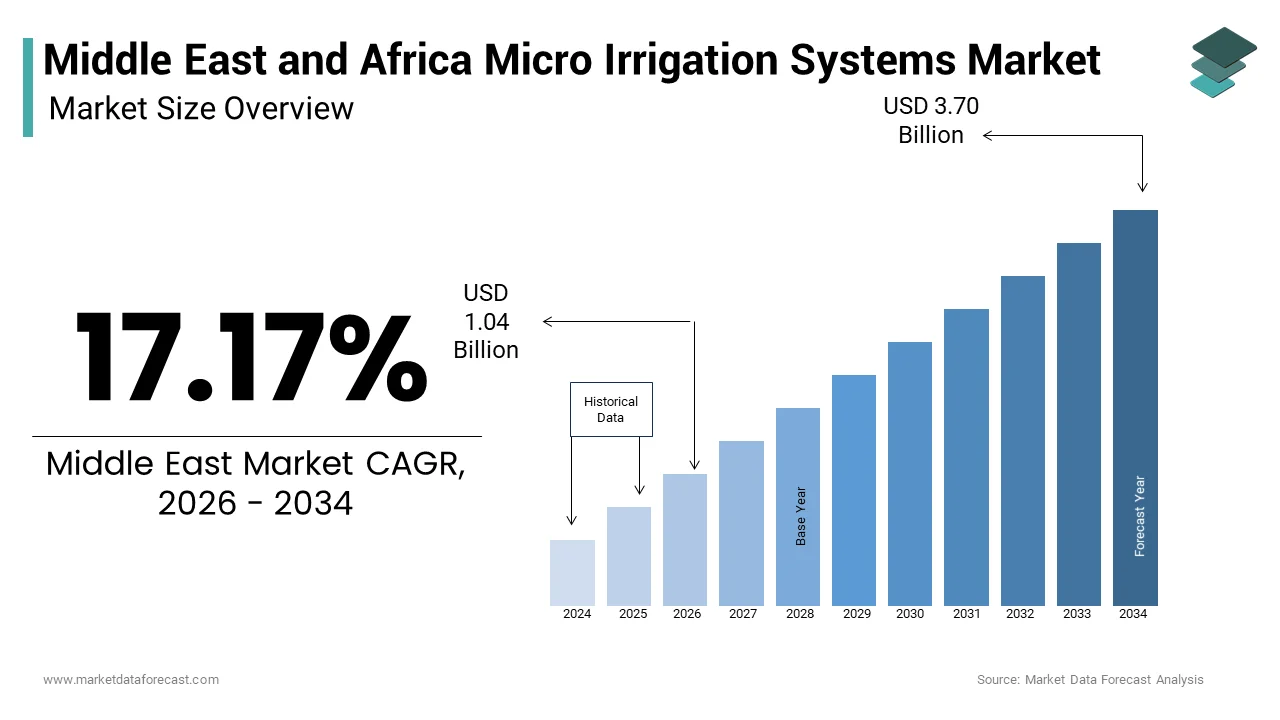
With a shortage of land and water, growing importance is being put on the support of advanced technologies that can help enhance crop output.
Micro-irrigation systems deliver water to the plant roots through an intricate pipe linkage system and low-discharge emitters. The water discharge outline in these systems can be altered as per individual plant water necessities, as several horticultural and agronomic plants have unique requirements. The system consists of components such as pipes, flow control gear, tubes, and low-discharge water-emitting machines.
The growth of the Middle East and Africa Micro Irrigation Systems market is majorly driven by factors such as water scarcity, rising population, and growing food demand, coupled with advanced production practices. However, factors such as high initial investment and high upkeep costs of the micro-irrigation systems are impeding the growth of the market in this region.
REPORT COVERAGE
| REPORT METRIC | DETAILS |
| Market Size Available | 2025 to 2034 |
| Base Year | 2025 |
| Forecast Period | 2026 to 2034 |
| CAGR | 17.17% |
| Segments Covered | By Irrigation Technology, Application, End-User, and Region. |
| Various Analyses Covered | Global, Regional, and Country-Level Analysis, Segment-Level Analysis; DROC, PESTLE Analysis; Porter’s Five Forces Analysis; Competitive Landscape; Analyst Overview of Investment Opportunities |
| Regions Covered | UK, France, Spain, Germany, Italy, Russia, Sweden, Denmark, Switzerland, Netherlands, Turkey, the Czech Republic, and the Rest of Europe |
| Market Leaders Profiled | Jain Irrigation Systems Ltd., Lindsay Corporation, Nelson Irrigation Corporation, The Toro Company, EPC Industries Limited, Valmont Industries Inc., and T-L Irrigation. |
SEGMENT ANALYSIS
By Type Insights
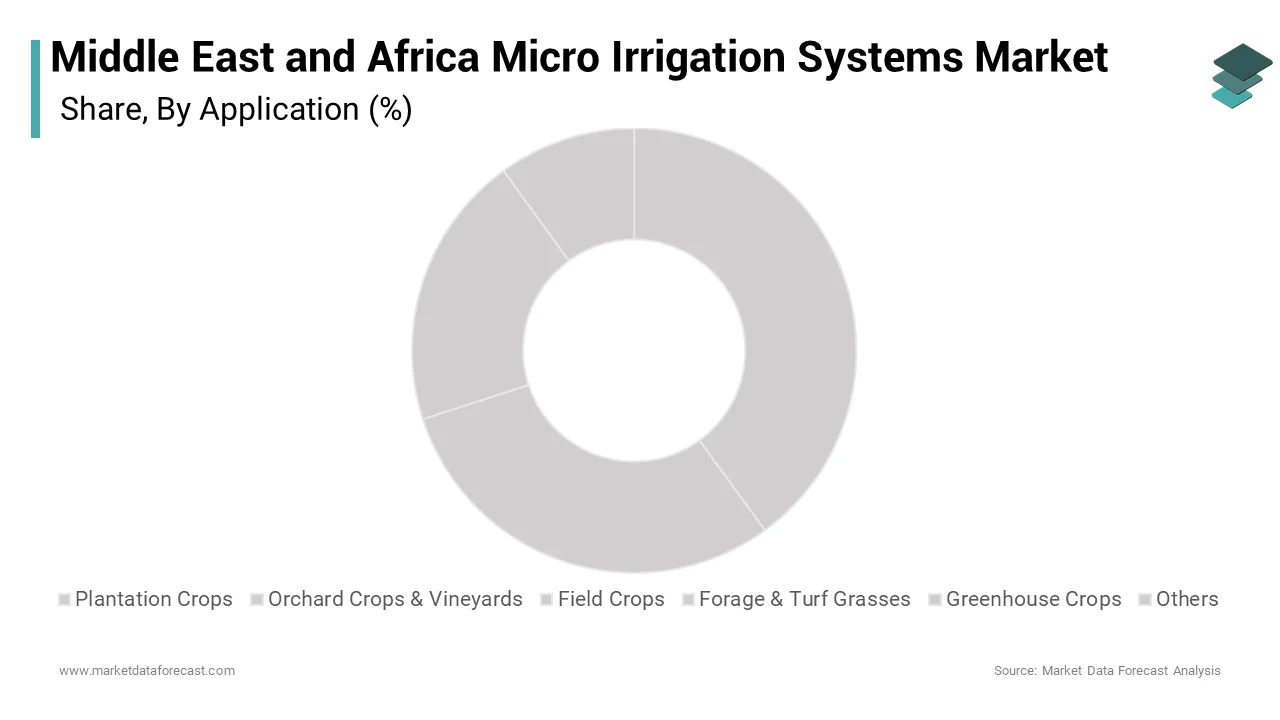
Sprinkler Irrigation Systems lead the market for micro irrigation systems, whereas Drip Irrigation Systems are growing at the highest CAGR during the forecast period. With the advance of micro-sprinklers, irrigation on low-value field crops has enhanced, thereby increasing the demand for micro-sprinklers.
COUNTRY ANALYSIS
The market has been geographically segmented into the Middle East and Africa. In 2015, the Middle East accounted for a major share of around 63% in terms of revenue in the Middle East and Africa irrigation systems market. The necessity for these systems is mainly due to the robust agriculture sector in countries such as Turkey, Egypt, Iran, Israel, and others. Moreover, countries such as Morocco, Qatar, and Sudan are concentrating on the growth of their agricultural sector in order to boost their agricultural productivity. Through this, these countries intend to decrease their dependency on food imports and attain self-sufficiency in food production.
KEY MARKET PLAYERS
The industry is highly disjointed with several small, medium, and large-scale players. Companies are funding R&D projects and building collaborations to achieve a stronger position in the market by boosting their product portfolio. The major companies dominating the Micro Irrigation Systems market in this region are
- Jain Irrigation Systems Ltd.
- Lindsay Corporation
- Nelson Irrigation Corporation
- The Toro Company
- EPC Industries Limited
- Valmont Industries Inc.
- T-L Irrigation.
MARKET SEGMENTATION
This research report on the Middle East and Africa micro irrigation system market is segmented and sub-segmented into the following categories.
By Irrigation Technology
- Drip Irrigation System
- Backflow Preventers
- Filters
- Drip Tubes
- Valves
- Pressure Regulators
- Emitters
- Others
- Sprinkler Irrigation System
- Tubing
- Sprinkler Heads
- Pumping Units
- Couplers
- Fittings & Accessories
- Others
- Center Pivot Irrigation System
- Pipelines
- System Control Towers
- Water Emitters
- Central Towers
- Lateral Move Irrigation System
- Pipelines
- Sprinkler Heads
- Drive Mechanisms
- Control Panels
- Water Distribution Units
- Subsurface Drip Irrigation (SDI) Systems
- Tubing
- Pressure Regulators
- Water Filtration Units
- Drip Emitters
- Boom Irrigation Systems
- Overhead Booms
- Nozzles
- Water Pumps
By Application
- Plantation Crops
- Orchard Crops & Vineyards
- Field Crops
- Forage & Turf Grasses
- Greenhouse Crops
- Others
By End User
- Farmers
- Industrial Growers
- Others
By Country
- KSA
- UAE
- IsraelThe restt of the GCC countries
- South Africa
- Ethiopia
- Kenya
- Egypt
- Sudan
- Rest of MEA