- Product Description Description
- Table of Contents TOC
- List of Table & Figure LOT
- Get Free Sample PDF Sample PDF
Middle East and Africa Nanomedicine Market Size
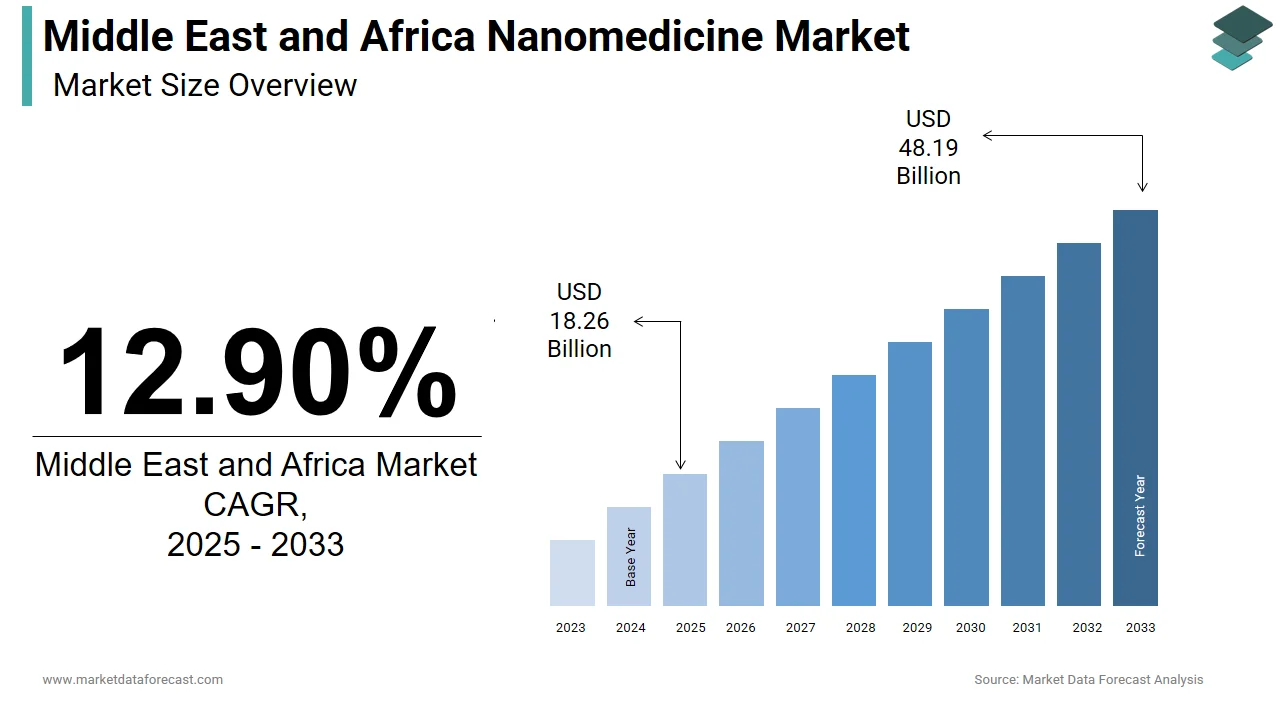
The Middle East and Africa nanomedicine market was valued at USD 16.17 billion in 2024, is estimated to reach USD 18.26 billion in 2025, and is projected to reach USD 48.19 billion by 2033, growing at a CAGR of 12.90% from 2025 to 2033.
MARKET DRIVERS
Technological Advancements and Rising Prevalence of Chronic Diseases
The growth of the Middle East and Africa nanomedicine market is predicted to be encouraged by technological advancements along with relevant applications in early illness diagnosis, preventive intervention, and prophylaxis of chronic and acute disorders. Nanomedicine, which involves the nanoscale development of larger structures and substances, has transformed drug administration. Nanotechnology's ability to serve in both diagnostics and therapeutics simultaneously as a result of its unique principle is expected to boost research in this field. Furthermore, the predicted growth is due to the use of DNA origami in healthcare applications.
The growing prevalence of cancer, genetic and cardiovascular illnesses, increasing advancements in nanoscale technologies for diagnostic processes, and a growing preference for personalized treatments drive the growth of the Middle East and Africa nanotechnology (nanomedicine) industry. Emerging methods for drug delivery, increased use of nanomedicine across various applications, increased government backing and funding, increased demand for therapies with fewer side effects, and cost-effectiveness of therapies are driving the Middle East and Africa nanomedicine market. One of the key factors driving the market's favorable outlook is the rising prevalence of chronic medical conditions in the region. Oncological, neurological, urological, infectious, ophthalmological, orthopedic, immunological, and cardiovascular illnesses benefit nanomedicine.
An increase in nanomedicine out-licensing and healthcare facilities in this country are expected to help the nanomedicine sector grow. Future expansion is projected to be fueled by the use of nanotechnology-based contrast reagents for diagnosis and monitoring of pharmacological effects on an unprecedentedly short timescale. Demand is also expected to be influenced by the demand for biodegradable implants with extended lifespans that allow for tissue repair. Other growth-inducing aspects include numerous technological developments in nanoscale technologies for improved diagnostic techniques. In addition, nanorobotic systems and other new solutions are being used by pharmaceutical companies to administer nanomedicines effectively.
MARKET RESTRAINTS
Regulatory Hurdles, High Costs, and Lengthy Approvals
Severe regulatory concerns and the high cost of nanoparticle-assisted medicine compared to its traditional competitors are expected to hamper the growth rate of the nanomedicine market in the Middle East and Africa region. The market's growth is also challenged by the lengthy approval process and the hazards connected with nanomedicine.
REPORT COVERAGE
| REPORT METRIC | DETAILS |
| Market Size Available | 2024 to 2033 |
| Base Year | 2024 |
| Forecast Period | 2025 to 2033 |
| Segments Covered | By Product, Disease Type, Nanomolecule Type, and Region. |
| Various Analyses Covered | Global, Regional and Country-Level Analysis, Segment-Level Analysis, Drivers, Restraints, Opportunities, Challenges; PESTLE Analysis; Porter’s Five Forces Analysis, Competitive Landscape, Analyst Overview of Investment Opportunities |
| Countries Covered | KSA, UAE, Israel, rest of GCC countries, South Africa, Ethiopia, Kenya, Egypt, Sudan, rest of Middle East and Africa |
| Market Leaders Profiled | Johnson & Johnson, Merck & Co, Pfizer, Abbott Laboratories, GE Healthcare, Celgene Corporation, Nanosphere, Inc, Gilead Sciences, Hoffmann-La Roche, Nanospectra Biosciences, and Arrowhead Pharmaceuticals. |
REGIONAL ANALYSIS
The pharmaceutical sector in South Africa can implement nanotechnology, and nanomedicine availability and access should not be a problem. Nanotechnology is a rapidly evolving field of research that deals with the study and manipulation of atomic-scale properties of matter, where the emergence of size-dependent phenomena typically enables novel applications. Nanotechnology research is not cheap, but experts believe that the money spent on it will be beneficial compared to the reductions in treatment expenses and significant improvements in health.
Because of increasingly developing partnerships between companies operating in the region and nanomedicine startup organizations, Africa dominated the Middle East and Africa nanomedicine industry; the largest portion of the region in the industrial space is attributable to government backing combined with increased R&D spending. South Africa became the first African country to possess a new electron microscopy center to enable the country and Africa to compete with the best in nanoscience and nanotechnology research in the world. South Africa also intends to boost developing advanced manufacturing technologies and R&D-led enterprises to change its industrial base.
KEY MARKET PLAYERS
A few of the noteworthy companies leading the Middle East and Africa Nanomedicine Market profiled in the report are Johnson & Johnson, Merck & Co, Pfizer, Abbott Laboratories, GE Healthcare, Celgene Corporation, Nanosphere, Inc, Gilead Sciences, Hoffmann-La Roche, Nanospectra Biosciences, and Arrowhead Pharmaceuticals.
MARKET SEGMENTATION
This research report on the Middle East and Africa nanomedicine market has been segmented and sub-segmented into the following categories.
By Product
- Diagnostic Imaging
- Regenerative Medicine
- Drug Delivery
- Implants
- Vaccines
- Others
By Disease Type
- Cardiovascular Diseases
- Neurological Diseases
- Ophthalmological Diseases
- Infectious Diseases
- Immunological Diseases
- Orthopedic Disorders
- Oncological Diseases
- Others
By Nanomolecule Type:
- Nanotubes
- Nanoparticles
- Nanodevices
- Nanoshells
- Others
By Country
- KSA
- UAE
- Israel
- rest of GCC countries
- South Africa
- Ethiopia
- Kenya
- Egypt
- Sudan
- Rest of Middle East and Africa