- Product Description Description
- Table of Contents TOC
- List of Table & Figure LOT
- Get Free Sample PDF Sample PDF
Market Size, 2025
$0.47 BnMarket Estimate, 2026
$0.49 BnMarket Forecast, 2034
$0.73 BnCAGR, 2026–2034
5.09%Middle East and Africa Organic Feed Market Size
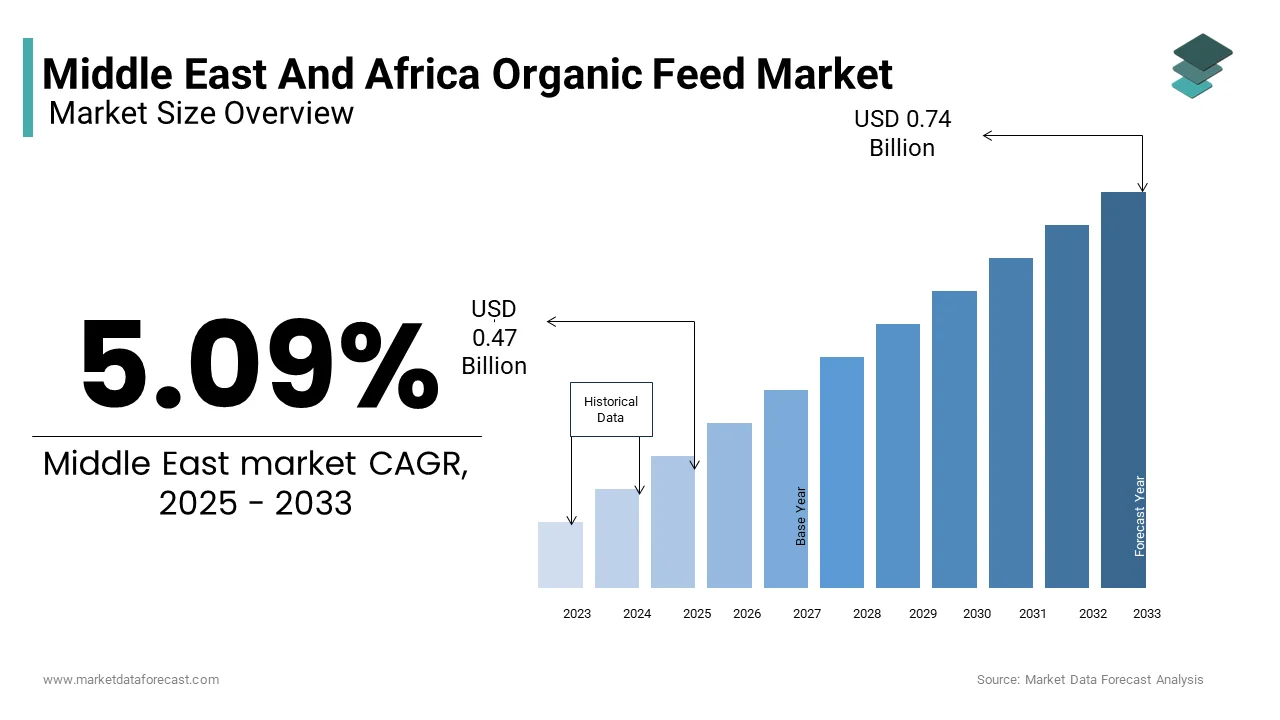
The Middle East and Africa organic feed market size was valued at USD 0.47 billion in 2025 and is anticipated to reach a valuation of USD 0.49 billion in 2026 and USD 0.73 billion by 2034, growing at a CAGR of 5.09%, from 2026 to 2034.
Organic feeds are primarily used in livestock, poultry, dairy, and aquaculture industries to support the growing demand for certified organic meat, eggs, milk, and seafood across the region. According to the Food and Agriculture Organization (FAO), there has been a gradual increase in consumer awareness regarding food safety and sustainable agriculture in several African and Gulf Cooperation Council (GCC) countries. The adoption of organic livestock systems by farmers and agribusinesses is being encouraged by this change, which is raising the need for feed inputs that comply with regulations. As per data from the Research Institute of Organic Agriculture (FiBL), the number of certified organic farms in the Middle East and Africa grew by over 12% between 2020 and 2023, which indicates a parallel rise in the need for organic feed ingredients such as maize, sorghum, and legumes.
MARKET DRIVERS
Increasing Consumer Awareness and Demand for Organic Animal Products
The growing consumer desire for organic meat, dairy, and egg products is a major factor driving the Middle East and Africa Organic Feed Market. According to the United Nations Conference on Trade and Development (UNCTAD), organic food sales in the GCC and North Africa increased by approximately 15% annually between 2020 and 2023. This trend is particularly noticeable in urban centers such as Riyadh, Doha, and Johannesburg, where consumers are more informed about the benefits of organic food and are willing to pay a premium for sustainably sourced animal products. In response, livestock producers are transitioning to organic feeding systems to meet certification requirements and gain access to premium markets. For instance, according to the Department of Agriculture, Land Reform and Rural Development in South Africa, between 2021 and 2023, more than 300 farms switched to raising livestock organically, which prompted a corresponding move towards the purchase of organic feed. Additionally, regional retailers and food service providers are increasingly adopting organic supply chain standards. The expansion of organic product lines by major supermarket chains like Pick n Pay in South Africa and Carrefour in Egypt has strengthened the demand for livestock fed organically and fuelled the rise of the organic feed sector throughout the region.
Government Support and Regional Agricultural Development Programs
Growing government support for organic agriculture through policy changes, subsidies, and development initiatives targeted at enhancing rural lives and environmental sustainability is another factor that is promoting the growth of the Middle East and Africa Organic Feed Market. According to the African Union's Comprehensive Africa Agriculture Development Programme (CAADP), several member states have introduced national strategies to promote organic farming as part of broader food security and climate resilience efforts. According to the National Institute of Agricultural Research (INRA), over the first two years of the plan, the area under organic production grew by 20%, which in turn raised demand for organic feed ingredients like barley and lentils. In 2022, Kenya's Ministry of Agriculture launched the Organic Agriculture Policy, which offers smallholder farmers raising organic livestock market connections and technical support. According to the Kenya Livestock Producers Association, during the previous three years, the number of registered organic cattle and poultry farms increased by 25% as a result of this campaign. Furthermore, the Gulf Cooperation Council (GCC) has implemented import regulations favoring organic-certified livestock products, which encourages domestic feed producers to align with international organic standards. These policy-driven developments are creating a conducive environment for the expansion of the organic feed sector across the Middle East and Africa.
MARKET RESTRAINTS
Limited Availability of Certified Organic Raw Materials
The lack of certified organic raw materials needed for feed formulation is one of the primary factors limiting the growth of Middle East and Africa Organic Feed Market. According to the Food and Agriculture Organization (FAO), only a small fraction of total agricultural land in the region is dedicated to organic crop production, which leads to shortages of key feed ingredients such as organic grains, legumes, and forage crops. According to the Research Institute of Organic Agriculture (FiBL), fewer than 3% of Sub-Saharan Africa's arable land is used for organic farming, which severely limits the supply of organic soybean, wheat, and maize are all crucial ingredients for animal feed. According to Nigeria's Federal Ministry of Agriculture, just 10% of the country's organic grain needs are met locally, which demands imports. Cost fluctuations, delays in logistics, and compliance with international certification requirements are some of the extra complications brought on by import reliance. The Saudi Standards, Metrology and Quality Organisation (SASO) enforces strict quality inspections on imports, which lengthens lead times and raises costs in Saudi Arabia, where there is little indigenous production of organic feed. These supply-side limitations create bottlenecks in scaling up organic feed manufacturing and hinder the ability of producers to meet rising demand in countries experiencing rapid growth in organic livestock farming.
High Cost of Organic Feed Production
The relatively high cost of manufacturing organic feed in comparison to conventional alternatives is also hindering the growth of Middle East and Africa Organic Feed Market. According to the International Fund for Agricultural Development (IFAD), organic feed production involves higher labor inputs, longer crop rotations, and restricted use of synthetic fertilizers and pesticides, all of which contribute to elevated costs. As reported by the University of Pretoria’s School of Agricultural Sciences, organic feed ingredients such as soybean and maize cost up to 40–50% more than their conventionally grown counterparts in major African markets. This price differential limits the affordability of organic feed for small and medium-sized livestock producers, particularly those operating in low-income regions. Furthermore, the certification process required for organic feed production adds another layer of expense. As per the Egyptian Center for Agricultural Research, obtaining and maintaining organic certification can increase operational costs by up to 30%, which discourages new entrants and limits market expansion. Additionally, limited economies of scale in organic feed manufacturing reduce cost efficiency.
MARKET OPPORTUNITIES
Expansion of Organic Livestock Farming in Emerging Economies
The rising popularity of organic livestock production in developing nations like Kenya, Ethiopia, and Morocco is creating new opportunities for the Middle East and Africa Organic Feed Market. According to the International Livestock Research Institute (ILRI), these countries are witnessing a shift toward sustainable animal husbandry practices driven by both consumer demand and government support. According to Kenya's Ministry of Agriculture, the number of certified organic dairy farms rose by 35% between 2020 and 2023, which indicates that the market is gaining substantial popularity. This growth is supported by rising rural incomes and greater awareness of the health benefits associated with organic milk and dairy products. Similarly, in Morocco, the National Office of Livestock and Pastures (ONABA) launched regional pilot programs to promote organic sheep and goat farming, which aims to boost local production of organic meat and wool. These initiatives promote market growth at the local level by providing farmers with subsidies and training to help them transition to organic feed. Additionally, private-sector players are investing in integrated organic livestock value chains that include feed supply, animal breeding, and end-product marketing.
Growing Export Demand for Organic Livestock Products
The growing export demand for organic animal products, especially from European and Asian countries, is another factor enhancing the growth of the Middle East and Africa Organic Feed Market. Organic feed plays a crucial role in meeting global certification requirements, particularly for livestock exports to the EU and Japan, where strict organic compliance protocols apply. According to the Gulf Organisation for Training and Consultancy (GOTAC), the GCC region's exports of organic livestock increased by 22% in 2023, with Saudi Arabia and Oman leading the way in the export of halal-certified meat and organic dairy products. In response, governments are introducing export-focused policies to strengthen the competitiveness of regional livestock producers. According to the Ethiopian Ministry of Trade and Regional Integration, the country's exports of organic meat to the Middle East and Europe rose by 27% in 2023, which led to more money being spent on acquiring organic feed. Moreover, multinational companies like Cargill and Nutreco are expanding their presence in the region by launching specialized organic feed lines designed for export-oriented livestock operations.
MARKET CHALLENGES
Supply Chain Fragmentation and Distribution Gaps
The supply chain's fragmentation, which results in inefficiencies in sourcing, shipping, and distribution, is a great challenging factor for the Middle East and Africa Organic Feed Market key players. Organic feed producers often face difficulties in securing consistent supplies of certified raw materials due to the lack of well-integrated procurement networks. In countries like Uganda and Tanzania, where smallholder farming dominates, the absence of centralized collection and processing facilities results in inconsistent feed quality and irregular supply. As per the Kenya Agricultural and Livestock Research Organization (KALRO), only 8% of organic feed manufacturers have access to reliable supply chains for key ingredients such as organic soy and corn. Additionally, transportation infrastructure remains a constraint, particularly in landlocked nations and remote areas. According to the World Bank, insufficient storage and handling facilities, particularly in West and Central Africa, cause organic feed to spoil during transit at rates of over 20%. These logistical challenges hinder market scalability and limit the reach of organic feed products to larger commercial farms. Addressing these gaps will require coordinated efforts between governments, cooperatives, and private enterprises to build more resilient and efficient supply networks across the region.
Lack of Awareness and Technical Expertise Among Farmers
The lack of technical expertise and awareness among livestock producers about the advantages and use of organic feeding systems is also hindering the growth of the Middle East and Africa Organic Feed Market from expanding. According to the Food and Agriculture Organization (FAO), many small-scale producers continue to rely on conventional feed due to misconceptions about organic alternatives and a lack of extension services. In countries like Sudan and Yemen, where traditional farming methods prevail, the adoption of organic feed remains low. As per the International Center for Agricultural Research in the Dry Areas (ICARDA), only 5% of surveyed farmers had received formal training on organic livestock nutrition, which indicates a substantial gap in educational outreach. Furthermore, the complexity of transitioning from conventional to organic feed systems poses a barrier. According to the Ethiopian Institute of Agricultural Research, farmers frequently struggle with feed composition, disease control, and organic certification criteria when they are not properly guided. To address this issue, several governments and non-governmental organizations have initiated farmer education programs focused on organic livestock management. Adoption is still moving slowly, though, which points out the necessity of more focused capacity-building programs to support sustained market expansion.
REPORT COVERAGE
| REPORT METRIC | DETAILS |
| Market Size Available | 2025 to 2034 |
| Base Year | 2025 |
| Forecast Period | 2026 to 2034 |
| CAGR | 5.09% |
| Segments Covered | By Type, Livestock, Form, and Region. |
| Various Analyses Covered | Global, Regional, Country-Level Analysis, Segment-Level Analysis, DROC, PESTLE Analysis, Porter’s Five Forces Analysis, Competitive Landscape, Analyst Overview of Investment Opportunities |
| Regions Covered | KSA, UAE, Israel, the rest of GCC countries, South Africa, Ethiopia, Kenya, Egypt, Sudan, the rest of MEA |
| Market Leaders Profiled | Heritage Feeds (Australia), ForFarmers (Netherlands), SunOpta (Canada), Purina Animal Nutrition LLC (US), Feedex Companies (US), Country Junction feed (US), Green Mountian Feeds (US), Unique Organic (US), Ranch-Way Feeds (US), Aller Aqua (Denmark), Scratch and Peck Feeds (US), Cargill (US), K-Much Feed Industry Co., Ltd (Thailand), The Organic Feed Company (UK), B&W Feeds (UK), Kreamer Feed (US), Cargill (US), BernAqua (Belgium), Yorktown Organics, LLC (US), and Hi Peak Feeds (UK). |
SEGMENT ANALYSIS
By Type Insights
The cereals & grains segment dominated the MEA Organic Feed market by capturing 42.9% of the share in 2025 due to its high calorie content, digestibility, and accessibility in the region's many agroclimatic zones. The rising demand for ruminant and poultry meat, which mostly depends on feed formulations based on cereals, is one of the main factors propelling this segment's expansion. Countries like Egypt, Ethiopia, and South Africa have seen a surge in poultry farming, with cereal grains such as maize, barley, and sorghum forming the backbone of feed composition. According to the Food and Agriculture Organization (FAO), cereal production in Sub-Saharan Africa reached over 150 million metric tons in 2023, which supports both human consumption and animal feed industries. Another major factor is government support for sustainable agriculture and organic farming practices. For instance, according to Kenya's Ministry of Agriculture, incentives and training initiatives targeted at converting conventional farms to organic systems were primarily responsible for the 18% rise in organic grain output between 2020 and 2023. This has directly fueled the supply of raw materials for organic feed manufacturers. Lastly, rising consumer awareness regarding food safety and health benefits associated with organically-fed livestock products has pushed farmers to adopt organic feed. Certified organic grains are becoming more popular as feed in the Gulf Cooperation Council (GCC), where there is a strong demand for high-quality meat and dairy products.
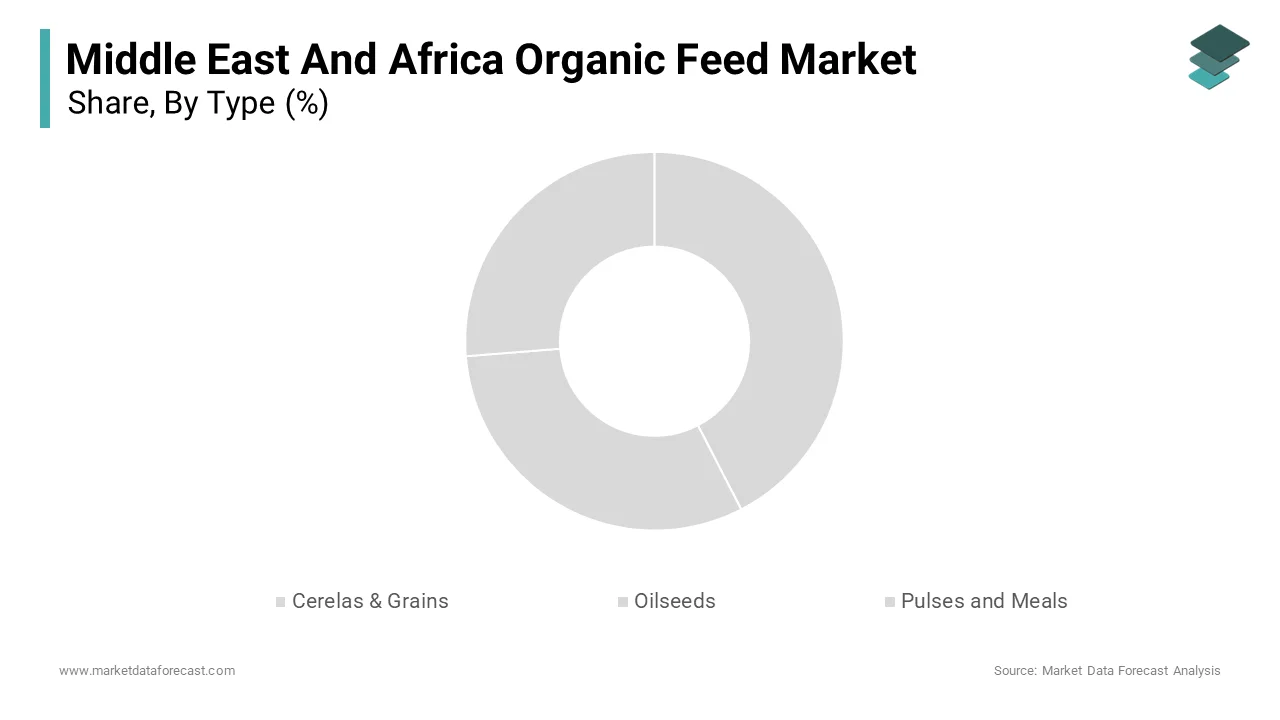
The oilseeds segment is predicted to witness a CAGR of 9.6% from 2025 to 2033 due to rising demand for protein-rich livestock diets, especially for poultry and swine, which require high-protein feed ingredients like soybean meal, sunflower cake, and cottonseed meal. The growing integration of organic oilseed crops into regional agricultural systems is one of the main factors propelling this expansion. According to the Ethiopian Agricultural Transformation Institute, Ethiopia has increased its production of organic flaxseed and sesame seeds, and exports increased by 21% in 2023. These crops are not only consumed domestically but also processed into organic feed, contributing to sectoral expansion. Additionally, regulatory developments in the region are encouraging the adoption of non-GMO and organic oilseeds. In South Africa, the Department of Agriculture, Land Reform and Rural Development introduced stricter labeling norms for organic feed ingredients in 2022, which prompted manufacturers to source certified organic oilseeds. Moreover, the rise of organic dairy and meat certification standards across the GCC and North Africa has created a ripple effect on feed formulation strategies.
By Livestock Insights
The poultry segment led the MEA Organic Feed market by occupying the share of 38.4% in 2025. Growing consumption of organic eggs and meat, particularly in urban centers across countries like Egypt, Kenya, and the UA, is one of the drivers for the segment’s growth. According to the FAO, poultry meat production in Africa reached 8.4 million metric tons in 2023, with a significant portion being organic or transitioning to organic certification. According to the Egyptian Ministry of Agriculture, export prospects and changing dietary habits among middle- and upper-class populations were the main drivers of the 22% rise in organic poultry farms between 2021 and 2023. Consumer preference for antibiotic-free and chemical-residue-free poultry products is a key force behind this trend. As per the Dubai Municipality report, a 35% increase in organic poultry product imports in 2023, which shows the need for organic feed inputs in the United Arab Emirates, where imported organic chicken demands a premium price. Furthermore, supportive policy frameworks in several African nations have facilitated the transition to organic poultry farming. Kenya’s National Organic Agriculture Policy, launched in 2021, includes financial incentives for smallholder farmers adopting organic feed practices.
The aquatic animal’s segment is expected to grow with a CAGR of 10.3% during the forecast period. The region's growing investments in sustainable fish farming and the rise of organic aquaculture are the main drivers of this growth. Egypt leads this growth trajectory, with the Nile tilapia farming industry witnessing a surge in organic certifications. According to the General Authority for Fish Resources Development (GAFRD), the use of organic feed derived from algae, spirulina, and organic plant proteins supported Egypt's organic fish production increase by 28% in 2023. In addition, international demand for sustainably sourced seafood has prompted investment in organic aquaculture infrastructure. Moreover, advancements in feed formulation technologies tailored for organic fish diets have enabled better nutrient absorption and disease resistance. According to a 2023 WorldFish Centre study, fish fed organic food had 15% higher survival rates than fish fed conventional food, which shows the business feasibility of organic aquafeed.
By Form Insights
The Pellets segment led the MEA Organic Feed market by capturing 47.3% of the share in 2025. The extensive use of pellets in large-scale livestock and poultry farms is one of the main factors contributing to the segment's prominence. According to the International Feed Industry Federation (IFIF), over 60% of commercial feed in Sub-Saharan Africa is now in pelleted form due to its ability to retain nutritional integrity and prevent ingredient segregation. Additionally, the rise of integrated feed mills in countries like Egypt and South Africa has favored pellet production. The Egyptian Feed Millers Association reported that pellet feed production rose by 21% in 2023, which is driven by investments from both domestic and foreign investors aiming to meet growing livestock feed demand.
The crumbles segment is anticipated to witness a CAGR of 10.1% from 2025 to 2033 due to its suitability for young livestock and aquaculture species, where smaller particle size enhances digestion and nutrient uptake. The main driver of this growth is the rising focus on early-stage nutrition in poultry and fish hatcheries. According to Kenya's Ministry of Fisheries, the use of organic crumble feed in tilapia fry rearing rose by 32% in 2023 as it promotes quicker development and decreased juvenile mortality rates. Similarly, in the UAE, the Abu Dhabi Animal Health Authority promoted the use of crumble feed in broiler starter diets, which points to enhanced feed conversion ratios and weight increase. According to an internal assessment from the agency, broilers fed crumbled organic feed acquired 12% more weight in the first four weeks than those fed mash, which shows the advantages of this feed for performance.
COUNTRY ANALYSIS
Saudi Arabia (KSA)
Saudi Arabia outperformed other regions in the MEA organic feed market by accounting for 18.4% of the share in 2025. KSA is a key player in determining regional trends as a leader in import diversification and agri-food innovation. The Kingdom's commitment to food security under Vision 2030 has spurred investments in organic livestock and dairy sectors. According to the Saudi Agricultural and Livestock Investment Company (SALIC), the demand for certified organic feed was fuelled by a 17% growth in organic livestock holdings in 2023. Additionally, the National Center for Organic Agriculture (NCOA) registered over 30 new organic feed producers in the same year. Consumer demand for clean-label and ethically produced meat and dairy products has surged, especially in Riyadh and Jeddah. Retailers like Panda Group and BinDawood Superstores have expanded their organic product lines, which indirectly boosts organic feed procurement.
United Arab Emirates (UAE)
The UAE accounts for 14.8% of the MEA organic feed market share in 2025. Dubai’s status as a global trade hub has facilitated access to high-quality organic feed ingredients from Europe and North America. According to the Dubai Chamber of Commerce, organic feed imports totaled $180 million in 2023, which represents a 26% increase from the previous year. This reflects growing investments in organic dairy and poultry farms catering to premium markets. Adoption of organic feed is consistent with the UAE's Food Security Strategy 2051, which places a focus on resilient and sustainable food systems. The Abu Dhabi Agriculture and Food Safety Authority (ADAFSA) launched the "Organic Emirati" certification program in 2022, which includes strict guidelines for organic livestock feed. According to ADAFSA data, certified organic farms in the emirate grew by 20% in 2023. Moreover, consumer awareness campaigns by private companies like Union Coop and Carrefour have boosted retail sales of organic meat and dairy, which creates a ripple effect on feed sourcing. Nestlé Middle East announced in 2023 that it would source 100% organic feed for its UAE-based dairy suppliers by 2025, which demonstrates long-term commitments from multinational players.
South Africa
South Africa's organic feed market growth is likely to grow with well-established certification bodies such as Ecocert and the Organic Products Certification Agency (OPCA). According to Statistics South Africa, the number of organic livestock increased by 15% in 2023, and the output of organic feed increased in parallel. The Western Cape and Mpumalanga provinces are hotspots for organic poultry and dairy farms. Local feed manufacturers like Nutri Feeds and AgriVet Organics have scaled production to meet domestic and export demand. According to the Department of Agriculture, Land Reform, and Rural Development, exports of organic feed increased by 19% in 2023, mostly to Southern African Development Community (SADC) countries. South Africa also benefits from research-driven innovations in feed formulation.
Egypt
Egypt's organic feed market is emerging as a regional powerhouse in organic livestock and poultry farming. According to the Egyptian Ministry of Agriculture, government incentives and training initiatives helped organic poultry farms grow by 22% in 2023. The country's leading feed producers, which include Juhayna and Al-Watania Poultry, have invested in dedicated organic feed lines to cater to this growing segment. Export potential is another key growth factor. Egypt’s participation in international organic trade agreements, such as the EU-Egypt Partnership Agreement, has opened doors for greater market access.
Kenya
Kenya's organic feed market is likely to have significant growth opportunities in the coming years. Its strategic location and progressive policies make it a hub for organic feed production and distribution. Organic livestock production has expanded as a result of the Kenyan government's push for climate-smart agriculture. According to the Kenya Organic Agriculture Network (KOAN), organic feed sales grew by 19% in 2023, with notable demand from dairy cooperatives and poultry integrators. Smallholder farmer engagement is a unique strength. Organizations like Biovision Africa Trust and the Kenya Institute of Organic Farming (KIOF) have trained over 50,000 farmers in organic feed practices since 2020, which promotes grassroots-level transformation. Kenya also benefits from donor-funded projects focused on sustainable livestock development.
KEY MARKET PLAYERS
Some of the key players of the MEA Organic Feed market are Country Heritage Feeds (Australia), ForFarmers (Netherlands), SunOpta (Canada), Purina Animal Nutrition LLC (US), Feedex Companies (US), Country Junction feed (US), Green Mountian Feeds (US), Unique Organic (US), Ranch-Way Feeds (US), Aller Aqua (Denmark), Scratch and Peck Feeds (US), Cargill (US), K-Much Feed Industry Co., Ltd (Thailand), The Organic Feed Company (UK), B&W Feeds (UK), Kreamer Feed (US), Cargill (US), BernAqua (Belgium), Yorktown Organics, LLC (US), and Hi Peak Feeds (UK).
Top Players In The Market
Cargill Incorporated
Cargill is a global leader in agricultural and food supply chains, with a strong presence in the organic feed sector across the Middle East and Africa. The company has strategically expanded its presence by partnering with local producers and investing in sustainable sourcing practices. Cargill plays a key role in shaping market dynamics through innovation in feed formulation and supply chain transparency. Its commitment to responsible agriculture aligns with growing regional demand for certified organic livestock products.
Nutreco N.V.
Nutreco is a prominent player known for its focus on animal nutrition and aquafeed solutions. In the MEA region, the company has been actively involved in promoting sustainable livestock production through high-quality organic feed offerings. Nutreco focuses on research-driven product development and collaborates with regional stakeholders to support the transition from conventional to organic farming systems. Its expertise contributes significantly to setting market benchmarks in feed safety and nutritional efficiency.
Alltech Inc.
Alltech has established itself as a major contributor to the organic feed market in the MEA region through its focus on natural and science-based solutions. The company supports farmers and producers with organic feed additives, yeast-based supplements, and mycotoxin management tools designed for organic compliance. Alltech is a reputable brand among livestock producers looking for healthier and more sustainable solutions due to its educational outreach initiatives and collaborations with regional organisations, which support the organic feed value chain.
Top Strategies Used by Key Market Participants
Strategic Partnerships and Collaborations
Leading companies are forming alliances with local governments, certification bodies, and agricultural cooperatives to promote organic feed adoption. These collaborations help in navigating regulatory landscapes, enhancing farmer education, and ensuring supply chain integrity across diverse markets in the MEA region.
Product Innovation and R&D Investments
Market players are prioritizing the development of customized organic feed formulations that cater to specific livestock needs. Market participants seek to acquire a competitive edge by investing in R&D to increase feed efficiency, improve nutritional profiles, and guarantee adherence to international organic standards.
Expansion into Emerging Markets
Key players are extending their operations into underserved areas of Africa and the Middle East to take advantage of the rising demand. This includes setting up regional distribution centers, launching localized marketing campaigns, and adapting product portfolios to meet regional dietary and climatic conditions.
COMPETITION OVERVIEW
The competition in the Middle East and Africa organic feed market is gradually intensifying as consumer awareness about sustainable and healthy livestock products continues to grow. Regional players and emerging startups are becoming more popular in local markets, even while international businesses continue to dominate the higher-end markets, especially in South Africa and the Gulf Cooperation Council (GCC). These smaller firms often leverage their proximity to raw materials and better understanding of regional farming practices to offer cost-effective and culturally relevant organic feed solutions. The market remains fragmented due to varying regulatory frameworks across countries, which influences how companies operate and scale their businesses. Additionally, the rising preference for locally sourced and traceable feed ingredients is encouraging domestic manufacturers to invest in organic certification and quality assurance processes. Competition is anticipated to shift towards differentiation through innovation, sustainability claims, and supply chain transparency as the market for organic meat, dairy, and aquaculture products grows. Companies that can successfully integrate ethical sourcing, scientific validation, and strong brand positioning are likely to emerge as long-term leaders in this evolving market.
RECENT HAPPENINGS IN THE MARKET
- In February 2024, Cargill launched a new line of organic poultry feed in Egypt that is aimed at large-scale egg and broiler producers aiming to meet rising demand for antibiotic-free poultry products. This move strengthened its presence in North Africa's rapidly growing organic livestock sector.
- In May 2024, Nutreco partnered with a Kenyan agricultural cooperative to provide training and technical support for smallholder farmers transitioning to organic dairy feed systems. This initiative aimed at improving feed quality and boosting local production capacity in East Africa.
- In July 2024, Alltech opened a regional innovation center in South Africa focused on developing organic feed additives tailored to the climate and livestock needs of sub-Saharan Africa. The center also serves as a hub for farmer education and field trials.
- In September 2024, a leading regional feed producer, Grand Cereals Limited, introduced an advanced crumble feed line specifically designed for organic aquaculture and young poultry. This expansion targeted niche markets requiring high digestibility and enhanced nutrient absorption.
- In November 2024, Juhayna, one of Egypt’s largest dairy companies, announced an exclusive sourcing agreement with a European organic feed supplier to ensure consistent quality and supply stability for its expanding organic milk production division.
MARKET SEGMENTATION
This research report on the Middle East and Africa organic feed market is segmented and sub-segmented into the following categories.
By Livestock
- Poultry
- Ruminants
- Swine
- Aquatic Animals
- Others
- Equine And Pets
By Type
- Cereals & Grains
- Wheat
- Maize And Barley
- Oilseeds
- Soybean
- Rapeseeds
- Sesame Seeds
- Copra
- Sunflower Seeds
- Pulses And Meals
By Form
- Pellets
- Crumbles And Mash
By Additives
- Minerals
- Amino Acids
- Vitamins
- Enzymes
- Phytogenic
By Country
- KSA
- UAE
- Israel
- Rest Of The GCC Countries
- South Africa
- Ethiopia
- Kenya
- Egypt
- Sudan
- Rest Of MEA