- Product Description Description
- Table of Contents TOC
- List of Table & Figure LOT
- Get Free Sample PDF Sample PDF
Market Size, 2025
$0.59 BnMarket Estimate, 2026
$0.60 BnMarket Forecast, 2034
$0.71 BnCAGR, 2026–2034
2.05%Executive Summary: Middle East And Africa Pickles Market
- Market Scope: Comprehensive Middle East and Africa pickles market analysis covering distribution channels, product types, regional leadership frameworks, key industry players, and emerging retail and culinary trends.
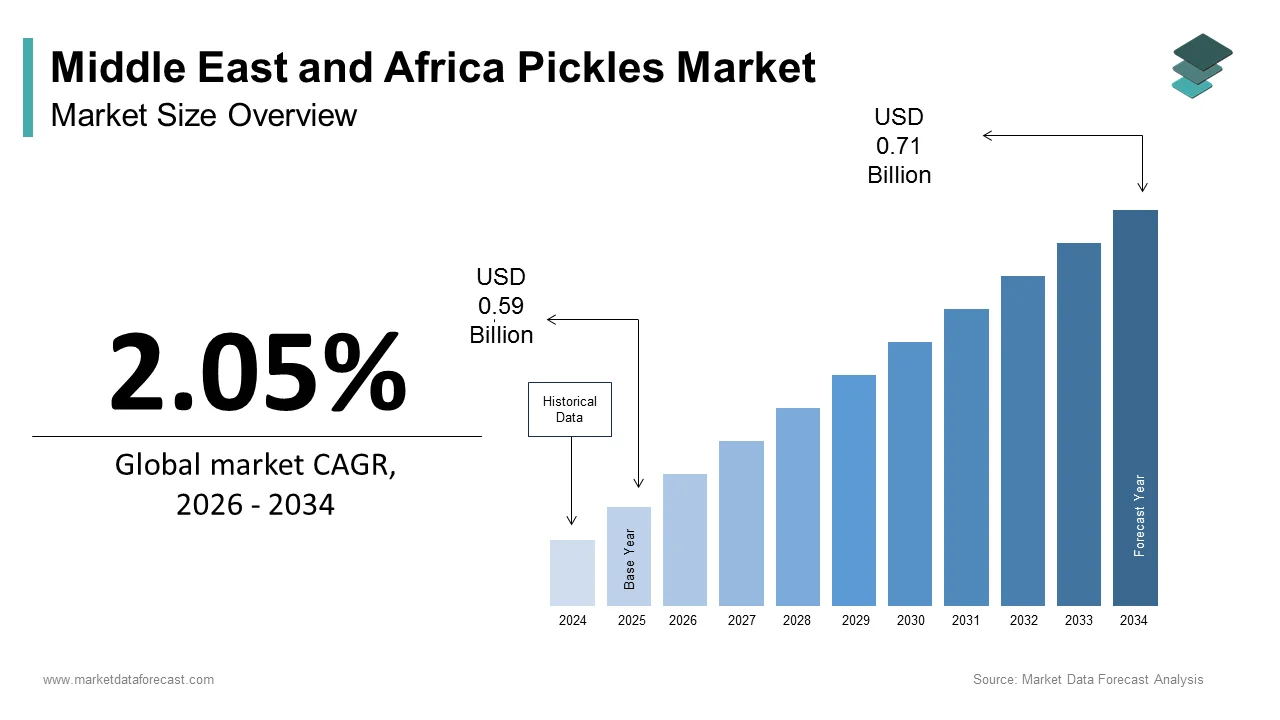
- Market Valuation: Valued at USD 0.59 billion (2025), estimated at USD 0.60 billion (2026), and projected to reach USD 0.71 billion by 2034, registering a steady CAGR of 2.05% (2026–2034).
- Primary Growth Drivers: Deep cultural culinary traditions, rapid urbanization, rising demand for affordable and shelf-stable food products, essential role of pickles in traditional regional meals, busy modern lifestyles requiring convenient condiments, extensive raw material production (mangoes, lemons, cucumbers), and proliferation of organized retail and digital commerce.
Key Market Segment Metrics (2026–2034)
| Category | Leading Segment (2025 Position) | Fastest-Growing Segment |
|---|---|---|
| By Distribution Channel | Supermarkets segment (dominated in 2025 due to consumer preference for bulk purchasing and product variety) | Convenience Stores segment (predicted to record a promising CAGR driven by urbanization and immediate accessibility) |
| By Type | Mango segment (held the largest share in 2025 due to cultural integration and local production) | Chilli Pickles segment (estimated to register a healthy CAGR owing to surging preference for spicy flavor profiles among youth) |
| By Region / Country | Saudi Arabia (poised for substantial expansion driven by population growth and food security focus) and Egypt (industrial processing output ramp-up) | High-urbanization metropolitan hubs and organized digital retail corridors across the MEA region |
Major Market Players & Market Structure
Market Structure: Highly competitive regional food processing landscape featuring major domestic and international participants competing on automated packaging infrastructure, organic/low-sodium product launches, probiotic-fermented functional offerings, and supply chain expansion.
Key Companies: ADF Foods, Del Monte Foods, Mt. Olive Pickle Company, Kraft Foods Inc., Reitzel International, Pinnacle Foods, Inc., Mitoku Company, Ltd, National Food Products Company, Al Alali Foods, and Tsabar Salads.
Middle East and Africa Pickles Market Size
The size of the Middle East and Africa Pickles Market was calculated to be USD 0.59 billion in 2025 and is anticipated to be worth USD 0.71 billion by 2034 from USD 0.60 billion in 2026, growing at a CAGR of 2.05% during the forecast period.
Pickles are preserved vegetables and fruits submerged in acidic solutions, such as vinegar, brine, or edible oils. This culinary category is deeply embedded in the regional gastronomic heritage, serving as an essential condiment that enhances the flavor profile of traditional dishes like rice, grilled meats, and flatbreads. The foundational availability of raw agricultural produce directly supports this extensive preservation industry. According to the Food and Agriculture Organization, the total agricultural production in Africa alone reached approximately 830 million metric tons in recent cycles, providing a massive and diverse supply of mangoes, lemons, olives, and cucumbers for local processing. Furthermore, the demographic expansion across the continent significantly amplifies the baseline consumption of these traditional accompaniments. As per the United Nations Department of Economic and Social Affairs, the population of the African continent is projected to exceed 2.5 billion people by the middle of the century, ensuring a continuously expanding consumer base that relies on affordable and shelf-stable flavor enhancers. According to the World Health Organization, traditional fermented and pickled foods play a critical role in regional diets by providing essential probiotics and preserving vital nutrients during periods of extreme heat. Consequently, the intersection of rich cultural culinary practices and abundant agricultural output defines the dynamic and resilient landscape of this vital food preservation sector across these diverse nations.
MARKET DRIVERS
Deep cultural roots and traditional meal pairings bolster regional daily pickle consumption.
The profound cultural integration of preserved condiments into daily traditional meals is driving the growth of the Middle East and African pickles market. In both the Middle East and Africa, pickled vegetables and fruits are not merely optional garnishes, but essential components that balance the rich, heavy, and spice-laden profiles of traditional cuisines. Dishes such as biryani, mandi, and various mezze platters require the sharp acidity and crunch of pickled lemons, turnips, and mangoes to cut through the fat and enhance the overall palate experience. According to the Food and Agriculture Organization, the global trade and utilization of major culinary spices have steadily climbed to meet intensive dietary environments, where highly acidic and pungent preserved foods are strictly necessary to complement intense flavors. Furthermore, the cultural practice of communal dining heavily features these condiments as central elements of hospitality. According to the Food and Agriculture Organization, traditional dietary patterns and community family gatherings in the region heavily mandate the presence of assorted pickles on the dining table to aid digestion and elevate the meal. This deep-seated culinary tradition ensures that, regardless of economic fluctuations, the demand for authentic and traditional pickled products remains exceptionally high and deeply woven into the daily dietary fabric of millions of consumers.
Rapid urbanization and inflationary pressures shift consumer demand toward affordable, shelf-stable foods.
The escalating consumer preference for affordable and shelf-stable flavor enhancers significantly accelerates the adoption of commercially packaged pickles, which further aids the regional market growth. Rapid urbanization and the resulting shift toward busy, modern lifestyles have drastically reduced the time available for traditional home preservation methods. Consequently, urban populations are increasingly turning to commercially processed and bottled pickles that offer an extended shelf life without the need for continuous refrigeration. According to the United Nations Department of Economic and Social Affairs, the urban population in Africa is projected to grow by nearly 500 million people over the next two decades, fundamentally altering food consumption patterns toward convenient and durable products. The extreme climatic conditions across vast portions of the continent further necessitate food products that can withstand high ambient temperatures during storage and transport. According to the World Bank, food inflation in several African nations recently surpassed 20%, prompting lower and middle-income households to seek out inexpensive, yet highly flavorful condiments to make basic staples like rice and bread more palatable. Pickles perfectly fulfill this economic and functional requirement by providing intense flavor at a very low cost per serving. According to the Food and Agriculture Organization, the procurement of preserved vegetable products has increased steadily among urban demographics seeking to optimize their household food budgets while maintaining culinary satisfaction.
MARKET RESTRAINTS
Aggressive public health mandates targeting high sodium intake disrupt conventional manufacturing recipes.
The implementation of rigorous governmental regulations concerning high sodium content and artificial preservatives severely restricts traditional manufacturing formulations, which is a significant restraint to the growth of the Middle East and African pickles market. Traditional pickling relies heavily on massive quantities of salt and chemical preservatives to inhibit microbial growth and ensure product longevity in hot climates. However, modern public health initiatives across the Middle East and Africa are aggressively targeting the reduction of dietary sodium to combat the rising epidemic of cardiovascular diseases. According to the World Health Organization, the prevalence of hypertension in the Eastern Mediterranean region affects nearly 38% of the adult population, prompting health ministries to introduce strict guidelines and potential taxation on high-sodium food products. This medical imperative forces commercial pickle manufacturers to completely overhaul their traditional recipes, which is a highly complex process because reducing salt can lead to rapid spoilage and severe textural degradation. According to the World Health Organization, over 1.28 billion adults globally suffer from hypertension, with a significant concentration in developing nations where traditional preserved foods constitute a major part of the daily diet. Reformulating these products to meet new health standards requires massive investments in research and development to find natural alternatives that maintain safety and taste. Consequently, the heavy burden of regulatory compliance and the technical difficulties of low-sodium preservation act as substantial barriers limiting the rapid expansion of conventional pickle manufacturing.
Severe climate abnormalities and water scarcity destabilize the agricultural procurement of raw materials.
The extreme vulnerability of agricultural supply chains to unpredictable climate shocks and prolonged droughts severely disrupts the consistent availability of raw produce, which is further impeding the regional market expansion. The commercial production of pickles is entirely dependent on the steady and abundant harvest of specific vegetables and fruits, such as cucumbers, mangoes, and lemons. However, the Middle East and Africa are among the most water-scarce regions on the planet, making agricultural output highly susceptible to erratic weather patterns. According to the World Meteorological Organization, successive failed rainy seasons and severe droughts have historically reduced crop yields across vulnerable agricultural zones by up to 40% in recent years, leading to catastrophic reductions in crop yields. When harvests fail or diminish significantly, the prices of raw agricultural commodities surge dramatically, squeezing the profit margins of pickle manufacturers who cannot easily pass these costs onto price-sensitive consumers. According to the Food and Agriculture Organization, regional agricultural yields can fluctuate by more than 20% during extreme weather anomalies, creating massive volatility in the procurement of essential raw materials. As per the United Nations Environment Programme, declining groundwater reserves are forcing farmers to abandon water-intensive crops, like certain citrus varieties required for premium pickles. This inherent agricultural instability prevents manufacturers from maintaining consistent production volumes and forces them to navigate a highly unpredictable and expensive raw material landscape.
MARKET OPPORTUNITIES
The rising wellness trend allows for the development of premium, probiotic-fortified pickle varieties.
The strategic development of functional and probiotic-enriched pickle variants presents a massive avenue for the Middle East and African pickle market. Traditionally, fermented pickles naturally contain beneficial lactic acid bacteria, but modern food science allows manufacturers to isolate and fortify these products with specific, clinically validated probiotic strains that target gut health and immune function. According to the World Health Organization, consumer interest and global food expenditures on health-supporting dietary options continue to grow dramatically, reflecting an intense willingness among affluent buyers to pay premium prices for functional foods. By repositioning artisanal and commercially produced pickles from simple condiments to active digestive health supplements, manufacturers can tap into the lucrative wellness market. According to the World Gastroenterology Organisation, regular consumption of naturally fermented foods significantly improves the intestinal microbiome and enhances nutrient absorption. Furthermore, according to the World Health Organization, hundreds of millions of people worldwide suffer from digestive disorders, creating a massive parallel demand for accessible and delicious dietary interventions. By leveraging advanced fermentation technologies and transparently marketing the specific health benefits of their live cultures, pickle producers can command significantly higher retail margins and establish a strong foothold in the premium health food sector across the region.
Digital commerce and online grocery platforms open direct supply routes to global consumer groups.
The rapid proliferation of electronic commerce platforms and specialized digital marketplaces offers a transformative channel for reaching diverse and geographically dispersed consumers. Historically, the distribution of regional pickles was confined to local physical markets and traditional grocery stores, severely limiting the geographic reach of artisanal and premium brands. Today, the explosive growth of online grocery retail allows specialized producers to bypass traditional distribution barriers and ship their products directly to consumers across vast international distances. According to the International Trade Administration, the electronic commerce sector across major Middle Eastern economies is expanding at an unprecedented rate, with digital sales growing by over 20% annually as smartphone penetration deepens. This digital transformation enables small-batch and heritage brands to connect directly with the massive regional diaspora living in Western countries who crave authentic culinary connections to their homelands. According to the World Bank, internet user penetration in the region has surpassed 60%, creating a massive digital infrastructure capable of supporting sophisticated direct-to-consumer logistics. Furthermore, according to the International Trade Administration, online platforms allow manufacturers to utilize targeted digital marketing and immersive storytelling to educate consumers about the traditional craftsmanship behind their products. This shift toward digital retail empowers brands to scale their operations exponentially, while maintaining the exclusivity and premium positioning of their artisanal offerings.
MARKET CHALLENGES
Deeply entrenched informal street vendors and unbranded products severely compromise corporate pricing power.
The overwhelming presence of unorganized and informal local producers creates a fiercely competitive landscape that severely undermines the pricing power of commercial manufacturers. In many parts of the Middle East and Africa, the production and sale of pickles remain deeply rooted in the informal economy, with countless street vendors, local markets, and households producing and selling unbranded preserved goods at extremely low prices. According to the International Labour Organization, the informal economy accounts for nearly 86% of total employment in Sub-Saharan Africa and a significant portion in the Middle East, meaning a vast network of micro-enterprises operates completely outside the formal tax and regulatory systems. This allows informal producers to avoid the massive overhead costs associated with quality control, packaging, and food safety compliance, enabling them to undercut formal commercial brands by substantial margins. According to the World Bank, unbranded and loosely packaged preserved foods often capture over 60% of the total volume consumed in rural and lower-income urban areas. Furthermore, according to the Food and Agriculture Organization, the lack of standardization in the informal sector leads to inconsistent quality and potential safety risks, yet consumers remain highly loyal to these cheap alternatives due to severe economic constraints. Consequently, formal manufacturers face the immense challenge of justifying their premium pricing and investing heavily in brand education to convince consumers to switch from deeply entrenched informal suppliers.
Surging industrial energy costs and advanced glass container procurement deflate manufacturer margins.
The escalating financial burden associated with advanced packaging materials and modern preservation technologies imposes severe margin pressures on manufacturing operations, which further challenges the expansion of the regional market. To ensure that pickles remain safe, flavorful, and visually appealing in the extreme heat and humidity characteristic of the Middle East and Africa, manufacturers must utilize highly specialized packaging and rigorous thermal processing methods. Traditional plastic containers are often unsuitable for highly acidic and oily products, necessitating the use of premium glass jars with advanced hermetic sealing technologies to prevent leakage and oxidation. According to the Food and Agriculture Organization, global procurement costs for packaging supplies have increased by over 15% in recent periods due to supply chain disruptions and rising energy prices. Furthermore, the pasteurization and sterilization processes required to eliminate harmful pathogens and extend shelf life consume massive amounts of thermal energy. According to the World Energy Council, industrial energy costs in several African and Middle Eastern nations have surged by more than 25% recently, drastically inflating the operational expenditures of food processing facilities. According to the United Nations Industrial Development Organization, maintaining strict quality assurance in harsh climates requires continuous investment in climate-controlled storage and advanced logistics. Consequently, the relentless rise in packaging and energy expenses severely squeezes profit margins, forcing manufacturers to navigate a highly complex and costly operational environment.
REPORT COVERAGE
| REPORT METRIC | DETAILS |
| Market Size Available | 2025 to 2034 |
| Base Year | 2025 |
| Forecast Period | 2026 to 2034 |
| CAGR | 2.05% |
| Segments Covered | By Distribution Channel, Type, and Country. |
| Various Analyses Covered | Global, Regional & Country Level Analysis, Segment-Level Analysis; DROC, PESTLE Analysis, Porter's Five Forces Analysis, Competitive Landscape, Analyst Overview of Investment Opportunities |
| Country Covered | KSA, UAE, Israel, Rest of GCC countries, South Africa, Ethiopia, Kenya, Egypt, Sudan, Rest of MEA. |
| Market Leader Profiled | ADF Foods, Del Monte Foods, Mt. Olive Pickle Company, Kraft Foods Inc., Reitzel International, Pinnacle Foods, Inc., Mitoku Company, Ltd, And Others |
SEGMENTAL ANALYSIS
By Distribution Channel Insights
The supermarkets segment dominated the market by capturing the largest share of the regional market in 2025. The leading position of the supermarket segment in the regional market is primarily driven by its extensive product variety and the consumer preference for comprehensive bulk purchasing. Modern shoppers in the Middle East and Africa increasingly favor large-format retail environments that offer a massive array of pickle brands, regional flavors, and diverse package sizes under one roof. According to the African Development Bank, the organized retail sector across the continent has expanded by over 15% annually, reflecting a massive shift away from fragmented traditional markets toward modern grocery chains. These large-scale stores allow families to purchase monthly provisions in bulk, which is highly economical and time-efficient. Furthermore, supermarkets frequently run aggressive promotional campaigns and bundle deals on preserved foods, attracting price-sensitive consumers who seek maximum value for their household budgets. According to the African Development Bank, modern format grocery stores capture nearly 60% of all packaged food sales in major urban centers across the region. By providing an unparalleled selection of both mass-market and premium artisanal pickle varieties, supermarkets have cemented their position as the absolute primary destination for consumers seeking reliable and diverse preserved food options.
The convenience stores segment is predicted to record a promising CAGR in the global market during the forecast period, owing to the intense urbanization and the escalating consumer demand for immediate product accessibility. As millions of people migrate to densely populated metropolitan areas across the Middle East and Africa, their daily routines have become increasingly fast-paced and time-constrained, leaving little room for lengthy grocery shopping excursions. According to the United Nations Department of Economic and Social Affairs, the urban population in the region is projected to grow by over 300 million people in the next two decades, fundamentally altering retail consumption patterns toward quick and accessible formats. Convenience stores perfectly fulfill this need by offering immediate access to essential daily items, including single-serve or small-format pickle jars, right in the consumers' immediate neighborhoods. According to the World Bank, the proliferation of modern convenience retail formats has grown by nearly 20% annually in major cities like Cairo, Johannesburg, and Dubai. This hyper-local availability allows busy professionals and students to instantly fulfill sudden culinary cravings or top up their pantry supplies without the logistical burden of visiting massive hypermarkets, thereby driving the exceptional growth velocity of this specific distribution channel.
By Type Insights
The mango segment had the largest share of the regional market in 2025. The absolute supremacy of mango pickles is deeply rooted in their profound cultural integration and indispensable role in traditional regional culinary practices. Across both the Middle East and Africa, the mango harvest season is celebrated with the massive preparation of preserved mangoes, which serve as a vital accompaniment to daily staples like rice, flatbreads, and grilled meats. According to the Food and Agriculture Organization, the total mango production in the region exceeds 5 million metric tons annually, providing an abundant and highly cost-effective raw material base for commercial and domestic preservation. According to the Food and Agriculture Organization, a vast percentage of agricultural households in major regional production zones consume or prepare fruit preserves regularly, reflecting a deeply ingrained dietary habit that transcends generational shifts. Furthermore, according to the Food and Agriculture Organization, specific regional variations of mango pickles are passed down through families as cherished culinary traditions. This unbreakable cultural bond ensures that mango pickles maintain an unassailable leading position in the overall market volume.
However, the chilli pickles segment is estimated to register a healthy CAGR in the regional market during the forecast period, owing to the surging consumer preference for intensely spicy and pungent flavor profiles across diverse demographic segments. Modern palates in the Middle East and Africa are increasingly seeking bold and aggressive taste experiences to elevate everyday meals and counteract the blandness of basic staple diets. According to the Food and Agriculture Organization, the regional trade and consumption of high-heat, capsaicin-rich ingredients have grown by over 18% annually, reflecting a massive cultural shift toward fiery and robust culinary profiles. Chilli pickles deliver an immediate and intense sensory impact that perfectly complements the expanding popularity of grilled meats, rich stews, and modern fusion cuisines. According to the Food and Agriculture Organization, products featuring extreme heat and complex spice blends are the fastest-moving items in the preserved food aisles of modern supermarkets. Furthermore, according to the Food and Agriculture Organization, younger demographics are actively experimenting with hyper-spicy condiments to create unique and exciting flavor combinations in their home cooking. This relentless pursuit of intense gustatory stimulation ensures that chilli pickles are experiencing the most rapid volume growth in the entire market.
REGIONAL ANALYSIS
Saudi Arabia Pickles Market Analysis
Saudi Arabia is poised to experience substantial expansion in its domestic food manufacturing landscape over the coming years, driven by a massive population base and deep cultural affinity for traditional preserved foods. The market status here is defined by the continuous integration of pickled vegetables into daily meals and the strong government focus on domestic food security. According to the World Bank, the total population recently surpassed 36 million citizens, driving immense baseline demand for affordable and flavorful condiments. According to the Ministry of Investment, national food and beverage manufacturing operations have attracted over 5 billion dollars in foreign direct investment recently to expand local production capacities. Furthermore, according to the General Authority for Statistics, retail food sales have grown by 12% annually as modern supermarket chains expand their footprint across major urban centers. This robust economic expansion and the profound cultural reliance on preserved foods guarantee sustained and highly profitable market growth across the entire kingdom today and tomorrow globally.
United Arab Emirates Pickles Market Analysis
The United Arab Emirates is projected to significantly elevate its position as a high-value consumer market over the next few years, fueled by a massive expatriate population and a thriving luxury food retail sector. According to the World Bank, expatriates constitute nearly 90% of the total population, creating a massive and diverse consumer base with varied culinary preferences. According to the Dubai Department of Economy and Tourism, the hospitality sector generated over 30 billion dollars in revenue recently, driving immense procurement of premium condiments by high-end restaurants. Furthermore, according to the Emirates Authority for Standardization and Metrology, strict quality control measures have elevated consumer trust in commercially packaged preserved foods. This continuous influx of global talent and the aggressive expansion of luxury retail environments ensure rapid and consistent market expansion right here and now.
Israel Pickles Market Analysis
Israel is expected to achieve exceptional growth in high-tech food preservation and export markets during the upcoming years, driven by exceptional agricultural technology and a strong culture of culinary innovation. According to the Ministry of Agriculture and Rural Development, the national agricultural technology export sector recently exceeded 5 billion dollars, demonstrating the immense capability to produce high-quality raw materials. According to the Central Bureau of Statistics, the domestic food manufacturing industry has expanded by 8% annually as consumers increasingly seek out organic and naturally fermented preserved vegetables. Furthermore, according to the Israel Export Institute, international demand for premium regional culinary products has surged by 15%, boosting local production volumes. This profound commitment to technological excellence and culinary authenticity guarantees continuous and robust commercial growth across the region today.
Gulf Cooperation Council Pickles Market Analysis
The remaining Gulf Cooperation Council nations are highly likely to experience a steady rise in premium food retail performance over the next few years, supported by rising disposable incomes and the rapid modernization of retail infrastructure. According to the International Monetary Fund, the collective economic output of these nations has grown by 3% recently, providing consumers with substantial discretionary income for premium grocery purchases. According to the Gulf Organization for Industrial Consulting, the regional food and beverage retail sector is expanding at an annual rate of 8%, driven by the proliferation of large-format supermarkets. Furthermore, according to the World Retail Congress, modern grocery chains are dedicating significantly more shelf space to high-quality preserved foods to meet evolving consumer demands. This continuous economic prosperity and retail modernization ensure sustained market expansion everywhere.
Egypt Pickles Market Analysis
Egypt is anticipated to significantly ramp up its industrial food processing output over the next few years, fueled by an enormous population and deep historical roots in the art of pickling. According to the Central Agency for Public Mobilization and Statistics, the national population recently surpassed 105 million citizens, creating an immense and continuous baseline demand for inexpensive flavor enhancers. According to the Ministry of Agriculture, domestic vegetable production exceeds 30 million metric tons annually, providing an abundant and highly cost-effective raw material base for local processors. Furthermore, according to the World Bank, the Egyptian food processing sector is rapidly modernizing to meet the needs of this massive demographic. This sheer demographic scale and deep cultural integration guarantee massive and consistent market volume right now.
COMPETITIVE LANDSCAPE
The competitive landscape of the regional preserved vegetable sector is defined by intense rivalry between established multinational food corporations and deeply entrenched local artisanal producers. Major global brands leverage their massive financial resources to dominate modern supermarket shelves through aggressive promotional campaigns and extensive distribution networks. These industry leaders continuously invest in advanced manufacturing technologies to ensure absolute product consistency and extended shelf life. Meanwhile, regional players compete fiercely by emphasizing authentic traditional recipes and localized flavor profiles that resonate deeply with cultural heritage. The market also witnesses a surge in premium artisanal manufacturers who focus on organic ingredients and unique spice blends, targeting affluent consumers willing to pay higher prices. Strategic mergers and acquisitions remain a prevalent tactic as companies seek to consolidate their supply chains and acquire emerging niche brands. Furthermore, sustainability initiatives have become a critical competitive differentiator with firms adopting eco-friendly packaging and carbon-neutral manufacturing processes to appeal to environmentally aware buyers. Ultimately, the competitive environment demands continuous adaptation to shifting dietary trends, ensuring that only the most agile and consumer-centric organizations maintain their long-term profitability and brand loyalty across all international retail markets today and tomorrow globally right here and now.
KEY MARKET PLAYERS
A few major players of the Middle East and Africa Pickles Market include
- ADF Foods
- Del Monte Foods
- Mt. Olive Pickle Company
- Kraft Foods Inc.
- Reitzel International
- Pinnacle Foods, Inc.
- Mitoku Company, Ltd
- Others
TOP STRATEGIES USED BY KEY MARKET PLAYERS
Key players in the market employ several strategic approaches to reinforce their competitive standing and capture evolving consumer preferences. Product diversification remains central as companies develop specialized pickle variants tailored for specific applications such as premium dining, household consumption, and artisanal culinary experiences. Vertical integration is another common tactic with major firms controlling everything from agricultural vegetable sourcing to final product distribution to ensure quality and cost efficiency. Investment in sustainable production methods, including advanced fermentation technologies and eco-friendly packaging, helps meet strict environmental regulations and modern consumer expectations. Geographic expansion, particularly into emerging retail channels, allows access to new demographics and diversified revenue streams. Lastly, strategic partnerships with modern supermarket chains enable the creation of exclusive private label products that address emerging trends like organic demands and clean label requirements, ensuring long-term commercial viability.
TOP PLAYERS IN THE MARKET
- National Food Products Company operates as a monumental force in the regional preserved food sector, providing exceptional quality pickles to millions of consumers. The corporation leverages its extensive agricultural network to source premium vegetables, ensuring consistent taste and absolute freshness across all product lines. Recently, the enterprise launched a comprehensive range of organic and low-sodium variants to cater to health-conscious buyers. This strategic innovation significantly enhances their portfolio and deeply resonates with modern dietary preferences. By continuously upgrading its manufacturing capabilities, the organization successfully reinforces its industry leadership and drives substantial commercial growth across international markets.
- Al Alali Foods stands as a premier traditional food brand actively transforming the artisanal pickle landscape through deep expertise in authentic regional recipes. The organization focuses heavily on preserving culinary heritage while implementing modern food safety standards to deliver premium products to diverse households. Recently, the company completed a massive upgrade to its automated packaging infrastructure designed to extend product shelf life and maintain optimal flavor profiles. This operational enhancement significantly improves supply chain efficiency and guarantees superior product quality for retail partners. By prioritizing cultural authenticity and technological excellence, the enterprise successfully attracts loyal consumers globally.
- Tsabar Salads functions as a highly innovative fresh produce company, dedicating significant resources toward the development of premium preserved vegetable innovations. The corporation utilizes its advanced processing facilities to create unique and spicy pickle variants that perfectly complement modern culinary trends and diverse dietary requirements. In a recent strategic initiative, the enterprise introduced a new line of naturally fermented products enriched with beneficial probiotics. This technological breakthrough enables the brand to capture the rapidly expanding functional food segment without compromising on authentic taste. Through continuous product development, the company continues to solidify its formidable presence and accelerate enterprise adoption.
MARKET SEGMENTATION
This research report on the Middle East and Africa Pickles Market has been segmented and sub-segmented based on Distribution Channel, Type, and region.
By Distribution Channel
- Departmental Stores
- Supermarkets
- Convenience Stores
By Type
- Fruits
- Cucumber
- Mango
- Orange
- Others
- Vegetables
- Cabbage
- Chilli
- Bell peppers
- Chilli
- Others
By Region
- KSA
- UAE
- Israel
- Rest Of GCC Countries