- Product Description Description
- Table of Contents TOC
- List of Table & Figure LOT
- Get Free Sample PDF Sample PDF
Market Size, 2025
$395.2 MnMarket Estimate, 2026
$408.4 MnMarket Forecast, 2034
$530.1 MnCAGR, 2026–2034
3.31%Executive Summary: Middle East and Africa Pigeon Peas Market
- Market Scope: Comprehensive analysis of the Middle East and Africa pigeon peas market covering product forms, price ranges, distribution channels, regional country breakdowns, growth drivers, restraints, and competitive structures.
- Market Valuation: Valued at USD 395.21 million (2025), estimated at USD 408.42 million (2026), and projected to reach USD 530.10 million by 2034, registering a solid CAGR of 3.31% (2026–2034).
- Primary Growth Drivers: Low cost and long storage ease of pigeon peas, rising consumer health and nutrition consciousness, expanding hybrid seed production technologies, and increasing government investments in agricultural welfare and infrastructure.
Key Market Segment Metrics (2026–2034)
| Category | Leading Segment (2025 Position) | Fastest-Growing Segment |
|---|---|---|
| By Form | Dried Pigeon Peas (dominant due to exceptional long storage ease, traditional culinary utility, and export viability) | Frozen & Canned Pigeon Peas (driven by growing demand for processed, ready-to-cook food products) |
| By Price Range | Mid-Range (captures the largest consumer base due to affordability and widespread staple diet inclusion) | Premium Range (propelled by rising disposable incomes and demand for certified organic food products) |
| By Distribution Channel | Supermarkets & Hypermarkets (lead retail distribution with organized cold chains and diverse product availability) | E-commerce (experiencing rapid expansion backed by digital connectivity and urban retail shifts) |
| By Region / Country | East & North Africa / GCC (key consuming and producing hubs including South Africa, UAE, KSA, and Egypt) | Middle East Markets (driven by rising food imports, urban expansion, and fiber-rich dietary preferences) |
Major Market Players & Market Structure
Market Structure: Fragmented to moderately consolidated agro-commodity and food processing landscape featuring regional exporters, grain processors, and international trade specialists competing on supply chain efficiency, quality grading, and packaging standards.
Key Companies: SYMAF Co Ltd., Sun Impex, Interamsa Agroindustrial SAC, Arvind Limited, A.B. Agro Company, Akyurek Kardesler Ltd., Taj Foods, Pulses Splitting & Processing Industry Pvt Ltd, Unitex Tanzania Limited, and others.
Middle East and Africa Pigeon Peas Market Size
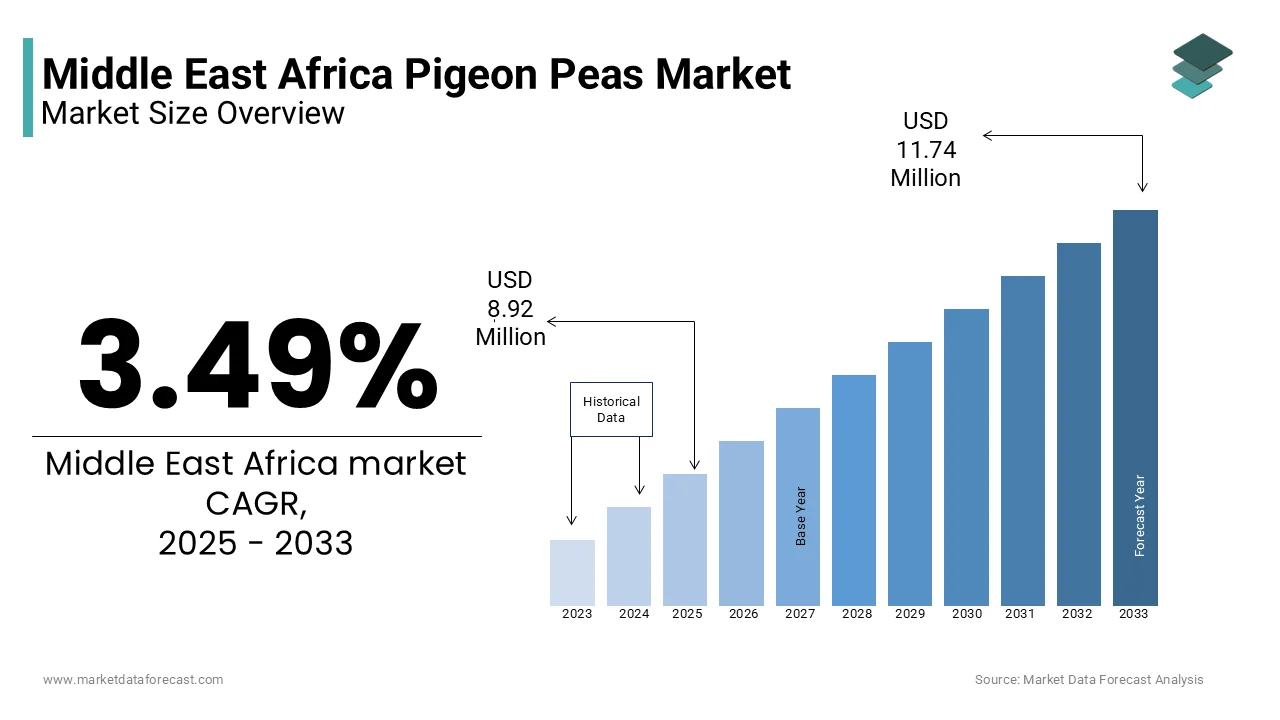
The Middle East and Africa pigeon peas market size was valued at USD 395.21 million in 2025 and is expected to reach USD 530.10 million by 2034 from USD 408.42 million in 2026. The market's promising CAGR for the predicted period is 3.31%.
The pigeon pea is a perennial legume that belongs to the family Fabaceae. Since its domestication in India at least around three and a half millennia ago, its seeds have become a common food grain in Africa, Asia and the Middle East and Africa. It is consumed on a large scale mainly in south Asia and is also a major source of protein for the population in the subcontinent. There are four varieties of pigeon peas which are tall varieties, dwarf varieties, tree types, and smaller bushes. Pigeon pea is one of the essential legume crops which originated in South Asia and is now growing in sub-tropical and tropical regions. Moreover, the largest pigeon peas producing regions are the Middle East and Africa, India, and Eastern Africa. Pigeon pea contains high levels of nutrition such as carbohydrates, vitamins, calories, proteins, and amino acids. Pigeon pea enhances soil fertilizer through symbiotic nitrogen fixation and enables farmers in having a valuable organic products and micronutrients. Pigeon pea is also used as a cover crop, green manure, intercrop and much more in various farming systems.
The driving factors of Middle East and Africa Pigeon Peas market are low cost of pigeon pea, long storage ease, advanced hybrid seed production technology, growing demand for processed products, rising production capacity, and logistical infrastructure. Moreover, consumers becoming health & nutrition conscious, increasing government investment in the agriculture sector and government initiatives for farmers' welfare are some of the other factors which can boost the demand for pigeon pea over the forecast period. However, seasonal changing patterns, unorganized sector, price fluctuation, high-quality standards, a threat from pathogens such as fusarium wilt disease and pests that attack crops and substitutes to pigeon pea are the foremost production are factors that are expected to constrain the growth of this market.
REPORT COVERAGE
| REPORT METRIC | DETAILS |
| Market Size Available | 2025 to 2034 |
| Base Year | 2025 |
| Forecast Period | 2026 to 2034 |
| CAGR | 3.31% |
| Segments Covered | By Form, Price Range, Distribution Channel, and Region |
| Various Analyses Covered | Global, Regional, & Country Level Analysis; Segment-Level Analysis; DROC; PESTLE Analysis; Porter’s Five Forces Analysis; Competitive Landscape; Analyst Overview of Investment Opportunities |
| Regions Covered | KSA, UAE, Israel, South Africa, Ethiopia, Kenya, Egypt, Sudan, Rest of GCC Countries, and Rest of MEA |
| Market Leaders Profiled | SYMAF Co Ltd., Sun Impex, Interamsa Agroindustrial SAC, Arvind Limited, A.B. Agro Company, Akyurek Kardesler Ltd., Taj Foods, Pulses Splitting & Processing Industry Pvt Ltd, Unitex Tanzania Limited, and others. |
MARKET SEGMENTATION
This research report on the Middle East and Africa pigeon peas market has been segmented and sub-segmented into the following categories.
By Form
- Frozen
- Fresh
- Canned
- Dried segments
By Price Range
- Mid
- Premium
- Low segments
By Distribution Channel
- Supermarkets
- Hypermarkets,
- Independent grocery stores,
- E-commerce
By Country
- UAE
- Israel
- KSA
- South Africa
- Egypt
The market in this region can be divided based on geography into Middle East and Africa regions. Factors such as growing preference of customers for fibre-rich foods and technological advancements are expected to drive the market growth in the region.
KEY MARKET PLAYERS
SYMAF Co Ltd., Sun Impex, Interamsa Agroindustrial SAC, Arvind Limited, A.B. Agro Company, Akyurek Kardesler Ltd., Taj Foods, Pulses Splitting & Processing Industry Pvt Ltd, and Unitex Tanzania Limited are playing dominating role in the Middle East and Africa pigeon peas market.