- Product Description Description
- Table of Contents TOC
- List of Table & Figure LOT
- Get Free Sample PDF Sample PDF
Market Size, 2025
$205 MnMarket Estimate, 2026
$221 MnMarket Forecast, 2034
$405 MnCAGR, 2026–2034
7.81%Middle East and Africa Plant Based Ice Creams Market Size
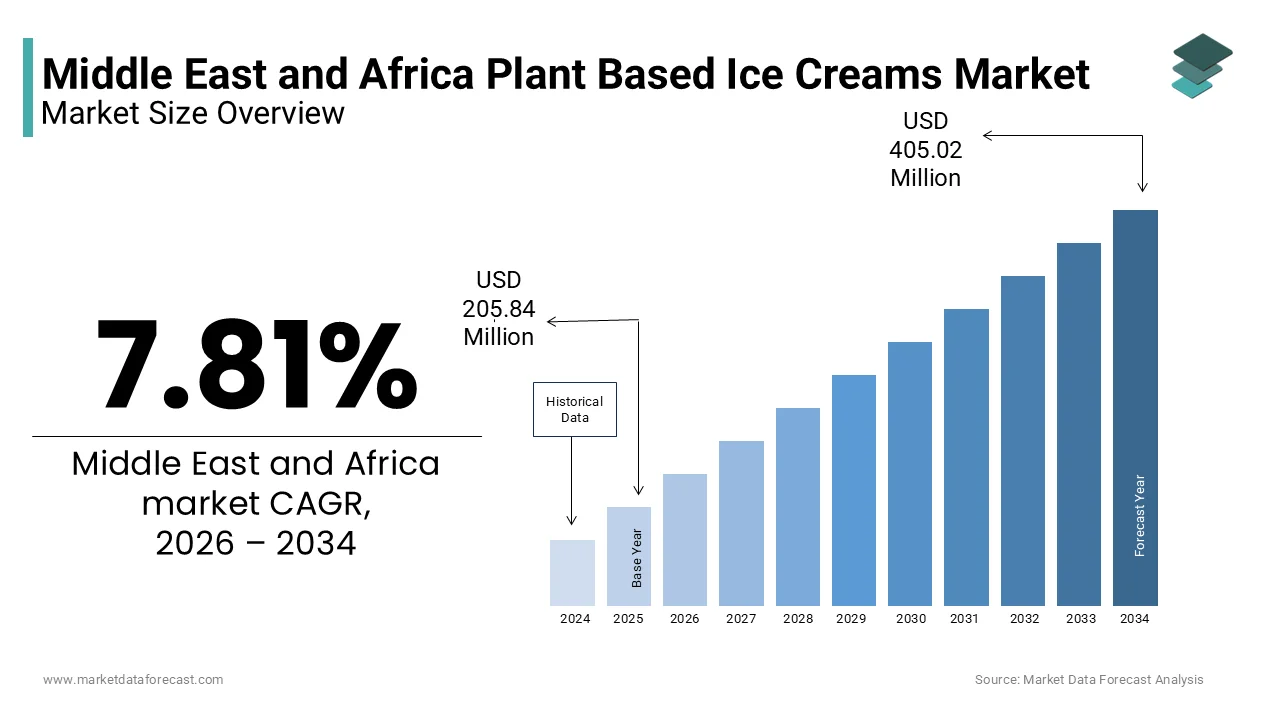
The Middle East and Africa ice creams market size was valued at USD 205.84 million in 2025 and is projected to reach USD 405.02 million by 2034 from USD 221.92 million in 2026, growing at a CAGR of 7.81%.
Plant-based ice cream is ice cream that is completely free of animal products such as egg and milk i.e. made with no animal products whatsoever. The ice cream base is made up of various plant-based milk such as coconut milk and house-made cashew milk. The healthy fats from these plant milk lend themselves wonderfully to a creamy texture that's just as delicious as dairy ice cream. Growing number of lactose-intolerant consumers is a key factor driving the market growth. In addition, higher protein content in plant-based ice-creams makes them a healthier option among ice-creams. Due to the increasing demand for these ice creams, the producers of plant-based ice-creams are focused on improving the taste of these ice-creams by introducing the consumers to a wide variety of flavors. High processing charges are associated with the preparation of plant-based ice creams, as most of the raw materials are processed and formulated through different high-energy consuming machinery. Moreover, the most frequently used milk in plant-based ice creams is soya milk, which has some adverse effects. For instance, soy milk can cause allergies in some people. Its taste is also not preferred among consumers. According to Cornell University, there is an increased risk of breast cancer in some women who consume soy food and most of plant-based ice cream manufacturers use soy milk as their major creaming ingredient. This particular factor may act against market growth.
REPORT COVERAGE
| REPORT METRIC | DETAILS |
| Market Size Available | 2025 to 2034 |
| Base Year | 2025 |
| Forecast Period | 2026 to 2034 |
| CAGR | 7.81% |
| Segments Covered | By Product Source, Packaging, Distribution Channel, and Region |
| Various Analyses Covered | Global, Regional and Country Level Analysis; Segment-Level Analysis; DROC; PESTLE Analysis; Porter’s Five Forces Analysis; Competitive Landscape; Analyst Overview of Investment Opportunities |
| Regions Covered | KSA, UAE, Israel, rest of GCC countries, South Africa, Ethiopia, Kenya, Egypt, Sudan and Rest of MEA |
| Market Leaders Profiled | Coconut Collaborative, Swedish Glace, Perfect World, Almond Drea, Booja-Booja, Turtle Mountain’s, Frankie & Jo’s, Smooze, So Delicious, Luna & Larry’s |
KEY MARKET PLAYERS
Key market players of Middle East and Africa Plant Based Ice Creams Market are Coconut Collaborative, Swedish Glace, Perfect World, Almond Drea, Booja-Booja, Turtle Mountain’s, Frankie & Jo’s, Smooze, So Delicious, Luna & Larry’s
MARKET SEGMENTATION
This Research Report on Middle East and Africa plant-based ice creams market is segmented and sub segmented into following categories
By product source
-
Soy milk based
-
Coconut milk based
-
Almond milk based
-
Cashew milk
-
Rice milk
By Package Type
-
Tub
-
Bag/sachet
By Distribution Channel
-
Supermarkets/hypermarkets
-
Convenience stores
-
Specialist stores
-
Health food stores
By Country
-
UAE
-
Israel
-
KSA
-
South Africa
-
Egypt