- Product Description Description
- Table of Contents TOC
- List of Table & Figure LOT
- Get Free Sample PDF Sample PDF
Market Size, 2025
$23.76 BnMarket Estimate, 2026
$25.68 BnMarket Forecast, 2034
$47.89 BnCAGR, 2026–2034
8.10%Executive Summary: Middle East and Africa Silk Market
- Market Scope: Regional analysis of the Middle East and Africa's silk sector, detailing silk types, application fields, and country-level profiles.
- Market Valuation: Valued at USD 23.76 billion in 2025, reaching USD 25.68 billion in 2026, and projected to expand to USD 47.89 billion by 2034, growing at a robust CAGR of 8.10% from 2026 to 2034.
- Primary Growth Drivers: Rapid expansion of the regional textile and fashion industries, rising investments in local sericulture and wild silk cultivation, and increasing adoption of silk in healthcare and cosmetics.
Key Market Segment Metrics
| Category | Leading Segment (Base Position) | Fastest-Growing / High-Growth Segment |
|---|---|---|
| By Type | Mulberry Silk (dominated in 2025, supported by high quality, soft texture, and widespread preference in traditional and formal wear) | Tussar & Eri Silk (projected at an elevated growth rate due to unique textures and growing interest in sustainable wild silk production) |
| By Application | Textile (held the dominant market share in 2025, driven by apparel manufacturing, formal dresses, and expanding clothing brands) | Cosmetics & Medical (expected to register a strong CAGR fueled by silk protein microparticles, hydrogels, shampoos, and lotions) |
| By Region | GCC / KSA & UAE (market leaders in 2025, backed by luxury fashion trends, high disposable incomes, and import hubs) | East Africa (fastest-growing regional zone driven by historical wild silk cultivation, sericulture investments, and infrastructure updates) |
Major Market Players & Industry Landscape
Market Structure: Emerging and innovative specialty fiber landscape characterized by biotechnology advancements (such as spider silk innovations), international distribution agreements, and regional sericulture initiatives.
Key Companies: Bolt Threads Inc., AMSilk GmbH, First Textile Co., and Kraig Biocraft Laboratories, Inc.
 Download Free Sample Report
Middle East and Africa Silk Market Size
As per our analysis report, the Middle East and Africa Silk Market was calculated to be USD 23.76 billion in 2025 and is anticipated to be worth USD 47.89 billion by 2034, from USD 25.68 billion in 2026, growing at a CAGR of 8.10% during the forecast period.
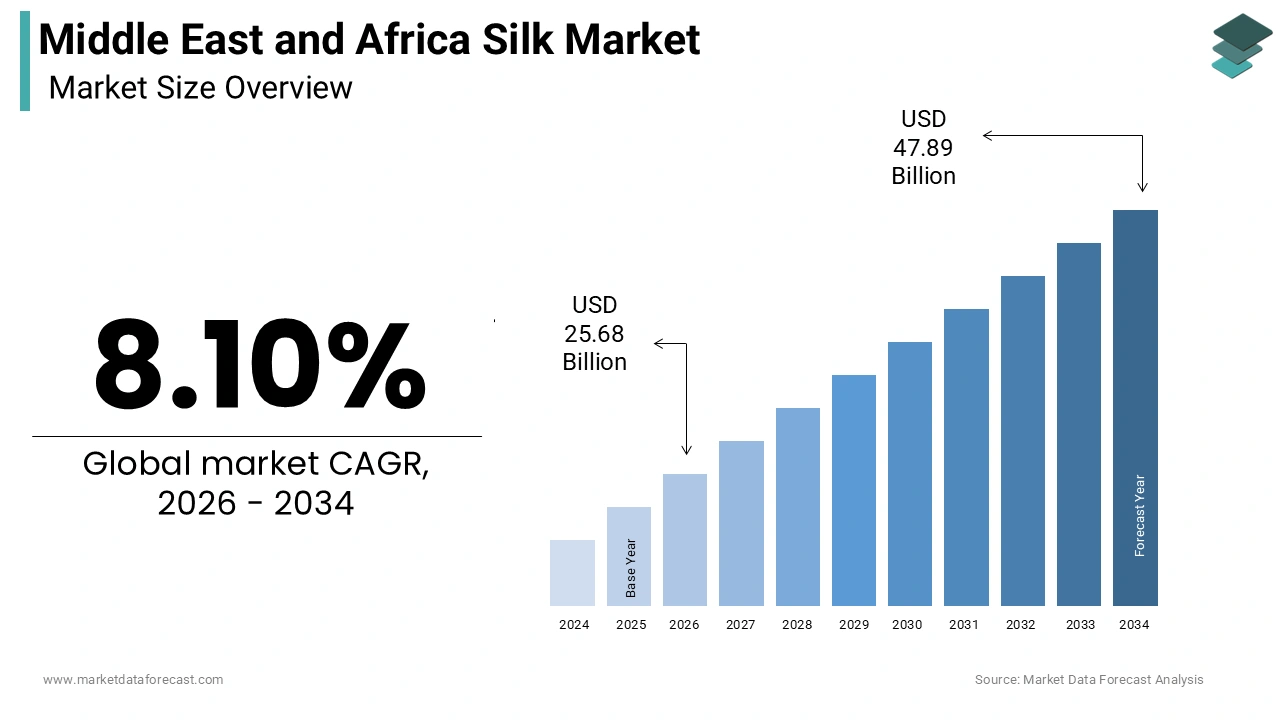
The Middle East and African countries are keen on starting their own sericulture industries in addition to importing silk from Asian countries, which is likely to develop the demand in the Middle East and Africa silk market in the foreseen years
MARKET DRIVERS AND RESTRAINTS
Progressions in the quality of silk products have been crucial driving forces in the Middle East and Africa silk industry. The textile industry is growing at a rapid pace in the Middle East and African area. This is also supplemented by the rising trends in the fashion industry of this area. Several investments have been made in this locale and silk is considered as a prominent fabric compared to others. The adoption of silk in the healthcare and cosmetic sectors is also promoting the sales of silk in this region. Silk has been extensively employed in the making of robes, formal dresses, etc. and this led to significant growth in the local industry. In the East African area, the cultivation of wild silk has been pertinent for a long period of time and now companies are looking to make fortune out of it by making the best use of wild silk in industrial products.
The availability of raw materials is not stable for the making of silk, which is acting as a major deterrent for the MEA silk market. This resulted in the utility of prices, slowing down the overall business. Moreover, there is not much cultivation of silk in this locale and regional markets are highly dependent on imports, acting as a limiting factor.
This research report on the Middle East and Africa Silk market has been segmented and sub-segmented based on the following categories.
Middle East and Africa Silk Market By Type
- Mulberry silk
- Tussar Silk
- Eri silk
Middle East and Africa Silk Market By Application
- Textile0
- Cosmetics
- Medical
The textile segment is the fastest growing in the MEA silk industry because of the extensive application of silk in this industry. Several clothing brands are selecting silk as their preferred fiber for the manufacturing of their products, improving their existing product portfolio.
The cosmetics segment is also considered a promising business that is likely to develop with a considerable CAGR in the MEA silk industry. The technological developments and the preference for new fashions among customers are supposed to accelerate the demand for silk fabrics in the Middle East and African region. In addition, silk is also employed in the making of several cosmetic products like shampoos, lotions, soaps, creams, nail enamel, and so on, which is creating immense growth potential for the local market.
Middle East and Africa Silk Market By Country
- KSA
- UAE
- Israel and rest of GCC countries
- South Africa
- Ethiopia
- Kenya
- Egypt
- Sudan and Rest of MEA
The Middle East and Africa East and African region are one of the largest markets for the industry.
It also shows signs of growing at a much higher rate post the COVID-19 pandemic. Wild silk is fairly popular in East Africa and that specific region has been cultivating the same for more than hundreds of years. There have been investments to improve the infrastructure and make use of that market.
KEY MARKET PLAYERS
Bolt Threads Inc., P AMSilk GmbH, First Textile Co., Kraig Biocraft Laboratories, Inc are some of the notable companies in the Middle East and Africa Silk market.
RECENT HAPPENINGS IN THE MARKET
- In March 2017, Bolt Threads Inc. started its novelty product made of spider silk. It then introduced a tie made of spider silk.
- In September 2016, AMSilk GmbH made a contract with Hanjoo C&C which is based in Korea for the distribution of their products in the Asian market. It will distribute AMSilk products, Silkbeads (microparticles), and Silkgel (hydrogel) in South Korea.\
- In June 2016, AMSilk GmbH also signed a deal with RAHN AG (based in Zurich), which involved the distribution of two ingredients made from AMSilk, Silkgel, and Silkbeads.