- Product Description Description
- Table of Contents TOC
- List of Table & Figure LOT
- Get Free Sample PDF Sample PDF
Market Size, 2025
$160.00 MnMarket Estimate, 2026
$170.56 MnMarket Forecast, 2034
$284.40 MnCAGR, 2026–2034
6.60%Executive Summary: Middle East and Africa Solar Pumps Market
- Market Scope: Comprehensive Middle East and Africa (MEA) solar pumps market analysis covering product types, application sectors, country frameworks, and renewable irrigation adoption metrics.
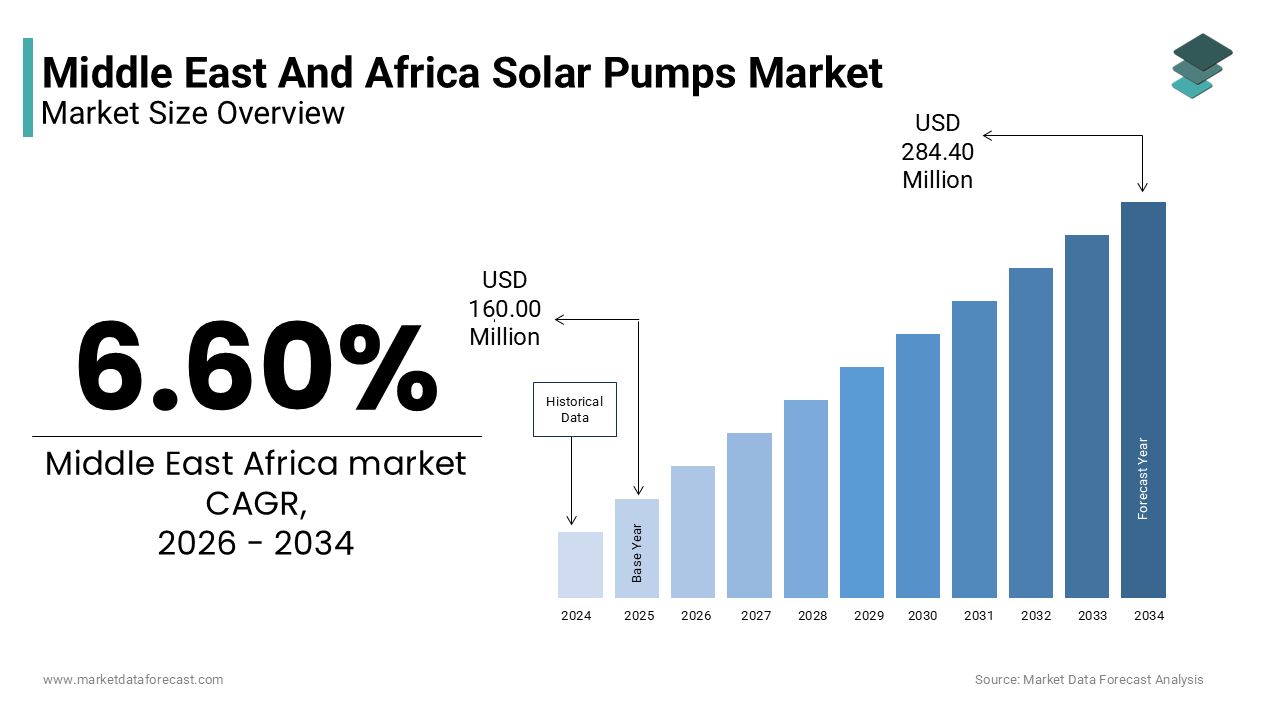
- Market Valuation: Valued at USD 160.00 million in 2025, estimated at USD 170.56 million in 2026, and projected to reach USD 284.40 million by 2034, registering a solid compound annual growth rate (CAGR of 6.60%) from 2026 to 2034.
- Primary Growth Drivers: Shift away from imported fossil fuels (diesel and butane) toward clean solar energy, expanding agricultural irrigation and water-intensive industries, government backing/subsidies, and the need for reliable clean water supplies in remote off-grid locations. Key market restraints include high capital costs, delayed spare part availability, and limited after-sales services.
Key Market Segment Metrics (2026–2034)
| Category | Leading Segment (2025 Position) | Fastest-Growing Segment |
|---|---|---|
| By Product | DC surface suction pumps (dominated historical market share) | AC submersible pumps (experiencing high expansion due to demand for higher efficiency) |
| By Application | Agriculture (accounted for the majority of total market volume via irrigation needs) | Drinking water and rural off-grid community supply |
| By Country / Region | GCC countries (KSA, UAE) and South Africa (leading regional adoption through large-scale solar initiatives) | Rest of MEA and East Africa (expanding via clean energy transition and rural water projects) |
Major Market Players & Market Structure
Market Structure: Highly competitive international and regional renewable energy landscape featuring global pump manufacturers and specialized solar engineering firms competing on efficiency, durability, and dealer network expansion.
Key Companies: Lorentz, C. R. I. Pumps Private Limited, Tata Power Solar Systems Ltd, Shakti Pumps Ltd, Wenling Jintai Pump Factory Limited, Bright Solar Limited, Grundfos, Symtech Solar, Photon Solar, Urja Global Limited, and Kavita Solar Energy Private Limited.
 Download Free Sample Report
Middle East And Africa Solar Pumps Market Size
The size of the Middle East and Africa solar pumps market was worth USD 160.00 million in 2025. The market is anticipated to grow at a CAGR of 6.60% from 2026 to 2034 and be worth USD 284.40 million by 2034 from USD 170.56 million in 2026.
Solar pumps are water pumping systems that run entirely on energy from the sun instead of grid electricity or diesel fuel. This market includes photovoltaic-powered fluid pumping technology utilised for agricultural irrigation, livestock watering, municipal water access, and industrial fluid transfer across arid and developing regions. Adoption of solar water pumping solutions across regional farming communities is accelerating rapidly to replace conventional, expensive diesel generators and offset erratic national electrical grids. According to the Food and Agriculture Organisation of the United Nations, less than 5% of cultivated land in Sub-Saharan Africa is equipped for formal irrigation, leaving vast agricultural zones vulnerable to climate-induced drought conditions. Furthermore, as per the World Bank, roughly 600 million people across Sub-Saharan Africa lack access to electricity, creating an urgent requirement for off-grid solar-powered water extraction systems. These systemic infrastructure challenges make solar-powered water pumping a critical technology for rural water security and sustainable agricultural productivity
MARKET DRIVERS
Expanding Off-Grid Agricultural Development and Irrigation Needs
The critical necessity to expand irrigated agricultural land without relying on expanding central electrical grids is a key driver of the Middle East and Africa solar pumps market. According to the Food and Agriculture Organisation of the United Nations, smallholder farms produce up to 80% of the total food supply in Sub-Saharan Africa, yet the vast majority remain entirely reliant on rainfed agriculture. Besides, as per the International Renewable Energy Agency, off-grid solar energy applications across rural African communities expanded significantly as module prices declined and solar technology efficiency improved. The direct correlation between these agricultural requirements and the pumping market is clear. Transitioning smallholder farms to photovoltaic solar pumping systems allows reliable multi-cropping cycles, raises crop yields, and reduces exposure to volatile global diesel fuel pricing. As national governments prioritise domestic food security programs, agricultural development funds are increasingly directed toward subsidising solar irrigation equipment for farming collectives.
Transition Away From Diesel Subsidies and Rising Fuel Logistics Expenses
The systematic phase out of national fuel subsidies alongside rising diesel distribution costs across remote rural areas is accelerating the shift toward solar pumping infrastructure, which contributes to the growth of the Middle East and Africa solar pumps market. According to the study, rural transport inefficiencies and fuel logistics overheads can substantially elevate the localised operating costs for off-grid farmers compared to urban supply hubs. Furthermore, as per research, the lifetime operating costs for solar photovoltaic water systems are structurally lower than those of equivalent diesel-powered systems due to zero recurring fuel requirements. This economic disparity drives rapid technological substitution. Farming operations and municipal water providers are replacing ageing diesel gensets with surface and submersible solar pumps to eliminate ongoing operational fuel expenses, cut carbon emissions, and establish self-sustaining water extraction capabilities.
MARKET RESTRAINTS
High Initial Capital Acquisition Costs for Smallholder Farmers
The substantial upfront capital expenditure required to purchase and install complete solar pumping systems is a persistent barrier to their widespread adoption across low-income agricultural communities in the Middle East and Africa market. According to the Food and Agriculture Organisation of the United Nations, a high percentage of smallholder farmers across developing African economies operate on marginal incomes under 2 dollars per day, rendering upfront equipment purchases unfeasible without external financing. Additionally, as per the study, rural financial institutions across Sub-Saharan Africa apply strict credit approval frameworks and maintain high lending rates that significantly limit access to agricultural microloans. This financial structure directly hinders equipment sales. Although solar pumps feature lower long-term maintenance and zero fuel costs, the initial expense of purchasing photovoltaic panels, specialised direct current inverters, and high-durability pump sets forces resource-constrained farmers to remain reliant on lower-cost diesel alternatives.
Limited Local Technical Capacity and Maintenance Infrastructure
The shortage of skilled technicians, combined with inadequate regional supply chains for specialised spare parts, hampers the expansion of the Middle East and Africa solar pumps market. This limits long-term operational performance in remote local markets. According to sources, decentralised renewable energy programs in developing markets often face operational disruptions when localised maintenance capacity and technical installation guidelines are insufficient. In parallel, as per research, approximately 25-30% of rural water points fail within their first year of installation, while studies show that only around 45% of solar-powered systems in certain remote districts remain fully functional after three years due to unaddressed technical issues. Coagulation and mechanical wear on pump impellers, solar panel degradation from dust accumulation, and inverter failures require specialised technical intervention. Without local technician networks and accessible repair components, agricultural users hesitate to invest in complex solar pumping platforms.
MARKET OPPORTUNITIES
Proliferation of Pay-As-You-Go and Innovative Microfinancing Business Models
The rapid introduction of digital pay-as-you-go financing platforms powered by mobile money integration offers a massive commercial growth vector for vendors in the Middle East and Africa solar pumps market. According to the World Bank, mobile money penetration in Sub-Saharan Africa leads global adoption, with over 600 million registered financial accounts facilitating digital transactions across rural populations. Moreover, as per the International Renewable Energy Agency, pay as you go business models have enabled hundreds of thousands of off grid households to acquire solar systems through flexible daily or weekly payment schedules. This financial innovation directly addresses the primary capital cost barrier. By equipping solar pumps with remote Internet of Things tracking and automated shutoff capabilities linked to mobile payments, manufacturers and distributors can offer lease-to-own structures, expanding their addressable consumer base among lower-income smallholder farmers.
Implementation of Government Subsidies and International Climate Finance Programs
Escalating financial support from multilateral development banks and national climate adaptation funds provides strong momentum in the Middle East and Africa solar pumps market. This backing enables large-scale solar water pumping deployments. According to the study, international climate finance commitments aimed at strengthening agricultural resilience and water security in developing nations exceed billions of dollars annually. Additionally, as per the International Renewable Energy Agency, public funding and competitive development grants are increasingly channelled into off-grid renewable energy initiatives across Africa and the Middle East to accelerate clean energy transitions. According to sources, national framework initiatives like India's PM-KUSUM deploy dedicated public funds to subsidise up to 60% to 75% of equipment costs for standalone solar irrigation projects, driving large-scale public procurement contracts for suppliers.
MARKET CHALLENGES
Severe Groundwater Depletion Risks and Unregulated Extraction Concerns
Unregulated and continuous solar water pumping is a major threat to regional aquifer levels, leading to environmental concerns and potential regulatory restrictions, and ultimately hindering the growth of the Middle East and Africa market. According to the Food and Agriculture Organisation of the United Nations, groundwater depletion across hyper-arid regions in the Middle East and North Africa has reached critical thresholds, with major aquifers declining by several meters annually due to agricultural overextraction. Furthermore, as per the World Bank, because solar pumps operate at zero marginal cost once installed, farmers tend to pump water continuously without economic penalty, unlike fuel-powered systems that incur fuel costs. This lack of financial restraint on water usage risks overpumping fragile groundwater basins. Consequently, environmental agencies are enacting stricter water metering policies, mandatory extraction permits, and sensor requirements, which increases compliance complexity for solar pump deployments.
Harsh Environmental Conditions and Dust Accumulation Effects
Extreme climatic conditions across the region, including high temperatures, sandstorms, and intense UV exposure, severely impact system efficiency and longevity in the Middle East and Africa solar pumps market. According to studies, dust deposition and environmental soiling on photovoltaic panels in desert climates gradually decrease power generation capacity, necessitating routine maintenance to protect cell efficiency. In addition, as per sources, severe ambient heat in arid agricultural climates can heighten stress on internal electronics and accelerate the thermal degradation of solar power inverter units. Ensuring long term operational reliability requires manufacturers to integrate ruggedized IP67 ingress protection, dust repellent module coatings, and active thermal management, which elevates manufacturing costs and complicates product engineering for harsh regional climates.
REPORT COVERAGE
| REPORT METRIC | DETAILS |
| Market Size Available | 2025 to 2034 |
| Base Year | 2025 |
| Forecast Period | 2026 to 2034 |
| CAGR | 6.60% |
| Segments Covered | By Product, Application, and Region. |
| Various Analyses Covered | Global, Regional & Country Level Analysis, Segment-Level Analysis, DROC, PESTLE Analysis, Porter’s Five Forces Analysis, Competitive Landscape, Analyst Overview of Investment Opportunities |
| Regions Covered | KSA, UAE, Israel, the rest of GCC countries, South Africa, Ethiopia, Kenya, Egypt, Sudan, and the rest of MEA |
| Market Leaders Profiled | Lorentz (Germany), C. R. I. Pumps Private Limited (India), Tata Power Solar Systems Ltd (India), Shakti Pumps Ltd (India), WenlingJintai Pump Factory Limited (China), Bright Solar Limited (India), Grundfos (Denmark) Symtech Solar (Oman), PhotonSolar.com (Australia), Urja Global Limited (India), Kavita Solar Energy Private Limited (India), and Others. |
SEGMENT ANALYSIS
By Application Insights
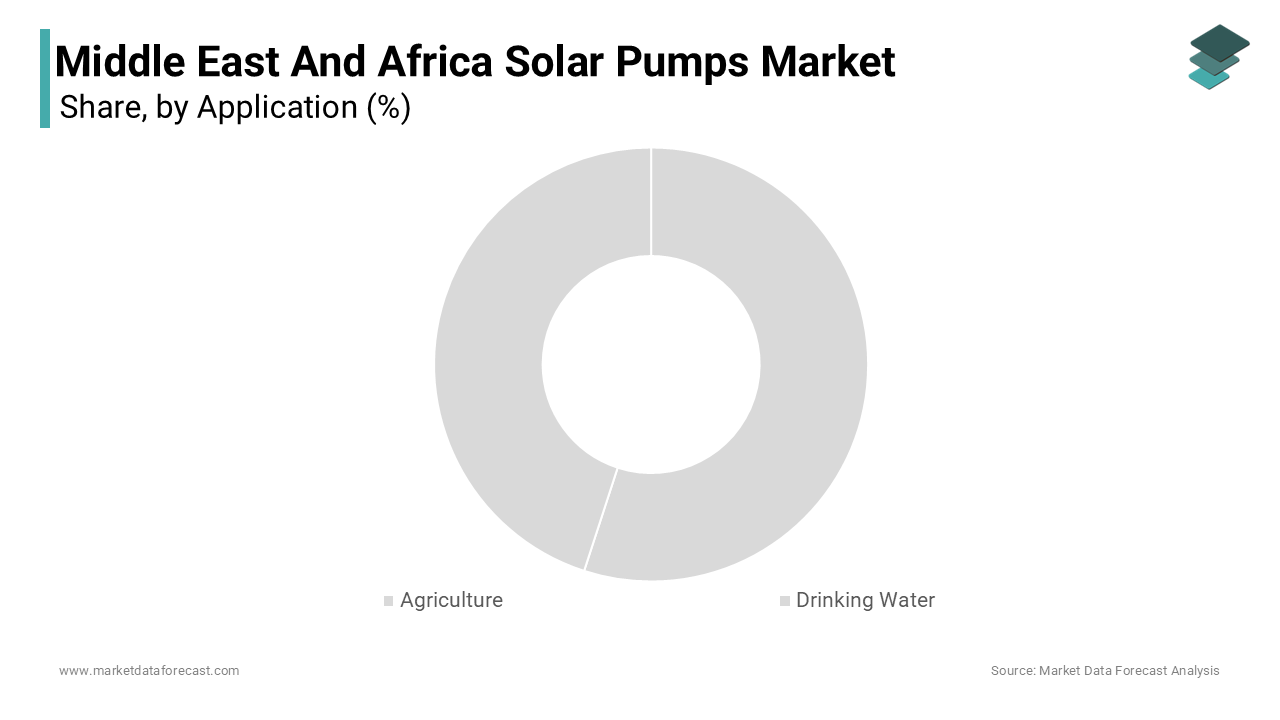
In 2025, the agriculture segment held the commanding share of the Middle East and Africa solar pumps market. It acted as the primary end-user vertical for solar-powered fluid extraction solutions across both large commercial farms and rural smallholder plots. The imperative to expand irrigated arable land across agrarian communities directly fuels the widespread installation of solar water pumps. According to the Food and Agriculture Organisation of the United Nations, smallholder farms produce over 80% of the food supply in Sub-Saharan Africa, yet less than 5% of cultivated land benefits from managed irrigation systems. Furthermore, as per research, deploying off-grid solar irrigation systems allows farming communities to increase crop yields by up to 300% by enabling dry-season farming. The direct link to the solar pump market lies in equipment utilisation, as replacing manual or rainfed farming with photovoltaic water pumping provides a reliable water source that transforms subsistence farming into commercially viable agricultural production.
Escalating diesel prices and difficult fuel logistics across rural farming districts accelerate the agricultural adoption of solar-powered water pumping solutions. According to the study, rural transport inefficiencies and fuel logistics overheads can substantially elevate localised diesel operating costs for off-grid farmers compared to urban supply hubs. Additionally, as per research, the lifecycle operating expenses of solar photovoltaic water systems are structurally lower than those of equivalent diesel-powered setups due to zero recurring fuel requirements. These financial realities encourage farming cooperatives and commercial growers to replace expensive generator sets with surface and submersible solar pumps, securing lower operational overhead and establishing steady irrigation capabilities.
The drinking Water segment is anticipated to witness the fastest CAGR of 10.2% during the forecast period. This rapid growth is propelled by international humanitarian water projects and government programs deploying decentralised clean water stations.
Severe potable water deficits across developing regional communities accelerate the installation of community solar water pumping stations. According to the World Health Organisation, over 400 million people across Sub-Saharan Africa lack access to basic drinking water services. In parallel, as per the World Bank, multilateral international aid organisations allocate billions of dollars annually toward rural water, sanitation, and hygiene initiatives across the Middle East and Africa. Solar pumps are the preferred technology for these potable water projects because they deliver continuous clean groundwater extraction without depending on unreliable national electrical grids, thereby driving high-volume adoption in remote villages.
National utility efforts to expand off-grid public water access points drive rapid procurement of community-scale solar pumping systems. According to the study, solar-powered water supply infrastructure often demonstrates higher long-term utility rates in remote settings compared to traditional hand pumps or diesel units. Furthermore, as per the International Renewable Energy Agency, public water utilities across arid Middle Eastern and African nations are increasingly integrating solar-powered groundwater extraction systems to supply municipal distribution kiosks. This transition creates steady public sector procurement contracts for high-capacity drinking water solar pumping installations.
By Product Insights
The DC submersible solar pumps segment was the largest and occupied a significant share of the Middle East and Africa solar pumps market in 2025. This prominence of the segment was supported by its high energy efficiency and direct compatibility with solar photovoltaic arrays without requiring complex inverter systems.
Direct Current submersible pumps operate seamlessly with direct current generated by solar panels, eliminating conversion energy losses associated with alternating current systems. According to sources, direct current brushless solar pumping systems exhibit high mechanical and operational energy efficiency levels, outperforming conventional alternating current setups in low-power and small-scale applications. In addition, as per the study, eliminating the requirement for complex external power inverters in dedicated low-voltage DC setups reduces overall system component vulnerabilities in rural operating environments. This mechanical reliability and high solar-to-water conversion efficiency make DC submersible pumps the primary choice for deep groundwater extraction across regional agricultural and community wells.
Deep water tables across arid regional landscapes mandate subsurface pumping solutions capable of lifting water from substantial depths. According to the Food and Agriculture Organisation of the United Nations, groundwater depth across arid zones in North Africa and the Middle East frequently exceeds 50 to 100 meters, rendering surface suction pumps ineffective. Besides, as per research, modern submersibles equipped with stainless steel impellers and specialised sand-resistant mechanical seals can achieve extended operational lifespans of up to 10 years or more with routine maintenance. Their ability to deliver high head performance from deep boreholes solidifies the market leadership of DC Submersible pumps across the region.
The AC submersible pumps segment is on the rise and is expected to be the fastest-growing segment in the market, witnessing a CAGR of 11.1% from 2026 to 2034. This swift growth is fuelled by the expanding adoption of large-scale commercial agricultural projects and high-capacity municipal water installations requiring high flow rates and variable frequency drives.
The transition toward high-volume commercial farming operations across the region mandates powerful alternating current pumping equipment capable of driving extensive drip and centre pivot irrigation systems. According to reports, commercial agricultural enterprises across the Middle East and East Africa continue to expand to fulfil strategic national food security agendas. Additionally, as per sources, modern variable frequency drives allow heavy-duty AC submersible pumps to dynamically adjust power consumption based on real-time solar intensity, facilitating high-volume water distribution. These performance metrics drive commercial farming enterprises to invest heavily in robust AC Submersible solar pumping systems.
Rapid technological advancement and cost reductions in smart solar inverters facilitate the deployment of AC Submersible pumps. According to the study, the global manufacturing and wholesale costs of power electronics, such as solar inverters and variable speed controller drives, declined significantly over the past decade. Moreover, as per the World Bank, hybrid solar pumping systems that combine AC Submersible units with grid power or backup generators ensure continuous 24-hour water extraction for critical agricultural and industrial applications. The ability to seamlessly integrate AC pumps into hybrid power configurations accelerates their growth trajectory across industrial and large-scale farming sectors.
REGIONAL ANALYSIS
Kingdom of Saudi Arabia (KSA) Solar Pumps Market Analysis
Saudi Arabia dominated the Middle East and Africa solar pumps market and accounted for a substantial share in 2025. This dominance of the Saudi market was driven by massive state-backed agricultural modernisation programs and aggressive national renewable energy targets under Vision 2030. According to sources, the Arabian Peninsula receives high solar horizontal irradiance averaging around 2200 kilowatt-hours per square meter annually. Furthermore, as per the study, public agricultural authorities direct modern capital investments and financial support toward high-efficiency localised irrigation infrastructure to mitigate the consumption of finite groundwater aquifers. The market is defined by high demand for high-capacity AC submersible solar pumps integrated with smart water metering technology across commercial desert farming developments.
United Arab Emirates (UAE) Solar Pumps Market Analysis
The United Arab Emirates is expanding moderately within the Middle East and Africa solar pumps market. It occupies a major position as a technology-adoption hub, propelled by national sustainability strategies, advanced agritech investments, and public water conservation initiatives. According to research, the United Arab Emirates has committed to mobilising over 54 billion dollars (AED 150 to 200 billion) by 2030 toward its national energy strategy to triple renewable energy capacity. In addition, as per sources, environmental authorities encourage the integration of solar power alongside advanced drip irrigation infrastructure to lower operating costs and reduce emissions across land management frameworks. This economic focus accelerates the adoption of premium DC and AC solar pumping units featuring remote monitoring capabilities.
South Africa Solar Pumps Market Analysis
South Africa is growing steadily within the Middle East and Africa solar pumps market. The country is known for an established commercial farming sector, ongoing national grid load-shedding challenges, and strong private sector adoption. According to the World Bank, chronic electricity supply interruptions across South Africa cause significant operational downtime for commercial farms reliant on grid-connected irrigation pumps. Furthermore, as per the International Renewable Energy Agency, solar photovoltaic installations across commercial and industrial sectors in South Africa expanded rapidly as private businesses sought energy self-sufficiency. Commercial farmers are rapidly replacing grid-dependent pumps with off-grid solar pumping setups to ensure continuous crop irrigation during load shedding events.
Ethiopia Solar Pumps Market Analysis
Ethiopia is gradually emerging in the Middle East and Africa solar pumps market, supported by public irrigation expansion policies, a large population of smallholder farmers, and international development initiatives. According to the Food and Agriculture Organisation of the United Nations, agriculture contributes over 32 per cent to Ethiopia's gross domestic product and employs more than 65 per cent of the national workforce. In parallel, as per the World Bank, national rural electrification projects supported by international development grants prioritise solar water pumping to expand smallholder irrigation access across remote highlands. Market growth in Ethiopia is led by high-volume procurement of portable DC surface and submersible solar pumps for smallholder farmer cooperatives.
Kenya Solar Pumps Market Analysis
Kenya maintains a noteworthy presence in the Middle East and Africa solar pumps market. It serves as a primary hub for pay-as-you-go business models and private sector solar pump distribution networks. According to the study, Kenya leads Sub-Saharan Africa in digital mobile money adoption, enabling widespread commercial leasing of solar agricultural equipment. Additionally, as per research, smallholder horticulture and tea cultivation projects are increasingly utilising alternative solar pumping systems to lower production overheads and replace expensive fossil fuels. Flexible microfinancing options and strong private distributor networks drive rapid market expansion across both smallholder and commercial farming segments.
COMPETITIVE LANDSCAPE
The competitive landscape of the Middle East And Africa Solar Pumps Market is defined by a dynamic mix of multinational pump manufacturers, specialized off grid solar technology developers, and emerging regional assembly enterprises competing for agricultural and municipal water contracts. Established global engineering firms leverage superior technical reliability, advanced smart monitoring software, and broad product portfolios to maintain strong positions in high capacity commercial agricultural and public utility tenders. Concurrently, specialized solar pumping companies differentiate themselves through purpose built direct current brushless technology, pay as you go software integration, and targeted rural distribution networks. Price competition remains highly intense, particularly in Sub Saharan Africa and North Africa, where lower cost manufacturers present strong competition against premium European and American brands. Market players increasingly compete on non price factors, including long term equipment warranties, remote mobile monitoring capabilities, energy conversion efficiency, and the strength of local after sales service networks. Furthermore, the ability to partner with multilateral funding agencies, national ministries, and microfinance institutions serves as a critical competitive differentiator for securing large scale rural water project deployments across the region.
KEY MARKET PLAYERS
Companies playing a prominent role in the Middle East and Africa solar pumps market include
- Lorentz
- C. R. I. Pumps Private Limited
- Tata Power Solar Systems Ltd
- Shakti Pumps Ltd
- Wenling Jintai Pump Factory Limited
- Bright Solar Limited
- Grundfos
- Symtech Solar
- Photon Solar
- Urja Global Limited
- Kavita Solar Energy Private Limited
- Others
Top Players in the Market
Grundfos
Grundfos maintains an active footprint in the Middle East And Africa Solar Pumps Market by engineering high efficiency photovoltaic pumping solutions tailored for agricultural irrigation, community water supply, and livestock management. The organization provides robust alternating current and direct current submersible and surface pump systems designed to perform reliably under harsh desert environments and off grid operating conditions. To solidify its regional market standing, Grundfos has continuously expanded its digital service infrastructure, incorporating mobile pump sizing tools and remote monitoring software to assist regional installers. Additionally, the company actively collaborates with regional distributors and municipal utility frameworks across the Middle East and East Africa to deploy hybrid solar water extraction systems.
LORENTZ
LORENTZ is a specialized manufacturer dedicated exclusively to solar powered water pumping technologies, establishing a wide distribution network across the Middle East and Sub Saharan Africa. The company delivers advanced brushless direct current solar pumps, microfluidic controllers, and off grid management software tailored for off grid agricultural smallholders and drinking water infrastructure. To strengthen its competitive positioning across regional developing markets, LORENTZ has expanded strategic pay as you go partnerships with digital finance providers to make solar pumping equipment accessible to resource constrained rural farmers. Furthermore, the enterprise actively provides technical training and localized maintenance certifications for regional technicians across African countries.
Shakti Pumps (India) Limited
Shakti Pumps (India) Limited plays a crucial role in the Middle East And Africa Solar Pumps Market by supplying energy efficient stainless steel submersible solar pumps and specialized solar drive controllers. The enterprise focuses heavily on developing durable solar water extraction equipment that supports rural water security and large scale agricultural projects. To strengthen its operational presence across Africa and the Middle East, Shakti Pumps has established direct regional branch offices and project execution hubs in East Africa. Furthermore, the company collaborates with national governments and international financial institutions to execute turn key, large scale solar piped drinking water supply projects across rural communities.
Top Strategies Used by the Key Market Participants
Key market participants operating within the Middle East And Africa Solar Pumps Market utilize strategic initiatives to expand their commercial distribution and navigate complex regional regulatory and financial landscapes. A primary operational strategy involves forming strategic partnerships with pay as you go digital finance platforms and local mobile money operators. This strategy allows manufacturers to offer flexible micro leasing payment structures, effectively neutralizing high initial capital cost barriers for rural smallholder farmers. Additionally, leading vendors prioritize product portfolio localization by designing ruggedized, sand resistant submersible pumps and high efficiency solar inverters capable of enduring high ambient temperatures and dusty desert conditions. Manufacturers also engage aggressively in strategic public sector tenders and international development bank projects, securing high volume municipal procurement contracts for rural water supply and climate adaptation programs. Furthermore, key players focus on establishing certified local technical training centers and authorized distributor networks across regional markets to ensure reliable spare parts availability and long term equipment maintenance services.
RECENT MARKET HAPPENINGS
- The Dubai Electricity and Water Authority (DEWA) welcomed the launch of its innovation center and the 800 MW third phase of the Mohammed bin Rashid Al Maktoum solar park. While DEWA's Innovation Center aims to be a global hub for innovation in renewable and clean energy. It will support innovation and creativity in clean and renewable energy, promote sustainability, develop Emirati talent, and strengthen the UAE's competitive advantage in this sector.
- Recently, Trina Solar Co., Ltd. announced that it has signed an agreement with the Yemeni PV company Al Raebi for Trading Co. as an authorized dealer in Yemen. This agreement is a further commitment to Trina Solar's expansion plans and to increase its presence in the Middle East and Africa.
MARKET SEGMENTATION
This Middle East and Africa solar pumps market research report has been segmented and sub-segmented based on product, application, and region.
By Application
- Agriculture
- Drinking Water
By Product
- DC Submersible
- AC Submersible
- DC Surface Suction
- AC Floating
By Application
- Agriculture
- Drinking water
By Country
- KSA (Saudi Arabia)
- UAE (United Arab Emirates)
- Israel
- Rest of GCC Countries
- South Africa
- Ethiopia
- Kenya
- Egypt
- Sudan
- Rest of MEA