- Product Description Description
- Table of Contents TOC
- List of Table & Figure LOT
- Get Free Sample PDF Sample PDF
Market Size, 2025
$116.12 BnMarket Estimate, 2026
$119.85 BnMarket Forecast, 2034
$154.31 BnCAGR, 2026–2034
3.21%Middle East Automotive Market Size, Share & Growth Analysis (2026–2034)
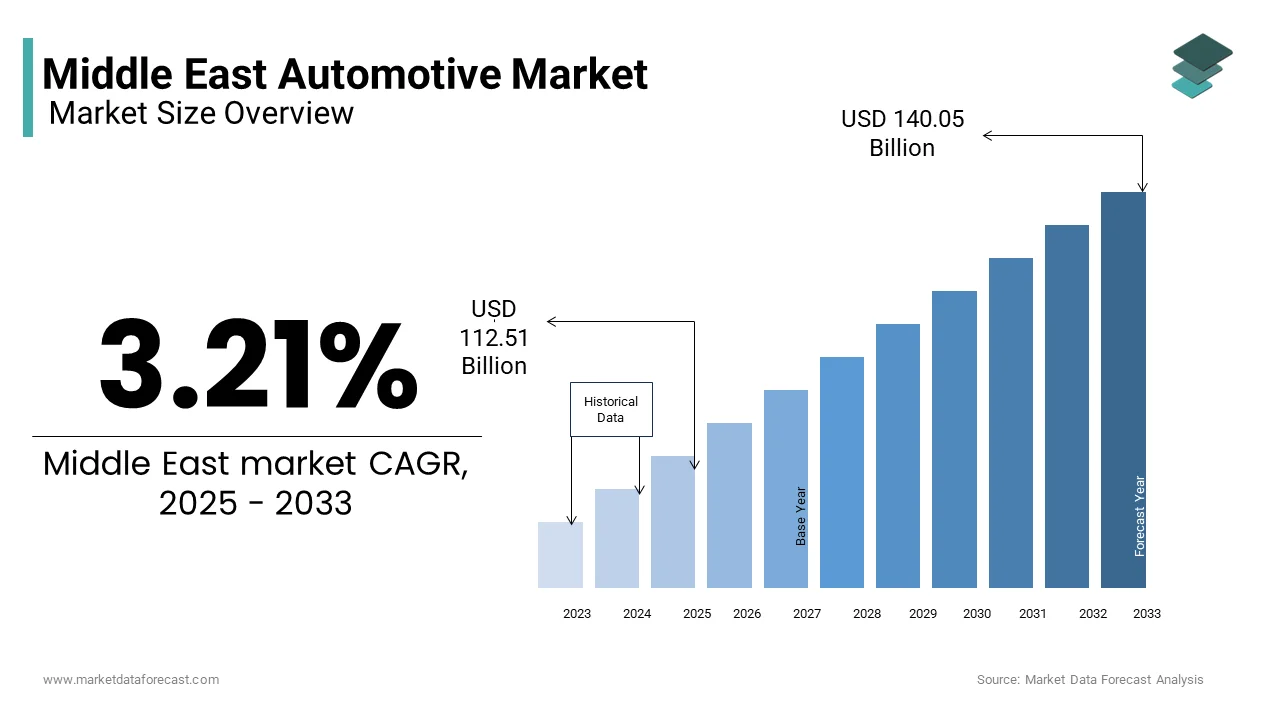
The Middle East automotive market was valued at USD 116.12 billion in 2025, reaching USD 119.85 billion in 2026, and is projected to expand to USD 154.31 billion by 2034, registering a compound annual growth rate (CAGR) of 3.21% during the forecast period from 2026 to 2034.
- Market Scope: Comprehensive regional assessment spanning vehicle types, fuel options, sales channels, size categories, and key country markets across Saudi Arabia, the UAE, Israel, and the broader Middle East & Africa (MEA) region.
- Primary Growth Drivers: Economic diversification initiatives (such as Saudi Vision 2030), robust consumer demand for passenger SUVs and luxury vehicles, and a growing population with rising disposable incomes.
Key Market Segment Metrics
| Category | Leading Segment | Fastest-Growing / Promising Segment |
|---|---|---|
| By Type / Fuel | Passenger Cars (56.4% share in 2024) & Internal Combustion Engines (dominant due to subsidized fuel and local terrain) | Electric Vehicles (EVs) (Projected to grow at a high CAGR of 21.2% from 2025 to 2033, backed by government green initiatives) |
| By Sales Channel | Dealerships (Preferred by over 80% of GCC buyers seeking physical showrooms, personalized service, and bundled warranties) | Online Retail (Anticipated to expand at a CAGR of 17.6%, driven by virtual configurators, AI chatbots, and fintech integration) |
| By Vehicle Size & Country | Mid-Size Vehicles (36.5% share in 2024) & Saudi Arabia (top regional contributor holding 28.3% market share) | Luxury Vehicles (Growing at a CAGR of 14.8%) & Israel/UAE markets accelerating advanced tech and EV adoption |
Major Market Players & Industry Landscape
Competitive Structure: An intensely competitive environment characterized by established global OEMs partnering with dominant regional dealer networks, alongside a transition toward electrification and digital retail.
Leading Companies: Toyota, Ford, Mercedes-Benz (Daimler), Hyundai, BMW, Nissan, Volkswagen, Tesla, Toyota, Renault, Honda, SAIC Motor, Subaru, Porsche, and FCA.
 Download Free Sample Report
Middle East Automotive Market Size
The Middle East Automotive market was valued at USD 116.12 billion in 2025 and is anticipated to reach USD 119.85 billion in 2026 and USD 154.31 billion by 2034, growing at a CAGR of 3.21% during the forecast period from 2026 to 2034.
The automotive industry is diverse and rapidly evolving i, encompassing vehicle manufacturing, imports, sales, and aftermarket services. According to the Organization of Arab Petroleum Exporting Countries (OAPEC), the automotive sector in the Middle East has gained momentum due to rising urbanization, growing middle-class populations, and increasing disposable incomes, particularly in Saudi Arabia, UAEthe, and QatQatars per the International Energy Agency (IEA), the demand for sustainability and emissions reduction has led to greater adoption of hybrid and electric vehicles in cities like Dubai and Doha.
MARKET DRIVERS
Economic Diversification and Industrial Development Initiatives
The region’s ongoing economic diversification efforts aimed at reducing reliance on oil revenues and fostering sustainable industrial growth are prompting the growth of the Middle East automotive market. Governments in countries such as Saudi Arabia, the United Arab Emirates, and Egypt have launched comprehensive development strategies that include automotive manufacturing and assembly as core components of their industrial policies. As part of Saudi Vision 2030, the Kingdom has allocated over USD 5 billion toward establishing localized automotive production facilities, aiming to produce 500,000 vehicles annually by 2030, according to the Saudi Ministry of Industry and Mineral Resources. These initiatives have attracted major global automakers such as Hyundai, Toyota, and Foxconn-Hon Hai to set up or expand operations in the region.
Rising Consumer Demand for Passenger Vehicles and SUVs
The surging consumer demand for passenger vehicles like sport utility vehicles (SUVs) and luxury cars, with the growing population, urbanization, and changing lifestyle preferences, is expected to fuel the growth of the Middle East automotive market. According to the Gulf Research Center (GRC), vehicle ownership rates in GCC countries have steadily increased, with the UAE recording over 500 cars per 1,000 people in 2023. Additionally, as per the Kuwait Institute for Scientific Research (KISR), SUVs accounted for more than 60% of new car sales in the Gulf in 2023, reflecting consumer preference for larger, durable vehicles suited to regional terrain and climate conditions. Luxury brands such as BMW, Mercedes-Benz, and Lexus have expanded their dealership networks across the region, capitalizing on high disposable incomes and strong brand loyalty. Furthermore, the rise of e-commerce-based automotive retail platforms and flexible financing schemes has made vehicle acquisition more accessible.
MARKET RESTRAINTS
Political and Economic Instability in Certain Regions
The persistent political and economic instability in certain parts of the region hampers investment confidence and disrupts supply chains. Countries such as Lebanon, Iraq, and Yemen face challenges, including currency devaluation, geopolitical tensions, and weak governance, whichwhich limitmotive market growth in the Middle East and Africa. According to the World Bank, Lebanon’s GDP contracted by over 20% between 2019 and 2023, leading to a sharp decline in vehicle imports and domestic sales. In Iraq, fluctuating exchange rates and security concerns have discouraged foreign automakers from expanding operations despite a growing population and latent demand.
High Import Dependency and Limited Local Manufacturing Capacity
Another significant constraint on the Middle East automotive market is the heavy reliance on vehicle imports, with most countries lacking robust domestic manufacturing capabilities beyond limited assembly plants. According to the Gulf Cooperation Council Secretariat General, over 90% of vehicles sold in the GCC are imported, primarily from Japan, South Korea, and China. While Saudi Arabia and the UAE have introduced localization incentives, the scale of production remains modest. Moreover, as per the Abu Dhabi Department of Economic Development (ADDED), only a handful of automotive assembly lines operate in the UAE, with limited integration into upstream manufacturing processes such as engine production or component sourcing.
MARKET OPPORTUNITIES
Growth of Electric and Hybrid Vehicle Adoption
The accelerating adoption of electric and hybrid vehicles (EVs and HEVs) is driven by government policies, environmental awareness, and advancements in charging infrastructure. Several Gulf states, including the UAE, Saudi Arabia, and Bahrain, have set ambitious targets for electrification under their respective sustainability agendas. According to the UAE Ministry of Energy and Infrastructure, the country aims to have 42,000 public EV charging stations by 2030, supporting its goal of having 50,000 zero-emission vehicles on the roads within the same timeframe.
Expansion of Mobility-as-a-Service (MaaS) and Ride-hailing Platforms
The rapid expansion of Mobility-as-a-Service (MaaS) and ride-hailing platforms is reshaping transportation habits and influencing vehicle demand patterns. Companies like Careem (now integrated with Uber), SWVL, and local taxi aggregators have significantly altered how consumers access personal mobility. According to the Dubai Roads and Transport Authority (RTA), ride-hailing usage in the UAE grew by over 35% in 2023, with fleet operators increasingly purchasing mid-range sedans and compact SUVs for commercial use. According to the Ministry of Transport, ride-hailing services expanded by 40% year-on-year in 2023, which is prompting companies to introduce electric and hybrid fleets to align with Vision 2030’s sustainability goals. Government-backed initiatives such as the Saudi Green Initiative have further encouraged fleet electrification among transport service providers.
MARKET CHALLENGES
Regulatory Fragmentation Across Regional Markets
A significant challenge confronting the Middle East automotive market is the fragmented regulatory landscape, where each country maintains distinct import regulations, emission standards, taxation policies, and licensing procedures. This inconsistency complicates cross-border distribution and deters large-scale investments from global automakers seeking streamlined operations. According to the Gulf Cooperation Council (GCC) Standardization Organization, while member states have harmonized some technical specifications, differences in customs duties, safety certifications, and after-sales service requirements persist.
Limited After-Sales Service Infrastructure in Emerging Markets
The inadequate after-sales service infrastructure in several emerging countries, particularly outside the Gulf Cooperation Council (GCC), is quietly impeding the growth of the Middle East and African automotive market. This includes the limited availability of certified service centers, spare parts warehouses, and trained technicians, which affects customer satisfaction and vehicle retention.
According to the Jordanian Association of Automobile Manufacturers and Importers (JAAMI), many automakers struggle to maintain consistent service coverage in the Levant and North African markets, where distribution networks are less developed compared to the UAE and Saudi Arabia. This gap in service accessibility not only impacts resale value but also influences initial purchase decisions, especially among buyers prioritizing long-term maintenance ease.
High Fuel Subsidies Discourage Shift to Alternative Fuels
Transition to alternative fuels is thhinderedy e theistorically high level of fuel subsidies, which makes conventional gasoline and diesel vehicles more economically attractive to consumers. Unlike in other global markets where fuel costs serve as a strong incentive for electric vehicle adoption, Middle Eastern consumers benefit from artificially low fuel prices, delaying the shift toward greener mobility solutions. While recent policy adjustments have seen gradual reductions in subsidies, the pace of change has been slow. As per the Kuwait Institute for Scientific Research (KISR), even with minor increases in fuel prices, internal combustion engine (ICE) vehicles continue to dominate new car registrations, with hybrids accounting for less than 5% of total sales in 2023.
REPORT COVERAGE
| REPORT METRIC | DETAILS |
| Market Size Available | 2025 to 2034 |
| Base Year | 2025 |
| Forecast Period | 2026 to 2034 |
| CAGR | 3.21% |
| Segments Covered | By Type, Fuel, Sales Channel, Vehicle Size, and Region. |
| Various Analyses Covered | Global, Regional, Country-Level Analysis, Segment-Level Analysis, DROC, PESTLE Analysis, Porter’s Five Forces Analysis, Competitive Landscape, Analyst Overview of Investment Opportunities |
| Regions Covered | KSA, UAE, Israel, the rest of GCC countries, South Africa, Ethiopia, Kenya, Egypt, Sudan, the rest of MEA |
| Market Leaders Profiled | BMW, Subaru, Porsche, Hyundai, FCA, Toyota, Tesla, Renault, Honda, Volkswagen, SAIC Motor, Nissan, Ford, Daimler |
SEGMENTAL ANALYSIS
By Type Insights
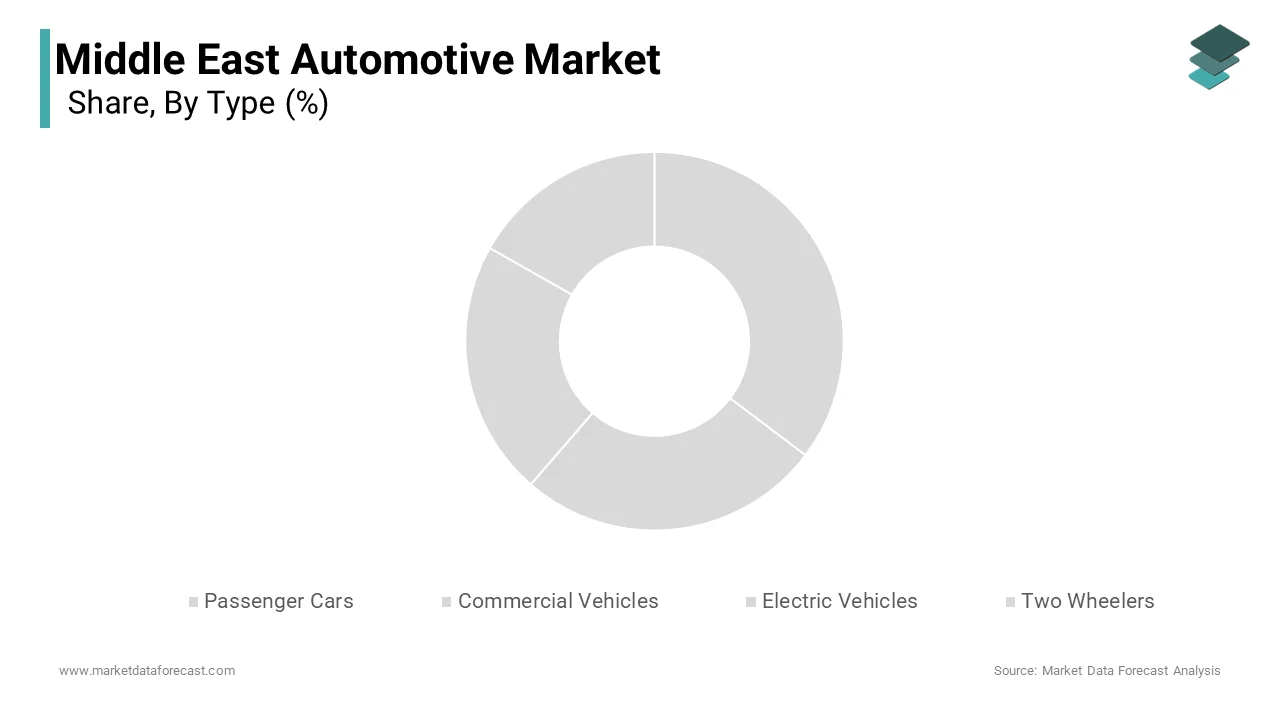
The passenger cars segment accounted in holding 56.4% of the Middle East automotive market share in 2024, owing to the rising urbanization, growing population, and increasing disposable incomes across key economies such as Saudi Arabia and the UAE. The region's car-centric culture, limited public transport infrastructure in many areas, and a strong preference for personal mobility further reinforce demand. Additionally, government initiatives like Saudi Vision 2030 have spurred economic diversification and infrastructure development, indirectly boosting consumer confidence and purchasing power.
The internal combustion engine vehicles segment was the largest, accounting for a dominant share of the Middle East automotive market in 2024. Despite global trends shifting toward electrification, the abundance of oil reserves and historically low fuel prices in the Gulf Cooperation Council (GCC) countries have sustained ICE dominance. Countries like Saudi Arabia and Kuwait benefit from subsidized fuel costs, making gasoline-powered vehicles more economical for consumers. According to the International Energy Agency (IEA), average gasoline prices in Saudi Arabia remained below $0.70 per liter in 2023. Furthermore, the rugged terrain and high temperatures in the region favor larger, more powerful ICE vehicles, particularly SUVs and pickup trucks. Automakers such as Ford and Toyota continue to dominate with robust, climate-adapted models that align with local usage patterns.
The electric vehicles segment is likely to grow with an expected CAGR of 21.2% from 2025 to 2033, with the national sustainability goals, such as the UAE’s commitment to reduce carbon emissions by 70% by 2050, as stated by the UAE Ministry of Climate Change and Environment. Governments across the region are introducing fiscal incentives, including VAT exemptions, reduced registration fees, and toll discounts for EV owners. For instance, in 2023, the UAE introduced a policy allowing zero import duties on fully electric vehicles by accelerating market penetration. Simultaneously, public and private sector investments in EV charging networks are addressing one of the major barriers to adoption. ENOC reported that it had installed over 200 fast-charging stations across the UAE by the end of 2023, with plans to expand to 1,000 by 2030. Localized marketing efforts by automakers and increasing consumer awareness regarding long-term cost savings and environmental benefits are further contributing to the segment's expansion.
By Sales Channel Insights
The dealerships segment was the largest with a dominant share of the Middle East automotive market in 2024 with t, witthe root ofed consumer trust in physical showrooms, where buyers can test-drive vehicles, negotiate pricing face-to-face, and receive immediate after-sales support. The dealership model is particularly favored in markets like Saudi Arabia and the UAE, where luxury and premium brands maintain extensive retail footprints. A survey conducted by Arab Advisors Group found that over 80% of car buyers in the GCC prefer visiting dealerships before making a purchase decision, citing personalized service and real-time assistance as key factors. Moreover, regional distributors often offer bundled packages that include extended warranties, maintenance plans, and insurance—enhancing the appeal of dealership-based purchases. Established dealer groups such as Al-Futtaim Motors, Abdul Latif Jameel (ALJ), and Al Habtoor Motors play a pivotal role in maintaining brand visibility and customer loyalty across the region.
The online retail segment is lucratively growing with an expected CAGR of 17.6% in the coming few years, with thththe digitalnsformation sweeping across the region, supported by high internet penetration and smartphone usage rates. Automakers like BMW, Mercedes-Benz, and Kia have launched virtual configurators, online financing calculators, and home delivery services, catering to time-conscious consumers. In 2023, Ford Middle East introduced an AI-powered chatbot to assist customers throughout the buying journey, enhancing engagement and conversion rates. Additionally, the rise of fintech platforms enabling seamless digital payments and vehicle financing is removing friction from the online purchasing process.
By Vehicle Size Insights
The mid-size vehicles segment held 36.5% of the Middle East automotive market share in 2024. These vehicles strike a balance between affordability, practicality, and performance, which makes them ideal for both urban commuting and family use. Popular mid-size sedans like the Toyota Corolla, Honda Civic, and Nissan Sentra are widely preferred for their fuel efficiency, spacious interiors, and ease of maintenance in harsh climatic conditions. In addition, mid-size SUVs such as the Hyundai Tucson and Mazda CX-5 are gaining popularity due to their versatility and enhanced ride quality. According to Kuwait Finance House (KFH), the middle-class demographic in GCC countries is expanding rapidly, with increasing income levels supporting vehicle ownership. Government-backed auto finance schemes and attractive leasing options further facilitate access to mid-size vehicles.
The luxury vehicles segment is projected to grow with a CAGR of 14.8% in the coming years. The region remains a stronghold for premium brands such as Mercedes-Benz, BMW, Lexus, and Porsche, which continue to report strong sales figures year after year. The prestige associated with luxury vehicles, coupled with technological advancements such as autonomous driving features, AI-powered infotainment systems, and advanced safety mechanisms, enhances their appeal. Additionally, governments in cities like Riyadh and Doha are upgrading road infrastructure and easing traffic congestion, making high-end vehicles more viable for daily use.
COUNTRY ANALYSIS
Saudi Arabia (KSA) Automotive Market Analysis
Saudi Arabia was the largest contributor to the Middle East automotive market, accounting for 28.3% of the market share in 2024. As the economic leader of the GCC, KSA benefits from a strategic push toward economic diversification under Vision 2030, which includes modernizing transportation infrastructure and promoting smart mobility solutions. The country recorded over 670,000 new vehicle registrations in 2023, reflecting strong consumer demand and supportive government policies. Low fuel prices, increased youth purchasing power, and the expansion of financing options have further stimulated vehicle acquisition. The introduction of the Saudi Green Initiative has also encouraged the adoption of hybrid and electric vehicles, with the government planning to establish 100,000 EV charging stations nationwide by 2030, as outlined by NEOM Smart City Initiatives.
United Arab Emirates (UAE) Automotive Market Analysis
The UAE Middle East automotive market is positioned second, with holding 24.3% share in 2024. Dubai and Abu Dhabi serve as hubs for luxury car sales, with brands like Ferrari, Lamborghini, and Rolls-Royce enjoying significant demand. The government’s proactive stance on sustainability has led to the launch of several EV-friendly initiatives, including the Dubai Green Mobility Strategy, which aims to make 20% of all trips in Dubai smart and green by 2030, as reported by the Dubai Roads and Transport Authority (RTA). The establishment of a comprehensive EV charging network, along with tax incentives and import duty waivers, is fostering a balanced transition between conventional and eco-friendly vehicles, ensuring steady market growth.
Israel Automotive Market Analysis
Israel's automotive market is likely to witness a prominent CAGR in the coming years. Israel demonstrates high purchasing power and a tech-oriented consumer base that favors advanced vehicle technologies. Over 320,000 new cars were registered in 202,3 with electric vehicles capturing more than 16% of total passenger car sales, as noted by the Israel Ministry of Environmental Protection. Government incentives, such as reduced taxes on EVs, expanding charging infrastructure, and strict emission regulations, have accelerated the shift toward cleaner mobility. Additionally, Israel’s innovation ecosystem, including startups focused on autonomous driving and battery technology, serves as a testing ground for global automakers looking to pilot next-generation mobility solutions in real-world environments.
COMPETITIVE LANDSCAPE
The Middle East automotive market is characterized by intense competition driven by a diverse mix of global original equipment manufacturers (OEMs), regional distributors, and emerging mobility solution providers. Traditional automotive giants maintain a strong foothold through established brand recognition, robust dealership networks, and comprehensive after-sales services. However, new entrants, particularly those focused on electric vehicles and digital retail models, are challenging conventional business practices. Consumer preferences are rapidly evolving, influenced by economic diversification efforts, increasing environmental consciousness, and digital transformation trends. As a result, automakers must continuously adapt by introducing technologically advanced, fuel-efficient, and digitally integrated products. Competitive pricing strategies, after-sales service enhancements, and localized marketing campaigns further intensify rivalry. Additionally, governments across the region are pushing for greener transportation alternatives, prompting both domestic and international players to invest in alternative fuel technologies and charging infrastructure. The convergence of these factors ensures a dynamic and competitive landscape, where innovation, agility, and customer-centric approaches determine market success.
KEY MARKET PLAYERS
These are the market players that are dominating the Middle East automotive market.
- BMW
- Subaru
- Porsche
- Hyundai
- FCA
- Toyota
- Tesla
- Renault
- Honda
- Volkswagen
- SAIC Motor
- Nissan
- Ford
- Daimler
Top Players In The Market
- Toyota has long maintained a dominant presence in the Middle East automotive market due to its reputation for reliability, durability, and adaptability to harsh climatic conditions. The brand is widely preferred across both personal and commercial segments, particularly in off-road and SUV categories. Toyota’s extensive dealership network and after-sales service infrastructure have reinforced customer loyalty. Its hybrid models are gaining traction as environmental awareness grows.
- Ford enjoys strong demand in the Middle East, especially for its pickup trucks and SUVs, which align well with local preferences for large and powerful vehicles. The company's regional strategy focuses on offering rugged, high-performance models suited to desert terrain and urban commuting alike. Ford has also been investing in digital retail experiences and localized marketing campaigns to enhance consumer engagement. Globally, Ford is advancing its electric vehicle lineup and investing heavily in autonomous driving technologies.
- Mercedes-Benz holds a prestigious position in the Middle East in the luxury automobile vehicle segments. The brand appeals to affluent consumers and government institutions alike, benefiting from its association with status and sophistication. In the global market, Mercedes continues to innovate in areas like electric mobility, automated driving, and connected car technologies. Its EQ sub-brand reflects its commitment to leading the shift toward electrification while maintaining its legacy of engineering excellence.
Top Strategies Used By Key Players In The Market
Localization of Products and Services
Automotive companies are increasingly tailoring their vehicle offerings to suit regional climate, terrain, and cultural preferences. This includes enhanced cooling systems, durable suspensions, and larger vehicle sizes that align with consumer expectations. Additionally, manufacturers are setting up regional service centers and training facilities to improve after-sales support and customer satisfaction.
Expansion of Digital Sales Channels
To meet evolving consumer behavior, major automakers are investing in online sales platforms, virtual showrooms, and contactless purchasing options. These digital initiatives allow customers to configure, finance, and even purchase vehicles remotely by enhancing convenience and accessibility across urban and rural markets.
Partnerships with Local Entities
Establishing joint ventures or strategic alliances with local distributors, financial institutions, and technology firms enables automakers to navigate regulatory frameworks more efficiently, expand distribution networks, and integrate smart mobility solutions into their offerings. Such collaborations help build trust and ensure long-term market sustainability.
RECENT MARKET NEWS
- In March 2024, Hyundai Motor Company launched its dedicated EV Experience Center in Dubai, aiming to educate consumers about electric mobility and showcase its full range of battery-electric vehicles. This initiative strengthens Hyundai’s presence in the region's growing EV segment.
- In July 2023, Renault announced a strategic partnership with Egypt’s Ministry of Trade and Industry to expand local production capacity at its plant in Ain Sokhna, reinforcing Renault’s commitment to the North African automotive corridor and boosting supply chain efficiency.
- In January 2024, BMW Group introduced a fully integrated digital retail platform across the GCC, enabling customers to configure, finance, and purchase vehicles online by reflecting its focus on enhancing digital customer experience in the region.
- In October 2023, Nissan expanded its aftersales service network across Saudi Arabia by opening 15 new service centers, significantly improving accessibility and customer retention in line with Vision 2030's automotive sector goals.
- In May 2024, Stellantis entered a joint venture with a UAE-based investment firm to establish a regional headquarters in Abu Dhabi by supporting its growth strategy and strengthening distribution logistics for brands like Jeep, Fiat, and Peugeot.
MARKET SEGMENTATION
This research report on the Middle East Automotive market is segmented and sub-segmented into the following categories.
By Type
- Passenger Cars
- Commercial Vehicles
- Electric Vehicles
- Two Wheelers
By Fuel Type
- Internal Combustion Engine
- Electric
- Hybrid
- Hydrogen
By Sales Channel
- Direct Sales
- Dealerships
- Online Retail
By Vehicle Size
- Compact
- Mid-Size
- Full-Size
By Country
- Ksa
- Uae
- Israel
- Rest of the GCC Countries
- South Africa
- Ethiopia
- Kenya
- Egypt
- Sudan
- Rest Of MEA