- Product Description Description
- Table of Contents TOC
- List of Table & Figure LOT
- Get Free Sample PDF Sample PDF
Market Size, 2025
$29,813 MnMarket Estimate, 2026
$31,080 MnMarket Forecast, 2034
$43,593 MnCAGR, 2026–2034
4.25%Executive Summary: Middle East Furniture Market
- Market Scope: Comprehensive Middle East furniture market analysis covering material categories, distribution channels, residential and commercial end-use verticals, country-level leadership frameworks, and real estate development metrics.
- Market Valuation: Valued at USD 29,813.42 million (2025), estimated at USD 31,080.49 million (2026), and projected to reach USD 43,593.00 million by 2034, registering a steady CAGR of 4.25% (2026–2034).
- Primary Growth Drivers: Massive real estate and housing initiatives such as Saudi Arabia’s Vision 2030 (targeting 70% homeownership and over 700,000 housing units completed or under construction), rapid urbanization, expanding tourism and hospitality sectors, and a booming digital retail footprint (with GCC online furniture sales growing over 25% in 2023).
Key Market Segment Metrics (2026–2034)
| Category | Leading Segment (2025 Position) | Fastest-Growing Segment |
|---|---|---|
| By Material Type | Wood (dominated with 38.2% of the market share in 2025 due to traditional preference and premium aesthetics) | Plastic Furniture (projected to register a fast-paced CAGR of 12.4%) |
| By Distribution Channel | Specialty Stores (accounted for 42.3% of the market share in 2024) | Online Stores & E-Commerce Platforms (projected to expand at a robust CAGR of 16.8%) |
| By End-Use Sector | Residential Furniture (held a dominant share in 2025, driven by homeownership goals) | Commercial Furniture (projected to register a strong 11.9% CAGR backed by business hubs and hospitality) |
| By Region / Country | Saudi Arabia (led the regional market with a 33.2% share in 2025, followed by the UAE at 26.3%) | Saudi Arabia and UAE Commercial & Residential Hubs (over 60% of furniture internationally sourced) |
Major Market Players & Market Structure
Market Structure: Highly competitive Middle Eastern furniture landscape featuring prominent regional retailers and global multinational giants competing intensely on localized designs, omnichannel retail integration, smart and modular furniture solutions, sustainability, ethical sourcing, customization, and digital shopping technologies like augmented reality.
Key Companies: Al Rugaib Furniture, Almutlaq Furniture Inc., Home Centre, Inter IKEA Group, Marina Home, and Pan Home.
Middle East Furniture Market Size
The Middle East Furniture Market is projected to grow from USD 29,813.42 million in 2025 to USD 31,080.49 million in 2026 and reach USD 43,593.00 million by 2034, registering a CAGR of 4.25% from 2026 to 2034.
The furniture is a broad spectrum of products ranging from traditional handcrafted items to contemporary, modular, and smart furniture tailored to modern lifestyles. Governments in key economies such as Saudi Arabia and the UAE are investing heavily in housing projects, hospitality developments, and retail infrastructure, which is directly fueling demand for interior design and furnishing solutions. According to BMI Research, the furniture industry is benefiting from the expansion of smart cities, luxury real estate developments, and lifestyle-driven consumer behavior. Additionally, shifting demographics with a young, tech-savvy population that values aesthetics and functionality are reshaping purchasing preferences. E-commerce platforms have also gained traction, which is offering consumers greater access to international brands and customized offerings.
MARKET DRIVERS
Urbanization and Expansion of Residential Real Estate
The rapid pace of urbanization and the concurrent boom in residential real estate development is propelling the growth of the Middle East furniture market. Governments across the region are launching large-scale housing programs to accommodate growing populations and improve living standards. In Saudi Arabia, Vision 2030 aims to increase homeownership rates from 47% to 70% by 2030 , as outlined by the Ministry of Housing. This initiative has spurred the construction of thousands of new homes, directly boosting demand for home furnishings. In the UAE, Dubai’s Department of Planning and Development reported that over 50,000 new residential units were completed in 2023, with an additional 80,000 under construction, according to Dubai Land Department.
Rise of E-Commerce and Changing Consumer Preferences
The digital transformation of retail has significantly influenced the Middle East furniture market, with e-commerce platforms playing a crucial role in expanding accessibility and choice. Consumers, particularly younger generations, are increasingly turning to online shopping for furniture due to convenience, competitive pricing, and the ability to customize orders. According to Arab Advisors Group , online furniture sales in the GCC grew by more than 25% in 2023 by improved logistics networks, secure payment systems, and enhanced delivery options. Platforms like Noon, IKEA’s online store, and regional players such as Zayna Home and Namshi have capitalized on this shift by offering curated collections, virtual room visualization tools, and flexible financing plans. In addition, social media and influencer marketing have played a pivotal role in shaping consumer tastes, encouraging experimentation with global design trends. The integration of augmented reality (AR) and artificial intelligence (AI) in online furniture shopping has further enhanced user engagement by allowing customers to preview how pieces will look in their homes before purchasing.
MARKET RESTRAINTS
High Import Dependency and Supply Chain Disruptions
The disruptions in the supply chain of the raw materials from emerging countries is specifically to degrade the growth of the Middle East furniture market. According to Oxford Business Group, more than 60% of furniture sold in the UAE and Saudi Arabia in 2023 was sourced internationally, which is limiting opportunities for local producers to capture market share. This dependency exposes the region to price volatility, trade restrictions, and supply chain disruptions issues that were exacerbated during the global pandemic and continue to pose challenges. For instance, geopolitical tensions affecting shipping routes through the Red Sea in early 2024 led to extended delivery times and increased costs for imported goods, impacting retailers and end consumers alike. Furthermore, while some governments offer incentives for local furniture production, such as tax exemptions and industrial park subsidies, many small and medium enterprises (SMEs) still struggle with high raw material costs, limited access to advanced machinery, and insufficient skilled labor.
Economic Volatility and Consumer Spending Constraints
Economic fluctuations in oil-dependent economies is hampering the growth of the MEA furniture market growth. While wealthier nations like the UAE and Qatar maintain stable purchasing power, countries such as Oman and Egypt have experienced currency devaluation, inflationary pressures, and reduced consumer confidence, which impact discretionary spending. According to the International Monetary Fund (IMF), inflation in Egypt reached over 30% in 2023, which is eroding household budgets and reducing expenditures on non-essential items such as furniture. The region’s reliance on expatriate labor also introduces uncertainty, as economic downturns or job losses can lead to abrupt declines in demand from foreign workers who typically contribute significantly to furniture sales.
MARKET OPPORTUNITIES
Growth of Smart and Sustainable Furniture Solutions
The realm of smart and sustainable furnishings by aligning with broader regional sustainability goals and technological advancements is substantially to fuel the growth of the MEA furniture market in the coming years. Governments across the Gulf Cooperation Council (GCC) are promoting green building certifications such as LEED and Estidam by encouraging developers and consumers to prioritize energy-efficient and eco-friendly materials. According to the Ministry of Climate Change and Environment (MOCCAE) in the UAE, over 40% of new residential developments in 2023 included sustainability features including low-emission furniture and recycled content materials. Additionally, the rise of smart homes equipped with IoT-enabled devices has led to increased demand for intelligent furniture such as adjustable beds, voice-controlled lighting tables, and space-saving modular units that integrate seamlessly with home automation systems. Companies like Turkish manufacturer VitrA and local UAE brand BoConcept have introduced smart furniture lines specifically tailored to Middle Eastern consumers.
Expansion of Commercial and Hospitality Interior Design Demand
The growing demand for commercial and hospitality interior design, fueled by large-scale tourism, retail, and office development projects are also to showcase huge growth opportunities. Countries like Saudi Arabia and Qatar are investing billions in mega-projects such as NEOM, Qiddiya, and Lusail City, all of which require extensive interior fit-outs for hotels, offices, malls, and entertainment venues. According to the Saudi Commission for Hotels and Restaurants (SCHR), the Kingdom plans to open over 200 new luxury hotels by 2030 by creating substantial demand for custom-made and branded furniture. In the UAE, Expo City Dubai and Al Seef District have spurred renewed interest in heritage-inspired yet contemporary interiors that blend cultural identity with modern aesthetics. International hotel chains and restaurant groups entering the region are also seeking bespoke furniture solutions that reflect their brand ethos while appealing to local tastes.
MARKET CHALLENGES
Regulatory Complexity and Quality Standardization Issues
The inconsistency in regulatory frameworks and product quality standards across different jurisdictions is definitely a big challenging for the growth of the Middle East furniture market. While some countries, such as the UAE and Saudi Arabia, have established comprehensive certification requirements for imported and locally manufactured furniture including fire safety, durability testing, and environmental compliance others lack uniform enforcement mechanisms. According to Gulf Standardization Organization (GSO) reports, discrepancies in labeling, material sourcing, and health regulations create confusion for both buyers and sellers, leading to potential reputational risks for brands operating across multiple markets. Additionally, the influx of low-cost furniture from unregulated sources often bypasses formal inspection channels, undermining consumer trust and posing health hazards due to substandard materials. Efforts to harmonize standards within the GCC have been slow, with member states maintaining differing interpretations of safety and sustainability benchmarks.
Limited Domestic Manufacturing Capabilities and Skills Gap
The Middle East furniture market faces structural limitations in its domestic manufacturing base due to a shortage of skilled labor and inadequate investment in technical training. Many furniture producers rely on semi-skilled workers with limited exposure to modern design software, CNC machining, or ergonomic production techniques. According to the King Abdullah Fund for Development (KAFD) in Saudi Arabia, only 12% of furniture firms in the Kingdom had fully automated production lines in 2023. Moreover, vocational training programs in carpentry, upholstery, and industrial design remain underdeveloped, leaving many young professionals without the necessary expertise to enter the sector. This skills deficit not only hampers productivity but also limits the ability of local manufacturers to scale up and compete with well-established international brands.
REPORT COVERAGE
| REPORT METRIC | DETAILS |
| Market Size Available | 2025 to 2034 |
| Base Year | 2025 |
| Forecast Period | 2026 to 2034 |
| Segments Covered | By Material, Distribution Channel, End Use, and Region |
| Various Analyses Covered | Global, Regional, & Country Level Analysis; Segment-Level Analysis; DROC; PESTLE Analysis; Porter’s Five Forces Analysis; Competitive Landscape; Analyst Overview of Investment Opportunities |
| Regions Covered | KSA, UAE, Israel, Rest of GCC countries, and Rest of Middle East. |
| Market Leaders Profiled | Al Rugaib Furniture, Almutlaq Furniture Inc., Home Centre, Inter IKEA Group, Marina Home, Pan Home, and others. |
SEGMENTAL ANALYSIS
By Material Insights
The wood segment held 38.2% of the Middle East furniture market share in 2025 with the region’s deep-rooted cultural preference for traditional wooden furniture, especially among affluent consumers who value craftsmanship and heritage aesthetics. In countries like Saudi Arabia, Jordan, and Lebanon, intricately carved wooden pieces often made from teak, walnut, or rosewood are highly sought after for both residential and hospitality settings. Additionally, the rise of hybrid designs that blend traditional Arab motifs with modern minimalism has expanded the market for wooden furniture beyond conservative buyers.
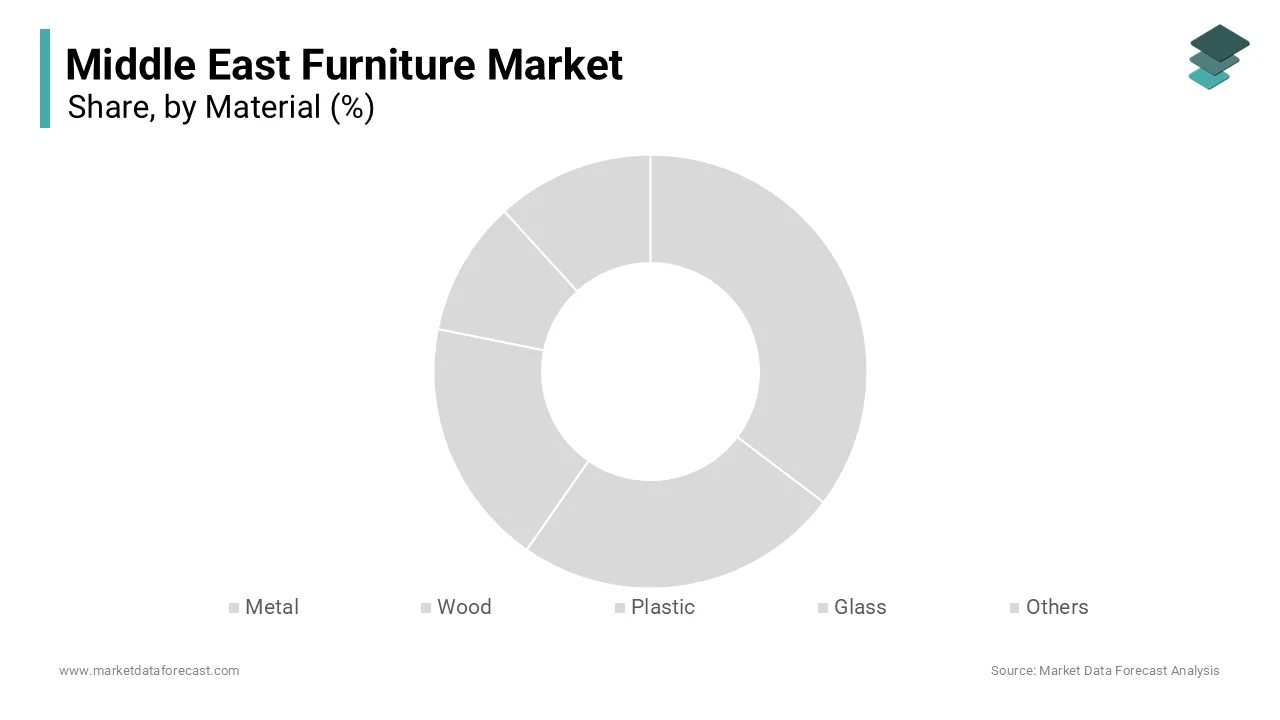
The plastic furniture is projected to grow with an expected CAGR of 12.4% in the next coming years with the increasing demand for affordable, lightweight, and durable furniture solutions tailored to urban living spaces and outdoor environments. With rapid urbanization and a rising youth population, there is growing interest in modular, stackable, and weather-resistant plastic furniture suited for apartments, cafes, and recreational areas. In Egypt, where housing affordability remains a challenge, the government-backed “Decent Living” initiative promoted the use of cost-effective materials including plastic-based dining sets and chairs, which is contributing to a surge in domestic production. According to Egyptian Plastics Manufacturers Association (EPMA), plastic furniture output increased by over 18% in 2023 , supported by improved polymer supply chains and local manufacturing incentives.
By Distribution Channel Insights
The specialty stores segment held 42.3% of the Middle East furniture market share in 2024. These dedicated furniture retailers offer curated collections, personalized design assistance, and immersive showroom experiences that resonate strongly with regional consumers who prioritize quality and aesthetics. In cities like Riyadh, Doha, and Jeddah, high-end specialty showrooms featuring brands such as B&B Italia, Roche Bobois, and local luxury designers remain key shopping destinations for affluent buyers. Additionally, many specialty retailers have adapted by offering online consultations, home delivery, and virtual room visualization tools, which is a blending digital convenience with in-person service. In Saudi Arabia, the Ministry of Commerce noted a 20% increase in new furniture retail licenses issued in 2023 by indicating strong investor confidence in physical retail formats.
The online stores segment is likely to witness an expected CAGR of 16.8% from 2025 to 2033 owing to the changing consumer behavior among younger generations who prefer digital shopping for its convenience, price comparison features, and flexible financing options. Platforms like Noon, IKEA’s online store, and regional players such as Zayna Home and Home Box have capitalized on this shift by offering curated collections, augmented reality (AR) room previews, and same-day delivery services. Moreover, the integration of live chat support, customer reviews, and customizable product filters has enhanced the online shopping experience. In response to rising demand, major logistics companies such as Aramex and Fetchr have expanded their furniture delivery networks, which is reducing delivery times and improving customer satisfaction.
By End Use Insights
The residential end-use segment was accounted in holding a prominent share of the Middle East furniture market in 2025. The rapid urbanization, expanding middle-class populations, and government-led housing initiatives aimed at increasing homeownership rates are propelling the growth of the market. In Saudi Arabia, Vision 2030 has spurred the construction of hundreds of thousands of new homes, with the Ministry of Housing reporting that over 700,000 housing units were either completed or under construction in 2023. Similarly, in the UAE, the launch of long-term residency visas for property investors has boosted demand for fully furnished apartments and villas, particularly in Dubai and Abu Dhabi. According to the Dubai Land Department , more than $45 billion worth of real estate transactions took place in Dubai alone during 2023 , directly stimulating furniture purchases. The rise of co-living spaces, serviced apartments, and short-term rental accommodations has also contributed to recurring demand for ready-to-assemble and modular furniture. Additionally, shifting lifestyle preferences toward home offices, wellness-oriented interiors, and multi-functional living spaces have led to increased spending on customized residential furnishings by ensuring sustained growth for this segment.
The commercial furniture segment is esteemed to register a CAGR of 11.9% in the next coming years with the large-scale investments in hospitality, retail, and office infrastructure across key markets like Saudi Arabia, Qatar, and the UAE. Governments are prioritizing economic diversification through tourism and business development, leading to the construction of luxury hotels, shopping malls, and smart office complexes. According to Emaar Properties , the developer behind Dubai Mall and Downtown Dubai, more than AED 15 billion was allocated for commercial fit-outs in 2023, which is including furniture procurement for new retail and entertainment hubs.
REGIONAL ANALYSIS
Kingdom of Saudi Arabia (KSA)
Saudi Arabia was the top performer in the Middle East furniture market with 33.2% of the share in 2025. Vision 2030 has catalyzed the creation of futuristic cities such as NEOM, Qiddiya, and the Red Sea Project, all of which require extensive interior design and furnishing solutions. The Ministry of Housing reported that over 700,000 housing units were either completed or under construction in 2023. Additionally, regulatory reforms such as the Privileged Residence Program and expanded mortgage financing have made property ownership more accessible to both citizens and expatriates. The government's emphasis on public-private partnerships has also encouraged private sector participation in large-scale developments. Smart city projects and green building certifications are increasingly influencing new furniture offerings, which is positioning Saudi Arabia as a leader in sustainable and tech-integrated interior design.
United Arab Emirates (UAE)
The UAE ranked second in the Middle East furniture market with 26.3% of share in 2025. The launch of the Golden Visa program, offering renewable ten-year residency permits to property investors who purchase properties valued at AED 2 million or more, has significantly boosted foreign buyer interest. In addition, Expo City Dubai, Meydan One Mall, and Palm Jebel Ali have reinforced the emirate’s reputation as a premier destination for high-end residential and commercial furniture. Meanwhile, Abu Dhabi has focused on expanding industrial zones and logistics hubs, attracting multinational corporations seeking strategic footholds in the region. The UAE’s proactive approach to legal reforms, digital infrastructure, and sustainability standards ensures continued investor confidence and market resilience.
Egypt
Egypt furniture market growth is likely to have a significant CAGR in the next coming years. The country's furniture sector benefits from a rapidly growing population, rising urbanization rates, and government-led housing programs. The Ministry of Housing announced that over 700,000 affordable housing units were delivered in 2023, which is significantly boosting demand for residential furnishings. The Suez Canal Economic Zone (SCZone) and New Administrative Capital (NAC) projects are also driving commercial and hospitality furniture demand by attracting foreign direct investment from Chinese, Emirati, and European firms.
Rest of GCC Countries (Bahrain, Kuwait, Oman, Qatar)
The GCC furniture market growth is driven by economic structure, industrial policy, and consumer preferences. Qatar, for example, has witnessed strong furniture demand due to the Lusail City development and preparations for post-World Cup infrastructure upgrades. The Qatar General Electricity & Water Corporation (Kahramaa) reported that over $20 billion was invested in infrastructure in 2023, which is supporting furniture-intensive projects. In Oman, the government’s Vision 2040 strategy has led to investments in industrial parks and logistics hubs, including the Sohar and Duqm ports, which require extensive interior fit-outs for commercial and residential buildings. Meanwhile, Kuwait’s aging infrastructure necessitates large-scale renovation projects, creating consistent demand for residential and office furnishings. Bahrain’s small but technologically advanced furniture market supports niche developments in eco-friendly and modular designs.
Israel
Israel furniture market is likely gain steady growth in the next coming years with the developed and technologically integrated, catering to a diverse range of residential, commercial, and hospitality needs. Tel Aviv remains a global hotspot for luxury property, with average prices exceeding NIS 20,000 per square meter ($5,400) in prime locations, as reported by JLL Israel . A notable trend is the growing integration of smart furniture technologies, with IoT-enabled desks, adjustable beds, and space-saving modular units becoming increasingly common in both residential and office settings. Government initiatives promoting urban renewal and public-private partnerships have also contributed to market expansion. Additionally, the expansion of high-tech campuses, innovation centers, and university-linked research facilities continues to sustain demand for contemporary and functional interior solutions.
KEY MARKET PLAYERS AND COMPETITIVE LANDSCAPE
Al Rugaib Furniture, Almutlaq Furniture Inc., Home Centre, Inter IKEA Group, Marina Home, Pan Home are playing dominating role in the Middle East furniture market
The Middle East furniture market is highly competitive, characterized by a mix of global giants, regional powerhouses, and growing local manufacturers vying for market share. International brands like IKEA and HAY bring established reputations and economies of scale, allowing them to offer competitively priced yet stylish products. Regional players such as Home Centre, Zulekha Furniture, and Al Nakheel Interiors leverage deep market insights and strong distribution networks to maintain relevance among local consumers. Meanwhile, small and medium-sized enterprises are gaining traction through niche offerings, custom-made solutions, and heritage-inspired designs that cater to discerning buyers. The rise of online retail has further intensified competition, forcing traditional retailers to innovate through digital integration, personalized services, and enhanced customer experiences. Additionally, shifting consumer preferences toward sustainable and smart furniture are compelling companies to invest in R&D, supply chain transparency, and product differentiation strategies. In this dynamic environment, success hinges on agility, brand positioning, and the ability to anticipate and respond to evolving market demands.
TOP PLAYERS IN THE MARKET
Al-Futtaim IKEA (UAE)
Al-Futtaim IKEA is a dominant force in the Middle East furniture market, bringing global design sensibilities and affordability to regional consumers. As part of the larger IKEA network, it blends Scandinavian minimalism with local aesthetics to cater to diverse tastes across the Gulf. The company has significantly influenced consumer expectations regarding functionality, sustainability, and value-for-money furnishings. Globally, its success in the Middle East serves as a model for adapting international retail formats to culturally distinct markets while maintaining brand consistency and operational efficiency.
Home Centre (UAE)
Home Centre is a flagship brand under Landmark Group, is one of the most recognized names in home furnishings across the Middle East. It offers a wide range of products tailored to both residential and commercial segments, combining international trends with region-specific preferences. Its presence in multiple GCC countries and strategic expansion into North Africa have made it a key player in shaping lifestyle retail in emerging markets. Globally, Home Centre contributes by showcasing how localized branding and diversified product portfolios can drive growth in fast-evolving consumer sectors.
Zulekha Furniture (UAE)
Zulekha Furniture is a prominent regional brand known for its premium craftsmanship and heritage-inspired designs. It appeals to affluent buyers seeking luxury, tradition, and customization in their interiors. The brand’s emphasis on quality materials and artisanal techniques has elevated the perception of locally made furniture in the global context. Internationally, Zulekha represents how niche luxury players from emerging markets can establish credibility and demand in high-end interior design circles.
TOP STRATEGIES USED BY KEY MARKET PLAYERS
Localization of Design and Product Offerings
Leading furniture brands are increasingly tailoring their designs to reflect cultural aesthetics and lifestyle preferences of Middle Eastern consumers. This includes integrating traditional motifs, colors, and materials into contemporary pieces that appeal to both conservative and modern buyers by enhancing relevance and customer engagement.
Omnichannel Retail Integration
Major players are blending physical and digital shopping experiences to meet evolving consumer behavior. This includes investing in e-commerce platforms with augmented reality tools, click-and-collect services, and seamless delivery options to enhance convenience and accessibility for tech-savvy customers.
Sustainability and Ethical Sourcing Initiatives
Companies are adopting eco-friendly practices such as using recycled materials, reducing carbon footprints, and promoting fair labor standards. These efforts align with global sustainability trends and resonate with an increasingly conscious consumer base in urban centers like Dubai and Riyadh.
RECENT HAPPENINGS IN THE MARKET
- In March 2024, Al-Futtaim IKEA launched a new line of region-specific modular furniture designed for compact urban living spaces in Dubai and Riyadh, which is reflecting its commitment to addressing changing lifestyle needs and strengthening its foothold in the affordable luxury segment.
- In July 2023, Home Centre introduced an AI-powered virtual interior design assistant across its website and mobile app, which is allowing users to visualize furniture placements in real-time by enhancing the online shopping experience and increasing customer engagement.
- In January 2024, Zulekha Furniture opened a state-of-the-art design studio in Jeddah, offering bespoke customization services and private consultations to high-net-worth clients with its position in the premium furniture segment.
- In October 2023, Landmark Group, parent company of Home Centre, announced a strategic partnership with a UAE-based logistics provider to streamline last-mile delivery and installation services for large furniture items by improving customer satisfaction and service reliability.
- In May 2024, Arabian Interiors Co. is a leading Saudi furniture manufacturer, signed a joint venture agreement with a European design firm to co-develop a new line of eco-friendly office furniture, targeting government and corporate clients pursuing green building certifications.
MARKET SEGMENTATION
This research report on the Middle East furniture market is segmented and sub-segmented into the following categories.
By Material
- Metal
- Wood
- Plastic
- Glass
- Others
By Distribution Channel
- Supermarkets and Hypermarkets
- Specialty Stores
- Online Stores
- Others
By End Use
- Residential
- Commercial
By Country
- KSA
- UAE
- Israel
- Rest of GCC countries and Rest of Middle East