- Product Description Description
- Table of Contents TOC
- List of Table & Figure LOT
- Get Free Sample PDF Sample PDF
Market Size, 2025
$33.58 BnMarket Estimate, 2026
$36.24 BnMarket Forecast, 2034
$66.63 BnCAGR, 2026–2034
7.91%Middle East Jewelry Market Size, Growth, Trends & Forecast (2026–2034)
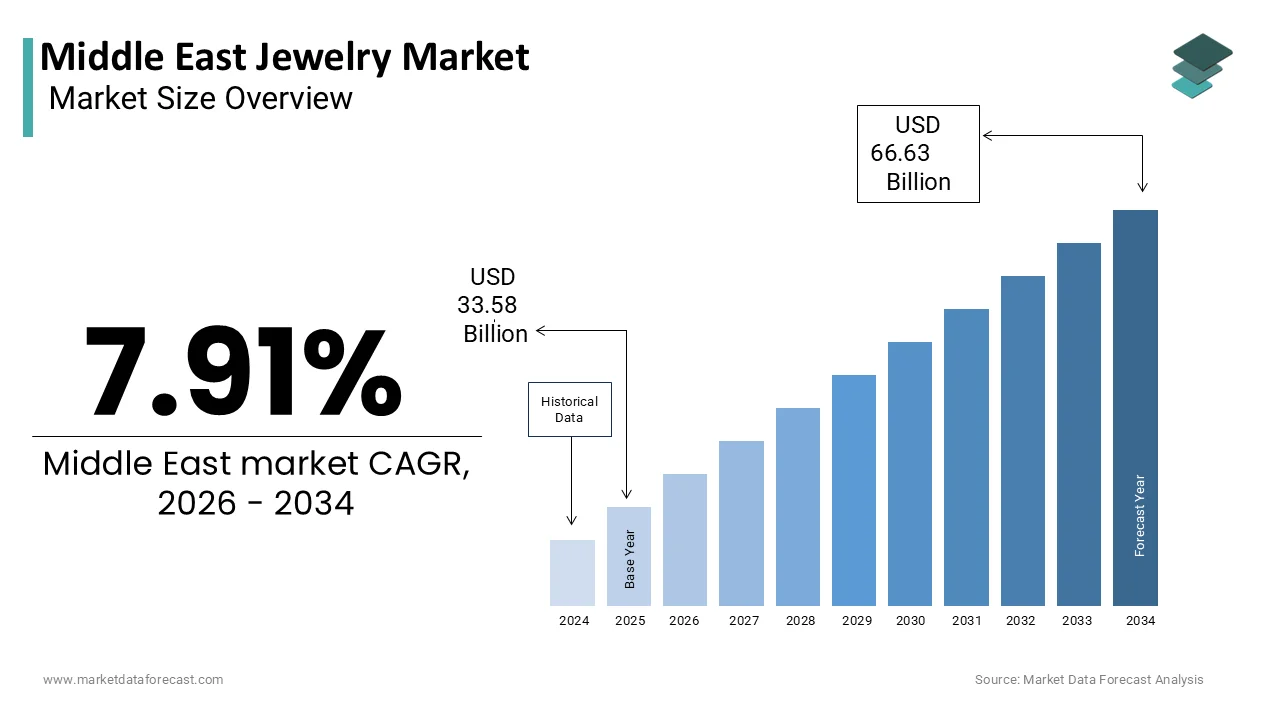
The Middle East jewelry market size was valued at USD 33.58 billion in 2025, is estimated to reach USD 36.24 billion in 2026, and is projected to reach USD 66.63 billion by 2034, registering a compound annual growth rate (CAGR) of 7.91% during the forecast period from 2026 to 2034. Driven by deep-rooted cultural affinities, strong gifting traditions, rising disposable incomes, and the expansion of digital retail platforms, the regional market continues to experience robust modernization and growth.
Key Executive Metrics (At-a-Glance)
- 2025 Base Valuation: USD 33.58 Billion
- 2026 Current Valuation: USD 36.24 Billion
- 2034 Forecast Valuation: USD 66.63 Billion
- Compound Annual Growth Rate (CAGR): 7.91% (2026–2034)
- Leading Product Segment: Necklaces (32.7% share in 2025)
- Leading Regional Country: Saudi Arabia (26.3% share)
Core Market Drivers
- Cultural Significance & Gifting Traditions: Deep-seated social customs, wedding dowry practices, and major religious celebrations driving steady demand for precious metals and stones.
- Rising Disposable Incomes & Urban Affluence: High per-capita incomes across GCC countries fueling luxury expenditures and investments in fine jewelry.
Primary Market Restraints & Challenges
- High Taxation & Import Duties: Steep tariffs and luxury excise taxes in select countries constraining legal retail trade and consumer affordability.
- Counterfeit & Unregulated Markets: Prevalence of illicit trade, uncertified alloys, and smuggling disrupting the formal competitive landscape.
Middle East Jewelry Market Segmentation Breakdown
| Segment Category | Largest / Dominant Segment | Fastest-Growing Segment |
|---|---|---|
| By Product | Necklaces (32.7% Share in 2025) | Earrings (9.4% CAGR) |
| By Material | Gold (Traditional Dominance) | Lab-Grown & Ethical Diamonds |
| By Country | Saudi Arabia (26.3% Share) | United Arab Emirates (UAE) |
Major Industry Players Profiled
Key market participants shaping the Middle East jewelry landscape include L’azurde, Malabar Gold & Diamonds, Pandora, Hans Diamond & Jewellery L.L.C., Bymystique, Yessayan Jewellery, Azza Fahmy Jewellery, and Caspian Jewellery.
Middle East Jewelry Market Size
The Middle East jewelry market size was valued at USD 33.58 billion in 2025, and is expected to reach USD 66.63 billion by 2034 from USD 36.24 billion in 2026. With a growing CAGR of 7.91%.
Jewelry includins fine and fashion jewelry crafted from gold, silver, platinum, and precious or semi-precious stones. This region has a long-standing cultural affinity for jewelry, which is deeply embedded in social customs, religious traditions, and investment behavior. Gold, in particular, holds significant value not only as an adornment but also as a store of wealth, especially during life milestones such as weddings and births.
Urbanization, rising disposable incomes, and evolving consumer preferences have contributed to the modernization of the market, with increasing demand for designer and international brands alongside traditional craftsmanship. As per the World Gold Council, the GCC countries collectively accounted for around 9-12% of global gold demand in 2024, with Saudi Arabia and the UAE emerging as key consumers.
Moreover, the growing influence of digital commerce has transformed how jewelry is marketed and sold across the region. ALSO, online jewelry sales in the UAE grew notably in 2024, driven by younger consumers seeking convenience and customization. The market is further supported by government initiatives promoting luxury retail and tourism, particularly in cities like Dubai and Doha.
This evolving landscape reflects a blend of heritage and innovation, positioning the Middle East as a crucial player in the global jewelry industry, where tradition meets contemporary design and technology-driven retail experiences.
MARKET DRIVERS
Cultural Significance and Gifting Traditions
Its deep-rooted cultural significance and the region’s strong gifting traditions is one of the primary drivers of the Middle East jewelry market. In many Middle Eastern societies, jewelry is not merely an accessory but a symbol of status, prosperity, and familial honor. As noted by the Arab Advisors Group, most of women in the Gulf Cooperation Council (GCC) receive gold or precious metal jewelry as gifts during major life events such as weddings, engagements, and religious celebrations.
These gifting practices are reinforced by societal norms that encourage the exchange of valuable ornaments during festivals like Eid, Ramadan, and Diwali, particularly among expatriate communities in the UAE and Kuwait.
Furthermore, in countries like Saudi Arabia and Oman, it is customary for families to invest in gold as part of dowry arrangements, ensuring intergenerational wealth transfer. These cultural dynamics create a consistent demand for high-value jewelry, making tradition one of the most enduring catalysts for market growth in the Middle East.
Rising Disposable Incomes and Urban Affluence
The steady rise in disposable incomes and urban affluence, particularly in the GCC countries, is another major driver of the Middle East jewelry market. As per the International Monetary Fund, per capita income in the UAE and Qatar exceeded USD 60,000 annually in 2024, enabling consumers to allocate greater spending toward luxury goods, including premium jewelry.
Urban centers such as Dubai, Riyadh, and Doha have seen a surge in high-net-worth individuals who view jewelry not only as a personal asset but also as a financial hedge against inflation. According to the Boston Consulting Group, luxury retail spending in the Gulf increased, with jewelry representing one of the top three categories of expenditure among affluent consumers.
Additionally, the growing presence of international luxury brands—such as Cartier, Bulgari, and Chopard in regional shopping malls and exclusive boutiques has expanded consumer choices beyond traditional gold offerings. With expanding middle classes and increasing female workforce participation, demand for both everyday and occasion-based jewelry continues to rise, reinforcing the sector’s strong growth trajectory across the Middle East.
MARKET RESTRAINTS
High Taxation and Import Duties on Precious Metals
The imposition of high taxation and import duties on precious metals, particularly gold and silver, is a significant restraint affecting the Middle East jewelry market. In several countries, including Egypt and Lebanon, import tariffs can reach up to 20%, according to the United Nations Conference on Trade and Development (UNCTAD), making finished jewelry products significantly more expensive for consumers.
These levies are often introduced as a fiscal policy measure to control imports and stabilize domestic economies. However, they discourage legitimate retailers and increase reliance on informal trade channels, where quality assurance and authenticity may be compromised. In Iraq and Yemen, for instance, unregulated gold markets have flourished due to excessive taxation, undermining formal sector growth.
Moreover, in some jurisdictions, additional excise taxes on luxury items further inflate costs. As reported by the Gulf Research Center, Saudi Arabia implemented a 5% excise tax on gold and jewelry in 2021 under the framework of the GCC’s unified tax policy, impacting purchasing behavior among price-sensitive consumers.
These financial barriers limit market expansion, reduce consumer affordability, and create distortions in supply chain operations, posing ongoing challenges for jewelers operating within the region.
Counterfeit and Unregulated Jewelry Markets
The prevalence of counterfeit and unregulated jewelry trade is another critical challenge restraining the Middle East jewelry market. Despite efforts to strengthen regulatory oversight, informal and illicit markets continue to thrive, particularly in countries with weak enforcement mechanisms.
In regions like Egypt, Jordan, and Sudan, unlicensed vendors sell imitation gold and low-purity alloys labeled as genuine, eroding consumer trust in the broader marketplace. The lack of standardized hallmarking systems in certain countries exacerbates this issue, making it difficult for buyers to verify product authenticity.
Additionally, smuggling remains a persistent problem, especially in border areas where customs controls are less stringent. As per the Arab Monetary Fund, illegal gold flows into conflict-affected zones have been used to finance regional instability, prompting stricter regulations that inadvertently burden legitimate businesses.
These factors contribute to a fragmented market landscape, limiting the growth potential for established jewellers and discouraging foreign brand entry into certain Middle Eastern markets.
MARKET OPPORTUNITIES
Growth of E-commerce and Digital Retail Platforms
The rapid expansion of e-commerce and digital retail platforms is one of the most promising opportunities in the Middle East jewelry market. As internet penetration increases and mobile payment systems become more secure, consumers are increasingly turning to online channels to purchase luxury goods, including fine and fashion jewelry. Like, online jewelry sales in the UAE grew notably in 2024, outpacing traditional retail growth rates.
Digital platforms offer consumers greater convenience, personalized product recommendations, and the ability to compare prices and authenticity certifications. Leading players such as Namshi, Noon, and Farfetch have expanded their jewelry categories, while homegrown startups like Diamond Mansion and PureJewels have gained traction by offering virtual try-ons, customized engraving, and AI-driven styling advice.
Moreover, social commerce via Instagram, TikTok, and WhatsApp has emerged as a powerful channel for independent jewelers and boutique brands to reach niche audiences. With continued advancements in digital payments and logistics infrastructure, e-commerce is set to redefine how jewelry is bought and sold across the Middle East.
Increasing Demand for Lab-Grown and Ethical Jewelry
The growing awareness of sustainability and ethical sourcing is creating new opportunities in the Middle East jewelry market, particularly for lab-grown diamonds and responsibly sourced gemstones. Consumers, especially among the younger and more socially conscious demographic, are showing increasing interest in alternatives to mined gems that align with environmental and ethical values.
Regional governments and private enterprises are responding to this shift by investing in synthetic diamond production and certification processes. In the UAE, the Dubai Multi Commodities Centre (DMCC) launched the world’s first government-backed lab-grown diamond trading hub in 2024, aiming to position the city as a global center for sustainable luxury.
Brands are also leveraging transparency and traceability in their marketing strategies, emphasizing conflict-free origins and reduced ecological footprints. This trend presents a strategic opening for both local and international players to differentiate themselves in a competitive market by appealing to environmentally aware consumers seeking responsible luxury options.
MARKET CHALLENGES
Volatility in Global Gold Prices
The volatility in global gold prices, which directly impacts consumer purchasing behavior and retailer profitability is one of the foremost challenges facing the Middle East jewelry market. Gold is a highly traded commodity influenced by geopolitical tensions, inflationary pressures, and central bank policies, leading to unpredictable fluctuations. According to the World Gold Council, gold prices experienced a 12% swing in 2024 alone, driven by shifts in U.S. Federal Reserve interest rate decisions and currency valuations.
Such volatility makes it difficult for jewelers to maintain stable pricing strategies, often resulting in frequent adjustments that can deter buyers. In markets like Saudi Arabia and the UAE, where gold is considered both a fashion staple and an investment asset, sudden price surges can lead to temporary declines in sales volume.
Moreover, uncertainty regarding future prices affects inventory management and financing decisions for small and medium-sized enterprises (SMEs) that dominate the regional jewelry trade. This instability poses a continuous challenge for stakeholders trying to balance customer expectations with cost control and profit margins in an otherwise culturally entrenched market.
Changing Consumer Preferences Toward Minimalist and Customized Designs
The evolving consumer preference toward minimalist and customized designs, which contrasts with traditional heavy gold ornamentation, is another critical challenge confronting the Middle East jewelry market. Younger generations, particularly in urban centers like Dubai, Doha, and Riyadh, are shifting toward lighter, contemporary pieces that reflect personal style rather than inherited conventions.
This shift necessitates a transformation in product development strategies, compelling established jewelers to adapt their collections to meet changing aesthetics. Many traditional retailers struggle to keep pace with fast-moving fashion trends, lacking agile supply chains or digital tools for bespoke creation.
Furthermore, the demand for personalized engravings, birthstone integration, and unique alloy combinations requires advanced manufacturing capabilities and higher R&D investments, which smaller players may find difficult to sustain.
As a result, the transition toward individuality and subtlety in jewelry design is forcing the market to innovate rapidly, presenting both a creative opportunity and an operational challenge for businesses accustomed to conventional styles and mass production models.
REPORT COVERAGE
| REPORT METRIC | DETAILS |
| Market Size Available | 2025 to 2034 |
| Base Year | 2025 |
| Forecast Period | 2026 to 2034 |
| Segments Covered | By Product, Material, and Region |
| Various Analyses Covered | Global, Regional, & Country Level Analysis; Segment-Level Analysis; DROC; PESTLE Analysis; Porter’s Five Forces Analysis; Competitive Landscape; Analyst Overview of Investment Opportunities |
| Regions Covered | KSA, UAE, Israel, Rest of GCC countries and Rest of Middle East. |
| Market Leaders Profiled | Hans Diamond & Jewellery L.L.C. (UAE), L’AZURDE (Saudi Arabia), Bymystique (UAE), Yessayan Jewellery (Lebanon), Azza Fahmy Jewellery (Egypt), Caspian Jewellery (UAE), and others. |
SEGMENTAL ANALYSIS
By Product Insights
The necklaces segment represented the largest product in the Middle East jewelry market by accounting for a 32.7% of total sales in 2025. This dominance is primarily attributed to cultural preferences, where necklaces are a staple in traditional attire across various age groups and occasions. In Saudi Arabia and the UAE, gold necklaces are often gifted during weddings, religious ceremonies, and family milestones, making them a preferred form of investment and adornment. A notable share of gold jewelry purchased in the GCC is in the form of necklaces, particularly among older generations who view them as valuable heirlooms. Besides, the popularity of layered and pendant-style necklaces among younger consumers has expanded their appeal beyond formal events into everyday fashion. Also, demand for lightweight and designer necklaces increased, driven by urban millennials seeking personalized styles that reflect individuality while respecting cultural norms. This dual role—both as an emotional symbol and a financial asset—cements necklaces as the most dominant product category in the Middle East jewelry market.
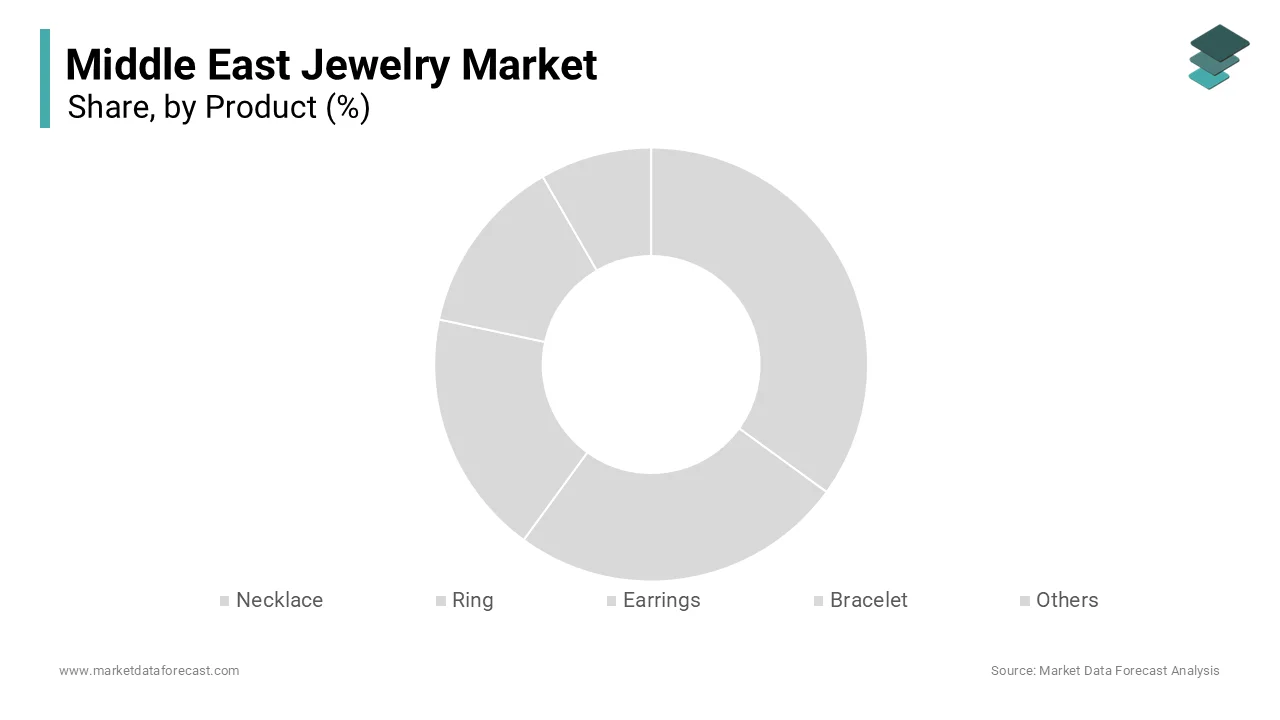
The earrings segment is emerging as the fastest-growing product and is expanding at a CAGR of 9.4% during the forecast period. This rapid growth is fueled by shifting fashion trends, increasing urbanization, and rising demand for statement and minimalist earring designs. One key driver is the growing influence of Gen Z and millennial consumers who prioritize self-expression through accessories. In cities like Riyadh, Doha, and Dubai, young women are opting for delicate studs, hoop earrings, and asymmetrical sets that complement modern outfits while adhering to modest dressing codes. Moreover, advancements in digital retail have made it easier for consumers to explore international trends and customize their choices. Online platforms reported a increase in earring sales in 2024, particularly for lightweight and hypoallergenic materials like titanium and rose gold-plated alloys. With changing lifestyles and increasing disposable incomes, earrings are becoming a go-to accessory for both casual and celebratory occasions, positioning this segment as the fastest-growing within the Middle East jewelry market.
REGIONAL ANALYSIS
Saudi Arabia Jewelry Market Insights
Saudi Arabia held the largest market share of 26.3% in the MEA jewelry industry. The country's strong cultural affinity for gold and precious metals, coupled with high disposable incomes, makes it a major consumer in the region. Wedding-related purchases drive a significant portion of demand, with families investing heavily in gold jewelry as part of dowry traditions. Furthermore, Vision 2030 initiatives have encouraged the development of luxury retail infrastructure, including high-end shopping malls and duty-free jewelry zones. Events like the Riyadh Season and Jeddah Season have also boosted consumer engagement with local and international brands. With government support for digital commerce and ethical sourcing, Saudi Arabia is evolving from a traditional gold-centric market to a more diversified luxury jewelry destination.
United Arab Emirates Jewelry Market Insights
The UAE contributes a significant share of the regional market share. The country’s well-established luxury retail ecosystem, tax-free environment, and cosmopolitan population make it a prime location for both traditional and contemporary jewelry sales. Dubai, in particular, serves as a global trading hub for gold and diamonds. Additionally, the rise of e-commerce and social commerce has expanded access to niche and international brands, attracting digitally savvy consumers. With initiatives like the Dubai Diamond Exchange and the Lab-Grown Diamond Trading Hub, the UAE is not only maintaining its traditional gold trade leadership but also pioneering sustainable and innovative jewelry solutions in the MEA region.
Egypt Jewelry Market Insights
Egypt is an emerging region in the market. Despite economic challenges, Egypt remains a key player due to its large population, deep-rooted cultural traditions, and growing middle-class demand for affordable gold and costume jewelry.
With over 100 million people, Egypt has one of the largest consumer bases in the Arab world. Traditional gold jewelry remains a favored investment, especially among rural and semi-urban populations. Horeover, the government has been promoting artisanal craftsmanship and exports, particularly in silver and semi-precious stones. Initiatives such as the Cairo International Jewelry Fair have attracted international buyers, boosting export potential. While informal markets remain a challenge, the expansion of digital payment systems and online retail is gradually transforming how Egyptians buy and sell jewelry, signaling long-term growth opportunities for the sector.
Israel Jewelry Market Insights
Israel commands a notable share of the regional market share. Though smaller in scale compared to Saudi Arabia and the UAE, Israel plays a vital role as a technology-driven jewelry innovation center within the MEA region. Renowned for its expertise in diamond cutting and polishing, Israel is a global leader in lab-grown diamond production. Additionally, Israel’s advanced manufacturing capabilities and startup culture have enabled the development of smart jewelry and wearable tech, blending fashion with health monitoring and security features. Government-backed incubators and R&D grants further enhance the country’s competitive edge. These strengths position Israel as a key enabler of technological advancement and sustainable luxury in the broader MEA jewelry market.
KEY MARKET PLAYERS AND COMPETITIVE LANDSCAPE
The key players in the Middle East jewelry market are
- Hans Diamond & Jewellery L.L.C. (UAE),
- L’AZURDE (Saudi Arabia),
- Bymystique (UAE),
- Yessayan Jewellery (Lebanon),
- Azza Fahmy Jewellery (Egypt),
- Caspian Jewellery (UAE).
The competition within the Middle East Jewelry Market reflects a dynamic mix of global luxury brands, regional powerhouses, and a multitude of independent retailers. International names like Cartier, Bulgari, and Pandora coexist alongside homegrown giants such as L’azurde, Malabar Gold & Diamonds, and Joyalukkas, each vying for consumer attention through differentiated product offerings and branding strategies. The market is further fragmented by the presence of numerous small-scale jewelers and family-owned boutiques that have deep-rooted connections with local communities.
As disposable incomes rise and consumer tastes evolve, the battle for market share has intensified not only on price and craftsmanship but also on innovation, digital engagement, and ethical sourcing. Brands are increasingly investing in e-commerce infrastructure, augmented reality experiences, and lab-grown diamonds to stay relevant amid shifting preferences. Meanwhile, government-backed initiatives promoting sustainable luxury and domestic manufacturing are reshaping the competitive landscape.
With expanding retail footprints, strategic brand collaborations, and a focus on personalized luxury, companies are continuously adapting to meet the demands of a culturally rich and economically diverse market that remains one of the most lucrative in the global jewelry industry.
TOP PLAYERS IN THE MARKET
L’azurde Company for Jewelry
L’azurde is a leading jewelry brand in the Middle East, known for its premium gold and diamond collections tailored to regional tastes. With a strong presence across Saudi Arabia, Egypt, and the UAE, the company blends traditional craftsmanship with contemporary design to cater to both conservative and modern consumers. L’azurde has played a pivotal role in shaping the Gulf’s luxury jewelry landscape by introducing innovative retail formats, personalized engraving services, and digital shopping experiences that align with evolving consumer expectations.
Malabar Gold & Diamonds
Malabar Gold & Diamonds is a globally recognized Indian-origin brand with a dominant footprint in the Middle East market. The company has built a reputation for offering high-quality, ethically sourced gold and diamond jewelry at competitive prices. In the Middle East, Malabar serves a diverse customer base, including expatriates and local nationals, through an extensive network of showrooms and state-of-the-art manufacturing facilities. Its emphasis on transparency, hallmarking, and customer service has made it a trusted name in the region.
Pandora (Middle East Operations)
Pandora has established a significant presence in the Middle East by adapting its global charm and bracelet concept to local preferences. The brand has successfully tapped into the growing demand for customizable, lightweight, and affordable jewelry among younger consumers. Through flagship stores in Dubai, Riyadh, and Doha, Pandora continues to expand its reach while leveraging digital platforms to enhance customer engagement and personalization, reinforcing its position as a key player in the regional market.
TOP STRATEGIES USED BY KEY MARKET PARTICIPANTS
One of the primary strategies adopted by leading players in the Middle East jewelry market is product personalization and customization. As consumer preferences shift toward individuality and self-expression, brands are investing in digital tools and in-store technologies that allow customers to design their own pieces, from engraving names and dates to selecting gemstones and metal types.
Another crucial approach involves expanding omnichannel retail experiences, blending physical store visits with online browsing, virtual try-ons, and social commerce. This hybrid model enhances convenience, builds brand loyalty, and caters to tech-savvy shoppers who expect seamless integration between digital and in-person interactions.
Lastly, strategic partnerships with local influencers and regional celebrities are being leveraged to strengthen brand relevance and cultural alignment. By collaborating with fashion icons, social media personalities, and even royalty figures, jewelry brands aim to create aspirational appeal and drive engagement within highly connected and image-conscious consumer segments.
RECENT HAPPENINGS IN THE MARKET
- In March 2024, L’azurde launched a digital design studio in Riyadh allowing customers to personalize gold and diamond jewelry using AI-powered styling tools, enhancing the brand’s appeal to digitally savvy millennials and Gen Z consumers.
- In July 2024, Malabar Gold & Diamonds opened a new flagship store in Jeddah Corniche, featuring immersive in-store experiences, live goldsmith demonstrations, and interactive kiosks for real-time product customization.
- In November 2024, Pandora introduced a limited-edition collection inspired by Arabian architecture and motifs, marking a strategic move to deepen its connection with Middle Eastern culture and aesthetics.
- In February 2025, Joyalukkas announced the launch of a blockchain-based certification system for gold and diamond jewelry sold in the UAE, aiming to build trust and transparency in the region’s high-value jewelry transactions.
- In September 2025, Swarovski expanded its presence in the Middle East by opening a luxury concept store in Doha Festival City, focusing on premium crystal and semi-precious jewelry designed for regional tastes and occasions.
MARKET SEGMENTATION
This research report on the Middle East jewelry market is segmented and sub-segmented into the following categories.
By Product
- Necklace
- Ring
- Earrings
- Bracelet
- Others
By Material
- Gold
- Platinum
- Diamond
- Others
By Country
- KSA
- UAE
- Israel
- Rest of GCC countries and Rest of Middle East