- Product Description Description
- Table of Contents TOC
- List of Table & Figure LOT
- Get Free Sample PDF Sample PDF
Middle East Medical Device Market Size
The Middle East medical device market is estimated to grow from USD 6.0 billion in 2024 to USD 9.0 billion in 2033, representing a CAGR of 4.6%.
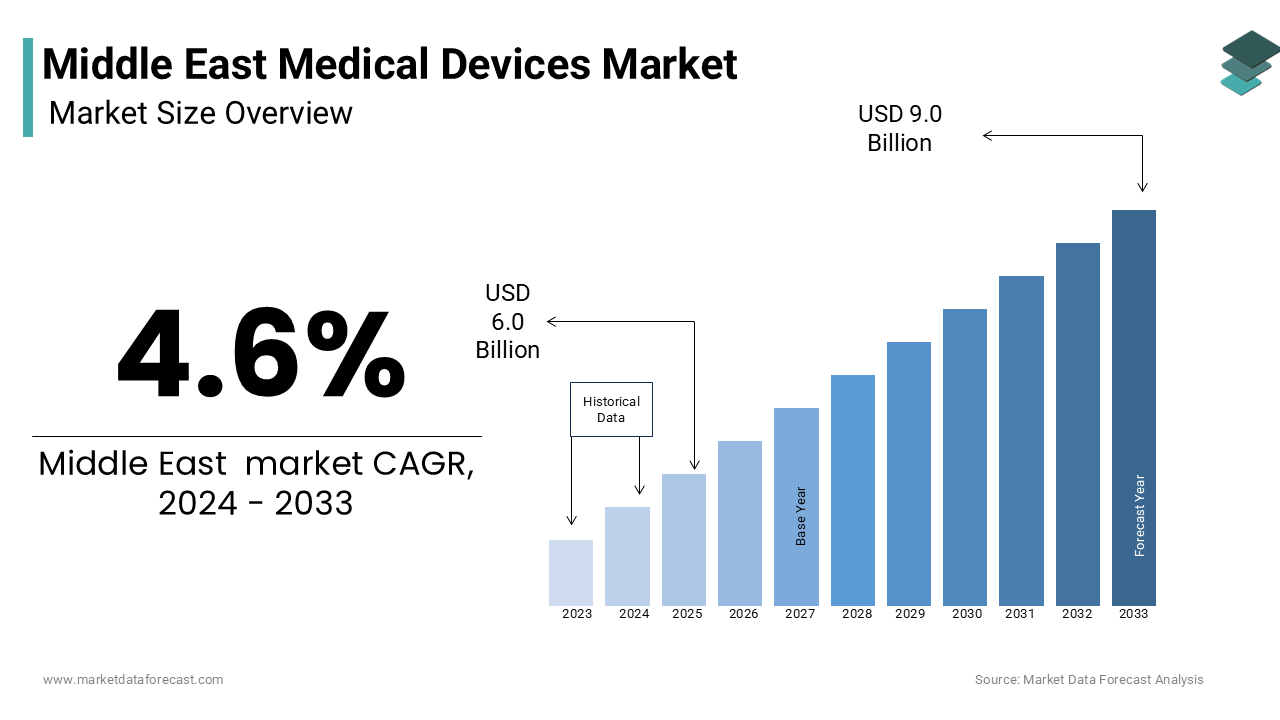
Medical device refers to the technologically advanced instruments and equipment used for diagnosis, monitoring, treatment, and surgical intervention across healthcare facilities in the region. Spanning several countries including Saudi Arabia, the UAE, Qatar, and Jordan, the sector is shaped by rising healthcare expenditure, government-led modernization initiatives, and an increasing burden of chronic diseases. According to the World Health Organization, non-communicable diseases account for over 70% of all deaths in the Eastern Mediterranean region, with cardiovascular conditions alone responsible for 45% of fatalities. The UAE Ministry of Health reports that diabetes prevalence exceeds 18% among adults, one of the highest rates globally, necessitating widespread use of glucose monitoring systems and insulin delivery devices.
MARKET DRIVERS
Government-Led Healthcare Expansion and Vision-Driven Infrastructure Development
National transformation agendas in the Gulf Cooperation Council (GCC) countries are catalyzing large-scale investments in healthcare infrastructure, directly stimulating demand for advanced medical devices. Saudi Arabia’s Vision 2030 includes a substantial financial commitment to healthcare modernization, with many new hospitals and specialty centers planned by 2030. Similarly, the UAE’s “We the UAE 2031” strategy prioritizes smart hospitals equipped with AI-integrated imaging and robotic surgery systems. The Dubai Health Authority commissioned three new AI-powered diagnostic centers, each outfitted with digital pathology scanners and automated analyzers. Qatar’s investment in the Sidra Medicine facility has created demand for neonatal intensive care devices and genomic diagnostic platforms. These state-driven initiatives not only expand physical infrastructure but also mandate the procurement of cutting-edge technologies, positioning government spending as a primary engine of market growth.
Rising Prevalence of Chronic and Lifestyle-Related Diseases
The escalating incidence of diabetes, cardiovascular disorders, and obesity is fundamentally reshaping clinical demand for therapeutic and monitoring devices across the Middle East. According to the International Diabetes Federation, over 38 million adults in the region lived with diabetes in 2023, with prevalence rates exceeding 20% in Kuwait and Bahrain. In Saudi Arabia, cardiovascular diseases are the leading cause of death, responsible for 42% of mortality, as per the King Faisal Cardiac Center. This epidemiological shift has driven the adoption of pacemakers, stents, dialysis machines, and continuous glucose monitors. The need for long-term disease management is accelerating procurement of home-based and wearable diagnostic equipment, reinforcing sustained demand across public and private healthcare networks.
MARKET RESTRAINTS
Fragmented Regulatory Frameworks and Divergent Approval Pathways
The absence of a unified regulatory system across Middle Eastern countries creates significant barriers to market entry and device commercialization. Each nation maintains distinct registration requirements, classification rules, and conformity assessment procedures, complicating compliance for multinational manufacturers. In Lebanon and Iraq, medical device registration can take up to 18 months due to administrative delays and lack of dedicated regulatory bodies, as per the Eastern Mediterranean Regional Office of the World Health Organization. Even in more advanced markets like Saudi Arabia, the transition from SFDA to the new National Center for Health Information (NCHI) has introduced temporary uncertainties. These inconsistencies increase time-to-market, raise compliance costs, and deter innovation diffusion, particularly for中小-sized device developers.
High Dependence on Imports and Limited Local Manufacturing Capacity
The Middle East imports over 85% of its medical devices, primarily from the United States, Germany, and China, according to the United Nations Industrial Development Organization (UNIDO). This dependency exposes the region to supply chain disruptions, currency fluctuations, and geopolitical risks. During the 2021–2022 global logistics crisis, hospitals in Jordan and Oman experienced delays of up to six months in receiving critical imaging components. In Yemen and Sudan, import restrictions and foreign exchange shortages have led to severe shortages of dialysis consumables and ventilator parts. Saudi Arabia and the UAE are attempting to localize production through industrial incentives, but domestic manufacturing remains below 15% of total consumption, as per data from the Saudi Food and Drug Authority. The lack of skilled labor, R&D infrastructure, and high tariffs on raw materials continues to hinder the development of a self-sustaining medical technology ecosystem.
MARKET OPPORTUNITIES
Expansion of Telemedicine and Remote Patient Monitoring Solutions
The integration of digital health platforms with connected medical devices presents a transformative opportunity across the Middle East, particularly in remote and underserved areas. As per the Dubai Health Authority, telehealth consultations in the UAE increased by 220% between 2020 and 2023, creating demand for interoperable devices such as Bluetooth-enabled blood pressure cuffs, ECG patches, and smart inhalers. Bahrain has introduced national reimbursement for remote monitoring services, incentivizing adoption. These initiatives are driving demand for cloud-connected, AI-powered devices that support real-time clinical decision-making and reduce hospital burden.
Growth of Medical Tourism and Specialized Care Hubs
The Middle East is emerging as a regional destination for high-end medical tourism, particularly in cosmetic surgery, fertility treatments, and orthopedic care, creating demand for premium medical devices. According to the Dubai Health Experience (DXH), over 600,000 medical tourists visited the UAE in 2023, seeking procedures such as robotic joint replacements and advanced IVF treatments. Dubai Healthcare City now hosts more than 180 specialized clinics equipped with next-generation imaging and surgical robotics. In Jordan, private hospitals in Amman perform over 50,000 medical tourism procedures annually, as per the Jordanian Ministry of Health, driving procurement of minimally invasive surgical tools and diagnostic platforms. Qatar’s Sidra Medicine and Saudi Arabia’s King Faisal Specialist Hospital are investing in genomic diagnostics and proton therapy systems to attract international patients. This trend incentivizes healthcare providers to adopt cutting-edge technologies, creating a premium segment for advanced device manufacturers.
MARKET CHALLENGES
Shortage of Skilled Clinical and Technical Personnel for Device Utilization
The effective deployment of advanced medical devices is constrained by a critical shortage of trained healthcare professionals and biomedical engineers. According to the World Health Organization, the Eastern Mediterranean region averages only 1.7 physicians and 1.3 nurses per 1,000 people, below the global minimum threshold. In Iraq and Sudan, fewer public hospitals have dedicated biomedical technicians, leading to prolonged downtime for imaging and life-support equipment. This skills gap reduces the return on investment in high-cost technologies and compromises patient safety, necessitating expanded training programs, regional certification frameworks, and public-private collaborations to build sustainable technical capacity.
Geopolitical Instability and Supply Chain Vulnerabilities in Conflict-Affected Regions
Ongoing conflicts and political instability in parts of the Middle East severely disrupt the procurement, distribution, and maintenance of medical devices. In Yemen, Syria, and Libya, healthcare infrastructure has been extensively damaged, with over 60% of hospitals in active conflict zones operating at reduced capacity, as documented by the World Health Organization. Medical supply chains are frequently interrupted due to blockades, sanctions, and port closures, delaying access to essential equipment such as dialysis machines and surgical kits. Even in stable countries, regional tensions affect logistics routes, increasing costs and delivery times. These conditions create a fragmented market landscape where humanitarian aid often supersedes commercial distribution, limiting the scalability of private-sector solutions.
SEGMENTAL ANALYSIS
By Type Insights
The Diagnostic Imaging segment commanded the Middle East medical device market by accounting for 21.5% in 2024. This dominance is driven by widespread demand for early and accurate disease detection across public and private healthcare systems. The increasing burden of cancer and cardiovascular diseases has intensified the need for MRI, CT, and ultrasound systems. According to the International Agency for Research on Cancer, over 650,000 new cancer cases were diagnosed in the Middle East in 2023, with breast and prostate cancers leading incidence rates. In the UAE, there has been an increase in imaging procedures, particularly in screening programs for metabolic and hereditary conditions. Additionally, government-led hospital modernization initiatives, such as Saudi Arabia’s “Quality of Life” program, have prioritized procurement of digital radiology and AI-integrated imaging platforms, reinforcing this segment’s leadership.
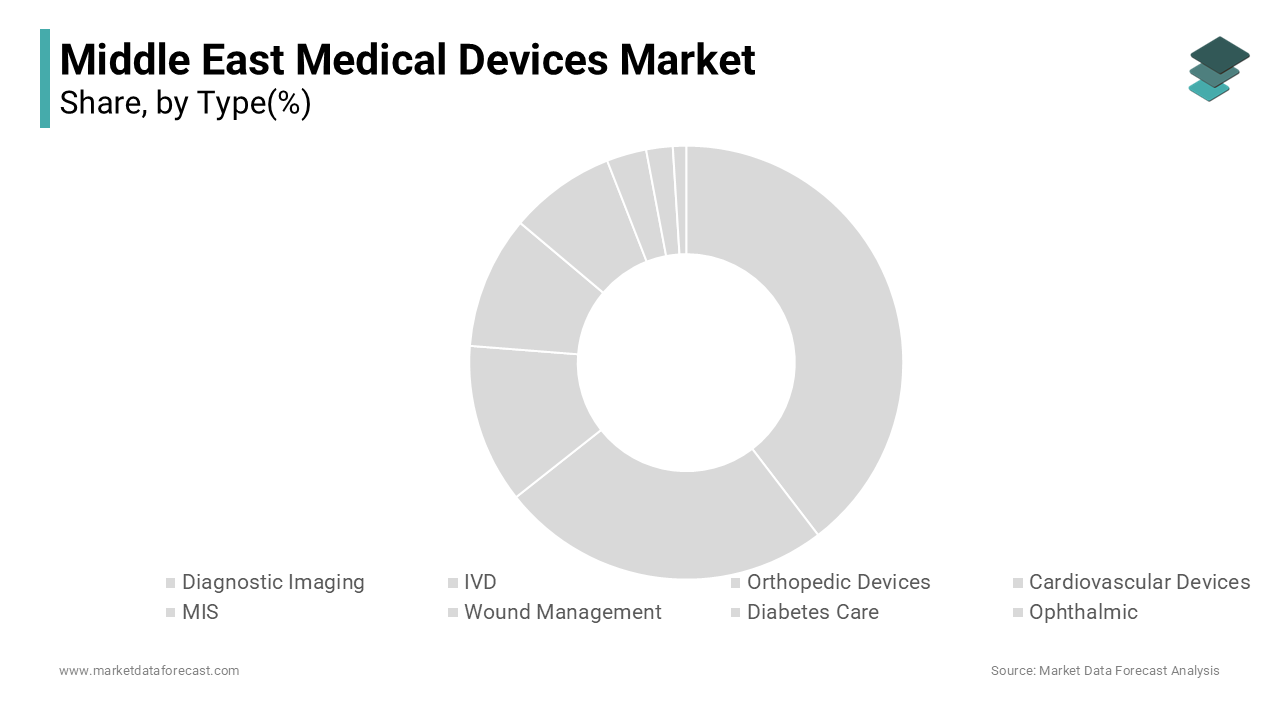
The In Vitro Diagnostics (IVD) segment is the fastest-growing and is projected to expand at a CAGR of 11.2% from 2025 to 2033. This rapid expansion is fueled by rising infectious disease surveillance, prenatal screening, and chronic disease monitoring. The region continues to face high burdens of hepatitis C, dengue, and tuberculosis, with Egypt alone reporting over 1.2 million hepatitis C cases as of 2023, as per the Egyptian Ministry of Health. Additionally, the integration of IVD into primary care networks has accelerated, particularly in maternal and neonatal health programs. In Jordan, mobile IVD labs were deployed to refugee camps in 2023, enabling rapid testing for infectious diseases, as documented by the United Nations High Commissioner for Refugees. Technological advancements in point-of-care testing, including handheld PCR devices and automated immunoassay analyzers, are enhancing accessibility and accuracy, making IVD a cornerstone of preventive and personalized medicine across the region.
By End-User Insights
The Hospital & Ambulatory Surgical Centers (ASCs) segment led the Middle East medical device market by capturing 64.7% of total device utilization in 2024. This lead position is rooted in the concentration of complex surgical procedures, intensive care units, and diagnostic services within institutional settings. Public hospitals in Saudi Arabia and Egypt perform the majority of cardiovascular, oncology, and transplant surgeries, driving sustained demand for high-value equipment such as angiography systems, anesthesia machines, and implantable devices. According to the Dubai Health Authority, over 80% of robotic surgeries in the UAE are conducted in accredited hospitals and ASCs. Furthermore, government investments in mega-hospital projects, such as Egypt’s 4,000-bed Capital Medical City and Saudi Arabia’s King Salman Medical City, are accelerating procurement of integrated diagnostic and therapeutic systems, consolidating hospitals as the central hub for advanced medical technology deployment.
The Clinics segment is growing at the fastest pace and is projected to achieve a CAGR of 10.7% from 2025 to 2033. This growth is driven by the rapid expansion of specialty outpatient facilities in dermatology, fertility, ophthalmology, and dental care, particularly in urban centers like Dubai, Riyadh, and Tel Aviv. In Israel, over 70% of cataract surgeries are now performed in private clinics using advanced femtosecond laser systems, as per the Ministry of Health. The shift toward minimally invasive and same-day procedures reduces hospital burden and lowers costs, incentivizing both patients and insurers. Additionally, clinics are increasingly adopting compact, AI-enabled devices such as digital X-rays, handheld ultrasounds, and automated blood analyzers. In 2023, the UAE introduced regulatory fast-tracking for clinic-based diagnostic equipment, further accelerating adoption and positioning clinics as a high-growth channel for device manufacturers.
REGIONAL ANALYSIS
Saudi Arabia held the most influential position in the Middle East medical device market by representing 32.8% of regional revenue in 2024. The country’s market is defined by aggressive healthcare modernization under Vision 2030, with a substantial amount allocated to hospital construction and digital health integration. The Ministry of Health points out that Saudi Arabia has increased its number of ICU beds, driving demand for ventilators, patient monitors, and infusion pumps. The National Center for Health Information (NCHI) has streamlined device registration, reducing approval times. Additionally, the establishment of medical cities in Riyadh, Jeddah, and Qassim has created high-volume procurement centers for imaging, cardiovascular, and surgical technologies, positioning the kingdom as the region’s largest and most strategically evolving market.
United Arab Emirates is also a key player in the MEA medical device market. The UAE serves as a regional logistics and innovation hub, hosting major trade exhibitions like Arab Health and attracting multinational device manufacturers to establish regional headquarters in Dubai Healthcare City. The country has one of the highest densities of private clinics per capita, with a large number of facilities offering advanced diagnostics and elective procedures. The government’s push for smart hospitals has accelerated the adoption of AI-driven imaging and robotic surgery systems, while free zones offer 100% foreign ownership, making the UAE a preferred gateway for market entry and distribution across the broader region.
Israel commands a notable share of the Middle East medical device market. The country stands out for its world-class innovation ecosystem, producing cutting-edge technologies in minimally invasive surgery, digital health, and wearable diagnostics. Israeli firms such as Medtronic’s R&D center in Yokneam and Biosense Webster’s facility in Tirat Carmel contribute significantly to global device development. The Ministry of Health mandates the adoption of advanced diagnostic tools in public hospitals, with most of the cardiac catheterization labs equipped with intravascular imaging systems. Additionally, Israel performs one of the highest rates of ophthalmic and fertility procedures per capita in the region, driving demand for precision devices. Its regulatory alignment with the EU and FDA accelerates clinical validation and export potential, reinforcing its dual role as a domestic adopter and global innovator.
Egypt holds a decent share of the MEA medical device market. As the most populous country in the region, Egypt faces immense healthcare demand, with millions of residents requiring scalable and cost-effective medical solutions. The government’s “Healthcare 2030” strategy includes the construction of several new hospitals and primary care units, creating significant procurement opportunities. Despite import dependency, local assembly of ultrasound machines and ECG devices is expanding under industrial incentives. Additionally, donor-funded programs from the World Bank and WHO have enabled large-scale distribution of diagnostic equipment to rural clinics, gradually improving access and market penetration.
KEY MARKET PLAYERS AND COMPETITIVE LANDSCAPE
Medtronic, Koninklijke Philips N.V., GE Healthcare, Abbott Laboratories, Siemens Healthineers, Johnson & Johnson, Stryker, B. Braun SE, Getinge AB, Smith+Nephew, Coloplast, Zimmer Biomet, Roche Diagnostics, Becton Dickinson (BD), Olympus Corporation, Cardinal Health, Boston Scientific, Biotronik, Fujifilm, Hitachi, Shimadzu, Mindray Medical, Saudi Mais Co., Kafou Medical Co., LifeWatch, Gulf Medical, Cairo Medical, Al Harbi Medical, and Abu Dhabi Medical Devices.
The competition in the Middle East medical device market is intensifying, shaped by a convergence of global multinationals, regional distributors, and emerging local innovators. Established players such as Medtronic, Siemens Healthineers, and GE HealthCare dominate high-end segments including imaging, cardiovascular implants, and robotic surgery, leveraging technological superiority and clinical validation. However, regional distributors and joint ventures are gaining traction by offering cost-effective alternatives and localized service models. Market rivalry is further amplified by government-led healthcare transformation programs in Saudi Arabia and the UAE, which prioritize innovation and digital integration. The rise of medical tourism and smart hospitals is compelling companies to differentiate through service ecosystems, financing models, and AI-enabled platforms. With regulatory harmonization progressing slowly and economic conditions varying widely, competitors must balance scale, agility, and adaptability to sustain growth across this diverse and dynamic region.
Top Players in the Middle East Medical Device Market
Medtronic
Medtronic maintains a robust presence across the Middle East, delivering a comprehensive portfolio of cardiovascular, neurological, and diabetes care technologies. The company operates regional headquarters in Dubai and has established clinical training centers in Riyadh and Cairo to support physician education on advanced implantable devices such as drug-eluting stents, pacemakers, and insulin pumps. In 2023, Medtronic launched its next-generation Micra AV2 pacemaker in Saudi Arabia, offering leadless cardiac pacing with enhanced algorithmic responsiveness. It also expanded its collaboration with the Sheikh Shakhbout Medical City in Abu Dhabi to integrate AI-driven decision support tools into electrophysiology procedures. Through its Access to Care initiative, Medtronic supports subsidized device programs for underserved populations in Egypt and Jordan, strengthening institutional trust and long-term market integration across both public and private healthcare ecosystems.
Siemens Healthineers
Siemens Healthineers is a leading provider of diagnostic imaging and laboratory diagnostics solutions in the Middle East, with a strong footprint in CT, MRI, and in vitro diagnostics. The company has deepened its regional engagement by establishing service hubs in Dubai and Riyadh, ensuring rapid maintenance and technical support for high-end imaging systems. In 2023, Siemens Healthineers introduced the Magnetom Free. Max, a lightweight MRI system, in select private hospitals in the UAE, enabling imaging in non-traditional settings. It also partnered with King Faisal Specialist Hospital in Riyadh to deploy AI-powered syngo.via software for oncology imaging analysis. The company has intensified its digital health integration, launching remote monitoring platforms for equipment performance tracking. These initiatives enhance operational efficiency for healthcare providers and reinforce Siemens Healthineers’ reputation as a technology innovator in advanced diagnostic infrastructure.
Stryker
Stryker has significantly expanded its orthopedic and surgical technologies presence in the Middle East, focusing on joint replacement, spine surgery, and minimally invasive systems. The company has strengthened its distribution network in GCC countries, supporting hospitals with its Mako robotic-arm assisted surgery platform, which was introduced in Dubai and Doha in 2023. Stryker also launched its Navigation 4.0 system in Saudi Arabia, enhancing precision in spinal and trauma procedures. It has invested in regional clinical education, conducting surgeon training workshops in collaboration with academic medical centers in Kuwait and Oman. Additionally, Stryker established a regional parts and service center in Dubai to reduce equipment downtime and improve after-sales support. These efforts reflect its strategic shift from product supplier to integrated solutions partner, positioning the company at the forefront of surgical innovation in high-growth private and specialized care facilities.
Top Strategies Used by Key Market Participants
Key players in the Middle East medical device market are employing multifaceted strategies to consolidate their regional influence. Localization is a primary focus, with companies establishing regional distribution centers, service hubs, and assembly facilities to reduce import dependency and improve supply chain responsiveness. Firms are increasingly engaging in public-private partnerships to supply devices under government tenders, enhancing access while building institutional credibility. Strategic collaborations with academic hospitals and medical associations for clinical training and research are strengthening physician adoption and brand loyalty. Investment in digital integration—linking devices to AI platforms and cloud-based monitoring systems—is enabling predictive maintenance and remote diagnostics. Additionally, regulatory agility, including early compliance with SFDA and UAE MOHAP requirements, allows faster market entry. These strategies collectively enhance competitiveness in a rapidly evolving, high-potential regional landscape.
RECENT MARKET DEVELOPMENTS
- In February 2023, Medtronic launched its Micra AV2 leadless pacemaker in Saudi Arabia, enhancing cardiac care capabilities and supporting minimally invasive treatments in major hospitals across the Kingdom.
- In June 2023, Siemens Healthineers introduced the Magnetom Free. Max portable MRI system in the UAE, enabling flexible imaging deployment in outpatient and mobile clinics and expanding diagnostic access in urban healthcare networks.
- In September 2023, Stryker initiated Mako robotic-arm-assisted surgery procedures in Doha, partnering with Hamad Medical Corporation to advance precision orthopedic care and strengthen its surgical technology footprint in Qatar.
- In January 2024, Abbott expanded its diabetes care presence in Egypt by launching the FreeStyle Libre 3 system with a national awareness campaign, increasing patient adoption and penetration in public and private health sectors.
- In April 2024, GE HealthCare inaugurated a new digital health innovation center in Dubai, focused on AI-driven radiology workflows and remote monitoring solutions, reinforcing its leadership in smart diagnostic ecosystems across the Gulf region.
MARKET SEGMENTATION
This research report on the Middle East medical device market has been segmented and sub-segmented based on type, end-user, and region.
By Type
- Orthopedic Devices
- Cardiovascular Devices
- Diagnostic Imaging
- IVD
- MIS
- Wound Management
- Diabetes Care
- Ophthalmic
- Dental
- Nephrology
- General Surgery
- Others
By End-User
- Hospitals & ASCs
- Clinics
- Others
By Country
- KSA (Kingdom of Saudi Arabia)
- UAE (United Arab Emirates)
- Israel
- Rest of GCC Countries
- Rest of the Middle East