- Product Description Description
- Table of Contents TOC
- List of Table & Figure LOT
- Get Free Sample PDF Sample PDF
Market Size, 2025
$1082.12 BnMarket Estimate, 2026
$1108.42 BnMarket Forecast, 2034
$1343.14 BnCAGR, 2026–2034
2.43%Middle East Mining of Metal Ores Market Report Summary
The Middle East Mining of Metal Ores Market was valued at USD 1,082.12 billion in 2025, is estimated to reach USD 1,108.42 billion in 2026, and is projected to reach USD 1,343.14 billion by 2034, growing at a CAGR of 2.43% during the forecast period from 2026 to 2034. The growth of the Middle East mining of metal ores market is driven by national economic diversification initiatives, rising investments in mineral exploration, and increasing regional demand for industrial metals. Expanding mining infrastructure, growing government support for value-added mineral processing, and increasing adoption of advanced exploration technologies are further fueling market growth. Moreover, the development of integrated mining and processing zones, AI-driven mineral prospecting, and strategic investments in downstream metal refining are supporting the expansion of the Middle East mining of metal ores market.
Key Market Trends
-
Rising government investments in mining as part of economic diversification strategies across the Middle East.
-
Increasing deployment of AI, satellite imaging, and drone technologies for mineral exploration.
-
Growing development of integrated mining, refining, and metal processing industrial zones.
-
Rising investments in sustainable mining practices and water recycling technologies.
-
Increasing focus on domestic refining and value-added metal production to reduce reliance on raw ore exports.
Segmental Insights
- Based on ore type, the copper ore segment accounted for 34.2% of the Middle East mining of metal ores market share in 2024. The segment’s dominance is attributed to abundant copper reserves across the Arabian Shield, increasing investments in copper mining projects, expanding industrial applications, and rising demand from renewable energy and infrastructure sectors.
- Based on mining method, the open-pit mining segment held the largest share of the Middle East mining of metal ores market in 2025. The dominance of this segment is driven by the widespread presence of near-surface mineral deposits, lower operational costs, high extraction efficiency, and extensive deployment across major copper and gold mining operations.
- Based on processing type, the concentration segment accounted for 52.3% of the Middle East mining of metal ores market share in 2025. The segment’s dominance stems from the growing adoption of mineral beneficiation processes, increasing copper and zinc concentration facilities, and expanding investments in ore processing infrastructure. Meanwhile, the refining segment is projected to witness the fastest growth due to increasing government initiatives promoting domestic value addition and downstream metal manufacturing.
Regional Insights
The Middle East mining of metal ores market is witnessing steady growth across the region, supported by increasing mineral exploration activities, government-led diversification programs, and investments in mining infrastructure.
- Saudi Arabia was the largest contributor, accounting for 48.2% of the Middle East mining of metal ores market share in 2024, driven by Vision 2030 initiatives, extensive copper and gold reserves, expanding mining operations, integrated mineral processing facilities, and significant government investment in the mining sector.
- The United Arab Emirates continues to perform strongly, accounting for 14.3% of the regional market in 2024, supported by growing investments in mineral processing, advanced exploration technologies, satellite-based resource mapping, and the expansion of sustainable metals production.
- Other Middle Eastern countries are gradually strengthening their mining sectors through increased exploration activities, development of new mineral projects, modernization of processing facilities, and strategic partnerships aimed at enhancing regional mineral production and export capabilities.
Competitive Landscape
The Middle East mining of metal ores market is characterized by the presence of state-backed mining companies, integrated mineral processing enterprises, and regional mining operators competing through strategic investments, technological innovation, and vertical integration. Leading companies are focusing on expanding mining capacity, investing in AI-powered exploration technologies, strengthening downstream refining operations, and developing sustainable mining practices. Continuous investments in integrated mining hubs, automation, mineral processing, and environmentally responsible operations are intensifying competition across the Middle East mining of metal ores market. Prominent players in the Middle East mining of metal ores market include Ma’aden (Saudi Arabian Mining Company), Emirates Global Aluminium (EGA), Qatar Mining Company, Oman Mining Company, National Mining Company (Saudi Arabia), Jordan Phosphate Mines Company (JPMC), Iran Minerals Production and Supply Company, Mubadala Investment Company (UAE), Aluminium Bahrain (Alba), and Gulf Mining Group (Oman).
Middle East Mining of Metal Ores Market Size
The Middle East Mining of Metal Ores Market was valued at USD 1082.12 billion in 2025, is estimated to reach USD 1108.42 billion in 2026, and is projected to reach USD 1343.14 billion by 2034, growing at a CAGR of 2.43% from 2026 to 2034.
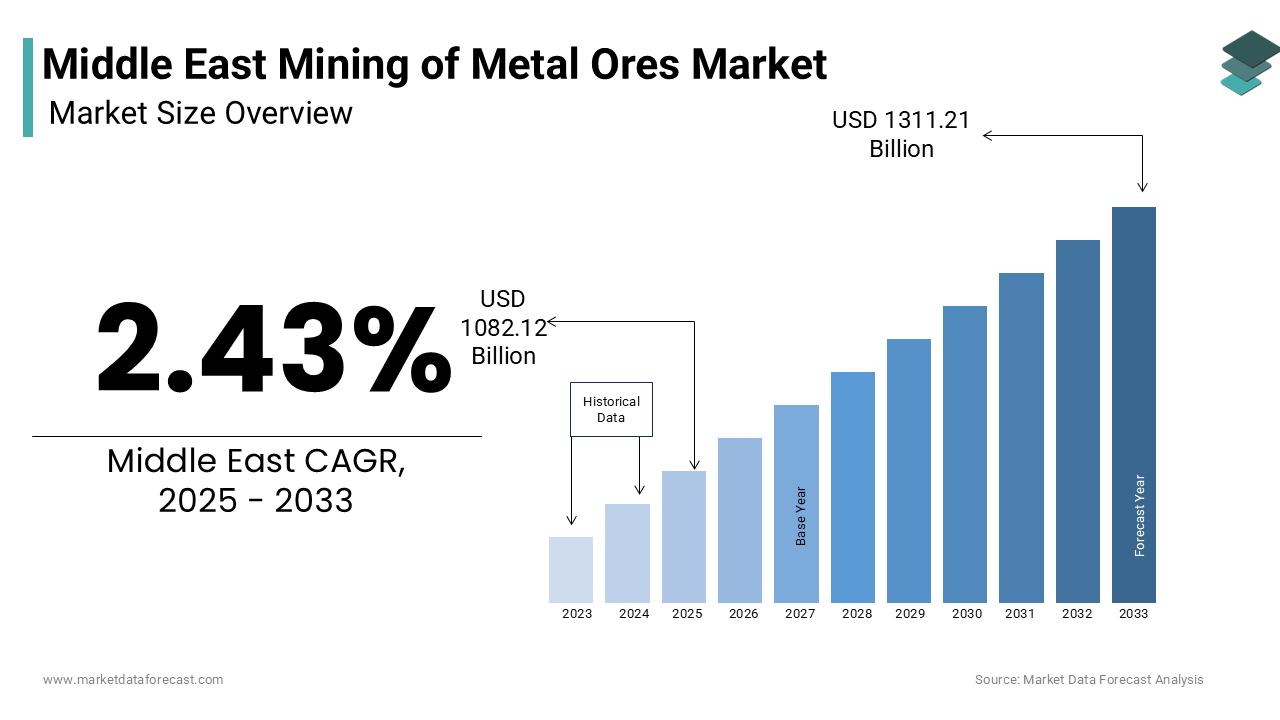
The mining of metal ores is the exploration, extraction, and initial processing of metallic mineral resources including copper, zinc, gold, iron ore, and rare earth elements across countries in Western Asia and the Arabian Peninsula. Historically overshadowed by hydrocarbon dominance, the sector is undergoing strategic transformation as nations diversify their economies. The U.S. Geological Survey reports that Saudi Arabia alone holds an estimated 20 million metric tons of copper metal in identified resources in the Arabian Shield’s volcanic belts.
MARKET DRIVERS
National Economic Diversification Initiatives
The ambitious national development strategies are driving investment in metal ore mining as a core component of post-oil economic transformation, which is fuelling the growth of Middle East mining of metal ores market. As part of this agenda, the government launched the National Industrial Development and Logistics Program by allocating $50 billion to develop mineral extraction and processing infrastructure. Similarly, Oman’s Vision 2040 targets mining to contribute 5% to GDP, with the Public Authority for Mining identifying over 1,200 mineralized zones. The UAE has established the Minerals Strategy 2023, focusing on rare earths and base metals to support advanced manufacturing. These state-backed initiatives are accelerating exploration licensing, attracting foreign capital, and enabling large-scale projects such as the $3.6 billion Jabal Sayid copper mine in Saudi Arabia.
Rising Domestic and Regional Demand for Industrial Metals
The expanding infrastructure, urbanization, and industrialization are fueling demand for base and precious metal ores, which is enhancing the growth of the Middle East mining of metal ores market. According to the Gulf Cooperation Council (GCC) Standardization Organization, the region’s construction sector consumed over 12 million metric tons of steel in 2023, much of it derived from imported iron ore, prompting efforts to develop local supply chains. Additionally, the International Renewable Energy Agency reports that the Middle East installed 15 gigawatts of solar capacity between 2020 and 2023, requiring significant copper for photovoltaic systems approximately 5 tons per megawatt.
MARKET RESTRAINTS
Water Scarcity and Environmental Constraints on Mining Operations
The extreme aridity is significantly limiting the growth of Middle East mining of metal ores market. According to the World Bank, the region has the lowest renewable freshwater per capita globally, with 14 of the 17 most water-stressed countries located in the Middle East. As per United Nations Environment Programme, a single copper concentrator can consume 10,000 cubic meters of water daily, a prohibitive demand in desert environments. Regulatory frameworks are tightening; the UAE’s Federal Law No. 24 of 1999 mandates strict water usage limits, which is forcing mining firms to invest in closed-loop recycling systems, which remain technologically and financially challenging.
Limited Skilled Workforce and Technical Expertise in Mineral Exploration
The deficit in geoscientists, mining engineers, and technical personnel required for advanced mineral exploration and extraction is also restraining the growth of Middle East mining of metal ores market. As per the International Labour Organization, the region produces fewer than 800 mining engineering graduates annually, insufficient to meet the demands of expanding operations. In Iraq and Yemen, where geological surveys are outdated or nonexistent, the lack of trained professionals hampers resource assessment. Saudi Arabia’s Ministry of Education reports that only 3% of university students enroll in earth sciences programs by creating a reliance on expatriate expertise.
MARKET OPPORTUNITIES
Development of Integrated Mining and Processing Zones
Governments are establishing specialized mining and industrial zones to create vertically integrated ecosystems that enhance value addition and attract foreign investment is creating new opportunities for the growth of the Middle East mining of metal ores market. Saudi Arabia’s King Salman Energy Park (SPARK) and Wa’ad Al-Shamal Industrial City are designed to co-locate mining operations with smelting, refining, and manufacturing facilities, reducing logistics costs and increasing export competitiveness. The Saudi Authority for Industrial Cities and Technology Zones reports that Wa’ad Al-Shamal will host the world’s largest phosphate and copper processing complex, with an annual capacity of 2 million metric tons of refined copper. Similarly, the UAE’s Ras Al Khaimah Mining Hub aims to process bauxite and rare earths for aerospace and electronics manufacturing. These zones offer tax incentives, streamlined permitting, and dedicated infrastructure, which is transforming raw ore extraction into high-value industrial activity and positioning the Middle East as a regional metals processing leader.
Adoption of Advanced Exploration Technologies and AI-Driven Prospecting
The integration of satellite imaging, drone-based surveys, and artificial intelligence is additionally to leverage the growth of Middle East mining of metal ores market. According to the King Abdullah University of Science and Technology, AI algorithms analyzing geological, magnetic, and hyperspectral data have increased the success rate of exploration drilling in Saudi Arabia by 40% since 2021. The UAE Space Agency’s KhalifaSat has been deployed to map mineral signatures across the Hajar Mountains, which is identifying previously undetected copper-gold anomalies in Fujairah. In Iran, the Geological Survey and Mineral Exploration Organization has partnered with European tech firms to implement machine learning models that predict ore body locations with 85% accuracy.
MARKET CHALLENGES
Geopolitical Instability and Cross-Border Resource Disputes
The mining activities are frequently disrupted by regional conflicts, territorial disputes, and shifting political alliances, which is degrading the growth of Middle East mining of metal ores market. In Yemen, ongoing conflict has halted all formal mining operations despite the country’s estimated $48 billion in untapped mineral wealth, as reported by the U.S. Geological Survey. Iraq’s mineral-rich Qayyarah region remains underdeveloped due to security concerns and overlapping claims between federal and Kurdish authorities. According to the United Nations Office for the Coordination of Humanitarian Affairs, artisanal mining in Syria’s eastern deserts occurs in conflict zones, often controlled by non-state actors.
High Capital Intensity and Long Payback Periods for Greenfield Projects
The development of new metal ore mines in the Middle East requires substantial upfront investment due to remote locations, harsh environments, and the need for supporting infrastructure is restricting the growth of Middle East mining of metal ores market. In Oman, the Ashalim copper project required $800 million for road, power, and water infrastructure before extraction began, as reported by the Public Authority for Mining. The World Bank notes that mining projects in the region face internal rate of return (IRR) delays of 3–5 years due to permitting, environmental assessments, and community consultations.
SEGMENTAL ANALYSIS
By Ore Type Insights
The copper ore segment was accounted in holding 34.2% of the Middle East mining of metal ores market share in 2024 with the extensive porphyry copper deposits within the Arabian-Nubian Shield, which spans Saudi Arabia, Oman, and Yemen. According to the U.S. Geological Survey, Saudi Arabia alone hosts over 18 million metric tons of identified copper resources, with major operations such as the Mahd Al-Dhahab and Jabal Sayid mines contributing significantly to output.
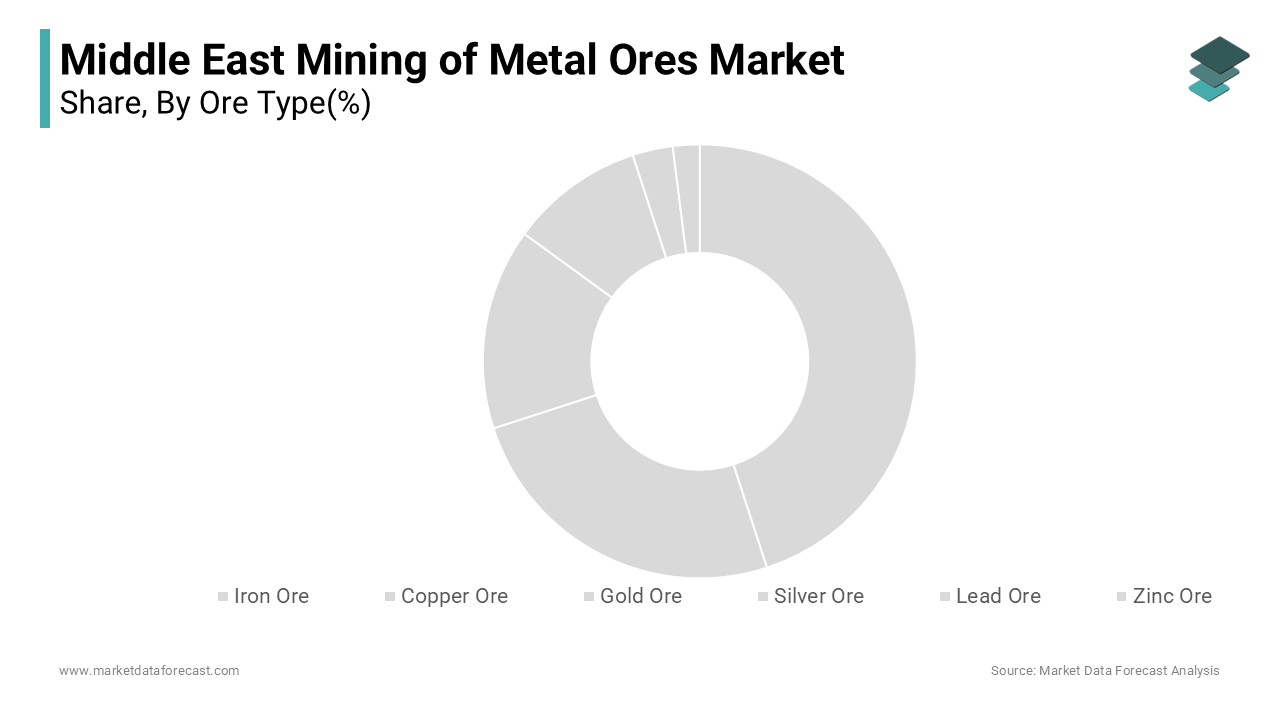
The gold Ore segment is projected to register a CAGR of 12.6% during the forecast period with the rising global gold prices, strategic national reserves diversification, and the discovery of high-grade deposits in previously underexplored terrains. In 2023, gold reached an average price of $1,940 per ounce, a 15% increase from 2022, according to the London Bullion Market Association, making extraction economically viable even in high-cost environments. Saudi Arabia’s Ministry of Industry and Mineral Resources identified over 70 million ounces of gold potential across the Arabian Shield with the Mahd Al-Dhahab mine producing 1.2 million ounces since 2020.
By Mining Method Insights
The open-Pit Mining segment held a prominent share of the Middle East mining of metal ores market in 2025 with the geological characteristics, where many economically viable ore bodies particularly copper, gold, and zinc are located near the surface in hard rock formations of the Arabian Shield. The method allows for high-volume, mechanized extraction with lower initial capital intensity compared to underground operations. According to the Saudi Ministry of Industry and Mineral Resources, over 80% of active metal mines in the country, including the Al-Lajat and Jabal Sayid projects, utilize open-pit techniques.
The underground mining segment is anticipated to witness a CAGR of 9.8% in the coming years with the depletion of near-surface deposits and the increasing exploitation of deeper, high-grade ore bodies that cannot be accessed through open-pit methods. Similarly, Jordan’s Al-Tafilah phosphate and base metals project is transitioning to underground extraction to access zinc-rich sulfide zones below 600 meters. The advancement of mechanized and automated underground mining technologies is additionally fuelling the growth of segment. The UAE’s Falcon Minerals has deployed AI-guided navigation systems in its underground copper exploration in Ras Al Khaimah, improving precision and reducing dilution.
By Processing Type Insights
The concentration segment was accounted in holding 52.3% of Middle East mining of metal ores market share in 2025 as mineral beneficiation involves crushing, grinding, and flotation to increase the metal content of raw ore before further refining. It is the first and most widely implemented processing step, particularly in copper and zinc operations. According to the Saudi Authority for Industrial Cities and Technology Zones, over 30 concentration plants are operational in the country, with the Wa’ad Al-Shamal facility processing 120,000 tons of copper ore daily.
The refining segment is likely to pose a significant CAGR of 11.3% in the coming years with the national strategies to move up the value chain and produce high-purity metals for domestic manufacturing and export. Historically, the Middle East exported most of its copper and zinc concentrates to Europe and Asia for refining, but countries are now investing in smelting and electrolytic facilities. The integration of refining with downstream industrial and energy projects is also leveraging the growth of the segment.
REGIONAL ANALYSIS
Saudi Arabia was the top performer in the Middle East mining of metal ores market by capturing 48.2% of share in 2024. As per Ministry of Industry and Mineral Resources, non-oil mining contributed $4.2 billion to GDP in 2023, with copper, gold, and phosphate as primary outputs. The country hosts over 70 active metal mines, including the high-grade Mahd Al-Dhahab gold mine and the Jabal Sayid copper project.
United Arab Emirates mining of metal ores market held 14.3% of the share in 2024. The Ras Al Khaimah emirate hosts over 50 mining licenses for copper, zinc, and bauxite, with the UAE Space Agency using satellite imaging to identify new deposits.
COMPETITIVE LANDSCAPE
Competition in the middle east mining of metal ores market is increasingly shaped by national industrial strategies, technological capability, and access to capital rather than purely commercial dynamics. State-owned enterprises such as Ma’aden and NICICO dominate due to sovereign backing and control over strategic assets, while private and joint ventures face regulatory and financing hurdles. Differentiation is emerging through value addition, with countries like Saudi Arabia and the UAE prioritizing refining over raw ore export.
KEY MARKET PLAYERS
Some of the promising companies that are playing a dominating role in the Middle East mining of metal ores market include
- Ma’aden (Saudi Arabian Mining Company)
- Emirates Global Aluminium (EGA)
- Qatar Mining Company
- Oman Mining Company
- National Mining Company (Saudi Arabia)
- Jordan Phosphate Mines Company (JPMC)
- Iran Minerals Production and Supply Company
- Mubadala Investment Company (UAE)
- Aluminium Bahrain (Alba)
- Gulf Mining Group (Oman)
Top Players in the Middle East Mining of Metal Ores Market
Saudi Arabian Mining Company (Ma’aden) is the top most player of Saudi Arabia’s strategic pivot toward mineral self-sufficiency and industrial diversification. The company operates integrated mining and processing complexes for gold, copper, and phosphate across the Arabian Shield, including the Mahd Al-Dhahab and Jabal Sayid mines. In 2023, Ma’aden launched the Wa’ad Al-Shamal Industrial City, a $3.6 billion megaproject that will house the world’s largest single-site copper refinery, capable of producing 300,000 tons of cathode copper annually. The company has partnered with global firms such as Barrick Gold and Alcoa to enhance technical capabilities and export reach. Ma’aden has also invested in AI-driven exploration technologies in collaboration with the Saudi Geological Survey, increasing discovery efficiency.
Emirates Global Aluminium (EGA), while primarily known for aluminum production, has expanded its footprint into metal ores through strategic investments in mineral processing and technology integration. The UAE-based company has initiated feasibility studies for refining imported copper and zinc concentrates at its Jebel Ali facility, aligning with the UAE’s Minerals Strategy 2023. In 2023, EGA partnered with the Ministry of Energy and Infrastructure to pilot a rare earth element recovery project from industrial byproducts, enhancing resource efficiency. The company has also developed low-carbon smelting technologies, reducing energy consumption by 15%, as verified by the International Aluminium Institute. EGA’s integration with Dubai’s industrial zones and its access to global shipping routes enable it to serve as a regional hub for high-purity metal production, supporting aerospace, defense, and renewable energy sectors.
National Iranian Copper Industries Company (NICICO) is a dominant force in Iran’s metal ore sector, overseeing the extraction, concentration, and refining of copper across multiple large-scale operations. The company manages the Sarcheshmeh copper mine, one of the largest in the world, which alone contributes over 1 million tons of copper annually, as reported by the Iranian Ministry of Industry, Mine and Trade. NICICO has modernized its smelting facilities in Sirjan and Kerman, increasing refining capacity by 25% since 2021. Despite international sanctions, the company has strengthened domestic supply chains and developed joint ventures with Chinese and Russian firms to upgrade technology.
Top Strategies Used by Key Market Participants
Key players in the Middle East mining of metal ores market are leveraging vertical integration, state-backed investment, technological modernization, public-private partnerships, and sustainable mining practices to consolidate their positions. Companies are expanding from extraction to refining and downstream manufacturing to maximize value capture. Strategic alliances with sovereign wealth funds and national development programs ensure long-term financing and regulatory support. Adoption of AI, satellite imaging, and automation is improving exploration accuracy and operational efficiency. Firms are also investing in water recycling, renewable energy integration, and community engagement to meet environmental and social governance standards. Additionally, digital licensing platforms and transparent bidding processes are enhancing investor confidence by enabling sustainable growth in a capital-intensive and geopolitically sensitive sector.
RECENT MARKET DEVELOPMENTS
- In June 2023, Emirates Global Aluminium launched a pilot project in Jebel Ali to recover rare earth elements from industrial waste streams by marking a strategic move into minerals and supporting the UAE’s advanced manufacturing and clean energy goals.
- In February 2024, Ma’aden signed a technology transfer agreement with a Canadian AI-mining firm to deploy autonomous drilling and ore forecasting systems across its gold and copper operations in the Arabian Shield, enhancing exploration precision.
- In May 2024, EGA announced a $750 million investment to expand its low-carbon smelting capacity at the Jebel Ali facility, aiming to refine imported copper concentrates and position the UAE as a regional hub for sustainable metal production in the Middle East mining of metal ores market.
MARKET SEGMENTATION
This research report on the Middle East Mining of Metal Ores Market has been segmented and sub-segmented based on ore type, mining method, type, application, and region.
By Ore Type
- Iron Ore
- Copper Ore
- Gold Ore
- Silver Ore
- Lead Ore
- Zinc Ore
By Mining Method
- Open-Pit Mining
- Underground Mining
- Solution Mining
- Alluvial Mining
By Type
- Concentration
- Extraction
- Refining
By Application
- Construction
- Transportation
- Industrial
- Consumer Goods
By Country
- KSA (Kingdom of Saudi Arabia)
- UAE (United Arab Emirates)
- Israel
- Rest of GCC Countries
- Rest of the Middle East