- Product Description Description
- Table of Contents TOC
- List of Table & Figure LOT
- Get Free Sample PDF Sample PDF
Middle East Pharmaceutical Market Size
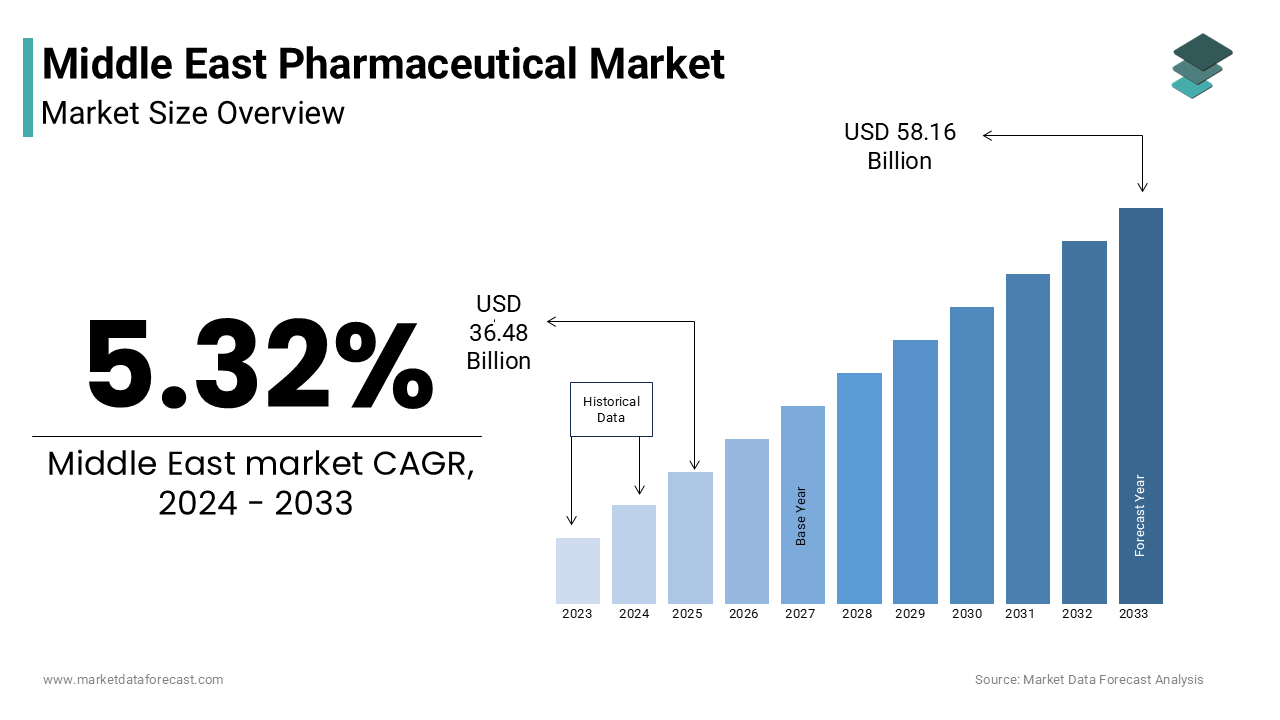
The Middle East pharmaceutical market is projected to grow from USD 36.48 billion in 2024 to USD 58.16 billion by 2033, at a CAGR of 5.32%.
The pharmaceutical is involved in drug manufacturing, distribution, regulatory development, and healthcare delivery across countries such as Saudi Arabia, the United Arab Emirates, Egypt, Iran, Israel, and Turkey. The region is also witnessing a shift toward local pharmaceutical production to reduce import dependency and ensure supply chain resilience. The expansion of healthcare insurance schemes and the implementation of digital health initiatives have further strengthened access to medicines across urban and rural populations. Moreover, the region is investing heavily in biopharmaceuticals and generic drugs, aiming to meet global quality standards while supporting economic diversification goals. Initiatives like Saudi Vision 2030 and the UAE’s National Strategy for Industry and Advanced Technology are reshaping the landscape by encouraging innovation and attracting foreign direct investment into the sector.
MARKET DRIVERS
Rising Prevalence of Chronic Diseases
The growing burden of chronic diseases such as diabetes, cardiovascular conditions, and respiratory illnesses is key driving factor of the Middle East pharmaceutical market growth According to the International Diabetes Federation (IDF), the Gulf region has some of the highest diabetes prevalence rates globally, with nearly 20% of adults in Saudi Arabia and 19% in the UAE affected by the condition in 2023. Governments across the Middle East are responding by expanding national health programs and promoting preventive care. For instance, Saudi Arabia's Ministry of Health launched a nationwide screening initiative in 2023 targeting metabolic disorders, which is directly boosting pharmaceutical sales.
Government-Led Healthcare Reforms and Investment
The implementation of comprehensive healthcare reforms and increased public investment in medical infrastructure is another attribute propelling the growth of the Middle East pharmaceutical market. Governments in the GCC and other key economies are prioritizing healthcare modernization to improve service delivery, expand insurance coverage, and reduce reliance on imported medicines. Saudi Arabia, for example, has committed over USD 13 billion to healthcare modernization projects under Vision 2030, which includes the establishment of dedicated pharma zones and incentives for local drug production. The Saudi Food and Drug Authority (SFDA) has introduced expedited approval processes for critical medicines, enhancing market responsiveness. The UAE’s Ministry of Health and Prevention has partnered with multinational firms to establish high-tech pharmaceutical facilities in Abu Dhabi and Dubai, fostering innovation and competitiveness.
MARKET RESTRAINTS
Regulatory Fragmentation Across Countries
The lack of harmonized regulatory frameworks across different countries is slowly restraining the growth of the Middle East pharmaceutical market. Unlike the European Union or ASEAN, where cross-border approvals streamline market access, the Middle East consists of multiple independent regulatory bodies such as the Saudi Food and Drug Authority (SFDA), UAE Ministry of Health and Prevention (MOHAP), and Egypt’s Egyptian Drug Authority (EDA) each with distinct registration requirements, clinical trial protocols, and pricing policies. According to IQVIA, these inconsistencies can delay product launches by up to 12–18 months by reducing the efficiency of market entry for international pharmaceutical companies.
This fragmentation increases operational complexity and compliance costs for small and mid-sized manufacturers aiming to distribute products across multiple markets. Additionally, differing reimbursement systems and price controls complicate commercial viability. For instance, Jordan and Lebanon impose strict price caps, limiting profitability for innovator drugs, whereas Gulf countries maintain more flexible pricing mechanisms.
Limited Local R&D Capabilities and Innovation Gaps
The Middle East countries are facing huge challenges related to limited indigenous research and development (R&D) capacity, which hinders the growth of the Middle East pharmaceutical market. Most countries in the region primarily rely on imported active pharmaceutical ingredients (APIs) and finished dosage forms rather than producing them domestically. According to the Organisation for Economic Co-operation and Development (OECD), the Middle East accounts for less than 2% of global pharmaceutical R&D expenditure with minimal contributions from academic institutions and private-sector labs. This gap is particularly evident in the field of biotechnology and specialty medicines.
MARKET OPPORTUNITIES
Expansion of Biopharmaceutical Manufacturing
One of the most promising opportunities in the Middle East pharmaceutical market lies in the rapid expansion of biopharmaceutical manufacturing. Governments in the region are increasingly recognizing the strategic importance of producing biosimilars and innovative biologics to meet rising demand for targeted therapies in oncology, autoimmune diseases, and rare conditions. Saudi Arabia has taken a leading role through the establishment of the Biopharma Valley project near Riyadh, a USD 2.5 billion initiative aimed at creating a world-class biopharmaceutical cluster. The Saudi Food and Drug Authority (SFDA) has introduced fast-track approval pathways for biosimilars, aligning regulations with international standards set by the EMA and FDA. Similarly, the UAE has invested in state-of-the-art manufacturing facilities in Abu Dhabi’s Khalifa Industrial Zone (KIZAD), attracting global players like AstraZeneca and Roche to explore joint ventures.
Digital Health Integration and Telepharmacy Growth
The integration of digital health technologies is emerging as a major opportunity for the Middle East pharmaceutical market in enhancing drug accessibility, supply chain efficiency, and patient engagement. Governments across the region are accelerating the adoption of e-health platforms, electronic prescriptions, and AI-driven diagnostics to streamline healthcare delivery. In 2023, Saudi Arabia launched the Seha app, a national telehealth platform connecting millions of users with doctors and pharmacies, facilitating online prescriptions and home deliveries. Similarly, the UAE’s Smart Dubai initiative has enabled real-time tracking of medicine inventories across hospitals and retail outlets, reducing stockouts and optimizing distribution. Telepharmacy services are gaining traction, which is allowing pharmacists to conduct virtual consultations and dispense digital prescriptions via mobile apps.
MARKET CHALLENGES
Supply Chain Disruptions and Import Dependency
The region’s heavy reliance on imported medicines and raw materials makes it vulnerable to global supply chain disruptions is a major challenging factor for the Middle East pharmaceutical market. According to the World Health Organization (WHO), over 70% of medicines consumed in the Middle East are imported with India, China, and Europe serving as primary suppliers. The impact of this dependency became evident during the early stages of the pandemic when export restrictions and logistical bottlenecks led to shortages of critical medications, including antibiotics, antivirals, and chronic disease treatments. The Eastern Mediterranean Public Health Network (EMPHNET) reported that several countries faced delays in receiving shipments, affecting hospital operations and patient care.
Pricing Pressures and Reimbursement Constraints
Pricing pressures and reimbursement constraints represent another significant challenge for pharmaceutical companies operating in the Middle East. Governments in the region often implement stringent price controls to make medicines more affordable, particularly for essential drugs and generics. According to IQVIA, several Middle Eastern countries apply mandatory price referencing systems that link local drug prices to those in lower-cost markets, sometimes resulting in margins too thin for sustainable business operations. Reimbursement frameworks also vary widely, complicating market access strategies. In countries like Jordan and Lebanon, limited public health budgets restrict coverage for newer, high-cost therapies, forcing patients to pay out of pocket. Even in wealthier Gulf states, there is increasing scrutiny over drug pricing, with authorities leveraging centralized procurement models to negotiate discounts. The Saudi Food and Drug Authority (SFDA) and the UAE’s Ministry of Health and Prevention have introduced value-based pricing pilots, yet these measures create uncertainty for manufacturers seeking predictable returns on investment.
REGIONAL ANALYSIS
By Molecule Insights
The Ranibizumab segment was accounted in holding 38.1% of the Middle East pharmaceutical market share in 2024 due to its long-standing presence in clinical practice and widespread adoption for treating age-related macular degeneration (AMD) and diabetic macular edema (DME). According to the International Diabetes Federation (IDF), nearly 20% of adults in Saudi Arabia and 19% in the UAE suffer from diabetes, which is significantly increases the risk of DME. Additionally, government-led awareness campaigns and improved screening programs have led to higher diagnosis rates, which is directly boosts demand for established therapies like Ranibizumab. The strong reimbursement support and integration into national treatment guidelines across several Middle Eastern countries is additionally to fuel the growth of the market. In Saudi Arabia, for example, the Ministry of Health has included Ranibizumab in its essential medicines list for ophthalmology, ensuring broad access through public healthcare facilities.
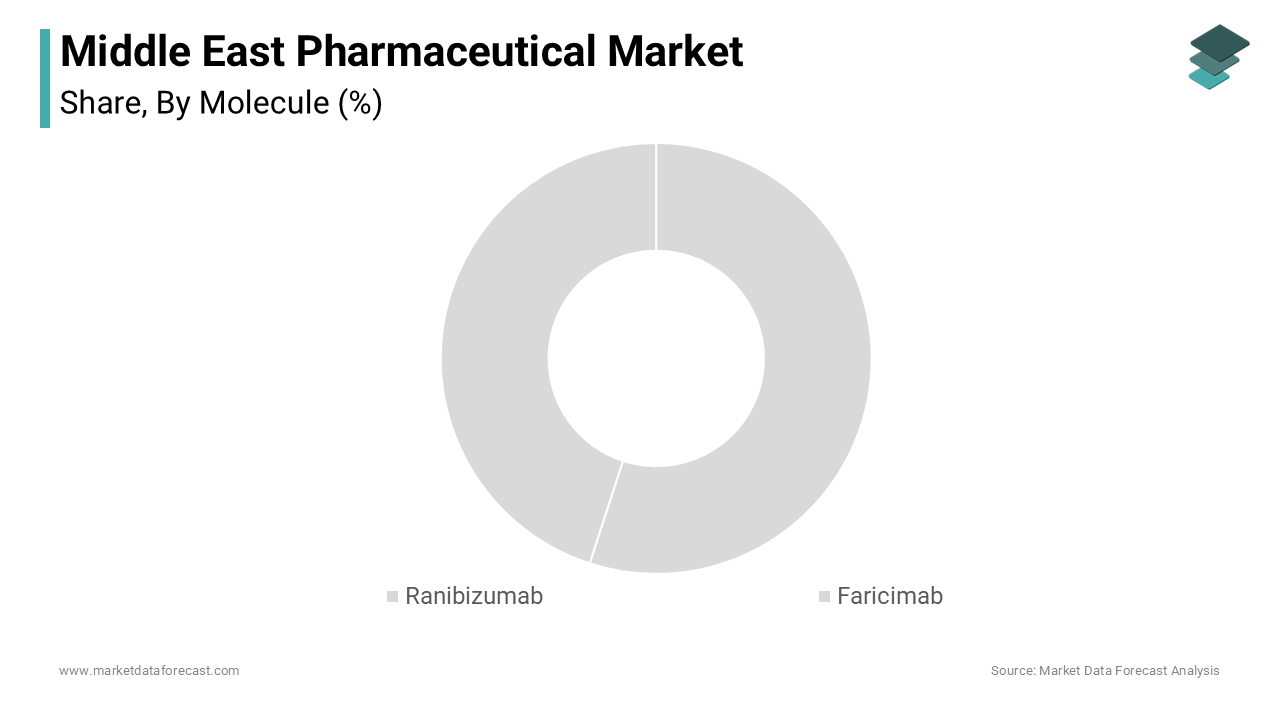
The faricimab segment is lucratively to grow with an anticipated with a CAGR of 14.6% in the next coming years with its approval as a next-generation bispecific antibody targeting both VEGF-A and angiopoietin-2 (Ang-2), offering longer durability and fewer injections compared to existing treatments. The growth of the segment is attributed to its surge in superior dosing flexibility and reduced treatment burden, which enhances patient compliance and reduces healthcare costs. The active promotion and pricing strategies adopted by Roche and Boehringer Ingelheim due to their joint development are anticipated to fuel the growth of the segment.
By Modality Insights
The monoclonal antibodies (mAbs) segment was the largest in the Middle East pharmaceutical market by accounting for 52.3% of the share in 2024 due to the widespread use of mAbs in oncology, autoimmune disorders, and infectious disease management. Drugs such as Trastuzumab, Rituximab, and Bevacizumab are widely prescribed in countries like Saudi Arabia and the UAE, where cancer and chronic inflammatory conditions are on the rise. Another major factor contributing to the growth of the monoclonal antibodies segment is the expansion of biosimilar markets and supportive regulatory reforms. Countries like Saudi Arabia and the UAE have introduced clear biosimilar approval pathways modeled after EMA and FDA standards, accelerating market access.
The fusion proteins segment is likely to register a CAGR of 13.2% from 2025 to 2033, with the smaller in overall size compared to monoclonal antibodies, fusion proteins are gaining traction due to their unique mechanism of action and applications in immunotherapy and chronic disease management. Etanercept, a tumor necrosis factor (TNF) receptor fusion protein, has gained widespread acceptance due to its efficacy and favorable safety profile. According to the Arab Journal of Rheumatology, over 400,000 patients in the Middle East suffer from rheumatoid arthritis, which is creating a strong patient pool for fusion protein-based therapies. In 2023, the Saudi Food and Drug Authority (SFDA) approved multiple biosimilar fusion proteins by enabling broader market penetration. Additionally, manufacturers such as Celltrion and Biocon have launched competitive pricing models to capture market share in the region. As per BMI Research, sales of biosimilar fusion proteins grew by 34% in the Middle East in 2023, indicating strong momentum.
By Route of Administration (RoA) Insights
The intravitreal route of administration segment held the dominant share of the Middle East pharmaceutical market with the high prevalence of retinal diseases such as age-related macular degeneration (AMD), diabetic macular edema (DME), and retinal vein occlusion (RVO), which require direct intraocular delivery of anti-VEGF therapies. Intravitreal injections remain the gold standard for managing these conditions due to their ability to achieve high drug concentrations at the target site. The growing burden of vision-threatening eye diseases in aging populations and diabetic communities is also propelling the growth of the market. According to the International Diabetes Federation (IDF), nearly 20% of adults in Saudi Arabia and 19% in the UAE suffer from diabetes, which is significantly increases the risk of diabetic retinopathy and macular complications. Additionally, the widespread adoption of anti-VEGF therapies in clinical practice and the expansion of treatment centers equipped to perform intravitreal injections will fuel the growth of the segment. Governments in Saudi Arabia and the UAE have invested heavily in specialized ophthalmology units and retina clinics, facilitating better patient access to these procedures.
The topical route of administration segment is emerging with a CAGR of 11.8% in the coming years. Eye drops, gels, and ointments are increasingly used for managing dry eye syndrome, glaucoma, conjunctivitis, and post-surgical inflammation. The rising prevalence of anterior segment disorders is likely to fuel the dry eye disease and allergic conjunctivitis, which are well-suited for topical treatment. According to the Saudi Journal of Ophthalmology, dry eye affects over 30% of the adult population in urban centers, exacerbated by environmental factors such as heat, dust, and prolonged screen exposure. The development of advanced drug delivery systems aimed at improving bioavailability and patient compliance is also expected to promote the growth of the market. Innovations such as preservative-free formulations, sustained-release eye drops, and nanoemulsions have enhanced therapeutic outcomes while reducing side effects. According to Frost & Sullivan, pharmaceutical companies are investing over USD 300 million collectively in new topical ophthalmic R&D projects in the Middle East, focusing on localized solutions tailored to regional disease patterns. Additionally, the ease of self-administration and minimal requirement for clinical supervision make topical treatments highly attractive in outpatient and home care settings.
By Indication Insights
The age-related macular degeneration (AMD) segment was accounted in holding 36.2% of the Middle East pharmaceutical market share in 2024 due to the rising elderly population and the increasing prevalence of age-associated vision disorders. AMD is a leading cause of irreversible blindness among individuals over 60, particularly in urbanized Gulf countries where lifestyle changes and sedentary habits contribute to earlier onset and progression of the condition.
The aging demographic structure in countries like Saudi Arabia and the UAE, where life expectancy has risen significantly over the past decade will also fuel the growth of the segment. According to the United Nations Economic and Social Commission for Western Asia (UNESCWA), the proportion of people aged 60 and above in the Gulf region is expected to reach 12% by 2030, up from 8% in 2020. These drugs are frequently administered via intravitreal injection and have become integral to managing neovascular or "wet" AMD.
The diabetic retinopathy (DR) segment is expected to witness CAGR of 13.9% during the forecast period. DR is gaining prominence due to the escalating diabetes epidemic and associated microvascular complications. In 2023, the International Diabetes Federation (IDF) estimated that over 37 million adults in the Middle East had diabetes with nearly one-third developing some form of retinopathy over time. The rising incidence of type 2 diabetes in Gulf countries where obesity and sedentary lifestyles are prevalent. According to the Saudi Ministry of Health, diabetes prevalence in the Kingdom has surpassed 18% with similar figures reported in the UAE and Kuwait.
The surge in DR-related pharmaceutical demand is the increased adoption of anti-VEGF therapies and corticosteroid implants for managing proliferative diabetic retinopathy and diabetic macular edema (DME). Governments across the region are integrating DR screening into national diabetes care programs, leading to earlier diagnosis and treatment initiation. According to Frost & Sullivan, ophthalmologists in the Middle East prescribed over 1.5 million anti-VEGF injections in 2023with a significant portion linked to DR. Additionally, the introduction of biosimilars and price reductions by manufacturers has improved affordability, which is further driving market expansion in both public and private healthcare settings.
REGIONAL ANALYSIS
Saudi Arabia Pharmaceutical Market Insights
Saudi Arabia was the largest contributor in the Middle East and Africa (MEA) pharmaceutical market with 29.3% of the share in 2024 owing to the substantial government investment in healthcare infrastructure, a rapidly growing population, and increasing prevalence of chronic diseases. The country’s Vision 2030 initiative has prioritized health system modernization, including the development of domestic pharmaceutical production capacity and the expansion of digital health services. The expansion of the National Unified Procurement Company (NUPCO), which streamlines medicine distribution across the public healthcare sector. NUPCO’s centralized procurement model ensures efficient supply chain management and price control by enhancing access to essential medications. Additionally, the Saudi Food and Drug Authority (SFDA) has introduced expedited approval pathways for critical drugs by encouraging multinational pharmaceutical firms to enter the market.
United Arab Emirates Pharmaceutical Market Insights
The United Arab Emirates ranked second with 21.3% of pharmaceutical market in the MEA share in 2024. Dubai and Abu Dhabi serve as major commercial and medical hubs by attracting international pharmaceutical companies and fostering innovation through regulatory reforms and investment incentives. The UAE’s pharmaceutical market benefits from a well-developed healthcare infrastructure, high per capita income, and a growing expatriate population with diverse medical needs. Moreover, the UAE has strengthened its regulatory alignment with global standards, allowing faster entry of new drugs and biosimilars. The Ministry of Health and Prevention (MOHAP) has introduced fast-track approval mechanisms for orphan drugs and specialty therapies, attracting investment from global players.
Israel Pharmaceutical Market Insights
Israeli pharmaceutical market is likely to gain huge traction with prominent CGAR in the coming years with the robust R&D environment, supported by government funding, academic institutions, and venture capital investment. According to the Israeli Ministry of Economy, over 400 life sciences startups were active in 2023, many focused on drug discovery, AI-driven diagnostics, and personalized medicine. Furthermore, Israel’s pharmaceutical export industry remains strong with generics and specialty APIs being major contributors.
Egypt Pharmaceutical Market Insights
Egypt pharmaceutical market growth is likely to grow with the production base and a growing focus on export-oriented strategies. However, economic challenges, including currency devaluation and inflation, have impacted purchasing power and drug affordability in recent years. A key factor shaping Egypt’s pharmaceutical market is the government’s push for self-sufficiency in drug production in response to supply chain disruptions during the pandemic. The Egyptian Ministry of Health and Population has initiated several industrial expansion projects, including the construction of new API manufacturing facilities in the Suez Canal Economic Zone. According to the Egyptian Drug Authority (EDA), domestic pharmaceutical production met over 90% of local demand in 2023, with particular strength in antibiotics, antihypertensives, and insulin.
KEY MARKET PLAYERS AND COMPETITIVE LANDSCAPE
Key market players in the Middle East pharmaceutical market include Julphar, Bayer Middle East FZE, Niner Pharmaceuticals LLC, Pfizer Gulf FZ-LLC, Novo Nordisk Pharma Gulf FZ LLC, Roche Pharmaceutical Middle East FZCO, AstraZeneca FZ LLC, Hikma Pharmaceuticals UAE, Merck Serono Middle East FZ-Ltd., Abbott Laboratories S.A., Teva Pharmaceutical Industries Ltd., AryoGen, Jamjoom Pharmaceuticals, Dar Al Dawa, Spimaco, Tabuk, Jazeera, and Sophal.
The competition in the Middle East pharmaceutical market is shaped by a combination of global pharmaceutical giants, regional manufacturers, and emerging biotech firms vying for influence in an evolving healthcare landscape. Multinational companies such as Novartis, Pfizer, and Roche maintain a strong foothold through innovative drug portfolios and regulatory expertise, while domestic players like Hikma Pharmaceuticals and Julphar are leveraging cost advantages and deep-rooted distribution networks to expand their reach. Governments across the region are actively promoting local drug production and biosimilar development, intensifying rivalry between international and homegrown firms. Additionally, increasing emphasis on digital health integration, pricing pressures, and evolving reimbursement policies are forcing companies to adapt their strategies to remain competitive.
Top Players in the Middle East Pharmaceutical Market
Novartis is a global healthcare company with a strong presence across the region. The company has been instrumental in supplying innovative therapies, particularly in oncology, cardiovascular diseases, and ophthalmology. Novartis plays a key role in shaping treatment protocols through its advanced drug portfolio and partnerships with regional health authorities.
Another major player is Pfizer, also known for its robust product pipeline and dominance in vaccine development and chronic disease management. In the Middle East, Pfizer has focused on expanding access to life-saving medicines and strengthening local distribution networks, while also engaging in public-private initiatives aimed at improving patient outcomes and healthcare infrastructure.
Sanofi is another dominant force in the region, with a broad range of products covering diabetes care, vaccines, rare diseases, and generics. Through its subsidiary Genzyme, Sanofi has contributed significantly to the treatment of rare and genetic disorders in the Gulf. Its commitment to innovation and affordability has reinforced its position as a trusted partner in the Middle East’s evolving pharmaceutical landscape.
Top Strategies Used by Key Market Participants
A primary strategy employed by key players in the Middle East pharmaceutical market is expanding local manufacturing and supply chain capabilities. Companies are increasingly investing in production facilities within the region to reduce dependency on imports, ensure faster delivery, and comply with national self-sufficiency goals set by governments like Saudi Arabia and the UAE.
Another critical approach is forming strategic alliances with regional stakeholders, including government agencies, research institutions, and local distributors. These collaborations enable multinational firms to navigate regulatory landscapes more efficiently, gain market insights, and co-develop solutions tailored to regional health challenges.
Leveraging digital transformation and personalized medicine has become central to competitive differentiation. Major players are integrating AI-driven diagnostics, telemedicine platforms, and data analytics into their offerings to enhance patient engagement, optimize treatment outcomes, and support value-based healthcare models across the Middle East.
RECENT MARKET DEVELOPMENTS
- In February 2024, Novartis announced a partnership with the Saudi Ministry of Health to support the localization of high-value biologics, which is aiming to enhance access to advanced treatments and align with Vision 2030's healthcare objectives.
- In May 2024, Pfizer launched a regional innovation hub in Dubai focusing on digital health solutions to integrate AI and real-world evidence into clinical practice and drug development specific to the Middle East population.
- In July 2024, Sanofi signed a memorandum of understanding with Abu Dhabi’s Department of Health to co-develop sustainable healthcare programs, which emphasize diabetes management and vaccine accessibility across the UAE.
- In September 2024, Hikma Pharmaceuticals expanded its injectables manufacturing facility in Amman, Jordan, to increase production capacity and strengthen export capabilities to North Africa and the broader MENA region.
- In November 2024, Roche initiated a multi-center clinical trial in Saudi Arabia and the UAE to evaluate next-generation cancer therapies by reinforcing its commitment to precision oncology and personalized medicine in the region.
MARKET SEGMENTATION
This research report on the Middle East pharmaceutical market is segmented and sub-segmented into the following categories.
By Molecule
- Ranibizumab
- Faricimab
By Modality
- Monoclonal Antibodies (mAbs)
- Fusion Proteins
By Route of Administration (RoA)
- Intravitreal
- Topical
By Indication
- Age-related Macular Degeneration (AMD)
- Diabetic Retinopathy (DR)
By Country
- KSA (Kingdom of Saudi Arabia)
- UAE (United Arab Emirates)
- Israel
- Rest of GCC Countries
- Rest of Middle East