- Product Description Description
- Table of Contents TOC
- List of Table & Figure LOT
- Get Free Sample PDF Sample PDF
Middle East Printing Inks Market Size
The Middle East Printing Inks Market is projected to grow from USD 0.85 billion in 2024 to USD 1.48 billion by 2033, at a CAGR of 6.64%.

The printing inks are offset, flexographic, gravure, digital, and screen inks each catering to different applications such as packaging, publishing, commercial printing, and industrial labeling. The demand for high-performance and eco-friendly inks has grown significantly due to rising environmental concerns and shifting consumer preferences toward sustainable packaging solutions. The growth of e-commerce has contributed to higher demand for corrugated box and label printing, which increases the importance of the printing inks market. Manufacturers in the Gulf Cooperation Council (GCC) are increasingly using water-based, UV-curable, and bio-based inks to meet regional sustainability goals.
MARKET DRIVERS
Growth of the Packaging Industry
The rapid expansion of the packaging sector in the food and beverage, pharmaceutical, and personal care industries, is one of the main factors driving the Middle East printing inks market. The surge in packaged goods consumption has led to higher demand for flexible and rigid packaging materials which require advanced printing inks that ensure vibrant color reproduction, durability, and compliance with health and safety standards. Additionally, the growing preference for branded products and premium packaging aesthetics has intensified competition among manufacturers, which promotes investments in high-performance inks such as UV-curable and electron beam (EB) formulations. The demand for printing inks led by packaging is going to continue to be significant as regional governments support local manufacturing through initiatives like Saudi Vision 2030 and UAE Industrial Strategy 2030.
Rising Demand for Sustainable and Low-VOC Inks
Low-volatile organic compound (VOC) inks and a growing focus on sustainability are the other two factors driving the Middle East printing inks market. The stricter environmental laws in the Gulf Cooperation Council (GCC) nations are forcing printers and converters to switch from traditional solvent-based inks to environmentally friendly substitutes. According to the Environment Agency, Abu Dhabi (EAD), VOC emissions from industrial sources were reduced by nearly 25% between 2020 and 2023 through policy enforcement and incentives for green manufacturing. Major ink producers like Sun Chemical and INX International have responded by expanding their range of UV-curable and bio-based inks primarily for Middle Eastern markets. Demand for sustainable formulations is also being increased by the food and beverage industry's brand owners, who are increasingly mandating the use of non-toxic, food-safe inks for direct touch packaging.
MARKET RESTRAINTS
Economic Volatility and Currency Fluctuations
Economic volatility and currency rate fluctuations are major factors restraining the Middle East printing inks market, particularly among oil-dependent nations like Saudi Arabia, Kuwait, and Bahrain. These countries experience fluctuating shares based on global oil prices, which directly impact industrial spending and import dynamics. According to the International Monetary Fund (IMF), the real GDP growth rate of the GCC region declined from 6.4% in 2022 to 2.3% in 2023 due to lower hydrocarbon output and global economic slowdowns. The printing and packaging sectors have been forced to make careful capital expenditure decisions as a result of this a downturn, which has impeded investments in new ink technologies and improved equipment. Additionally, currency devaluations in some Middle Eastern countries have increased the cost of imported raw materials used in ink production which makes them less accessible to smaller manufacturers. For example, according to a Bloomberg article from early 2024, the availability of specialized inks has been significantly hampered by Lebanon's prolonged financial crisis. Suppliers have raised ink costs due to inflationary pressures, which has reduced demand even in more stable economies like the United Arab Emirates.
Supply Chain Disruptions and Raw Material Shortages
Shortages of key raw materials for ink formulation and the disruption of global supply networks pose a further challenge for the Middle East printing inks market. The available supply of resins, pigments, solvents, and additives necessary for making high-quality printing inks has been impacted by the pandemic's consequences, geopolitical tension, and logistical constraints. According to McKinsey & Company, global chemical supply chains faced delays of up to 30% in 2023, impacting ink manufacturers’ ability to maintain consistent production schedules. As per Euromonitor International, Middle Eastern ink producers relying on imports from Europe and Asia experienced cost increases of up to 18% for critical raw materials during the same period. Additionally, restrictions on certain chemicals due to environmental regulations have limited sourcing options, which has forced formulators to seek alternative ingredients that may compromise performance or increase costs. A 2023 report by BMI Research shows that these supply chain constraints have disproportionately affected small and medium-sized enterprises (SMEs), many of which lack the purchasing power to secure stable material supplies.
MARKET OPPORTUNITIES
Expansion of Digital Printing Technologies
The quick development of digital printing technologies for use in commercial, packaging, and industrial settings is one of the most promising opportunities for the Middle East printing inks market. Digital printing provides more flexibility, quicker turnaround times, and the capacity to create customized, short-run print jobs. According to Smithers, a leading market research firm specializing in the printing industry, the global digital printing market is expected to grow at a CAGR of 6.3% from 2024 to 2030, with the Middle East emerging as a key growth hub. According to Euromonitor International, the demand for high-resolution, full-color outputs from luxury brands, food packaging companies, and advertising agencies drove a 20% growth in the number of digital printing presses in the United Arab Emirates alone in 2023. Additionally, the adoption of UV-curable and LED-curable inks in digital workflows has gained traction due to their fast-curing properties and low environmental impact. The Middle East's transition to digital printing is expected to fuel an ongoing demand for compatible ink solutions due to regional governments' supporting of digital transformation efforts and incentives for adopting new technologies.
Rise of Smart and Functional Packaging
The growing trend of smart and functional packaging presents a substantial opportunity for the Middle East printing inks market by creating demand for specialized inks that enable interactive, trackable, and protective packaging features. Smart packaging technologies such as temperature indicators, anti-counterfeiting tags, and QR-coded labels require inks with conductive, reactive, or printable electronic properties. As per Euromonitor International, the demand for intelligent packaging in the Gulf Cooperation Council (GCC) region grew by 14% in 2023, which was driven by government initiatives to combat counterfeit medicines and enhance product traceability. Ink manufacturers are responding by developing conductive inks for RFID tags, thermochromic inks for freshness monitoring, and antimicrobial coatings for extended shelf life. Furthermore, the integration of augmented reality (AR)-enabled packaging through special effect inks has opened new avenues for brand engagement. The Middle East has the opportunity to be a major user of smart packaging technologies that are creating new ink application options due to rising investments in logistics and supply chain digitalization.
MARKET CHALLENGES
Regulatory Compliance and Environmental Standards
Stricter regulatory compliance requirements about chemical usage and environmental safety are impeding the growth of the Middle East printing inks market. Governments across the Gulf Cooperation Council (GCC) have introduced stricter emission norms, labeling mandates, and restrictions on hazardous substances to align with international standards such as REACH and RoHS. As per a study published by Oxford Business Group, over 30% of ink producers in the region have had to modify their production processes since 2022 to meet updated environmental directives. Moreover, the implementation of halal certification for food-contact inks in Saudi Arabia and the UAE has added complexity to product development and approval cycles. According to an SGS white paper from 2023, the transition to compliant formulations often results in higher R&D expenditures and supply chain adjustments for SMEs lacking technical resources.
Intense Competition and Market Fragmentation
The Middle East printing inks market faces intense competition and fragmentation with a mix of global players, regional manufacturers, and independent distributors competing for market share. International giants such as Sun Chemical, DIC Corporation, and INX International dominate the premium segments, with advanced formulations and extensive distribution networks. However, they face stiff competition from local and regional players offering cost-effective solutions tailored to specific end-use applications. According to Euromonitor International, the number of active ink manufacturers in the UAE alone increased by over 15% between 2020 and 2023, which intensified pricing pressures and reduced profit margins. Additionally, the influx of grey-market and unregulated ink imports poses a threat to brand equity and quality assurance, particularly in price-sensitive markets such as Egypt and Iraq. Balancing innovation with affordability while maintaining quality standards remains a critical challenge for both global and regional players in the Middle East printing inks market.
SEGMENTAL ANALYSIS
By Ink Type Insights
The nitrocellulose inks segment led the Middle East printing ink market 35.3% of share in 2024. The growth of the segment can be attributed to the widespread use in gravure and flexographic printing processes across flexible packaging, labels, and industrial applications. According to Euromonitor International, nitrocellulose-based formulations remain a preferred choice among converters due to their fast-drying times, excellent adhesion properties, and compatibility with high-speed printing equipment commonly used in the region’s packaging sector. Additionally, the growing demand for shrink sleeves and pressure-sensitive labels has further reinforced the segment's position. According to a Smithers analysis, continued expenditures in consumer products packaging and labeling infrastructure drove a roughly 7% growth in nitrocellulose ink use in the GCC area in 2023 over the previous year.
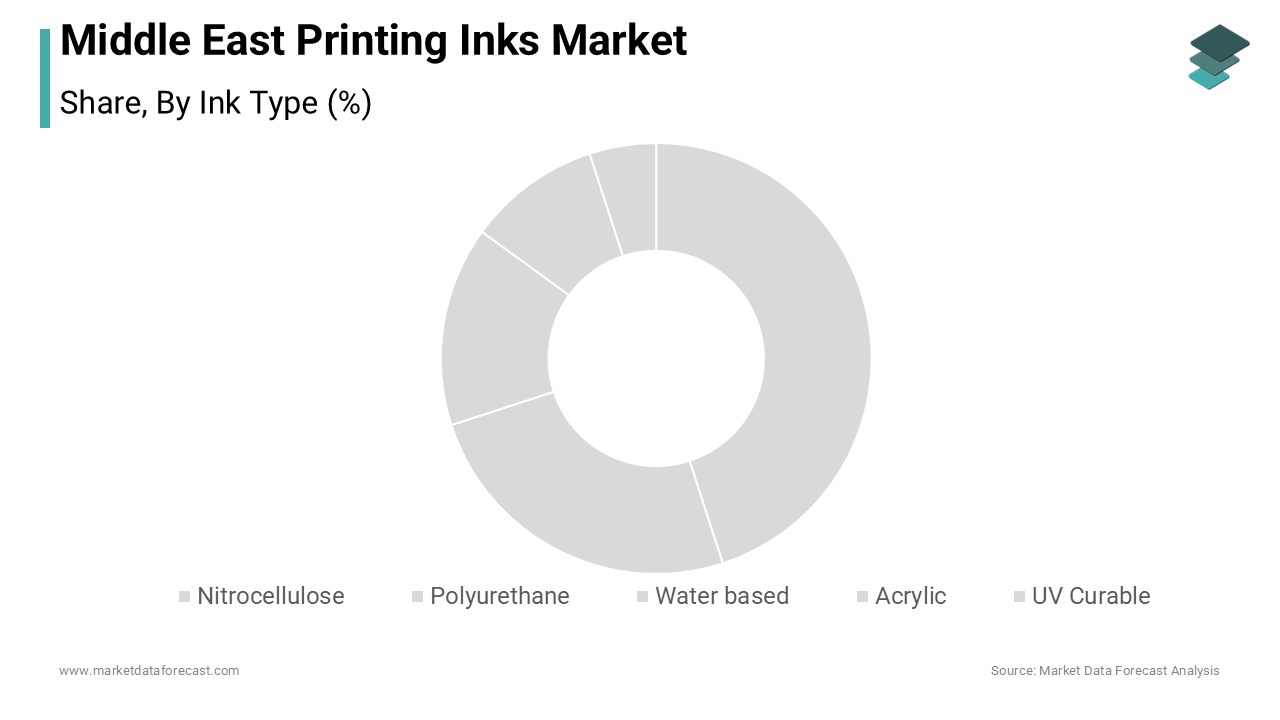
The UV curable inks segment is anticipated to witness a CAGR of 9.8% from 2025 to 2033. This growth is largely fueled by increasing demand for sustainable, energy-efficient, and high-performance printing solutions across commercial and industrial sectors. UV-curable inks offer significant advantages such as instant curing, low VOC emissions, and superior resistance to fading and abrasion making them ideal for digital and offset printing applications. As per Euromonitor International, the adoption of UV-curable inks in the UAE and Saudi Arabia surged by over 15% in 2023, particularly in luxury packaging, label printing, and corrugated box production. The rise of e-commerce and the need for durable, high-quality printed surfaces have further accelerated this trend. Additionally, government-led environmental regulations in the Gulf Cooperation Council (GCC) countries encouraging the reduction of volatile organic compound (VOC) emissions have strengthened the case for UV technology.
By Printing Process Insights
The gravure printing segment dominated the market by capturing 38.8% of Middle East printing inks market share in 2024 with its extensive use in high-volume flexible packaging applications, especially for food, beverages, and personal care products. According to Euromonitor International, gravure remains the dominant printing method for long-run packaging jobs due to its ability to deliver high-resolution images and consistent color reproduction. As per Smithers, more than 65% of flexible packaging converters in the Gulf Cooperation Council (GCC) region utilize gravure technology, particularly for pouches, sachets, and laminated films. The demand is especially strong in Saudi Arabia and Egypt, where rising urbanization and disposable incomes have boosted packaged goods consumption. Gravure continues to benefit from its established presence in key industries and the availability of cost-effective solvent-based ink formulations tailored to regional needs.
The digital printing segment is expected to witness a CAGR of 11.2% from 2025 to 2033 owing to the rising demand for short-run, customized, and variable data printing across packaging, advertising, and industrial applications. According to a report by Smithers, the number of digital printing installations in the UAE alone increased by over 22% in 2023. This growth was due to the broad adoption of digital printing by commercial printers and package converters who were looking for more flexibility and quicker turnaround times. Additionally, the expansion of e-commerce platforms in the region has heightened the need for custom-branded packaging, which digital printing supports effectively. Governments across the Gulf Cooperation Council (GCC) are also promoting digital transformation initiatives that encourage the adoption of advanced printing technologies.
By Application Insights
The flexible packaging segment was the largest by capturing 42.9% of Middle East printing inks market share in 2024 due to the rapid expansion of the food and beverage, pharmaceutical, and personal care industries, all of which rely heavily on flexible materials such as films, foils, and laminates for product protection and branding. As per Euromonitor International, the preference for lightweight, resealable, and portable packaging formats among consumers has significantly boosted demand for printed flexible substrates. In addition, regulatory mandates requiring clear nutritional labeling and traceability have increased the need for high-quality, durable inks that can withstand handling and transportation conditions. Flexible packaging continues to be the key driver of the region's need for printing inks due to continuous expenditures in food processing and logistical infrastructure.
The tags & labels segment is anticipated to witness a CAGR 10.5% from 2025 to 2033 with the rising need for product identification, brand differentiation, and supply chain traceability across the food and beverage, pharmaceutical, and luxury goods sectors. According to Euromonitor International, the demand for self-adhesive labels and security tags increased by 18% in 2023, particularly in Saudi Arabia and the UAE where anti-counterfeiting measures and smart packaging innovations are gaining momentum. Additionally, the proliferation of QR codes, holographic inks, and RFID-enabled tags has created new opportunities for specialty ink suppliers. The need for water-based and UV-compatible inks is expected to rise steadily as digital label printing technologies become more widely used.
REGIONAL ANALYSIS
United Arab Emirates (UAE) Printing Inks Market Insights
The UAE was the top performer in the Middle East printing inks market by holding a 28.2% of the share in 2024. As a regional hub for trade, manufacturing, and logistics, the country hosts a robust packaging and commercial printing ecosystem that drives consistent demand for high-quality inks. The country’s status as a global logistics and retail hub encourages extensive use of flexible packaging, labels, and corrugated boxes, all of which require specialized inks. The growing influence of sustainability trends has also prompted major ink suppliers to introduce eco-friendly alternatives including water-based and UV-curable formulations. The UAE is still at the top of innovation and ecologically friendly printing techniques in the region because to Vision 2030 projects that support the ideas of the circular economy.
Saudi Arabia (KSA) Printing Inks Market Insights
Saudi Arabia was positioned second in the MEA printing inks market with a share of 24.5% in 2024. The country’s reliance on gravure and flexographic printing for large-scale flexible packaging production has made solvent-based and nitrocellulose inks particularly popular. Additionally, the rise of private-label products and branded consumer goods has increased demand for vibrant, high-definition printing. Government initiatives promoting local manufacturing and export-oriented production have further reinforced the need for high-performance inks. Growing awareness of halal certification requirements and sustainable packaging is driving up demand for environmentally friendly and compliant ink solutions, which will influence the future of the Saudi printing ink market.
Egypt Printing Inks Market Insights
Egypt printing inks market is anticipated to grow in the next coming years. Egypt, one of the region's most populous nations, has a sizable consumer goods sector that mostly depends on printed packaging for product information and branding. Cairo and Alexandria are important industrial centers where modern and tradition printing techniques coexist, which produce a variety of ink use patterns. The government’s support for local manufacturing through tax incentives and import restrictions has further bolstered domestic ink demand.
KEY MARKET PLAYERS AND COMPETITIVE LANDSCAPE
Key market players in the Middle East Printing Inks Market include Sun Chemical, Flint Group, DIC Corporation, ALTANA AG, Ashland Inc., DuPont, Siegwerk Druckfarben AG & Co. KGaA, Hubergroup, Toyo Ink SC Holdings, Sakata INX, Siegwerk Middle East, and Tokyo Printing Ink Mfg. Co., Ltd.
The competition in the Middle East printing inks market is intense and highly dynamic, shaped by the coexistence of global chemical giants, regional manufacturers, and independent distributors vying for market share. International companies such as Sun Chemical, INX International, and Toyo Ink maintain a dominant presence due to their advanced technological capabilities, extensive product portfolios, and strong supply chain networks. At the same time, local and regional ink producers are gaining traction by offering cost-effective, application-specific solutions and leveraging government-backed industrial development programs. The market is further fragmented by the rapid evolution of printing technologies, shifting regulatory frameworks, and increasing demand for sustainable ink alternatives. Printers and converters are under pressure to balance performance, compliance, and affordability has created a complex ecosystem where agility, innovation, and customer-centric support determine success. The printing inks market is still a high-growth battleground where differentiation via technology, sustainability, and service excellence is crucial for continuing relevance in view of growing expenditures in packaging infrastructure and digital transformation.
Top Players in the Middle East Printing Inks Market
Sun Chemical Corporation
Sun Chemical is a leading global supplier of printing inks and plays a dominant role in the Middle East market by offering a wide range of products including offset, flexographic, gravure, and digital inks tailored to regional needs. The company has established a strong presence through its distribution network and technical support centers across the Gulf Cooperation Council (GCC) countries. Sun Chemical contributes to the global market by setting industry standards in sustainable ink development in water-based and UV-curable formulations.
INX International Ink Co.
INX International is a key player in the Middle East printing inks market which known for its innovative product portfolio that includes food-safe packaging inks, energy-curable systems, and digital inkjet solutions. The companies serve the region's growing demands for branded consumer goods by serving to a variety of end-use sectors including flexible packaging, commercial printing, and labels. INX contributes to the global market by advancing low-VOC technologies and promoting circular economy principles through recyclable ink formulations. Partnerships with regional converters and printers have enabled deeper market penetration and localized service offerings that align with GCC sustainability goals and industrial growth strategies.
Toyo Ink SC Holdings Co., Ltd.
Toyo Ink has become in the Middle East due to its high-quality ink formulations and technological expertise in packaging and publication printing. The company provides advanced ink solutions that cater to both conventional and emerging printing methods making it a preferred choice among converters and brand owners. By leading the way in the development of smart and functional packaging inks such as conductive and antimicrobial coatings, Toyo Ink provides value to the worldwide market. Focusing on performance and sustainability, the business promotes the move to more environmentally friendly options by establishing its position as a progressive leader in the market.
Top Strategies Used by Key Market Participants
One major strategy employed by key players in the Middle East printing inks market is product innovation and formulation customization, where companies develop specialized inks tailored to regional applications such as halal-certified packaging, food-safe inks, and UV-curable solutions that comply with environmental regulations. This approach allows manufacturers to meet specific industry requirements while differentiating themselves in a competitive environment.
Expanding through local partnerships and distribution networks wherein global ink suppliers collaborate with regional distributors, printers, and packaging converters to enhance accessibility and after-sales support. These alliances help multinational firms navigate regulatory landscapes more effectively and build long-term trust with local stakeholders.
A third strategic focus is leveraging sustainability as a competitive advantage particularly through the promotion of bio-based, waterborne, and low-VOC ink technologies. Companies are investing heavily in green chemistry and carbon footprint reduction initiatives to align with government mandates and consumer expectations helping to improve their relevance in an increasingly environmentally conscious market.
RECENT MARKET DEVELOPMENTS
- In February 2024, Sun Chemical opened a new technical service center in Dubai Industrial Park with the aim of providing localized support, product testing, and formulation customization for packaging and label printers across the GCC region.
- In May 2024, INX International launched a new line of halal-certified inks specifically designed for food packaging applications in Saudi Arabia and the UAE, which complies with regional religious and regulatory standards to expand its customer base.
- In July 2024, Toyo Ink partnered with a leading Egyptian packaging manufacturer to introduce next-generation UV-curable inks which will enhance print durability and reducing drying times for high-speed production lines serving export-oriented FMCG brands.
- In September 2024, DIC Corporation acquired a stake in a UAE-based ink distributor which helps in strengthening its regional supply chain and improving access to fast-growing markets in Qatar and Oman.
- In November 2024, Altana AG’s subsidiary BYK-Chemie expanded its additive offerings for the Middle East printing sector allows formulators to improve dispersion stability and surface performance of solvent- and water-based inks used in flexible packaging.
MARKET SEGMENTATION
This research report on the Middle East printing inks market is segmented and sub-segmented into the following categories.
By Ink Type
- Nitrocellulose
- Polyurethane
- Water based
- Acrylic
- UV Curable
By Process
- Gravure
- Flexographic
- Lithographic
- Digital
- Others
By Application
- Corrugated Cardboard
- Flexible Packaging
- Tags & Labels
- Folding Cartons
- Others
By Country
- KSA (Kingdom of Saudi Arabia)
- UAE (United Arab Emirates)
- Israel
- Rest of GCC Countries
- Rest of Middle East