- Product Description Description
- Table of Contents TOC
- List of Table & Figure LOT
- Get Free Sample PDF Sample PDF
Market Size, 2025
$4.56 BnMarket Estimate, 2026
$4.77 BnMarket Forecast, 2034
$6.88 BnCAGR, 2026–2034
4.67%Global Military Vetronics Market Size, Share, & Growth Analysis (2026–2034)
The global military vetronics market was valued at USD 4.56 billion in 2025, estimated at USD 4.77 billion in 2026, and is projected to reach USD 6.88 billion by 2034, registering a CAGR of 4.67% from 2026 to 2034. This report covers vehicle types, applications, subsystems, fit types, end-users, and regional frameworks worldwide.
- Market Valuation: USD 4.77B (2026) to USD 6.88B by 2034 (4.67% CAGR).
- Primary Growth Drivers: Escalating cyber threats, geopolitical tensions, rising demand for advanced tactical communication systems, and increased procurement of modern armored and unmanned vehicles.
- Key Market Restraints: Scarcity of skilled professionals capable of handling advanced vetronics systems, along with government budget constraints and economic crises in developing nations.
Global Military Vetronics Market Segment Metrics (2026–2034)
| Category | Leading Segment Focus | Segment Overview & Key Details |
|---|---|---|
| By Vehicle Type | Light-Protected Vehicles & APCs | Light-protected vehicles gain significant traction; main battle tanks (MBTs) register the highest CAGR; includes LAVs, IFVs, MRAPs, UGVs, and amphibious units. |
| By Subsystem | C3 / C4 Systems | Command, Control, Communications, and Computers dominate market share, while communication and navigation systems display prominent growth. |
| By End-User | Homeland Security & Defense | Homeland security holds a major share via real-time data solutions, while defense applications expand at the highest CAGR driven by international military pacts. |
| By Region | North America & Europe | North America leads via heavy defense upgrades in the US; Europe expands at the fastest CAGR fueled by regional conflict dynamics and defense expenditure spikes. |
Major Market Players & Market Structure
Market Structure: Highly consolidated defense technology ecosystem featuring major aerospace and defense contractors securing high-value government production contracts for armored vehicle electronics.
Key Companies: Thales Group, Lockheed Martin Corporation, Curtiss-Wright Corporation, Leonardo S.p.A., BAE Systems plc, Saab AB, L3Harris Technologies, Inc., General Dynamics Corporation, Raytheon Technologies Corporation, and Rheinmetall AG.
Global Military Vetronics Market Size
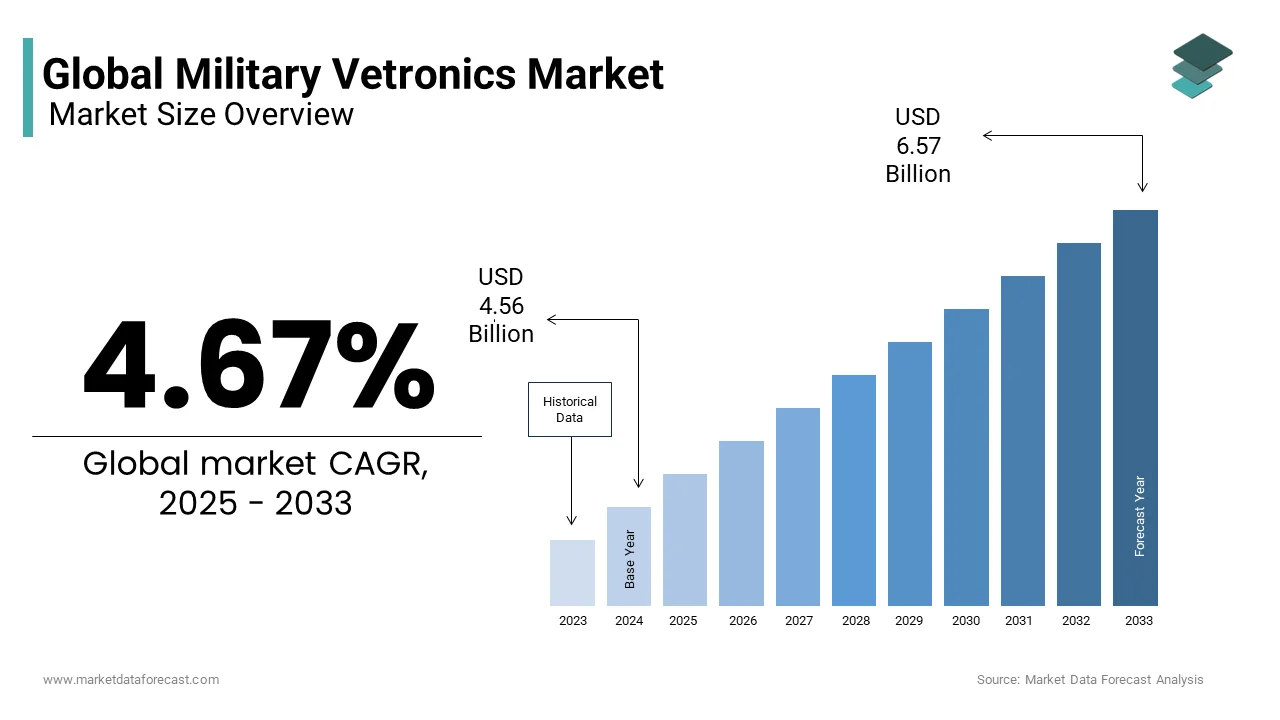
The global military vetronics market was valued at USD 4.56 billion in 2025 and is anticipated to reach a valuation of USD 4.77 billion in 2026 and USD 6.88 billion by 2034, growing at a CAGR of 4.67%, from 2026 to 2034.
Introduction to the Military Vetronics Market
Military vetronics (short for vehicle electronics) is the integration of electronic systems, computers, software, and displays inside military ground vehicles like tanks and armored trucks. Just as avionics handles electronics for aircraft, vetronics acts as the digital nervous system for land combat vehicles. These systems include advanced communication networks, navigation aids, threat detection sensors, and vehicle health monitoring units that transform traditional armored platforms into intelligent combat assets. According to the Stockholm International Peace Research Institute (SIPRI), global military expenditure reached $2443 billion in 2023, reflecting a sustained commitment to defense modernization that directly fuels demand for upgraded vehicular electronics. As per sources, major global defense forces are increasingly prioritizing digital transformation and network-centric architectures in their land warfare doctrines, which accelerates the integration of advanced vetronics systems for real-time data processing. This technological evolution is critical as modern conflicts increasingly rely on information superiority rather than mere firepower. The integration of these electronic subsystems ensures that military vehicles can operate effectively in complex electromagnetic environments while maintaining seamless connectivity with command centers. Consequently, the market is driven by the urgent need to retrofit legacy fleets and equip new platforms with state-of-the-art electronic architectures that support autonomous functions and enhanced crew protection mechanisms in high-intensity combat scenarios.
MARKET DRIVERS
Rising Demand for Network Centric Warfare Capabilities
The imperative for network centric warfare capabilities significantly propels the adoption of advanced vehicle electronics systems across global defense forces and ultimately boosts the growth of the military vetronics market. Modern military strategies increasingly depend on the seamless exchange of real-time data between disparate units, requiring vehicles to serve as nodes in a broader tactical internet. According to sources, multi-domain military programs and Joint All-Domain Command and Control initiatives rely extensively on modern, integrated vehicle electronics to improve combat tactical communication and situational awareness. This strategic shift demands high-bandwidth communication modules and secure data links within armoured platforms to ensure coordinated manoeuvres and rapid decision-making. As per studies, continuous public funding and multi-billion dollar investments in network-enabled operational capabilities reflect a strong financial priority placed on establishing fully interconnected battlefield communication systems. Such investments directly translate into procurement contracts for vetronic suites that facilitate sensor fusion and shared operational pictures. Furthermore, the complexity of contemporary threats necessitates that individual vehicles possess the computational power to process incoming data streams from drones, satellites, and ground sensors simultaneously. This requirement drives manufacturers to develop modular electronic architectures that can be easily upgraded to accommodate emerging communication protocols. Armies are transitioning from platform-centric to network-centric operations. Therefore, the role of vetronics has become central to maintaining a tactical advantage, which sustains a robust demand for sophisticated electronic integration solutions in both new acquisitions and legacy vehicle modernization programs.
Increasing Modernisation of Legacy Armoured Vehicle Fleets
The extensive modernization of legacy armored vehicle fleets is a crucial driver for the Military Vetronics Market. This creates sustained demand for retrofitting older platforms with contemporary electronic systems. Many nations possess large inventories of ageing tanks and infantry fighting vehicles that lack the digital infrastructure required for modern combat environments. As per research, a sizeable portion of the main battle tanks currently in active service worldwide consists of older platform generations, establishing a broad market requirement for comprehensive electronic and vetronic upgrades. These legacy systems often feature obsolete analogue components that cannot support current mission requirements such as digital mapping, encrypted communications, or advanced fire control integration. As per sources, European defense ministries allocate considerable funding toward multi-year vehicle modernization efforts, prioritising the replacement of outdated electronic subsystems and computing architectures. This financial commitment reflects the recognition that upgrading existing fleets is often more cost-effective than procuring entirely new vehicles. Retrofitting involves installing new vetronic buses, display units, and sensor interfaces that enable older vehicles to participate in networked operations. Additionally, the extended service life of many armoured platforms means that electronic components must be replaced multiple times during their operational lifespan due to technological obsolescence. This cycle of continuous upgrades ensures a steady revenue stream for vetronic suppliers who specialise in integrating modern digital solutions into constrained mechanical spaces. Hence, the persistent need to maintain the relevance of legacy assets in evolving threat landscapes guarantees long term growth opportunities for providers of specialised military electronic integration services.
MARKET RESTRAINTS
Stringent Cybersecurity Vulnerabilities in Connected Systems
Stringent cybersecurity vulnerabilities inherent in connected vehicular systems are a serious restraint to the widespread adoption of advanced solutions in the military vetronics market. As military vehicles become increasingly integrated into digital battle networks, they expose themselves to potential cyber attacks that could compromise mission integrity or even seize control of critical functions. According to studies, cyber incidents targeting defense networks and critical military infrastructure have steadily escalated, demonstrating the increasingly sophisticated capabilities of adversaries against interconnected defense systems. This escalating threat landscape forces defense contractors to invest heavily in secure coding practices and encryption protocols, which substantially increases development costs and prolongs certification timelines. As per research, complying with stringent cybersecurity regulations and data protection standards for military electronics can noticeably escalate program costs, often creating high entry and financial barriers for smaller subsystem suppliers. Moreover, the complexity of ensuring end to end security across heterogeneous systems often leads to integration challenges that delay deployment schedules. Military operators are consequently cautious about adopting new vetronic technologies until rigorous penetration testing and vulnerability assessments are completed, which slows down procurement cycles. The fear of supply chain compromises further complicates matters, as components sourced from multiple vendors must meet stringent security standards to prevent backdoor installations. These security concerns necessitate continuous monitoring and patching throughout the vehicle lifecycle, adding operational burdens for maintenance crews. Until robust and standardized cybersecurity frameworks are universally adopted, the perceived risk of digital exploitation will continue. This ongoing threat will hinder the rapid expansion of fully connected vetronic architectures in sensitive military applications.
High Development and Integration Costs for Specialised Components
High development and integration costs for specialized vetronic components are also a major obstruction for the military vetronics market. These costs limit accessibility for smaller defence budgets and extend procurement timelines. The unique requirements of military environments demand electronics that can withstand extreme temperatures, shock, vibration, and electromagnetic interference, which necessitates expensive ruggedisation processes. As per sources, the development and manufacturing of certified military-grade electronics cost substantially more than standard commercial-off-the-shelf alternatives due to rigorous environmental testing, thermal stress screening, and strict certification mandates. This cost disparity makes it challenging for defense ministries with constrained budgets to prioritize comprehensive vetronic upgrades across their entire fleet. According to studies, major defense acquisition programs frequently experience notable cost overruns and scheduling delays due to underestimated system integration complexities and production bottlenecks. These financial pressures force decision makers to delay or scale back modernization efforts, thereby reducing immediate market demand. Furthermore, the low-volume production typical of military contracts prevents manufacturers from achieving economies of scale, keeping unit prices elevated. Small and medium-sized enterprises often struggle to compete in this high-cost environment, leading to market consolidation that reduces innovation diversity. The lengthy qualification processes required for military approval also tie up capital for extended periods, discouraging new entrants. Consequently, the prohibitive expense associated with designing, testing, and certifying specialized vetronic hardware continues to restrict market growth, particularly in regions where defense spending is not prioritized over other national needs.
MARKET OPPORTUNITIES
Integration of Artificial Intelligence for Autonomous Vehicle Operations
The integration of artificial intelligence for autonomous vehicle operations is a key growth area for the Military Vetronics Market. This enables next-generation unmanned and semi-autonomous combat platforms. AI-driven vetronic systems can process vast amounts of sensor data to make real-time decisions, reducing cognitive load on human operators and enhancing mission effectiveness. According to research, public investments in autonomous systems technologies continue to expand rapidly, indicating strong defense agency commitment to developing highly intelligent, uncrewed vehicle capabilities. This funding accelerates the development of advanced algorithms for navigation, obstacle avoidance, and target recognition that require sophisticated onboard computing hardware. As per studies, the development of uncrewed military land and aerial vehicle variants has grown notably, marking a widespread shift toward automated logistics, tactical transport, and reconnaissance missions. These programs create demand for high performance processors, machine learning accelerators, and redundant sensor arrays that form the core of modern vetronic architectures. As armies seek to reduce personnel exposure in high risk zones, the ability of vehicles to operate independently becomes a critical capability. This transition necessitates robust electronic systems that can handle complex decision trees and communicate seamlessly with manned units. Suppliers who can provide scalable AI ready hardware platforms will benefit from long term contracts as militaries expand their autonomous fleets. The convergence of artificial intelligence with vehicular electronics thus opens new revenue streams for companies capable of delivering reliable, intelligent solutions that meet the rigorous demands of future battlefield automation.
Expansion of Unmanned Ground Vehicle Programs Globally
The expansion of unmanned ground vehicle programs globally offers a significant growth avenue for the Military Vetronics Market. This growth occurs as nations increasingly deploy robotic platforms for diverse military tasks. These unmanned systems rely entirely on advanced electronic subsystems for navigation, communication, and payload management, creating sustained demand for compact and reliable vetronic solutions. According to sources, active inventories of unmanned ground vehicles have steadily scaled across various military branches to accelerate the deployment of robotic platforms on the battlefield. This growth is mirrored internationally, with countries such as South Korea and Israel launching major initiatives to integrate robotic units into their frontline operations. As per studies, specialized defense and security deployment applications constitute a significant segment of the global professional service robot market, demonstrating the ongoing scaling of military robotics. Each unmanned platform requires specialized electronic modules for remote control, telemetry, and autonomous navigation, driving procurement of miniaturized and ruggedized components. The versatility of these vehicles in roles ranging from explosive ordnance disposal to perimeter surveillance ensures diverse application scenarios for vetronic suppliers. Furthermore, the modularity of unmanned systems allows for rapid technology insertion, enabling frequent upgrades to electronic payloads as new capabilities emerge. This dynamic environment encourages continuous innovation in sensor fusion, power management, and wireless communication technologies. As military doctrines evolve to incorporate mixed manned-unmanned teams, the reliance on sophisticated vetronics for coordinating these heterogeneous forces will intensify. This shift will provide enduring opportunities for manufacturers specialising in unmanned vehicle electronics.
MARKET CHALLENGES
Complexity of Interoperability Across Multi-Vendor Systems
The complexity of interoperability across multi-vendor systems is a formidable challenge to the Military Vetronics Market. This issue hinders the seamless integration of diverse electronic components. Military vehicles often incorporate subsystems from numerous suppliers, each using proprietary protocols and interfaces that may not communicate effectively without extensive customisation. According to research, allied multi-national military electronics and communication networks frequently exhibit technical gaps in full cross-platform compatibility and tactical data link communication during coalition operations. This lack of standardization forces integrators to develop custom middleware solutions, which increases project complexity and raises the risk of system failures. According to sources, persistent data formatting and network interoperability issues serve as key contributors to deployment delays in defense vehicle electronics architectures, directly impacting overall operational readiness. Different nations adhere to varying technical standards, further complicating efforts to create unified vetronic architectures for coalition operations. The absence of universal communication protocols means that data sharing between vehicles from different manufacturers often requires additional translation layers that introduce latency and potential points of failure. Maintenance crews face difficulties troubleshooting integrated systems when diagnostic tools are not compatible across vendor boundaries. These technical barriers discourage collaboration among suppliers and limit the ability to leverage best-in-class components from multiple sources. The continued fragmentation of vetronic ecosystems severely impedes efficient system integration and degrades operational effectiveness in multinational military contexts. This systemic vulnerability will persist until industry-wide standards for data exchange and interface definitions are strictly enforced.
Supply Chain Disruptions for Critical Electronic Components
Supply chain disruptions for critical electronic components are a severe obstacle to the Military Vetronics Market. These disruptions cause production delays and increase procurement uncertainties. The global semiconductor shortage has disproportionately affected defense industries that rely on specialized chips for vetronic systems, leading to extended lead times for essential parts. According to studies, the procurement lead times for specialized defense-grade microcontrollers and semiconductor components remain elongated compared to pre-pandemic baselines, adding unpredictability to military vehicle production lines. This scarcity forces original equipment manufacturers to seek alternative suppliers or redesign circuits, both of which incur substantial costs and validation efforts. As per research, supply chain vulnerabilities leave defense electronics manufacturers highly susceptible to active component shortages, often disrupting specialized hardware delivery schedules. Geopolitical tensions further exacerbate these issues by restricting access to materials sourced from specific regions, compelling companies to diversify supply bases at considerable expense. The reliance on single source suppliers for rare earth elements and specialized substrates creates vulnerabilities that adversaries could exploit during conflicts. Inventory buffering strategies help mitigate some risks but tie up capital and storage resources. Additionally, the rapid obsolescence of electronic components means that discontinued parts must be replaced with newer versions that require requalification, adding further delays. These persistent supply chain instabilities undermine planning reliability and increase the total cost of ownership for vetronic systems, challenging the industry's ability to sustain consistent production levels in an increasingly volatile global trade environment.
REPORT COVERAGE
| REPORT METRIC | DETAILS |
| Market Size Available | 2025 to 2034 |
| Base Year | 2025 |
| Forecast Period | 2026 to 2034 |
| CAGR | 4.67% |
| Segments Covered | By Application, Vehicle Type, Sub System, and Region |
| Various Analyses Covered | Global, Regional & Country Level Analysis, Segment-Level Analysis, DROC, PESTLE Analysis, Porter’s Five Forces Analysis, Competitive Landscape, Analyst Overview on Investment Opportunities |
| Regions Covered | North America, Europe, APAC, Latin America, Middle East & Africa |
| Market Leaders Profiled | Thales Group, Lockheed Martin Corporation, Curtiss-Wright Corporation, Leonardo S.p.A., BAE Systems plc, Saab AB, L3Harris Technologies, Inc., General Dynamics Corporation, Raytheon Technologies Corporation, and Rheinmetall AG |
SEGMENTAL ANALYSIS
By Vehicle Insights
Main Battle Tank
In 2025, the Main Battle Tank segment held the majority share of the Military Vetronics Market because of its status as the primary offensive asset in conventional land warfare. These heavily armoured platforms require extensive electronic integration for fire control, navigation, and crew survivability, driving substantial procurement volumes. According to studies, global inventories of main battle tanks encompass tens of thousands of active and reserve units, with international militaries steadily modernizing their armored fleets to maintain operational readiness and technological parity. This vast installed base creates a recurring demand for vetronic modernization programs that replace obsolete analog systems with digital architectures. As per sources, public funding for major armored platform programs incorporates significant financial allocations dedicated to upgrading electronic subsystems, digital networks, and sensor suites to enhance vehicle combat effectiveness. Such investments ensure that legacy tanks remain viable against modern anti armor threats by integrating advanced sensor suites and networked communication capabilities. Furthermore, the complexity of modern tank operations necessitates robust data processing units that can manage multiple threat inputs simultaneously, requiring sophisticated vetronic buses and display interfaces. The high value associated with each platform justifies significant expenditure on electronic enhancements, making this segment the primary revenue generator for market participants. Nations prioritize heavy armor capabilities amidst rising geopolitical tensions. Consequently, the sustained focus on maintaining and upgrading main battle tanks ensures continued dominance in the vehicular electronics sector.
Mine Resistant Ambush Protected Vehicles
The Mine Resistant Ambush Protected vehicle segment is likely to experience the fastest CAGR of 8.5% during the forecast period due to increasing asymmetric warfare threats. These vehicles are essential for protecting troops from improvised explosive devices and ambushes in irregular conflict zones, driving urgent procurement needs. According to research, the deployment and deployment rate of Mine-Resistant Ambush Protected (MRAP) tactical platforms remain integral to modern force protection strategy and asymmetric warfare operations. This operational reliance translates into heightened demand for specialized vetronic systems that support situational awareness and remote detonation detection. As per studies, international trade and procurement contracts for armored multi-mission vehicles routinely include dedicated allocations for integrating specialized electronic systems and counter-IED equipment to ensure crew survivability. These vehicles require compact yet powerful electronic suites that can operate in harsh environments while providing real-time threat alerts to crews. The modularity of MRAP designs allows for rapid insertion of new sensors and communication modules, facilitating frequent technology updates. As military forces increasingly engage in urban and guerrilla warfare scenarios, the need for protected mobility solutions grows, accelerating the adoption of advanced vetronics in this segment. The combination of high operational tempo and continuous threat evolution ensures that MRAP vehicles remain a focal point for electronic innovation and procurement expansion.
By Application Insights
Defense
The Defence application segment was the largest in 2025 and occupied a commanding share of the Military Vetronics Market. It covers the core operational requirements of national armed forces. This segment includes all electronic systems integrated into combat vehicles used for frontline engagements, logistics, and strategic deterrence missions. According to sources, global military expenditures are predominantly driven by direct national defense outlays, funding both the acquisition of new platforms and the operational maintenance of advanced vetronics-equipped vehicles. This overwhelming financial allocation ensures that defense applications remain the primary driver of market revenue and technological development. As per research, allied nations commit substantial multi-year financial investments toward regional capability modernization goals, prioritizing advanced vehicle electronics and secure communication networks. These funds support the development of advanced command and control systems, encrypted communication networks, and sensor fusion technologies that are exclusive to military use. The stringent performance requirements of defense applications necessitate high reliability and ruggedization, creating barriers to entry that favor established suppliers. Additionally, the long lifecycle of defense contracts provides stable revenue streams for manufacturers who can meet rigorous qualification standards. As geopolitical instability persists, nations prioritise strengthening their defensive postures through enhanced vehicular capabilities. This prioritization sustains robust demand for specialized electronic solutions tailored to combat environments.
Homeland Security
The Homeland Security application segment is expected to exhibit a noteworthy CAGR of 7.2% from 2026 to 2034 owing to increasing internal security concerns and border protection initiatives. Governments are increasingly deploying armored vehicles for domestic law enforcement, counter terrorism operations, and disaster response, creating new demand vectors for vetronic systems. According to sources, institutional funding for border security technologies expands consistently, including targeted allocations to integrate high-definition surveillance suites within law enforcement patrol vehicles. This budgetary expansion supports the integration of advanced sensors, thermal imaging cameras, and real time data transmission modules into security vehicles. As per studies, shifts in regional cross-border crime prompt security agencies to reinforce their tactical mobile response elements with sophisticated electronics and monitoring tools. These vehicles require vetronic systems that enable seamless coordination with central command centres and other emergency services, driving adoption of interoperable communication platforms. The dual-use nature of many vetronic components allows commercial technologies to be adapted for security applications, reducing development costs and accelerating deployment. As urban centres face evolving security challenges, the need for intelligent, connected response vehicles grows, positioning homeland security as a high-potential growth area for market participants seeking diversification beyond traditional defence contracts.
REGIONAL ANALYSIS
North America Market Analysis
North America maintained its dominance in the Military Vetronics market and accounted for a substantial share in 2025. This dominance of the region’s market was driven by substantial defense budgets and advanced technological infrastructure. The region benefits from strong government support for modernisation programs and a robust industrial base capable of producing high-quality electronic components. According to the US Department of Defence, the United States alone allocated 842 billion USD for defence spending in fiscal year 2024, with significant portions dedicated to vehicle upgrades and new procurements. This financial commitment drives continuous innovation in vetronic systems, particularly for main battle tanks and armoured personnel carriers. As per sources, national defense budgets within North America incorporate steady funding increases for capital equipment to systematically upgrade the computing networks and electronic architecture of armored vehicle fleets. These investments support the integration of network-centric warfare technologies that improve situational awareness and operational efficiency. The presence of major defense contractors in the region facilitates rapid technology transfer and customization, ensuring that military vehicles meet evolving threat requirements. Additionally, strict cybersecurity mandates drive demand for secure communication modules, further boosting market activity. The region’s emphasis on maintaining technological superiority ensures sustained growth in the vetronics sector, supported by ongoing research and development initiatives.
Europe Market Analysis
Europe was positioned second in the Military Vetronics market and captured a large share in 2025. This position was propelled by collaborative defense initiatives and increasing geopolitical tensions on its eastern borders. The region is characterized by multinational procurement programs that standardize electronic systems across allied forces, enhancing interoperability and reducing costs. According to studies, multinational procurement frameworks emphasize the development of standardized vehicle architectures and shared vetronics systems to streamline equipment delivery across participating allied nations. This collaborative approach accelerates the adoption of advanced electronic technologies across diverse national fleets. The German Federal Ministry of Defence announced a 100 billion EUR special fund for Bundeswehr modernization, with the broad initiative targeting major gaps across air, sea, and land capabilities, including next-generation combat systems and armored vehicles. These programs create steady demand for suppliers who can meet stringent NATO compatibility standards. As per research, national modernization frameworks for ground combat forces place a heavy priority on digital connectivity, driving consistent public sector investment into integrated sensor platforms and secure data links. Political commitments to strengthen collective defence capabilities ensure long term stability for the vetronics market in Europe. The region’s focus on sovereign technological capabilities also encourages local manufacturing, supporting regional supply chains and innovation ecosystems.
Asia-Pacific Market Analysis
Asia-Pacific is the fastest-growing region in the Military Vetronics market due to rising territorial disputes and increasing defense modernization efforts among key nations. Countries in this region are rapidly expanding their armored fleets to address security challenges, driving demand for advanced electronic systems. According to the International Institute for Strategic Studies (IISS), real-term military spending in East Asia and the Pacific grew by 2.9% in 2023 (excluding China), while overall regional outlays reached a record USD 510 billion driven by Chinese and Indian defense modernization. As per sources, state-backed ground force modernisation initiatives incorporate indigenous vetronics architectures into modern armored vehicle classes and infantry fighting systems. According to studies, major operational fleets of older-generation armored fighting vehicles undergo recurring mid-life upgrades focused on optimizing fire control computers and legacy tactical communications. These initiatives create substantial opportunities for both domestic and international suppliers of vehicular electronics. The region’s diverse operational environments, ranging from mountainous terrain to jungle landscapes, require robust and adaptable vetronic solutions. Increasing indigenous production capabilities in countries like South Korea and Australia further stimulate market growth by fostering local innovation and reducing reliance on imports. The strategic imperative to maintain regional balance of power ensures continued investment in military vehicle technologies.
Latin America Market Analysis
Latin America is a modest but steadily growing region within the Military Vetronics market because of internal security needs and limited modernisation budgets. Most countries in the region prioritize cost effective solutions for maintaining existing fleets rather than acquiring new platforms, leading to demand for retrofitting services. According to research, regional defense outlays in Latin America focus primarily on optimizing operational readiness, resource maintenance, and structural security upkeep for existing ground defense assets. As per sources, wheeled armored transport vehicle variants undergo phased updates integrating digital intercom architectures and secure data terminals to meet incremental force communication goals. According to studies, public safety budgets frequently allocate institutional funding toward specialized mobile border security platforms integrated with high-definition optical surveillance electronics. These targeted investments drive demand for compact and affordable vetronic modules that can be easily integrated into older platforms. The region’s challenging economic conditions limit large-scale procurement, but the need for effective internal security measures sustains steady demand. Local partnerships with international suppliers facilitate technology transfer and capacity building, supporting gradual market expansion. The focus on practical, reliable solutions ensures that vetronics providers can establish long term presence in the region.
Middle East and Africa Market Analysis
The Middle East and Africa region exhibits strong potential for the Military Vetronics market owing to ongoing conflicts and the need for robust force protection capabilities. Nations in this region prioritise armoured vehicles that can withstand harsh environmental conditions and asymmetric threats, driving procurement of specialised electronic systems. According to the Stockholm International Peace Research Institute (SIPRI), military expenditure in the Middle East rose by 9.0 per cent to an estimated $200 billion in 2023, marking the highest annual increase in the region over the decade. As per sources, primary defence procurement strategies in the Gulf region involve substantial investments to upgrade ground mechanised fleets with modern situational awareness sensors and battle management systems. According to research, regional technology initiatives increasingly back the development and field deployment of unmanned ground vehicle platforms optimized with automated vetronic modules for logistics and intelligence roles. These initiatives reflect a strategic shift toward technology-enabled warfare that minimises personnel risk. African nations such as Egypt and Algeria are also modernising their armoured forces, creating opportunities for suppliers offering ruggedised electronic solutions. The region’s extreme climate conditions require highly durable vetronic components, favoring suppliers with proven reliability records. Continued instability and security concerns ensure sustained demand for protective and communicative vehicular technologies in this dynamic market.
COMPETITIVE LANDSCAPE
The Military Vetronics Market features intense competition among established defense contractors and emerging technology specialists vying for lucrative government contracts. Competition is primarily driven by technological differentiation rather than price alone, as military customers prioritize reliability and interoperability over cost savings. Established players leverage decades of experience and existing relationships with defense ministries to secure long term modernization programs, while newer entrants compete through innovative solutions in areas like artificial intelligence and autonomous systems. The market exhibits moderate consolidation as larger firms acquire specialized companies to fill capability gaps and expand geographic presence. Barriers to entry remain high due to stringent qualification requirements and lengthy certification processes that favor incumbents with proven track records. However, increasing emphasis on open architectures and modular designs is gradually lowering these barriers, enabling smaller firms to participate in specific subsystem segments. Regional variations in procurement preferences create opportunities for local champions alongside global players. Success increasingly depends on ability to deliver integrated solutions that address multiple operational needs simultaneously while maintaining cybersecurity compliance and supply chain resilience in an era of geopolitical uncertainty and technological disruption.
KEY MARKET PLAYERS
A few of the market players in the global military vetronics market include
- Thales Group
- Lockheed Martin Corporation
- Curtiss-Wright Corporation
- Leonardo S.p.A.
- BAE Systems plc
- Saab
- AAB L3Harris Technologies, Inc
- General Dynamics Corporation
- Raytheon Technologies Corporation on
- Rheinmetall AG
Top Players In The Market
- BAE Systems contributes significantly to the Military Vetronics Market through its advanced electronic architectures for armored vehicles. The company develops integrated mission systems that enhance situational awareness and crew survivability across multiple platform types. BAE Systems recently secured contracts to upgrade electronic suites for legacy tank fleets, demonstrating commitment to modernization programs. Their involvement includes developing open architecture vetronic solutions that facilitate future technology insertion and interoperability. The firm invests heavily in research to create modular electronic components that reduce lifecycle costs while improving performance. Recent actions include expanding partnerships with allied nations to standardize vehicular electronics and establishing dedicated engineering centers focused on next generation combat vehicle integration technologies.
- Leonardo SpA strengthens the Military Vetronics Market by providing sophisticated sensor fusion and communication systems for military platforms. The company specializes in integrating electro optical sensors with vehicle management systems to deliver comprehensive battlefield intelligence. Leonardo recently launched upgraded vetronic packages for infantry fighting vehicles that incorporate artificial intelligence driven threat detection capabilities. Their market involvement extends to developing secure data links that enable network centric operations across diverse vehicle types. The firm actively participates in multinational defense programs to ensure compatibility with NATO standards. Recent strategic initiatives include acquiring specialized electronics firms to expand technical expertise and investing in domestic production facilities to secure supply chains for critical vetronic components.
- Rheinmetall AG plays a pivotal role in the Military Vetronics Market through its comprehensive digitalization solutions for land warfare systems. The company provides integrated electronic architectures that connect sensors, weapons, and command systems within armored vehicles. Rheinmetall recently introduced modular vetronic kits designed for rapid deployment across different vehicle platforms, enhancing operational flexibility. Their contribution includes developing ruggedized computing units capable of processing real time sensor data in extreme environments. The firm collaborates closely with European defense ministries to align product development with emerging operational requirements. Recent actions involve expanding software development teams to create advanced user interfaces and establishing joint ventures with technology partners to accelerate innovation in autonomous vehicle electronics and cyber secure communication modules.
Major Strategies Used By Key Players
Key participants in the Military Vetronics Market employ strategic acquisitions to rapidly expand technological capabilities and geographic reach. Companies frequently acquire specialized electronics firms possessing niche expertise in areas like sensor fusion or secure communications to enhance their product portfolios without lengthy internal development cycles. Another prevalent strategy involves forming strategic partnerships with allied nation defense contractors to access new markets and share development costs for complex vetronic systems. Major players also prioritize investment in open architecture designs that allow easier integration of third party components and future upgrades, making their solutions more attractive to budget constrained customers. Additionally, firms focus on vertical integration by bringing critical component manufacturing in house to mitigate supply chain risks and ensure quality control. Many companies are increasingly emphasizing software defined functionality over hardware specificity to reduce obsolescence risks and extend system lifecycles. These strategies collectively enable market leaders to maintain competitive advantages while addressing evolving customer requirements for flexible, interoperable, and cost effective vehicular electronic solutions in an increasingly complex global security environment.
MARKET SEGMENTATION
This research report on the global military vetronics market has been segmented and sub-segmented based on the vehicle type, application, sub-system, and region.
By Platform
- Military
- Homeland Security
By Vehicle Type
- Main Battle Tank (MBT)
- Light Armored Vehicle (LAV)
- Armored Personnel Carrier (APC)
- Infantry Fighting Vehicle (IFV)
- Mine-Resistant Ambush Protected (MRAP) Vehicle
- Amphibious Armored Vehicle
- Unmanned Ground Vehicle (UGV)
- Special Purpose Vehicle
- Others
By System
- Command, Control, Communications, and Computers (C4) Systems
- Communication & Navigation Systems
- Power Systems
- Weapon Control Systems
- Sensor & Control Systems
- Observation and Display Systems
- Vehicle Protection Systems
- Control and Data Distribution Systems
- Optronics
- Others
By Fit
- Line Fit
- Retrofit
By Application
- Original Equipment Manufacturer (OEM)
- Aftermarket
By End-User
- Defense
- Homeland Security
By Region
- North America
- Europe
- Asia-Pacific
- South America
- Middle East & Africa