- Product Description Description
- Table of Contents TOC
- List of Table & Figure LOT
- Get Free Sample PDF Sample PDF
Market Size, 2025
$28.78 BnMarket Estimate, 2026
$31.58 BnMarket Forecast, 2034
$66.32 BnCAGR, 2026–2034
9.72%Global Mobile Communication Antenna Market Size, Growth, Trends & Forecast (2026–2034)
The global mobile communication antenna market size was valued at USD 28.78 billion in 2025, is estimated to reach USD 31.58 billion in 2026, and is projected to scale up to USD 66.32 billion by 2034, registering a compound annual growth rate (CAGR) of 9.72% during the forecast period from 2026 to 2034. Driven by the rapid nationwide deployments of 5G networks, the exponential proliferation of Internet of Things (IoT) devices, and the integration of AI-driven beamforming technologies, mobile communication antennas serve as critical infrastructure for modern wireless connectivity.
Key Executive Metrics (At-a-Glance)
- 2025 Base Valuation: USD 28.78 Billion
- 2026 Current Valuation: USD 31.58 Billion
- 2034 Forecast Valuation: USD 66.32 Billion
- Compound Annual Growth Rate (CAGR): 9.72% (2026–2034)
- Dominant Technology Segment: Multiple Input, Multiple Output (MIMO) (holding a leading 36.7% share anchored by 5G efficiency and spectral optimization)
- Dominant Antennas Segment: Omnidirectional Antennas (capturing 59.1% share due to uniform coverage suitability across general environments)
- Dominant Region: North America (leading with ~32.6% market share propelled by early 5G adoption and robust telecom investments)
Core Market Drivers
- 5G Infrastructure Rollouts: Massive base station upgrades, high-frequency spectrum shifts, and active antenna system implementations.
- IoT & Industrial Expansion: Proliferation of connected smart devices, automated vehicles, and IIoT applications requiring specialized wireless links.
- AI & Smart Optimization: Real-time automated beamforming, interference mitigation, and digital twin network simulations.
Primary Market Restraints & Challenges
- High Deployment Costs: Substantial capital expenditures for tower upgrades, structural reinforcement, and dense micro-cell siting.
- Spectrum Fragmentation: Inconsistent national frequency allocations complicating antenna design standardizations and raising supply chain overhead.
Global Mobile Communication Antenna Market Segmentation Breakdown
| Segment Category | Leading Sub-Segment (2025 Base) | Fastest-Growing Sub-Segment (2026–2034) |
|---|---|---|
| By Technology | MIMO (holding 36.7% share due to critical 5G data throughput and spectral performance) | MISO (growing at a projected 14.8% CAGR balancing performance with cost-effective base station diversity) |
| By Application | Cellular Applications (stable predictable demand from continuous subscriber and network upgrade cycles) | Technical / Industrial Applications (fastest CAGR at 18.2% driven by manufacturing, energy, and IoT transformations) |
| By Antennas | Omnidirectional Antennas (capturing 59.1% share for uniform suburban and rural coverage) | Directional Antennas (fastest CAGR at 16.5% powered by urban 5G densification and spatial multiplexing) |
| By Region | North America (leading 32.6% share anchored by early mid-band rollouts and major vendors) | Asia-Pacific (fastest-growing regional market propelled by aggressive 5G expansion in China, India, and Southeast Asia) |
Major Industry Players Profiled
Key global market competitors shaping the mobile communication antenna industry include Huawei Technologies, Ericsson AB, Nokia Corporation, CommScope Inc., AT&T Inc., Sierra Wireless, Airgain, Inc., Broadcom Corp., and Advanten.
Global Mobile Communication Antenna Market Size
The global mobile communication antenna market was worth USD 28.78 billion in 2025. The global market is predicted to reach USD 31.58 billion in 2026 and USD 66.32 billion by 2034, growing at a CAGR of 9.72% from 2026 to 2034

The Mobile Communication Antenna Market encompasses the design, manufacture, and deployment of specialized hardware components that facilitate wireless signal transmission and reception across cellular networks. These antennas serve as critical infrastructure elements enabling connectivity for smartphones, Internet of Things devices, and industrial communication systems. The European telecommunications landscape demonstrates robust evolution, with the European Commission stating that 5G coverage reached 81% of populated areas across the European Union by the end of 2023. This extensive network expansion necessitates sophisticated antenna solutions capable of handling increased data throughput and reduced latency requirements. The transition toward higher frequency bands, including millimeter wave spectrum, requires advanced antenna architectures such as massive multiple-input multiple-output systems and beamforming technologies. These subscribers increasingly rely on high-speed data services for video streaming, cloud computing, and remote work applications. The regulatory framework established by the European Electronic Communications Code mandates harmonized spectrum allocation, facilitating cross-border compatibility and encouraging investment in next-generation antenna infrastructure throughout the region.
MARKET DRIVERS
Accelerating Fifth Generation Network Deployment Drives Antenna Innovation
The rapid rollout of fifth generation networks is majorly fuelling the growth of the mobile communication antenna market. Telecom operators are investing heavily in infrastructure upgrades to meet escalating consumer demands for ultra-low latency and enhanced mobile broadband capabilities. This ambitious target requires deployment of approximately 150000 new base stations across the continent by 2025, as per the study. Each base station incorporates multiple antenna elements configured in massive multiple-input multiple-output arrays to optimize spectral efficiency and network capacity. The shift from fourth generation to fifth generation technology necessitates antennas operating at higher frequencies, including the 3.5 gigahertz band, which offers wider channel bandwidths. Nokia reported that its AirScale radio access network solutions deployed across Europe support up to 64 transceiver channels per antenna unit, enabling superior beamforming precision. The technical complexity of fifth generation deployments drives demand for active antenna systems that integrate radio frequency components directly into the antenna structure.
Proliferation of Internet of Things Devices Expands Antenna Application Scope
The exponential growth in Internet of Things device adoption creates substantial demand for specialized mobile communication antennas, which is another factor amplifying the growth of the mobile communication antenna market. Connected sensors, wearables, and industrial automation equipment require reliable wireless connectivity to transmit data efficiently within smart city ecosystems and enterprise environments. This expansion encompasses applications ranging from smart metering and asset tracking to healthcare monitoring and agricultural automation. Each connected device necessitates optimized antenna designs tailored to specific form factors, power constraints, and environmental conditions. The automotive sector alone accounts for significant antenna demand, with each modern vehicle incorporating between 15 and 20 antennas for cellular connectivity, global positioning system navigation, and vehicle-to-everything communications. Industrial Internet of Things implementations in manufacturing facilities drive requirements for ruggedized antennas capable of operating in harsh electromagnetic environments.
MARKET RESTRAINTS
High Infrastructure Deployment Costs Impede Market Expansion
The substantial capital expenditure requirements for deploying advanced antenna infrastructure for smaller telecom operators and emerging participants are hindering the growth of the mobile communication antenna market. The transition to fifth-generation networks demands extensive physical infrastructure upgrades, including new tower installations, fiber optic backhaul connections, and power supply enhancements. These costs escalate significantly in dense urban environments where space constraints and aesthetic considerations require specialized antenna designs and concealed installation methods. Tower companies face additional financial burdens related to structural reinforcement necessary to support heavier active antenna systems weighing up to 40 kilograms per unit. Ericsson indicated that network densification strategies require three to five times more antenna sites compared to fourth-generation deployments to achieve equivalent coverage levels. Regulatory fees and licensing charges further compound deployment expenses, with some European municipalities imposing annual fees exceeding 5000 euros per antenna installation. The fragmented regulatory landscape across European countries creates administrative complexities, increasing project timelines and associated costs. Small and medium-sized operators struggle to compete with established players who benefit from economies of scale and existing infrastructure assets. This financial disparity limits market entry for innovative antenna manufacturers targeting niche segments or regional operators. Additionally, the rapid technology evolution cycle renders existing infrastructure obsolete within five to seven years, necessitating continuous reinvestment that strains operator budgets and delays comprehensive network modernization initiatives across less profitable rural areas.
Stringent Electromagnetic Radiation Regulations Limit Installation Options
The strict health and safety regulations governing electromagnetic field emissions are another factor degrading the growth of the mobile communication antenna market. Public concerns regarding potential health effects of radio frequency radiation have prompted governments to establish conservative exposure limits that often exceed international guidelines. These restrictive thresholds complicate antenna deployment in residential areas, schools, and hospitals where population density is highest, and connectivity demand is greatest. Municipal authorities frequently reject permit applications for new antenna installations citing precautionary principles despite scientific evidence confirming safety within established limits. Compliance with varying national standards requires antenna manufacturers to develop region-specific solutions, reducing production efficiency and increasing development costs. Operators must conduct extensive electromagnetic field measurements before and after installation, adding months to deployment schedules. Public opposition manifests through legal challenges and community protests, delaying projects indefinitely in some cases. These regulatory uncertainties discourage investment in dense urban areas where small cell deployments are most needed for fifth generation performance optimization.
MARKET OPPORTUNITIES
Integration of Artificial Intelligence Enables Smart Antenna Optimization
The emergence of artificial intelligence technologies for network performance enhancement and operational efficiency improvement is to impact positively on the growth of the mobile communication antenna market. Machine learning algorithms enable real-time analysis of traffic patterns, interference levels, and environmental conditions, allowing antennas to dynamically adjust beamforming parameters and power output. AI-driven antenna management systems can identify and mitigate interference sources automatically, improving signal quality for end users without manual intervention. Nokia reported that its ReefShark chipset, incorporating artificial intelligence capabilities, processes 84 terabits per second, enabling complex beamforming calculations for massive multiple-input multiple-output configurations. The integration of digital twin technology allows operators to simulate antenna performance under various scenarios before physical deployment, reducing trial-and-error costs. Edge computing integration with antenna systems facilitates localized data processing, reducing latency for critical applications such as autonomous driving and remote surgery. The ability to self-heal and self-optimize network parameters minimizes downtime and maintenance requirements.
Expansion of Private Fifth Generation Networks Creates Specialized Antenna Demand
The emergence of private fifth generation networks in industrial manufacturing, logistics, and healthcare sectors is attributed to escalating the growth of the mobile communication antenna market. Organizations seek dedicated wireless infrastructure offering enhanced security, predictable performance, and customized coverage patterns unavailable through public networks. Manufacturing facilities require antennas capable of supporting ultra-reliable, low-latency communications for robotic automation and augmented reality maintenance applications. BMW implemented private fifth-generation networks at three German plants in 2024, utilizing specialized ceiling-mounted antennas providing seamless coverage across 200000 square meter facilities. These indoor antenna systems must operate reliably in electromagnetically noisy environments containing heavy machinery and metal structures that cause signal reflection and attenuation. Healthcare institutions deploy private networks for mission-critical applications including remote patient monitoring and surgical robot control, requiring antennas with guaranteed uptime and interference immunity. The Port of Hamburg installed over 500 private fifth-generation antennas in 2024 to enable autonomous crane operations and container tracking, achieving 99.99% reliability. Enterprise customers prioritize antennas with simplified installation procedures and centralized management interfaces, reducing dependence on telecom expertise.
MARKET CHALLENGES
Spectrum Fragmentation Complicates Antenna Design Standardization
The inconsistent allocation of frequency bands is creating a challenge for manufacturers seeking to develop standardized products, which is creating a new challenge for the growth of the mobile communication antenna market. Each nation assigns different spectrum blocks for fifth-generation services, resulting in antenna designs that must accommodate varying frequency ranges, bandwidth requirements, and regulatory certifications. This fragmentation forces manufacturers to produce multiple antenna variants, increasing research and development costs and complicating supply chain management. Operators purchasing equipment for cross-border services face compatibility issues when antennas optimized for one country perform suboptimally in neighboring markets. The lack of harmonization extends to millimeter wave spectrum, where assignments vary between 24.25 to 27.5 gigahertz and 26.5 to 29.5 gigahertz depending on national decisions. Qualcomm indicated that developing antennas supporting all European frequency combinations increases component count by 40% compared to single-band designs. Testing and certification requirements differ across jurisdictions, requiring separate approvals from national regulatory bodies, extending time to market by six to nine months. Small antenna manufacturers struggle to maintain inventory for multiple configurations, leading to longer delivery times and higher prices. The absence of unified spectrum policy undermines economies of scale that typically drive down costs in telecommunications equipment markets.
Supply Chain Vulnerabilities Disrupt Antenna Production Timelines
The global supply chain disruptions continue to impact mobile communication antenna manufacturing, causing delays in product delivery and increased component costs, which additionally to impede the growth of the mobile communication antenna market. Critical materials, including rare earth elements, copper, and specialized semiconductors, face availability constraints due to geopolitical tensions, trade restrictions, and production bottlenecks. According to the European Semiconductor Industry Association, lead times for radio frequency chips used in active antenna systems extended to 52 weeks in 2024 compared to 12 weeks before the pandemic. China controls approximately 80% of global rare earth processing capacity, creating dependency risks for European antenna manufacturers sourcing magnetic materials essential for miniaturized designs. Trade tensions between major economies resulted in export restrictions affecting gallium and germanium supplies, with China implementing controls in August 2023 that impacted 70% of global production. These materials are crucial for high-frequency antenna components operating in millimeter-wave bands. Logistics challenges persist with shipping costs remaining 40% above pre-pandemic levels, according to the European Shippers Council, causing budget overruns for imported antenna assemblies. Component shortages force manufacturers to redesign products using alternative materials, requiring extensive requalification testing that delays customer deliveries by three to six months. The just-in-time manufacturing model prevalent in telecommunications equipment proves vulnerable to sudden supply interruptions, leaving operators unable to meet network expansion deadlines.
REPORT COVERAGE
| REPORT METRIC | DETAILS |
| Market Size Available | 2025 to 2034 |
| Base Year | 2025 |
| Forecast Period | 2026 to 2034 |
| Segments Covered | By Technology, Application, System, Antennas, and Region. |
| Various Analyses Covered | Global, Regional, and Country-Level Analysis, Segment-Level Analysis, Drivers, Restraints, Opportunities, Challenges; PESTLE Analysis; Porter’s Five Forces Analysis, Competitive Landscape, Analyst Overview of Investment Opportunities |
| Regions Covered | North America, Europe, APAC, Latin America, Middle East & Africa |
| Market Leaders Profiled | AT&T Inc., Advanten, Sierra Wireless, Airgain, Inc., Airgo Networks Inc., AirNet Communications Company, Ericsson AB, Huawei Technologies, CommScope Inc., Arraycom LLC, Nokia Corporation, Bandspeed Inc., Bluesocket, Broadcom Corp., Global Smart Antenna Sector. |
SEGMENTAL ANALYSIS
By Technology Insights
The multiple input, multiple output technology segment accounted for 36.7% of the mobile communication antenna market share in 2025 due to its fundamental role in enabling fifth-generation network performance standards. This technological architecture utilizes multiple antennas at both transmitter and receiver ends to improve spectral efficiency and data throughput without requiring additional bandwidth allocation. The dominance stems from regulatory mandates requiring minimum downlink speeds that only this technology can reliably deliver in dense urban environments. This performance level is approximately four times higher than what traditional Single Input Multiple Output architectures can support under similar conditions. Network operators prioritize this technology because it maximizes return on spectrum investment, which represents their most valuable asset. The technology also enables advanced beamforming, which focuses signal energy toward specific users rather than broadcasting omnidirectionally, thereby reducing interference and improving overall network quality.
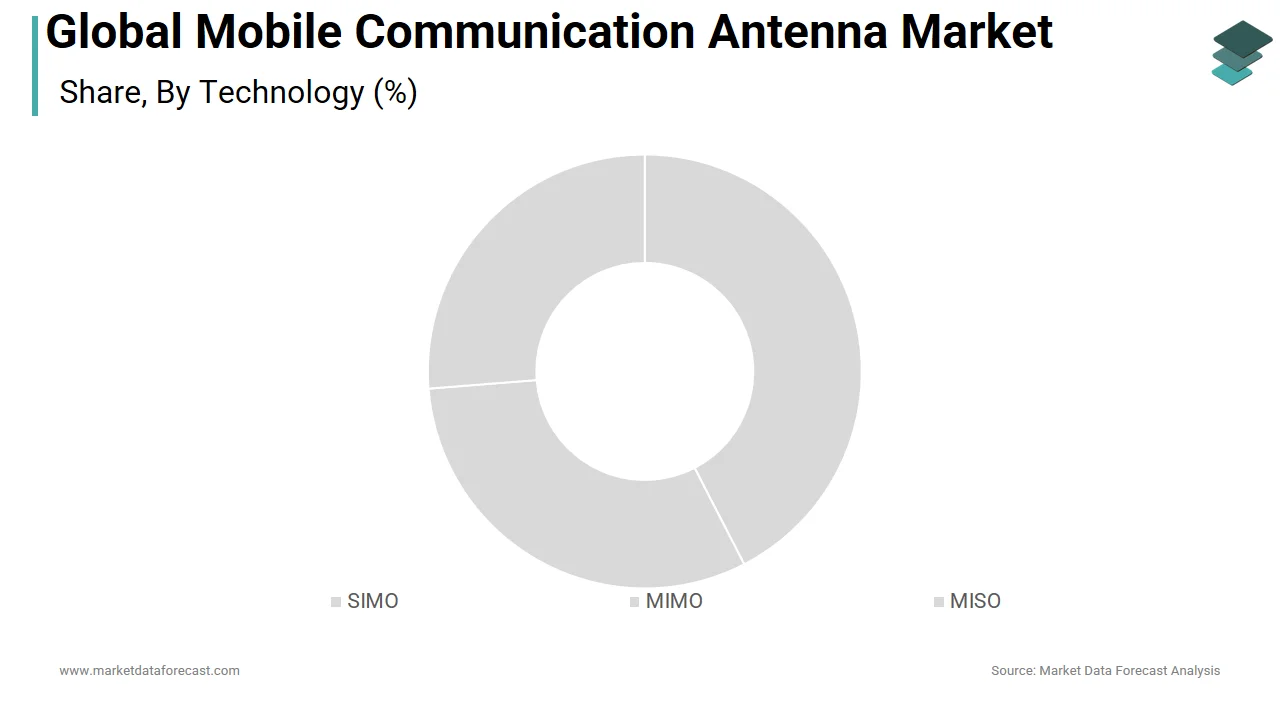
The multiple-input, single-output technology segment is the fastest-growing in the mobile communication antenna market, with a projected compound annual growth rate of 14.8% from 2024 to 2030, according to ABI Research's market analysis. This growth trajectory exceeds other technology segments primarily because Multiple Input Single Output offers an optimal balance between performance enhancement and cost-effectiveness for specific deployment scenarios. Unlike full Multiple Input Multiple Output implementations requiring complex user equipment with multiple receive chains, this technology leverages transmit diversity at the base station while maintaining compatibility with existing single-antenna devices. The expansion is driven by massive Internet of Things deployments where billions of low-cost sensors require improved downlink reliability without the expense of upgraded terminal hardware. Network operators recognize that upgrading entire device fleets is economically unfeasible, making infrastructure-side improvements via Multiple Input Single Output the pragmatic solution. This translates to extended battery life and reduced retransmission overhead, critical for remote monitoring applications.
By Application Insights
The cellular applications segment was accounted for as holding a significant share of the mobile communication antenna market in 2025. The continuous network evolution cycles require regular antenna replacements and upgrades independent of new subscriber additions. The segment benefits from predictable replacement demand as aging equipment reaches end of life regardless of economic conditions, creating stable revenue streams for manufacturers. Additionally, cellular applications encompass diverse form factors from traditional macro towers to small cells and distributed antenna systems, broadening the addressable market beyond simple site counts.
The technical applications segment is anticipated to register the fastest CAGR of 18.2% throughout the forecast period with the emergence of digital transformation initiatives across manufacturing, energy, and transportation sectors. Unlike mature cellular markets approaching saturation, technical applications remain nascent with vast untapped potential as industries recognize wireless connectivity as an enabler of operational excellence. The fundamental shift viewing antennas not merely as connectivity components but as integral elements of cyber-physical systems enabling real-time process optimization is accelerating the growth of the segment. The segment benefits from higher value per unit compared to commoditized cellular antennas, as technical solutions require customization, environmental hardening, and certification for hazardous locations, commanding premium pricing. ABB stated that their wireless condition monitoring antenna systems sell at five times the price of equivalent cellular base station antennas, reflecting specialized engineering content. Emerging use cases including drone swarm coordination, underground mining communications, and offshore wind farm telemetry continuously expand application scope beyond traditional boundaries.
By Antennas Insights
The omnidirectional antennas segment was the largest by capturing 59.1% of the mobile communication antenna market share in 2025, with their fundamental suitability for providing uniform coverage in residential, suburban, and rural environments where user distribution lacks directional concentration. The technology benefits from lower manufacturing costs and simpler installation procedures, making it economically preferable for coverage-oriented deployments where capacity demands remain moderate. Vodafone Portugal reported that omnidirectional antenna sites cost 25% less to deploy than three-sector directional equivalents when serving villages under 5000 inhabitants. Inventory management advantages further reinforce prevalence, as a single omnidirectional model can serve multiple geographic contexts, whereas directional antennas require careful azimuth alignment and sector-specific stocking. This hybrid requirement maintains baseline demand even as networks evolve, preventing complete displacement by directional technologies.
The directional antennas segment is likely to grow at the fastest CAGR of 16.5% from 2026 to 2034 with the fifth generation network densification strategies that prioritize capacity over coverage in high-value urban markets. Directional antennas concentrate radiated energy into defined sectors, enabling frequency reuse and spatial multiplexing essential for meeting exponential data demand growth. The growth is structurally linked to massive Multiple Input Multiple Output adoption since these systems inherently employ directional beamforming to achieve promised performance gains. Small cell proliferation further amplifies demand as street-level installations require precise directional patterns to avoid interference while serving targeted pedestrian zones.
REGIONAL ANALYSIS
North America Mobile Communication Antenna Market Analysis
North America mobile communication antenna market was the top performer by holding 32.6% of share in 2025 through early fifth-generation adoption, aggressive infrastructure investment, and the presence of major antenna manufacturers, including CommScope and Andrew Corporation. United States operators completed extensive mid-band spectrum deployments throughout 2023 and 2024, creating sustained antenna demand as networks transition from initial coverage to capacity optimization phases. Mexico's telecommunications reform continues driving competition among operators, spurring antenna modernization as América Móvil and AT&T México race to capture fifth-generation subscribers. The presence of hyperscale data center clusters generates additional demand for specialized point-to-point microwave antennas supporting backhaul connectivity between facilities. Trade policies including CHIPS Act incentives encourage domestic antenna manufacturing, strengthening regional supply chain resilience against geopolitical disruptions affecting Asian suppliers.

Europe Mobile Communication Antenna Market Analysis
Europe mobile communication antenna market was positioned second by holding 28.9% of the share in 2025 through coordinated regulatory frameworks and cross-border harmonization efforts. The region distinguishes itself through emphasis on universal coverage obligations and digital inclusion policies that sustain antenna demand even in commercially marginal areas. European Commission Digital Decade targets mandate gigabit connectivity for all populated areas by 2030, driving continued infrastructure investment across member states. The growth of the market is propelled by stringent aesthetic regulations requiring concealed antenna solutions that command premium pricing and specialized engineering. The region also leads in private fifth-generation deployments, with Germany issuing over 300 campus network licenses, creating specialized antenna demand distinct from public network requirements. Cross-border roaming harmonization ensures antenna interoperability across member states, supporting tourism and business travel connectivity needs.
Asia Pacific Mobile Communication Antenna Market Analysis
Asia Pacific mobile communication antenna market growth is likely to witness the fastest growth in the coming years with the massive population scale, rapid technology adoption, and government-led digital economy initiatives across China, India, Japan, South Korea, and Southeast Asian nations. China alone deployed over 3.3 million fifth-generation base stations by the end of 2024, representing more than half of the global installed base, as per the study. Indian operators added 450000 antenna sites during fiscal year 2024 as Reliance Jio and Bharti Airtel executed the world's fastest fifth generation rollout, reaching 700 million people within 18 months of launch. Countries including Indonesia, Thailand, and Vietnam are experiencing accelerated growth as governments allocate spectrum and incentivize infrastructure sharing to bridge digital divides. Manufacturing ecosystem concentration in China, Taiwan, and South Korea provides regional suppliers with cost advantages and rapid innovation cycles unavailable elsewhere. Government initiatives like China's Dual Gigabit Plan and India's Digital Bharat Mission create policy-driven demand supplements beyond commercial considerations.
Latin America Mobile Communication Antenna Market Analysis
Latin America mobile communication antenna market growth is growing steadily in the coming years, with the uneven development patterns and significant untapped potential. Mexico and Brazil are the sole contributors to the growth of the mobile communication antenna market. Chile and Colombia demonstrate progressive regulatory approaches, with Subtel and CRC respectively implementing infrastructure sharing mandates that reduce deployment costs and accelerate coverage expansion. Argentina faces economic challenges yet maintains steady antenna replacement demand as operators upgrade aging fourth-generation infrastructure to maintain service quality amid currency volatility. Agricultural and mining sectors drive specialized antenna demand for remote monitoring applications distinct from urban consumer markets. Political instability in some countries creates deployment risks, yet successful operators achieve attractive returns due to limited competition and growing middle-class adoption.
Middle East and Africa Mobile Communication Antenna Market Analysis
Middle East and Africa mobile communication antenna market is anticipated to have steady growth in the coming years. Nigeria's NCC documented 18000 new fourth generation antenna sites in 2024 as MTN and Airtel pursue universal service obligations despite security challenges. East African markets, including Kenya and Tanzania, leverage mobile money ecosystems, driving antenna demand for transaction processing connectivity in remote areas. The heavy reliance on tower companies, who own 60% of passive infrastructure, influences antenna procurement decisions. Renewable energy integration becomes crucial, as grid reliability issues necessitate solar-powered antenna sites with specialized low-power designs.
COMPETITIVE LANDSCAPE
The mobile communication antenna market exhibits intense competition characterized by continuous technological innovation and strategic collaborations among global and regional players. These companies compete primarily on product performance, reliability, and ability to provide integrated end-to-end solutions rather than price alone. Emerging specialists focus on niche segments such as indoor small cells and Internet of Things-specific antennas, offering highly customized designs that address unique deployment challenges. The barrier to entry remains high due to substantial research and development costs, rigorous certification requirements, and complex intellectual property landscapes. Competitive dynamics are further influenced by government policies promoting domestic manufacturing and security concerns regarding foreign suppliers. Companies differentiate themselves through superior after-sales support, rapid prototyping capabilities, and adherence to sustainability standards. The shift toward open radio access network architectures introduces new competitors, including software vendors and cloud providers, who challenge traditional hardware-centric business models. This evolving competitive environment drives constant improvement in antenna efficiency, size reduction, and cost optimization, benefiting network operators and end users alike through enhanced connectivity experiences and reduced operational expenses across diverse geographic regions.
KEY MARKET PLAYERS
The major companies operating in the global mobile communication antenna market include
- AT&T Inc.
- Advanten
- Sierra Wireless
- Airgain, Inc.
- Airgo Networks Inc.
- AirNet Communications Company
- Ericsson AB
- Huawei Technologies
- CommScope Inc.
- Arraycom LLC
- Nokia Corporation
- Bandspeed Inc.
- Bluesocket
- Broadcom Corp.
- Global Smart Antenna Sector
TOP PLAYERS IN THE MARKET
- Huawei Technologies stands as a dominant force in the global mobile communication antenna landscape by delivering comprehensive end-to-end network solutions. The company actively develops advanced massive multiple-input multiple-output antennas that support high-frequency bands essential for fifth-generation deployments. Huawei recently launched its Active Antenna Unit series featuring integrated radio frequency components that significantly reduce signal loss and improve energy efficiency. The firm collaborates extensively with European telecom operators to customize antenna designs for dense urban environments and industrial applications. Its continuous investment in research and development enables rapid innovation in beamforming technologies and artificial intelligence-driven network optimization. Huawei maintains a strong focus on sustainability by designing lightweight antennas that minimize structural load on existing towers. The company also participates in standard-setting bodies to influence global technical specifications, ensuring compatibility across diverse network architectures.
- Ericsson AB leverages its extensive telecommunications heritage to provide sophisticated antenna systems tailored for modern cellular networks. The Swedish multinational focuses on developing radio dot systems and street macro solutions that address specific coverage challenges in complex urban settings. Ericsson recently introduced its Air Antenna portfolio, which integrates advanced filtering capabilities to mitigate interference from adjacent frequency bands. The company emphasizes software-defined antenna functionalities, allowing operators to remotely adjust performance parameters without physical site visits. Ericsson partners with chipset manufacturers to ensure seamless integration between baseband units and antenna arrays, enhancing overall system reliability. Its commitment to open radio access network standards promotes interoperability and encourages competition among equipment vendors. Ericsson also invests heavily in testing facilities to validate antenna performance under extreme weather conditions, ensuring durability and consistent service quality. These efforts enable telecom providers to deploy robust networks capable of supporting emerging applications, such as autonomous driving and smart manufacturing across global markets.
- Nokia Corporation contributes significantly to the mobile communication antenna market through its innovative AirScale product family designed for flexible network deployments. The Finnish technology leader specializes in creating compact active antenna units that support dynamic spectrum sharing and carrier aggregation techniques. Nokia recently expanded its antenna offerings to include millimeter wave solutions catering to high-capacity requirements in stadium and airport venues. The company integrates machine learning algorithms into its antenna management platforms, enabling predictive maintenance and automated fault detection. Nokia collaborates with cloud providers to offer virtualized radio access network solutions that decouple hardware from software, increasing deployment flexibility. Its focus on energy-efficient designs helps operators reduce operational expenditures while meeting environmental sustainability goals.
TOP STRATEGIES USED BY KEY MARKET PARTICIPANTS
Key players in the mobile communication antenna market primarily focus on research and development investments to create innovative products that meet evolving fifth-generation requirements. Companies prioritize partnerships with telecom operators to co-develop customized solutions addressing specific network densification needs. Strategic acquisitions of specialized technology firms enable market leaders to integrate advanced materials and manufacturing processes into their product portfolios. Manufacturers emphasize sustainability by designing energy-efficient antennas using recyclable materials to align with global environmental regulations. Participation in industry consortia helps shape technical standards, ensuring interoperability and reducing fragmentation across different network architectures. Diversification of supply chains mitigates risks associated with geopolitical tensions and component shortages. Companies also invest in artificial intelligence capabilities to offer smart antenna management services that optimize network performance automatically.
MARKET SEGMENTATION
This research report on the global mobile communication antenna market has been segmented and sub-segmented based on the technology, application, system, antennas, and region.
By Technology
-
SIMO
-
MIMO
-
MISO
By Application
-
Technical
-
Cellular
By System
-
Radar System
-
Wi-Fi System
By Antennas
-
Directional Antennas
-
Omnidirectional Antennas
By Region
- North America
- Europe
- Asia-Pacific
- Latin America
- Middle East & Africa